
CRM for SaaS: Best CRM for SaaS Companies by Sales Motion
Best CRM for SaaS companies by sales motion: what the CRM must hold for trials, renewals and expansion, six CRMs compared, and a keep-your-CRM option.


CEO and Founder of ZUUZ. He scaled Cloud Box Technologies from 0 to $25M ARR in IT services and distribution before building ZUUZ. Connect on LinkedIn
The best CRM for SaaS is the one that fits your sales motion and still holds the account after the first signature. Founder-led teams do well on HubSpot's free tools or Attio, sales-led teams with an admin on Salesforce, simple pipelines on Pipedrive or Close. Whatever you pick, renewals, expansion and every stakeholder must live in the record.
TL;DR: A SaaS company sells the same account three times: the first deal, the renewal and the expansion. Choose a CRM for SaaS by how your team sells, then check that it holds renewal dates, contract value, the buying committee and the conversation history. If your current CRM is the right shape but out of date, keeping it and letting ZUUZ, the agentic AI CRM, write the updates may beat a migration.
- SaaS selling does not end at close. Renewal and expansion revenue are decided in year two.
- Pick by motion first: founder-led, inbound with sales assist, sales-led with AEs, or a renewal and expansion book.
- A SaaS CRM must link trials to deals and hold renewal dates, contract value, expansion deals, the buying committee and email and meeting history.
- The Second-Year Test checks ten customers signed about a year ago and shows whether the CRM can run a renewal without anyone's memory.
- ZUUZ can be the CRM or keep your existing one current with two-way sync. It does not read product usage data or billing systems.
Picture a B2B software company with 160 customers and nine sellers. The CRM shows every deal it has won. It does not show that the champion at the third-largest account left in August, or that a customer asked about forty more seats in a reply to a billing email. The scene is an illustration, but most SaaS sales managers know its shape.
This guide is SaaS-specific: subscriptions, renewals and expansion. If you are choosing by company stage, read the best CRM for startups. If you run an established team and care most about rep effort, read the best CRM for small B2B sales teams. For the general buying process, start with how to choose a CRM.
What a CRM for SaaS Has to Hold
A SaaS CRM has to hold the account for its whole lifetime. Five things matter more for a subscription business than for anyone else.
The signup or trial, tied to a deal
Buyers can book a demo or start a free trial. If the CRM treats the trial user as a stray contact and the demo request as a new lead, the AE walks into a call without knowing that four people at the account already use the product.
Renewal date and contract value
A closed-won deal starts a contract. The CRM needs the term, renewal date, current contract value and notice period in fields a report can filter. A renewal stored in a note is a renewal nobody sees coming. Billing stays the source of truth for invoiced amounts; the CRM holds the commercial picture behind them. For the tooling side, see renewal tracking software.
Expansion opportunities
Seat increases, a second team, a higher tier, an add-on. These requests rarely arrive through a form. They arrive as a line in an email to the account manager. The CRM needs a way to open an expansion deal on an existing account without losing the history of the first one.
The full buying committee
Mid-market software deals involve a champion, an economic buyer, security, IT, and often procurement and legal. The person who signed in year one may not renew in year two. The record must hold many contacts per deal, with roles, and show when one of them leaves.
Email and meeting history
Renewals turn on what was promised in the first deal: a multi-year discount, a roadmap item, a pilot price. That context sits in threads and meeting notes. Without it, the renewal owner has to ask the customer what was agreed.
Choose a CRM for SaaS by Sales Motion
The motion decides what the CRM must do well on day one. A team running two motions should choose for the one that drives most of next year's revenue.
Founder-led sales
The founder runs every deal from the inbox and nobody has time to configure anything. What matters is a cheap start, an inbox connection and a data model that will not need rebuilding when the first AE arrives. HubSpot's free tools (up to two users) and Attio's free plan (up to three) are the usual picks, as of November 2026. The risk is that the founder never types anything in.
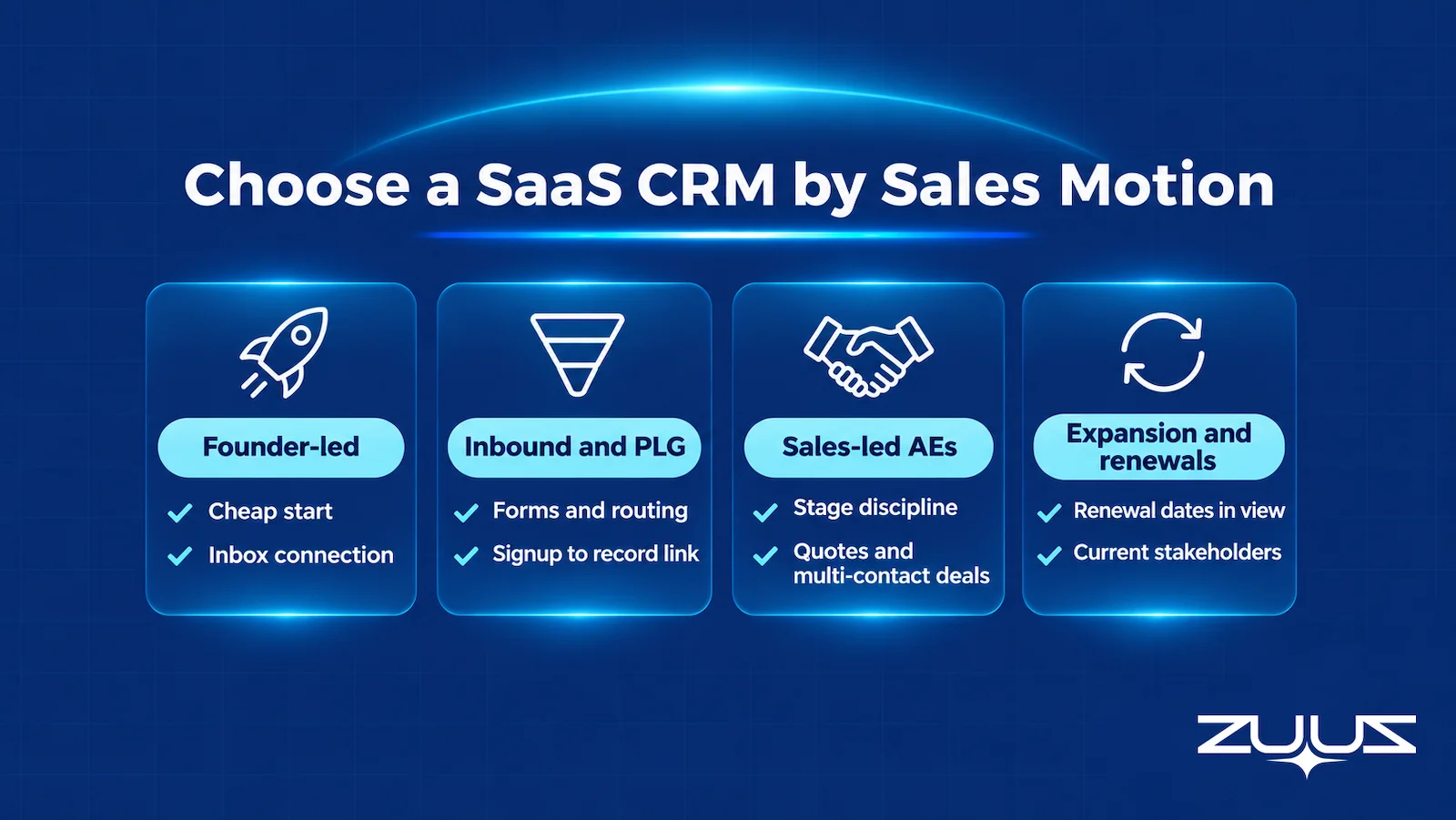
Inbound and PLG-assisted sales
Signups and demo requests arrive daily and sellers decide which accounts deserve a human. The CRM needs forms, routing, company matching and a link between product signups and the sales record. HubSpot is strong here because marketing and sales share one database. Attio lists product usage and events tracking on its Pro and Ultra plans.
Sales-led with account executives
AEs run multi-stage deals with demos, security reviews, procurement and redlines. This motion needs stage discipline, multi-contact deals, quotes and approvals. Salesforce fits when there is an admin to own it, HubSpot Sales Hub Professional when there is not. Pipedrive and Close fit smaller AE teams.
Expansion and renewals
Account managers own a book of existing customers. The CRM must show every renewal in the next two quarters, with contract value, stakeholders and the last real conversation. What breaks this motion is stale contact data. Teams with several products renewing on different dates should read how to track renewals across multiple products.
The Second-Year Test for a SaaS CRM
Feature lists do not tell you whether a CRM will run a renewal. Your own customers will. This test takes about two hours on your current CRM or a loaded trial.
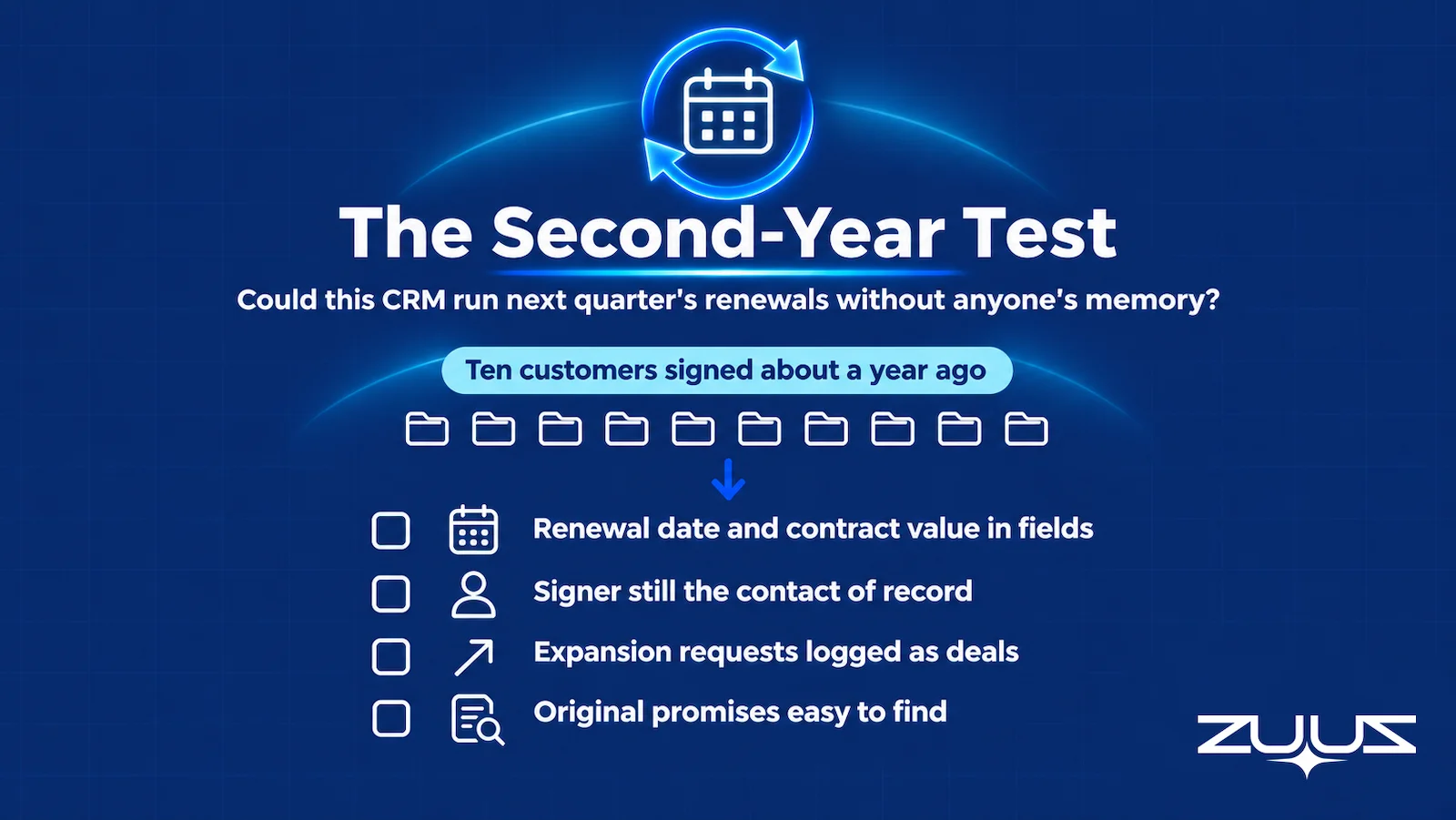
The Second-Year Test: could this CRM run next quarter's renewals without anyone's memory?
- Pick ten customers that signed between ten and fourteen months ago.
- For each, check whether the renewal date and current contract value sit in fields, not notes.
- Check whether the signer is still the contact of record, and whether anyone new has joined the account's email threads since.
- Check whether any expansion request from the last year exists as an open or closed deal.
- Check whether the original deal's promises (discounts, roadmap items, pilot terms) can be found from the record in under two minutes.
- Score one point per check per customer, out of 40. Under 30 means renewals are being run from memory and inboxes.
Step three fails most often, because a new stakeholder shows up as a name in a CC line and nobody adds them. In ZUUZ, a new person who joins a deal or renewal thread is added to the account from that email, and the email stays attached as the source.
Renewals Are Won in Year One. Keep the Record That Proves It.
ZUUZ writes renewals, stakeholders and next steps into the CRM from the inbox, calendar and calls, with a source on every value.
Best CRM for SaaS Companies Compared
Six CRMs that SaaS teams of 3 to 50 sellers shortlist most, plus the option of keeping your CRM and adding ZUUZ. Prices are from each vendor's own pricing page as of November 2026. Where a page would not load for us, we left the number out.
| CRM | Entry price (as of November 2026) | Subscriptions and renewals | Product or billing data | Who updates the record | Where it wins for SaaS |
|---|---|---|---|---|---|
| HubSpot | Free tools for up to 2 users; Sales Hub Starter from $20 per seat per month | Revenue Hub adds subscriptions, recurring billing and renewals from contract history | HubSpot Payments and Stripe options in Revenue Hub | Rep, applying AI suggestions; per-property automatic updates optional | Inbound and PLG-assisted teams |
| Salesforce | Starter Suite $25, Pro Suite $100 per user per month | Revenue Cloud add-on from $200 per user per month | Through Revenue Cloud or the AppExchange | Rep, or pipeline agent in suggest or automatic mode | Sales-led teams with an admin |
| Pipedrive | Not shown (pricing page would not load for us) | Subscription reports on Growth and above | Through marketplace apps | Rep, approving Nova's suggested updates | Small AE teams wanting a simple pipeline |
| Attio | Free for up to 3 users; Plus $40 per month with one user, annual | Custom objects for contracts; a Churn Risk agent | Product usage and events tracking on Pro and Ultra | Mixed; workflows and agents write once published | Technical founders designing their own data model |
| Close | Essentials $35 per user per month, annual; no free plan | Deals and custom fields | Through integrations | Rep, with AI auto updates on Growth and Scale | Inside sales teams that live on the phone |
| Zoho CRM | Free for 3 users; paid prices not shown in page text | Configurable modules | Zoho's own billing apps | Rep, plus Zia agents | Budget-led teams willing to configure |
| Your CRM plus ZUUZ | 14-day free trial, no credit card; see pricing | Agents create and update renewals from conversations | Does not read product usage or billing systems | ZUUZ agents, from inbox, calendar, meetings and calls; the rep's edits win | Teams whose CRM is the right shape but out of date |
HubSpot
The default for SaaS companies that sell through inbound. Sales Hub pricing lists Professional at $100 per seat per month with a $1,500 onboarding fee. Revenue Hub adds quotes, contracts, recurring billing and payments, and HubSpot says reps can renew and upsell from full contract history. Seat and credit costs rise as the team grows.
Salesforce
Fits sales-led teams that have, or will hire, an admin. Salesforce's pricing page lists Sales Cloud editions from $195 per user per month, Revenue Cloud from $200 and Agentforce for Sales from $125. It wins on approvals and complex quoting, at the cost of an admin and add-ons. Our Agentforce for Sales guide covers the AI side.
Pipedrive
A clean visual pipeline a small AE team learns in a day, with subscription reports on Growth and above. Its Nova assistant drafts CRM updates from calls, and Pipedrive says nothing Nova suggests is applied automatically. Renewal and expansion work depends on the process your team builds. See Pipedrive vs HubSpot.
Attio
Appeals to technical founders who want to model contracts and usage their own way. Attio's pricing lists Plus at $40 a month on annual billing with one user and $35 per added user. Attio also lists a Stripe app that lets workflow agents look up subscriptions and invoices on demand. Call intelligence covers video meetings only, and there is no two-way sync with Salesforce or HubSpot.
Close and Zoho CRM
Close's pricing lists Essentials at $35, Growth at $99 and Scale at $139 per user per month on annual billing, with built-in calling on every plan. Zoho CRM is free for three users and suits budget-led teams that will configure; we found no documented undo for its Zia agents.
A Worked Example: One Quarter of Renewals
This is an illustration with round numbers, not customer data. A SaaS company has 140 customers at an average of $15,000 a year, about $2.1M in annual recurring revenue. Thirty-five contracts, worth $525,000, renew next quarter.
The sales manager runs the Second-Year Test on ten of them. Renewal dates are in fields for nine. Contract values are current for seven, because three customers added seats mid-term. The signer is still right for six; at four accounts the champion has left. Two of five expansion requests became deals. The score is 24 out of 40.
- Four of ten accounts have a stale champion. Across 35 renewals, that suggests about 14, roughly $210,000, where the team may be selling to the wrong person.
- Three of five expansion requests never became deals, so that pipeline is invisible.
- Three of ten contract values are wrong, so the reported renewal number is low before a single call.
None of this needs a new CRM. It needs facts already in email and meetings to reach the record. ZUUZ reads the previous 90 days of a connected mailbox on first connection, and it sets a deal's value only from a quote, purchase order or contract, never from a guess in an email.
Where SaaS Deal Facts Get Lost
SaaS teams usually have good product data and weak conversation data. The usual leaks:
- The trial-to-paid conversation. A trial user emails the AE about permissions and pricing. The product knows the user is active. The CRM never sees the questions, which are the buying signal.
- The security review. A security lead joins with a questionnaire and becomes a decision-maker for this deal and the renewal, but is never added as a contact.
- Expansion asks in the wrong channel. A customer asks about forty more seats in a reply to an invoice email. When ZUUZ cannot tell whether a thread like that is sales, it asks the rep ("Maybe sales?") instead of guessing.
- The champion who leaves. An out-of-office reply names a replacement. That one email changes the renewal, and it is the email most likely to be deleted unread.
For the account-risk side of this, see churn risk software.
The Champion Left in August. Your CRM Should Know.
Connect one account manager's mailbox and see which stakeholders, renewals and expansion asks never reached the record.
What Most SaaS CRM Guides Get Wrong
Most top-ranking guides on this topic are written by a CRM vendor that ranks itself first. Four gaps repeat.
- They confuse "SaaS CRM" with "cloud CRM." Every CRM on any shortlist is cloud-hosted. The real question is whether it fits a subscription business.
- They stop at closed-won. Lead scoring and outreach get long sections. Renewals and expansion get a sentence, though they decide net revenue retention.
- They treat product data as the whole answer. Usage tells you an account is active. It does not tell you the economic buyer changed or procurement wants a new term.
- They compare entry prices. A 15-seller team rarely pays the starter rate. Onboarding fees, add-ons, AI credits and the hours spent updating records matter more.
Almost none ask who will keep the CRM current. A CRM chosen perfectly for your motion still fails the Second-Year Test if sellers must type every update.
Keep the CRM You Have and Let ZUUZ Keep It Current
Many SaaS teams looking for a new CRM have the right one with the wrong data in it. Before a migration, which costs a quarter of attention (see CRM migration), ask whether the record can be fixed where it is.
ZUUZ is the agentic AI CRM for B2B teams of 3 to 50 sellers who sell through email, calls and meetings. Its agents create and update leads, deals, follow-ups and renewals from the sales inbox (Gmail, Outlook), calendar, meetings (Teams, Meet, Zoom) and calls (JustCall, GoTo Connect, CallTrackingMetrics, CallTools). It works through two doors.
- ZUUZ as your CRM. A SaaS company with no CRM, or one outgrowing spreadsheets, runs on ZUUZ directly. See ZUUZ as your CRM.
- Keep your CRM. A team on Salesforce, HubSpot, Zoho, Attio, Pipedrive, Dynamics 365 or Less Annoying CRM keeps it, and ZUUZ syncs both ways as a revenue intelligence layer on top. An admin approves the first match-up once, and the rep's own edits win. See keep your CRM.
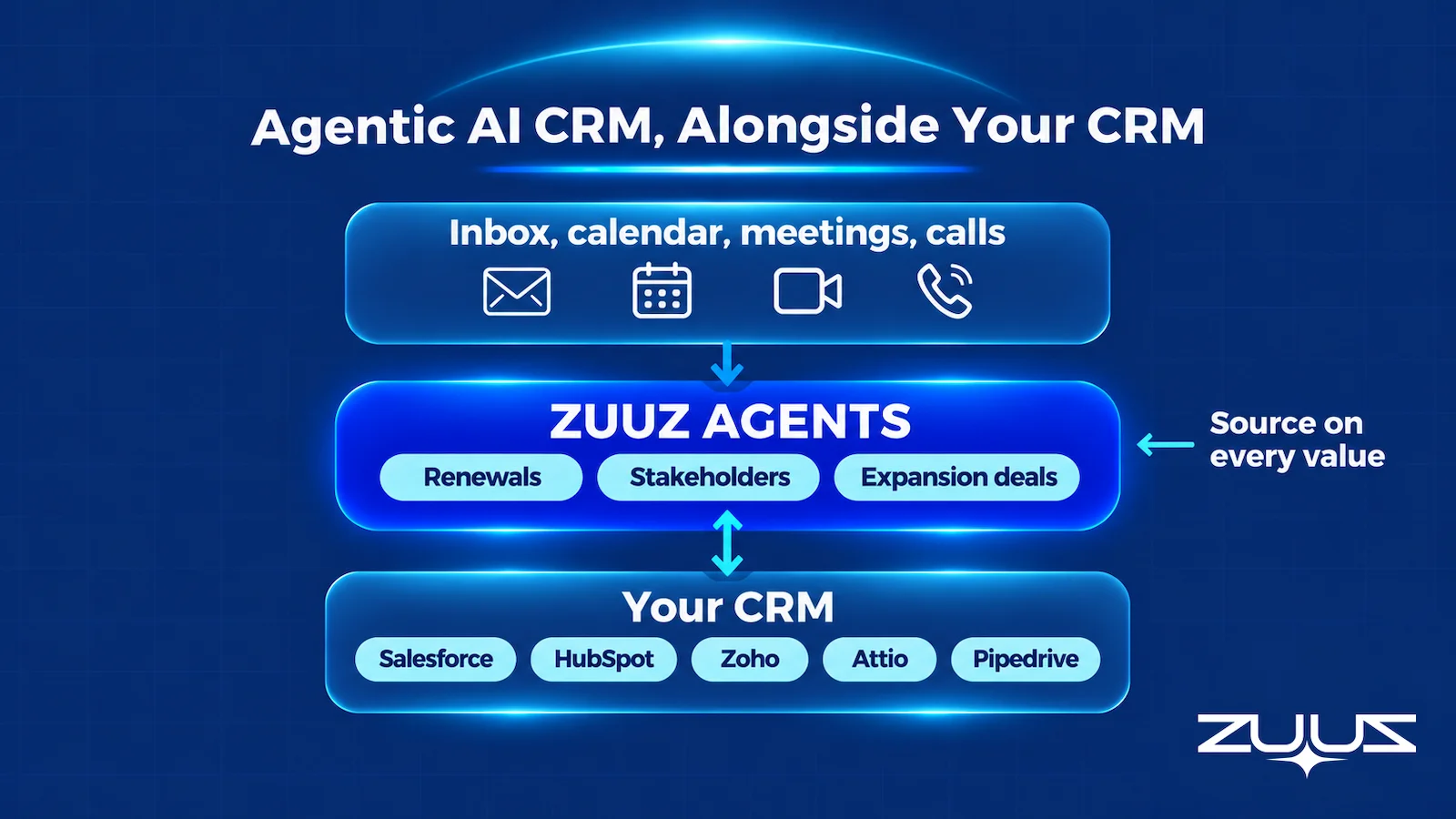
Every value ZUUZ writes has a source, and every lead and deal its agents create has a one-click undo. You can ask Zari, the ZUUZ agent, about an account, and Claude or ChatGPT can see and ask about your ZUUZ data over MCP. ZUUZ has completed SOC 2 Type I, with Type II in progress. See ZUUZ for software and AI companies and what an agentic AI CRM is.
The evidence so far is one team. RA Technologies, a US IT services company, ran ZUUZ on the HubSpot instance it had used for two years, with the same team, and ZUUZ surfaced $120K in pipeline within 72 hours. That is a services company, so treat it as proof of the mechanism, not a SaaS benchmark. Read the RA Technologies case study.
Run the Second-Year Test on your own book. Connect two account managers' mailboxes, calendars and call platform to ZUUZ on the CRM you already run. ZUUZ reads the previous 90 days and writes renewals, stakeholders and expansion deals with a source on every value. First records appear within 72 hours. 14-day free trial, no credit card: https://zuuz.ai/signup
When ZUUZ Is Not the Right Choice
ZUUZ is the wrong pick, or only part of the answer, in these cases.
- Your selling happens inside the product. ZUUZ does not read product usage data or billing systems, so a pure self-serve business gets little from it.
- You need a dialer or outbound sequences. ZUUZ does neither. Close or HubSpot covers that.
- You need forecasting or deal scores. ZUUZ does not forecast and gives no deal health scores or win probabilities. Its reports are partial today.
- You need CSV import, a public API or Zapier. ZUUZ offers none of these today.
- Your deals move in Slack or WhatsApp. ZUUZ does not capture them.
The B2B CRM for your team hub picks a CRM by team size and industry, the CRM alternatives and switching hub covers the main options in more depth, and the agentic AI CRM hub covers how agents change the work.
Keep the CRM You Chose. Stop Typing Into It.
Two-way sync with Salesforce, HubSpot, Zoho, Attio, Pipedrive, Dynamics 365 and Less Annoying CRM, with the rep's edits winning.
Frequently Asked Questions
What is the best CRM for SaaS companies?
There is no single best CRM for SaaS companies; it depends on the sales motion. HubSpot suits inbound and PLG-assisted teams, Salesforce suits sales-led teams with an admin, Pipedrive and Close suit small AE teams, and Attio suits founders who want a flexible data model. Any choice must hold renewals, expansion and every stakeholder.
What is a SaaS CRM?
A SaaS CRM can mean a CRM delivered as a cloud service or a CRM used by a software-as-a-service company. Nearly every modern CRM is cloud-hosted, so the useful meaning is the second: a CRM set up to track trials, subscriptions, renewal dates, contract value and expansion across the customer lifetime.
What should a CRM for SaaS track that other CRMs do not?
A CRM for SaaS should track the trial or signup linked to the account, renewal date and contract value, expansion deals on existing customers, and every member of the buying committee with their role. It also needs email and meeting history, because renewal terms often depend on what was promised in the first deal.
Is HubSpot or Salesforce better for a SaaS startup?
HubSpot is usually better for a SaaS startup without an admin, because its free tools and Starter tier are quick to set up and marketing and sales share one database. Salesforce becomes a fair choice once deals need complex approvals or quoting and someone owns the system. Both track subscriptions through add-ons.
How do SaaS companies track renewals in a CRM?
SaaS companies track renewals by storing the term, renewal date, contract value and notice period in fields on the account or a renewal deal, then reporting on renewals due in the next two quarters. The weak point is keeping stakeholders and conversation history current, which is where most renewal surprises start.
Does ZUUZ read product usage or billing data?
No. ZUUZ does not read product usage data or billing systems. Its agents work from the sales inbox, calendar, meetings and calls, and create and update leads, deals, follow-ups and renewals from those conversations. Teams that need usage signals rely on their CRM's own product data or billing tools.
Should a SaaS company switch CRMs or keep the one it has?
Keep the CRM if it can hold renewals, contract value and multiple contacts per deal, and the real problem is stale records. Switch if the data model cannot represent your subscriptions or the cost no longer fits. Run the Second-Year Test first, because it shows whether the gap is the tool or the typing.
How long does ZUUZ take to show results on an existing CRM?
ZUUZ reads the previous 90 days of a connected mailbox on first connection, and first records appear within 72 hours. An admin approves the first match-up with the existing CRM once. RA Technologies, a US IT services company, surfaced $120K in pipeline within 72 hours on the HubSpot instance it had used for two years.