
How to Track Renewals Across Multiple Products
Learn how to track renewals across multiple products using email signals to catch SKU mismatches and co-term conflicts before contracts lapse.
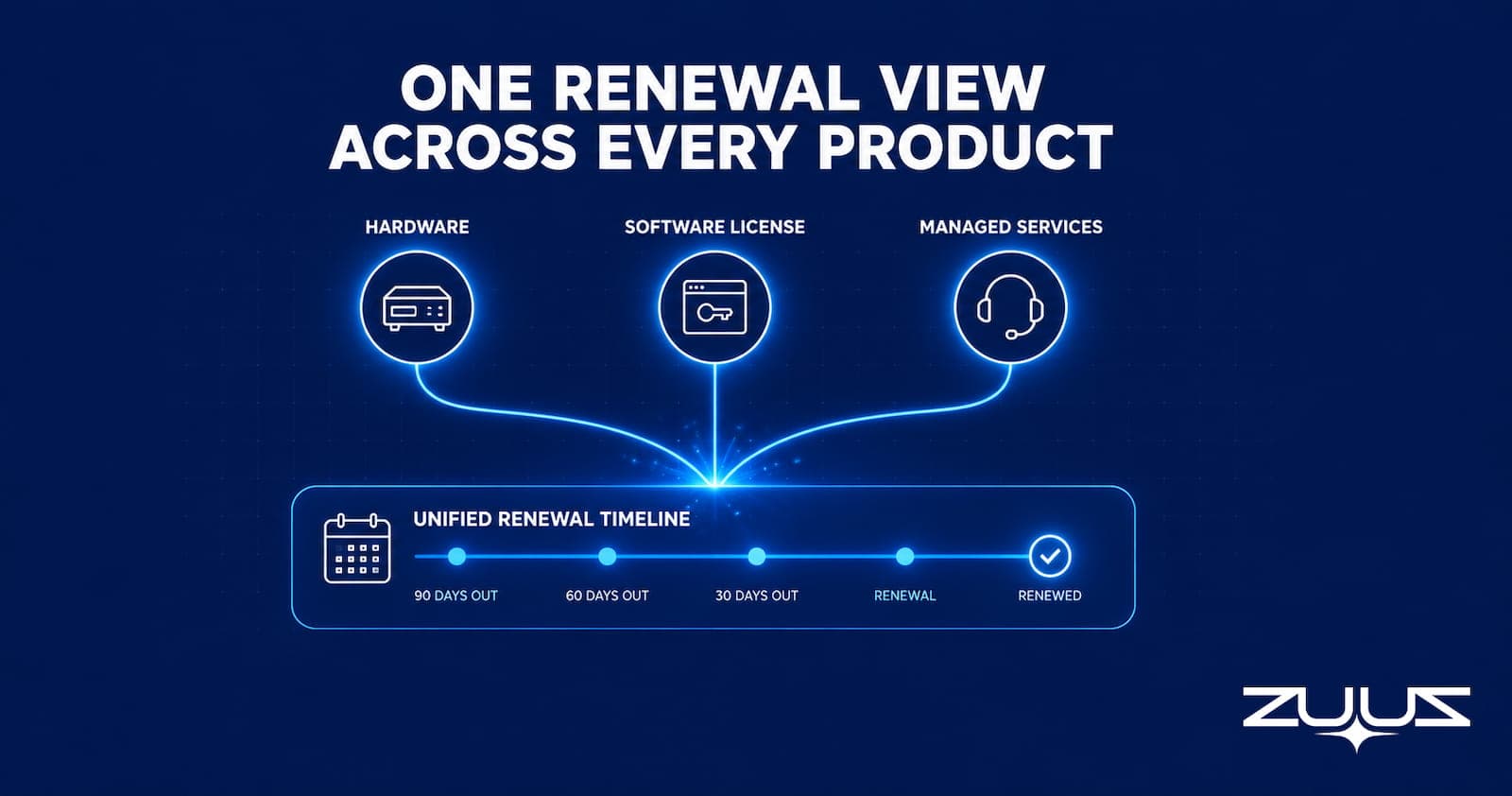
- Multi-product businesses face compounding renewal risk every quarter as contracts split across spreadsheets, vendor portals, PSA tools, and a CRM that captures only what reps manually log.
- Standard CRMs were designed for single-product SaaS. The moment hardware, software licenses, professional services, and managed services share the same account, the CRM stops functioning as a renewal system.
- The six renewal signals that predict a lapse (contract date mentions, usage changes, competitive evaluations, procurement involvement, SKU modifications, and vendor renewal quotes) almost always appear in email 60 to 120 days ahead of the renewal date.
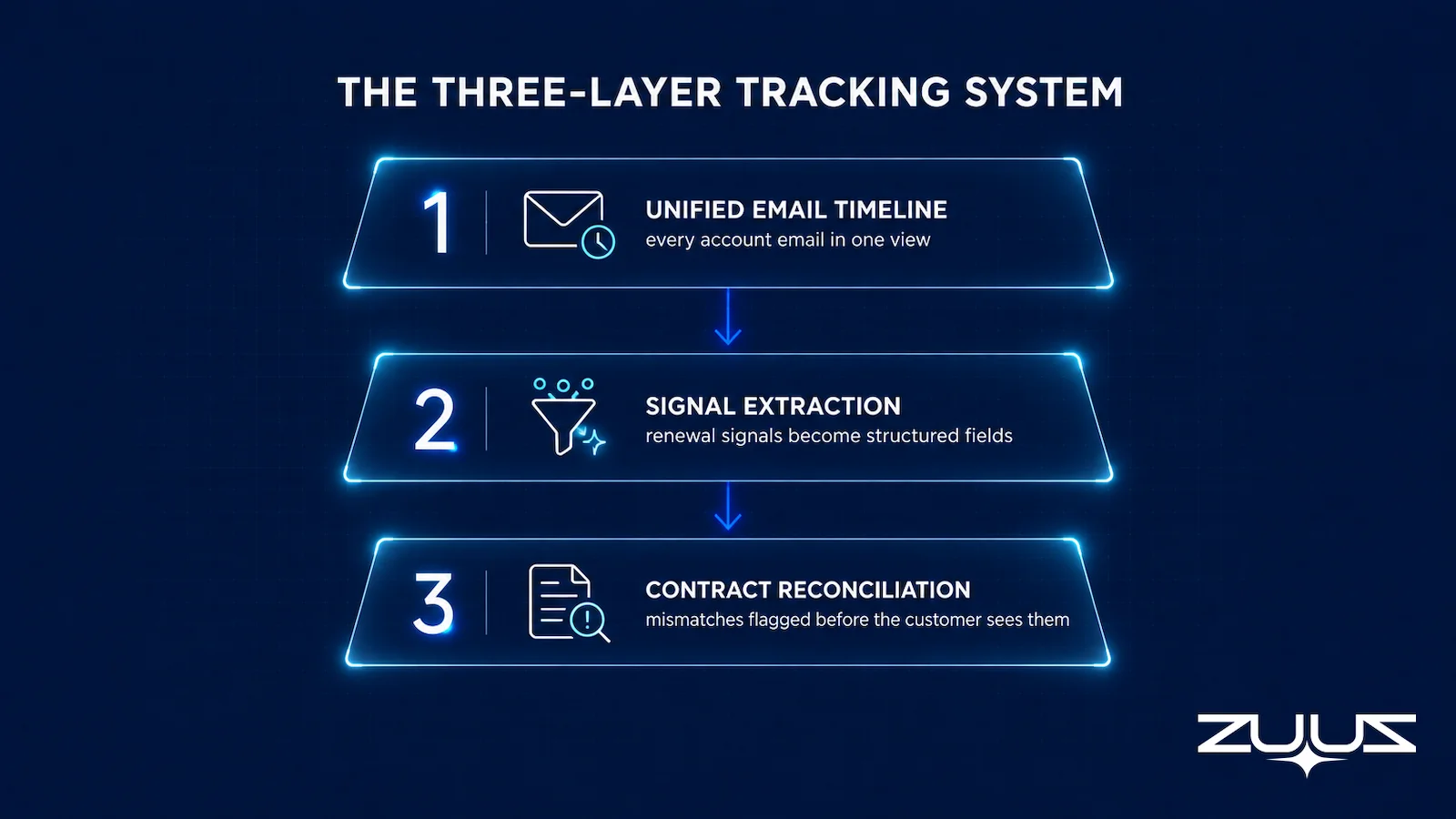
- The system that works has three layers: ingest every account email into a unified timeline, extract renewal signals as structured contract fields, and reconcile against existing contracts to flag mismatches before they become surprises.
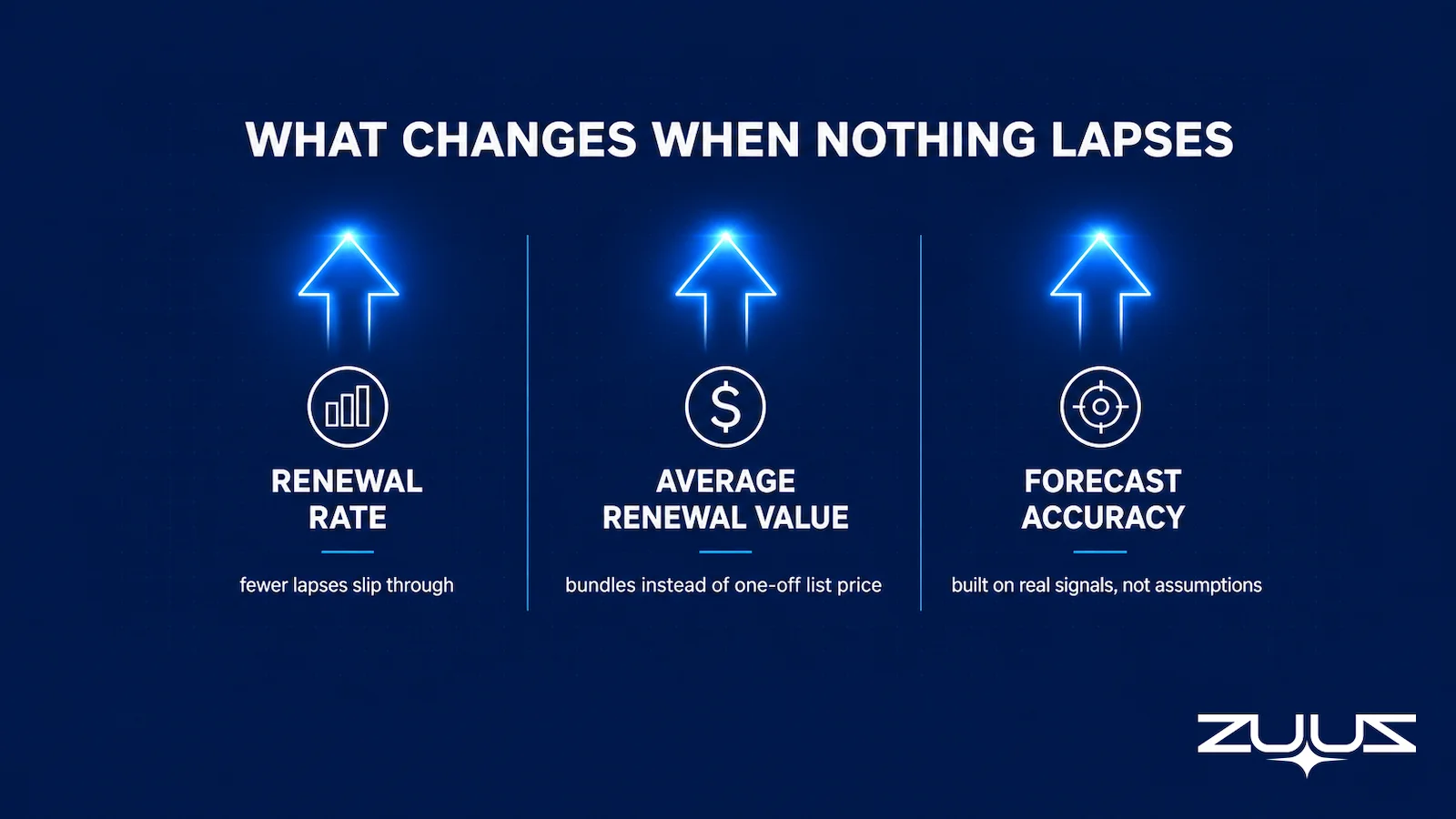
- When renewal visibility extends to 90 days out with SKU-level detail, renewal rate, average renewal value, and forecast accuracy improve simultaneously because decisions are based on real customer signals rather than rep assumptions.
- Customers stop evaluating alternatives when the renewal quote matches their actual usage. Sending last year’s configuration sends them to a competitor.
- ZUUZ is an AI layer on top of the CRM a team already runs: it connects to the sales inbox, reads LinkedIn messages and meeting or call transcripts, and writes leads, stakeholders, next steps and renewal signals into the CRM for the rep to approve in one click.
A single-product business has a renewals problem. A multi-product business has a renewals catastrophe waiting to happen. Every quarter, contracts lapse that should not have lapsed. Every quarter, someone in finance asks why a customer churned, and the answer is the same: nobody saw the renewal coming.
If a team sells more than one product, or resells more than one vendor, this is a revenue problem and it compounds. The signals that predict which renewals will slip are already in the inbox. The gap is a system problem, not a rep discipline problem.
This article covers how to track renewals across multiple products, why standard CRM renewal modules fail for multi-vendor accounts, what signals to watch for in email, and how automated reconciliation changes the outcome.
The Multi-Product Renewal Problem
One customer. Six contracts. Four vendors. Three account managers. Two renewal dates that do not align. That is a normal Tuesday at any distributor, MSP, or VAR. The customer does not think of it that way. They think: “we use your stuff.” Internally, the renewal tracking is split across spreadsheets, vendor portals, PSA tools, and a CRM that captures maybe half of what actually happened.
The structural issue is that most CRMs were designed for single-product SaaS: one subscription, one renewal date, one owner. The moment a team sells hardware, software licenses, professional services, and managed services to the same account, the CRM stops being a renewal system. It becomes a deal-tracking system with no opinion on what is coming due.
According to Salesforce’s State of Sales research, sales representatives spend an average of 28% of their week on administrative tasks including manual CRM data entry. In a multi-product environment, that administrative burden falls hardest on renewal tracking, which is lower-urgency than new business but higher-stakes when it fails.
So renewal tracking migrates to spreadsheets. Spreadsheets work for a quarter. Then somebody leaves, the file gets out of date, a customer switches procurement contacts, and a $40K license auto-renews to the wrong vendor configuration. The recurring revenue line takes a hit that shows up three months later as unexpected churn.
See the Pipeline Your CRM Can’t See.
ZUUZ connects to the sales inbox, extracts the deal signal, and writes it to Salesforce, HubSpot, Zoho, Attio or Pipedrive. Book a 15-minute walkthrough on your own inbox.
What Gets Missed and Why
The things that get missed follow a pattern. Co-termed contracts that should have been renegotiated as a bundle instead renew individually at list price. Auto-renewal clauses on legacy contracts that no one revisited. SKU-level changes inside a renewal where the customer wanted to drop ten seats and add five of a different product, but the renewal was rebooked at the old configuration because no one pulled the email thread.
The reason these get missed is that the signal is almost always in email, not in a contract management tool. The customer writes “remind me when this is up” in a thread six months before the date. The vendor sends a renewal quote 90 days out with line items that need reconciling against the customer’s actual usage. The procurement contact emails to renegotiate. None of this lands in the CRM unless someone manually puts it there.
Nobody does it consistently, because the workflow rewards closing new business, not maintaining existing accounts. The renewal becomes a fire drill 30 days out when the customer asks why the quote does not match what they are currently using.
This pattern is not a rep failure. It is a system design problem. The CRM was built to store what salespeople enter. It was not built to read email and extract renewal intelligence from unstructured text.
- Does it capture from the channels where a renewal actually moves – email, calendar, LinkedIn messages, meeting and call transcripts – or only from the renewal date field?
- Does what it captures land in CRM fields a report can read, at SKU level, or only in an activity feed someone has to open?
- Does it reconcile what the customer said against the contract on file, and flag the mismatch?
- Does the rep have to remember anything – a BCC, a button, a sidebar – for a renewal signal to be recorded?
- Can the rep correct it in one click before it is written to the record?
- Does it run on the CRM already in place – Salesforce, HubSpot, Zoho, Attio or Pipedrive – across every vendor and co-term in the account?
Six Email Signals That Predict a Lapse
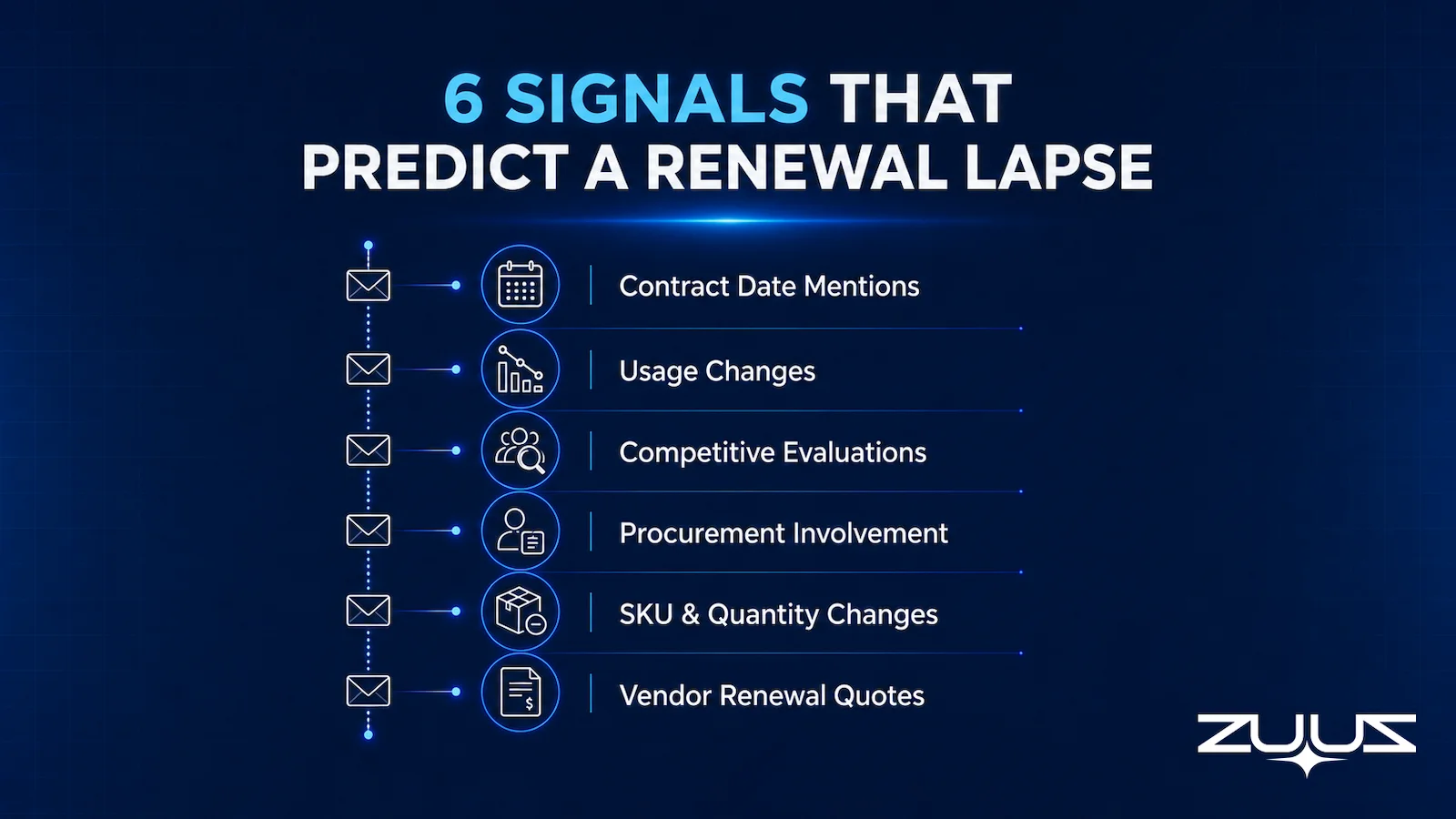
For any account approaching renewal, the signals appear in email 60 to 120 days in advance. Reading those threads with renewal tracking in mind reveals six categories of signal:
- Contract date mentions: phrases like “our agreement runs through August” or “we are budgeting for next fiscal year” indicate the customer is thinking about the renewal timeline
- Usage changes: “we added two new offices” or “we are sunsetting that workflow” signals that the current configuration no longer matches actual usage
- Competitive evaluations: “we are looking at alternatives” or “send us a comparison against [vendor]” indicates the renewal is not yet secured
- Procurement involvement: when a procurement contact appears on an email thread, the renewal is being formalized at the organizational level
- SKU and quantity changes: “drop the analytics module,” “add 20 more seats,” or “we do not need the premium tier” signals that the pending renewal quote will be contested if it does not reflect the change
- Vendor-side renewal quotes: line items in the vendor’s renewal PDF need to be matched against the original contract and current usage before the customer receives a quote
Every one of these signals sits in a sales or account-management mailbox right now. They are not being read with renewal tracking in mind, because reps are reading email with quota in mind. The signals and the system are misaligned.
For more on how email signals get missed across the broader sales process, see why missed sales leads accumulate in email and what to do about it.
The Three-Layer Tracking System
Tracking renewals across multiple products requires a system that operates on email natively, not one that waits for a rep to log a call. The system that works has three layers.
Layer 1: Unified Account Email Timeline
The first layer ingests every email that touches an account into a single conversation timeline. Not just emails that reps manually logged, but every email: forwards from distributors, replies from engineers, procurement queries from contacts not yet in the CRM, and vendor-side renewal quotes with line-item attachments. This creates a complete view of what has been said about an account, sorted by date and contact.
Without this layer, renewal tracking is always reactive. The account manager owns one email thread. The engineer owns another. The procurement contact communicated with someone who has since left. No single person has the full picture.
Layer 2: Structured Renewal Signal Extraction
The second layer extracts renewal-relevant signals from email text and converts them into structured fields tied to the correct contract record. This means reading a forwarded email that says “we are planning to cut five seats next renewal” and writing “quantity change: -5 seats, source: customer email, date: [date], tied to contract: [contract ID]” to the CRM record automatically.
This is where IT-specific language classification matters. “Co-term options for the refresh cycle,” “renegotiating the ELA,” and “the OEM quote came in high” are all renewal signals. Generic text processing misses them. Classification trained on IT distribution and VAR sales communication reads them correctly.
For companies already using CRM-to-email integration tools, this breakdown of email-to-CRM automation for IT companies explains what the different integration types capture and where each falls short for multi-product tracking.
Layer 3: Contract Reconciliation and Mismatch Flagging
The third layer reconciles extracted signals against existing contract records and flags mismatches before they reach the customer. A customer who emails to drop 10 seats but whose pending renewal quote still shows the original count is a mismatch that should be flagged 60 days before the invoice, not discovered when the customer pushes back on a quote they were not expecting.
This is what changes the renewal conversation. The account manager calls 60 days out with a quote that already reflects the customer’s stated changes. The customer does not need to re-explain. They do not need to negotiate something that was already agreed to in email. The renewal closes faster and at the right configuration.
How ZUUZ Implements This for Multi-SKU Accounts
ZUUZ applies this three-layer approach through capabilities that sit on top of the CRM a team already runs. Email Lead Capture reads every thread on an account, including forwarded distributor messages and attachments, so a line-item change such as a seat reduction or a product swap becomes structured signal instead of staying in one inbox. Customer Renewals & Subscriptions watches those conversations for renewal and churn warning signs, and Account Management keeps renewal status and history visible per account.
CRM Sync then writes the extracted changes to the right record in Salesforce, HubSpot, Zoho, Attio or Pipedrive, and the account manager gets finished work to approve in one click. For multi-SKU renewals that matters because a renewal is not one decision. It is dozens of line items, each with a quantity, a price and a customer-side owner who may have changed roles since the last term, and every email-borne change needs to land on the right one.
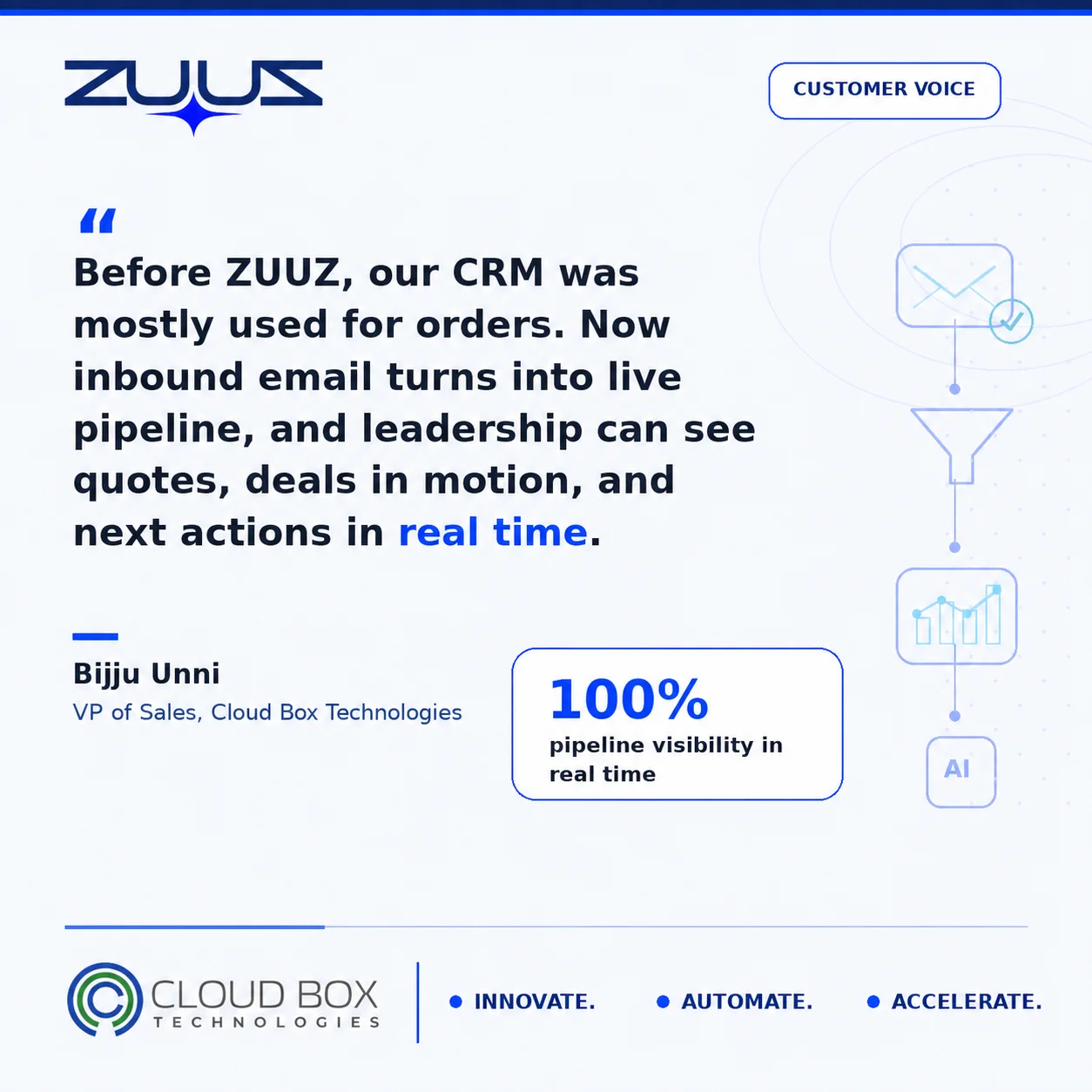
RA Technologies, a US IT services company, shows what reading the mailbox surfaces: ZUUZ ran on its existing HubSpot instance with the same team and surfaced $120K in pipeline within 72 hours that the CRM had never seen, including renewal signal that existed only in email. The RA Technologies case study has the detail.
Stop Losing Pipeline in the Inbox.
Connect your CRM in minutes and let ZUUZ capture the signals your team never logs. Start free, with no integration project required.
From an operator’s seat
From an operator’s seat, the surprise is that the renewal date is usually wrong rather than missing. Across the deployments ZUUZ runs, the pattern on multi-vendor accounts is that the first reconciliation pass produces a queue of mismatches between what the CRM says renews and what the customer’s own email says they are on, and the queue has no owner: the account manager thinks it is an ops job, ops thinks it is a sales job. Fixing the dates before chasing the signals is the right order, because a signal attached to a wrong date lands in the wrong quarter and gets ignored. The part teams do not plan for is that a handful of accounts will turn out to have two live definitions of the same renewal, one in a spreadsheet and one in the CRM, and somebody has to choose which one is real.
ZUUZ is an AI layer on top of the CRM a team already runs; it is never a CRM and never replaces one. Most renewal tooling in this category reports on the dates a human entered; ZUUZ writes the renewal signals into the record from the conversation itself, for the rep to approve in one click.
Spreadsheet vs. CRM Module vs. Email-Native Tracking
Most teams cycle through three approaches to multi-product renewal tracking before settling on a system that actually holds. Understanding where each approach breaks down clarifies what to look for in a sustainable solution.
| Tracking Approach | How It Works | Where It Breaks Down | Best Suited For |
|---|---|---|---|
| Spreadsheet | Manual entry of renewal dates, contacts, and contract values by the account manager or ops team | Person dependency; no signal capture; breaks on personnel change or scale; no SKU-level detail | Teams under 20 accounts with single-vendor relationships |
| CRM Renewal Module | Renewal dates and stages stored in CRM fields; alerts triggered by date proximity | Only records what reps manually entered; no email reading; no SKU-level reconciliation; misses 60-to-120-day signal window | Single-product SaaS businesses with one renewal per customer |
| PSA / Contract Management Tool | Contract records stored centrally; renewal dates tracked against signed agreements | Covers formal contracts only; misses informal signals in email; no behavioral risk scoring; no multi-vendor co-term view | Legal and finance teams tracking contract compliance |
| Email-Native Tracking (AI-Assisted) | System reads all account email, extracts renewal signals, reconciles against contracts, writes structured data to CRM | Requires email access and CRM connection; initial classification tuning needed for industry-specific language | Multi-product VARs, distributors, MSPs, and IT services firms with 50+ active accounts |
| ZUUZ (AI layer on the CRM already in place) | Connects to the sales inbox, reads LinkedIn messages and meeting or call transcripts, extracts renewal signals and writes them into CRM fields on Salesforce, HubSpot, Zoho, Attio or Pipedrive for the rep to approve in one click | Needs mailbox and CRM access; a signal that only ever existed on an unrecorded phone call still will not appear; ConnectWise PSA is on the ZUUZ roadmap rather than live today | Multi-product VARs, distributors, MSPs and IT services teams that already run a supported CRM and do not want to migrate to get renewal visibility |
The pattern is consistent across all three legacy approaches: they capture what was formally entered but miss what was informally communicated. For multi-product accounts where contract complexity is high, the gap between formal records and actual customer communication is where renewals get lost.
Organizations that automate the capture of buyer signals from email tend to act on those signals sooner than teams relying on manual CRM entry, for the simple reason that the signal reaches the record while it is still current. The same principle applies directly to renewal tracking: signal capture speed determines whether a renewal is managed or recovered.
The Renewal Signal Check
Before changing tooling, find out how much of the renewal book the system genuinely knows something about. The Renewal Signal Check exists to find renewal and expansion risk that lives outside the renewal date field.
- List every renewal in the next two quarters and its date field.
- For each, find the last real conversation – email, message or meeting – and what it said about budget, champion or satisfaction.
- Mark every renewal where the date is the only thing the system knows.
- Those are the renewals that surprise you. The signal existed; it was in a mailbox.
Worked example. On a multi-SKU account with hardware support, two software subscriptions and a managed services agreement, the check usually produces three categories. A handful of renewals have a recent thread confirming the configuration and the sponsor, and those are safe. A second group has a date and a thread that says something uncomfortable – a champion who changed roles, a license count the customer says is wrong, a procurement team newly involved – and those are the ones worth a call this week. The third group has nothing but a date, and on a co-termed account that group is larger than anyone expects, because the date was copied from last year’s renewal quote. Every lapse post-mortem lands in the second or third group, never the first.
What Changes When Nothing Lapses
When renewal visibility extends to 90 days with SKU-level detail intact, three things change simultaneously. Renewal rate increases because nothing slips through without a human reviewing it. Average renewal value increases because co-termed contracts get renegotiated as bundles rather than renewed one-off at list price. Forecast accuracy improves because the recurring revenue line is built on signals from the customer, not assumptions from the account manager.
The customer experience changes too. A renewal call 60 days out with a quote that already reflects the customer’s stated usage changes does not generate friction. The customer does not need to re-explain what they told the account manager four months ago in an email. They do not need to negotiate something that was already discussed. The renewal closes faster.
A renewal call 15 days out with last year’s configuration sends a different signal. The customer interprets it as evidence that the vendor is not paying attention. That interpretation is accurate. And it sends them to evaluate alternatives, even when they were not planning to.
For IT services and distribution teams building out their renewal operations, this guide to renewal tracking software for VARs and distributors covers the specific tool criteria and deployment patterns that apply to channel businesses.
The broader pipeline visibility problem in IT sales is closely related: when renewal signals are captured and written to the CRM, the pipeline forecast becomes a reflection of actual customer intent rather than a collection of rep estimates.
A concrete first step
Running the Renewal Signal Check by hand on twenty accounts takes a day. A faster version: connect one mailbox, ZUUZ reads the last 90 days, and the account owner reviews the renewal signals it found before anything is written to the CRM. Thirty-day free trial, no credit card: https://zuuz.ai/trial/
Frequently Asked Questions
Why Do Multi-Product Renewals Fail More Often Than Single-Product Renewals?
Single-product renewals have one contract, one date, and one owner. Multi-product renewals involve multiple vendors, separate contract dates, and SKUs at different usage rates. Renewal discussions split across multiple email threads, often with different contacts at each vendor or customer touchpoint. Most CRMs were designed for single-product SaaS and cannot model this complexity without extensive manual configuration that rarely gets done consistently.
Where Do Renewal Signals Most Often Get Missed?
Renewal signals get missed in email. Customers mention contract timelines, usage changes, and competitive evaluations in email threads 60 to 120 days before the renewal date. These signals exist in account manager and engineer inboxes long before they appear in any renewal dashboard or CRM record. No standard CRM renewal module reads email automatically, which is why the signals never make it to the forecast.
What Is the Difference Between a Renewal Tracking Tool and a CRM Renewal Module?
A CRM renewal module records dates and pipeline stages that someone entered manually. A renewal tracking tool actively monitors for renewal signals in email, flags risk based on behavioral changes such as account silence, competitor name-drops, or pricing questions, and surfaces those signals before the renewal window closes. The core difference is passive record-keeping versus active signal monitoring.
How Do You Handle Co-Termed Contracts Across Multiple Vendors?
Co-term management requires consolidating renewal dates across vendors into a single account view, then identifying which contracts can be bundled for renegotiation. The signals that indicate a customer is open to co-terming, including mentions of consolidating vendor relationships or annual budget discussions, typically appear in email months before any formal conversation. Tracking those signals prevents individually renewed contracts that close at list price instead of as negotiated bundles.
Does Automated Renewal Tracking Require Reps to Change Their Email Behavior?
No. Effective renewal tracking operates at the email account level, not the rep behavior level. The system reads inbound and outbound email for every account, classifies renewal signals, and writes structured data to the CRM automatically. Reps continue working in email without any change to their workflow. The difference is that the CRM receives structured renewal intelligence without requiring manual data entry from the rep.
What SKU-Level Signals Should a Renewal Tracking System Capture?
A renewal tracking system should capture seat count changes, product tier modifications, module add or drop requests, quantity adjustments tied to team restructuring, and vendor-side renewal quotes with line items that differ from the original contract configuration. Each signal indicates a mismatch between the pending renewal and the customer’s actual current usage. Missing any one of them produces a renewal quote the customer will contest.

CEO of ZUUZ. He scaled Cloud Box Technologies from 0 to $25M ARR in IT services and distribution before building ZUUZ. Connect on LinkedIn
See What Your Inbox Is Actually Doing.
A 15-minute demo shows which renewals are already at risk in your team’s inbox and how ZUUZ surfaces them to the right account owner. Works with Salesforce, HubSpot, and Zoho, with no data preparation required before the call.