
Renewal Tracking Software for B2B Revenue Teams
Renewal tracking software helps B2B teams catch expiring customer contracts before they lapse. See what the category covers and how ZUUZ closes the gaps.


CEO of ZUUZ. He scaled Cloud Box Technologies from 0 to $25M ARR in IT services and distribution, managing multi-OEM renewals, distributor relationships, and a 200-plus account customer base before building ZUUZ. Connect on LinkedIn
TL;DR: Renewal tracking software helps B2B teams monitor customer contract and subscription renewals so nothing lapses unnoticed. Most tools ranking for this term are built for IT teams tracking their own software spend, not for sales and account teams tracking what their customers owe them. ZUUZ approaches the category as an AI layer over the existing CRM, reading renewal and churn risk signals out of email and writing them back automatically.
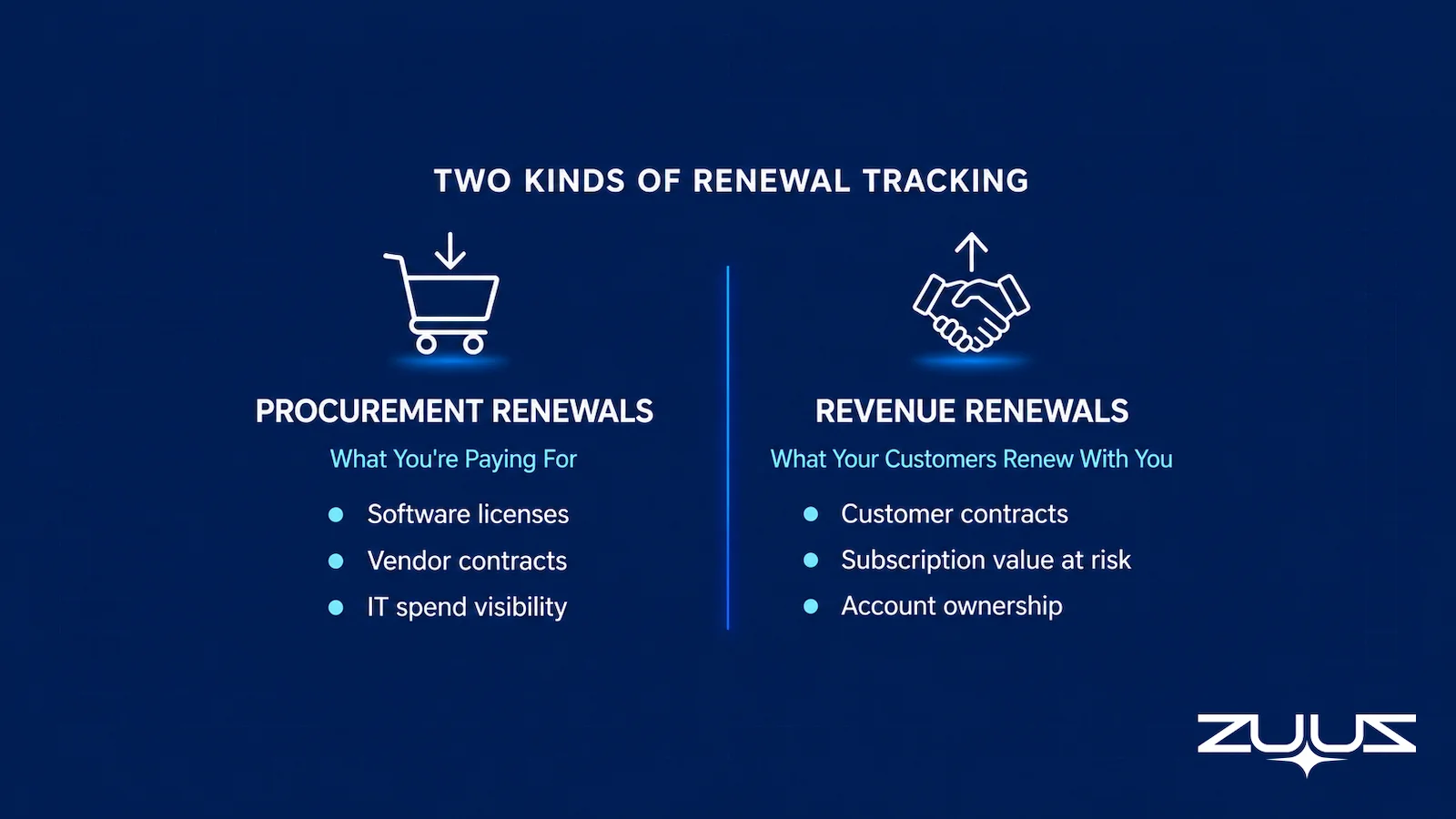
- Renewal tracking software splits into two different categories: tools for tracking what a company buys (IT and procurement) and tools for tracking what a company’s customers owe it (sales, account management, customer success).
- A complete renewal record needs more than a due date. It needs the account, contract value, notice period, owner, stage, next action, and recent conversation history.
- Missed renewal windows are a leading, preventable cause of B2B churn, and the earliest warning signs usually surface in email before they ever reach a CRM field.
- Renewal tracking is a narrower, more operational category than contract lifecycle management (CLM) or a full customer success platform.
- Evaluating renewal tracking software means testing whether it can answer specific operational questions, not just whether it has a calendar view.
- ZUUZ reads renewal-related email automatically, keeps Salesforce, HubSpot, or Zoho current without manual entry, and flags churn risk without claiming to forecast outcomes.
A renewal date sitting in a spreadsheet does not say much about what is actually happening with an account. It does not say whether the customer’s champion left, whether pricing came up in a thread three weeks ago, or whether the renewal owner even knows the contract is up in six weeks. That gap between a date on a calendar and the real state of a relationship is where B2B companies lose recurring revenue, quietly and repeatedly.
Search “renewal tracking software” today and most results are built for IT and procurement teams tracking their own software spend, not for sales, account management, or customer success teams tracking what their customers owe them. That mismatch matters, because the two jobs need almost entirely different tools. This guide covers what renewal tracking software actually is, how it differs from adjacent categories, what to check for when evaluating it, and where ZUUZ fits as a CRM-native approach to the problem.
What Is Renewal Tracking Software?
Renewal tracking software is any tool built to make sure a contract, subscription, or service agreement gets addressed before it lapses. That sounds simple, but the term covers two genuinely different product categories depending on who is doing the tracking and why.
Two Different Categories Hiding Under the Same Search Term
The first category, and the one that dominates most search results for renewal tracking software, is built for IT and procurement teams. Tools in that lane help a company track the software licenses and vendor contracts it pays for, flagging upcoming renewals so nothing auto-renews unnoticed and spend stays visible. That is a real and useful category, but it solves the opposite problem from the one most B2B revenue teams actually have.
The second category, the one this guide focuses on, is built for companies that sell subscriptions or recurring contracts and need to track their own customers’ renewals. A rep, account manager, or customer success manager using this kind of tool is not asking what the company is paying for. They are asking who owes the company a renewal, when it is due, and whether anything is putting it at risk. ZUUZ, along with most CRM-native pipeline visibility tools, sits in this second category.
What a Renewal Record Should Actually Contain
A useful renewal tracking record needs more fields than a due date. At minimum it should carry the account and the specific contract or subscription, the renewal and expiration dates, the contract or renewal value, the notice period required to cancel or renegotiate, a named owner, a current stage or status, the next required action, and a link to recent conversation or contract history. Miss any one of these and the record technically tracks the renewal while still leaving the team unable to answer whether it is actually on track, which is really a question of whether the underlying CRM data stays current.
Why Renewal Tracking Breaks Down Without a System
Most B2B companies do not lose renewals because nobody cares about them. They lose renewals because the information needed to act on them lives in four or five different places at once, and nobody reconciles those places until it is too late.
- Renewal data gets fragmented. Contract terms sit in a signed PDF, the renewal date sits in a CRM field nobody updates, and the real signal that a customer is unhappy sits in an email thread the team never reviewed.
- Missed dates create preventable churn. A renewal that auto-lapses or gets caught two days before expiration rarely ends well, even when the underlying relationship was healthy.
- Late conversations shrink negotiating room. A renewal flagged 90 days out leaves room to handle a pricing objection or a champion change. One flagged five days out does not.
- Unclear ownership is its own failure mode. A renewal with no named owner is a renewal nobody is actually working, even when it shows up correctly on a report that looks complete but is not telling the full story.
Harvard Business Review’s research on retention economics is blunt about why this matters: a small improvement in customer retention rates compounds into a disproportionate gain in profit. A missed renewal is not a minor administrative slip.
See Renewal Risk Before It Reaches a Deadline.
ZUUZ reads the email threads where renewal risk actually shows up first and writes the signal straight into Salesforce, HubSpot, or Zoho.
Core Features to Look for in Renewal Tracking Software
Not every renewal tracking tool needs every feature below, but a serious evaluation should check for all of them before committing budget to one.
| Feature | Why It Matters | How ZUUZ Handles It |
|---|---|---|
| Centralized renewal pipeline | One place to see every renewal, not a mix of spreadsheets and CRM reports that disagree with each other | Keeps the renewal pipeline inside the CRM records the team already runs, not in a second database |
| Automated notice-period reminders | Alerts timed to a customer’s actual cancellation window, not a generic 30-day default | Surfaces notice-period language found in the thread and writes the date into the CRM field the alert runs on |
| Ownership and stage tracking | Makes clear who is working a renewal and what has to happen next | Drafts owner, stage and next step from the conversation for the rep to approve in one click |
| Contract value visibility | Ties renewal status to actual recurring revenue at risk, not just a date on a calendar | Writes values stated in the thread against the renewal record, with a link back to the source |
| CRM integration | Keeps Salesforce, HubSpot, or Zoho as the system of record instead of creating a second, competing database | Salesforce, HubSpot, Zoho, Attio and Pipedrive; ConnectWise PSA is on the ZUUZ roadmap |
| Email and conversation context | Surfaces the real state of the relationship instead of only what got logged manually | The primary input: the connected sales inbox, LinkedIn messages, and meeting or call transcripts |
| Reporting and dashboards | Answers what renews this quarter and what it is worth without a manual pull | No dashboard of its own; the CRM’s own reports work because the fields underneath them are populated |
The tools worth serious evaluation increasingly build in email-to-CRM automation rather than relying on reps to log renewal-relevant conversations by hand, since manual logging is exactly the step that breaks down first under real workload.
How to evaluate a renewal tracking tool
- Which renewal book is it built for: the contracts you buy, or the contracts your customers renew with you?
- Where does the renewal record live afterwards, in the CRM of record or in a second system somebody has to reconcile every week?
- Is there a capture layer under the reminders, something that reads the sales inbox, LinkedIn messages and meeting or call transcripts and writes renewal dates, stakeholders and next steps into CRM fields?
- Are the fields a renewal report reads populated by the tool, or by a person remembering to update them?
- Are notice periods modelled per contract, rather than as one global reminder window?
- Would the renewal record survive the owning rep leaving next month?
Renewal Tracking Software vs. Adjacent Software Categories
Part of the confusion around this keyword comes from four adjacent categories that overlap in places but solve different problems.
| Category | What It Actually Does |
|---|---|
| Contract lifecycle management (CLM) | Drafts, negotiates, approves, stores, and manages compliance for contracts across their full life |
| IT / SaaS spend management | Tracks the software licenses and vendor contracts a company pays for, not what its own customers owe it |
| Full customer success platforms | Cover the entire customer lifecycle, including onboarding, product adoption, and health scoring, with renewals as one piece of a much broader system |
| Churn risk monitoring | Flags accounts showing signs of disengagement so a team can intervene before a renewal conversation even starts |
| Renewal tracking software (this category) | Keeps a company’s own customer renewals visible, owned, and on schedule without requiring a full CS or CLM platform |
A company can use CLM software to store and approve contracts and still need dedicated renewal tracking to manage the actual renewal process day to day. Likewise, churn risk software and renewal tracking software overlap but are not the same thing: one asks which accounts look at risk, the other asks who owns this specific renewal and what needs to happen next. Most teams need both working together rather than one instead of the other, and both sit inside the broader account management software category alongside key account planning suites and CRM-native account views.
The Renewal Signal Check
Feature tables do not tell a team how exposed its own renewal book is. This check does, and it takes an afternoon.
- List every renewal in the next two quarters and its date field.
- For each, find the last real conversation – email, message or meeting – and what it said about budget, champion or satisfaction.
- Mark every renewal where the date is the only thing the system knows.
- Those are the renewals that surprise you. The signal existed; it was in a mailbox.
Teams running this for the first time usually find the marked list is not the messy end of the book. It is the quiet end: multi-year agreements with a clean date, an assigned owner, and no recorded conversation since the last invoice went out.
From an operator’s seat
From an operator’s seat, the renewals that get missed are almost never the ones with no date. They are the ones with a date, an owner and a thread from five weeks ago where a procurement contact asked about a discount and nobody copied the rep who owns the account. Across the deployments ZUUZ runs, the first lookback regularly turns up renewals whose notice period had already opened while the CRM still filed them as a future-quarter item. The part teams do not plan for is that a notice period is a contract term rather than a reminder setting, so the first real work after connecting is correcting notice windows that a previous tool had quietly defaulted to thirty days.
How ZUUZ Approaches Renewal Tracking Differently
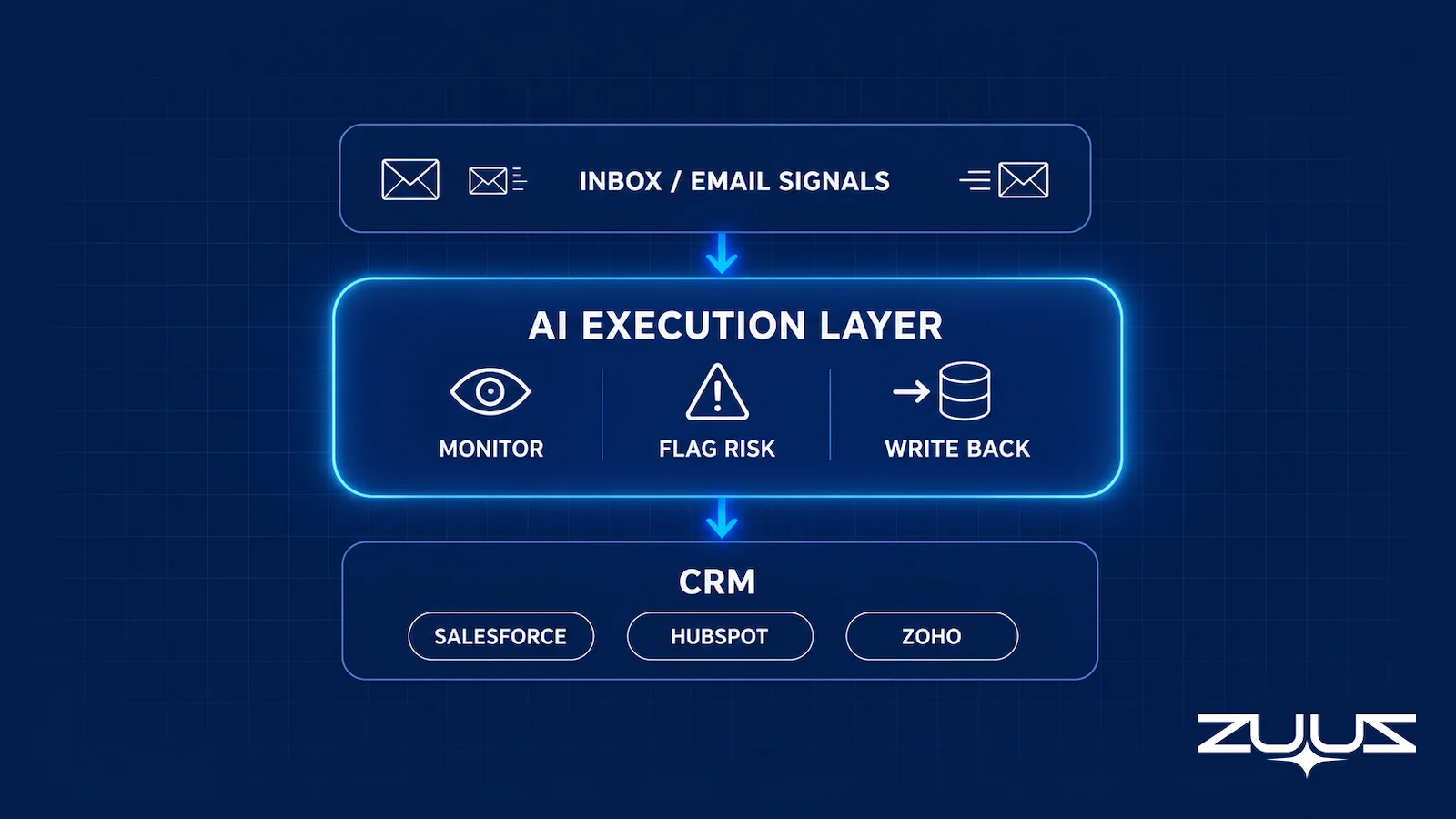
ZUUZ is an AI execution layer that sits on top of an existing CRM rather than replacing it. It does not ask a revenue team to adopt a second system of record for renewals. Instead it reads what is already happening in email and writes structured updates back into Salesforce, HubSpot, or Zoho, whichever the team already runs.
For renewal tracking specifically, ZUUZ reads inbound and outbound email tied to an account, extracts renewal-relevant signals such as a pricing question, a champion change, or an explicit cancellation mention, and updates the relevant CRM record automatically. Renewal and churn risk monitoring runs as part of the same pipeline-monitoring capability ZUUZ applies across an account, not as a separate bolted-on module. That distinction matters: ZUUZ surfaces risk signals for a rep or CS manager to act on, it does not generate a forecast or predict a specific outcome.
RA Technologies, a US-based IT services firm, used ZUUZ’s email lookback to surface $120,000 in renewal and pipeline signals that were not visible in its CRM. Because ZUUZ is CRM-agnostic, the same approach applies whether a company runs Salesforce, HubSpot, or Zoho, and it does not require migrating existing renewal data anywhere new.
Keep Every Renewal Inside the CRM You Already Run.
See how ZUUZ turns everyday inbox activity into an always-current renewal pipeline without asking anyone to adopt a second system.
A Renewal Tracking Workflow That Actually Works
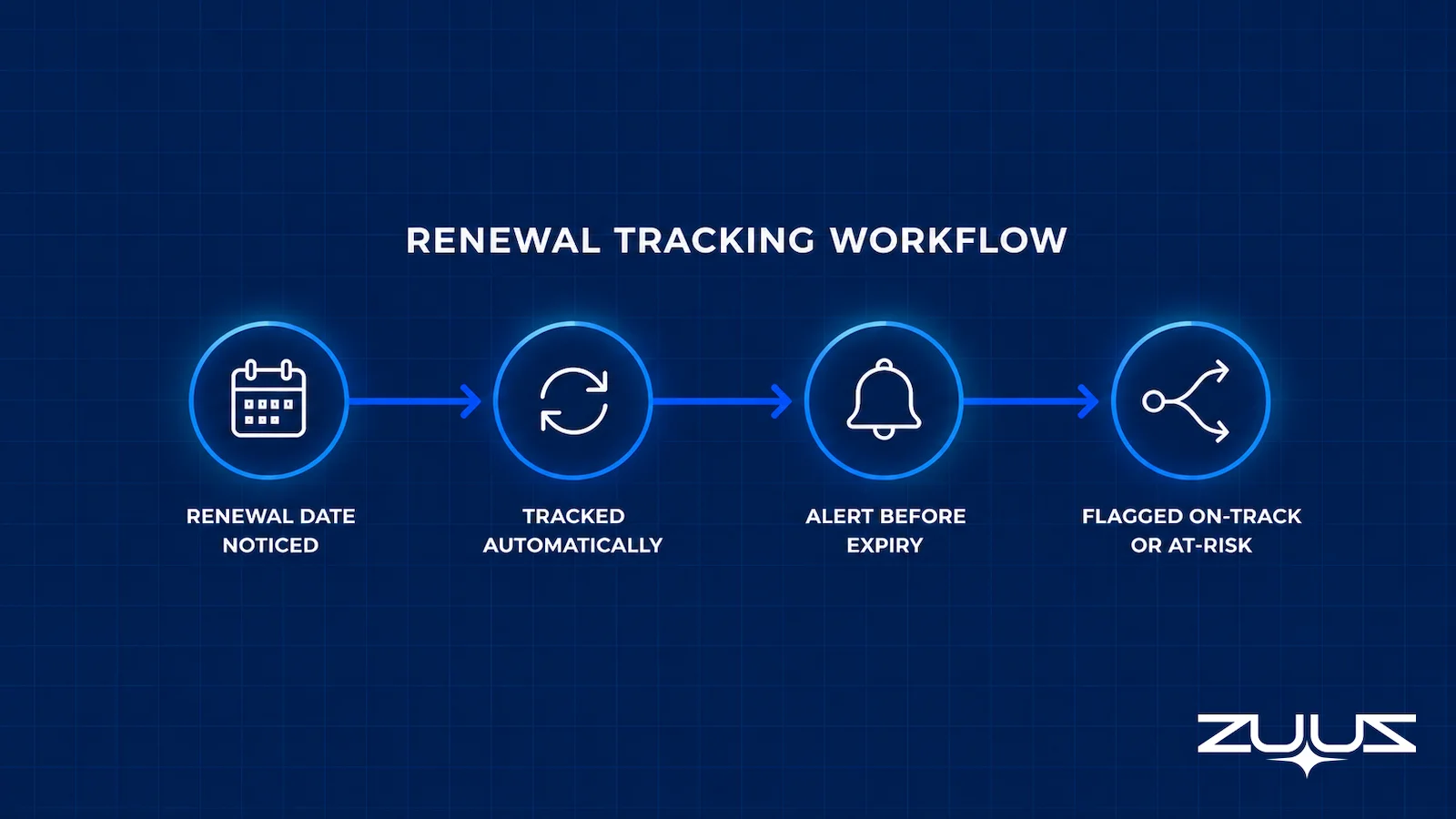
The mechanics of a working renewal process are not complicated. What usually breaks is consistency: teams follow the steps below for the accounts they remember and skip them for the ones they do not.
- Identify the renewal and confirm the real date. Pull the date from the signed contract, not from memory or a stale CRM field.
- Assign an owner and a stage. A renewal without a named owner will not get worked, regardless of how well it is documented.
- Trigger reminders ahead of the notice period. Time alerts to the customer’s actual cancellation window, not a flat 30-day default that may already be too late.
- Track conversations and changes through completion. Log pricing discussions, champion changes, and objections as they happen instead of reconstructing them from memory later.
- Record the outcome. Renewed, expanded, downgraded, or churned, each outcome should feed back into how the next renewal in that account gets handled.
Teams managing renewals across many products or SKUs at once, where a single account can have several overlapping contract terms, should also see how to track renewals across multiple products for the deeper mechanics of co-term scheduling.
How to Evaluate Renewal Tracking Software
A demo can make almost any tool look organized. The real test is whether it can reliably answer specific operational questions using an account list a team actually recognizes.
- What renews in the next 30, 60, 90, and 120 days, and what is it worth?
- Who owns each of those renewals right now?
- Which renewals currently have no next action assigned?
- Which notice-period deadlines are approaching without a plan in place?
- What happened in the most recent customer interaction for each one?
- Is the underlying CRM record actually current, or does it just look current?
Beyond those questions, evaluate the workflow itself, not only the dashboard: how the tool sources its data, whether it depends on manual entry, how flexible its reminders are, how it handles ownership handoffs, whether it pulls email and contract context automatically, and whether a rep can ask plain-English questions about upcoming renewals instead of building a new report each time. Also worth asking honestly: does the team need a full CS or CLM platform, or would that be more system than current renewal volume justifies?
Test It Against Your Own Renewal Book.
Run ZUUZ against a real account list and see which renewals it surfaces that the CRM alone currently misses.
Choosing the Right Approach for a Growing Renewal Book
There is no single correct answer here. The right approach depends on renewal volume, complexity, and how much of the team’s process is already built around the existing CRM.
CRM fields and spreadsheets. Workable when renewal volume and complexity are genuinely low, but this approach tends to break down quietly as account count grows, usually without anyone noticing until a renewal is already missed.
Dedicated renewal tracking software. The right fit once renewals need structured ownership, timed alerts, and reporting that a spreadsheet cannot produce on its own.
Full customer success or CLM platforms. Makes sense when renewal tracking is genuinely one part of a much broader operational need, such as onboarding, product adoption, or contract compliance across the whole business.
An AI layer connected to the existing CRM. The right fit when the CRM should stay the system of record but the team wants less manual tracking and more context pulled automatically from email and other customer signals. Companies managing renewals across many vendors or reseller relationships, such as VARs and distributors, usually need this more specialized version of the same approach.
Renewal tracking is fundamentally a revenue operations problem, not a reminder problem. A tool that only flags an upcoming date solves a small part of what actually causes churn. What matters more, who owns the renewal, what value is at risk, and what is really happening in the relationship, only shows up when the tracking system pulls from where the relationship actually lives: email.
A First Step on One Mailbox
A pilot on a renewal book does not need a project plan. Connect one mailbox, let ZUUZ read the last 90 days of that inbox against the accounts already in the CRM, and have the renewal owner review what it found before a single field is written. ZUUZ is an AI layer on top of the CRM a team already runs; it is never a CRM and never replaces one, which is why nothing has to be migrated to try it. The trial runs 30 days, free, with no credit card: https://zuuz.ai/trial/
Frequently Asked Questions
What is renewal tracking software?
Renewal tracking software is a tool that monitors upcoming contract, subscription, or service renewals so a team can act before they lapse. For B2B revenue teams specifically, that means tracking customer-facing renewals, including the account, contract value, owner, stage, and next action, rather than a company’s own internal software spend. The category ranges from CRM fields and spreadsheets at the low-complexity end to dedicated tools and AI layers like ZUUZ that read email and update the CRM automatically.
What is the difference between renewal tracking software and contract management software?
Contract lifecycle management (CLM) software handles the full life of a contract, including drafting, negotiation, approval, storage, and compliance. Renewal tracking software is narrower and more operational, focused specifically on making sure a customer’s renewal gets identified, owned, worked, and completed on time. A company can use CLM software for contract storage and still need dedicated renewal tracking to manage the actual renewal process.
Can Salesforce or HubSpot track customer renewals on their own?
Salesforce and HubSpot can store renewal dates and contract values in custom fields, and both support reminder workflows built on top of those fields. What neither does natively is read the email conversations where renewal risk usually shows up first, such as a pricing objection or a champion change, and update those fields automatically. That is the gap tools like ZUUZ are built to close without requiring a separate system of record.
What is the difference between renewal tracking software and customer success software?
Customer success platforms cover the full customer lifecycle, including onboarding, product adoption, health scoring, and support, with renewals as one piece of a much larger system. Renewal tracking software is narrower and focuses specifically on the commercial renewal itself: the date, the value, the owner, and the status. Teams with a broad customer success mandate often need a full CS platform; teams that just need renewals reliably tracked usually do not.
How do B2B teams automate customer renewal reminders?
Most teams start by setting reminder rules against a renewal date field in their CRM, typically at 90, 60, and 30 days out. The more reliable approach adds context to those reminders, tying an alert to what actually happened in the account recently rather than firing on a fixed schedule regardless of relationship health. ZUUZ automates this by reading account email directly and updating renewal status and next-action fields without manual entry.
What information should every customer renewal record include?
A complete renewal record needs the account and contract, the renewal and expiration dates, the contract or renewal value, the notice period, a named owner, a current stage, the next required action, and a link to recent conversation history. Leaving out any of these fields technically tracks a date while still leaving the team unable to answer whether the renewal is actually on track.
Is renewal tracking software the same as churn prediction software?
No. Renewal tracking software focuses on operational visibility: what is renewing, who owns it, and what needs to happen next. Churn risk monitoring adds a layer of signal detection on top, flagging accounts showing warning signs so a team can act earlier, but it is not the same as forecasting or predicting revenue outcomes. ZUUZ combines both as part of one pipeline-monitoring capability rather than as a separate predictive module.
How is renewal tracking software different for SaaS vendors than for IT procurement teams?
For a SaaS or services company, renewal tracking means monitoring the renewals its own customers owe it, tracked by sales, account management, or customer success. For an IT or procurement team, renewal tracking usually means the opposite: tracking the software licenses and vendor contracts the company itself pays for. Most tools ranking for “renewal tracking software” are built for the procurement side, which is worth checking before choosing one.
What is co-terming in subscription renewals?
Co-terming means aligning the end dates of multiple subscriptions or licenses so they renew on a single date, usually by prorating anything added mid-term to the existing term. It reduces renewal events and paperwork, but it moves the renewal conversation earlier and ties several contracts together, so the discussion needs to be visible on the account record.