Gmail Salesforce Integration: What Gets Logged vs. What Gets Lost
Gmail Salesforce integration logs emails but misses deal signals. Compare Lightning for Gmail, Einstein Activity Capture, and Email-to-Salesforce — and what an AI capture layer adds.
Three Native Gmail-to-Salesforce Paths — and the Signal Each One Misses
Salesforce offers three ways to connect Gmail. Each covers a different slice of the problem, and each leaves the same slice uncovered.
| Path | What It Does | What It Misses | Setup Effort |
|---|---|---|---|
| Lightning for Gmail | Chrome extension — lets reps view and create Salesforce records from the Gmail sidebar, manually log emails to contacts/leads | Manual per-email logging. Chrome-only, no mobile. No calendar sync. Reps must remember to click "Log" on every thread that matters. | Per-user install from Chrome Web Store; admin enables in Setup |
| Einstein Activity Capture (EAC) | Auto-captures emails and calendar events between connected Gmail accounts and Salesforce records | Captured data lives in a separate store — not in standard Activity records, not reportable in standard reports, not included in list views or automation. 6-month retention limit. Removing EAC deletes all captured history. | Admin enables in Setup, each user connects their Gmail; sync can take up to 24 hours initially |
| Email-to-Salesforce (BCC) | Reps BCC a unique Salesforce address; the email is matched to a record by the sender/recipient address | Reps must remember to BCC every time. Matching fails on personal addresses, duplicates, and formatting mismatches. No thread context — just the single email. 25 MB attachment limit. | Admin enables in Setup; each user gets a unique BCC address |
Notice the pattern: every path logs that an email happened. None of them reads what the email says. A thread where a prospect confirms a $240K renewal for three product lines, names two stakeholders, and asks for a co-term adjustment gets logged as "Email — RE: Quick question." The CRM records that a conversation occurred. The pipeline stays empty.
Why "Email Logged" Is Not "Pipeline Updated"
The assumption behind every Gmail-Salesforce integration is that logging the email is the job. It is not. The job is getting the deal signal into the right CRM field so a manager can see pipeline, a forecast is accurate, and a renewal does not lapse because nobody updated a date.
Native integrations treat the email as a document to attach. The fields that matter — deal stage, product SKU, competitor mentioned, next-step date, stakeholder added — stay blank because no native tool reads the email body and maps its content to CRM fields.
This creates a specific failure mode for IT sales teams that run Gmail and Salesforce:
- Pipeline reviews rely on what reps remember to type, not what the email thread actually says.
- Renewals with date changes confirmed in email stay at the original date in Salesforce until someone notices.
- Stakeholder changes — a new decision-maker CC'd on a thread — never reach the Opportunity's Contact Roles.
- Competitor mentions in reply threads are invisible to anyone who does not read the thread themselves.
The Capture Gap: A Framework for Evaluating Gmail-Salesforce Integration
Before choosing (or layering) a Gmail-Salesforce integration, run the Capture Gap Audit on your last 20 closed-won deals:
- Pull the Activity Timeline for each Opportunity in Salesforce. Count the logged emails.
- Search Gmail for the same contact/domain. Count the actual emails exchanged.
- Compare. The gap between logged and actual is your capture gap — typically 40-80% of threads are missing entirely.
- For the emails that are logged, check: did the deal stage, product, competitor, or renewal date mentioned in the email body make it into the CRM record? In most teams, zero of those fields were updated from the email content.
- Calculate the cost. One missed renewal confirmation on a $50K deal costs $50K. One competitor mention that never reached the rep's manager costs the response time that could have saved the deal.
If your capture gap is under 10% and your field-update rate is above 80%, your native integration is working. If not, the problem is not which Gmail extension you installed — it is that no tool is reading the email content.
What an AI Email-Parsing Layer Adds to Gmail + Salesforce
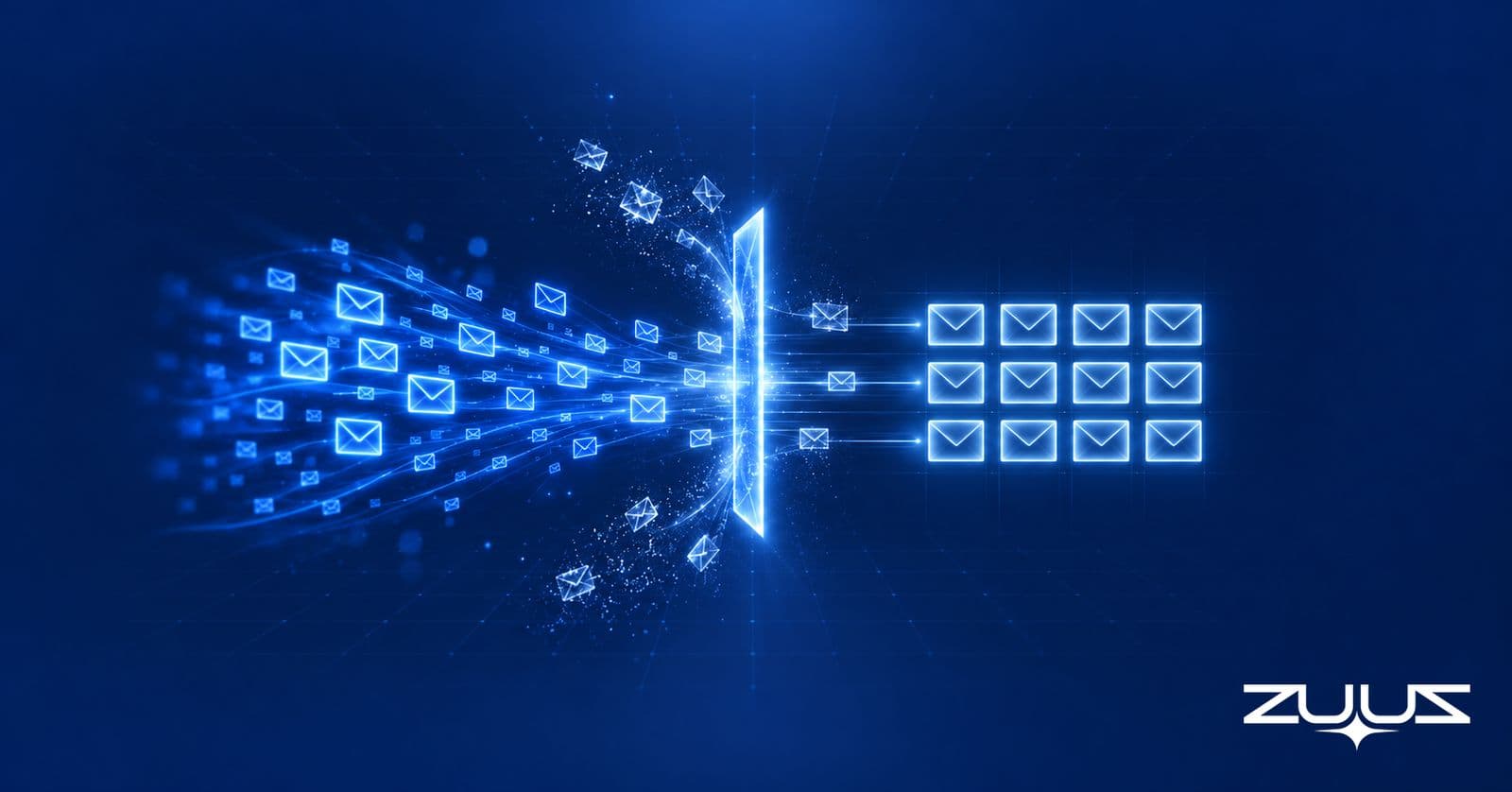
An AI email-parsing layer sits between Gmail and Salesforce and does the work that native integrations skip:
- Reads every inbound and outbound email in the connected sales inbox — no manual logging, no BCC, no Chrome extension.
- Extracts structured deal signals: product names, dollar amounts, renewal dates, competitor mentions, stakeholder names and roles, next steps with dates.
- Maps signals to CRM fields and writes them to the correct Opportunity, Contact, or Account record in Salesforce.
- Classifies email intent: is this a new lead, an active deal update, a renewal conversation, or a support issue? Routes accordingly.
- Works across all five major CRMs — Salesforce, HubSpot, Zoho, Attio, and Pipedrive — so a team that switches CRMs does not lose its capture layer.
ZUUZ is built on this model. It connects to the sales inbox (Gmail, Outlook, or LinkedIn messages), reads every thread, and writes structured records to the CRM. No browser extension to install, no per-user setup, no rep behavior change. For IT companies, this approach to email-to-CRM automation addresses the signal gap that native integrations leave open. A team at RA Technologies, an IT services company on HubSpot, surfaced $120K in pipeline in the first 30 days — deals that existed in email threads but had never been logged.
Connect your inbox. ZUUZ shows you the pipeline signals your Salesforce integration is missing.
Start Free Trial
Gmail + Salesforce Integration: Setup Comparison
| Criterion | Lightning for Gmail | Einstein Activity Capture | Email-to-Salesforce BCC | AI Capture Layer (e.g., ZUUZ) |
|---|---|---|---|---|
| Requires rep action per email | Yes — manual log | No — auto-capture | Yes — manual BCC | No — auto-capture |
| Captures email content/signals | Attaches email text | Attaches email text | Attaches email text | Extracts deal signals into CRM fields |
| Updates deal stage automatically | No | No | No | Yes |
| Identifies new stakeholders | No | No | No | Yes |
| Flags competitor mentions | No | No | No | Yes |
| Standard Salesforce reporting | Yes (logged as Tasks) | No (separate data store) | Yes (logged as Tasks) | Yes (writes to standard fields) |
| Data retention | Permanent | 6 months | Permanent | Permanent |
| Mobile support | No (Chrome-only) | Yes | Yes (any email client) | Yes (server-side) |
| Works across CRMs | Salesforce only | Salesforce only | Salesforce only | Salesforce, HubSpot, Zoho, Attio, Pipedrive |
When Each Gmail-Salesforce Integration Is Enough
Lightning for Gmail alone works when: your team is small (under 5 reps), deal volume is low enough that manual logging is realistic, and you do not need mobile access or pipeline reports that go beyond "email was sent."
Einstein Activity Capture alone works when: you need auto-capture without rep effort, you can accept that captured data is not in standard reports, and your compliance requirements allow a 6-month retention window. EAC is included in Sales Cloud Einstein licenses.
Email-to-Salesforce BCC alone works when: you have disciplined reps who will BCC every relevant email, and you do not need thread context or signal extraction.
Add an AI capture layer when: your pipeline reviews depend on what reps typed into the CRM rather than what the emails actually say, your renewal dates drift because confirmations are in threads nobody reads, or your capture gap (step 3 of the audit above) exceeds 20%.
Compare what your Gmail threads say against what Salesforce knows. Most teams find a 40-80% gap.
Book a Demo
The Record-Ready Test for Gmail-Salesforce Integration
After connecting Gmail to Salesforce — through any path — run this five-question test on your last 10 closed deals:
- Can a new manager reconstruct the deal's history from the Salesforce record alone, without reading email threads?
- Are the products/SKUs discussed in email threads present in the Opportunity's line items?
- Do the Contact Roles on the Opportunity include every stakeholder who appeared in the email threads?
- Is the close date in Salesforce within one week of the date confirmed in the last email exchange?
- Are competitor mentions from email threads captured anywhere in the Opportunity record?
If three or more answers are "no," your integration is logging emails but not capturing pipeline. The distinction matters: logged emails prove a conversation happened; captured signals let a manager forecast, coach, and catch at-risk deals without reading every thread themselves.
How ZUUZ Works With Gmail and Salesforce
ZUUZ connects to your sales inbox — Gmail, Outlook, or LinkedIn messages — and reads every thread. It does not replace Salesforce or compete with it. It is the AI layer on top of your CRM that turns email conversations into structured pipeline data.
- No browser extension. ZUUZ connects server-side to the inbox. No Chrome extension to install, no per-user setup, no "forgot to click Log."
- No behavior change. Reps keep working in Gmail. ZUUZ reads the threads in the background.
- Structured output. Every signal — product, amount, stakeholder, competitor, next step, renewal date — is written to the correct Salesforce field. Not attached as an email text blob.
- Works with your existing Salesforce. No migration, no new CRM, no duplicate database. ZUUZ writes to the fields you already have.
Your emails already contain the deal signals your CRM is missing. ZUUZ reads them so your team does not have to.
Start Free Trial
Frequently Asked Questions
How do I integrate Gmail with Salesforce?
Salesforce offers three native paths: Lightning for Gmail (a Chrome extension for manual email logging), Einstein Activity Capture (automatic email and calendar sync with a separate data store), and Email-to-Salesforce (a BCC address that logs individual emails). Each requires admin setup in Salesforce and per-user connection of their Gmail account. An AI capture layer like ZUUZ connects server-side and requires no per-user browser setup.
Does Salesforce integrate with Gmail?
Yes. Salesforce supports Gmail integration through Lightning for Gmail, Einstein Activity Capture, the Email-to-Salesforce BCC feature, and the Salesforce Connector for Gmail available on the Google Workspace Marketplace. Each path has different capabilities, setup requirements, and limitations around reporting and data retention.
What is the best Gmail to Salesforce integration?
It depends on what you need. For basic manual logging, Lightning for Gmail is free and fast to install. For automatic capture without rep effort, Einstein Activity Capture works but stores data outside standard reports and has a six-month retention limit. For teams that need email signals — deal stages, competitors, renewal dates — extracted into CRM fields automatically, an AI email-parsing layer fills the gap that native tools leave.
Is Einstein Activity Capture free?
Einstein Activity Capture is included with Sales Cloud Einstein licenses. It is not available on all Salesforce editions. Check your Salesforce license terms — the feature may require an upgrade or add-on depending on your current plan.
Why is my Gmail Salesforce integration not working?
Common causes include expired OAuth tokens (re-authenticate in Salesforce Setup), browser extension conflicts (disable other Chrome extensions temporarily), misconfigured sync settings (check Einstein Activity Capture or Lightning for Gmail configuration in Setup), and permission issues (the Salesforce user profile needs the correct permission sets for email integration features).
Does Einstein Activity Capture work with standard Salesforce reports?
No. Einstein Activity Capture stores captured emails and events in a separate data store, not in standard Task or Event records. This means captured activities do not appear in standard reports, list views, or automation rules. Data captured by EAC also has a six-month retention limit, after which it is no longer accessible on the activity timeline.
Can I use Gmail with Salesforce on mobile?
Lightning for Gmail does not work on mobile — it is a Chrome desktop extension only. Einstein Activity Capture syncs data server-side and works regardless of device. The Salesforce Connector for Gmail supports the Gmail mobile app on iOS and Android. Email-to-Salesforce BCC works from any email client, including mobile.
What is the difference between Lightning for Gmail and Einstein Activity Capture?
Lightning for Gmail is a Chrome extension that lets reps manually log emails and view Salesforce records from the Gmail sidebar. Einstein Activity Capture automatically syncs emails and calendar events without manual action. The tradeoff: Lightning for Gmail creates standard Activity records (reportable) but requires rep effort. EAC requires no effort but stores data outside standard records (not reportable, six-month retention).
How does ZUUZ differ from native Gmail-Salesforce integration?
Native integrations log that an email happened — they attach the email text to a Salesforce record. ZUUZ reads the email content and extracts structured deal signals: products mentioned, dollar amounts, stakeholder names, competitor references, renewal dates, and next steps. Those signals are written to the correct CRM fields automatically. No browser extension, no manual logging, no per-user setup.
Can I use Gmail Salesforce integration with other CRMs?
Native Salesforce integrations (Lightning for Gmail, EAC, Email-to-Salesforce) work only with Salesforce. If your team uses HubSpot, Zoho, Attio, or Pipedrive, you need a different integration path. An AI capture layer like ZUUZ works across all five CRMs from a single inbox connection, so a team that switches CRMs keeps its capture layer.
What happens if I turn off Einstein Activity Capture?
Deactivating Einstein Activity Capture removes all previously captured activities from the activity timeline. This data is not recoverable. Plan accordingly before disabling the feature — if you need the historical data, export it or ensure it has been logged through another path before turning EAC off.
How do I automatically log emails in Salesforce from Gmail?
Einstein Activity Capture is the only native path that logs emails automatically without rep action. Lightning for Gmail and Email-to-Salesforce both require manual steps (clicking "Log" or adding a BCC address). For automatic logging that also extracts deal signals from the email content, an AI capture layer like ZUUZ reads every thread and writes structured records to Salesforce without any manual step.