
ConnectWise PSA Integration: Deal Signals It Misses
A ConnectWise PSA integration syncs what was already logged but misses deal signals in email. See the three gaps MSPs face and how a capture layer helps.

CEO of ZUUZ. He scaled Cloud Box Technologies from 0 to $25M ARR in IT services and distribution before building ZUUZ. Connect on LinkedIn
TL;DR: A ConnectWise PSA integration typically syncs companies, contacts and opportunities between the PSA and the CRM, but it can only move what someone already logged, so deal signals in email, such as a renewal date a client confirmed in a reply or a competitor a prospect named, never arrive. ZUUZ is a revenue intelligence layer on top of the CRM the team already runs: it captures signals from the sales inbox and LinkedIn messages (read-only) and writes structured records to the CRM automatically, with full change history and one-click rollback, so the sync has something to move. For MSPs on ConnectWise PSA, ZUUZ also syncs won customers to the PSA; it does not read PSA tickets or agreements.
- A ConnectWise PSA integration moves records between the PSA and the CRM, but it can only sync what someone already logged, so deal signals in email never arrive.
- MSPs and VARs that run a PSA beside a CRM face three gaps: a capture gap in email, a sync gap when won deals are re-entered, and a renewal gap where the client's intent lives in the thread and not in the agreement date.
- A better ConnectWise PSA integration fixes a sync problem and a capture layer fixes a capture problem, so pipeline data that flows from email to CRM to PSA needs both.
- The Renewal Signal Check finds the renewals where the PSA end date is the only thing either system knows.
- ZUUZ is not a PSA. An MSP without a CRM can use it as its AI CRM, and an MSP on Salesforce, HubSpot, Zoho, Pipedrive or Attio keeps that CRM and uses ZUUZ as the revenue intelligence layer on top. Either way, ZUUZ syncs won customers to ConnectWise PSA and does not read PSA tickets.
What ConnectWise PSA Does and What It Was Never Built to Do
ConnectWise PSA (formerly ConnectWise Manage) is the operational backbone for managed service providers, VARs, and IT services companies. Depending on the package, it handles:
- Service tickets: incident tracking, SLA management, time entry
- Project management: resource allocation, milestones, budget tracking
- Agreements and billing: recurring contracts, billing, invoicing
- Procurement: purchasing, inventory, vendor pricing, distributor ordering
- Configuration management: IT asset and configuration tracking, with RMM integrations
What ConnectWise PSA was never built to do is read the sales inbox and extract deal intelligence. Most of what it tracks happens after a deal closes: the service delivery, the billing, the support tickets. It does include sales and opportunity tracking, so some MSPs run their pipeline inside it, but those records hold what someone typed. The deal itself, the email thread where a prospect asks for pricing on a three-year managed services agreement, names two decision-makers and mentions they are also talking to another MSP, lives in Gmail or Outlook and reaches the PSA only if someone logs it.
What Is ConnectWise CRM, and When Do MSPs Outgrow It?
ConnectWise CRM is the name MSPs use for the CRM features built into ConnectWise PSA, rather than a separate CRM product. It covers company and contact records shared with the service desk, opportunities with sales stages, and sales activities such as follow-up calls, tasks and reminders. ConnectWise's own MSP CRM page for ConnectWise PSA describes opportunity tracking with lead sources and logged activities, pipeline and quota tracking, and a handoff in which opportunity data carries into agreements and projects once a deal closes.
For an MSP where the owner sells, most growth comes from existing clients and the opportunity list is short, that is often enough, because the sale and the service sit in one system. MSPs tend to outgrow it when a dedicated sales team, a marketing function with lead sources and campaigns, or a steady new-logo motion needs stage reporting and pipeline views that a PSA-first tool was not designed around. That is usually when a separate CRM joins the stack, and when the PSA-CRM gap starts.
In both setups, the records hold only what someone typed, and ZUUZ fits either path. An MSP that still sells from ConnectWise PSA or a spreadsheet can use ZUUZ as its AI CRM, with leads, contacts, accounts, deals and renewals built from email, calendar, meetings and LinkedIn, and won customers synced to ConnectWise PSA. An MSP that has added a separate CRM keeps it and uses ZUUZ as the revenue intelligence layer on top, which updates that CRM automatically with full change history and one-click rollback. Either way, ZUUZ does not read PSA tickets, and the rep sends any reply ZUUZ drafts.
The PSA-CRM Gap for MSPs and VARs
Many MSPs and VARs that outgrow a handful of clients run into the same structural problem: ConnectWise PSA is the system of record for delivery, and its built-in sales tools are one module among many. So they add a CRM, such as Salesforce, HubSpot, or a lighter-weight option like Attio or Pipedrive.
Now they have two systems and three gaps:
| Gap | What Happens | What It Costs |
|---|---|---|
| Capture gap | Deal signals in email threads do not reach the CRM unless a rep logs them. Reps are too busy delivering services to log every sales conversation. | Pipeline reviews are based on what reps remember, not what the emails say. Deals fall through. |
| Sync gap | Without a connector, won deals in the CRM do not create agreements or opportunities in ConnectWise PSA. Data is re-entered manually. | Billing setup can be delayed and agreement terms can be mistyped. |
| Renewal gap | Renewal conversations happen in email. ConnectWise PSA tracks agreement expiration dates, but the client's actual intent (renew, expand, reduce, churn) is in the thread, not the system. | Renewals are treated as administrative tasks instead of sales opportunities. Expansion signals are missed. Churn surprises happen. |
The sync gap gets the most attention because it is the most visible: someone has to re-enter won deal data into PSA, and when they do it wrong, billing breaks. But the capture gap is where revenue actually leaks: deals that existed in email and never made it into either system.
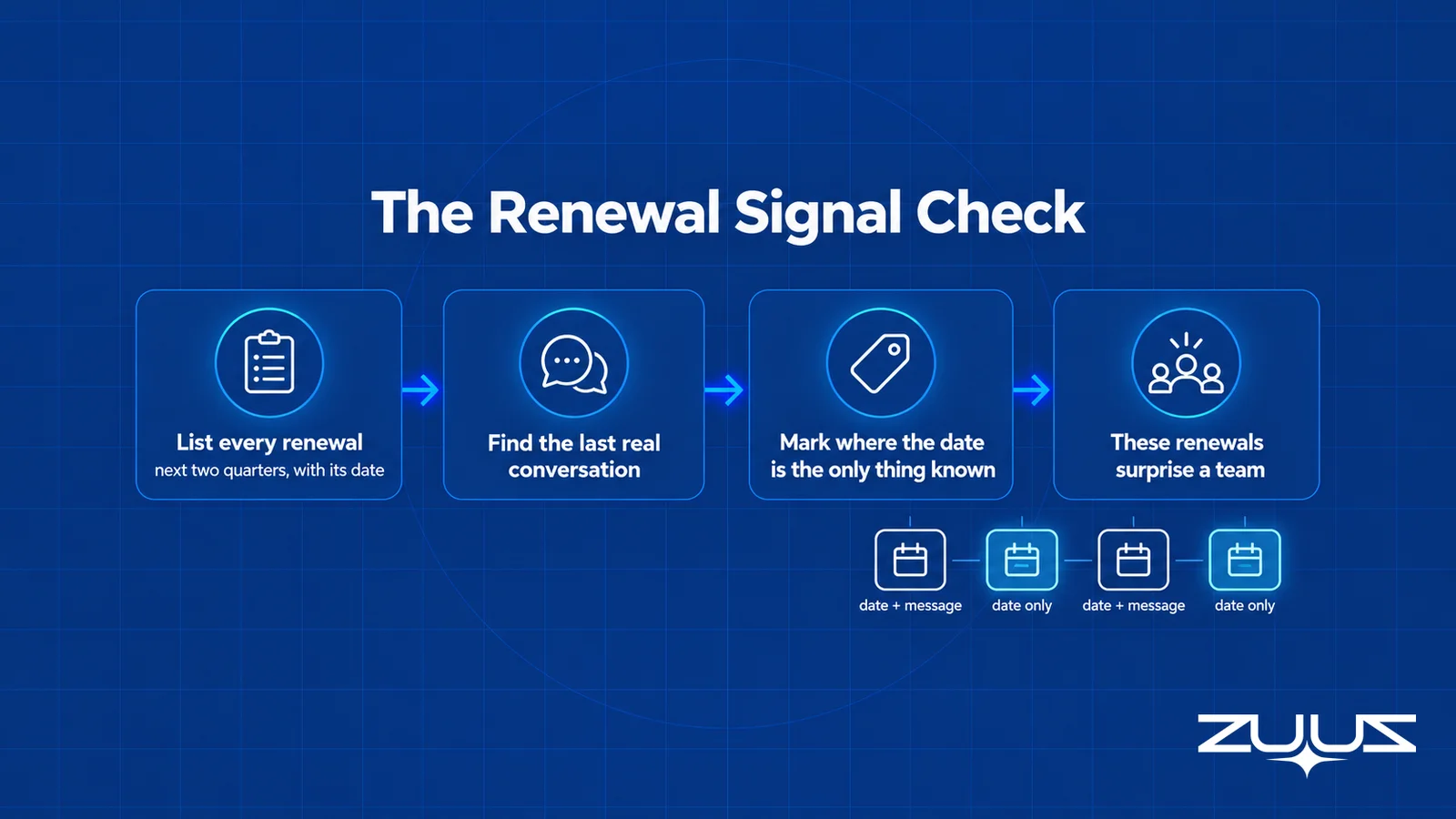
The size of the capture gap can be tested before anything is bought. The renewal calendar is the fastest place to look, because every renewal has an end date in the PSA and, somewhere in a mailbox, the conversation that shaped it. The Renewal Signal Check turns that into four steps.
How to evaluate whether a PSA and CRM stack shows renewal signals: the Renewal Signal Check
- List every renewal in the next two quarters and its date field.
- For each, find the last real conversation and what it said about budget, champion or satisfaction.
- Mark every renewal where the date is the only thing the system knows.
- Those are the renewals that surprise you; the signal existed, in a mailbox.
See What the Email Threads Are Hiding From the PSA and the CRM.
Connect one mailbox and ZUUZ reads the last 90 days, so renewal and expansion signals that never reached the CRM show up from the thread instead of from memory.
Why a Native ConnectWise PSA Integration Does Not Close the Capture Gap
ConnectWise has a marketplace of integrations that includes CRM connectors. HubSpot lists a ConnectWise PSA connector in its own marketplace, and third-party integration platforms cover Salesforce and other CRMs. Depending on the connector, these integrations sync:
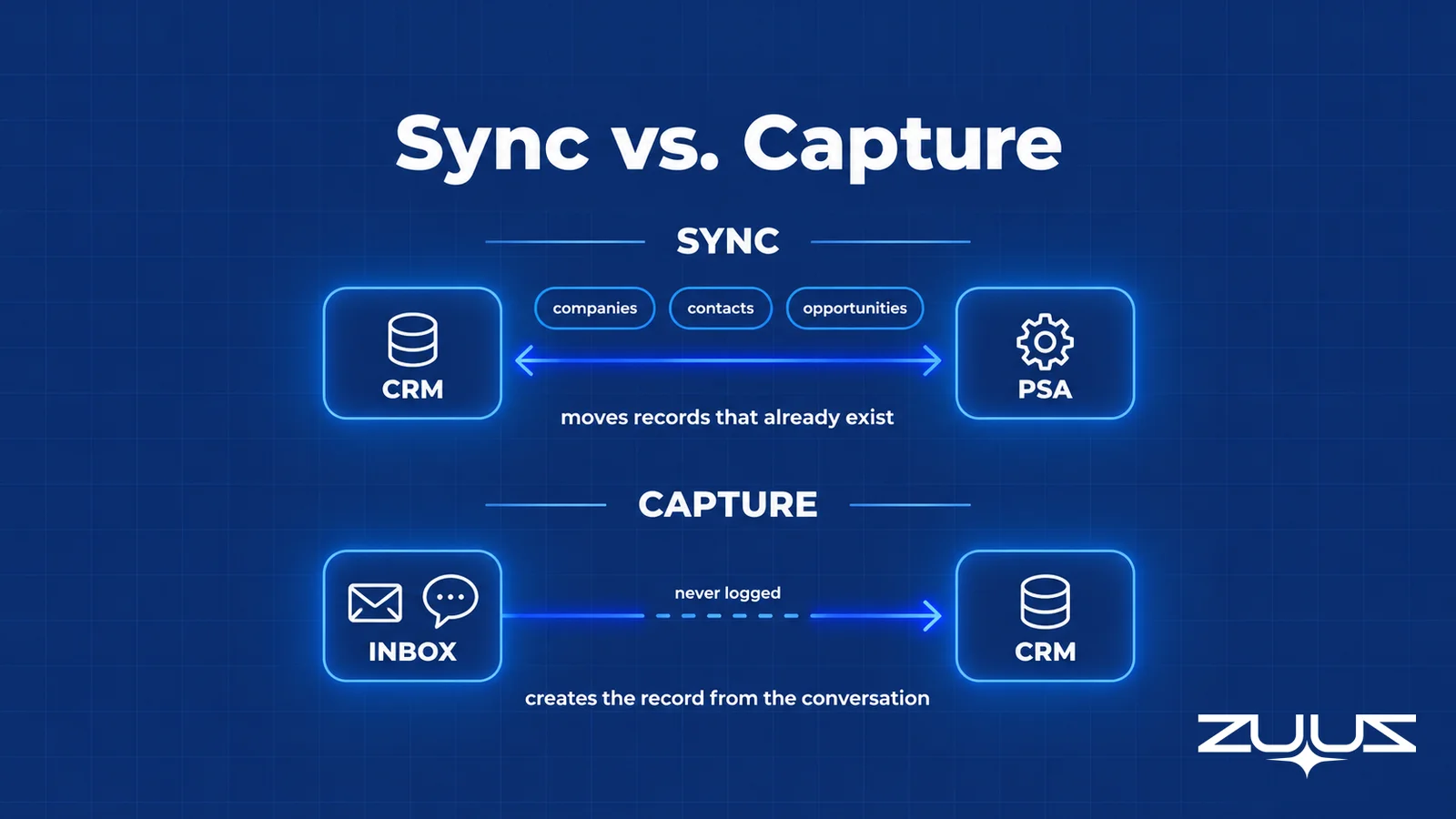
- Contacts and companies between CRM and PSA
- Won opportunities from CRM to PSA
- Ticket status from PSA back to CRM for account visibility
This solves the sync gap, because data flows between systems without re-entry. It does not solve the capture gap, because the integration assumes the data is already in the CRM. If a deal signal lives in an email thread and nobody logged it to the CRM, the ConnectWise PSA integration has nothing to sync. IT companies need email-to-CRM automation that creates the data from email signals, not just moves it between systems.
The same limitation applies to third-party integration platforms and ConnectWise-to-HubSpot bridges. They move data between systems. They do not create data from email content.
What MSPs Actually Lose to the Capture Gap
For an MSP or VAR running ConnectWise PSA, the capture gap creates specific losses. The four patterns below are illustrations, not reports of real client events:
- Renewal conversations that never reach the pipeline. A client emails about their upcoming agreement renewal, asks about adding endpoint security to their managed services bundle, and mentions a competitor's pricing. That thread contains a renewal, an upsell, and a competitive signal, none of which reach ConnectWise or the CRM unless a rep manually logs them.
- New business from existing clients. A support ticket thread evolves into a project discussion: "while you are fixing the VPN, can you price a migration to Azure?" That expansion signal lives in the PSA ticket thread or the email chain, not in a CRM opportunity.
- Vendor and distribution signals. For VARs and distributors, product availability, pricing changes, and co-term opportunities arrive in email from vendors. These affect active deals but are rarely captured in the CRM or PSA because they are not customer-facing conversations.
- Multi-product renewal co-terming. A client has three agreements expiring in different months. The renewal conversation in email mentions co-terming them. ConnectWise PSA tracks each agreement's expiration date independently. The co-term intent, confirmed in email, does not reach either system unless someone logs it.
The Renewal Signal Check for a ConnectWise PSA and CRM Stack
Before adding another integration or tool to a ConnectWise PSA stack, run the Renewal Signal Check from the box above on the renewals the PSA already lists. Step one starts in ConnectWise PSA: pull every agreement ending in the next two quarters, with its end date, products and billing amount. Step two moves to the mailbox: search Gmail or Outlook for each client's domain across the 90 days before that end date, and read for the last real conversation that touched pricing, scope changes, competitor mentions or expansion.
Then comes the comparison that matters in a PSA-CRM stack. Does the CRM hold a renewal opportunity with the right products and amounts, and did anything the client said reach a field in the CRM or the PSA? Where the answer is no, the end date is the only thing either system knows, and step three marks that renewal. A renewal in that position is processed as a billing event, not a sales event.
Worked example, as an illustration. An MSP lists six agreements ending in the next two quarters. Four have a CRM opportunity and a recent client message the team has acted on, and two have an end date in the PSA and nothing else.
When the account manager searches the mailbox for those two clients, one thread shows the client asking whether a competitor could match the current price, and the other shows a request to add three seats of endpoint security and to co-term the agreement with a second one. Neither fact is in a CRM field or a PSA record, and those are the renewals that would have surprised the team.
The check does not say the integration is broken. If it finds renewals where the end date is the only thing known, the ConnectWise PSA integration is solving the sync problem but not the capture problem, which is the pattern behind MSP customer retention surprises.
Close the Capture Gap Before the Next Renewal.
A CRM-to-PSA connector syncs what is in the CRM. ZUUZ writes the missing updates from the sales inbox automatically, with every change logged and reversible in one click, so renewals known only by an end date come with the conversation behind them.
What an AI Capture Layer Adds to the ConnectWise PSA Stack
An AI capture layer sits upstream of both the CRM and the PSA. It connects to the sales inbox (Gmail or Outlook), reads LinkedIn messages (read-only), and extracts the structured deal signals that neither system captures natively:
- Renewal intent and scope changes from client email threads, written to the CRM automatically, with full change history and one-click rollback
- Expansion signals from client email conversations, such as a support reply that turns into a project question, surfaced as new pipeline instead of staying in one inbox
- Competitor mentions flagged for the rep and written to the account record in the CRM automatically
- Stakeholder mapping: new decision-makers copied on threads are added as CRM contacts and roles automatically, keeping a full change history with one-click rollback, without manual entry
- Co-term and multi-product signals extracted from renewal threads and written to the matching CRM records
Once the deal data is in the CRM, the CRM-to-PSA connector the team already runs can carry it downstream, so agreements and billing start from captured pipeline data instead of re-entered fragments.

ZUUZ is built on this model. It connects to the sales inbox and writes structured pipeline records to the CRM: Salesforce, HubSpot, Zoho, Attio or Pipedrive. Today ZUUZ does not read PSA tickets, so a conversation that lives only inside a ticket is outside what it captures.
Where the Capture Layer Fits in the ConnectWise PSA Integration Architecture
The typical MSP/VAR tech stack flows in one direction: CRM → PSA → RMM/service delivery. An AI capture layer adds the missing upstream step:
| Layer | System | What It Does | ZUUZ Today |
|---|---|---|---|
| 1. Capture | AI layer on top of the CRM (for example, ZUUZ) | Connects to the sales inbox and LinkedIn messages (read-only), extracts deal signals, writes structured records to the CRM automatically, with full change history and one-click rollback | ZUUZ is built for this layer |
| 2. Pipeline | CRM (Salesforce, HubSpot, Zoho, Attio, Pipedrive) | Manages opportunities, contacts and pipeline stages | ZUUZ writes structured records here; the CRM stays the system of record |
| 3. Operations | ConnectWise PSA | Agreements, ticketing, project management, billing, procurement | ZUUZ syncs won customers to ConnectWise PSA. It does not read PSA tickets or agreements. |
| 4. Delivery | RMM and documentation tools | Remote monitoring, documentation, endpoint management | Not a ZUUZ capture source |
Without the capture layer, the pipeline step depends entirely on manual data entry, and for MSPs where the same person selling is also delivering, that entry rarely happens. The capture layer reduces the dependency on rep behavior and feeds pipeline data into the CRM automatically, with every change logged and reversible in one click, which then flows downstream to the PSA through the connector the team already runs.
When to Add a Capture Layer vs. a Better ConnectWise PSA Integration
Add a better ConnectWise PSA integration when: the deal data is already in the CRM and the problem is getting it into the PSA without re-entry. This is a sync problem, and a ConnectWise-CRM connector solves it.
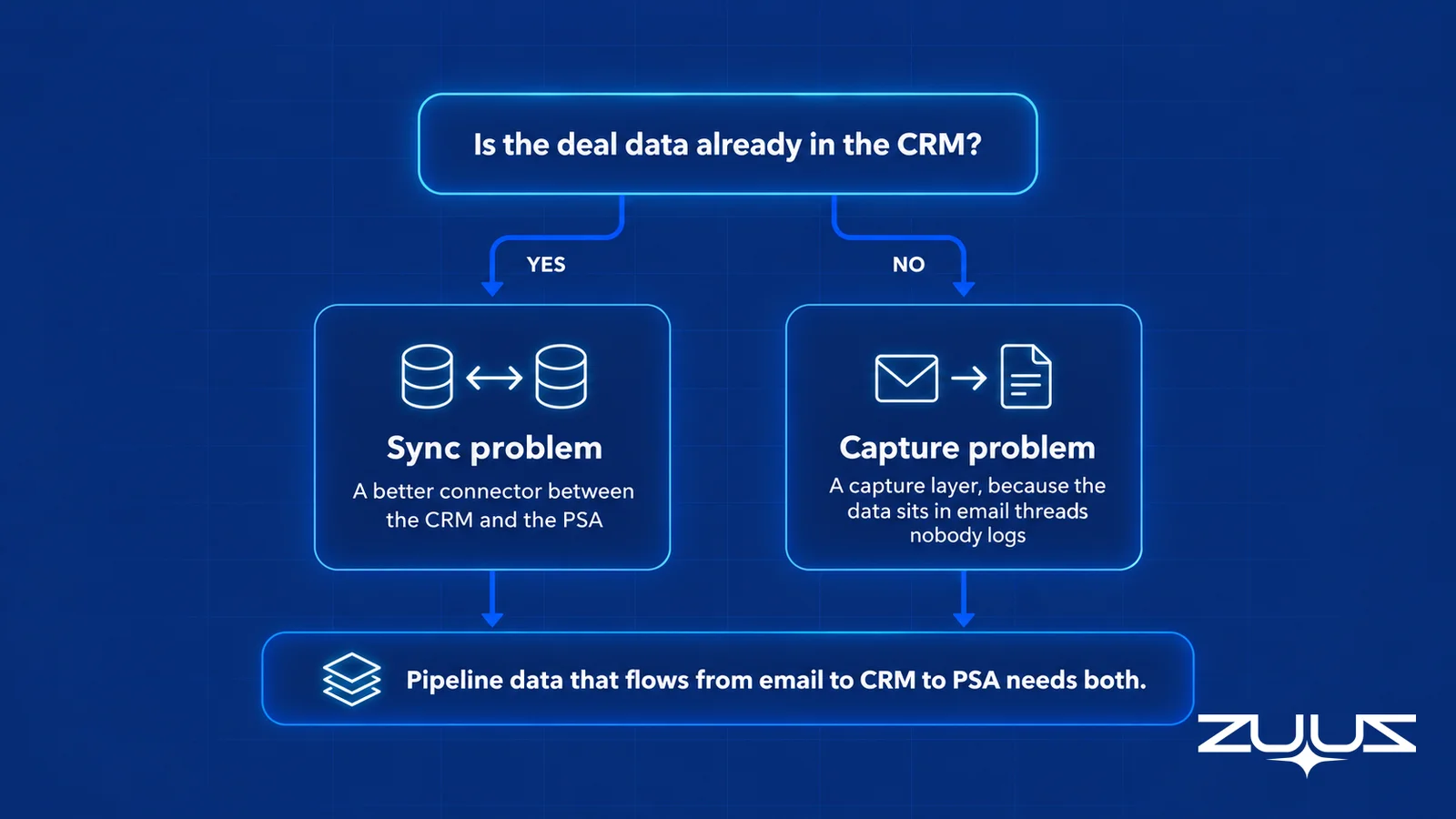
Add a capture layer when: the deal data is not in the CRM in the first place. It is in email threads that nobody logs. This is a capture problem, and no amount of PSA-CRM integration fixes it because there is nothing to sync.
Add both when: the goal is pipeline data that flows from email to CRM to PSA without anyone re-keying it. The capture layer feeds the CRM automatically, with one-click rollback on each update; the CRM integration feeds the PSA.
Put the Deals in the CRM Before the Sync Runs.
A CRM-to-PSA connector can only move what is already logged. ZUUZ connects to the sales inbox and writes the missing records automatically, with every change logged and reversible in one click.
The Operator View of a ConnectWise PSA and CRM Stack
From an operator's seat in IT services and distribution, where Avinash Gujje, CEO of ZUUZ, scaled Cloud Box Technologies from $0 to $25M ARR, the sync is the part everyone sees and the capture is the part nobody owns. Across the deployments ZUUZ runs, the pattern is that the first 90-day mailbox lookback turns up leads, renewals and expansion conversations that have no record in the CRM behind them. The part teams do not plan for is that a better sync would have moved the CRM exactly as it was, gaps included, so the renewal still arrives as an end date instead of as a conversation. A renewal with a date also looks handled, which is why the question of what the client last wrote tends to be asked late.
How ZUUZ Fits Alongside a ConnectWise PSA Stack
ZUUZ is a revenue intelligence layer on top of the CRM a team already runs, with no migration. It connects to the sales inbox, the calendar, LinkedIn messages (read-only), Microsoft Teams meeting transcripts and inbound call transcripts, and writes structured pipeline records to Salesforce, HubSpot, Zoho, Attio or Pipedrive. Every update is logged with full change history and one-click rollback, keyword filtering keeps out-of-scope threads out, manual entries take precedence, and a 90-day mailbox lookback on first connection means history is not blank.
For MSPs and VARs running ConnectWise PSA:
- Today: ZUUZ captures deal signals from the sales inbox and LinkedIn messages and writes them to the CRM (Salesforce, HubSpot, Zoho, Attio or Pipedrive) automatically, keeping a full change history with one-click rollback. ZUUZ also syncs won customers to ConnectWise PSA, so a closed deal reaches the PSA without being retyped. It does not read PSA tickets or agreements.
- Without a separate CRM: An MSP that still sells from ConnectWise PSA or a spreadsheet can use ZUUZ as its AI CRM, with leads, contacts, accounts, deals and renewals built from email, calendar, meetings and LinkedIn, and won customers synced to the PSA.
The result: deal signals from email reach the CRM without a rep retyping them, and a connector the team already runs can carry those records on to the PSA.
In the proof so far, a US-based IT services company, RA Technologies, ran ZUUZ on the HubSpot instance it had used for two years, with the same team, and $120K in pipeline was surfaced within 72 hours that the CRM had never seen, captured from the sales mailbox. At Cloud Box Technologies, a UAE cloud and IT services business, one connected user tracks 10 to 12 renewals in minutes and leadership sees live pipeline.
The first step is small. Connect one mailbox, let ZUUZ read the last 90 days, and run the Renewal Signal Check against the renewals it finds. The gap between the CRM and the conversation is visible in minutes, and it settles the choice between a better ConnectWise PSA integration and a capture layer with evidence instead of opinion.
Frequently Asked Questions
Does ConnectWise PSA have a built-in CRM?
Partly. ConnectWise PSA includes sales features such as opportunity tracking and deal stages next to its service desk, but it is a PSA first and not a dedicated CRM. Many MSPs and VARs add Salesforce, HubSpot or a similar CRM once a dedicated sales motion outgrows those tools, and that is where the integration and capture questions begin.
What is ConnectWise CRM?
ConnectWise CRM refers to the sales features inside ConnectWise PSA rather than a standalone CRM. It covers company and contact records, opportunities with sales stages, sales activities and follow-up reminders, and it carries won opportunity data into agreements and projects. MSPs that outgrow it usually add a separate CRM. ZUUZ works either way: as the AI CRM for an MSP without one, or as the revenue intelligence layer on top of the CRM it adds, syncing won customers to ConnectWise PSA.
What CRMs integrate with ConnectWise PSA?
Connectors exist for HubSpot and Salesforce, through marketplace listings or third-party integration platforms, and other CRMs can be linked through the same kinds of tools. Depending on the connector, they sync companies, contacts and opportunities between the CRM and the PSA. They move records that already exist and cannot sync deal signals that were never logged, which takes a separate capture layer.
Why do MSPs need both a CRM and ConnectWise PSA?
MSPs add a CRM when a dedicated sales team, marketing or a steady new-logo motion outgrows the sales tools built into ConnectWise PSA. The PSA stays the system for post-sale operations: ticketing, agreements, billing and project management. The CRM holds the pre-sale pipeline of deals, contacts and sales stages, which becomes hard to manage in ticket notes or spreadsheets at scale.
What is the biggest integration gap between ConnectWise PSA and CRMs?
The biggest gap in a ConnectWise PSA integration is not between the two systems. It is upstream of both. Deal signals in email threads (pricing discussions, renewal intent, competitor mentions, stakeholder changes) do not reach the CRM unless someone logs them, so they never flow to the PSA either. Integrations sync data between systems, but they cannot sync data that was never captured in the first place.
How does ZUUZ work with ConnectWise PSA?
ZUUZ syncs won customers to ConnectWise PSA, and it does not read PSA tickets or agreements. Upstream of the PSA, it captures deal signals from the sales inbox and LinkedIn messages and writes them to the CRM (Salesforce, HubSpot, Zoho, Attio or Pipedrive) automatically, with full change history and one-click rollback. An MSP without a separate CRM can use ZUUZ as its AI CRM instead, so leads, contacts, accounts, deals and renewals are built in ZUUZ and won customers still sync to the PSA.
Can ConnectWise PSA track renewals automatically?
ConnectWise PSA tracks agreements and their expiration dates, and its sales tools include updates on opportunity status and renewals. What it is not built to do is read the email thread where the client discusses renewal terms, scope changes or competitor alternatives. The expiration date triggers a billing event; the email thread holds the actual sales opportunity, with products, pricing and competitive context.
What is an AI capture layer for MSPs?
An AI capture layer connects to the sales inbox (Gmail or Outlook) and LinkedIn messages, extracts structured deal signals such as renewal dates, competitor mentions and stakeholder names, and writes them as CRM updates automatically, keeping a full change history with one-click rollback. The point is that pipeline data no longer depends on rep data entry. ZUUZ is an example: it writes to Salesforce, HubSpot, Zoho, Attio or Pipedrive.
How do VARs and distributors lose deals in the PSA-CRM gap?
VARs and distributors lose deals when vendor pricing changes, co-term opportunities and product availability updates arrive in email but do not reach the CRM or PSA. As an illustration, a vendor confirms a revised discount in an email thread, and the new pricing never reaches the opportunity record. A client asks to co-term three agreements in a renewal thread, and each agreement renews independently because the co-term intent was never captured.
Does ConnectWise PSA read email for deal signals?
No. ConnectWise PSA offers automated ticket intake, so a service email can become a ticket, but it is not built to read a sales inbox for deal signals such as pricing requests, competitor mentions or renewal intent. A sentence about budget inside a service email stays text on a ticket unless someone logs it as an opportunity.
What is the Renewal Signal Check?
The Renewal Signal Check is a four-step audit that finds renewals where the date is the only thing the system knows. It lists every renewal in the next two quarters, finds the last real conversation behind each one, and marks the renewals that have only a date. In a ConnectWise stack, the list comes from the PSA agreements and the conversations come from the mailbox.
A first step smaller than a rollout. Connect one mailbox. ZUUZ reads the last 90 days and writes what it finds to the CRM automatically, with full change history and one-click rollback, so the gap between what was logged and what was said shows in minutes. Whatever that surfaces on the renewals the PSA lists is the honest evidence for choosing between a better ConnectWise PSA integration and a capture layer. 14-day free trial, no credit card: https://zuuz.ai/trial/