
ICP Scoring Criteria for B2B Sales: A Practical Framework
A practical guide to ICP scoring criteria for B2B sales: the four dimensions that matter, how to weight them, and where manual scoring breaks down.
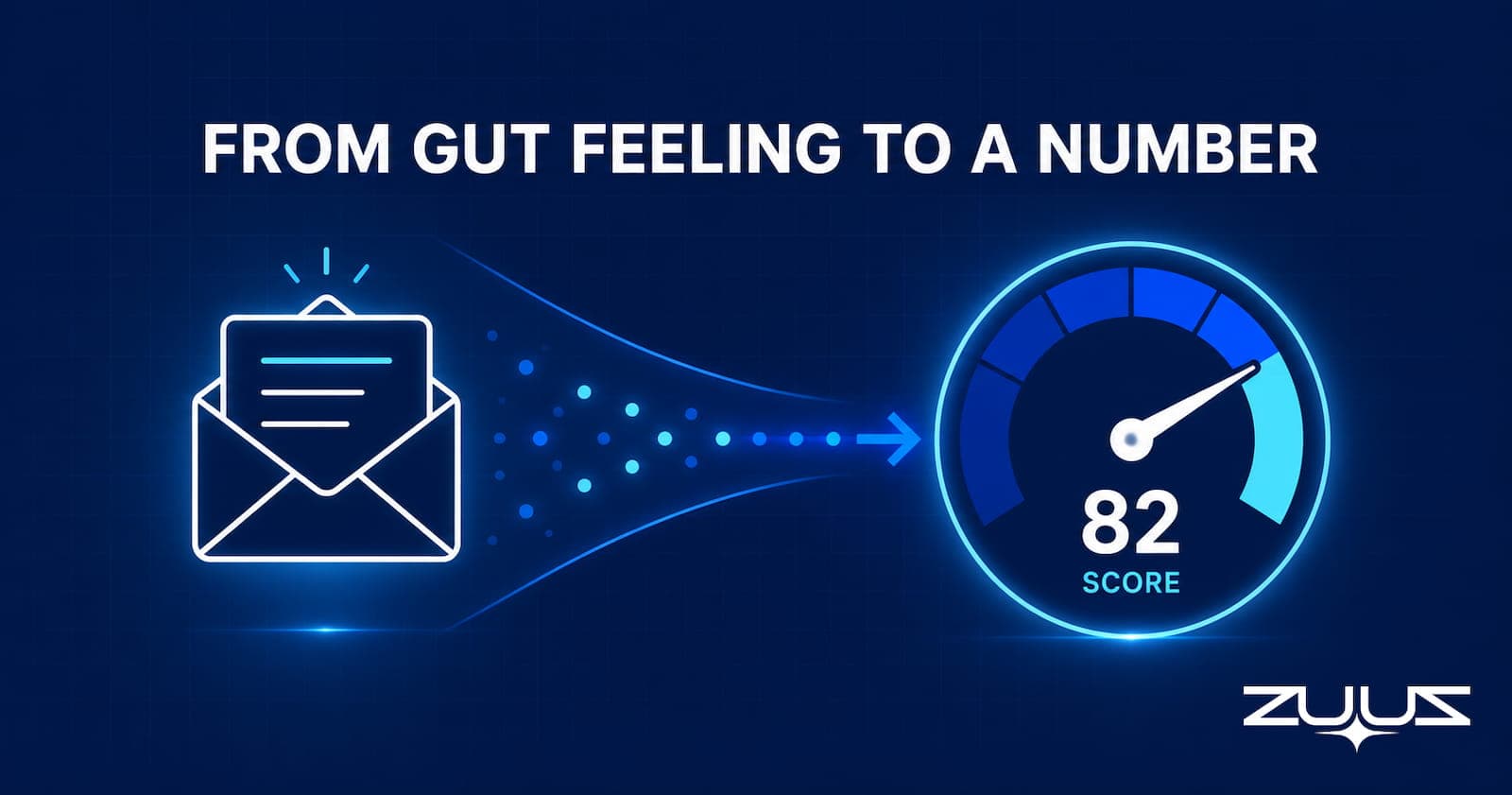
- ICP scoring criteria measure how closely a prospect matches the accounts a company actually wins, converting fit into a number instead of a rep’s gut feeling.
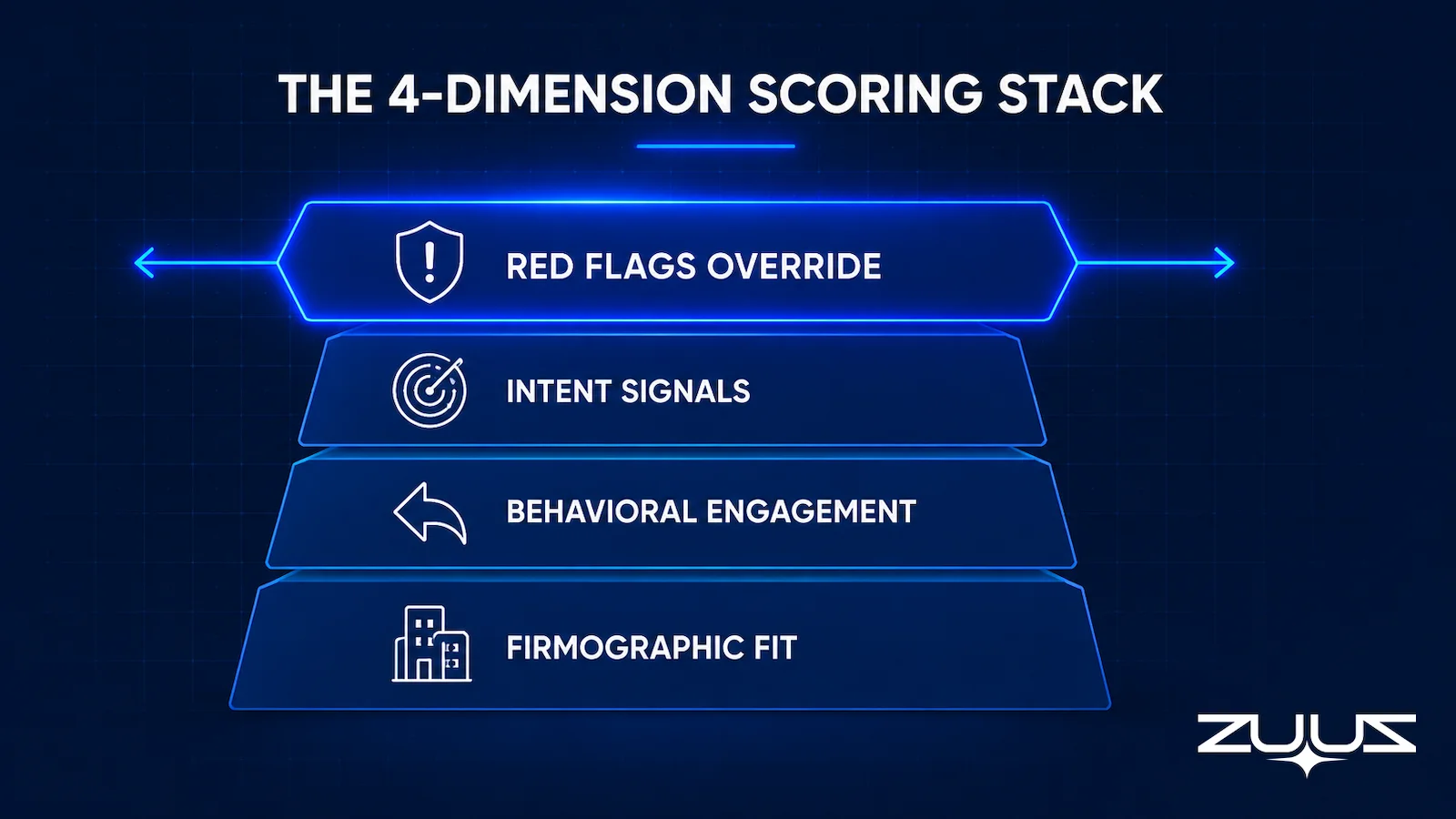
- A workable B2B ICP scoring model has four dimensions: firmographic fit, behavioral engagement, intent signals, and red flags that override a high score.
- Firmographic fit is static and cheap to score. Behavioral and intent signals are where most scoring models fail, because the data lives in email and calls, not the CRM.
- A spreadsheet-based rubric works for a first pass, but it goes stale the moment a prospect’s behavior changes between review cycles.
- ZUUZ reads inbound and outbound email, scores each contact against a team’s ICP criteria automatically, and updates the score as new signals arrive, with no manual re-scoring cycle.
- The mechanism underneath the score: ZUUZ is a revenue intelligence layer on top of the CRM a team already runs. It connects to the sales inbox, reads LinkedIn messages and meeting or call transcripts, and writes leads, stakeholders, next steps and renewal signals into the CRM automatically, with full change history and one-click rollback.
A lead comes in, and the rep has ten seconds to decide whether it is worth a reply today or a follow-up next week. Most teams answer that question on instinct, and instinct is inconsistent across a team of ten reps. ICP scoring criteria exist to replace that guess with a number every rep reads the same way.
The idea is simple. The execution is where most teams struggle, because a real scoring model needs data that rarely lives in one place: firmographic facts, behavioral signals, and intent that shows up in email long before it shows up in the CRM.
This guide breaks down the four dimensions a working ICP scoring model actually needs, walks through building a rubric from scratch, and covers where manual scoring quietly falls apart once a team scales past a handful of reps. Teams whose leads arrive through an AI receptionist or phone-first channel are usually applying similar fit criteria at the intake stage, covered in the guide to the best lead qualification software for AI receptionists.
What ICP Scoring Criteria Actually Measure
ICP scoring criteria are the specific, weighted factors a team uses to score how closely a prospect or account matches its ideal customer profile. The output is a number, often 0 to 100, that tells a rep how much attention a lead deserves before they read a single email thread. Teams that want a lighter-weight version of this same fit-plus-behavior logic, without building a full rubric, are usually looking at lead scoring software instead.
The criteria matter more than the score itself. A score without transparent criteria is a black box reps stop trusting the first time it ranks a bad-fit account above a good one. Criteria that map to real, verifiable facts about a prospect keep the score defensible when a manager asks why a lead ranked where it did.
Most B2B teams already have an informal version of this. A rep learns which industries close, which company sizes ghost after a demo, and which titles actually hold budget. ICP scoring criteria formalize that tribal knowledge into a rubric the whole team can apply the same way, including reps who joined last month.
The Four Dimensions of a B2B ICP Scoring Model
A scoring model built on one dimension alone produces a score that looks precise and misleads anyway. Four dimensions, weighted and combined, produce a number worth trusting.
The four dimensions form a simple scoring stack. Firmographic fit determines eligibility, behavioral engagement and intent signals determine urgency, and red flags override everything beneath them regardless of how high the rest of the score climbs.
Firmographic Fit
Firmographic fit covers the static facts about a company: industry, employee count, revenue band, and geography. These attributes answer whether a prospect could even become a customer, regardless of how they are behaving today. Firmographic fit is the cheapest dimension to score, since most of it comes from enrichment data rather than observed behavior.
Weighting firmographic fit too heavily is the most common early mistake. A company can match every firmographic box and still never buy, because fit alone says nothing about timing or interest.
Behavioral Engagement
Behavioral engagement measures what a prospect actually does: opening emails, replying, attending a demo, forwarding a thread to a colleague. This is where most scoring models weaken, because the richest behavioral signals live in email threads and call notes, not in CRM fields a rep has to remember to update.
A prospect who replies within an hour and loops in a second stakeholder is behaving differently than one who opens an email and goes quiet. Both can carry the same firmographic score. Only behavioral data tells them apart, which is why CRM platforms like HubSpot’s own lead-scoring tool score fit and engagement as two separate, combinable dimensions rather than one blended number.
Intent Signals
Intent signals capture what a prospect is trying to accomplish, often visible in the specific language they use: a pricing question, a request for a security questionnaire, a mention of an internal deadline. Intent signals tend to arrive later in a deal but carry more predictive weight than fit or generic engagement, since they describe a prospect actively moving toward a decision.
The guide to fixing missed sales leads in email covers how often these exact signals get buried in a thread nobody re-reads after the first reply.
Red Flags and Disqualifiers
Red flags are conditions that override an otherwise strong score: a competitor mentioned as the incumbent with a long contract remaining, a stated budget far below the product’s floor, or a stakeholder who explicitly says the timeline is next year. A scoring model without a red-flag layer keeps ranking dead deals near the top of the list.
Red flags do not need to be numerous to matter. A single disqualifying fact, caught early, saves more rep time than a dozen additional points of firmographic precision.
Building an ICP Scoring Rubric Step by Step
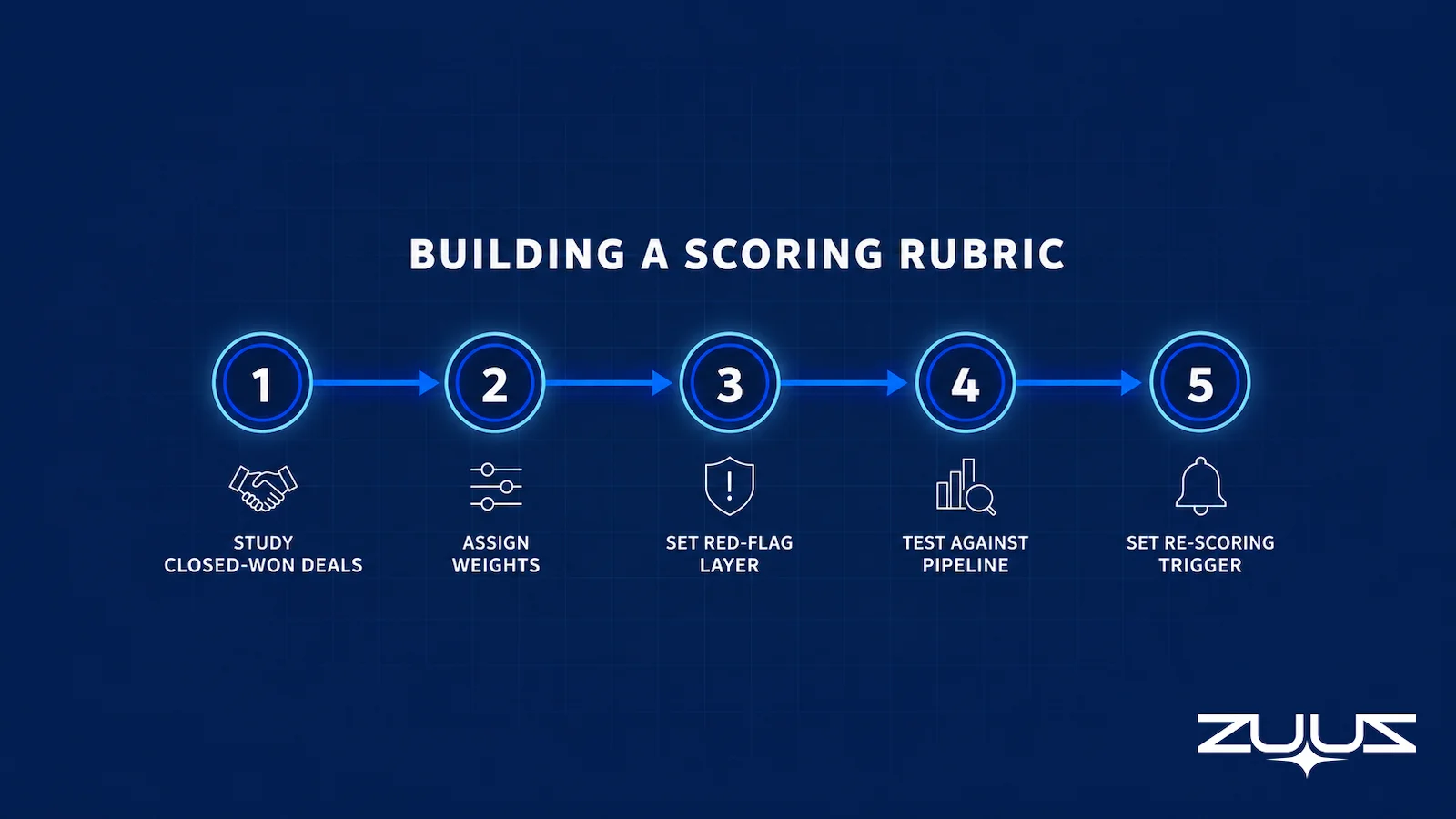
A usable rubric starts smaller than most teams expect. Four steps get a first version into reps’ hands without waiting on a perfect model.
Step 1: Study the Last Twenty Closed-Won Deals
Pull the firmographics, the engagement pattern, and the intent signals that showed up before each of the last twenty closed-won deals. Patterns emerge fast: a company size band that converts, a title that consistently holds budget, a specific question that shows up right before a deal moves to proposal.
Step 2: Assign Weights, Not Just Categories
List the criteria found in Step 1, then assign each a weight based on how strongly it separated closed-won deals from closed-lost ones. Firmographic fit is usually 20 to 30 percent of the total. Behavioral and intent signals typically carry more weight than teams expect on the first draft.
| Dimension | Typical Weight | Example Signal |
|---|---|---|
| Firmographic fit | 20-30% | Industry, employee count, revenue band match the closed-won profile |
| Behavioral engagement | 25-35% | Reply within one business day, second stakeholder joins the thread |
| Intent signals | 25-35% | Pricing question, security questionnaire request, stated internal deadline |
| Red flags | Override, not weighted | Named competitor with 12+ months remaining on contract |
These weights are a starting point, not a fixed rule. A team that closes mostly on referral, where firmographic fit is nearly guaranteed before a lead ever arrives, should weight behavioral and intent signals even higher than the ranges above.
Step 3: Set a Red-Flag Layer That Overrides the Score
Define two or three disqualifying facts specific to the business, not generic ones borrowed from a template. A red flag should be something a rep can confirm from a single email or call note, not something requiring judgment.
Step 4: Test the Rubric Against Deals in Flight
Score the current open pipeline against the new rubric before rolling it out team-wide. Deals the team already believes are strong should score high. If they do not, the weights need adjusting before reps start trusting the number.
Step 5: Set a Re-Scoring Trigger, Not a Review Calendar
A rubric scored once at intake goes stale the moment a prospect’s behavior changes. Define which events force an immediate re-score, a reply, a new stakeholder on the thread, a pricing question, rather than relying on a weekly or monthly review cycle. A trigger-based rubric catches a lead moving from cold to hot the same day it happens, not at the next scheduled review.
Where Manual ICP Scoring Breaks Down
A spreadsheet rubric works for the first review cycle. It breaks down the moment a prospect’s behavior changes between cycles, because nobody re-scores a lead the day a new signal arrives. The score reps see in the CRM reflects last week’s inbox, not today’s.
The gap is not the rubric. It is the update mechanism, since firmographic data barely changes and stays accurate in a spreadsheet for months.
Behavioral and intent signals change daily, and a manual process cannot keep pace without turning scoring into a full-time job nobody has budget for.
Signs an ICP Scoring Model Needs a Rebuild
- Reps routinely override the score. When the team trusts its own judgment over the number more often than not, the weights no longer match how deals actually close.
- The top-ranked leads are not the ones converting. A rubric that has not been re-tested against recent closed-won deals drifts from the market it was built on.
- Nobody can explain why a lead scored the way it did. A rubric that has grown too many ad hoc adjustments stops being defensible in a pipeline review.
- Scoring updates lag real behavior by days. If a lead that replied this morning still shows yesterday’s score, the rubric is accurate in principle and wrong in practice.
The guide to CRM data quality covers the same underlying problem from a different angle: data that is accurate once and stale a week later costs a team more than data that was never captured at all.
Score Every Lead. Without Re-Scoring Anything.
Connect Salesforce, HubSpot, Zoho, Attio, or Pipedrive and let ZUUZ score every inbound contact against your ICP criteria from the email signal alone. Start free, with no integration project required.
ICP Scoring: How ZUUZ Scores Every Inbound Lead Automatically
ZUUZ connects to the sales inbox, reads the thread in both directions, and scores each contact against a team’s ICP criteria without a rep touching a spreadsheet. Firmographic fit, behavioral signals like reply speed and stakeholder count, and intent language pulled directly from the thread all feed the same score, recalculated as new email arrives rather than on a weekly review cycle.
Red flags work the same way. A mention of a competitor’s name, a stated budget, or a timeline pushed to next year gets flagged the moment it appears in a thread, not discovered three weeks later when a rep finally reads back through the conversation.
What Customers Say

RA Technologies, an IT services firm in the United States, connected its shared inbox to ZUUZ and ran a 90-day historical lookback. The system scored and surfaced $120,000 in pipeline from prior email threads that had never been logged in the CRM, without anyone building a scoring rubric by hand.
What Customers Say
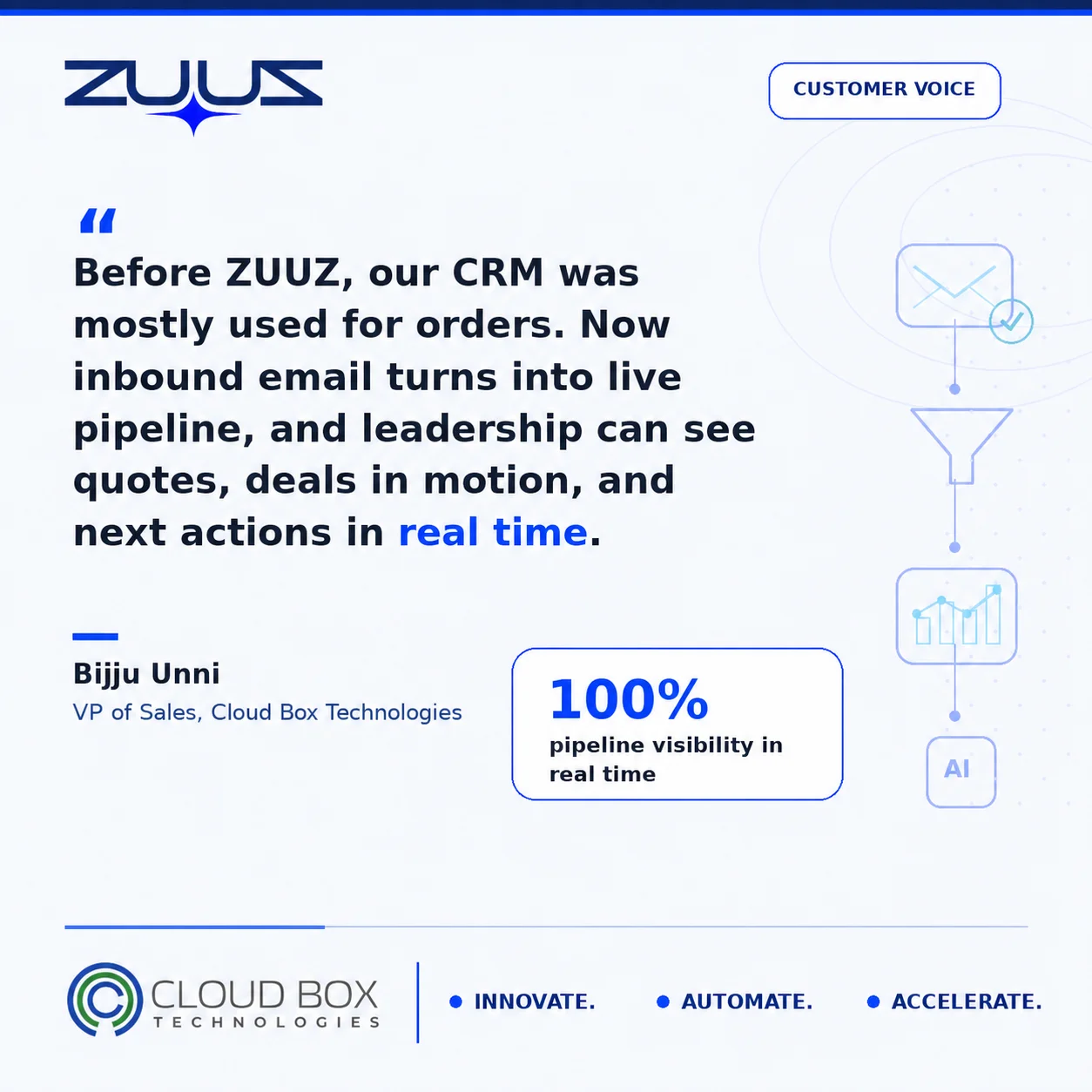
Cloud Box Technologies, an IT services and cloud firm in the UAE, saw the same signal-surfacing mechanism applied to a different problem: renewals. Its CRM held processed orders only, with no automatic visibility into which accounts were approaching renewal or already at risk. Connecting ZUUZ surfaced that signal on its own, the same underlying mechanism that scores an inbound lead against ICP criteria without a rep building the rubric by hand.
The Capture Layer Test
Scoring sits downstream of capture, so a rubric can only weigh the signals the system actually holds. Before choosing anything that promises automatic ICP scoring, run the Capture Layer Test on it:
- Does it capture from the channels where the deal actually moves: email, calendar, LinkedIn messages, meeting and call transcripts?
- Does what it captures land in CRM fields a report can read, or only in an activity feed a human must open?
- Does the rep have to remember anything, such as a BCC, a button, a sidebar or a sync?
- Can the rep correct or roll it back in one click?
A tool that fails 2 or 3 produces activity history, not a pipeline you can run a review on. Applied to ICP scoring the consequence is specific. A tool that fails question 1 can only ever score firmographics, because reply speed, a new name joining the thread and a stated timeline never enter the system at all. A tool that fails question 2 may well detect those signals and still leave them somewhere no scoring rule can read them, which looks like a scoring problem and is really a capture problem.
How to Choose an ICP Scoring Approach
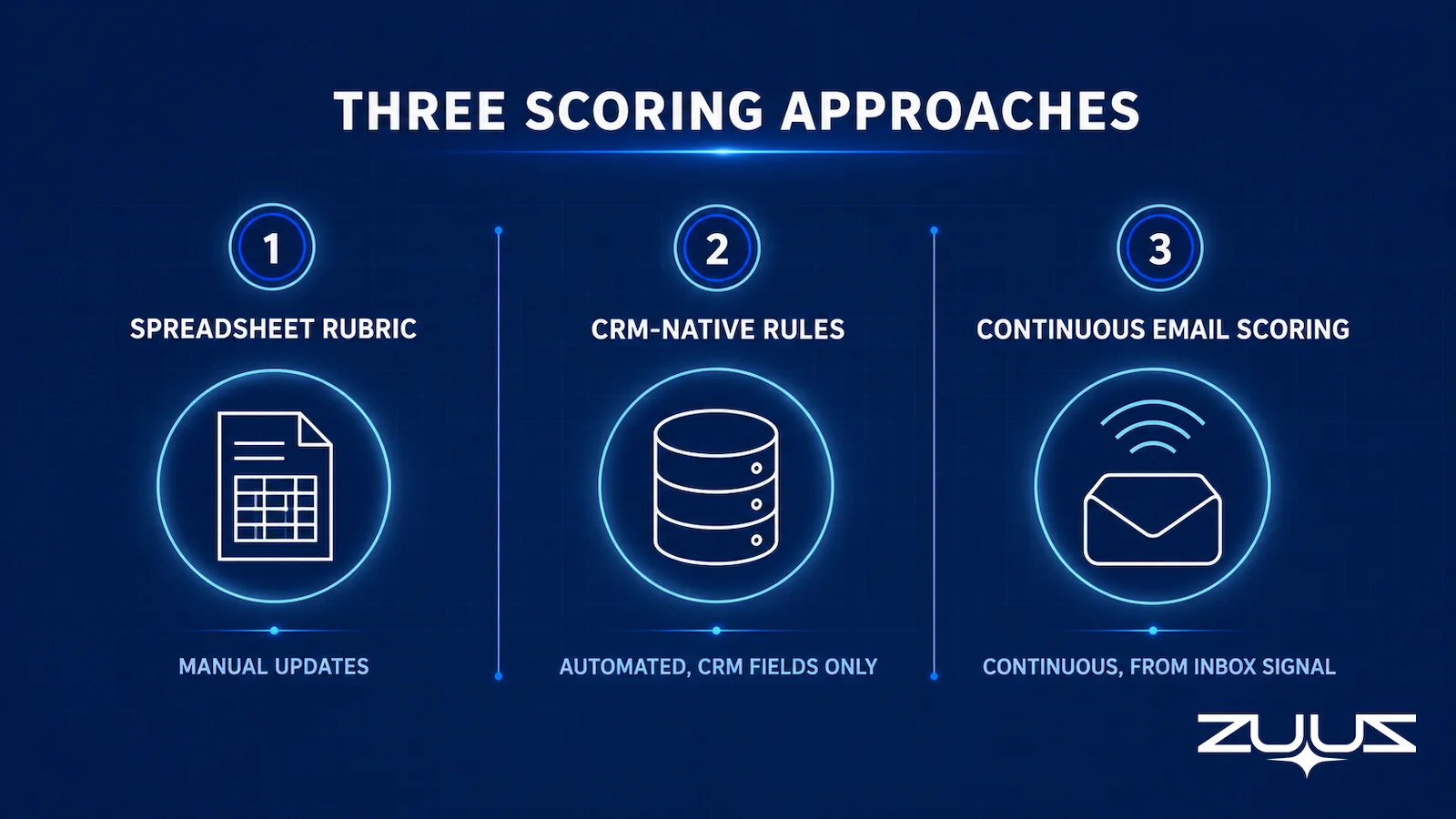
Three approaches cover most teams. The right one depends on how often behavior actually changes between review cycles, and how much rep time is worth spending on keeping scores current.
| Approach | Update Frequency | Setup Effort | Best-Fit Team |
|---|---|---|---|
| Spreadsheet rubric | Manual, per review cycle | Low | Small teams testing a first ICP model |
| CRM-native scoring rules | Automated on CRM fields only | Medium | Teams whose signals already live inside the CRM |
| ZUUZ | Continuous, from email signal | Low, no rubric-building required | Teams whose behavioral and intent signals live in the inbox |
The guide to email lead qualification automation covers the qualification step that follows scoring, once a lead clears the ICP threshold.
From an Operator’s Seat
Across the deployments ZUUZ runs, the pattern is that teams arrive convinced their weights are wrong when the real problem is that two of their four dimensions have no data behind them. Behavioral and intent criteria get written into the rubric first and populated last, so for months the score is firmographics wearing a four-dimension label. The part teams do not plan for is the disqualifier side: red flags are the highest-value criteria in the model and the least likely to be logged, because a rep who hears “we just renewed with someone else” treats it as a reason to stop working the deal, not as a field to fill in. Order of operations that works is to wire capture for one dimension at a time and only then re-tune the weights, because re-tuning against missing data moves the number without improving the decision.
ZUUZ is a revenue intelligence layer on top of the CRM a team already runs; it is never a CRM and never replaces one. Most scoring tools in this category rank what the rep entered, while ZUUZ writes the record the score is calculated from, reading the sales inbox, LinkedIn messages and meeting or call transcripts and putting stakeholders, intent language and red flags into fields the scoring rule can see.
Frequently Asked Questions
What Is ICP Scoring in B2B Sales?
ICP scoring is the process of assigning a numeric score to a prospect or account based on how closely it matches a company’s ideal customer profile. The score typically combines firmographic fit, behavioral engagement, and intent signals into one number reps can use to prioritize follow-up. A good model also includes red flags that override a high score when a disqualifying fact appears.
What Criteria Should Be Included in an ICP Scoring Model?
A working model includes firmographic fit (industry, size, geography), behavioral engagement (replies, opens, meeting attendance), intent signals (specific language indicating active buying), and red flags (competitor lock-in, budget mismatch, distant timeline). Firmographic fit alone is not enough, since it says nothing about timing or genuine interest. Behavioral and intent data are what separate a real opportunity from a company that merely fits on paper.
How Do You Weight ICP Scoring Criteria?
Start by studying twenty recent closed-won deals and noting which criteria consistently appeared before each one closed. Firmographic fit usually accounts for 20 to 30 percent of the total score, with behavioral and intent signals carrying the remainder. Weights should be tested against deals currently in the pipeline before rolling the rubric out, adjusting anything that scores a known-strong deal too low.
Why Does Manual ICP Scoring Stop Working as a Team Scales?
A spreadsheet rubric stays accurate for firmographic data, which rarely changes, but goes stale immediately for behavioral and intent signals, which change daily. Nobody has time to manually re-score every open lead each time new email activity comes in. The score a rep sees in the CRM often reflects last week’s inbox rather than today’s, which is the exact gap automated scoring closes.
What Are Red Flags in ICP Scoring, and Why Do They Matter?
Red flags are specific, verifiable facts that override an otherwise strong score, such as a long remaining contract with a competitor, a stated budget below the product’s floor, or a timeline pushed out a year. Without a red-flag layer, a scoring model keeps ranking dead deals near the top of a rep’s list. A single disqualifying fact caught early saves more time than additional precision on the fit score.
Does ZUUZ Replace a Team’s Existing ICP Definition?
ZUUZ scores contacts against whatever ICP criteria a team already defines rather than replacing that definition with its own model. A sales or RevOps leader sets the firmographic, behavioral, and intent weights that matter for their business, and ZUUZ applies them continuously to every inbound and outbound email. The score updates as new signals arrive instead of waiting for the next manual review cycle.
How Is ICP Scoring Different From Lead Scoring?
Lead scoring is often used as a broader term covering any prioritization method, including simple form-fill or page-visit points. ICP scoring specifically measures fit against a defined ideal customer profile, combining firmographic, behavioral, and intent data into one account-level or contact-level number. In practice, a strong lead-scoring program is built on top of clear ICP scoring criteria rather than replacing them.
How Often Should an ICP Scoring Rubric Be Reviewed?
Most teams review the underlying criteria and weights quarterly, checking whether the accounts scoring highest still match the deals actually closing. The score itself, once the rubric is set, should update continuously rather than on a fixed schedule, since behavioral and intent signals arrive daily. A rubric review is about the model; a score update is about the data feeding it.
ICP scoring criteria turn a rep’s gut feeling into a number the whole team reads the same way, but only if the score updates as fast as the signals that feed it. Firmographic fit alone will always miss the deals that matter, since fit says nothing about timing or intent. Teams that combine fit with behavioral and intent data, refreshed continuously rather than on a review cycle, are the ones whose reps trust the score enough to act on it the moment a lead arrives.
A Concrete First Step
A rubric can be tested before it is rebuilt. Connect one mailbox, let ZUUZ read the last 90 days, and see what it writes to the CRM, with full change history and one-click rollback, then compare the contacts it flags as high fit against the deals that actually closed. It is a 30-day free trial, no credit card: https://zuuz.ai/trial/