
Email Lead Qualification Automation for B2B Teams
Email lead qualification automation reads inbound B2B threads, scores by intent and deal size, and writes structured records to Salesforce, HubSpot, or Zoho.
- Most B2B deal signals appear in the third or fourth email reply, not the first message. Single-email scoring misses them.
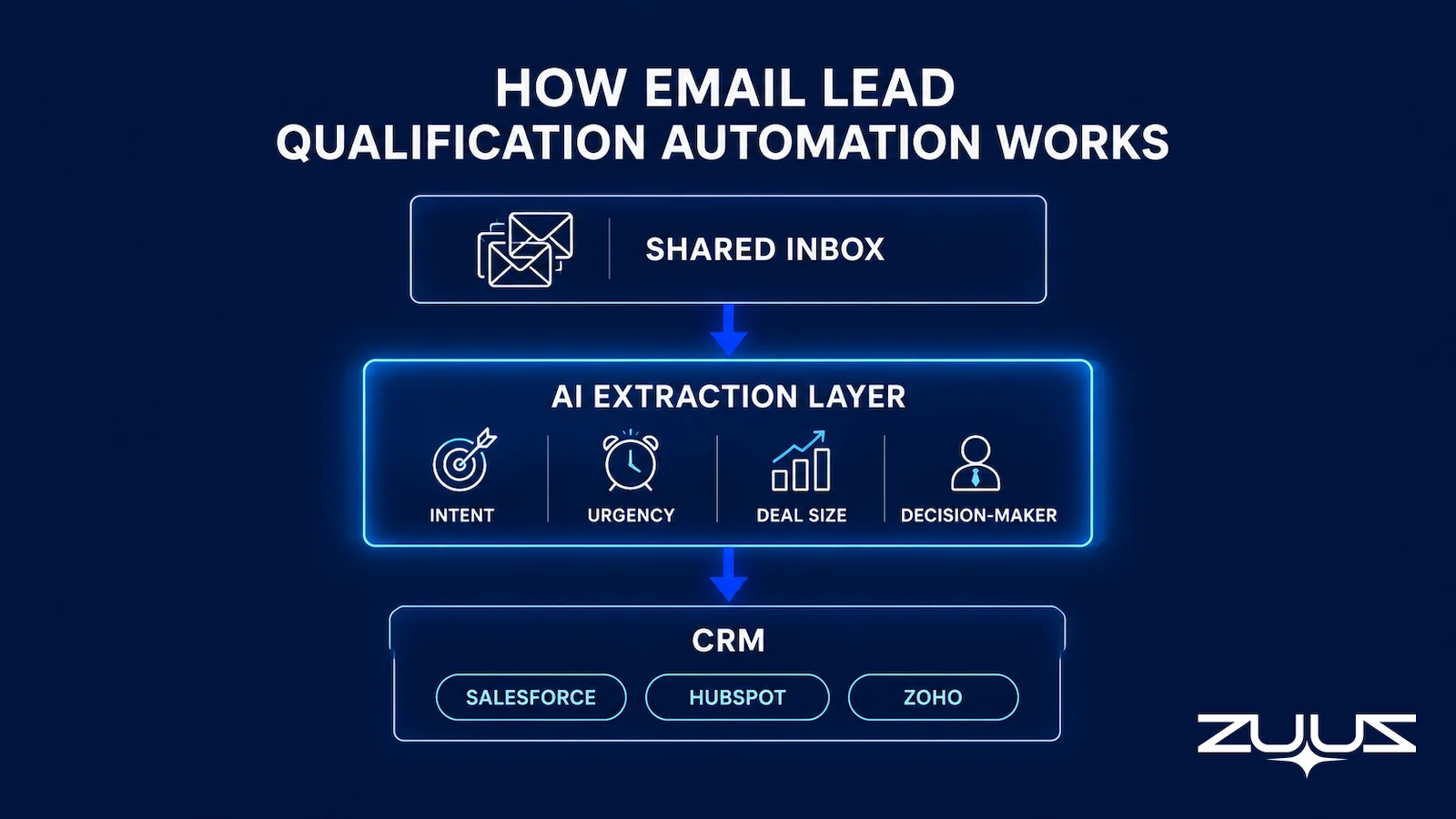
- Effective email lead qualification automation reads entire conversation threads, extracts structured fields (intent, urgency, deal size, decision-maker presence), and writes them to the CRM without rep input.
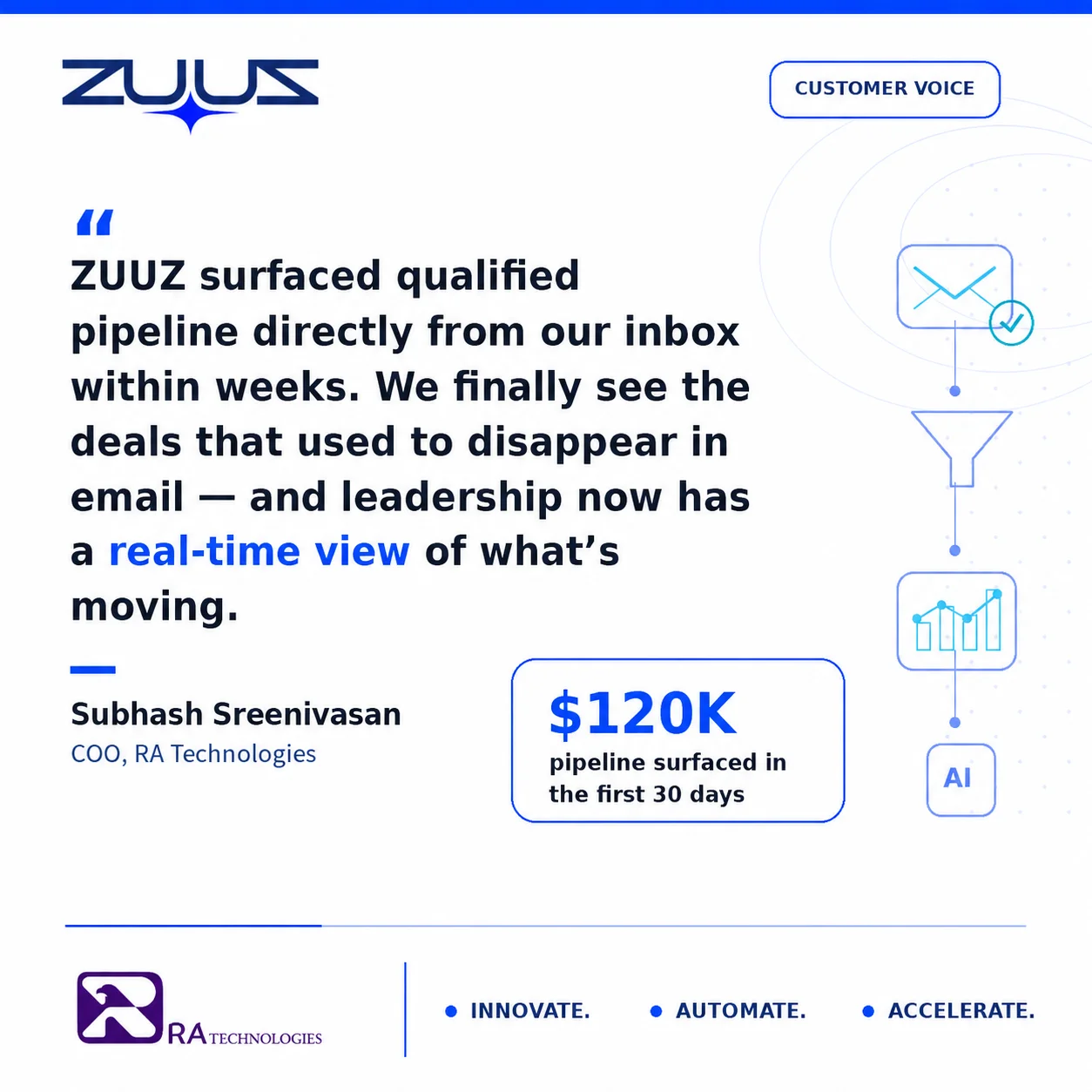
- RA Technologies surfaced $120K in pipeline from a 90-day email lookback using ZUUZ, surfacing qualified conversations that had never been logged in their CRM.
- Human approval gates are not optional in the first 30 days. Trust is earned per classification category, not granted to the system as a whole on day one.
- ZUUZ writes lead records to Salesforce, HubSpot, Zoho, Attio or Pipedrive, operating as a CRM-agnostic execution layer above whichever system the team already uses.
- When qualification is automated and accurate, the MQL vs. SQL debate disappears: every lead in the CRM has a source thread, extracted fields, and a confidence score as evidence.
- ZUUZ connects to your sales inbox, reads LinkedIn messages and meeting or call transcripts, and writes leads, stakeholders, next steps and renewal signals into Salesforce, HubSpot, Zoho, Attio or Pipedrive for the rep to approve in one click.
Manually qualifying every inbound email works fine when a team receives five a day. At 50 per rep, it starts breaking. At 200 across a shared mailbox, real revenue disappears into the inbox every week, unrecognized and unlogged. Teams evaluating this space by product category rather than by channel often start from a broader look at lead scoring software.
Email lead qualification automation is the operational answer, but doing it well is harder than most tools admit. The majority of “AI lead scoring” products treat each email as a standalone message and match it against keywords. Real B2B qualification happens across a conversation, where the signals that predict a closed deal only surface after a second or third exchange.
This article covers what email lead qualification automation actually does, which signals matter and which do not, how conversation-level scoring differs from single-email approaches, and how ZUUZ runs this process across Salesforce, HubSpot, Zoho, Attio or Pipedrive for enterprise sales teams in IT services, distribution, and manufacturing. Teams whose lead volume comes through a phone-first or AI receptionist channel instead of email are usually solving a related but different problem, covered in the guide to the best lead qualification software for AI receptionists.
What Email Lead Qualification Automation Does
Email lead qualification automation reads inbound email threads, extracts deal signals, scores conversations against qualification criteria, and writes structured lead records to a CRM without requiring a rep to manually review each message. The output is not a dashboard or a heatmap. It is a lead record with populated fields: intent, urgency, company fit, deal size signal, decision-maker presence, and source thread attached for full context.
The problem it solves is triage. Most B2B sales teams have a shared inbox receiving a mix of genuine pipeline, vendor solicitations, newsletter replies, and ambiguous inbound from real companies that may or may not convert. Sorting that mix manually is expensive, inconsistent, and the first thing that breaks when email volume grows past what the SDR team can cover.
Automation does not replace judgment. It applies a consistent qualification standard at scale, surfaces what deserves attention, and lets reps spend their time on conversations that arrive with context already attached.
See the Pipeline Your CRM Can’t See.
ZUUZ connects to the sales inbox, extracts the deal signal, and writes it to Salesforce, HubSpot, Zoho, Attio or Pipedrive. Book a 15-minute walkthrough on your own inbox.
The Scale Problem: Why Manual Qualification Breaks
A typical mid-market B2B sales team receives 100 to 500 inbound emails a week into a shared mailbox. A senior rep can triage one in 30 seconds from experience. A junior rep takes five minutes and gets it wrong roughly half the time. An SDR working at volume labels everything “MQL” and pushes it forward, polluting the pipeline downstream for account executives who then spend time on dead leads.
The cost of errors is asymmetric. A missed qualified lead means a lost deal. A falsely qualified lead costs 20 minutes of an AE’s time, plus the organizational friction it creates when the AE flags poor lead quality to the SDR manager. Most teams respond by over-qualifying: treating too many contacts as leads because the alternative, missing a real one, feels worse. The result is a queue full of noise and genuine opportunities receiving insufficient follow-up.
According to Salesforce’s State of Sales report (2024), sales representatives spend an average of 70% of their time on non-selling activities, with manual data entry and lead triage among the top contributors. Email lead qualification automation directly attacks that ratio by moving triage out of the rep’s inbox and into a structured review process.
Triage speed compounds the problem. Classic research from Harvard Business Review on the short life of online sales leads found that firms contacting a prospect within an hour are far more likely to qualify the lead than those who wait even a day. When triage sits in a shared inbox, that window closes before anyone scores the thread.
Signals That Actually Predict Deals
The signals that predict whether an email conversation becomes a deal are different from what most scoring tools track. Domain authority and job title matter less than most teams assume. The signals that correlate with closed revenue are behavioral and contextual:
- Specificity of the ask. “Can you send pricing for 50 seats on the enterprise tier” is a fundamentally different signal than “What does your product do.” Specificity implies prior research and a real evaluation in progress.
- Stated context. “We are evaluating three vendors and need a decision by end of month” provides urgency and competitive framing in a single sentence. A rep who sees that gets to work. A scoring tool that only reads the subject line misses it.
- Procurement or technical detail. References to integrations, SSO requirements, SOC 2 compliance, or contract terms come from buyers who have purchased enterprise software before and know what to ask for.
- Existing relationship. Is this domain already in the CRM? Is the contact linked to an open opportunity? A warm inbound from an existing account is categorically different from a cold inquiry and should be routed differently.
- Thread context. The first email is often vague by design. The third reply typically contains budget range, timeline, and decision criteria. Scoring only the first message means scoring the least informative point in the conversation.
- Negative signals. Mass-CC patterns, free email domains on B2B inquiries, generic language copied across multiple vendors, and competitor mentions suggesting the prospect is already deep in a competing evaluation all indicate low conversion probability.
Single-email scoring catches some of these signals. Conversation-level scoring catches all of them, because the most predictive signals only appear after an exchange or two.
Conversation Scoring vs. Single-Email Scoring
The distinction between single-email and conversation-level scoring is the most important architectural decision in any email lead qualification automation system. It determines accuracy, false positive rate, and whether the CRM data the system produces is actually trustworthy.
| Dimension | Single-Email Scoring | Conversation-Level Scoring |
|---|---|---|
| Signal source | One inbound message | Entire thread across multiple exchanges |
| Intent detection | Keyword matching on subject and body | Intent extracted from stated context, questions, and procurement signals across replies |
| Budget signals | Rarely present in first email | Typically surfaces in reply 2 or 3 |
| Decision-maker detection | Title lookup only | Detected from CC patterns, authority signals in language, and procurement involvement |
| False positive rate | High (vague first emails misclassify often) | Lower (score updates as context accumulates) |
| CRM output | Point-in-time score | Structured record with field-level evidence and source thread attached |
| Rep transparency | Black-box score | Field-by-field rationale visible in CRM |
| Retrospective capability | Typically none (scores live messages only) | Can run on historical thread archive to surface missed pipeline |
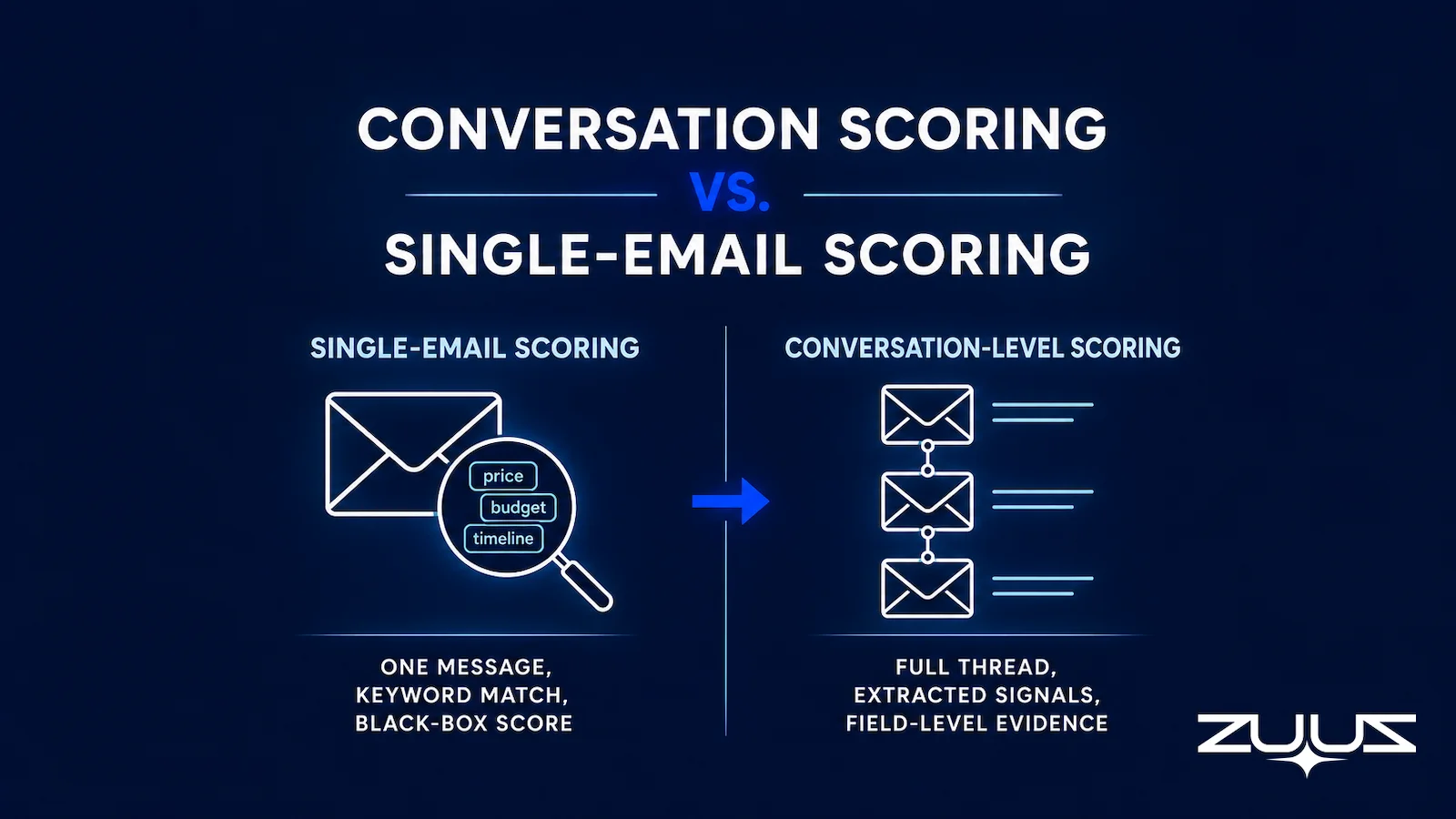
The practical consequence: a system that scores only the first email misclassifies a large share of genuinely qualified inbounds as unclear or low-priority, because the prospect has not yet disclosed enough. Conversation-level scoring holds classification open until sufficient evidence accumulates, then commits with field-level evidence.
How ZUUZ Runs Email Lead Qualification Automation
ZUUZ reads the entire thread, not just the latest message. The first inbound from a new domain may score as “unclear” when context is thin. By the second exchange, the prospect has usually disclosed company size, use case, and timing. By the third, procurement is on the CC line or the conversation is stalling.
As the thread evolves, ZUUZ extracts and updates a set of fields: source, intent, urgency, deal size signal, decision-maker presence, competitive context, and any specific asks around integrations, security, or pricing. Each field updates with new messages. The lead score is not a one-shot decision. It is a running interpretation that sharpens with every reply.
The output is a structured lead record in Salesforce, HubSpot, or Zoho with all extracted fields populated, the source email thread attached, and a confidence level on each classification. The rep can read exactly why the system scored a conversation as qualified. There are no black-box scores.
RA Technologies, a US-based IT services firm, ran ZUUZ on a 90-day email lookback across their shared sales inbox. The process surfaced $120K in pipeline that had never been logged in their CRM. Those were real buyer conversations buried in email volume, never triaged, never followed up. For teams dealing with this pattern, the operational mechanics of email-to-CRM automation for IT companies covers how the data sync works in practice.
BANT, MEDDIC, and What Actually Works in Inbound Email
BANT (Budget, Authority, Need, Timeline) and MEDDIC (Metrics, Economic Buyer, Decision Criteria, Decision Process, Identify Pain, Champion) are the two most widely used B2B lead qualification frameworks. Both were designed for live discovery calls, not for asynchronous email conversations. That creates a translation problem for any automated system.
In a discovery call, a rep asks directly about budget and timeline. In an email thread, those signals have to be inferred from what the prospect volunteers. The table below maps how each BANT criterion typically surfaces in email versus a live conversation, and how ZUUZ extracts each signal.
| BANT Criterion | How It Appears in Email | ZUUZ Extraction Method |
|---|---|---|
| Budget | Pricing tier requests, seat count mentions, procurement CC, “within our Q3 budget” | Deal size signal field, pricing language detection, procurement involvement flag |
| Authority | Sender title, CC patterns, “I need to check with my manager”, VP or C-suite copied on reply | Decision-maker presence field, CC hierarchy analysis |
| Need | Specificity of the ask, stated use case, problem description, integration requirements | Intent field, urgency field, stated context extraction, technical detail flags |
| Timeline | “Decision by end of month”, “evaluating vendors now”, contract renewal dates mentioned | Urgency field, competitive context, stated timeline extraction |
MEDDIC adds decision process and champion detection, which are harder to extract from email alone. ZUUZ applies a BANT-proximate model to email because Budget, Authority, Need, and Timeline signals are reliably present in conversations where a genuine deal is forming. When MEDDIC-level detail appears (a champion forwarding the thread internally, decision criteria shared explicitly), those signals update the record accordingly.
For teams using Salesforce with existing lead scoring logic, ZUUZ fields sync into the same opportunity and contact records. The system extends existing qualification infrastructure rather than replacing it. Teams using HubSpot or Zoho follow the same pattern, with field mapping configured to match the CRM’s existing lead object structure. For context on how HubSpot handles this technically, the HubSpot email lead capture automation guide covers the integration mechanics.
Stop Losing Pipeline in the Inbox.
Connect your CRM in minutes and let ZUUZ capture the signals your team never logs. Start free, with no integration project required.
A framework decides what qualifies. It says nothing about how much autonomy the system gets while applying it, and that second decision derails more rollouts than the first one does.
Human Approval Gates
No AI system should write to a production CRM unsupervised on day one. That is how a team spends 90 days cleaning up junk records and loses the trust of the sales org permanently.
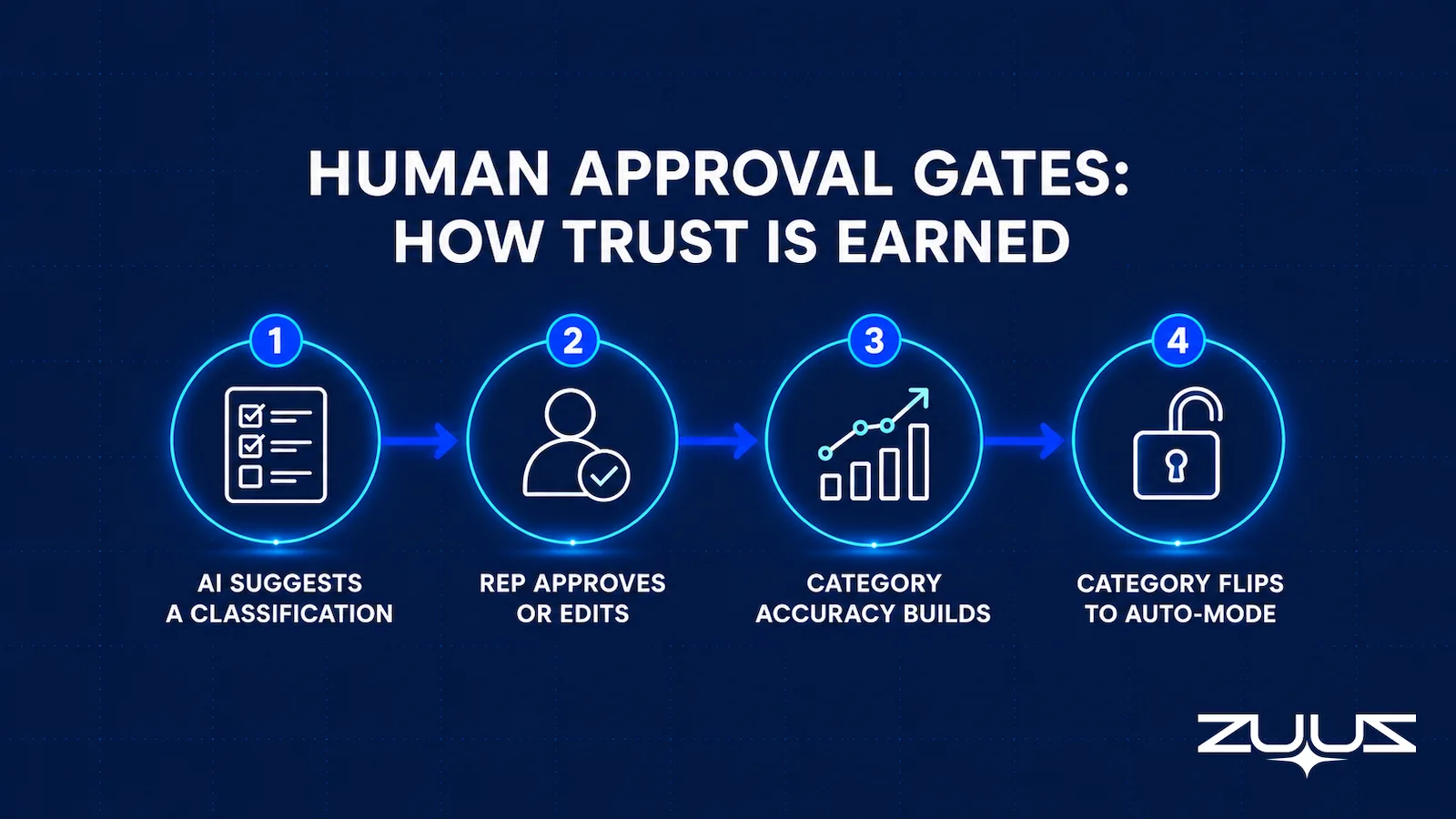
The pattern that works: ZUUZ runs in approval mode for the first two to four weeks. Every classification surfaces in a review queue. The rep approves, edits, or rejects each one. The system learns from every correction. After a few weeks, the team has a clear picture of which classification categories are reliable. Intent and urgency typically stabilize first, then deal size signal, then competitive context.
Once a category reaches high accuracy on the team’s actual data, that category flips to auto-mode independently. Renewal mentions auto-write. Procurement-on-CC auto-flags. Anything still in the long tail continues through the approval queue. The rep controls where the line sits for each category individually, not as a single global switch.
This is the piece most “AI for sales” tools skip, and it is the primary reason most automation pilots fail to make it past the pilot stage. Trust is earned per classification category, not granted to the system as a whole. Teams that try to skip the approval period typically revert to manual triage after the first bad record reaches an AE.
For teams dealing with existing pipeline data quality problems before adding automation, the analysis of why CRM pipelines become inaccurate is worth reading first. Automation on top of a broken qualification process amplifies the existing problems rather than fixing them.
What Qualified Pipeline Looks Like
When email lead qualification automation runs accurately, three visible changes occur inside the sales org. First, reps stop triaging and start selling. Qualified leads arrive in their queue with full context attached; unqualified contacts do not arrive at all. Most teams see reps recovering two to four hours per week that previously went to manual inbox review. Qualification is one stage inside the larger inbound lead management process, which still has to route the lead to the right owner and sync the result back to the CRM before a rep ever sees it.
Second, the pipeline becomes honest. Every qualified lead in the CRM has a source thread that any manager can read. “Qualified” stops being a political label applied by whoever entered the record and becomes an evidence-based classification tied to extracted signals from the prospect’s own words. Pipeline reviews become faster because the data has a traceable origin.
Third, the MQL vs. SQL argument between marketing and sales disappears. The debate over definitions becomes unnecessary when every lead has structured fields extracted from the actual conversation. There is no definition meeting required. The criteria are set once and applied consistently to every inbound thread.
Avinash Gujje built Cloud Box Technologies from $0 to $25M ARR in IT services and distribution. The single highest-impact operational change in that journey was establishing a consistent standard for which inbound conversations deserved real sales attention. Done manually, it was inconsistent and expensive. Automated at conversation level, it becomes a repeatable filter that improves as the team’s own data grows.
For teams managing pipeline across multiple products or renewal cycles, the problem of missed leads in email connects directly to broader pipeline visibility gaps. The analysis of missed sales leads in email documents the structural patterns that cause deals to disappear before they are ever logged.
The Record-Ready Test: Is a Qualified Lead Actually Usable?
A lead can be scored, classified and sitting in the CRM and still be unusable by anyone except the rep who read the thread. The Record-Ready Test separates the two. Its purpose is to decide whether a record could be handed to someone else today without a conversation.
- Choose an account the owning rep has not touched in two weeks.
- Ask a colleague to say who the buying group is, what was last agreed and what happens next, using the CRM alone.
- Every answer that needs the rep, the inbox or a call is a record-ready failure.
- A record that passes survives a handoff, a territory change and a departure. One that fails is a person, not a system.
Run it on a lead that the qualification layer marked as sales-ready. The score will be there. The question is whether the three facts that made it sales-ready are there too: the person who named a timeline, the objection raised on the fourth reply, and the commitment someone made in writing. If a colleague has to open the thread to find any of those, the automation produced a label, not a record. That is the difference between scoring email and qualifying from it.
From an operator’s seat
Across the deployments ZUUZ runs, the pattern is that the first week of rejected suggestions clusters in one place rather than spreading evenly across categories. Teams expect a qualification layer to be wrong at random. In practice almost all of the early corrections land on threads that arrived through a distribution list or a support alias, where the person writing is not the person buying. The part teams do not plan for is cleaning up those aliases, which is a mailbox routing job rather than a tuning job, and it is usually finished before anyone touches a scoring rule. Approve category by category rather than all at once and that distinction shows up in days instead of weeks.
Where ZUUZ sits
ZUUZ is an AI layer on top of the CRM a team already runs: it is never a CRM and never replaces one. Most tools in this category score what the rep already entered, so an unlogged conversation scores nothing; ZUUZ writes the record from the conversation first, then hands the rep one click to approve or correct it.
The first step, concretely
Connect one mailbox. ZUUZ reads the last 90 days of that inbox, and the rep reviews everything it found before a single field is written to the CRM. That review is the whole evaluation: if the 90-day lookback surfaces deals, stakeholders and next steps the CRM never recorded, the capture gap is real. The trial runs 30 days free with no credit card: https://zuuz.ai/trial/
Frequently Asked Questions
What Is Email Lead Qualification Automation?
Email lead qualification automation uses AI to read inbound email threads, extract deal signals such as intent, urgency, decision-maker presence, and budget context, and score each conversation without manual rep review. The output is a structured lead record written directly to the CRM with the source thread attached and a confidence score on each classification field. It is distinct from email marketing automation, which manages outbound sequences rather than evaluating inbound intent.
How Does Automated Email Lead Scoring Differ from Traditional Lead Scoring?
Traditional lead scoring assigns points based on form fills, page visits, or demographic data. Automated email lead scoring reads the actual conversation: what the prospect said, how specific the ask was, whether procurement language appeared, and how signals changed across multiple replies. Conversation-level scoring produces more accurate results because most B2B intent signals only appear in the third or fourth email exchange, after a prospect has disclosed company size, timeline, and technical requirements.
Which CRMs Does ZUUZ Support for Email Lead Qualification?
ZUUZ writes qualified lead records to Salesforce, HubSpot, Zoho, Attio or Pipedrive. It operates as a CRM-agnostic execution layer, so revenue teams are not locked into a single vendor’s native AI tools. Extracted fields, thread attachments, and confidence scores sync to whichever CRM the team already uses, without requiring migration or a parallel system. Field mapping is configured to match the existing lead object structure in each CRM.
What Signals Does ZUUZ Extract from Inbound Email Conversations?
ZUUZ extracts source, intent, urgency, deal size signal, decision-maker presence, competitive context, stated timeline, procurement detail such as SSO requirements or SOC 2 mentions, and negative signals such as free email domains or mass-CC patterns. Each field updates as the conversation evolves. The first inbound may generate only a partial record. By the third reply, most qualifying fields are populated with evidence from the prospect’s own words.
How Long Does It Take to Set Up Email Lead Qualification Automation?
Most teams run ZUUZ in approval mode for the first two to four weeks. Every classification surfaces in a review queue where reps approve, edit, or reject. The system learns from each correction and builds accuracy on the team’s own data rather than generic training sets. Full automation on high-confidence categories typically stabilizes within 30 days. A retrospective lookback on existing email history can run before any live automation begins, which is often how teams first see the financial case for the system.
What Is the Difference Between MQL and SQL in an Automated Qualification System?
In a manual system, the MQL vs. SQL distinction is often a political definition that marketing and sales negotiate in quarterly reviews. In an automated email qualification system, the distinction becomes evidence-based: an MQL is a contact that has shown topical interest, while an SQL has disclosed company size, use case, timing, and decision authority, all extracted directly from the email thread. The criteria are set once, applied consistently, and visible to both teams in the CRM record.
Can Email Lead Qualification Automation Surface Missed Deals from Older Email Threads?
Yes. ZUUZ can run a retrospective lookback on existing email history from any time window. RA Technologies, a US-based IT services firm, surfaced $120K in pipeline from a 90-day email lookback. Those were qualified conversations from real buyers that had never been logged in their CRM because they arrived in a shared inbox with no consistent triage process in place. Running the lookback before going live with new automation is standard practice for new ZUUZ deployments.
See What Your Inbox Is Actually Doing.
ZUUZ shows what is in your pipeline before any automation goes live, using your actual email threads rather than a demo dataset. Book a session with Avinash directly to see what the shared inbox is hiding.

CEO of ZUUZ. He scaled Cloud Box Technologies from 0 to $25M ARR in IT services and distribution before building ZUUZ. Connect on LinkedIn