
CRM Data Quality: Why It Degrades and How AI Fixes It
CRM data quality decays because deal signals stay trapped in email. The six dimensions, what bad data costs, how to measure it, and the fix.

- CRM data quality is the degree to which records match reality, measured across six dimensions: accuracy, completeness, consistency, timeliness, validity, and uniqueness.
- A CRM can look full and still be 40 to 60 percent stale because the deal signals that matter never leave email and reach the system of record.
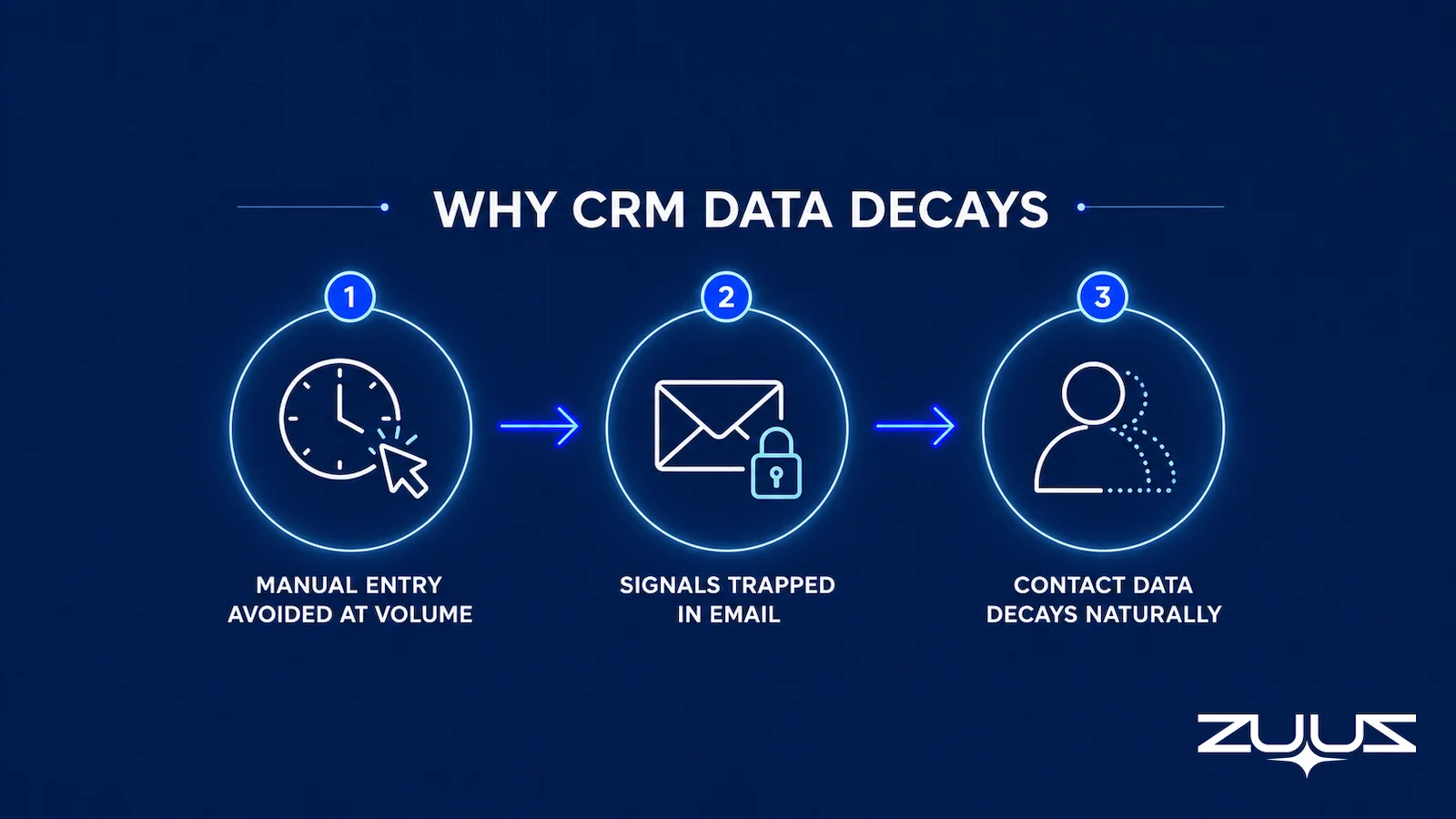
- Data degrades for three structural reasons: manual entry that reps avoid at volume, signals trapped in the inbox, and natural decay as contacts change roles and companies.
- Gartner research from 2020 put the average cost of poor data quality at $12.9 million per year per organization, surfacing in CRM as wrong forecasts, misrouted leads, and missed renewals.
- Periodic cleansing treats the symptom and the CRM decays again the next morning; continuous capture at the source prevents the decay before it starts.
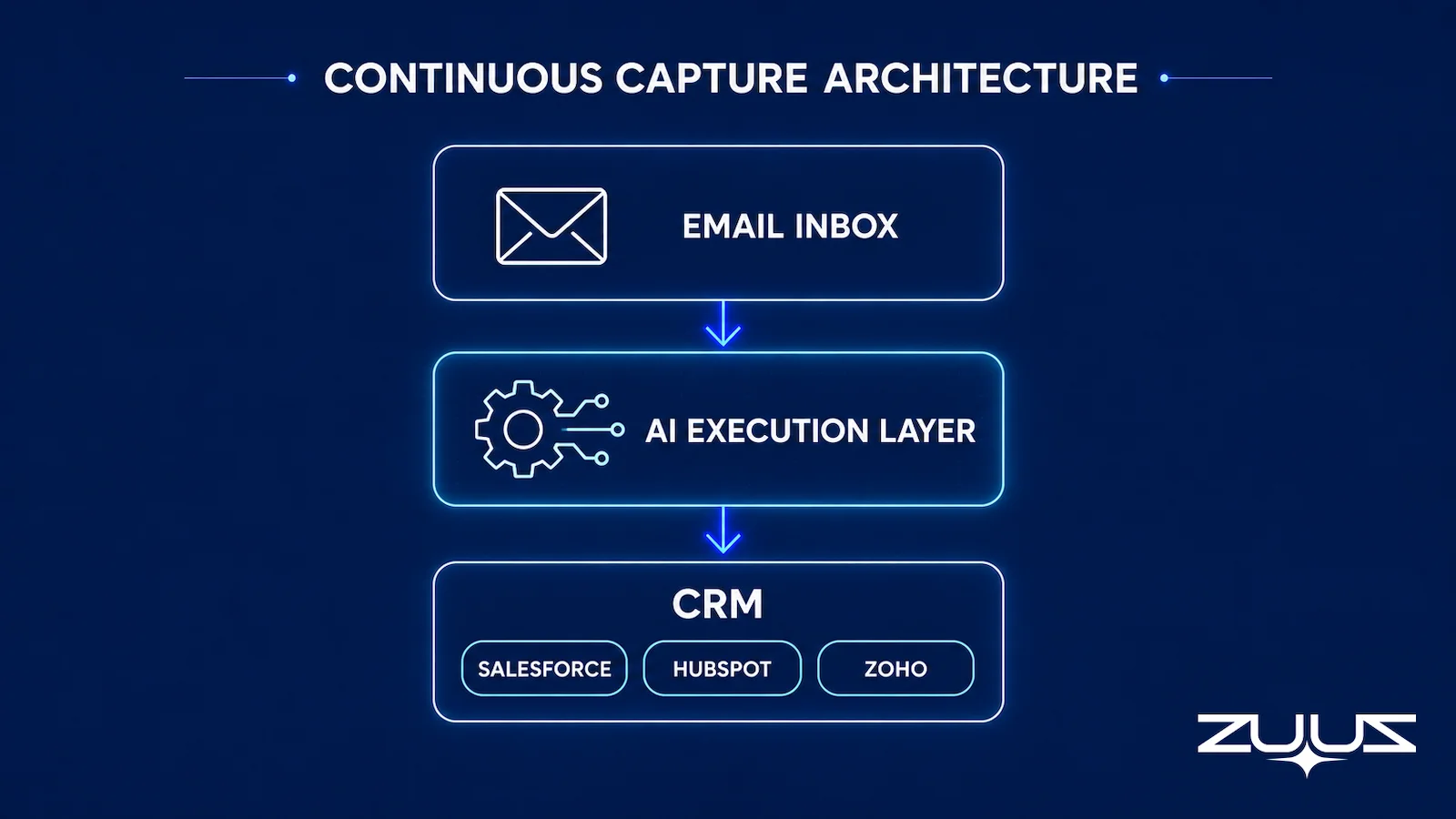
- ZUUZ reads email, extracts deal signals, and writes structured records to Salesforce, HubSpot, or Zoho, keeping the CRM correct continuously rather than between cleanups.
- ZUUZ connects to your sales inbox, reads LinkedIn messages and meeting or call transcripts, and writes leads, stakeholders, next steps and renewal signals into the CRM for the rep to approve in one click, which is how the record stays current between cleanups.
Open most B2B CRM instances and the picture looks healthy. Thousands of contacts, hundreds of open opportunities, dashboards that render without errors. The system looks full. The problem is that full and correct are not the same thing.
In practice, a large share of those records are stale. Industry estimates of CRM decay run wide, but the pattern operators see firsthand is consistent: somewhere between 40 and 60 percent of what a CRM should reflect is either missing, out of date, or duplicated. The deals are real. The records describing them are not.
This is the pillar for everything ZUUZ publishes on CRM data quality. It defines the term, walks the six dimensions, explains why data decays at the source, quantifies what bad data costs, lays out the metrics that measure it, and separates the fix that holds from the one that does not.
What CRM Data Quality Actually Means
CRM data quality is the degree to which the records inside a CRM accurately reflect the real state of accounts, contacts, and deals. It is not a measure of how much data exists. A CRM packed with records can have low data quality, and a leaner one can have high quality, depending on how closely the records track reality.
The distinction matters because most teams treat volume as a proxy for health. They count contacts and opportunities and assume the pipeline is well documented. Quality asks a different question: of the records that exist, how many are accurate, current, complete, and unique, and of the activity that happened, how much was recorded at all.
That second clause is where most CRM data quality problems live. A record can be perfectly formatted and still be wrong because the renewal conversation it should describe happened in an email thread last Tuesday and never reached the system. Quality is not only about the records present. It is about the gap between what happened and what got logged.
The Six Dimensions of CRM Data Quality
Data quality professionals break the concept into six standard dimensions. Each one names a distinct way a record can be wrong, and each maps to a metric that can be measured. The table below defines all six in CRM terms.
| Dimension | Definition | CRM Example of Failure | What a Capture Layer Like ZUUZ Changes |
|---|---|---|---|
| Accuracy | The record matches the real-world state it describes | A deal sits in “Proposal” while the customer already signed | Stage and commitment are written from the dated thread rather than recall |
| Completeness | Required fields are populated, not blank | A contact has no title, no phone, and no account link | Stakeholders named in the thread are written as contacts for the rep to approve |
| Consistency | The same value appears the same way across systems and fields | “Western Intl” in one record and “Western International Group” in another | Fewer hand-typed variants, because the rep approves a written value instead of typing one |
| Timeliness | The record reflects the current state, not last quarter’s | Last activity dated 90 days ago on a deal that closed last week | The field moves when the conversation happens, not at the next pipeline review |
| Validity | A value conforms to the expected format or business rule | A close date in the past on an open opportunity | Dates come from a written, dated commitment rather than an estimate |
| Uniqueness | Each entity exists once, with no duplicate records | Three contact records for the same procurement manager | Nothing to claim here: deduplication remains a CRM-side rule |
The six are not equally common as failure points. Validity and consistency tend to be the easiest to enforce, because format rules and picklists can be set at the field level. Uniqueness is a recurring nuisance that dedupe routines partially contain.
The two that quietly cause the most damage are timeliness and completeness. A CRM degrades on those two dimensions every single day, not because anyone made a mistake, but because the activity that should update the records is happening somewhere the CRM cannot see. That is the root cause the rest of this article addresses.
Find Out What Your CRM Is Missing.
ZUUZ reads your inbox, extracts the deal signals your records never captured, and writes them to Salesforce, HubSpot, or Zoho. Book a 15-minute walkthrough on your own data.
Six dimensions describe the state of a database at a single point in time. They do not explain why that state keeps changing, and the why is what determines whether a cleanup holds for a quarter or a week.

- Does it improve the records you already have, or does it change what arrives in the first place?
- Does it capture from the channels where the deal actually moves – email, calendar, LinkedIn messages, meeting and call transcripts – or only from data already inside the CRM?
- Does what it captures land in CRM fields a report can read, or only in an activity feed someone has to open?
- Does the rep have to remember anything for it to work: a BCC, a button, a sidebar, a sync?
- Can the rep correct it in one click before it is written?
- Does the vendor quote a quality score, or a decay rate? A score improves after any cleanse; the decay rate is what tells you whether the improvement will last a quarter.
Why CRM Data Degrades, Starting at the Source
CRM data quality is not a one-time setup problem that a good migration solves. It is a continuous decay process. Records that were accurate on Monday drift out of alignment with reality through the week, and three forces drive that drift.
Manual Entry Is a Task Humans Avoid at Volume
Logging a single email to a CRM record takes several clicks: find the contact, open the account, navigate to activities, fill the fields, save. Multiply that by the inbound and outbound volume a working rep handles, and the math stops working. The result is selective logging. Reps record the deals large enough to affect commission and skip the rest.
This is not a discipline failure. It is a workload reality. According to the Salesforce State of Sales statistics (2024), sales reps spend roughly 60 percent of their time on non-selling tasks, and manual CRM entry is a meaningful slice of that. Every minute spent logging is a minute not spent selling, so reps ration it, and the CRM pays the price. The deeper case for removing reps from this task lives in the best CRM to reduce manual data entry.
Deal Signals Stay Trapped in Email
This is the cause almost every data quality guide skips. Most data quality content treats decay as a hygiene issue: dedupe, standardize, enrich. Those steps matter, but they operate on records that already exist. They do nothing about the signals that never became records in the first place.
In B2B selling, the substance of a deal moves through email. A renewal intent shows up as one line in a support reply. A pricing objection arrives as a forwarded thread. A new project scope lands as an attachment in a shared inbox. None of that is structured. None of it auto-populates a CRM field. It sits in the inbox, and unless a human manually transcribes it, the CRM never learns it happened. The pipeline-level consequence is covered in why your CRM pipeline is wrong.
Contact Data Decays Naturally
The third force is the one everyone acknowledges. People change jobs, switch companies, and update titles. Phone numbers get reassigned and email addresses bounce. A contact record that was accurate the day it was entered loses fidelity month over month with no action by anyone. This is the steady background erosion that contact enrichment tools target, and it is real, but it is the smallest of the three for revenue teams. The renewal that slipped because no one logged the signal costs far more than the bounced email address.
What Poor CRM Data Quality Costs
The cost of bad CRM data is rarely a single line item, which is why it stays invisible on the P&L. It shows up distributed across forecasting, routing, renewals, and rep time. The headline figure is well documented.
The macro picture is larger still. Harvard Business Review (2016) estimated bad data costs the US economy roughly $3 trillion per year, and a related HBR analysis (2017) found only 3 percent of company data meets basic quality standards. Those are economy-wide numbers, but they describe the same mechanism a single revenue team feels. Here is how the cost breaks down inside a CRM.
| Cost Area | What Goes Wrong | Business Impact |
|---|---|---|
| Forecasting | Pipeline reflects 40 to 60 percent of real activity | Forecasts look precise but miss deals still sitting in email |
| Lead Routing | Stale or incomplete records send leads to the wrong owner | Slow response, duplicated outreach, leads that go cold |
| Renewals | Renewal signals never reach the CRM in time | Renewals slip because no one resourced the at-risk account |
| Rep Productivity | Reps reconstruct account history from old threads | Selling hours lost to research that should have been automatic |
| Reporting Trust | Leaders learn the dashboard is unreliable | Teams revert to spreadsheets, and the CRM loses its purpose |
The last row is the quiet killer. Once a revenue leader stops trusting CRM reports, the organization routes around the system. Forecasts get rebuilt in spreadsheets, pipeline reviews run on gut feel, and the CRM becomes an expensive contact archive. Restoring that trust requires fixing the data, not the dashboard, which is the throughline in why your CRM pipeline is wrong.

How to Measure CRM Data Quality
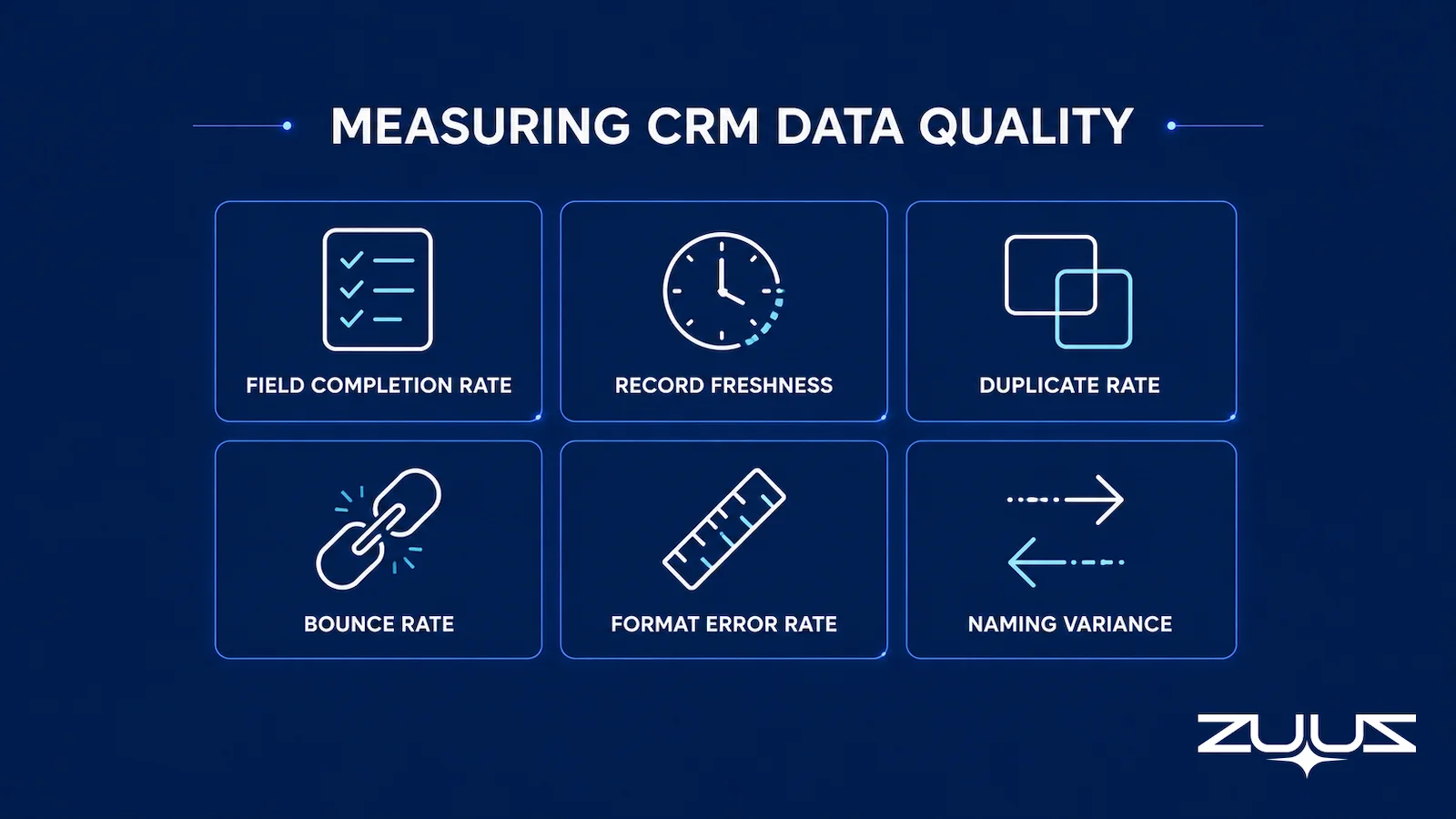
CRM data quality is measurable, and the metrics map directly to the six dimensions. The goal is not a one-time audit but a trend line, so each metric should be sampled on a fixed cadence, usually monthly, and tracked per object: accounts, contacts, opportunities.
| Metric | Dimension Measured | How It Is Calculated |
|---|---|---|
| Field Completion Rate | Completeness | Percentage of required fields populated across records |
| Record Freshness | Timeliness | Average days since last meaningful update per record |
| Duplicate Rate | Uniqueness | Percentage of records that are duplicates of another entity |
| Bounce Rate | Accuracy | Percentage of email or phone contacts that fail on use |
| Format Error Rate | Validity | Percentage of fields violating an expected format or rule |
| Naming Variance | Consistency | Count of distinct spellings for the same account or value |
Record freshness deserves the most attention because it is the leading indicator. A rising average age since last update means activity is happening that the CRM is not capturing, which is the early warning sign of a capture gap widening. A team can roll these six metrics into one composite score per object to give leadership a single trend line rather than a wall of numbers. The software that automates this measurement is compared in the CRM data quality tools roundup.
For teams that want a repeatable routine rather than a set of definitions, the operational version of this lives in the CRM data quality checks guide, which turns these metrics into a recurring checklist with thresholds and owners.
The Two Fixes: Cleansing Versus Capture
There are two distinct approaches to CRM data quality, and confusing them is why so many cleanup projects fail to hold. One treats the symptom. The other addresses the cause. Most teams need both, in the right order.
Periodic Cleansing Treats the Symptom
Cleansing is the familiar approach: run a dedupe pass, standardize formats, enrich contact records, fill blank fields, archive dead accounts. On the day it runs, data quality jumps. Field completion rises, duplicates fall, the dashboard looks trustworthy again.
The problem is that cleansing operates on a backlog and then stops. The morning after the project ends, the same capture gap that created the backlog starts refilling it. Renewal signals keep landing in email and not in the CRM. Reps keep skipping manual logging. Within a quarter, freshness and completeness are sliding again, which is why teams find themselves rerunning the same cleanup every year. Whether to run that cleanup in-house or hand it to a provider is weighed in the CRM data quality services breakdown. Cleansing is necessary for the existing backlog. It is not a fix for the decay rate.
Continuous Capture Prevents the Decay
The alternative is to close the gap at the source so the records never go stale in the first place. Instead of letting deal signals accumulate in email and cleaning up the wreckage later, the signals are captured the moment they arrive and written to the CRM continuously.
This changes the shape of the problem. Freshness stays high because records update in real time as signals arrive, not at the next quarterly cleanup. Completeness stays high because the system populates fields from the conversation rather than waiting for a rep to remember. The CRM stops decaying because the force that drove the decay, the gap between inbox and system of record, is closed. The direct contrast between the two approaches is laid out in ZUUZ versus manual CRM entry.

The Capture Gap Audit
The six dimensions and the metrics above describe the quality of the records the CRM holds. Neither says anything about the records it never received. The Capture Gap Audit measures that, on two deals, without a tool.
- Pick one closed-won and one slipped deal from the last quarter.
- Read the full email and message thread end to end; list every fact that mattered – people, objections, dates, competitors, commitments.
- Open the CRM record for the same deal and mark which of those facts appear in a field, not a note.
- The percentage missing is the capture gap. Anything above about a third means the team is running on a CRM that records outcomes, not the deal.
The slipped deal is the one worth the full hour. In most audits the thread contains the warning the pipeline never carried: a champion who stopped replying in week four, a procurement contact who entered on a CC line and was never a contact record, a competitor named once, a commitment to revisit after a budget cycle that never became a next step or a close date. None of that is a data quality failure in the six-dimension sense – the record can score well on completeness, validity and uniqueness while the capture gap on the same deal is most of the deal. Treat the audit as the seventh number on the data quality dashboard and report it beside the other six.
From an operator’s seat
The part teams do not plan for is that a cleanse changes the level and not the slope. Quality scores jump in the weeks after a dedupe and enrichment project, then decay at exactly the rate they did before, because nothing about how the record gets written changed – so the useful number to baseline before any project is the monthly decay rate, not the score on the day the project closes. Across the deployments ZUUZ runs, the pattern is that the timeliness dimension is the first to become misleading: integrations touch records and refresh the last-activity date, so freshness reports start measuring sync traffic rather than deals. Do the capture gap audit before the cleanse rather than after, because once fields are being written from threads, nobody can reconstruct what the record looked like first. And expect a merge queue for the first month: closing the gap creates contacts that collide with records from older imports, and somebody has to own that.
ZUUZ is an AI layer on top of the CRM a team already runs – it is never a CRM and never replaces one. Cleansing tools grade and repair what the rep entered; ZUUZ writes the record at the moment the fact appears, and the rep approves it.
CRM Data Quality: How ZUUZ Keeps It Correct at the Source
ZUUZ is the continuous-capture layer that sits between email and the CRM. It reads inbound and outbound email, identifies deal signals, and writes structured records to Salesforce, HubSpot, or Zoho. The CRM stays current because capture happens as the activity happens, not weeks later when someone gets around to it.
The mechanism maps directly onto the dimensions that degrade. Timeliness holds because records update within the hour. Completeness holds because the system fills fields from the conversation rather than relying on rep memory. Reps do not change how they work in email. They review flagged signals in a short daily pass and the records write themselves. This is the decision-and-execution layer on top of the CRM, sitting within the broader revenue operations software stack.
The CRM-agnostic design matters here. Many organizations run different CRM systems across divisions or have migrated recently, so a fix tied to one platform leaves part of the business uncovered. ZUUZ writes to Salesforce, HubSpot, Zoho, Attio or Pipedrive in each system’s native format, which means data quality improves uniformly regardless of which CRM a given team runs.
RA Technologies: $120K Surfaced in 72 Hours
RA Technologies, an IT services firm in the United States, connected their shared inbox to ZUUZ and ran a 90-day historical lookback on first connection. The system surfaced $120,000 in pipeline that had never been recorded in their CRM.
Those were not lost deals or cold leads. They were active conversations, including renewal discussions, that had been progressing through email while remaining invisible to sales leadership. That gap is a data quality failure in its purest form: real activity, zero records. Continuous capture closed it on day one, and kept it closed because the same engine runs on every email after the lookback.
Stop Cleaning Up the Same Mess Every Quarter.
Cleansing resets the backlog. Continuous capture keeps it from refilling. Connect your CRM in minutes and let ZUUZ keep your records current. Start free, no integration project required.
Where to Go Next in the Cluster
This pillar covers the what, why, and how of CRM data quality at a strategic level. Four companion guides go deeper on the decisions a revenue team faces once it commits to fixing the problem.
- Hiring help. If the question is whether to bring in outside expertise, the guide to CRM data quality consultants covers when a consultant earns their fee and what to expect from the engagement.
- Outsourcing the work. For teams weighing a managed service over an internal effort, the CRM data quality services breakdown covers pricing models and what is and is not included.
- Choosing software. If the decision is which platform to buy, the CRM data quality tools roundup compares the categories of software that monitor, cleanse, and capture.
- Building a routine. For the operational checklist that turns the metrics above into a recurring process, the CRM data quality checks guide lays out the steps, thresholds, and owners.
A CRM data quality analyst or RevOps lead reading this pillar typically starts with the metrics, runs the checks, decides whether to cleanse internally or outsource, and then addresses the capture gap so the gains hold. The order that works is measure, cleanse the backlog, then close the source.
A first step that is one mailbox, not a project
The concrete first step does not need a data quality programme behind it. Connect one mailbox, ZUUZ reads the last 90 days, and the rep reviews what it found before anything is written to the CRM. The review list is your capture gap, itemised on real deals, which is the one quality figure a cleanse cannot give you. The trial runs 30 days free, with no credit card: https://zuuz.ai/trial/
Frequently Asked Questions
What Is CRM Data Quality?
CRM data quality is the degree to which the records in a CRM accurately reflect the real state of accounts, contacts, and deals. It is measured across six dimensions: accuracy, completeness, consistency, timeliness, validity, and uniqueness. A CRM can look full and still be low quality when records are stale, duplicated, or missing the deal signals that stayed inside email threads and never reached the system of record.
What Are the Dimensions of CRM Data Quality?
There are six standard dimensions. Accuracy means a record matches reality. Completeness means required fields are filled. Consistency means the same value appears the same way everywhere. Timeliness means the record reflects current state, not last quarter’s. Validity means a value conforms to the expected format or rule. Uniqueness means each entity exists once, with no duplicates. Most CRM problems trace back to timeliness and completeness.
Why Does CRM Data Degrade Over Time?
CRM data degrades for three reasons. Manual entry is a task reps avoid at volume, so records go unlogged. Deal signals such as renewal mentions and pricing questions stay inside email and never reach the CRM. And contact data decays naturally as people change roles and companies. The first two causes are structural, which is why periodic cleansing alone never holds the gain for long.
How Do You Measure CRM Data Quality?
CRM data quality is measured with metrics mapped to each dimension. Field completion rate tracks completeness. Duplicate rate tracks uniqueness. Record freshness, the average age since last update, tracks timeliness. Bounce rate tracks accuracy of contact data. Format error rate tracks validity. A single composite score per object, sampled monthly, gives revenue leaders a trend line rather than a one-time snapshot of where the data stands.
What Does Poor CRM Data Quality Cost a Business?
Gartner research from 2020 put the average cost of poor data quality at $12.9 million per year per organization. In CRM terms the cost shows up as wrong forecasts built on stale pipeline, leads routed to the wrong rep, renewals that slip because no one saw the signal, and wasted rep hours spent reconstructing account history that should have been recorded automatically at the source.
How Does AI Improve CRM Data Quality?
AI improves CRM data quality by capturing signals at the source instead of cleansing them after the fact. ZUUZ reads inbound and outbound email, extracts deal signals, and writes structured records to Salesforce, HubSpot, or Zoho. Because the capture is continuous, records stay current and complete by default rather than decaying between quarterly cleanups and forcing a fresh cleanup project every year.
Is Data Cleansing Enough to Fix CRM Data Quality?
Data cleansing treats the symptom, not the cause. Deduplicating and standardizing records improves quality on the day it runs, but the CRM starts decaying again the next morning because the underlying capture gap remains. Cleansing is necessary for the existing backlog. Continuous capture at the source is what keeps the CRM correct after the cleanup, so most teams need both, applied in that order.
See the Records Your CRM Never Got.
Cleansing fixes the past. ZUUZ keeps the present current by capturing every deal signal from email and writing it to your CRM within the hour. Book 15 minutes and see the gap on your own data.

CEO of ZUUZ. He scaled Cloud Box Technologies from 0 to $25M ARR in IT services and distribution before building ZUUZ. Connect on LinkedIn