
How Lead Scoring Software Turns Signals Into Sales Priority
Compare lead scoring software, scoring models, and signals, then see how ZUUZ scores inbound email leads and writes the score back into any CRM you run.
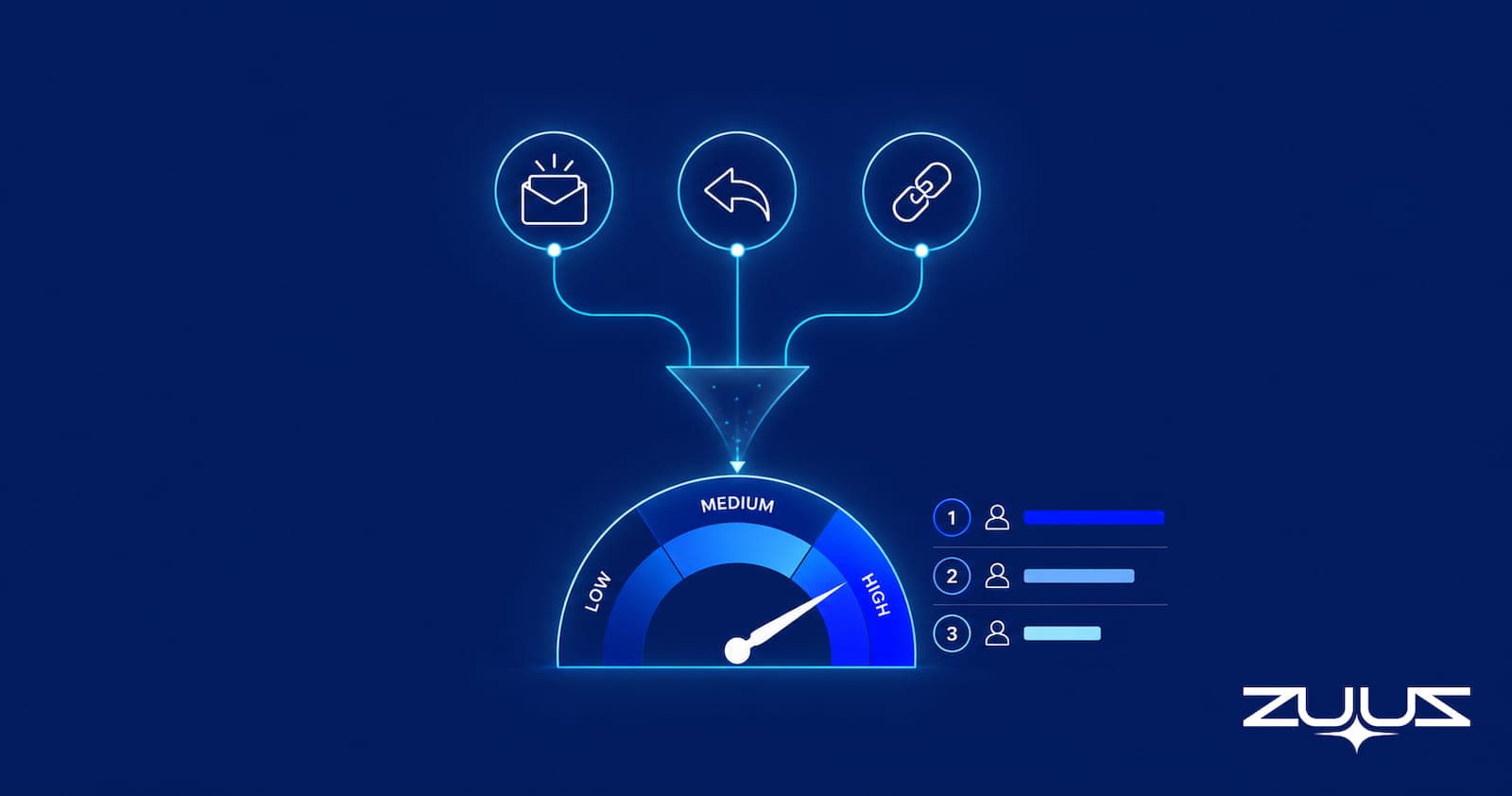
TL;DR: Lead scoring software ranks inbound leads by how likely they are to convert, so reps work the best opportunities first instead of guessing, using rule-based, predictive, or hybrid models on signals that already sit in the CRM. The signal most tools miss is the buyer conversation in a rep’s inbox, because a lead often exists in email before it ever reaches the CRM. ZUUZ scores leads directly from email and writes the score and surrounding context back into Salesforce, HubSpot, or Zoho.
- Lead scoring software assigns a numeric priority to each lead so sales teams focus attention where conversion is most likely, which is different from a pass or fail qualification gate.
- Scores combine fit signals (who the lead is) with engagement signals (what the lead does), and mature systems apply decay so old activity stops keeping a cold lead artificially warm.
- The three common models are rule-based, predictive or AI-driven, and hybrid, and each fits a different level of data maturity.
- Email is the highest-intent signal most scoring tools ignore, because a lead often exists in the inbox before it ever reaches the CRM.
- ZUUZ captures and scores leads from email, then writes the score and context back into the CRM through bi-directional sync, working across Salesforce, HubSpot, Zoho, Attio or Pipedrive at once.
- A score is only useful when it reaches the rep in time to act, so score-to-action speed matters as much as model accuracy.
A sales rep opens the inbox to forty new messages. Some are vendor newsletters, a few are internal threads, and buried among them are three or four real buyers asking about pricing, timelines, and integrations. Without a system that ranks those leads, the rep works them in the order they happen to appear, and the most valuable conversation waits behind a cold one. Lead scoring software exists to fix that problem, and this guide explains how it works, how the models differ, and how an execution layer like ZUUZ scores inbound leads directly from email.
What Lead Scoring Software Actually Does
Lead scoring software assigns each lead a number that represents how likely it is to become a customer, then keeps that number current as new activity arrives. The score gives sales a ranked queue, so reps spend their first and best hours on the leads most likely to close rather than on whoever emailed most recently. It is a prioritization tool, not a decision that removes leads from the pipeline.
That distinction matters because scoring is often confused with qualification. Qualification asks a yes-or-no question about whether a lead is worth pursuing at all, and ZUUZ covers that separately in its guide on email lead qualification automation. In funnel terms, scoring is often what helps move a marketing qualified lead (MQL) toward becoming a sales qualified lead (SQL), and some teams express the same idea as lead grading with letter grades instead of points. Scoring instead ranks the leads that pass, so two qualified leads can carry very different scores based on urgency and fit. Both work together, but they answer different questions.
Scoring is also distinct from ICP fit criteria. Ideal customer profile fit describes how closely a lead’s company matches the accounts a business sells to best, and it is one input into a score rather than the whole score. Teams building that fit layer can start with the ZUUZ breakdown of ICP scoring criteria for B2B sales. This article stays focused on the scoring software category itself, one of six AI sales tool categories: how the number is built, which models produce it, and how the score becomes an action a rep can take.
How Lead Scoring Works With Signals, Weights, and a Score
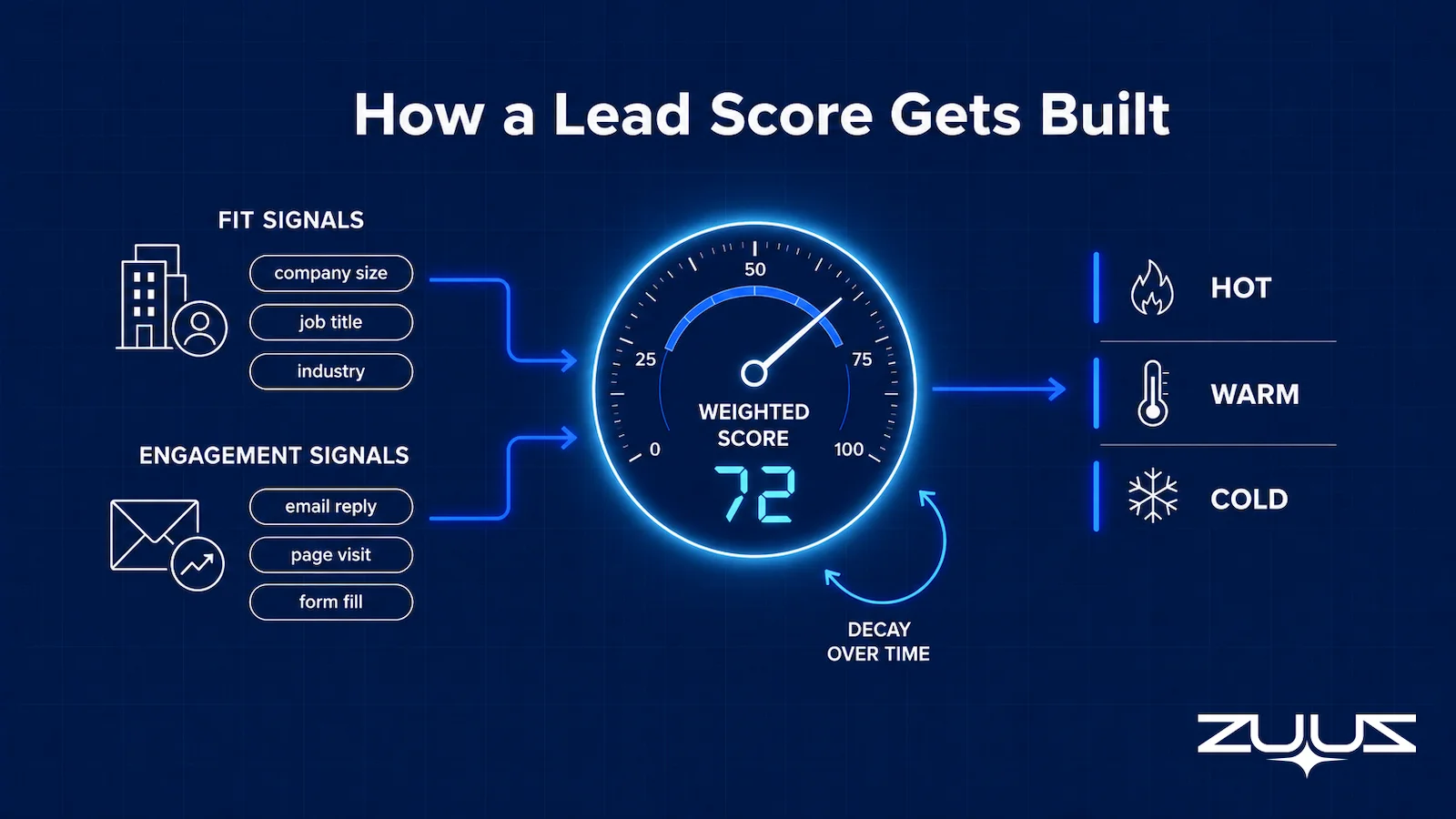
Every lead scoring system does three things in sequence. It collects signals about a lead, it applies a weight to each signal based on how strongly that signal predicts a sale, and it sums those weighted signals into a single score. When new activity arrives, the score recalculates, so a lead that opens a proposal and replies with a question moves up the queue automatically. Most teams also set a scoring threshold, the point value at which a lead is treated as hot enough to route straight to a rep.
The signals fall into two broad families that answer different questions. Fit signals describe who the lead is, such as company size, industry, region, and job title, and fit is often split into demographic scoring for the person and firmographic scoring for the company. Engagement signals describe what the lead does, such as opening an email, visiting a pricing page, or replying to a thread, and this activity is the basis of behavioral scoring. Strong scores blend both, because a perfect-fit company that never engages is not ready, and a highly engaged contact at a company that will never buy is a distraction.
The table below groups the signal types most B2B lead scoring software can read, with an example and what each one tends to indicate.
Table 1: Common lead scoring signal categories
| Signal type | Example | What it suggests |
|---|---|---|
| Firmographic fit | Company size, industry, region | Whether the account matches the ideal customer profile |
| Demographic fit | Job title, seniority, department | Whether the contact can influence a purchase |
| Behavioral engagement | Email opens, page visits, form fills | Level of active interest |
| Email conversation | Questions, buying language in a reply | Depth and urgency of intent |
| Intent data | Research activity on relevant topics | Whether the account is in a buying cycle |
| Negative signals | Unsubscribes, job-seeker titles, free-mail domains | Reasons to lower the score |
Negative signals deserve attention because they prevent inflated scores. A contact who unsubscribes or lists a role unrelated to buying should lose points, not gain them. Score decay plays a similar role over time, reducing the weight of activity that happened weeks ago so a burst of old interest does not keep a lead at the top of the queue forever. Together, negative scoring and decay keep the ranking honest, which sets up the question of which model does the scoring.
Lead Scoring Models Compared
The three scoring models differ mainly in how the weights get set, and comparing predictive vs rule-based lead scoring is the choice most teams wrestle with first. Rule-based scoring uses weights a human defines, predictive scoring learns weights from historical outcomes, and hybrid scoring combines the two. Choosing among them depends less on which sounds most advanced and more on how much clean historical data a team actually has.
Rule-Based (Manual) Scoring
Rule-based scoring assigns fixed point values to specific attributes and actions. A director-level title might add ten points, a pricing-page visit might add five, and a free-email domain might subtract fifteen. It is transparent and fast to launch, and any rep can understand why a lead scored the way it did.
The limitation is maintenance. Humans guess at the weights, those guesses drift out of date as the market shifts, and someone has to revisit the rules regularly. Rule-based scoring works well for teams early in their motion or with lower lead volume, where simplicity and explainability outweigh precision.
Predictive and AI Lead Scoring
Predictive lead scoring uses machine learning to study past won and lost deals, then sets the weights automatically based on which signals actually preceded a sale. AI lead scoring can surface patterns a human would not think to encode, and it updates those patterns as more outcomes accumulate. For high-volume teams with a clean history of closed deals, it can rank leads more accurately than a manual point system.
The catch is data. Predictive models need enough clean examples of real outcomes to learn from, and a team without that history will get unreliable results no matter how sophisticated the algorithm. AI removes the guesswork in setting weights, but it does not remove the need for good inputs.
Hybrid Models
Hybrid scoring lets a team keep a few trusted manual rules while a predictive layer handles the patterns that are hard to define by hand. A business might hard-code a rule that any enterprise-tier inbound reply routes to a senior rep, while letting the model rank everything else. This balances explainability against accuracy and is where many mature teams land.
The lead scoring model examples below sit side by side so the trade-offs are easy to weigh.
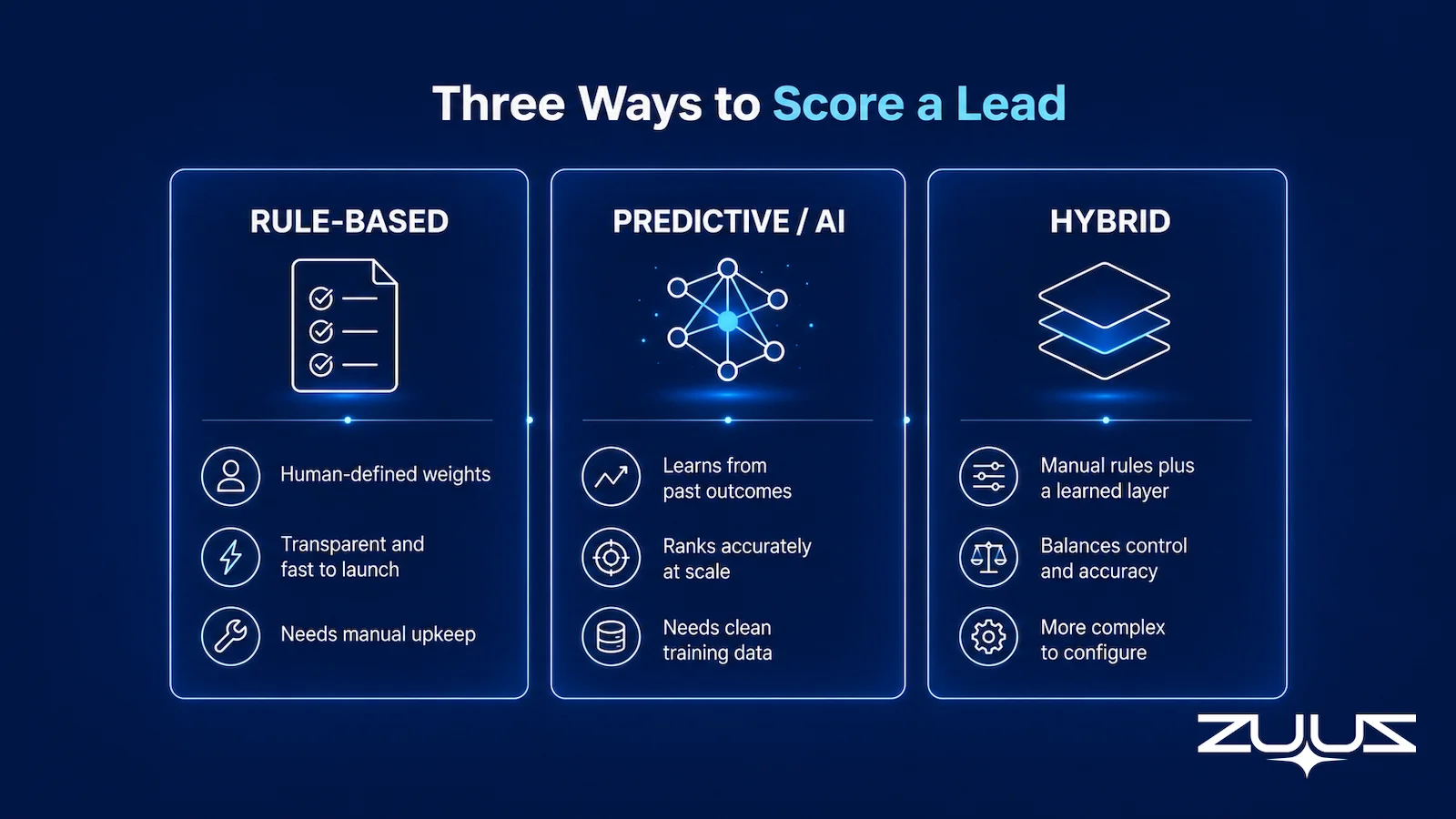
Table 2: Lead scoring model comparison
| Model | How weights are set | Best fit | Main limitation |
|---|---|---|---|
| Rule-based | Defined by a human | Early-stage or lower-volume teams | Needs manual upkeep, guesses at weights |
| Predictive / AI | Learned from historical outcomes | High-volume teams with clean deal history | Requires enough quality training data |
| Hybrid | Manual rules plus a learned layer | Mature teams wanting control and accuracy | More complex to configure and maintain |
No model is universally best, and the right choice follows the data a team can feed it. That leads to a more important question than which model to run, which is whether the model ever sees the signal that matters most.
Email Is the Signal Most Lead Scoring Software Misses
Most lead scoring software scores what already lives in the CRM. That works for form fills and tracked page visits, but it leaves out the richest signal in B2B sales, which is the direct email conversation. A buyer who replies to a rep asking about implementation timelines has shown far stronger intent than one who opened a newsletter, yet that reply often never becomes a scoring input at all.
The reason is a coverage gap. A lead frequently exists in the inbox before it exists in the CRM, because the buyer emailed a rep directly instead of filling out a web form. If the scoring system depends entirely on CRM records, that lead is invisible until someone types it in by hand, and the score is blind to everything said in the thread. ZUUZ examines this specific problem in its guide on missed sales leads in email and how to fix it.
There is also a difference between scoring email metadata and scoring email meaning. Counting opens and clicks measures activity, but it cannot tell that a buyer wrote a question about contract terms or named a competitor they are comparing. Reading the substance of the conversation is a stronger signal than counting whether a message was opened. A scoring system that never reaches the inbox is scoring an incomplete picture, which is the gap ZUUZ is built to close.
Stop Scoring the Wrong Signals.
Curious how much qualified pipeline is sitting unscored in your reps’ inboxes right now? See it mapped against your CRM on a live 15-minute walkthrough.
How ZUUZ Scores Leads From Email and Writes the Score to the CRM
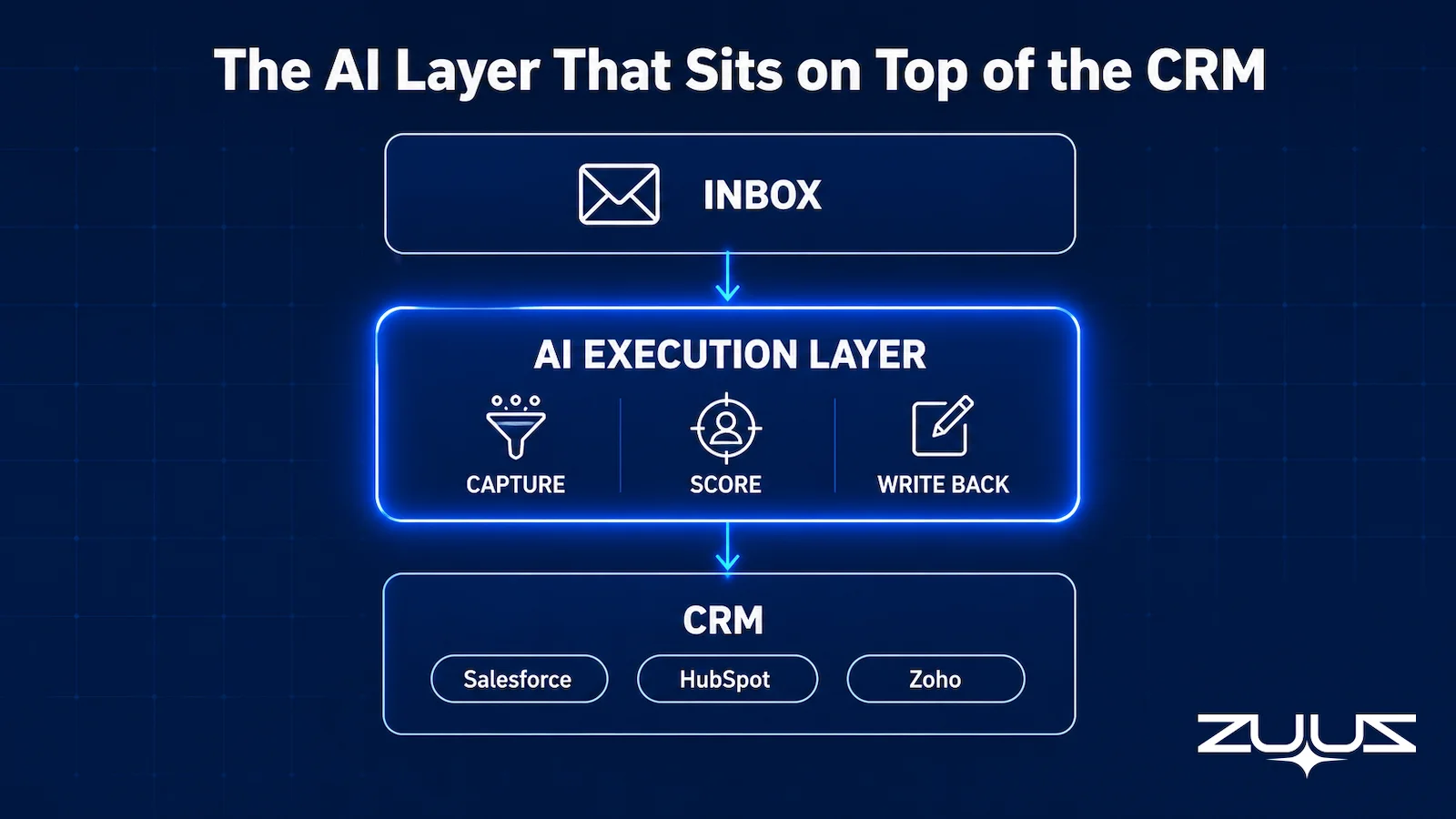
ZUUZ is an agentic AI execution layer that sits on top of the CRM rather than replacing it. It reads the inbound email a rep receives, captures the lead, scores it based on the fit and conversation signals in the thread, and then writes that score and the surrounding context back into the CRM. Because the capture happens at the inbox, the lead gets scored even when it never came through a web form.
The score does not stop at a dashboard. ZUUZ syncs bi-directionally with the CRM, so the score, the lead record, and the conversation context all land inside the system of record the team already uses. That keeps the CRM current as the single source of truth instead of creating another isolated tool reps have to check, a problem ZUUZ addresses more broadly in its guide to the best CRM approach to reduce manual data entry. Reps see the ranked lead where they already work.
ZUUZ is also CRM-agnostic, running across Salesforce, HubSpot, Zoho, Attio or Pipedrive at the same time, which matters for teams with more than one CRM or a plan to switch. On top of the scoring, its Sales AI agent answers plain-English questions about the pipeline, so a rep can ask which high-scoring leads have gone quiet this week without building a report. ZUUZ scores and prioritizes individual leads, and it does not perform sales forecasting. It is rep-facing internal tooling focused on turning email signals into scored, actionable records, an execution-layer approach IT services teams have applied in practice, as covered in the ZUUZ RA Technologies case study.
Table 3: What ZUUZ scores from email versus a CRM-only scoring tool
| Capability | CRM-only scoring | ZUUZ execution layer |
|---|---|---|
| Scores form fills and tracked visits | Yes | Yes |
| Captures leads that arrive only by email | No | Yes |
| Scores the content of the reply, not just opens | Rarely | Yes |
| Writes the score back into the CRM | Depends on integration | Yes, bi-directional |
| Works across Salesforce, HubSpot, Zoho, Attio or Pipedrive at once | No | Yes |
The result is a scoring loop that starts at the true first touch and ends inside the CRM the rep already trusts. That architecture raises a fair buying question: when is a layer over the CRM the right call, and when is native CRM scoring enough?
CRM-Native Scoring vs an AI Layer Over the CRM
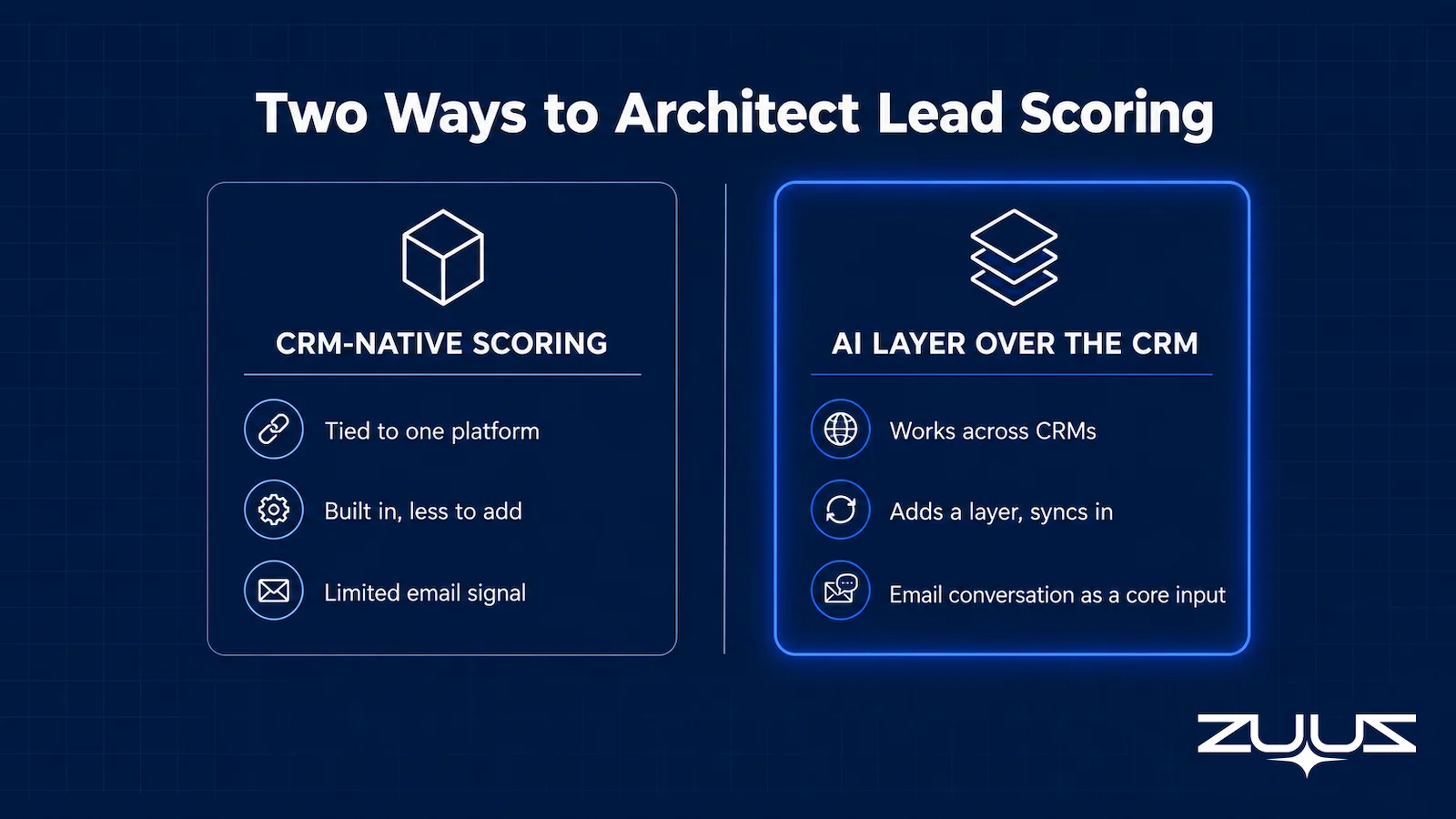
Lead scoring software comes in two architectures, and neither is universally better. CRM-native scoring is built inside a single CRM, such as HubSpot’s or Salesforce’s own scoring. An AI execution layer sits above the CRM and feeds scores into it. The right choice depends on where a team’s buyer signals actually originate.
CRM-native scoring is enough when the signals a team scores already live in one CRM, the team is committed to that ecosystem, and the native workflows cover the actions reps need to take. A marketing-led team scoring web forms and campaign engagement inside HubSpot may never need anything more. Simplicity and a single vendor are real advantages when the data fits.
An AI layer over the CRM makes more sense when meaningful signals originate outside it, when reps need to act across more than one system, or when a business wants to avoid locking its scoring into a CRM it might replace. Email-heavy sales motions fall squarely in this group, because the highest-intent signal starts in the inbox, not the CRM. Teams weighing this trade-off can also review how ZUUZ thinks about a conversational CRM approach to sales data.
Table 4: CRM-native scoring versus an AI layer over the CRM
| Consideration | CRM-native scoring | AI layer over the CRM |
|---|---|---|
| Best when | Signals live in one CRM | Signals start outside the CRM, such as email |
| CRM flexibility | Tied to one platform | Works across CRMs, easier to switch |
| Setup | Built in, less to add | Adds a layer, syncs into the CRM |
| Email conversation scoring | Limited | A core input |
Choosing an architecture is only half the decision. A team also needs a way to tell whether the scoring it picks is actually working after it goes live.
See Scoring That Reads the Actual Conversation.
Want scoring that reads the real email thread and lands inside your CRM instead of a separate dashboard? Book a 15-minute walkthrough on your own inbox.
How to Tell If Lead Scoring Software Is Working
A score is a prediction, and predictions have to be checked against outcomes. Too many teams trust a vendor’s model description and never validate it, then wonder why reps quietly ignore the scores. A handful of measurable checks separate a scoring system that improves the sales workflow from one that just decorates the CRM with numbers.
The most direct check is conversion rate by score band. If high-scoring leads do not convert at a materially higher rate than low-scoring ones, the model is not ranking well. It also helps to measure lift over the previous prioritization method, because a score that only matches how reps already sorted leads has added no value.
Table 5: Metrics that show whether lead scoring is working
| Metric | What it measures | Why it matters |
|---|---|---|
| Conversion by score band | Whether higher scores convert better | Proves the ranking is real |
| Lift over baseline | Score vs the team’s old method | Confirms the tool added value |
| Precision among worked leads | How often top leads were worth it | Reflects real rep experience |
| Signal coverage rate | Share of real activity that reaches the score | Exposes blind spots like email |
| Score-to-action time | Signal to rep action | Fresh signals lose value fast |
| Rep override rate | How often reps ignore the score | Flags trust and explainability gaps |
Two of these deserve emphasis. Signal coverage rate exposes whether important activity, especially inbox conversations, ever reaches the model, since even a strong algorithm is incomplete if it never sees the best signal. Score-to-action time measures how long it takes a new signal to become something a rep can act on, because a high score that surfaces a week late arrives after the buyer has moved on. A model that reads email and syncs to the CRM in near real time shortens that gap.
Why Lead Scoring Software Fails and How to Avoid It
When lead scoring disappoints, the cause is rarely the algorithm and usually the inputs or the workflow around it. The first common failure is scoring easy-to-measure activity instead of real buying evidence, so a pile of low-value opens produces an impressive score while a substantive email reply goes uncounted. The second is stale data, where a lack of decay keeps a cold lead near the top. The third is a black-box score reps cannot explain, which erodes trust until the team overrides it out of habit.
The most common failure is producing a score that never changes what the rep does. If the tool creates another dashboard instead of surfacing the priority inside the rep’s normal workflow, the score is technically correct and practically useless. Avoiding these traps comes down to complete signal capture, honest decay, an explainable score, and delivery into the place the rep already works.
From an operator’s seat
From an operator’s seat, the order of operations matters more than the model. Across the deployments ZUUZ runs, the pattern is that teams want to tune weights in week one, when the leads worth scoring most were never records in the first place, so the model is being tuned on a sample that excludes its best cases. The part teams do not plan for is the argument that follows the first complete week: once email replies are in scope, leads a rep had mentally written off start outranking the marketing-sourced ones everyone had agreed to trust, and someone has to sit with the sales manager and work through that list by hand. Teams that treat that week as a disagreement about inputs keep their scoring; teams that treat it as a bug in the score quietly go back to gut feel. The cheap move is to freeze the weights for two weeks and argue only about what is being fed in.
Score the Leads Hiding in Your Inbox.
If your team runs Salesforce, HubSpot, or Zoho and the best leads arrive by email, a 15-minute walkthrough shows what ZUUZ would capture and score from your own inbox.
Choosing Lead Scoring Software for a B2B Sales Team
The most reliable way to choose sales lead scoring software, and specifically the best lead scoring software for a B2B sales team, is to start with where the buyer signals originate, because that determines which architecture and model will actually fit, and which one delivers the sharpest lead prioritization. Teams whose signals already sit in a single CRM should favor native scoring, where simplicity and ecosystem fit outweigh cross-platform flexibility. Teams whose important leads start in rep inboxes should prioritize a tool that can capture the email signal, score it, sync the CRM, and surface the result to the rep. High-volume operations with clean deal history can lean on predictive models, while earlier-stage teams often get more from transparent rules they can adjust as they learn. For a wider view of how scoring fits the surrounding toolset, the ZUUZ overview of sales pipeline management software puts these pieces in context.
Whatever the choice, the test is the same. Does the software see the real signals, keep the score fresh, explain its ranking, and put the priority in front of the rep in time to act. Scoring that clears that bar changes how a sales day gets spent, and scoring that does not is just another number in the CRM.
The Capture Layer Test
One test settles most of this shortlist. The Capture Layer Test judges any tool on whether the record is complete without rep effort.
- Does it capture from the channels where the deal actually moves – email, calendar, LinkedIn messages, meeting and call transcripts?
- Does what it captures land in CRM fields a report can read, or only in an activity feed a human must open?
- Does the rep have to remember anything – a BCC, a button, a sidebar, a sync?
- Can the rep correct it in one click before it is written?
A tool that fails 2 or 3 produces activity history, not a pipeline you can run a review on. Applied to scoring, a tool that cannot answer question 1 is ranking the subset of leads that happened to get typed in, and a tool that cannot answer question 2 leaves the score somewhere a territory report cannot sort on.
Conclusion and Next Steps
Lead scoring software earns its place when it makes the next sales action obvious, and that depends on more than a clever model. Complete signal capture, fresh scores, an explainable ranking, and delivery into the rep’s real workflow decide whether scoring lifts conversion or gets ignored. The signal most tools miss is the email conversation that arrives before a lead ever reaches the CRM, and closing that gap is where the biggest gains usually sit. A practical next step is to audit how many of the last quarter’s best opportunities came through email and never got scored. For teams that find a large gap there, ZUUZ scores those inbound email leads and writes the result straight into Salesforce, HubSpot, or Zoho.
A concrete first step, not a demo: connect one mailbox to ZUUZ. ZUUZ reads the last 90 days on that connection and lists the leads, stakeholders, next steps and renewal signals it found, and the rep reviews that list before anything is written to the CRM. It is a 30-day free trial, no credit card: https://zuuz.ai/trial/.
Frequently Asked Questions
What is lead scoring software?
Lead scoring software assigns each lead a numeric value that reflects how likely it is to convert, based on fit signals like company and role and engagement signals like email replies and page visits. The score gives sales a ranked queue so reps work the most promising leads first. It updates automatically as new activity arrives, keeping the priority current.
How is lead scoring different from lead qualification?
Lead qualification is a yes-or-no decision about whether a lead is worth pursuing, while lead scoring ranks the qualified leads by priority. Two leads can both qualify yet score very differently based on urgency, fit, and engagement. Scoring tells a rep which qualified lead to work first, so the two functions complement each other rather than compete.
Does lead scoring software read email content or just opens and clicks?
It varies by tool. Most scoring software counts email engagement such as opens and clicks, which measures activity but not meaning. Systems built to read the conversation can score what a buyer actually writes, such as a question about pricing or a mention of a competitor, which is a much stronger intent signal. ZUUZ scores the content of the inbound email, not just whether it was opened.
Is AI lead scoring better than rule-based scoring?
It depends on data. AI and predictive scoring learn weights from historical won and lost deals and can rank accurately at high volume, but they need enough clean outcome data to train on. Rule-based scoring is transparent and fast to launch but requires manual upkeep. Teams with limited deal history often start with rules and add predictive scoring as their data matures.
How do you set up a lead scoring model?
Setting up a lead scoring model starts with pulling the traits and actions of past closed-won deals, then defining eight to ten fit and engagement rules with sales and assigning point weights. Add negative scoring for poor-fit signals, set a scoring threshold for routing, apply decay, and review the weights every 60 to 90 days against real outcomes.
What is lead score decay?
Lead score decay reduces the weight of older activity so that engagement from weeks ago does not keep a cold lead artificially high in the queue. Without decay, a single burst of past interest can permanently inflate a score. Decay keeps the ranking tied to recent, relevant behavior, which matters most in B2B cycles where buying intent changes over time.
Can one lead scoring system work with Salesforce, HubSpot, and Zoho?
Yes, if the platform is CRM-agnostic and supports the required integrations. Most CRM-native scoring is locked to a single platform, but an execution layer that sits above the CRM can score leads and sync results across several systems. ZUUZ works across Salesforce, HubSpot, Zoho, Attio or Pipedrive at the same time, which helps teams running more than one CRM or planning to switch.
How do you know if a lead scoring model is accurate?
Check conversion rate by score band to confirm high scores convert better than low ones, and measure lift over the team’s previous prioritization method. Watch precision among the leads reps actually work, the share of real activity the model sees, and how often reps override the score. Frequent overrides usually signal poor inputs or a score reps cannot trust.
Is lead scoring the same as sales forecasting?
No. Lead scoring prioritizes individual leads or accounts using current signals, while forecasting estimates future pipeline or revenue over a period. They serve different purposes and should not be confused. ZUUZ provides lead scoring and prioritization from email signals and does not perform sales forecasting.

CEO of ZUUZ. He scaled Cloud Box Technologies from 0 to $25M ARR in IT services and distribution before building ZUUZ. Connect on LinkedIn