
MSP Sales Leads: Where They Come From and Get Lost
MSP sales leads come from referrals, clients, vendors and LinkedIn, then get lost in the inbox. How to capture and qualify them before they reach the CRM.


CEO of ZUUZ. He scaled Cloud Box Technologies from 0 to $25M ARR in IT services and distribution before building ZUUZ. Connect on LinkedIn
TL;DR: Most MSP sales leads come from client referrals, existing-client expansion, vendor and distributor referrals, peer groups, events, and inbound website and LinkedIn messages. Many never reach the CRM, because they arrive as a forward, a CC or a line in a support email. Qualify each one on fit, seat count, current provider and buying trigger. ZUUZ, revenue intelligence for the IT channel, reads email, calendar, meetings and LinkedIn messages, captures and qualifies those inbound and referral leads, and writes them to the CRM automatically, with full change history and one-click rollback.
- MSP sales leads are mostly relationship leads. In a December 2025 MSP Success reader survey, 43% of MSPs named referrals as their top customer acquisition strategy.
- The best leads rarely arrive through a form. They arrive as forwards, partner CCs, LinkedIn messages and requests in support email, and many never become a CRM record.
- Qualify every MSP lead on four questions first: fit, seat count, current provider and buying trigger. Decision maker and timeline come next.
- The Capture Gap Audit shows how many of last quarter's leads ever reached the CRM.
- ZUUZ captures and qualifies inbound and referral leads from email and LinkedIn and writes them to Salesforce, HubSpot, Zoho, Attio or Pipedrive. It does not run cold outbound.
Picture a twenty-five-person MSP on a Tuesday. A distributor's channel account manager copies the owner on an email introducing a dental group that needs a new provider. A long-time client forwards a note from her accountant, who wants "someone like you" for his firm. A practice manager asks on LinkedIn whether the MSP supports a second office, making three warm MSP sales leads before lunch, and by Friday none of them exists in the CRM.
Most guides on MSP lead generation focus on producing more leads and skip the ones that already arrive and disappear. This guide covers where MSP sales leads come from, why they get lost before the CRM, and how to capture and qualify them. It does not cover cold outbound.
What Counts as an MSP Sales Lead
An MSP sales lead is a person or business that has shown interest in buying managed IT, security, cloud or project services from the MSP. That interest can be explicit, such as a request for a quote, or implied, such as a client asking whether the MSP "can help with" a new office. Both count, and the implied ones are often worth more.
What matters is how much is known. A raw inquiry becomes a qualified lead once the MSP knows the business fits, roughly how many users it has, who supports it today and why it is looking now. It becomes an opportunity once there is a confirmed need, a decision maker and a next meeting, and moves into the MSP sales process.
Where MSP Sales Leads Really Come From
Managed services is a trust purchase: a business hands over its systems and data, so buyers lean on someone they already know. That is why a December 2025 MSP Success reader survey found that 43% of MSPs named referrals as their top customer acquisition strategy, well ahead of cold outreach at 18% and SEO or the website at 16%.
Client referrals
A satisfied client introduces a peer, a supplier or a friend who runs a business. These are the warmest MSP sales leads there are, and they almost always arrive by email: a forward, a CC or a "you two should talk" message.
Expansion requests from existing clients
New offices, hiring batches, a cyber insurance questionnaire or a compliance audit all create new work, and these requests close faster than any new logo. They tend to arrive in a support ticket or a reply to an account manager, which is exactly where they get treated as service work instead of a sale. The MSP sales pipeline grows mostly from this source.
Vendor and distributor referrals
Vendors and distributors pass end customers to MSPs that can implement, migrate or support their products. These leads arrive as partner email threads with several people copied, and ownership is often unclear from the first reply.
Peer groups and events
Peer groups, business associations and vendor events produce introductions that become meeting requests weeks later. The only record is often a business card, a calendar entry and an email.
Inbound website leads
Contact forms, assessment requests and local search inquiries are the most visible source and the easiest to capture, because a form can write straight to the CRM. The weakness is depth: a form rarely captures seat count, current provider or trigger.
LinkedIn messages
Business owners and IT managers often ask for help in a LinkedIn message rather than a form. Those messages sit in one person's LinkedIn inbox, and teams that log LinkedIn messages in the CRM by hand know how rarely that happens on a busy day.
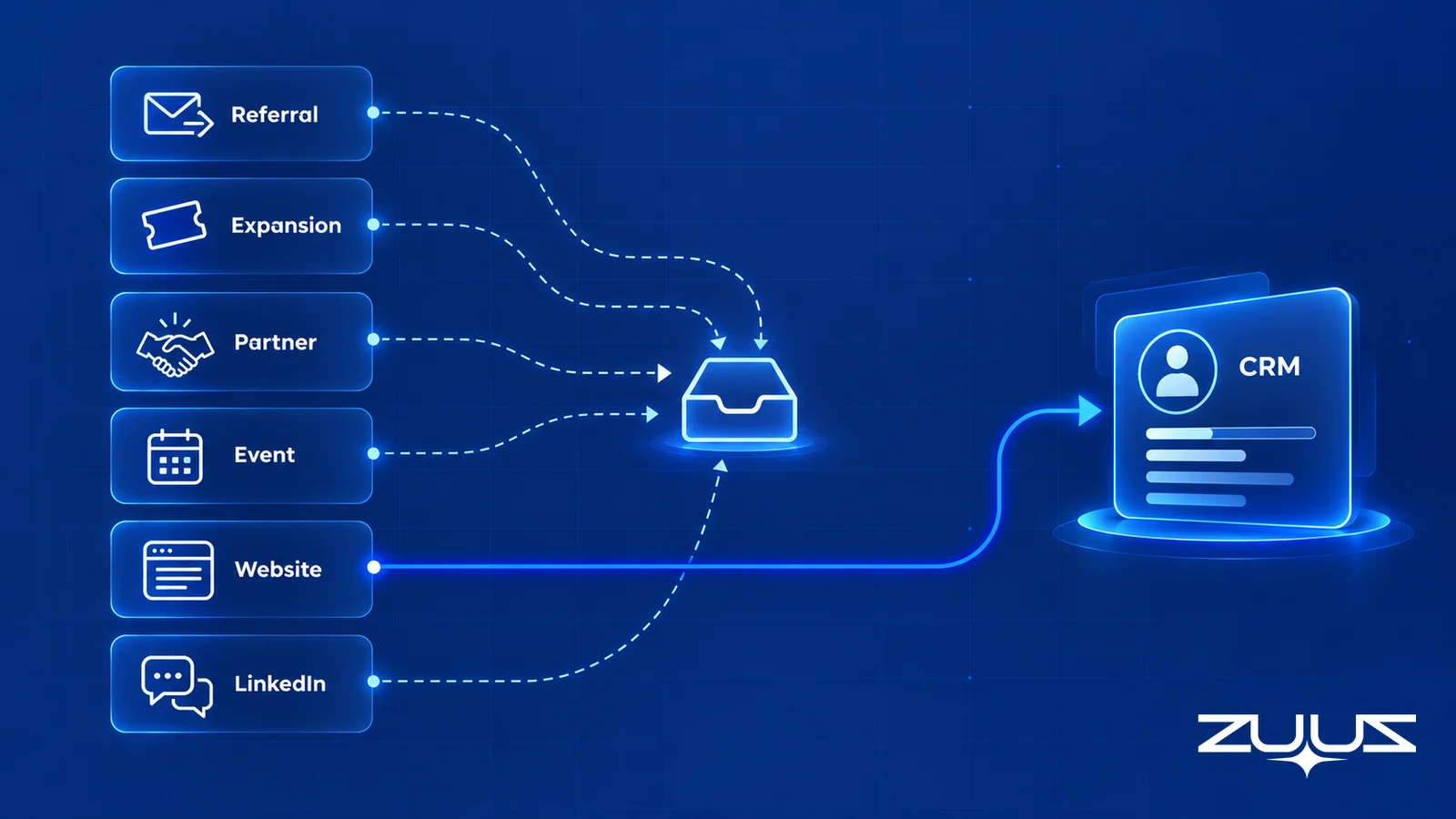
| Lead source | Where it first appears | Capture risk |
|---|---|---|
| Client referral | Forwarded email or CC | The forward is read, replied to once and never logged |
| Existing-client expansion | Support ticket or account manager email | Handled as service work, never priced as a project |
| Vendor or distributor referral | Partner email thread with several people copied | No clear owner, so everyone assumes someone else has it |
| Peer group or event | Calendar invite and follow-up email | Lives in one calendar, with no record attached |
| Inbound website | Form, phone call or email | Captured, but without fit or trigger details |
| LinkedIn message | One person's LinkedIn inbox | Stays outside the CRM entirely |
Only one row in that table writes to the CRM on its own. Every other source depends on a person noticing a commercial sentence and typing it into a record, which is where the trouble starts.
Five of Six Lead Sources Never Write to the CRM.
ZUUZ reads email, calendar and LinkedIn messages and writes referral and inbound leads into the CRM an MSP already runs.
Why MSP Sales Leads Get Lost Before They Reach the CRM
Most MSPs have a lead capture problem more than a lead generation problem. The leads arrive and then stall in the channel they arrived through, in five common ways.
The owner's inbox is the real pipeline
In an owner-led MSP, the owner is the sales team, and the owner's inbox is the pipeline. The CRM holds whatever the owner found time to enter, which on a heavy service week is very little. The guide on missed sales leads in email covers how common this is beyond MSPs.
Expansion requests get filed as tickets
When a client writes "we're hiring six people next month, can you get them set up," the service desk does exactly that. Nobody asks whether the hiring wave means a bigger agreement or a security review. The sale was in the request, and it was handled as a task.
Forwarded introductions have no owner
A vendor introduction copies the owner, an account manager and a technical lead. Each assumes another will follow up, and a week later the customer is talking to a different partner. The lead never became a record that could hold an owner.
LinkedIn and calendar sit off the record
A LinkedIn message and the meeting it produces are two of the most common ways a referral turns into a conversation. Neither writes to the CRM by default. The meeting happens and the CRM shows nothing until a proposal is due.
Slow capture means slow response
A lead that is not on a shared record usually gets answered late, because nobody else can see it waiting. In research published in Harvard Business Review (2011), firms that tried to contact a lead within an hour were nearly seven times as likely to qualify it as firms that waited even one hour longer, and the average response time across responding companies was 42 hours. Referral leads are more forgiving than web leads, but the direction holds.
Salesforce reports that sales reps spend 60% of their time on non-selling tasks, including manually entering customer notes into the CRM (Salesforce, 2026). In an MSP, where sellers also run service, lead entry is the first task to slip.

The Capture Gap Audit for MSP Leads
Before buying more leads or tools, measure how many existing MSP sales leads reached the CRM at all. The Capture Gap Audit takes about an hour.
The Capture Gap Audit
Run it on last quarter, using the mailbox and the CRM side by side.
- Pick one closed-won and one slipped deal from last quarter.
- Read the full email and message thread end to end and list every fact that mattered.
- Open the CRM record and mark which of those facts appear in a field, not a note.
- The percentage missing is the capture gap; above about a third means the CRM records outcomes, not the deal.
For leads, extend step 1: also list every referral, partner introduction and expansion request from the quarter, and check which ones became a record at all.
A worked example, as an illustration: an MSP picks a won 30-seat client and a slipped referral. The won thread holds six facts that mattered: referral source, incumbent provider, seat count, compliance deadline, decision maker and close date. The CRM has only the seat count and close date in fields, a capture gap of about two thirds. The slipped referral never became a record at all.
How to Capture MSP Sales Leads From Every Channel
Capture works when it is defined, consistent and owned. The process below assumes nothing beyond the CRM already in place. For a broader look at the same workflow across industries, see the guide to inbound lead management.
- Define what counts as a sales inquiry. List what makes a message commercial: a referral, a pricing question, a new office, new hires, a provider change, an audit.
- Capture the minimum fields from every channel. Email, LinkedIn, forms and meetings should all produce the same record: company and contact, lead source, service need, seat count, current provider, trigger and timing.
- Match to an existing account first. An inquiry from a current client is expansion, and matching by domain prevents duplicates.
- Assign one owner the same day. A lead with three people copied needs one name on it.
- Record the next step and a date.
- Review weekly against the inbox. Fifteen minutes comparing the week's commercial conversations with new records shows what was missed.
How to Qualify MSP Sales Leads
MSP leads qualify differently from generic B2B leads because the purchase is recurring and the incumbent matters. Four questions do most of the work, and two more confirm it.
Fit: industry, location and requirements
Does the business sit in an industry the MSP already serves well, inside its service area, with requirements its stack and team can meet? Fit filters out leads that look good on size and go badly in delivery.
Seat count: is the contract worth it?
Seat count, plus devices and locations, sets likely monthly value under per-user pricing. Most MSPs have a floor below which a client costs more to support than it pays.
Current provider: in-house, another MSP or nobody
A business with no provider buys differently from one leaving an MSP, and both differ from one with an internal IT person who wants help. A business leaving another MSP usually has a contract end date, which becomes the timeline.
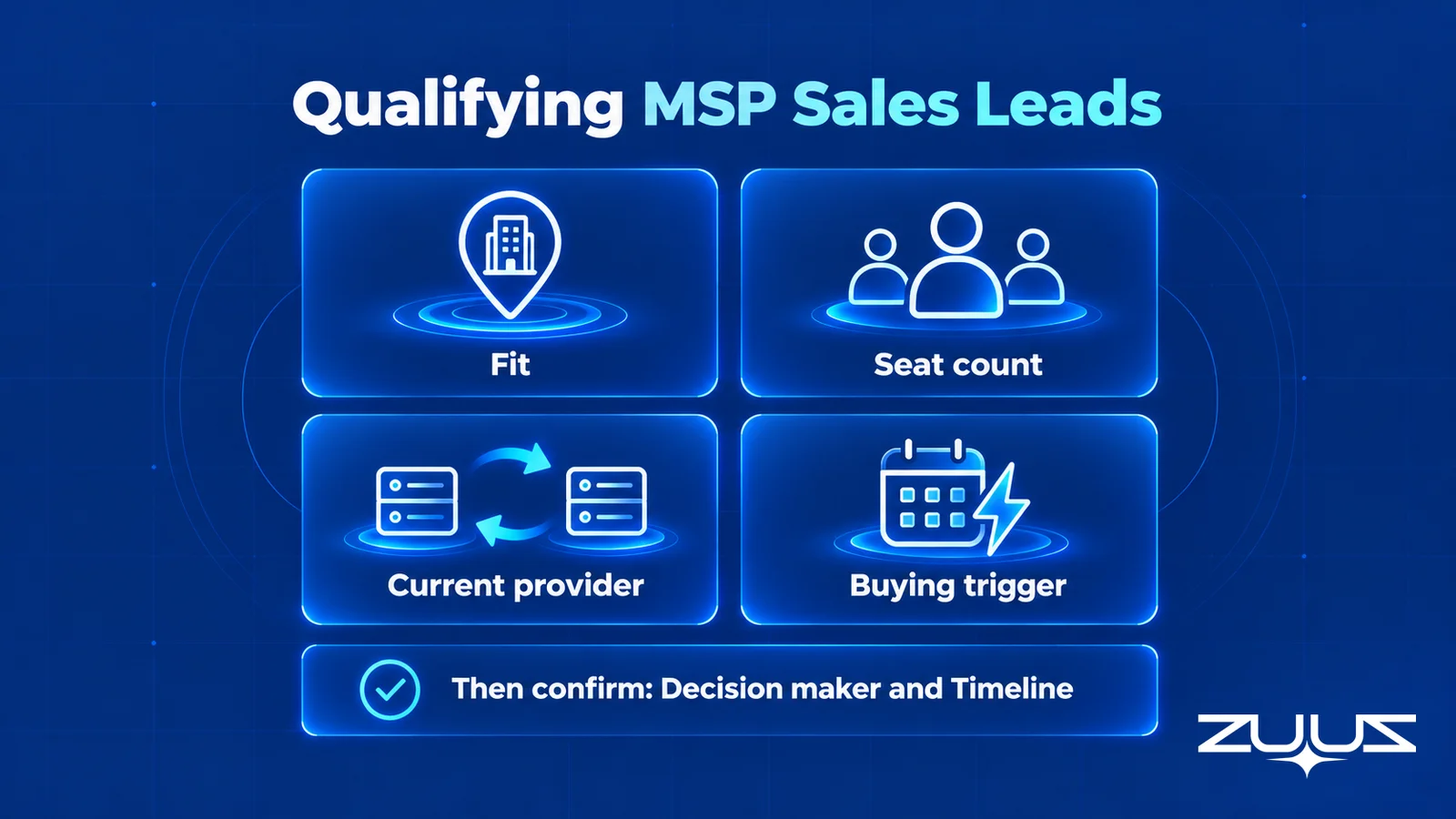
Buying trigger: why now?
Something made the business reach out this month: a breach scare, an insurance questionnaire, an audit, growth, an office move, a key IT person leaving or frustration with the incumbent. A lead with no trigger is usually research and belongs in a slower lane.
Then confirm decision maker and timeline
Then confirm who signs and when a decision is realistic. Tie the timeline to the trigger, not to company size.
| Question | What to ask | Strong signal |
|---|---|---|
| Fit | Does this business match the clients the MSP serves best? | Same industry and region as existing clients |
| Seat count | How many users, devices and locations need support? | Above the MSP's practical minimum, with growth plans |
| Current provider | Who manages IT today? | Leaving an MSP, or an internal IT lead asking for help |
| Buying trigger | What made the business reach out now? | Audit, insurance renewal, office move, contract ending |
| Decision maker | Who signs and who advises? | Owner or managing partner in the conversation |
| Timeline | When does a decision need to happen? | A date tied to the trigger |
Expansion leads skip most of this, because fit and the decision maker are already known.
Qualify the Lead From the Conversation It Arrived In.
ZUUZ reads the referral, the LinkedIn message or the client email and writes fit, contact and next-step details to the CRM record.
MSP Sales Lead Generation Without Cold Outbound
Once capture is reliable, it makes sense to grow the sources that already work. For most MSPs that means relationship channels first, because they produce the leads that qualify fastest. These approaches add MSP sales lead generation without cold outbound.
Make referrals a process, not luck
Ask for referrals at moments of goodwill: after a smooth project, a quick fix to an urgent problem or a strong quarterly business review. Log every referral against the client who made it, so the thank-you happens and the pattern becomes visible.
Treat account reviews as expansion discovery
Quarterly reviews, renewal conversations and routine service check-ins are where clients mention plans. A standing question about hiring, offices, audits and insurance turns those meetings into a source of expansion leads. The guide to MSP account management covers how to run those reviews.
Tell vendors and distributors exactly who to send
Channel partners refer to the MSPs they remember and trust. A one-page profile of industries, region and ideal client size helps, but a fast response to the first referral matters more.
Show up where peers and local businesses meet
Peer groups, local associations and vendor events build the relationships that produce referrals months later. Every introduction should become a record before the badge goes in the drawer.
Match the website and LinkedIn to real buying triggers
Service pages for the triggers buyers search, such as cyber insurance or a provider switch, attract leads with intent, and an owner's LinkedIn presence draws direct messages. Both work only if the inquiries get captured and answered fast.
How to Measure MSP Lead Generation
Counting inquiries tells an MSP very little. The metrics below show whether MSP lead generation is producing pipeline and whether capture is keeping up.
| Metric | How to calculate it | What it reveals |
|---|---|---|
| Qualified leads by source | Leads passing the four questions, by source | Which partners and channels deserve more time |
| Capture rate | Share of commercial conversations that became CRM records | How much demand never reaches the pipeline |
| Time to owner | Hours from first message to an assigned owner | Whether leads wait unseen |
| Lead to opportunity rate | Qualified leads that became opportunities | Whether qualification is honest |
| Leads with no next step | Open leads with no dated next action | Where follow-up has stalled |
Capture rate is the metric most MSPs have never measured. A team that captured half of last month's commercial conversations can double its pipeline potential without a single new lead.
From an operator's seat
From an operator's seat in IT services and distribution, the most valuable leads never looked like leads. They arrived as a client's forward, a distributor's CC or a line at the bottom of a support email, and the warmer the lead, the less formal the channel. The part teams do not plan for is that the service inbox carries more of them than the sales inbox, because clients write to the people who fix things.
Across the deployments ZUUZ runs, the first week of captured leads surprises owners by source more than volume: expansion requests the service desk had already closed as tickets. One named person reviewing captured leads daily beats any team-wide logging rule.
Measure the Leads That Never Became Records.
ZUUZ connects to the mailbox, reads the last 90 days and shows which referral and inbound leads the CRM never recorded.
Inbound and Referral Leads: How ZUUZ Writes Them to the CRM
ZUUZ is revenue intelligence for the IT channel: MSPs and the vendors, distributors and resellers they work with. It reads email, calendar, meetings and LinkedIn messages, finds the deal signals in them, and updates the CRM automatically, with full change history and one-click rollback. For MSP sales leads, the forwarded referral, the distributor introduction, the LinkedIn question and the expansion request each become a lead or opportunity on the right account, with contact, source, need and next step.
The structural difference is where capture starts. Form tools and CRM plugins capture what someone submits or chooses to log; ZUUZ starts from the conversations themselves. It also drafts replies to new leads, which the rep reviews and sends. ZUUZ works on Salesforce, HubSpot, Zoho, Attio and Pipedrive, and the lead capture and lead scoring capabilities sit on top of whichever one the MSP runs.
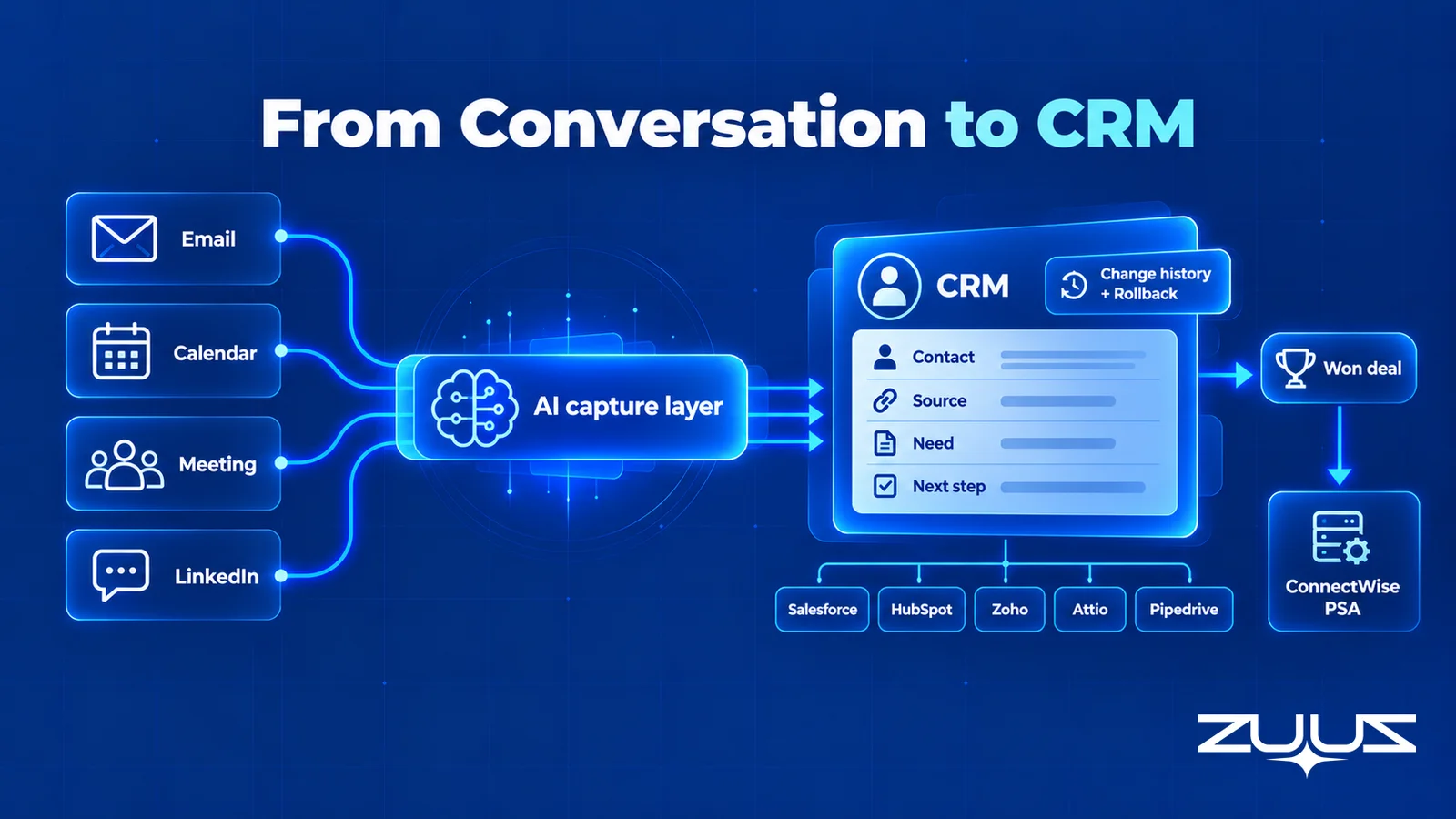
Stage decides how an MSP uses it: an early-stage MSP can use ZUUZ as its AI CRM, building leads, accounts and deals from its conversations, while a later-stage MSP keeps its existing CRM and adds ZUUZ as the intelligence layer on top. In both cases, won customers sync to ConnectWise PSA, so service delivery starts from the same record. The best CRM for MSPs guide covers that choice, and the ZUUZ page for managed service providers shows the setup.
The proof is measured in identified pipeline. RA Technologies, a US IT services company, surfaced $120K of identified pipeline within 72 hours that two years of HubSpot had never recorded.
| Capability | Manual inbox and CRM entry | Web form to CRM | ZUUZ |
|---|---|---|---|
| Client referrals by email | Only if someone logs them | No | Captured from the forward or CC |
| Expansion requests in client email | Usually handled as service work | No | Written to the existing account as a lead or opportunity |
| LinkedIn messages | Rarely | No | Read and written to the CRM |
| Qualification details | Whatever was typed | Form fields only | Contact, need and next step from the conversation |
| Correcting a wrong record | Manual edit | Manual edit | Full change history and one-click rollback |
The limits are clear. ZUUZ does not read PSA tickets, so a request that exists only as a ticket stays in the PSA. It does not run outbound campaigns, produce forecasts or write RFP responses.
MSP Lead Mistakes That Quietly Cost Pipeline
Most lost MSP sales leads trace back to a few habits, none of which needs budget to fix.
- Counting every contact as a lead. Inquiries without fit or a trigger inflate the pipeline.
- Chasing new logos while ignoring expansion. Existing clients produce the fastest-closing leads, and they are the ones most often filed as tickets.
- Capturing without an owner. A lead on a record with no owner and no date is only slightly better than no record.
- Buying more leads before fixing capture. Paying for new demand while referrals sit in an inbox is the most expensive mistake on this list.
A first step that takes an hour
Connect one mailbox to ZUUZ, let it read the last 90 days, and compare the referral, partner and inbound leads it finds with what the CRM recorded. First pipeline typically shows within 72 hours, full rollout takes one to two weeks, and every change carries full change history and one-click rollback. The trial is free for 30 days: https://zuuz.ai/trial
Frequently Asked Questions
What are MSP sales leads?
MSP sales leads are businesses or people who have shown interest in buying managed IT, security, cloud or project services from a managed service provider. They include new prospects and existing clients asking for more. Most arrive through relationships, such as referrals, vendor introductions and LinkedIn messages, rather than through website forms, which makes them easy to miss in the CRM.
Where do MSPs get most of their sales leads?
Referrals are the largest source for most MSPs. A December 2025 MSP Success reader survey found 43% of MSPs named referrals their top acquisition strategy, ahead of cold outreach at 18% and SEO or the website at 16%. Expansion requests from existing clients, vendor and distributor referrals, peer groups, events and LinkedIn messages make up much of the rest.
How do you qualify an MSP sales lead?
Qualify an MSP sales lead on four questions first: fit with the MSP's industries and region, seat or user count, the current provider and the buying trigger. If those check out, confirm the decision maker and a realistic timeline. Expansion leads from existing clients need less, because fit and the decision maker are already known.
What is MSP sales lead generation?
MSP sales lead generation is the work of attracting and capturing businesses that may buy managed services. For most MSPs it centers on referral programs, existing-client expansion, vendor and distributor relationships, events, the website and LinkedIn. Capturing and qualifying the leads that already arrive is part of it, and it is often the part that adds pipeline fastest.
Why are MSP sales leads missing from the CRM?
MSP sales leads go missing because they arrive in channels that do not write to the CRM: forwarded emails, partner CCs, LinkedIn messages, calendar invites and support tickets. Someone has to notice the commercial sentence and type a record, and on a busy service week that rarely happens. The lead is then answered late or not at all.
How fast should an MSP respond to a new lead?
An MSP should respond to a new lead within the hour where possible. Research published in Harvard Business Review in 2011 found firms that contacted web leads within an hour were nearly seven times as likely to qualify them as firms that waited longer. Referral leads are more patient, but a quick first reply still signals reliability.
Should an MSP buy lead lists?
Buying lead lists rarely suits MSPs, because managed services is a trust purchase and a list contact has no relationship or trigger. Most MSPs get better returns by capturing the referrals, partner introductions and expansion requests they already receive, then growing those sources. A list may help with market research, but it is not a substitute for warm leads.
How do vendor and distributor referrals work for MSPs?
Vendors and distributors pass end customers to MSPs that can implement, migrate or support their products. The referral usually arrives as an email thread with a partner manager and the customer copied. MSPs that respond fast, assign a clear owner and report back to the partner tend to receive more referrals over time.
What information should an MSP record for a new lead?
An MSP should record company and contact, lead source, service need, seat or user count, current provider, buying trigger and timing, plus an owner and a dated next step. Those fields are enough to qualify the lead, route it to the right person and see later which sources produce clients worth having.
Can AI find MSP sales leads in email and LinkedIn?
AI can find MSP sales leads in email and LinkedIn when it is connected to those channels. ZUUZ reads email, calendar, meetings and LinkedIn messages, identifies referrals, inquiries and expansion requests, and writes them to the CRM with full change history and one-click rollback. It drafts replies for the rep to send and does not run cold outbound.