
Where Revenue Leakage Starts Before It Reaches Billing
Revenue leakage guides start at billing errors, but a real leak happens earlier, before a deal ever becomes a recorded CRM entry at all. See how.

CEO of ZUUZ. He scaled Cloud Box Technologies from 0 to $25M ARR in IT services and distribution before building ZUUZ. Connect on LinkedIn
TL;DR: Most revenue leakage guides start at billing: missed invoices, pricing errors, uncollected payments. A real amount of revenue leaks earlier than that, when a deal never becomes a recorded pipeline entry at all because the signal stayed in an inbox. ZUUZ closes that earlier gap by reading email and writing the record automatically.
- Most published revenue leakage guides define it at the billing and contract stage: missed invoices, pricing errors, unenforced renewal terms.
- A separate, earlier form of leakage happens before a deal is ever recorded as pipeline, when the signal exists only in an email thread.
- Industry research puts billing-stage leakage at one to five percent of revenue annually, and that figure does not include deals that never became a CRM record to leak from.
- Across the full revenue lifecycle there are four leak points: capture, in-deal, billing, and post-sale renewal. Three of them have an established detection method. The capture stage has none.
- Fixing billing-stage leakage with better contract and invoicing tools does nothing for a deal the CRM never knew existed.
- ZUUZ reads email and writes structured deal records automatically, closing the leak before it reaches the stage most tools are built to fix.
Search for revenue leakage and nearly every result explains the same stage of the problem: billing errors, missed renewal invoices, unenforced contract terms, uncollected payments. All of it happens after a deal has already closed and become a paying account.
A real, separate form of leakage happens earlier and rarely gets named. It is revenue that never became a recorded deal in the first place, because the only evidence it existed was a reply sitting in a sales inbox.
This guide covers both stages, why the earlier one is harder to catch, and what closes it.
What Revenue Leakage Actually Means
Revenue leakage is the unintentional loss of revenue a company was entitled to collect, through process gaps rather than lost deals or market conditions. Industry estimates put it at one to five percent of revenue annually for a typical B2B company, and the figure rises with contract complexity.
Nearly all published material on the topic frames it as a finance and billing problem: unbilled usage, delayed invoicing, misapplied discounts, missed renewal terms. That framing is accurate as far as it goes. It also assumes the deal already exists as a record somewhere, which is not always true.
Billing Stage Leakage: What Most Guides Cover
Billing stage leakage happens after a deal closes. A renewal term goes unenforced, a usage overage never gets billed, a manual handoff between CRM and billing systems drops a line item. These are real, well-documented failure points, and centralizing pricing and contract data in one system meaningfully reduces them.
The tools built for this stage, quote-to-cash platforms, contract management systems, billing automation, all assume the underlying deal record is accurate and complete. That assumption is where the earlier gap starts, and it is the same assumption behind most revenue operations software category maps, which start from the CRM record rather than questioning whether it exists.
Pipeline Stage Leakage: The Gap Before Billing
Pipeline stage leakage happens before a deal becomes a paying account, sometimes before it becomes a CRM record at all. A prospect replies to a proposal sent months ago. A distributor emails a bulk reorder request. A renewal conversation happens in a thread with a procurement contact who was never added as a contact.
None of this shows up in a revenue leakage audit built around billing data, because the deal never reached the stage an audit starts from. The leak happens earlier than the tools built to catch leakage are designed to look.
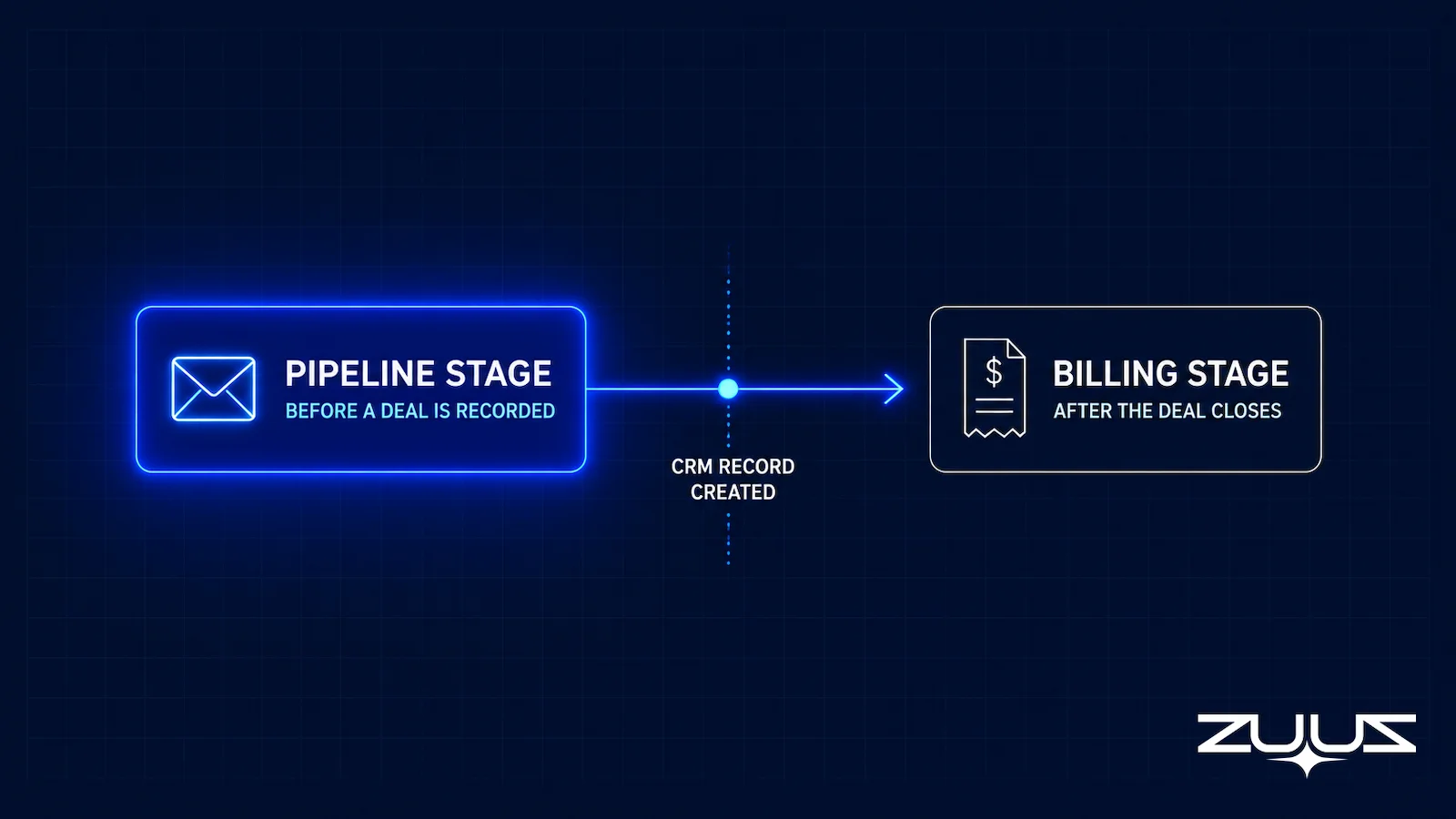
The distinction matters because the two stages need different fixes. Billing stage leakage needs better contract and invoicing discipline. Pipeline stage leakage needs a way to capture the signal before the CRM record exists, not after.
Find the Leak Before It Reaches Billing.
ZUUZ runs a historical lookback across a connected inbox to show what never became a CRM record. Book a 15-minute walkthrough.
How to evaluate a fix for revenue leakage
- Which lifecycle stage does it inspect – capture, in-deal, billing or renewal? Most tools cover one.
- Can it see a deal that never became a record, or does it only validate rows that already exist?
- Is there a capture layer on the channels where deals actually move – sales inbox, LinkedIn messages, meeting and call transcripts – or does detection start at the CRM?
- Does what it finds land in CRM fields a report can read, or in a dashboard nobody owns?
- Is the measurement repeatable on a schedule, or is it a one-off audit?
- Who owns the remediation once the number exists, and can a rep correct an entry before it is written?
Where Revenue Leaks Across the Full Lifecycle
Two stages are enough to make the argument. An ops team running a real audit needs a finer map, because money goes missing at four separate points between a first inbound signal and a renewal invoice, and each point has a different owner, a different detection method, and a different chance of being noticed at all.
Capture stage: before a record exists
A prospect replies to a proposal sent months ago. A distributor asks for pricing on a reorder. A dormant account resurfaces through a forwarded thread. Nothing enters the CRM, so nothing enters pipeline, reporting, or any review built on top of them. Salesforce puts manual data entry at 13 percent of the sales workweek, with 60 percent of that week going to non-selling work, which is the mechanical reason capture fails: the recording step competes with selling time and loses.
Capture stage leakage is the only kind that leaves no trace inside the system of record. Every other stage produces at least a row somebody can query.
In-deal stage: the record exists and then decays
A recorded opportunity stalls. The close date gets pushed twice. The champion changes jobs and the conversation continues with a colleague who was never added as a contact. The deal is still on the board, so it looks accounted for, while the account underneath it has gone quiet. US median employee tenure is 3.9 years, and 22 percent of workers have a year or less with their current employer, so losing a contact partway through a long cycle is ordinary rather than exceptional. This leak is detectable, since there is a record to inspect, and it gets missed anyway because pipeline reviews spend their time at the top of the list rather than the bottom.
Billing stage: contract to cash
This is the stage nearly all published material describes: unbilled usage, delayed invoicing, misapplied discounts, terms nobody enforced, a manual handoff between CRM and billing that drops a line item. It is well covered because it is measurable after the fact. Finance can reconcile invoices against contracts and produce a defensible number without anyone having to reconstruct what was said in a conversation.
Post-sale stage: renewal and expansion never pursued
A renewal date passes without a conversation. An expansion signal arrives in a support thread and never reaches sales. The account keeps paying its current amount, so nothing looks wrong on a revenue report, which makes this the second hardest stage to see. Where renewals are tracked in a spreadsheet rather than the CRM, the post-sale stage collapses back into a capture problem: the signal exists, and the system of record does not know about it.
Set the four stages side by side and the coverage asymmetry becomes hard to miss. The stages with a queryable record attract most of the tooling and most of the writing. The one stage with no record at all attracts almost none.
Table 1: Revenue Leakage Across the Revenue Lifecycle
| Lifecycle stage | What leaks | Who typically owns it | How it gets detected |
|---|---|---|---|
| Capture, before the deal exists | Inbound replies, reorder requests, and renewal inquiries that never become a record | Nobody by default. Nominally the rep whose mailbox received it | No standard method. Requires comparing mailbox activity against CRM records for the same window |
| In-deal, after the record exists | Opportunities that stall, lose their champion, or age past the normal cycle length | Sales management and revenue operations | Pipeline review, stage-age reports, last-activity reports |
| Billing and invoicing | Unbilled usage, misapplied discounts, unenforced contract terms, dropped line items | Finance and billing operations | Invoice-to-contract reconciliation and billing exception audits |
| Post-sale renewal and expansion | Renewal dates that pass without a conversation, expansion signals that never reach sales | Customer success and account management | Renewal calendar review and account health reporting |
The rightmost column is the one to read carefully. Three of the four stages have an established detection method an ops person could run this quarter with an export and a spreadsheet. The capture stage has none, which is why it stays open the longest, and why an audit that starts from CRM data cannot find it.
The Pipeline Truth Test
The full audit further down takes a day. This one takes twenty minutes and tells a team whether the audit is worth running.
- Take the top five deals by value in the current quarter.
- For each, find the evidence in the CRM for its stage and close date – a dated, written commitment, not a rep’s assurance.
- Count how many rest on a stage last changed more than two weeks ago.
- A pipeline in which most of the top five lack dated evidence is a forecast of rep optimism. ZUUZ does not forecast; it makes the record underneath the number real.
Worked on a leakage review, the test usually fails in a specific way: the stage is defensible, the close date is not. The commitment behind the date exists – a buyer wrote it in an email – but it was never copied into a field, so the only dated artefact is the stage change a rep made before the last pipeline review. That gap is the same leak as an unlogged deal, one stage later.
Why CRM Cleanup Tools Do Not Catch This
CRM data quality tools deduplicate, validate, and enrich records that already exist. They are built to clean up what is already in the database, not to notice what never made it in. A deal sitting unrecorded in an inbox produces no duplicate, no validation error, and no enrichment opportunity, because there is no record to act on.
This is the same blind spot that shows up in bidirectional CRM sync tools, which sync fields between systems but only for records that exist in both places already. A signal with no CRM counterpart has nothing to sync.
How the Detection Approaches Compare
Three approaches get used to find revenue leakage before it reaches billing: a manual audit run by an ops person, CRM data quality tooling, and a capture layer that reads email directly. They overlap less than their category descriptions suggest, and the differences concentrate at exactly the stage with no established detection method.
A manual audit can see anything a person is willing to read, which makes it the most complete option and the least repeatable one. Data quality tooling is fully repeatable and sees only what is already in the database. A capture layer sits on the mailbox, so it sees deal signal before a record exists, which is the one thing neither of the others can do at the moment it would matter.
Table 2: What Each Detection Approach Can and Cannot See
| Approach | What it inspects | What it can see | What it cannot see |
|---|---|---|---|
| Manual audit | Mailbox exports and CRM exports, joined by hand | Unrecorded threads, stalled deals, missing contacts, anything a reviewer reads | Anything outside the sampled window, and everything that happens between audits |
| CRM data quality tooling | Records already stored in the CRM | Duplicates, malformed fields, missing values, stale contact details | A deal that never became a record, because there is no row to validate |
| Capture layer on the mailbox | Inbound and outbound email as it arrives | Deal signal before a CRM record exists, plus recorded accounts that have gone quiet | Anything discussed outside a connected mailbox, such as a call that produced no follow-up email |
| ZUUZ | The connected sales inbox, LinkedIn messages, and meeting or call transcripts | Leads, stakeholders, next steps and renewal signals before a CRM record exists, written into CRM fields for the rep to approve in one click | Channels that are not connected; it does not replace the CRM it writes into, and it does not inspect invoices or contracts |
The practical implication is about sequencing. Running the manual audit first tells a team how large the capture gap is and whether automating it is worth anything. Buying data quality tooling first improves the records that exist without changing how many of them exist, which is a real improvement aimed at a different problem.
How to Audit for Pipeline Stage Leakage
A billing-stage revenue leakage audit checks invoices, contracts, and payment records against what should have been collected. A pipeline-stage audit checks something different: whether the sales inbox contains deal activity the CRM has no record of.
The most direct way to run this is a historical lookback across a connected mailbox, comparing what appears in email against what exists in the CRM for the same accounts and time window. The gap between the two is the leak, measured directly rather than estimated. This is a different exercise from measuring the ROI of lead qualification automation, which assumes the leads already made it into a queue to qualify.
Step 1: Fix the window and the population
Pick a closed period long enough to contain a full sales cycle and recent enough that people still remember the deals in it. Ninety days works for most B2B teams. A team with a nine-month cycle should use two full quarters instead, or the audit will flag deals as leaked that are simply still in progress. Then decide whose mailboxes count. A first pass usually covers every quota-carrying rep plus any shared alias such as sales@ or orders@, because shared aliases are where reorder and renewal requests land with no individual owner attached.
Step 2: Pull the email side
Export a list of every external email domain those mailboxes exchanged mail with inside the window, with a message count and the date of the last inbound message from a human sender. A Google Workspace or Microsoft 365 administrator can produce this from an admin export or a mailbox search without anyone reading message bodies at this stage. Then suppress the obvious noise: internal domains, vendors, recruiters, newsletters, ticketing and calendar notifications, and free mail providers used for personal correspondence. Keep the suppression list in version control or a shared sheet, because the audit gets rerun and rebuilding the list each time is where the effort goes.
Step 3: Pull the CRM side
Export accounts, contacts, and opportunities created or modified in the same window, each carrying its email domain. Domain is the join key, not company name. Company names are entered inconsistently by humans and domains are not, so joining on name manufactures false gaps that then have to be argued about. Where the CRM stores only a website field, normalize it before joining: strip the protocol, strip the leading www, lowercase everything, and drop any path.
Step 4: Join the two lists and split the result
A domain-level join produces three buckets. Domains present on both sides are working as intended and need no further reading. Domains present only in the CRM are old accounts with no recent conversation, which is a separate finding worth noting but not the one being measured here. Domains present only in email are the candidate leaks, and the rest of the audit happens inside that bucket.
Step 5: Qualify the email-only bucket
Most of the email-only bucket is not revenue. It is support, logistics, one-off questions, and mail that slipped past the suppression list. Qualification means reading enough of each thread to answer one question: did an external human raise a commercial request that nobody recorded? Threads worth keeping generally contain an inbound reply from a real person and language about price, quote, quantity, availability, renewal, contract, or a purchase order. Threads with no inbound human reply come out of the count, because an unanswered outbound email is prospecting rather than leaked revenue, and mixing the two inflates the result in a way a skeptical CFO will find in the first five minutes.
Step 6: Put a number on what survives
An unsized gap gets ignored. Value each surviving domain using a rule written down before the reading starts, so the estimate cannot be argued backwards from a preferred answer. For a domain that is already a customer, trailing twelve-month revenue is the closest available proxy for what a reorder would have been worth. For a domain that is not yet a customer, the median value of a won deal in the same segment is more defensible than the mean, which a single large deal distorts badly in most B2B datasets. Then multiply the total by the historical win rate for comparable opportunities. Reporting the full unadjusted sum as recovered revenue is the fastest way to lose the room.
Step 7: Read the distribution, not just the total
The total says whether the problem is worth fixing. The distribution says what is causing it, and three cuts do most of the work:
- By mailbox. Leakage concentrated in one or two reps is a habit, and coaching plus a process reminder may close it. Leakage spread evenly across everyone is structural, and coaching will not touch it.
- By entry point. If a shared alias accounts for a disproportionate share, the failure is ownership rather than diligence, because nothing in the system assigns a thread that arrives addressed to no one in particular.
- By week. Clustering at quarter end is the familiar pattern. Recording activity is the first thing dropped when selling time gets tight, so the busiest weeks produce the thinnest records.
What a bad result looks like
Two ratios carry most of the interpretation, and both are internal comparisons rather than published benchmarks. The first run sets the baseline. Later runs are read against it.
The first ratio is capture rate: qualified commercial threads that produced a CRM record, divided by all qualified commercial threads in the window. A figure close to one means the mailbox and the CRM agree about what happened. Anything materially below that is the size of the blind spot, expressed as a share rather than a dollar amount, which makes it comparable across quarters even when deal sizes move.
The second is recording lag: the median number of days between the first inbound commercial message in a thread and the creation of the matching CRM record. Lag matters on its own, separately from capture rate, because a record created three weeks late was invisible to every pipeline review held in between. A team can have a healthy capture rate and still run its forecasts on a picture of the pipeline that is consistently out of date.
Two findings should escalate immediately, whatever the ratios say. The first is any qualified thread from an existing customer with no matching record, since that is money left on the table by an account that had already decided to buy. The second is a thread carrying an inbound commercial request with no reply at all. That is not a recording failure, it is a response failure, and it costs more.
Table 3: A Repeatable Pipeline Stage Leakage Audit
| Step | What to pull | Compare it against | What a bad result looks like |
|---|---|---|---|
| Window and population | Mailbox list for quota-carrying reps plus shared aliases | One full sales cycle of history | Shared aliases left out, so requests that arrived with no owner never enter the sample |
| Email side | External domains, message counts, date of last inbound human message | A suppression list of vendors, recruiters, and automated senders | Raw domain list used unfiltered, burying real signal under support and newsletter traffic |
| CRM side | Accounts, contacts, and opportunities in the same window, keyed by domain | The filtered email domain list | Company name used as the join key, which manufactures gaps that do not exist |
| Qualification | Thread contents for the email-only bucket | Commercial-intent criteria written down before reading begins | Criteria loosened partway through, so the result reflects the reader rather than the mailbox |
| Sizing | Trailing revenue or median won-deal value for each surviving domain | Historical win rate for comparable opportunities | The full unadjusted gap reported as recoverable revenue |
| Distribution | The same gap split by mailbox, entry point, and week | The previous run of the same audit | Only the headline total reported, so the cause stays unknown and the fix is guesswork |
Run once, this produces a number. Run every quarter with the same suppression list and the same qualification criteria, it produces a trend, and a trend is what tells a team whether anything they changed actually worked.
Table 4: Revenue Leakage by Stage, Summarized
| Stage | What Leaks | Typical Cause | What Fixes It |
|---|---|---|---|
| Pipeline stage | Deals that never become CRM records | Signal exists only in email | Automated email signal capture |
| Billing stage | Revenue on deals already closed | Manual handoffs, unenforced terms | Contract and billing automation |
Most companies running a revenue leakage initiative have already invested in the billing-stage fix. Few have measured how much never reached that stage to begin with.
From an operator’s seat
Across the deployments ZUUZ runs, the pattern is that the first lookback finds most of its money in two places nobody audits: replies to proposals that were already marked lost, and renewal questions answered by someone who is not the account owner. Both look like closed business in the CRM, so no report flags them. The part teams do not plan for is whose mailbox to connect first – connecting the top rep surfaces the least, because that rep logs well, while the technical lead and the shared sales alias surface the most. Start there, and expect the first review queue to be dominated by history rather than this week.
Before the Invoice: How ZUUZ Closes the Earlier Leak
ZUUZ is an AI layer on top of the CRM a team already runs – it is never a CRM and never replaces one. Most tools in this category measure leakage against what the rep entered; ZUUZ writes the record the measurement depends on.
RA Technologies, a US-based IT services company, ran HubSpot for two years before connecting its sales inbox to ZUUZ. A 90-day historical lookback across that mailbox surfaced $120,000 in pipeline that had never been recorded in HubSpot at all, replies to old proposals and renewal inquiries that existed only in email.
ZUUZ reads inbound and outbound email, extracts contact, company, and deal signals, and writes structured records back to Salesforce, HubSpot, or Zoho without requiring manual entry. A pipeline risk layer then flags accounts that have gone quiet against their typical cycle length, so a deal that gets captured does not leak a second time by going stale unnoticed.
None of this replaces a billing or contract management system. It closes the stage before those systems ever get a chance to work, since a deal has to exist as a record before any invoice can be issued or missed against it.
Run the Same 90-Day Lookback RA Technologies Ran.
See what your own connected inbox is holding that the CRM never recorded.
Naming the problem precisely matters, because leakage gets used loosely enough to cover discounting, billing errors, and ordinary lost deals in the same breath. The definition that follows is narrower, and the narrower version is the one a capture layer can actually do something about.
A concrete first step
Pick the 90-day window from the audit above and connect one mailbox to it. ZUUZ reads those 90 days and the rep reviews what it found before anything is written into the CRM, so the email-only bucket is qualified by the person who owns the deals rather than by a script. It is a 30-day free trial, no credit card: https://zuuz.ai/trial/
Frequently Asked Questions
What is revenue leakage?
Revenue leakage is the unintentional loss of revenue a company was entitled to collect, caused by process gaps rather than lost deals or market conditions. Industry estimates put typical B2B leakage at one to five percent of revenue annually.
What causes revenue leakage?
Commonly cited causes include billing errors, missed renewal invoices, misapplied discounts, and manual data entry errors between CRM and billing systems. A separate, less discussed cause is deal signal that never reaches the CRM as a record at all, most often when it exists only in an email thread.
How is pipeline stage leakage different from billing stage leakage?
Billing stage leakage happens after a deal closes, through invoicing or contract errors. Pipeline stage leakage happens earlier, when a deal never becomes a recorded CRM entry in the first place, so there is nothing yet to bill correctly or incorrectly.
How do you reduce revenue leakage?
Standard recommendations include centralizing pricing and contract data, automating billing and rebate calculations, and reconciling records regularly. These fix billing stage leakage. Reducing pipeline stage leakage requires capturing deal signals from email automatically, before a record exists to reconcile.
Can CRM data quality tools catch revenue leakage?
CRM data quality tools clean records that already exist through deduplication, validation, and enrichment. They cannot catch a deal that never became a record, since there is nothing in the CRM for them to act on.
How do you measure revenue leakage?
Billing stage leakage is measured by reconciling invoices against contracts and usage records for a closed period, then totaling what was billable but never billed. Pipeline stage leakage needs a different method: export the external domains a sales mailbox corresponded with over a fixed window, export CRM records for the same window, join the two lists on email domain, then qualify the email-only bucket by reading each thread for commercial intent. The output is a capture rate and a sized estimate for that specific company, not an industry average.
What are some examples of revenue leakage?
Billing stage examples include usage that was delivered but never invoiced, a discount applied past its expiry date, a contracted price increase nobody enforced, and a line item lost in a manual handoff between CRM and billing. Capture stage examples look different: a reply to a proposal sent four months ago that nobody logged, a reorder request sent to a shared sales alias with no owner, a renewal question answered inside a thread that never produced an opportunity, and an expansion signal raised in a support conversation that never reached sales.
How much revenue is lost to revenue leakage?
Published estimates put billing stage leakage at one to five percent of revenue annually for a typical B2B company, rising with contract complexity. That range counts only revenue that leaked out of deals already recorded and invoiced. Revenue that never became a record at all sits outside the measurement entirely, so the honest answer for the capture stage is that it has to be measured company by company rather than quoted from a study.
Who owns revenue leakage in a company?
Ownership splits by stage, which is part of why the earliest stage stays open. Finance and billing operations own invoicing errors. Revenue operations usually owns reconciliation and reporting. Sales management owns stalled opportunities. Customer success owns renewals and expansion. The capture stage has no default owner at all, because the signal sits in an individual mailbox and no function is accountable for records that were never created.
What is the difference between revenue leakage and revenue recognition?
Revenue recognition is an accounting question about when earned revenue may be recorded in financial statements, governed by standards such as ASC 606. Revenue leakage is an operational question about revenue a company was entitled to collect and did not. A company can follow recognition rules correctly and still leak, because recognition governs the treatment of revenue that reached the books rather than revenue that never got there.
What does ZUUZ do about revenue leakage?
ZUUZ reads inbound and outbound email, extracts deal signals, and writes structured records to Salesforce, HubSpot, or Zoho automatically. This addresses pipeline stage leakage specifically, closing the gap before a deal ever reaches the billing stage most revenue leakage tools are built for.