
MSP Customer Retention Signals the PSA Never Records
MSP customer retention is decided in client conversations months before a renewal date. Learn the warning signs the PSA and CRM miss and how to catch them.


CEO of ZUUZ. He scaled Cloud Box Technologies from 0 to $25M ARR in IT services and distribution before building ZUUZ. Connect on LinkedIn
TL;DR: MSP customer retention depends on hearing a client drift early, and the earliest signals live in email, meetings and LinkedIn messages long before a ticket, a late payment or a cancellation notice. The PSA records service and the CRM records the renewal date, but neither records what the client said about budget, champion or satisfaction. ZUUZ reads that conversation layer and flags renewal and churn warning signs on the right account, so the account manager acts while the contract is still open.
- MSP customer retention is mostly decided in the months before a renewal date, and the evidence sits in conversations rather than in the PSA.
- Churn warnings arrive as sentences: a new IT lead, a budget review, a competing quote, a thread that stops getting answered.
- Ticket volume and satisfaction scores describe service delivery. They do not say whether a client intends to renew.
- The Renewal Signal Check finds the renewals that will surprise a team by listing which ones have only a date and no conversation behind it.
- Notice windows and auto-renew terms make the real deadline earlier than the contract end date.
- ZUUZ reads client conversations and flags warning signs in the CRM. It does not read PSA tickets, predict churn or score clients.
Picture a managed service provider with ninety clients and a renewal calendar that looks healthy on every dashboard. Ticket times are good, satisfaction is steady, and the agreements show twelve renewals in the next two quarters. Then a client with a clean record gives notice. The account manager is stunned, and the CFO's email from eleven weeks earlier, asking whether the monthly fee could be revisited, is still sitting in an inbox. This scene is an illustration, but the sequence behind it is one of the most common in managed services.
MSP customer retention is usually discussed as a service quality problem. Quality matters, but the clients who leave often leave with acceptable metrics, because the decision was made in a budget review or by a new IT lead the MSP had not met. This guide covers where the early signals live, why neither the PSA nor the CRM holds them, a short audit that finds the renewals most at risk, and how ZUUZ captures the conversations behind them. It is the retention companion to the MSP sales pipeline guide.
Why MSP Customer Retention Is Decided Before the Renewal Notice
Recurring revenue changes what a lost client costs. A new-logo deal that slips is a missed gain. A churned managed services client removes revenue the business has already planned around, along with the account's expansion potential. That is why MSP client retention deserves more attention than it usually gets in a sales process built around new logos.
The trouble with MSP customer retention is timing. By the time a notice arrives, the decision is made. The useful window is the months before, when the client is still talking and can still be persuaded. In that window the signals are conversational. A finance lead asks about the monthly fee. An IT manager mentions that the board wants a vendor review. A new director says the previous provider "was never this expensive." None of these opens a ticket, and none changes a field in the CRM.
To reduce MSP churn, the first question is different from "how is service going." It is "what has this client said recently that the system does not know." For how the PSA and the CRM divide the work and where the client signal falls between them, see PSA vs CRM for MSPs.
The Renewal Signal Check for MSP Customer Retention
The fastest way to see how exposed a renewal base is takes an afternoon. It needs a list of upcoming renewals and access to the account managers' inboxes, nothing else.
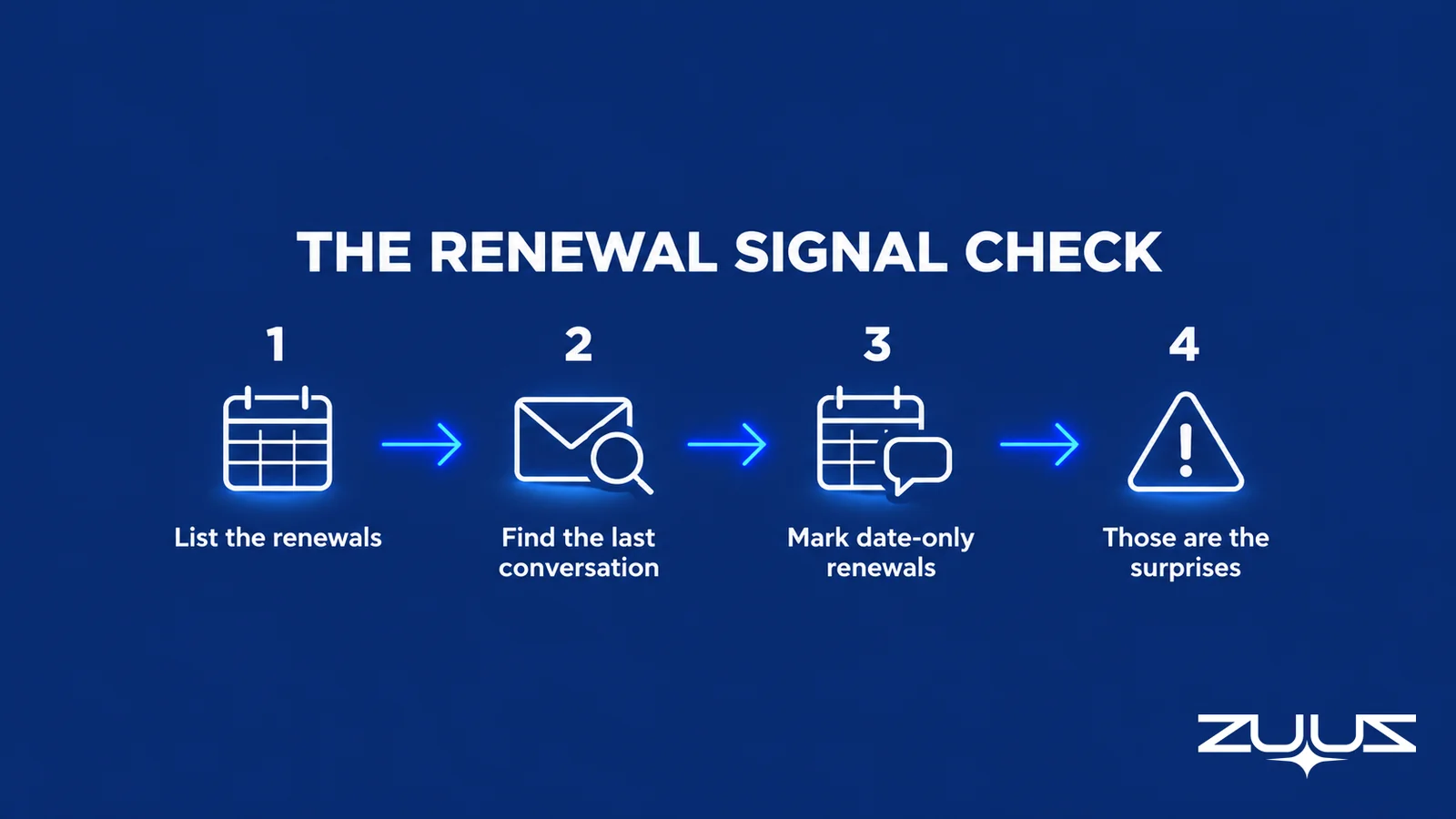
Four steps, run once per quarter. The count in step three is the exposure.
- List every renewal in the next two quarters and its date field.
- For each, find the last real conversation and what it said about budget, champion or satisfaction.
- Mark every renewal where the date is the only thing the system knows.
- Those are the renewals that surprise you; the signal existed, in a mailbox.
Here is a worked example, labeled as an illustration. An MSP lists twelve renewals. For nine of them, a recent conversation exists and the account manager can say who the champion is and whether budget was discussed. For three, the date is the only thing anyone knows, and the last real conversation was a ticket-closure email four months ago. Those three are the renewals that will surprise the team. Their combined value is the number worth bringing to the next sales meeting.
The check is deliberately low-tech. It does not score clients or rank them by risk. It sorts renewals into "somebody has recently talked with this client about it" and "nobody has," which is the distinction that matters before a notice window opens.
Find the Renewals Nobody Has Talked About. Before the Notice Window.
ZUUZ reads the conversation behind each renewal and flags the ones with warning signs.
What the PSA, the CRM, and the Inbox Each Know About a Client
A typical MSP runs a PSA such as ConnectWise, Autotask or HaloPSA, and a CRM such as Salesforce, HubSpot or Zoho. Each holds a different slice of a client, and neither holds the slice that retention depends on.
| System | What it knows | What it does not know |
|---|---|---|
| PSA | Tickets, time, agreements, billing, SLA performance | What the client said about budget, contacts or satisfaction |
| CRM | The renewal date and amount, plus whatever a rep chose to log | Anything the account manager did not have time to type |
| Inbox and meetings | Every conversation, including the warning signs | Nothing in it reaches a report on its own |
The inbox is the only place that holds the full conversational record, and it is the one place nobody reports from. A sales manager cannot filter an inbox for "clients who mentioned a vendor review." A CRM field can be filtered, counted and audited, which is why the signal has to travel from the inbox to the CRM before anyone can manage retention with it.

Churn Warning Signs That Arrive as Sentences
Almost every churn warning that affects MSP customer retention shows up first as a sentence in a conversation. The list below is not a score. It is a set of phrases and events worth routing to the account owner the day they appear.
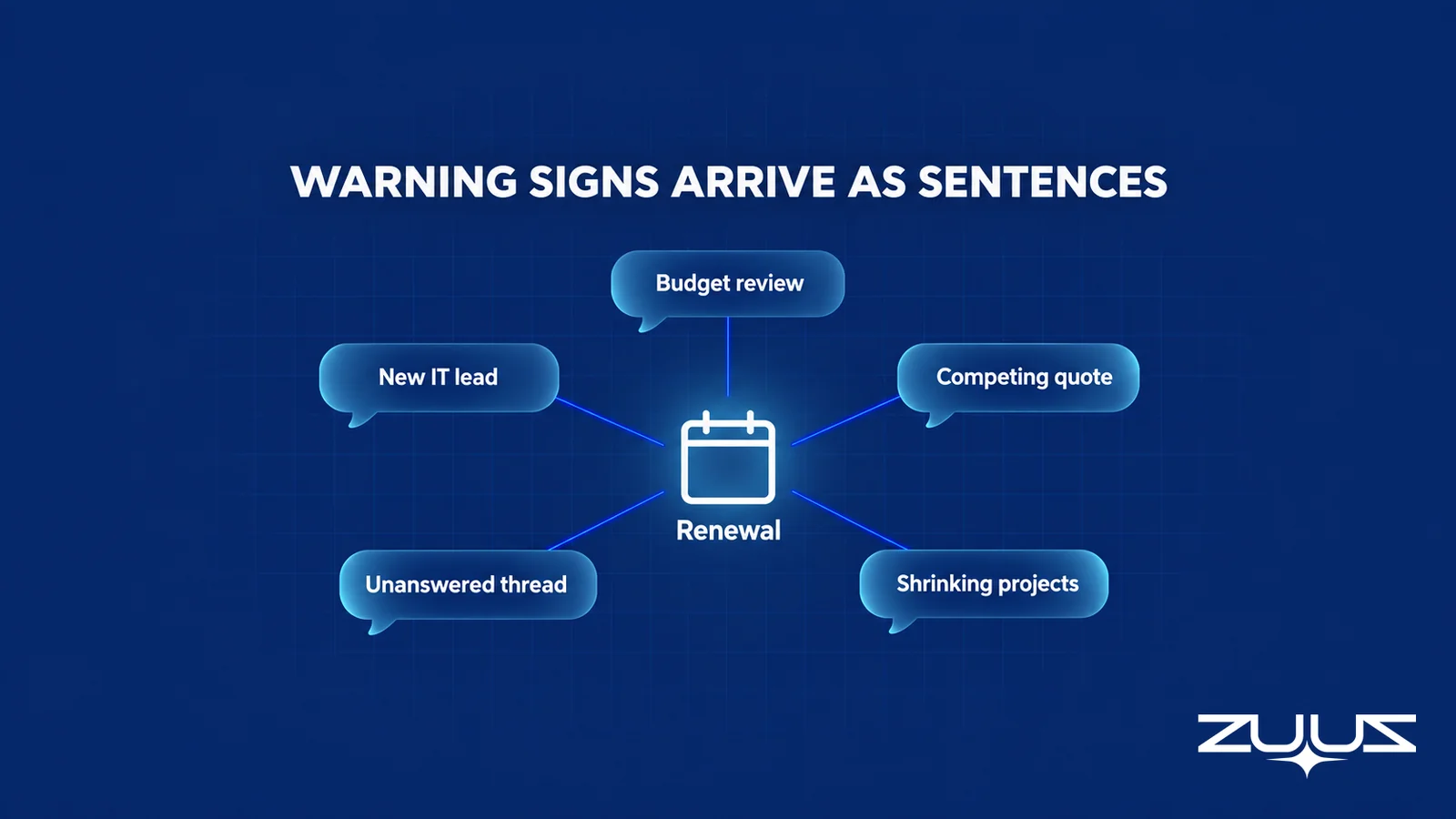
A budget review or fee question
"Finance is looking at all vendor spend this quarter" is a retention event. It arrives by email, usually from someone who is not the main contact, and it rarely produces a ticket.
A new IT lead or decision-maker
A new person with a favorite provider is the most common reason a stable relationship ends. The change appears as a signature line or a LinkedIn message long before the contract is discussed. For capturing it, see logging LinkedIn messages in the CRM.
A competing quote
Clients who request documentation exports, ask about co-termination, or mention that another provider "reached out" are comparing. The sentence is short and easy to miss in a long thread.
A thread that stops getting answers
A client who used to reply within the day and now takes a week is telling the MSP something. No rule can interpret that perfectly, but an account manager who is shown the pattern can ask a better question.
From an operator's seat, the renewals that surprise a team are almost never a surprise to the client. The client has been telling someone for weeks. The recurring failure is routing: the sentence reached an inbox that belonged to a person who had no reason to treat it as a renewal event. Teams that fix retention fix routing first, then conversation quality.
The Warning Was in the Thread. Route It to the Account Owner.
ZUUZ flags renewal and churn warning signs on the right account in the CRM.
Contract Terms Move the Real Deadline
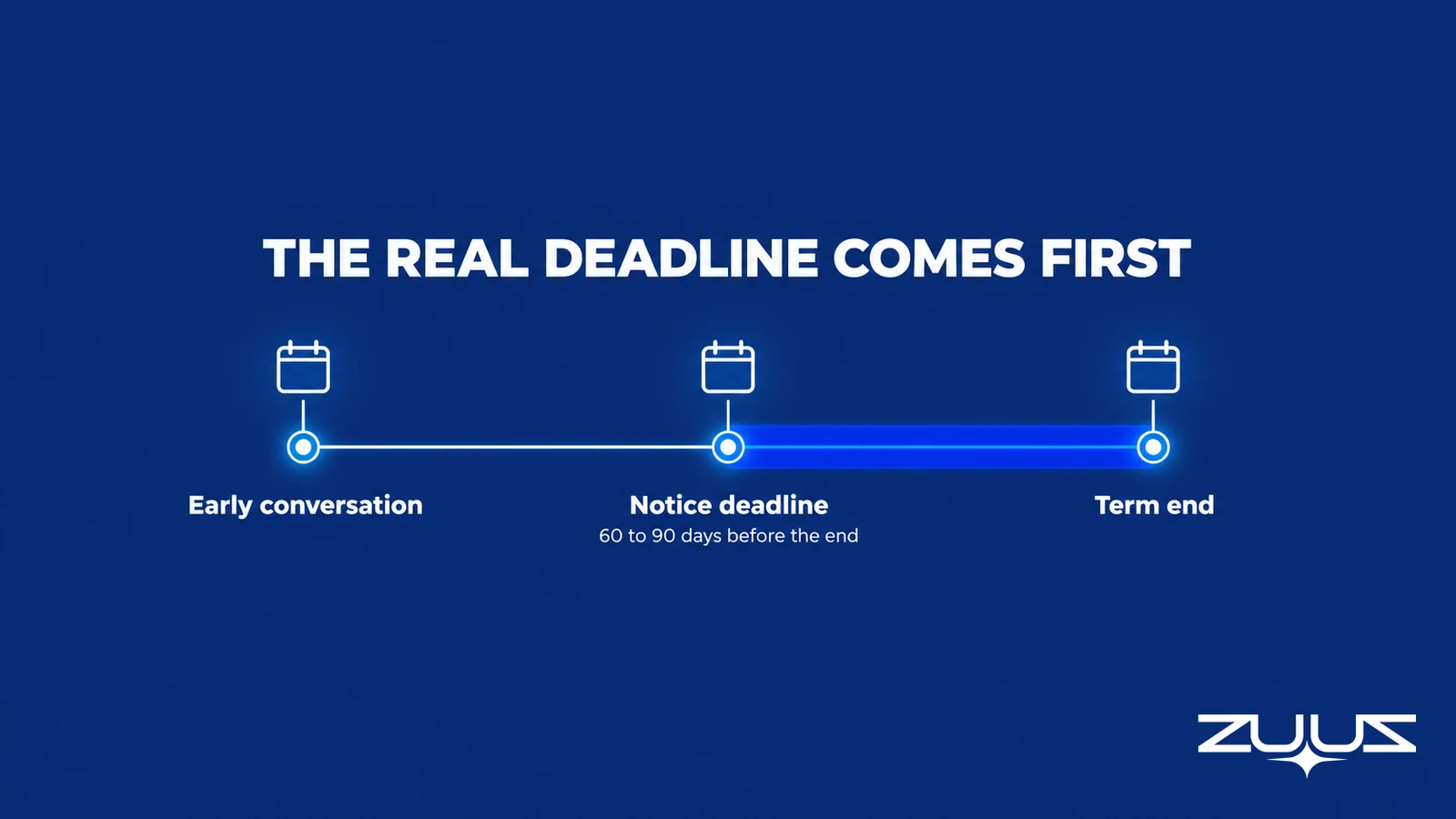
For MSP contract renewals, a date field is rarely the real deadline. Many managed services agreements auto-renew unless the client gives notice, and the notice window is often 60 to 90 days before the term ends. A client who intends to leave has to say so inside that window, which means the conversation that matters happens earlier than the date in the system suggests.
Contract structure adds more distance. Co-terming, where several services align to one end date, means a single renewal conversation covers multiple lines of revenue. Amendments mid-term create dates that differ from the original agreement. An MSP that tracks only the master end date will be early on some accounts and late on others.
For a deeper look at tracking renewals across several products and terms, see how to track renewals across multiple products. For the broader category, renewal tracking software covers what to look for.
The practical rule is to track two dates for each account: the term end and the notice deadline. The notice deadline is the one that should drive when a conversation begins. The date is a trigger, and the conversation is the work.
MSP Customer Retention With ZUUZ, From Conversation to Flag
ZUUZ is an AI layer on top of the CRM an MSP already runs. For MSP customer retention, it connects to the sales inbox and calendar, reads LinkedIn messages without sending anything, and takes in Teams meeting transcripts and inbound call transcripts. It watches those conversations for renewal and churn warning signs and flags them on the right account in Salesforce, HubSpot, Zoho, Attio or Pipedrive.
Each flag arrives as a prepared record that shows the account, the sentence it came from and why it matters. The account manager reviews it, edits if needed, and approves it in one click. Manual entries take precedence over anything captured, and keyword filtering keeps out-of-scope threads out. Reporting shows what actually happened: renewals due, pipeline at risk in dollars, and what changed on each account.
What is structurally different is that nothing here requires a new habit. The account manager does not log a note, tag a thread or remember a BCC. ZUUZ does not replace the PSA, does not migrate the CRM, and does not send messages to clients. It reads the conversations the team is already having and brings the warning signs to the account owner.
What the evidence says so far
At Cloud Box Technologies, a UAE-based cloud and IT services business, 10 to 12 renewals are tracked in minutes from a single connected user, and leadership sees live pipeline without asking for it. The founder, Avinash Gujje, scaled Cloud Box from $0 to $25M ARR in IT services and distribution before building ZUUZ.
RA Technologies, a US IT services company, ran ZUUZ on the HubSpot instance it had used for two years, with the same team, and $120K in pipeline was surfaced in the first 30 days that the CRM had never seen. The result was captured from the sales mailbox, and it is described on the RA Technologies case study. Two customers do not make a benchmark, but both are services businesses where the signal lives in email.
| Approach | What it sees | When the team learns |
|---|---|---|
| PSA reports | Ticket volume, SLA performance, satisfaction | After service patterns shift, often late |
| CRM renewal date field | The term end and amount | On the date, or when a rep checks |
| Periodic business reviews | What the client chooses to say in the room | On the review calendar |
| Account manager memory | Whatever was remembered | When someone happens to think of it |
| ZUUZ conversation capture | Warning signs in email, meetings, calls and LinkedIn messages | When the conversation happens, for the rep to approve |
Warnings Reach the Right Account. While the Contract Is Open.
Connect one mailbox and see which renewals have a conversation behind them.
What This Approach Does Not Do
An MSP customer retention process should be honest about what it cannot see. ZUUZ does not read PSA tickets today, so an MSP that wants ticket-driven signals will need those from the PSA itself. A ConnectWise PSA integration is on the ZUUZ roadmap, with no date, and nothing in this guide should be read as a delivery promise.
ZUUZ also does not predict churn, assign scores to clients or forecast revenue. A flag is a pointer to a conversation, not a probability. The account manager still decides what the sentence means and what to do about it. That keeps the judgment where the relationship is.
A team that wants the sales-side picture can read MSP sales automation, which covers the data entry reps skip, and MSP account management, which covers what an account record needs to survive a handoff. For churn across other industries, see churn risk software.
Run the Check on One Mailbox
The simplest test of how exposed MSP customer retention is lies in running the Renewal Signal Check by hand, then connect one real mailbox and compare. ZUUZ reads the previous 90 days on first connection, so the conversations behind the next two quarters of renewals are already in scope. The gap between what the CRM knows and what clients said becomes visible within minutes.
- Pick the account manager who owns the most renewals in the next two quarters.
- Run the Renewal Signal Check by hand for those renewals and note which are date-only.
- Connect the mailbox and the CRM, and review the flags the same day.
- Compare the date-only list with the flagged accounts, and assign owners before the notice windows open.
The cluster page for this vertical is CRM automation for managed service providers. Teams running similar renewal-heavy models in resale and distribution can read renewal tracking software for VARs and distributors.
Frequently Asked Questions
What is MSP customer retention?
MSP customer retention is the work of keeping managed service clients through each renewal and expanding what they buy. Because MSP revenue is recurring, retention shapes growth more than new-logo wins. The earliest evidence of a client drifting usually appears in conversations about budget, contacts and satisfaction rather than in tickets or invoices.
Why do MSP clients churn?
Clients leave for reasons that surface in conversation first: a budget review, a new IT lead with a favorite vendor, a competing quote, a rocky project, or an account manager who stopped checking in. Service quality matters, but many churned clients had acceptable ticket metrics. The decision was made in meetings the MSP was not part of.
How do you reduce MSP client churn?
Hear the warning signs while the contract is still open. List every renewal in the next two quarters, find the last real conversation behind each one, and mark the renewals where the date is the only thing the system knows. Then assign a named person to reach out on those accounts before the notice window.
What are the early warning signs of MSP churn?
Common signs include a new IT lead or finance owner, a client asking how to export their documentation, mentions of a vendor review, a competing quote, shrinking project requests, and threads that go unanswered. Each arrives as a sentence in email, a meeting or a LinkedIn message, which is why the PSA and a date field both miss it.
Can ticket data and CSAT predict MSP churn?
Ticket volume and satisfaction scores describe service delivery, and they are worth tracking, but they do not say whether a client plans to renew. A client with clean metrics can still be leaving because of price or a new decision-maker. ZUUZ does not predict churn. It captures what the client said so the account manager can act on it.
How does ZUUZ help with MSP customer retention?
ZUUZ connects to the sales inbox and reads LinkedIn messages, Teams meeting transcripts and call transcripts, then flags renewal and churn warning signs on the right account in the CRM. The account manager sees the conversation behind each flag and approves the record in one click. The CRM stays the system of record.
Does ZUUZ read PSA tickets to spot churn risk?
No. ZUUZ does not read PSA tickets today, and it does not score or predict churn. It works from client conversations: email, calendar, LinkedIn messages and meeting or call transcripts. A ConnectWise PSA integration is on the ZUUZ roadmap, with no date, so retention decisions should not wait on it.
How early should an MSP start a renewal conversation?
Earlier than the notice window in the agreement, which is often 60 to 90 days before the end date for auto-renewing contracts. The effective deadline is the notice date, not the term end. Starting at six months gives the account manager time to resolve concerns that surface in the first real conversation.
What does a renewal tracker need beyond the date?
It needs the last conversation, the named champion, the budget owner, and any stated concern, each tied to the account. A date alone tells the team when a contract ends, not whether the client is likely to stay. ZUUZ captures these fields from email and meetings and writes them to the existing CRM.
Which CRMs does ZUUZ write renewal signals to?
ZUUZ writes to Salesforce, HubSpot, Zoho, Attio and Pipedrive, and an MSP can run more than one at once. There is no CRM migration. At Cloud Box Technologies, a UAE-based IT services business, 10 to 12 renewals are tracked in minutes from a single connected user, with leadership seeing live pipeline.