
Best Clari Alternatives for Sales and RevOps Teams
See the best Clari alternatives now that Clari and Salesloft have merged, grouped by category, with pricing context and the option most lists skip.
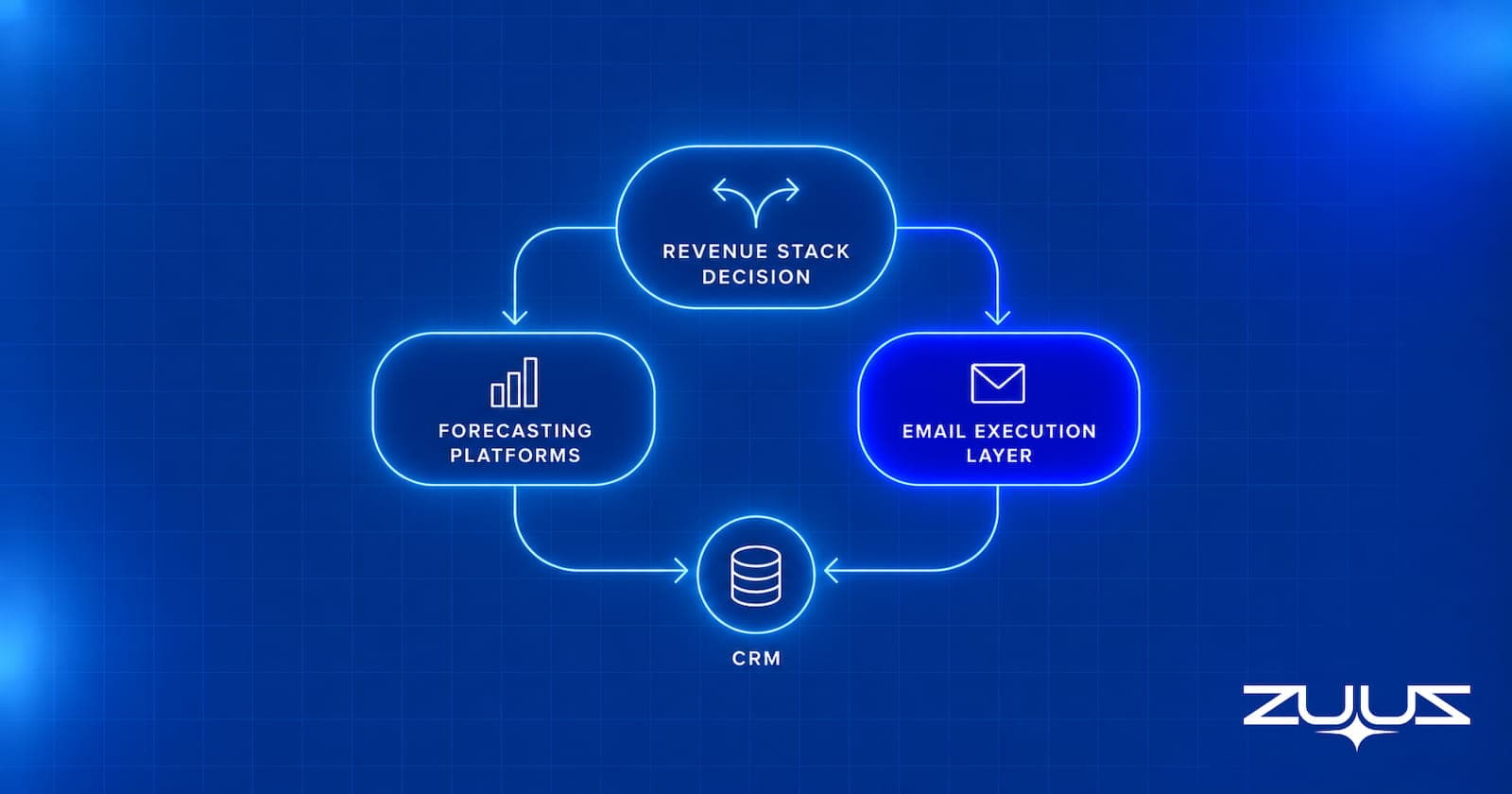
- Clari and Salesloft completed their merger on December 3, 2025 and now operate as one company under CEO Steve Cox, building what the combined business calls a Predictive Revenue System.
- Teams evaluate Clari alternatives for three factual reasons: quote-only pricing, a platform scope that keeps expanding since the merger, and fit between forecasting, engagement, and execution.
- The direct forecasting and revenue-intelligence peers are Gong and Aviso, both of which combine call and email signal with pipeline scoring.
- Teams standardized on Salesforce often compare Salesforce’s own Revenue Intelligence and Agentforce, or Revenue Grid, before adding a separate forecasting platform.
- ZUUZ sits in a different category entirely. It does not forecast or score pipeline. It reads email, extracts deal signals, and writes them to Salesforce, HubSpot, Zoho, Attio, or Pipedrive.
- The right pick depends on what is actually being replaced, forecasting, pipeline inspection, or CRM execution, not on which tool has the longest feature list.
A revenue operations lead searching for Clari alternatives in 2026 is not asking the same question they would have asked a year ago. Clari and Salesloft completed their merger on December 3, 2025, and the two products that used to sit in separate categories, forecasting on one side and sales engagement on the other, now report to the same company under CEO Steve Cox.
Most existing roundups of Clari competitors were written before that closed, and it shows. They still frame the choice as forecasting tool versus forecasting tool, without mentioning that Clari’s own scope, and its pricing, changed the moment the merger completed.
This guide describes Clari factually as it exists today, lays out why teams still look for alternatives, covers Clari pricing directly, and groups the real options by category so the choice maps to what a team is actually trying to replace. It also names the category most lists leave out entirely, the email-signal and execution layer where ZUUZ sits. Teams comparing sales engagement platforms rather than forecasting tools are often having a different conversation, mapped out in the guide to Salesloft alternatives, which now overlaps meaningfully with this one.
What Changed With the Clari-Salesloft Merger
Clari built its name on AI-driven revenue forecasting and pipeline inspection, the software layer that gives RevOps leaders a rolling view of which deals are likely to close. On December 3, 2025, Clari and Salesloft completed a full merger, appointing Steve Cox as CEO of the combined company to build what they call the first Predictive Revenue System.
What the Merger Actually Combined
The combined entity now serves more than 5,000 customers on a platform that spans Clari’s forecasting and pipeline intelligence, Salesloft’s sales engagement and cadence tooling, and Clari Groove, the sales engagement product Clari itself had already acquired in 2023. A first integrated release connecting Clari’s forecasting into Salesloft’s execution layer shipped in April 2026.
What Clari Now Competes With
That combination matters for anyone shopping alternatives, because the comparison set got wider the day the merger closed. A team once comparing Clari only against other forecasting tools is now implicitly comparing it against sales engagement platforms too, since Clari’s own product line does both. Most Clari alternative articles published before December 2025 still compare against the narrower, pre-merger product, which is the specific gap this guide is written to close.
Why Teams Evaluate Clari Alternatives
Three factual reasons drive most Clari alternative searches. None of them require claiming the product does not work well. They are about whether the combined platform matches a given team’s budget, scope, and the surface where deals actually move.
Quote-Only Pricing
Clari does not publish per-seat pricing on its site and directs buyers to request a quote, a structure that predates the merger and has not changed since. That model fits organizations buying into the full forecasting-plus-engagement platform and prompts smaller teams to compare options with clearer, published pricing instead.
Expanding Platform Scope
The Salesloft merger adds cadence execution and conversation intelligence on top of forecasting and pipeline inspection. A team that only needed forecasting may now find itself evaluating, and paying for, a broader combined platform than the specific problem requires.
Fit for Email-Driven Motions
Clari and its forecasting peers are built to score deals that are already logged in the CRM. They read structured pipeline data well, but the reply with a pricing question, the forwarded purchase request, or the renewal mention that arrives by email and never makes it into the CRM stays invisible to a forecast no matter how good the model is. As covered in how to fix missed sales leads in email, the deals that slip are usually the ones a forecasting tool never sees in the first place.
These three reasons overlap in practice. A mid-market IT services team might start comparing Clari alternatives because the quote outpaced budget, then realize during evaluation that forecast accuracy was never the real gap.
The forecast was only ever as good as the pipeline data feeding it, and that data was already stale before Clari or any competitor touched it. A CRM pipeline that is wrong produces an inaccurate forecast regardless of which forecasting engine sits on top of it.
Fix the Input Before You Fix the Forecast.
ZUUZ connects to the sales inbox, extracts the deal signal from threads in both directions, and writes it to Salesforce, HubSpot, Zoho, Attio or Pipedrive. See it run on your own inbox in 15 minutes.
Clari Pricing
Clari pricing has always been quote-based rather than published, and the merger has not changed that. What has changed is what a quote now covers, since Core forecasting, Copilot conversation intelligence, and Groove sales engagement can all be bundled into a single enterprise contract.
Does Clari Publish Its Pricing?
No. Clari’s pricing page directs every prospect to request a quote rather than listing per-seat rates, and that has been true both before and after the Salesloft merger. Buyers evaluating Clari pricing should expect a sales conversation before seeing a real number, which is itself one of the most common reasons smaller teams start comparing alternatives.
What to Compare Beyond the Quoted Number
A quote-only structure makes it easy to compare the wrong thing. Before treating any Clari competitor’s number as comparable, confirm what modules are actually included: forecasting, conversation intelligence, sales engagement, CRM integrations, implementation, and contract minimums all vary by vendor and by tier.
A Public Reference Point
Not every alternative hides its number. Salesforce lists Revenue Intelligence, a comparable pipeline-inspection and forecasting capability, at $220 USD per user per month billed annually (2026), with a $250 tier that adds Tableau. That public figure is a useful anchor for judging whether a quote-only competitor’s eventual number is in the same range or well above it.
Clari Alternatives by Category
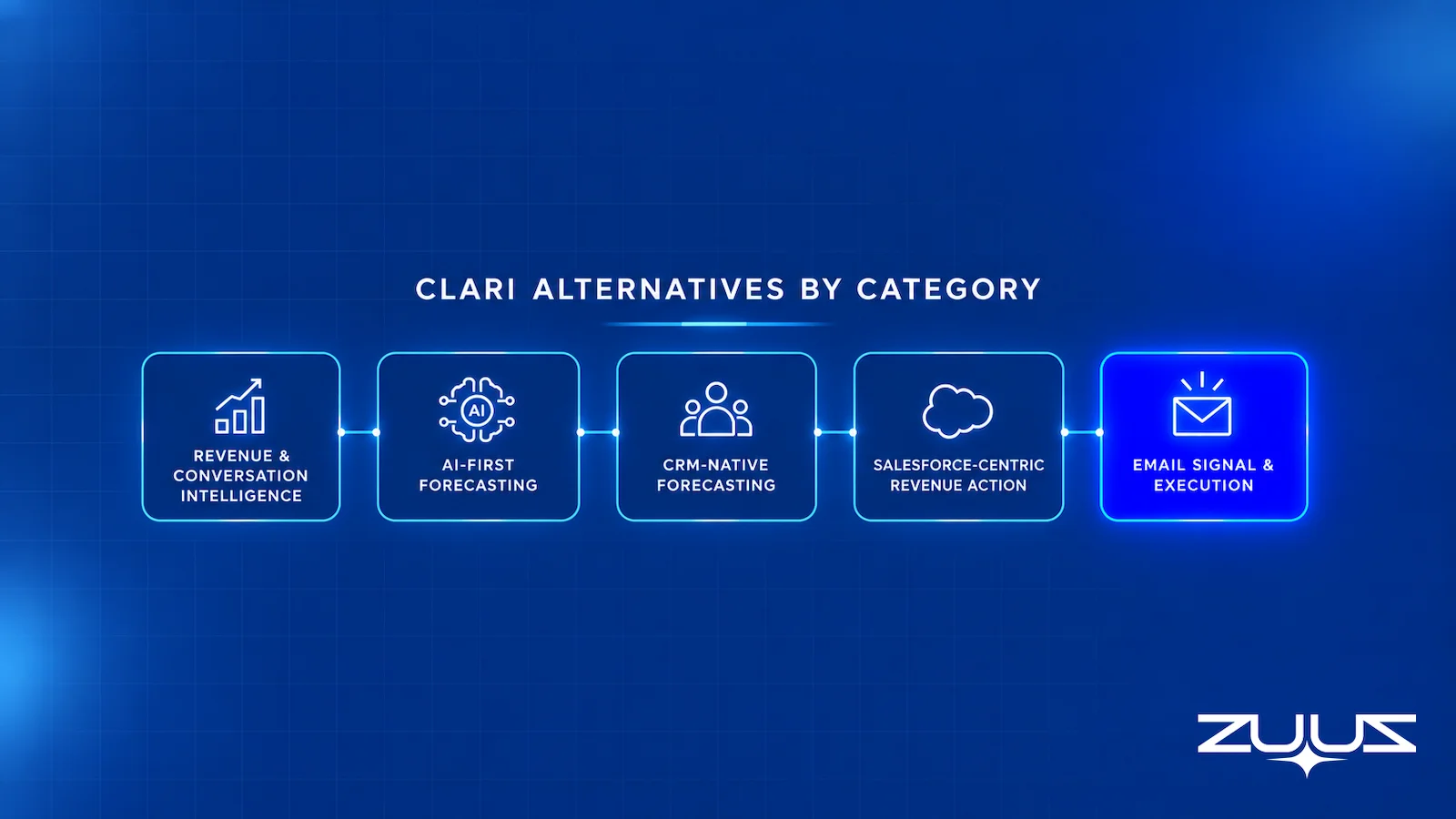
The fastest way to shortlist is by category, because a forecasting engine, a CRM-native option, and an email-signal layer solve different problems. Below is a factual map of the main names in each, matching the real Clari competitors buyers evaluate.
Revenue and Conversation Intelligence
These tools compete most directly with Clari’s forecasting core, often adding call and email analysis as the input to the score.
- Gong is a revenue intelligence platform built around conversation analysis, pipeline management, and forecasting drawn from calls and emails, frequently evaluated head to head against Clari for its depth on the call-intelligence side.
A closer breakdown of where Gong fits on its own, separate from the Clari comparison, is covered in the guide to Gong alternatives.
AI-First Forecasting and Pipeline Inspection
This is the closest direct comparison for a team whose only reason for buying Clari was forecast accuracy and pipeline risk scoring.
- Aviso is an AI-based revenue operations and forecasting platform that scores deals and projects pipeline outcomes, evaluated by teams that want forecasting depth without the combined Clari-Salesloft engagement scope.
CRM-Native Forecasting
These options live inside a CRM a team already runs, trading a dedicated forecasting product for lower total cost and one less platform to administer.
- Salesforce Sales Cloud with Agentforce and Revenue Intelligence adds pipeline inspection, AI-assisted forecasting, and agentic workflows directly inside Salesforce, appealing to teams that want to avoid a separate revenue platform entirely.
Salesforce-Centric Revenue Action
A narrower category for teams that want Clari-style visibility without leaving their existing Salesforce instance.
- Revenue Grid is a Salesforce-native revenue platform combining pipeline visibility, activity capture, and forecasting, positioned for teams that want the intelligence layer built on top of Salesforce rather than alongside it.
ZUUZ’s Take

Email Signal and Execution
This is the category most Clari alternative lists leave out, and it is where ZUUZ sits. Instead of forecasting from records already in the CRM, this category reads the email that never made it into a record at all and writes it there automatically. The section below covers why this category matters and how ZUUZ approaches it.
Clari Alternatives Comparison Table
The table maps each option to its category, primary strength, and the team it fits best. It is built for shortlisting by what is being replaced, not for ranking tools that do different jobs against one another.
| Tool | Category | Primary Strength | Best-Fit Team |
|---|---|---|---|
| Clari | Forecasting / revenue platform | Pipeline forecasting now merged with Salesloft engagement | Teams wanting forecasting and engagement together |
| Gong | Revenue / conversation intelligence | Call and email analysis feeding pipeline scoring | Teams whose deal risk shows up in conversations |
| Aviso | AI forecasting / RevOps | Deal scoring and pipeline projection | Teams wanting forecasting without the full Clari-Salesloft scope |
| Salesforce (Agentforce + Revenue Intelligence) | CRM-native forecasting | Pipeline inspection and AI forecasting built into Salesforce | Salesforce-first teams avoiding a separate platform |
| Revenue Grid | Salesforce-centric revenue action | Activity capture and forecasting layered on Salesforce | Teams wanting Clari-style visibility inside Salesforce |
| ZUUZ | Email signal and CRM execution | Inbound email deal-signal capture, auto CRM updates | Email-driven teams wanting an accurate CRM to forecast from |
Not a Forecasting Engine. The Layer That Feeds One.
Connect Salesforce, HubSpot, Zoho, Attio, or Pipedrive and let ZUUZ capture the email signals that Clari, Gong, or Aviso never see. Start free, with no integration project required.
The Category Most Clari Alternative Lists Skip
Almost every Clari alternative roundup compares forecasting engines to each other. That makes sense when the entire question is which model scores pipeline most accurately. It misses the step before scoring even happens, which is whether the deal made it into the CRM as a record at all.
In distribution and IT services, a single week can generate a reply with a pricing question, a forwarded RFP from procurement, and a renewal mention from an existing account, all arriving as email rather than as CRM activity. A forecasting tool, however sophisticated, scores what is already recorded. It does not read what came back and was never entered.
The result is a forecast that reflects which deals were logged rather than which deals are actually moving. As explored in the guide to revenue intelligence software, that gap sits upstream of the forecasting layer entirely, in the data the forecast is built on.
There is a second reason this category rarely appears on Clari competitor roundups. Most of those lists are published by forecasting or engagement vendors comparing themselves to a peer in the same category. None of them solves the inbound capture problem, so none of them raises it as a category worth naming.
Email Signal Versus Revenue Forecasting
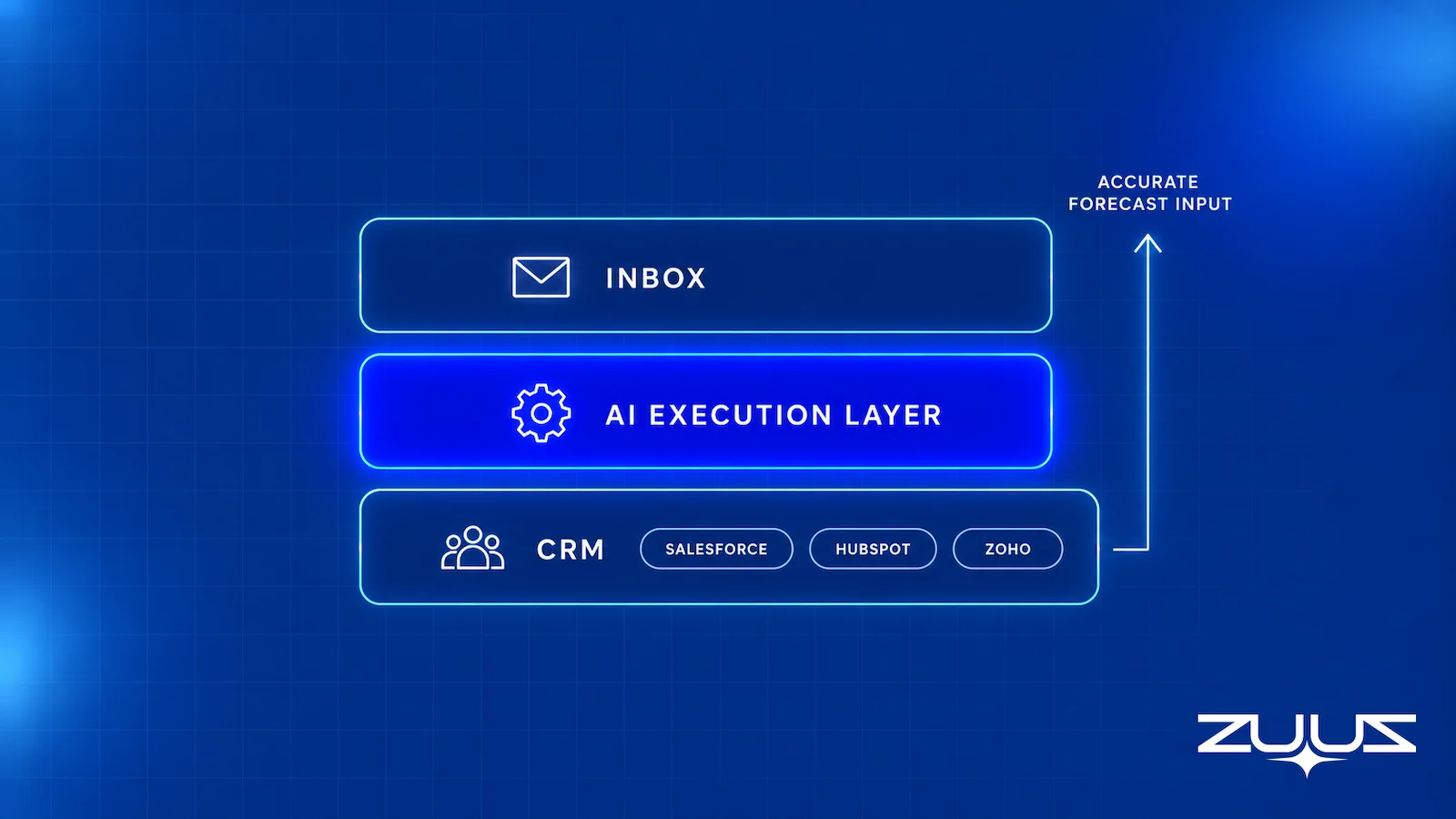
The cleanest way to hold the distinction is by the question each layer answers. A forecasting tool like Clari, Gong, or Aviso answers which deals in the CRM are likely to close and when. An email-signal layer answers whether a deal that is moving right now has even made it into the CRM yet.
One scores the record. The other creates the record the score depends on. For a team running sales pipeline management software on top of incomplete data, the second question determines how much the first one can be trusted.

Email Signal and Execution: How ZUUZ Replaces Manual CRM Work
ZUUZ is not a Clari clone, and it is honest to say so up front. ZUUZ does not build a forecast, score deal risk, or project pipeline outcomes. It works on a different surface: the inbound and outbound email that a forecasting tool assumes is already reflected in the CRM.
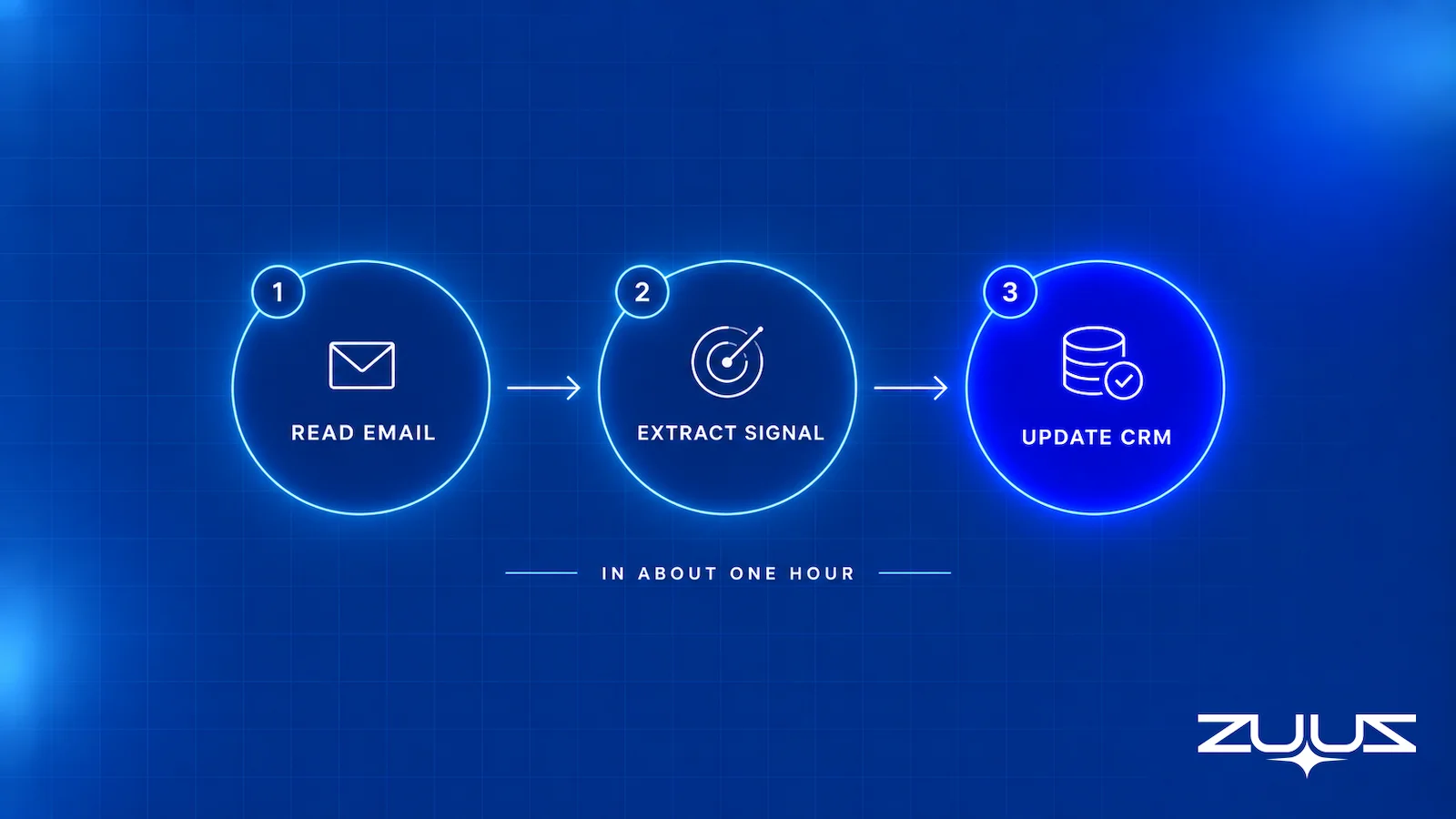
ZUUZ reads inbound and outbound email, extracts deal signals such as renewals, expansion requests, pricing questions, and new opportunities, and writes structured records to Salesforce, HubSpot, Zoho, Attio, or Pipedrive. Every update carries a full change history with one-click rollback, so reps no longer perform manual CRM entry.
The work that used to take four to six clicks per email moves to the background. ZUUZ also handles email lead qualification automation, scoring and routing inbound interest as it arrives, whether that interest came from a Clari-scored account, a referral, or an inbound form.
CRM-Agnostic by Design
The CRM-agnostic design is the differentiator. ZUUZ runs natively on Salesforce, HubSpot, Zoho, Attio or Pipedrive, so teams that run different systems across divisions, or that are mid-migration, are not forced onto a single platform the way a deep Salesforce-native tool would require.
It connects to whatever is already in place and writes data back through a bidirectional CRM sync rather than a one-way import. The guide to automated sales pipeline software covers the pipeline layer ZUUZ keeps current.
What This Looks Like in Practice
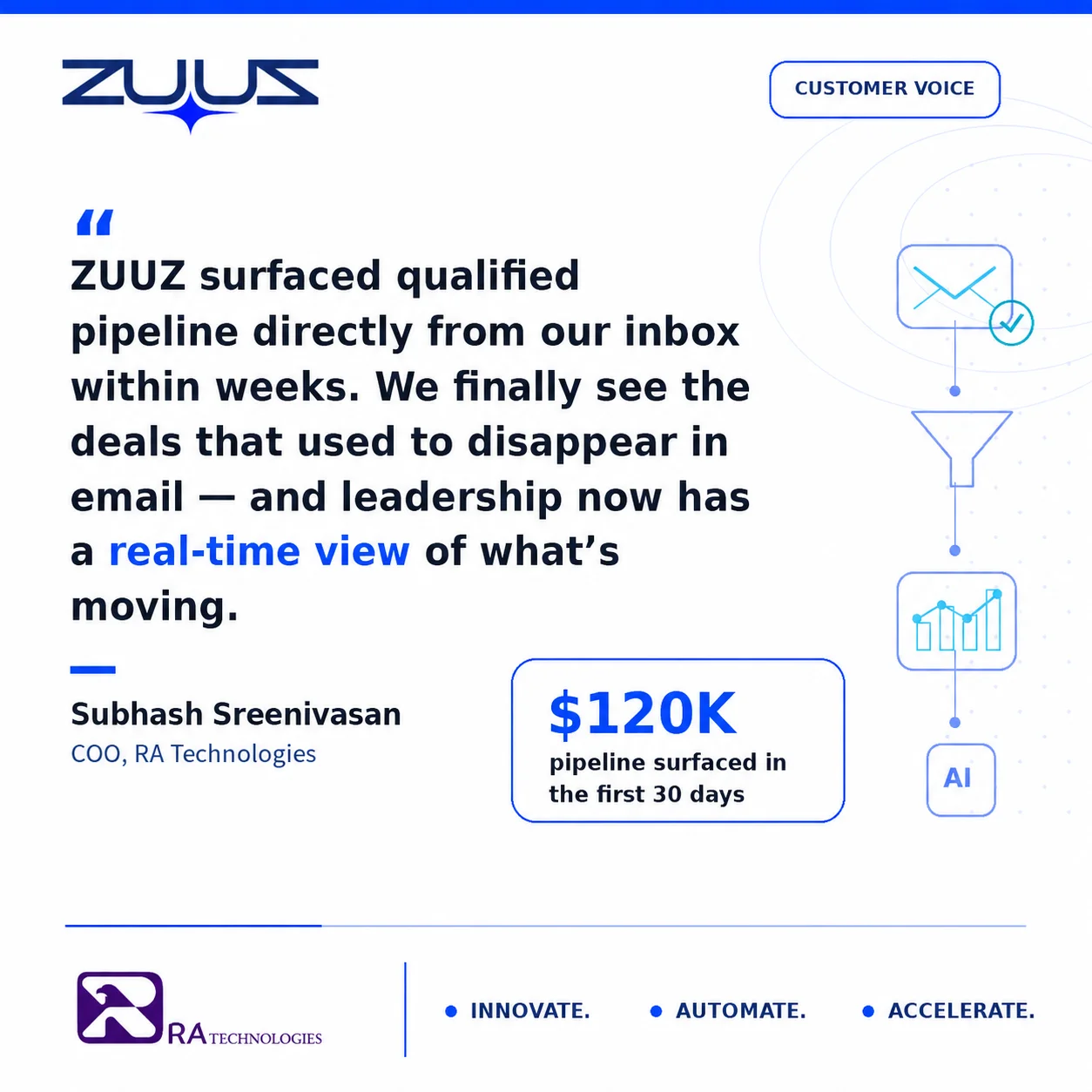
RA Technologies, an IT services firm in the United States, connected their shared inbox to ZUUZ and ran a 90-day historical lookback. The system surfaced $120,000 in pipeline from prior email threads that had never been recorded in their CRM.
Those were not lost deals. They were active conversations, including renewals and project expansions, that had been progressing over email while remaining invisible to any forecast built on the CRM as it stood.
Running ZUUZ Alongside a Forecasting Platform
Replacing Clari is not the only path, and for a team that genuinely needs enterprise-grade forecasting, it is often not the right one. Many teams keep a forecasting tool for the deals already in the CRM and add an email-signal layer for the deals that are not there yet, because the two cover non-overlapping surfaces.
Clari, Gong, or Aviso score the pipeline. ZUUZ makes sure the pipeline being scored actually reflects what happened over email, including the reply, the forwarded purchase request, and the renewal mention that would otherwise depend on a rep remembering to log them. Together they give a fuller account of a deal than either does alone.
For teams that decide a full forecasting platform is not worth its expanding scope at their current size, ZUUZ can stand on its own as the system that keeps the CRM accurate enough to forecast from manually. The decision comes back to what is actually missing.
From an operator’s seat
Across the deployments ZUUZ runs, the pattern is that teams start shopping for a forecasting platform when the real complaint is that the forecast does not match what reps say out loud in the meeting. Both layers can be bought, and often are, but the order of operations decides how the project is judged: a scoring engine pointed at a thin CRM returns a confident number built on the same gaps, and the team then distrusts the tool instead of the input. The part teams do not plan for is the first pipeline review after capture is switched on. It runs long, because deals and stakeholders the CRM had never recorded arrive at once and somebody has to decide what is real. Book that meeting with extra time rather than discovering the need for it.
How to Choose the Right Clari Alternative
The choice gets simple once it is framed by what is being replaced rather than by feature count. Name the actual gap, then match the category to that gap.
What Customers Say
Start With What You Are Actually Replacing
If the gap is forecast accuracy or deal-risk scoring, the direct peers are Gong and Aviso. If the team is standardized on Salesforce and wants to avoid a separate platform, Salesforce’s own Revenue Intelligence with Agentforce, or Revenue Grid, cover that ground natively.
If the real problem is that the CRM feeding any of those forecasts is incomplete because deals move over email, the email-signal and execution category, where ZUUZ sits, is the fit. Some teams need both a forecasting layer and an execution layer, and running them together is common rather than unusual.
Compare Total Cost, Not the Sticker
Headline price is misleading across this entire category. Compare total cost per active user, contract length, and which capabilities are bundled versus sold as add-ons, especially since the Clari-Salesloft merger means a single quote can now include forecasting, conversation intelligence, and engagement together.
Salesforce’s published $220 per user per month for Revenue Intelligence is a useful anchor precisely because it is public. Any quote-only alternative, Clari included, should be compared against that same total-cost basis rather than against a vendor’s own framing of the number.
Check CRM Fit and Manual Work Removed
The last filter is operational. Does the tool work with the CRM already in place, and how much manual logging does it remove before a forecast is even generated.
According to the Salesforce State of Sales report (2024), sellers spend a large share of the workweek on tasks other than active selling, and CRM data entry is a recurring drain. A tool that keeps the CRM current without rep effort returns that time, which is the practical payoff behind every alternative on this list, forecasting-focused or not.
The Capture Layer Test
ZUUZ is a revenue intelligence layer on top of the CRM a team already runs, never a CRM and never a replacement for one: the forecasting platforms on this list report on what the rep entered, while ZUUZ writes the record they report on. That distinction is what this test is for. Use it on any alternative that claims to keep the CRM current, and judge it on whether the record is complete without rep effort.
- Does it capture from the channels where the deal actually moves, email, calendar, LinkedIn messages, meeting and call transcripts?
- Does what it captures land in CRM fields a report can read, or only in an activity feed a human must open?
- Does the rep have to remember anything, a BCC, a button, a sidebar, a sync?
- Can the rep reverse it in one click after it is written?
A tool that fails 2 or 3 produces activity history, not a pipeline you can run a review on.
Run it across a Clari shortlist and the categories separate cleanly. A platform that scores deals reads the CRM rather than the channels in step 1, which is not a flaw, it is a different job, but it does mean the score inherits whatever the reps logged. Activity capture tools pass step 1 and stall on step 2, because a logged email attached to a contact is history, not a field a pipeline report can filter. Step 4 is where the demo time is best spent: a captured close date a rep cannot reverse in one click after it is written gets corrected in a spreadsheet instead, and the forecast goes back to being a side file.
See the Deals Your Forecast Never Recorded.
Clari, Gong, and Aviso score the pipeline you already have. ZUUZ makes sure that pipeline is complete. Book 15 minutes and see it on your own inbox, or reach out with questions.
A concrete first step
Before replacing a forecasting platform, test the input it runs on. Connect one mailbox, let ZUUZ read the last 90 days, and see the deals, stakeholders and next steps it writes to the CRM, each with a full change history and one-click rollback. The 30-day free trial needs no credit card: zuuz.ai/trial.
Frequently Asked Questions
What Are the Best Clari Alternatives?
There is no single best alternative because the right choice depends on what is being replaced. Teams needing forecast accuracy and deal-risk scoring look at Gong or Aviso. Teams standardized on Salesforce look at Salesforce’s own Revenue Intelligence and Agentforce, or Revenue Grid. Teams whose real gap is incomplete CRM data from email look at ZUUZ, which works as the email-signal and execution layer rather than a forecasting tool.
Who Are Clari’s Main Competitors?
Clari’s main competitors include Gong and Aviso on the direct forecasting and revenue-intelligence side, and Salesforce’s native Revenue Intelligence and Agentforce along with Revenue Grid on the CRM-native side. Since the Salesloft merger, Clari also indirectly competes with standalone sales engagement platforms, since its own product line now includes Salesloft’s cadence tooling and the Clari Groove engagement suite.
How Much Does Clari Cost?
Clari does not publish per-seat pricing and requires a sales conversation to get a quote, a structure unchanged by the Salesloft merger. For comparison, Salesforce lists its own Revenue Intelligence capability publicly at $220 per user per month billed annually, which gives buyers a public reference point when evaluating a Clari quote.
Does Clari Publish Its Pricing?
No. Clari’s website directs prospects to request a quote rather than listing rates, and this has been the case both before and after the December 2025 Salesloft merger. Buyers should ask specifically which modules, Core forecasting, Copilot conversation intelligence, or Groove engagement, are included in any quoted figure.
Is Clari Now Part of Salesloft?
Clari and Salesloft completed a full merger on December 3, 2025, becoming one company under CEO Steve Cox rather than one acquiring the other. The combined business describes itself as building the first Predictive Revenue System, spanning Clari’s forecasting and pipeline intelligence and Salesloft’s sales engagement and conversation intelligence.
What Is the Difference Between Clari and Gong?
Clari built its core product around pipeline forecasting and deal-risk scoring, while Gong built its core product around conversation intelligence from recorded calls and emails, though both have expanded toward covering the other’s territory. Since the Salesloft merger, Clari also includes sales engagement and cadence tooling that Gong does not natively provide, while Gong’s conversation analysis remains deeper on the call-intelligence side.
What Is the Best Clari Alternative for Salesforce Teams?
Teams standardized on Salesforce most often evaluate Salesforce’s own Revenue Intelligence paired with Agentforce, since it adds pipeline inspection and AI-assisted forecasting without a separate platform to administer. Revenue Grid is a common second option for teams that want a dedicated revenue-intelligence layer built specifically on top of Salesforce rather than the native product.
Can ZUUZ Replace Clari?
Not for teams whose primary need is enterprise forecasting and deal-risk scoring, since ZUUZ does not build forecasts or score pipeline. ZUUZ replaces the manual CRM entry that feeds any forecast, reading inbound and outbound email and writing structured records to Salesforce, HubSpot, Zoho, Attio, or Pipedrive, which makes it a fit for teams whose real problem is an incomplete CRM rather than an inaccurate forecasting model.

CEO of ZUUZ. He scaled Cloud Box Technologies from 0 to $25M ARR in IT services and distribution before building ZUUZ. Connect on LinkedIn