
Best Gong Alternatives for Sales Teams (2026)
A factual roundup of the best Gong alternatives for 2026, by category, with a comparison table and how to choose. Includes the email-signal option most lists skip.
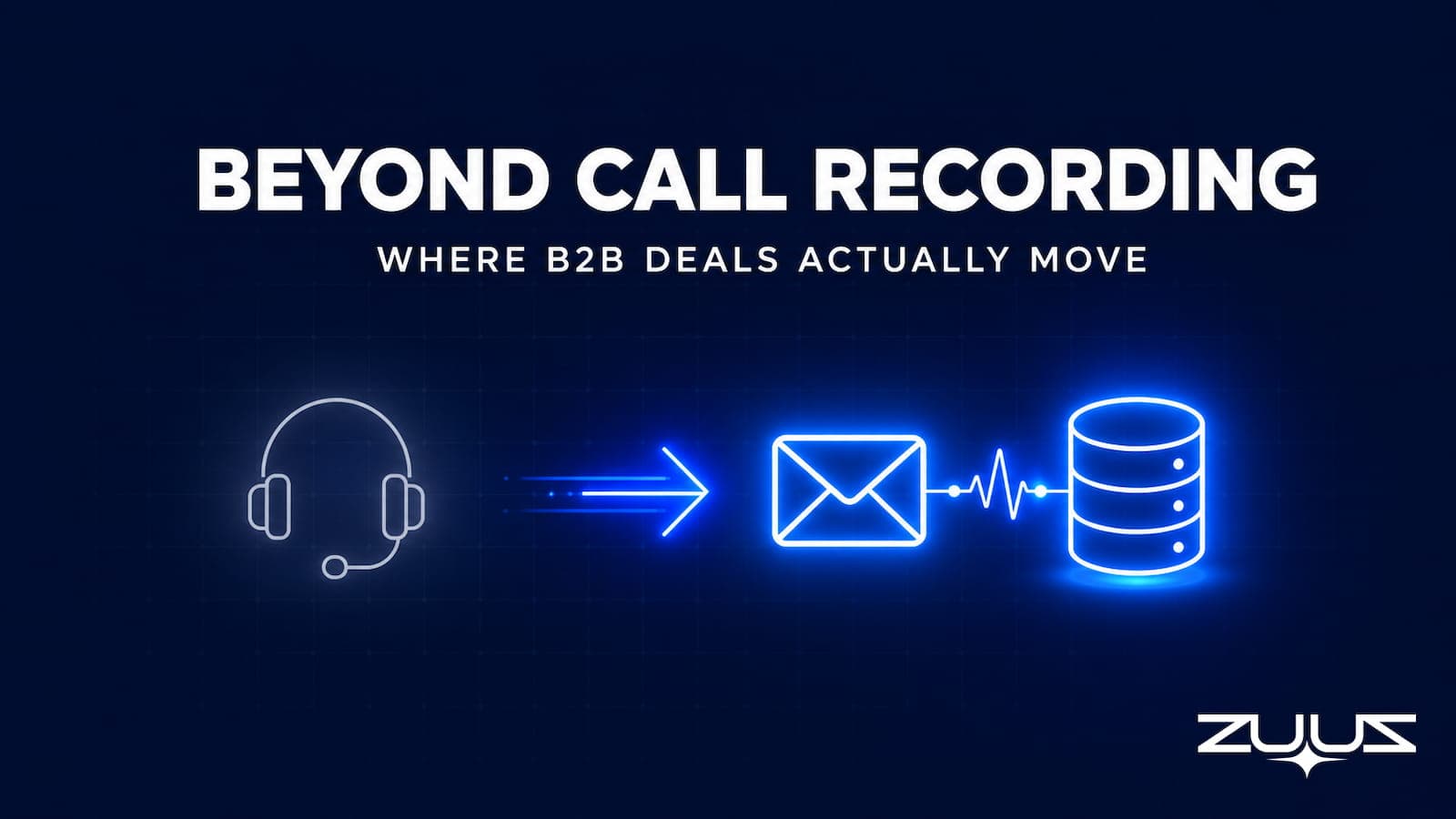
- Gong is a revenue intelligence platform built around call recording and transcription. It is strong at analyzing what happens on recorded sales calls.
- Teams evaluate Gong alternatives for three factual reasons: custom enterprise pricing, a design centered on recorded calls, and motion fit for deals that move over email.
- The conversation intelligence peers are Avoma, Jiminny, Sybill, and Chorus by ZoomInfo. They record and analyze calls at different price points and feature depths.
- For forecasting accuracy rather than call analysis, the relevant names are Clari and Aviso. For engagement and sequencing, Salesloft.
- ZUUZ sits in a different category. It does not record calls itself; it reads email, LinkedIn messages and existing call transcripts, extracts deal signals, and writes them to Salesforce, HubSpot, Zoho, Attio or Pipedrive.
- The right pick depends on where deals actually move. Pick by motion, cost per active user, and CRM fit, not by feature count.
A VP of Sales comparing Gong alternatives is usually not shopping for a feature list. The question underneath the search is sharper: where do our deals actually move, and which tool covers that surface without a contract that outgrows the team.
Teams whose evaluation started from account-level targeting rather than call recording are usually running a different comparison, mapped out in the guide to 6sense alternatives.
Most roundups answer that by comparing call recorders to each other. That is useful when the motion is call-heavy. It is incomplete when deals advance through email between calls, which is the reality for distribution, IT services, and most B2B teams running multi-thread accounts.
This guide describes Gong factually, lays out the real reasons teams evaluate alternatives, and groups the options by category so the choice maps to a motion rather than a brand. It also names the category most lists leave out: the email-signal and execution layer where ZUUZ sits. Teams whose gap is sequencing volume rather than call intelligence are often running a different comparison of sales engagement platforms.
What Gong Does and Does Well
Gong is a conversation and revenue intelligence platform built around call recording and transcription. It captures sales calls and meetings, transcribes them, and applies AI to surface coaching moments, deal risk, and conversation patterns across a team. On G2, Gong holds a 4.7 out of 5 rating across more than 6,600 reviews (2026) and is listed in the conversation intelligence and revenue intelligence categories.
The core strength is clear. When a sales motion runs through recorded calls and demos, Gong gives managers a searchable record of what was said, who said it, and how the conversation tracked against the deal. That supports coaching at scale and gives revenue leaders signal they would otherwise have to gather call by call.
Gong has also expanded beyond pure call analysis into forecasting and deal execution features over time. For teams whose pipeline lives on calls, it is a well-reviewed and widely adopted choice. The reasons teams still evaluate alternatives are not about whether Gong works. They are about cost, scope, and fit.
Why Sales Teams Evaluate Gong Alternatives
Three factual reasons drive most Gong alternative searches. None of them require claiming the product is weak. They are about whether the tool matches a given team’s budget, motion, and stack.
Cost and Contract Structure
Gong uses custom enterprise pricing quoted per seat, typically with a platform fee, and does not publish a public self-serve price. That model fits larger organizations and prompts smaller teams to compare options with published or lower entry pricing. Cost is one of the most common terms paired with this search, and “gong cost” is a frequent follow-up query for a reason.
Call-Centric Scope
Gong’s design centers on recorded calls and meetings. For teams whose deals progress mainly through email, shared inboxes, and forwarded threads, a call-first tool covers part of the motion and leaves the email surface to manual logging. That is a scope question, not a quality question.
Fit for Email-Driven Motions
Many B2B sales motions, especially in distribution and IT services, move between calls over email: renewal mentions, RFP attachments, pricing questions, and procurement back-and-forth. Teams running those motions often want a tool that captures email signals and updates the CRM, which is a different job from analyzing calls. As covered in how to fix missed sales leads in email, the deals that slip are usually the ones that never left the inbox.
These three reasons are not mutually exclusive. A mid-market IT services team might evaluate alternatives because the Gong quote outpaced the budget, and then realize during the evaluation that the bigger gap is the email surface their call tool never touched. That is why framing the search by category matters more than ranking products. The right comparison set depends on which of the three reasons is driving the decision, and a faulty CRM pipeline often points to the email surface rather than the call one.
Deals Move Over Email Between Calls.
ZUUZ connects to the sales inbox, extracts the deal signal from threads in both directions, and writes it to Salesforce, HubSpot, Zoho, Attio or Pipedrive. See it run on your own inbox in 15 minutes.
Those three reasons rarely show up in isolation, and the mix determines the shortlist. A team leaving over cost is looking at a different set of products than a team leaving because the signal it needs never happens on a call.
Gong Alternatives by Category
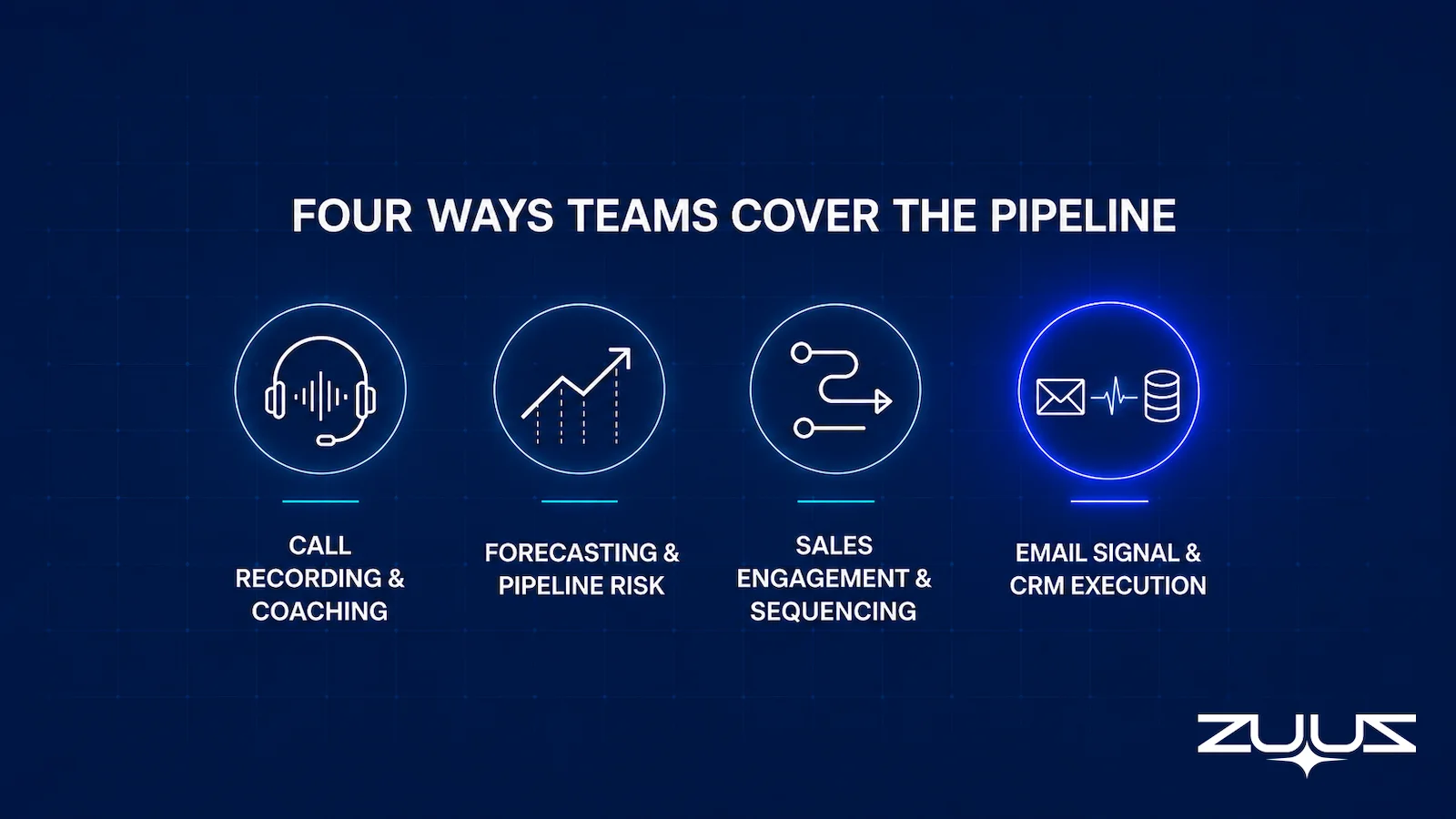
The fastest way to shortlist is by category, because the categories solve different problems. A call recorder, a forecasting platform, an engagement tool, and an email-signal layer are not interchangeable. Below is a factual map of the main names in each.
Conversation Intelligence Peers
These tools do the same core job as Gong: record sales calls, transcribe them, and surface coaching and deal signals. They are the closest direct comparisons.
- Avoma is an AI meeting assistant and conversation intelligence platform that records, transcribes, and summarizes calls, with scheduling and note-taking features. It is frequently positioned as a lower-cost option for smaller teams.
- Jiminny is a conversation intelligence and call recording platform focused on coaching and revenue intelligence, commonly evaluated by mid-market sales teams.
- Sybill is an AI assistant for sales that generates call summaries, behavioral insights, and follow-up emails from recorded conversations.
- Chorus by ZoomInfo is a conversation intelligence platform that records and analyzes calls, now part of the ZoomInfo data platform.
Forecasting and Revenue Platforms
These tools sit above the CRM and focus on forecast accuracy and pipeline risk rather than call analysis. Teams evaluate them when the problem is predicting the number, not coaching the call.
- Clari is a revenue platform centered on forecasting, pipeline management, and revenue operations workflows.
- Aviso is an AI-based revenue operations and forecasting platform that scores deals and projects pipeline outcomes.
Sales Engagement
Engagement tools focus on outbound sequencing, cadences, and rep activity rather than recording conversations.
- Salesloft is a sales engagement platform for cadences, email sequencing, and rep workflow, with conversation features added over time.
Email Signal and Execution
This is the category most Gong alternative lists leave out, and it is where ZUUZ sits. Instead of recording calls, these tools read email, extract deal signals, and write structured records to the CRM. The section below covers why this category matters and how ZUUZ approaches it.
Gong Alternatives Comparison Table
The table maps each option to its category, primary strength, and the team it fits best. It is built for shortlisting by motion, not for ranking tools that do different jobs against one another.
| Tool | Category | Primary Strength | Best-Fit Team |
|---|---|---|---|
| Gong | Conversation / revenue intelligence | Call recording, transcription, coaching signal at scale | Call-heavy teams wanting deep call analytics |
| Avoma | Conversation intelligence | Meeting recording, summaries, scheduling | Smaller teams seeking a lower-cost recorder |
| Jiminny | Conversation intelligence | Call coaching and revenue intelligence | Mid-market teams focused on coaching |
| Sybill | Conversation intelligence | AI call summaries and follow-up drafting | Reps wanting automated post-call notes |
| Chorus by ZoomInfo | Conversation intelligence | Call analysis inside the ZoomInfo platform | ZoomInfo customers consolidating tools |
| Clari | Forecasting / revenue platform | Forecast accuracy and pipeline management | RevOps teams focused on the forecast |
| Aviso | Forecasting / revenue platform | AI deal scoring and pipeline projection | Teams wanting predictive forecasting |
| Salesloft | Sales engagement | Cadences, sequencing, rep workflow | Outbound-heavy SDR and AE teams |
| ZUUZ | Email signal and CRM execution | Email deal-signal capture, auto CRM updates | Email-driven teams wanting an accurate CRM |
Not a Call Recorder. An Execution Layer.
Connect Salesforce, HubSpot, or Zoho and let ZUUZ capture the email signals your team never logs. Start free, with no integration project required.
That framing explains why the usual comparison set feels incomplete to some teams. If the deciding moments in a deal are not happening on calls, a better call recorder is not the upgrade.
The Category Most Lists Skip: Email Signal and Execution
Almost every Gong alternative roundup compares call recorders to each other. That makes sense when the entire question is which tool best analyzes calls. It misses the teams whose deals do not live on calls in the first place.
In distribution and IT services, a single account can run a renewal, an active quote thread, and a new project scope through the same procurement contact at once. Those signals arrive as email: an RFP attachment in a shared inbox, a renewal mention in a support thread, a pricing question forwarded on a Friday afternoon. A call recorder, however good, does not see any of it.
The result is a CRM that reflects what reps remembered to log rather than what actually happened in accounts. As explored in why your CRM pipeline is wrong, that gap is not a reporting problem. It is a capture problem that reporting then inherits. An email-signal and execution layer fixes the source, which is why it belongs on any honest list of Gong alternatives for email-driven teams.
There is a second reason this category rarely appears on roundups: most of those lists are published by conversation intelligence vendors comparing themselves to a peer. A call recorder writing about Gong alternatives will name other call recorders. None of them solves the email problem, so none of them raises it. That is the gap this guide is meant to fill, and it maps directly to the broader revenue intelligence software stack rather than to the call layer alone.
Email Signal Versus Call Intelligence
The cleanest way to hold the distinction is by the question each tool answers. A conversation intelligence tool answers how a recorded call went and what to coach next. An email-signal layer answers which deals are moving in the inbox right now and whether the CRM knows about them. One looks backward at a conversation that was captured on purpose. The other looks at the live thread that no one thought to log. For a team running sales pipeline management software on top of stale records, the second question is usually the one costing revenue.
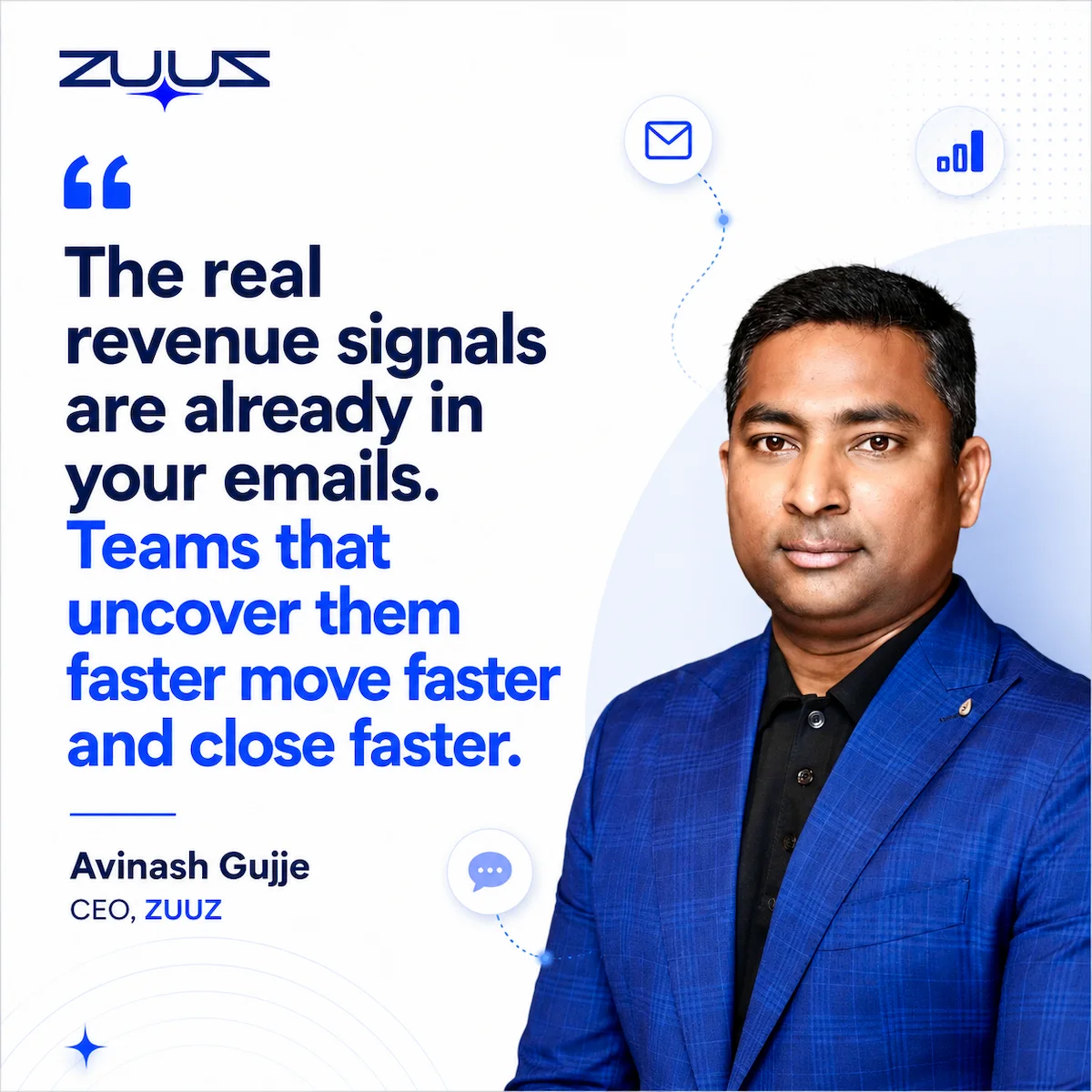
Avinash Gujje, CEO of ZUUZ, spent the years before it running sales in IT services and distribution, scaling Cloud Box Technologies from zero to $25M ARR. One pattern held across that market. Deals in it are rarely decided on the recorded call. They turn on the forwarded purchase order, the reply from a procurement manager who never joined a meeting, and the renewal date mentioned in the third message of a thread about something else.
The observation that matters for a Gong comparison is about where signal sits rather than how good the calls are. In an email-driven motion, a call recording covers the half of the account that was scheduled, and the unscheduled half arrives in writing. The textbook answer is tighter logging discipline, which reads well in a process document and does not survive a rep carrying thirty accounts where a renewal and an expansion land in the same message. In that market the surface that needs covering is the mailbox.
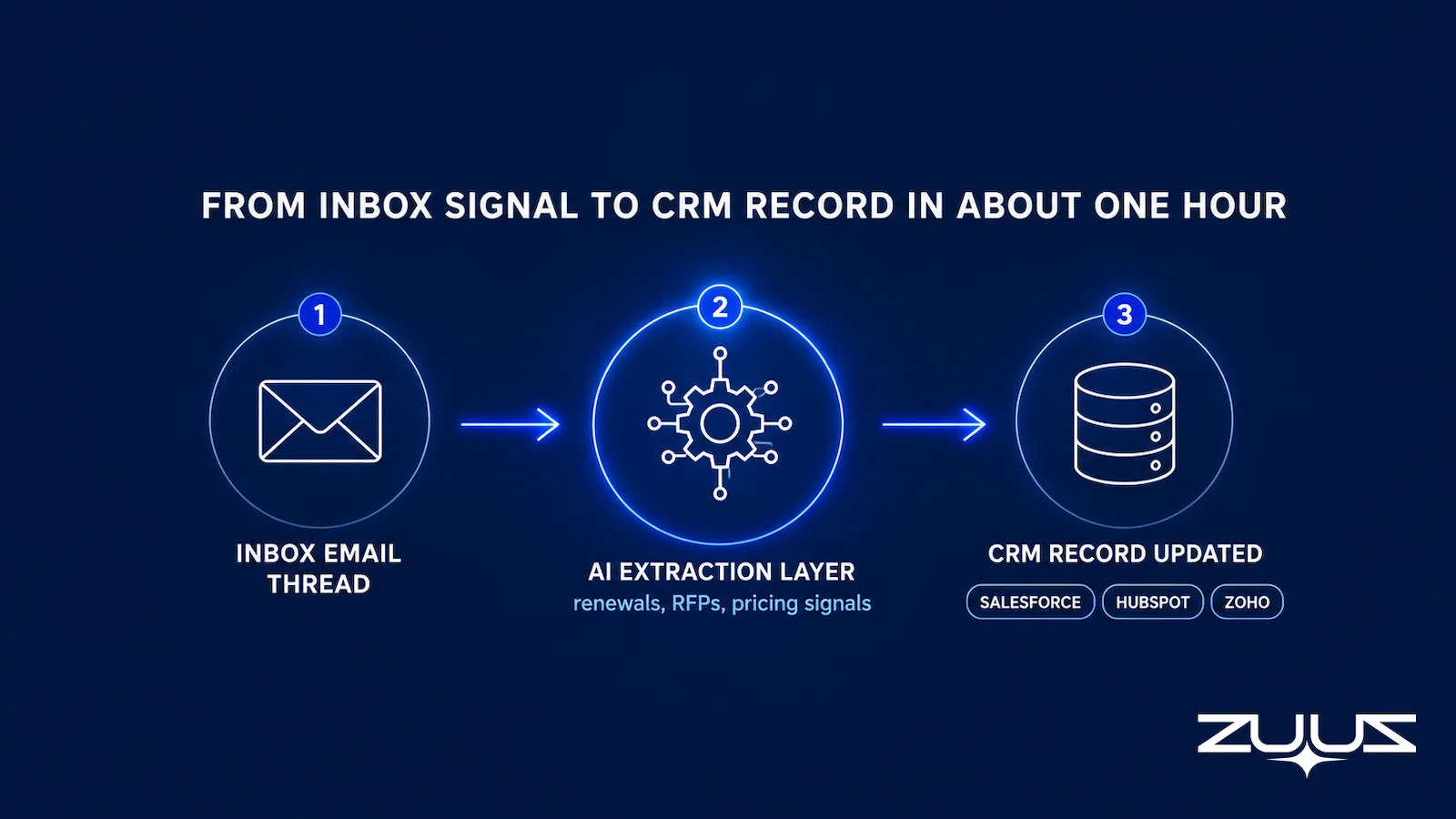
Email Signal and Execution: How ZUUZ Replaces Manual CRM Work
The category line matters here: ZUUZ is an AI layer on top of the CRM a team already runs, never a CRM and never a replacement for one. A call intelligence tool reports on the conversation a rep already had; ZUUZ writes the record of it into the CRM the team already pays for.
ZUUZ is not a Gong clone, and it is honest to say so up front. ZUUZ does not record or transcribe calls itself; where a team already has transcripts from Microsoft Teams meetings or CallTrackingMetrics inbound calls, ZUUZ can read those alongside email and LinkedIn messages. Its main surface is different: the email where deals move between calls, and the CRM that is supposed to reflect them.
ZUUZ reads inbound and outbound email and LinkedIn messages, extracts deal signals such as renewals, expansion requests, pricing questions, and new opportunities, and writes structured records to Salesforce, HubSpot, Zoho, Attio or Pipedrive. Reps review flagged signals in a short daily digest rather than performing manual CRM entry. The work that used to take four to six clicks per email moves to the background. ZUUZ also handles email lead qualification automation, scoring and routing inbound interest as it arrives.
CRM-Agnostic by Design
The CRM-agnostic design is the differentiator. ZUUZ runs natively on Salesforce, HubSpot, Zoho, Attio or Pipedrive, so teams that run different systems across divisions or that have recently migrated are not forced into a single platform. It connects to whatever is already in place and writes data in that system’s native format. For a fuller picture of the category, the overview of revenue intelligence software sets the context, and the guide to sales pipeline management software covers the pipeline layer ZUUZ keeps current.
What This Looks Like in Practice
RA Technologies, an IT services firm in the United States, connected their shared inbox to ZUUZ and ran a 90-day historical lookback. The system surfaced $120,000 in pipeline from prior email threads that had never been recorded in HubSpot, the CRM the team had already run for two years. Those were not lost deals. They were active conversations, including renewals and project expansions, that had been progressing over email while remaining invisible to sales leadership.
That is the practical line between an email-signal layer and a call recorder. A conversation intelligence tool tells a manager how a recorded call went. ZUUZ surfaces the deal that was advancing in the inbox and was never in the CRM at all. The two answer different questions, and a team can run both.
Named proof, on the CRM the team already ran.
RA Technologies, a US IT services company, ran ZUUZ on the HubSpot instance it had used for two years, with the same team and no migration. Within 72 hours, $120K in pipeline the CRM had never seen was surfaced from the sales mailbox. The detail is in the RA Technologies case study.
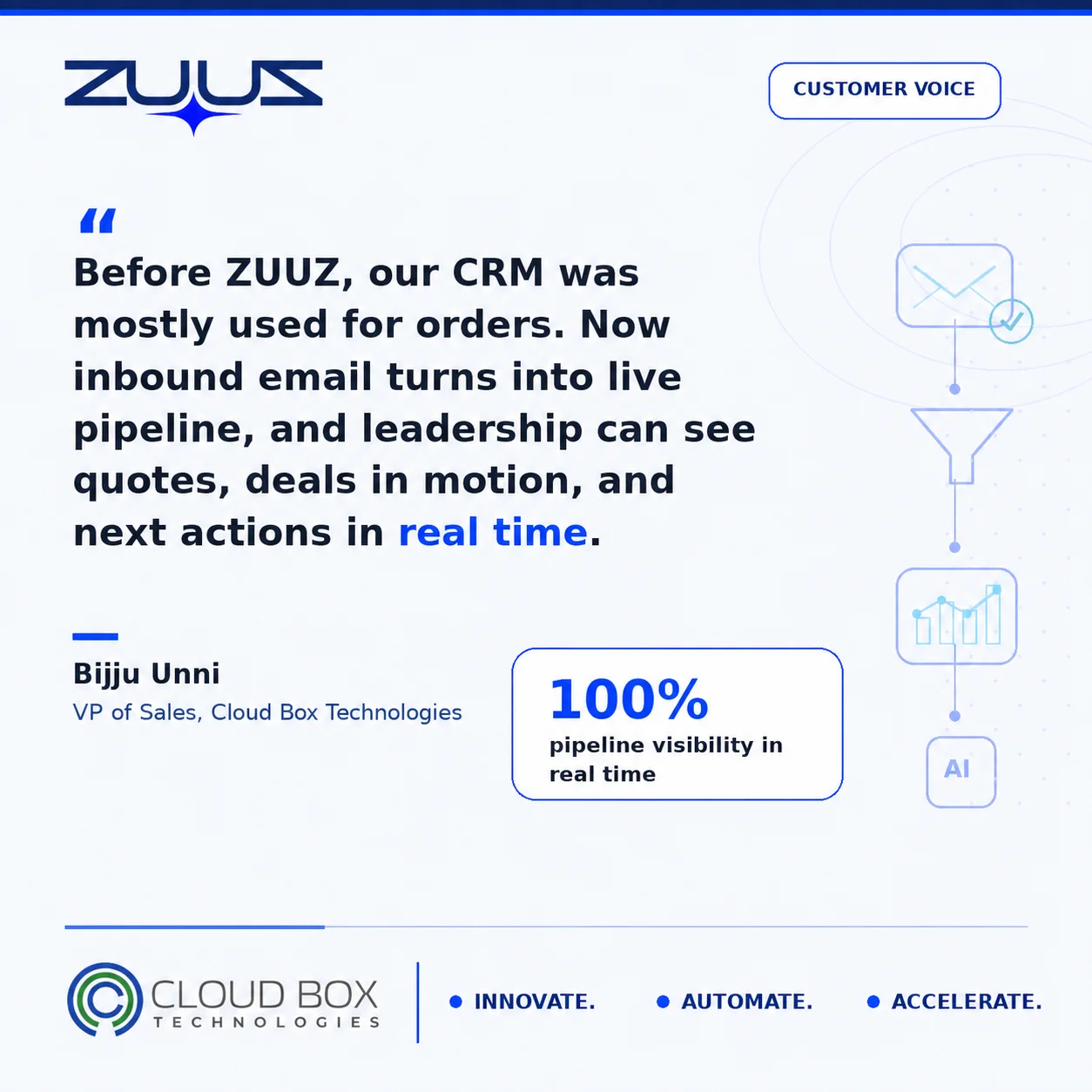
Cloud Box Technologies, a UAE cloud and IT services business, tracks 10 to 12 renewals in minutes from a single connected user, with leadership seeing live pipeline instead of a weekly rollup.
Running ZUUZ Alongside a Call Tool
Replacing Gong is not the only path. Many teams keep a call recorder for coaching and add an email-signal layer for capture, because the two cover non-overlapping surfaces. The call tool handles demos and discovery calls. ZUUZ handles the renewal mention, the forwarded purchase request, and the pricing question that arrive by email and would otherwise depend on a rep remembering to log them. Together they give a fuller account of a deal than either does alone, and the email lead qualification automation side keeps inbound interest scored and routed without manual triage.
For teams that decide the call layer is not worth its cost, ZUUZ can stand on its own as the system that keeps the CRM accurate. The decision comes back to motion. A call-heavy team likely keeps both. An email-driven team often finds the email-signal layer covers the surface that was actually leaking pipeline, which is the point RA Technologies reached when 90 days of unlogged threads turned into $120,000 of visible pipeline.
From an operator’s seat
From an operator’s seat, the comparison most teams run is the wrong one. Across the deployments ZUUZ runs, the pattern is that a call tool and an email capture layer get argued over as rivals for one budget line, and then the first week of capture shows the two surfaces barely overlap: the call says what the buyer cares about, the email is where the buyer agreed to something. The part teams do not plan for is who reconciles the two, because a call summary and a captured commitment can contradict each other on the same account, and the rep is the only person who can say which one is current. Running the email layer first is usually the cheaper order of operations, since it tells the team how much of the deal never reached a call at all before anyone signs another recording contract.
How to Choose the Right Gong Alternative With the Capture Layer Test
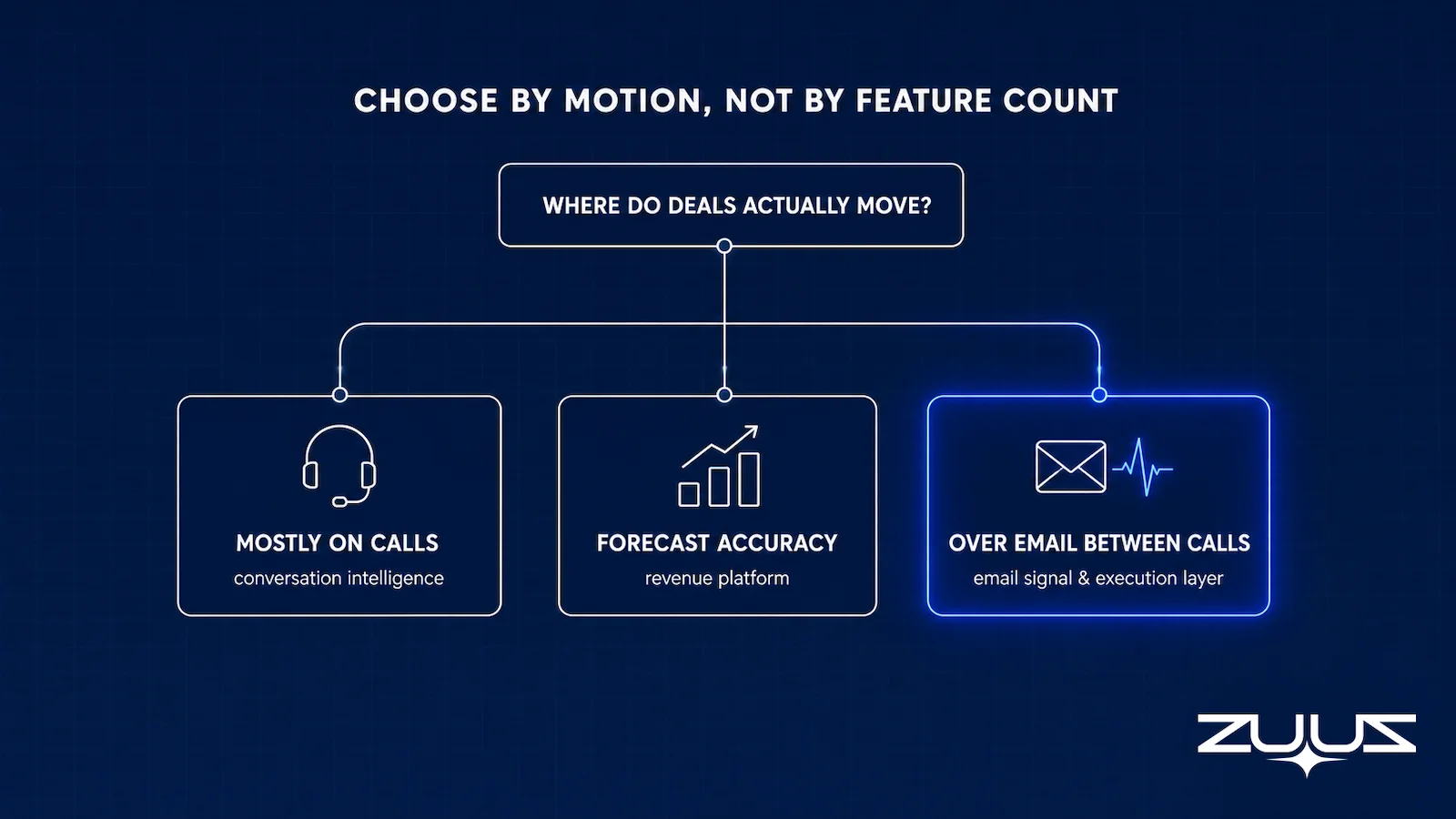
The choice gets simple once it is framed by motion rather than feature count. Name where deals actually move, then match the category to that surface. The Capture Layer Test sets the bar a capture setup has to clear: it creates records rather than summaries, writes to the CRM record itself, reads what changed on the account, covers every channel where deals move, and does not lean on a path that is being retired.
Start With Where Deals Move
If most deal progress happens on calls and demos, a conversation intelligence tool is the right category: Gong, Avoma, Jiminny, Sybill, or Chorus by ZoomInfo. If the problem is forecast accuracy, look at Clari or Aviso. If the bottleneck is outbound sequencing, look at Salesloft. If deals advance over email and the CRM is chronically behind, the email-signal and execution category is the fit.
Compare on Cost per Active User and Contract Terms
Headline price is misleading. Compare total cost per active user, contract length, and which capabilities are included versus sold as add-ons. Gong’s custom enterprise pricing means the real number depends on the quote, so any alternative should be compared on the same total-cost basis rather than on a sticker.
Check CRM Fit and Manual Work Removed
The last filter is operational. Does the tool work with the CRM already in place, and how much manual logging does it remove. According to the Salesforce State of Sales report (2024), sellers spend a large share of the workweek on tasks other than active selling, and CRM data entry is a recurring drain. A tool that keeps the CRM current without rep effort returns that time, which is the practical payoff behind every alternative on this list.
That filter is cheap to settle with evidence rather than a demo script. Connecting one mailbox to ZUUZ is the whole first step, and the lookback reads the last 90 days on that connection, so the gap between what the CRM logged and what the accounts actually said is visible in minutes. A team weighing a Gong quote against the cost of covering email can read that gap before committing to either license.
A concrete first step, not a demo: connect one mailbox to ZUUZ. ZUUZ reads the last 90 days on that connection and lists the leads, stakeholders, next steps and renewal signals it found, and the rep reviews that list before anything is written to the CRM. It is a 30-day free trial, no credit card: https://zuuz.ai/trial/.
See the Pipeline Your Call Tool Can’t.
Gong analyzes the calls. ZUUZ captures the email signals that move deals between them and keeps the CRM current. Book 15 minutes and see it on your own inbox, or reach out with questions.
Frequently Asked Questions
What Is the Best Alternative to Gong?
There is no single best alternative because the right choice depends on where deals move. Teams that need call recording and coaching look at Avoma, Jiminny, Sybill, or Chorus by ZoomInfo. Teams that need forecasting look at Clari or Aviso. Teams whose deals progress over email between calls and who want the CRM updated automatically look at ZUUZ, which works as the email-signal and execution layer rather than a call recorder.
Is There a Free or Cheaper Alternative to Gong?
Several conversation intelligence tools position themselves at lower price points than Gong, and many publish self-serve tiers. Gong itself uses custom enterprise pricing quoted per seat with platform fees, so cost is a common reason teams evaluate alternatives. Buyers should compare on total cost per active user, contract length, and which capabilities are included versus add-ons rather than headline price alone.
What Does Gong Actually Do?
Gong is a revenue intelligence platform built around call recording and transcription. It captures sales calls and meetings, transcribes them, and applies AI to surface coaching signals, deal risk, and conversation patterns. G2 lists it in the conversation intelligence and revenue intelligence categories with a 4.7 out of 5 rating across more than 6,600 reviews. Its core strength is analyzing what happens on recorded calls.
Why Do Sales Teams Look for Gong Alternatives?
The common reasons are cost, scope, and motion fit. Gong uses custom enterprise pricing, which prompts smaller teams to compare cheaper options. Its design centers on recorded calls, so teams whose deals move primarily over email find a coverage gap. Some teams also want a tool that updates the CRM automatically rather than one that only analyzes conversations, which points toward a different category of alternative.
Does ZUUZ Record or Transcribe Sales Calls Like Gong?
No. ZUUZ does not record or transcribe calls itself, though it can read existing call and meeting transcripts from CallTrackingMetrics and Microsoft Teams. It reads inbound and outbound email and LinkedIn messages, extracts deal signals such as renewals, expansion requests and pricing questions, and writes structured records to Salesforce, HubSpot, Zoho, Attio or Pipedrive. ZUUZ is not a Gong clone. It is the email-signal and execution layer for teams whose deals progress over email and who want the CRM kept current automatically.
Can ZUUZ Be Used Alongside Gong Rather Than Replacing It?
Yes. The two tools address different surfaces. Gong analyzes recorded calls, while ZUUZ captures the email signals that move deals between those calls and syncs them to the CRM. A team can run call intelligence for coaching and run ZUUZ for email capture and CRM execution at the same time, since neither depends on the other to function.
How Do I Choose Between Gong Alternatives?
Start by naming where deals actually move. If most progress happens on calls, choose a conversation intelligence tool. If the problem is forecast accuracy, choose a forecasting platform. If deals advance over email and the CRM is chronically out of date, choose an email-signal and execution layer. Then compare on cost per active user, CRM fit, contract terms, and how much manual logging the tool removes.

CEO of ZUUZ. He scaled Cloud Box Technologies from 0 to $25M ARR in IT services and distribution before building ZUUZ. Connect on LinkedIn