
Revenue Intelligence Software: A 2026 Buyer’s Guide
Revenue intelligence software reads deal signals and forecasts revenue. A guide to evaluating signal coverage, accuracy, and the email blind spot.
- Revenue intelligence software does four jobs: it captures activity signals, scores deals by health and risk, forecasts revenue from that evidence, and flags deals that are slipping before the close date does.
- Revenue operations software runs the process. Revenue intelligence software reads the signals. One executes the workflow; the other interprets what the workflow produces.
- Most revenue intelligence tools score deals from call recordings. That leaves a blind spot: between calls, B2B deals move through email, where pricing, scope, and procurement threads live.
- The four evaluation axes that separate platforms are signal coverage across email and calls, forecast accuracy measured against closed results, CRM-agnosticism, and signal latency.
- A scoring model is only as honest as the evidence it reads. A platform can score precisely and still mislead if it reads a narrow slice of deal activity.
- ZUUZ reads inbound and outbound email, extracts deal signals, scores them, and writes structured records to Salesforce, HubSpot, or Zoho, with a 90-day lookback on first connection.
- ZUUZ is an AI layer on top of the CRM a team already runs: it connects to the sales inbox, reads LinkedIn messages and meeting or call transcripts, and writes leads, stakeholders, next steps and renewal signals into the CRM for the rep to approve in one click.
A forecast call opens, and the same ritual plays out. The numbers in the CRM say one thing, the reps say another, and the leader trusts the reps. Revenue intelligence software exists to settle that argument with evidence rather than opinion.
The category has grown fast, and the marketing has blurred. Some tools call themselves revenue intelligence, some say conversation intelligence, some say predictive forecasting. Underneath the labels sits one promise: read what is actually happening in deals, then score and forecast from that, not from a rep’s gut. A related but narrower question is how individual deals get tracked and flagged once they’re in motion, covered in the guide to deal management software.
This guide defines what revenue intelligence software does, separates it from the broader operations category, and walks through the four axes that matter when buyers compare platforms. It also names the blind spot most tools share.
Most read calls. Few read email, where B2B deals move between meetings.
What Revenue Intelligence Software Actually Does
Revenue intelligence software is the interpretation layer of a sales organization. It ingests signals from sales activity, scores deals on health and risk, forecasts revenue from that evidence, and surfaces the deals that need attention.
The system of record stays the CRM. The intelligence layer reads it and writes structured insight back.
The word that matters is signal. A signal is any observable event that changes the probability of a deal closing: a pricing question, a new stakeholder added to a thread, a champion who goes quiet, a competitor named in a reply, a contract sent for review.
Revenue intelligence tools turn those events into scores instead of leaving them as scattered context in someone’s inbox. The same logic of reading email as structured evidence drives recovering missed sales leads from email earlier in the funnel.
That distinguishes the category from reporting. A dashboard shows what the CRM already holds.
A revenue intelligence platform generates new fields the CRM never had: a deal score, a risk flag, a forecast category derived from activity rather than from the rep’s stage selection. The depth of that interpretation depends entirely on how much real activity the platform can read, which is the same constraint behind why CRM pipeline data drifts from reality.
The category also overlaps with the wider operations function. For the full map of where intelligence sits among routing, sequencing, and CRM hygiene, the guide to revenue operations software covers the broader category and how the pieces connect. This article stays on the intelligence layer specifically.
Score Deals on Signals Your CRM Never Captured.
ZUUZ connects to the sales inbox, extracts the deal signal from threads in both directions, and writes a scored record to Salesforce, HubSpot, Zoho, Attio or Pipedrive. Book a 15-minute walkthrough on your own inbox.
Revenue Intelligence vs Revenue Operations Software
Buyers conflate these two categories constantly, and vendors are happy to let the confusion ride. The distinction is simple once stated plainly.
Revenue operations software runs the process. Revenue intelligence software reads the signals.
Operations software is execution. It routes leads, sequences outreach, generates quotes, enforces stage rules, and keeps the CRM clean.
It is the machinery that moves a deal from inbound to closed. The job is to make the workflow happen reliably and at volume.
Intelligence software is interpretation. It does not move the deal; it reads the deal.
It watches the activity the operations layer produces and asks a different question: is this deal actually healthy, and will it close when the rep says it will. The two layers are complementary, not competing. Most mature teams run both.
The sequencing matters. Running an intelligence layer on top of a thin operations layer produces confident scores built on sparse activity.
The deeper foundation, and how the layers stack from capture through forecasting, is laid out in the guide to the modern RevOps software stack for 2026. The short version: intelligence is one layer in a stack, and it is only as good as the activity feeding it.
| Dimension | Revenue Operations Software | Revenue Intelligence Software |
|---|---|---|
| Primary job | Runs the process: route, sequence, quote, sync | Reads the signals: score, flag risk, forecast |
| Core question | Did the workflow execute correctly | Is this deal actually going to close |
| Output | Completed actions and clean records | Deal scores, risk flags, evidence-based forecast |
| Relationship to CRM | Writes and maintains the record | Reads the record plus external signals, writes insight back |
| Fails when | Steps break or records go stale | It scores deals on a narrow slice of real activity |
The Four Capabilities Inside a Revenue Intelligence Platform
Strip away the branding and a revenue intelligence platform performs four functions in sequence. A buyer comparing tools should ask how well each one is done, and on what evidence.
Signal Capture
The foundation. The platform connects to data sources, calls, email, CRM activity, calendar, and extracts the events that matter to a deal.
Capture quality sets the ceiling for everything above it. A platform that reads only one channel captures only that channel’s signals, and the deal score inherits that limit whether the buyer realizes it or not.
Deal Scoring
The platform assigns each open deal a health or risk score based on the captured signals. Strong models weigh engagement recency, stakeholder count, momentum direction, and negative signals such as a champion going silent. The score is a hypothesis about close probability, and its credibility rests on the breadth of evidence underneath it.
Forecasting
The platform rolls deal scores up into a revenue forecast, often with categories like commit, best case, and at risk. Predictive revenue intelligence applies models trained on historical close patterns to project the quarter.
The forecast is the headline output, and it is the output most exposed to thin capture. A model fed partial activity produces a number that looks precise and reads wrong.
Risk Flagging
The platform surfaces deals that are slipping while there is still time to act: a deal with no activity in two weeks, a single-threaded relationship, a renewal with a quiet champion. This is where intelligence earns its keep, because it changes what a manager does this week rather than explaining last quarter. The same logic drives email lead qualification automation at the top of the funnel, where signals decide which inbound deals deserve a rep’s time.
What to Look For Before You Shortlist
- Capture layer: does the tool write the record itself from the channels where deals move, or does it only score what a rep already typed into the CRM?
- Channel coverage: calls, the sales inbox, LinkedIn messages and meeting transcripts, or only one of the four?
- Evidence behind every score: can a rep open a flag and see the dated thread it came from, or is the number unexplained?
- CRM-agnostic and CRM-resident: does it read and write the CRM already in place, or does it stand up a second system of record to reconcile?
- Latency: how many days pass between a conversation happening and the record changing?
- Correction path: can the rep accept, edit or reject what was extracted in one click before it is written?
Top Revenue Intelligence Platforms for B2B Sales Teams
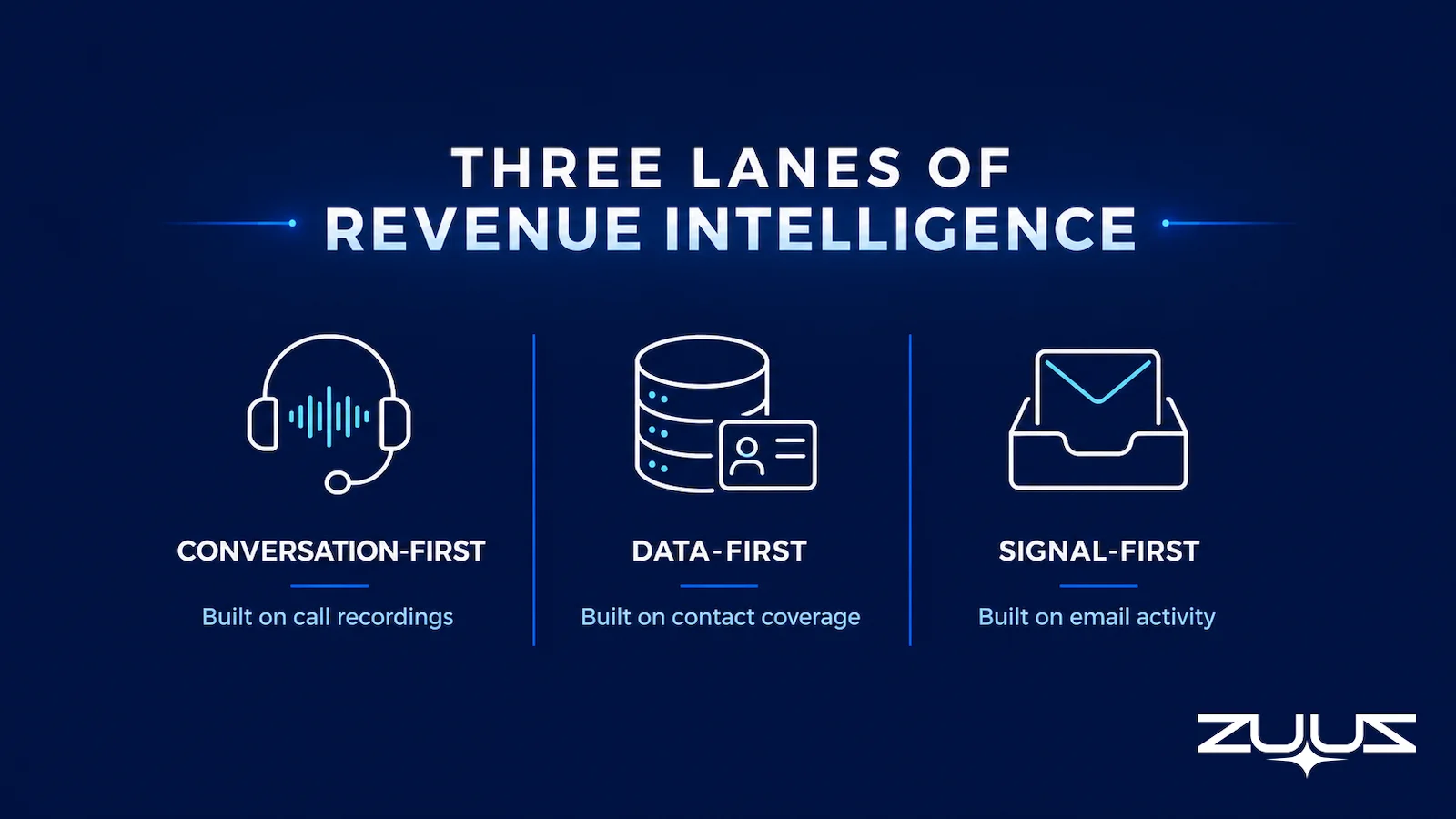
The revenue intelligence market splits into three lanes: conversation-first tools built on call recordings, data-first tools built on contact and firmographic coverage, and forecast-first tools built for enterprise pipeline inspection. Most B2B teams end up comparing across all three before choosing one.
| Platform | Category | Primary Strength | Best-Fit Team |
|---|---|---|---|
| Gong | Conversation intelligence | Call recording, objection mining, rep coaching | Teams whose deals move primarily through calls |
| Clari | Revenue operations and forecasting | Enterprise pipeline inspection and commit tracking | Large sales orgs standardizing forecast discipline |
| ZoomInfo | Sales intelligence and data | Contact and firmographic data paired with native conversation features | Teams prioritizing prospecting data alongside call insight |
| Apollo.io | Sales engagement and data | Outbound sequencing bundled with a contact database | Teams wanting data and outreach in one subscription |
| ZUUZ | Email signal intelligence | Reads inbound and outbound email for deal signals calls never capture | Teams whose deals move through email between meetings |
Every platform on this list is strong at what it was built to read. The gap is the channel most of them share: calls. The next section covers what that blind spot actually costs a forecast.
The Data-Source Blind Spot in Call-Only Intelligence
Here is the structural gap in the category. Most revenue intelligence tools were built on conversation intelligence, which means they read call recordings.
They transcribe the meeting, score sentiment, flag competitor mentions, and coach reps on talk ratios. That is genuine value for the portion of a deal that happens on calls.
The problem is what happens between calls. A B2B deal does not pause when the meeting ends. The pricing question arrives by email on Tuesday.
The procurement contact loops in legal on a forwarded thread Thursday. The champion’s reply that says the budget moved to next quarter lands on a Friday afternoon. None of that reaches a call recording, so a call-only platform never scores it.
The consequence is a deal score built on the visible slice of the relationship while the decisive movement happens in a channel the platform cannot see. A deal can look healthy on call sentiment and be quietly dying in email. This is the same capture failure that makes pipeline reports lag reality, explored in why your CRM pipeline is wrong, applied one layer up at the scoring model.
Email is not a secondary channel in B2B. It is where most of the deal lives.
Renewal negotiations, scope changes, multi-stakeholder coordination, and the slow accumulation of buying signals run through the inbox. A revenue intelligence platform that cannot read email is scoring deals with its eyes half closed, which is exactly the gap behind missed sales leads in email and how to fix it.
What a category does in principle and what a given platform sees in practice are different questions. The second one is settled by where each tool is listening, not by how it describes itself.
Call Intelligence vs Email-Signal Coverage
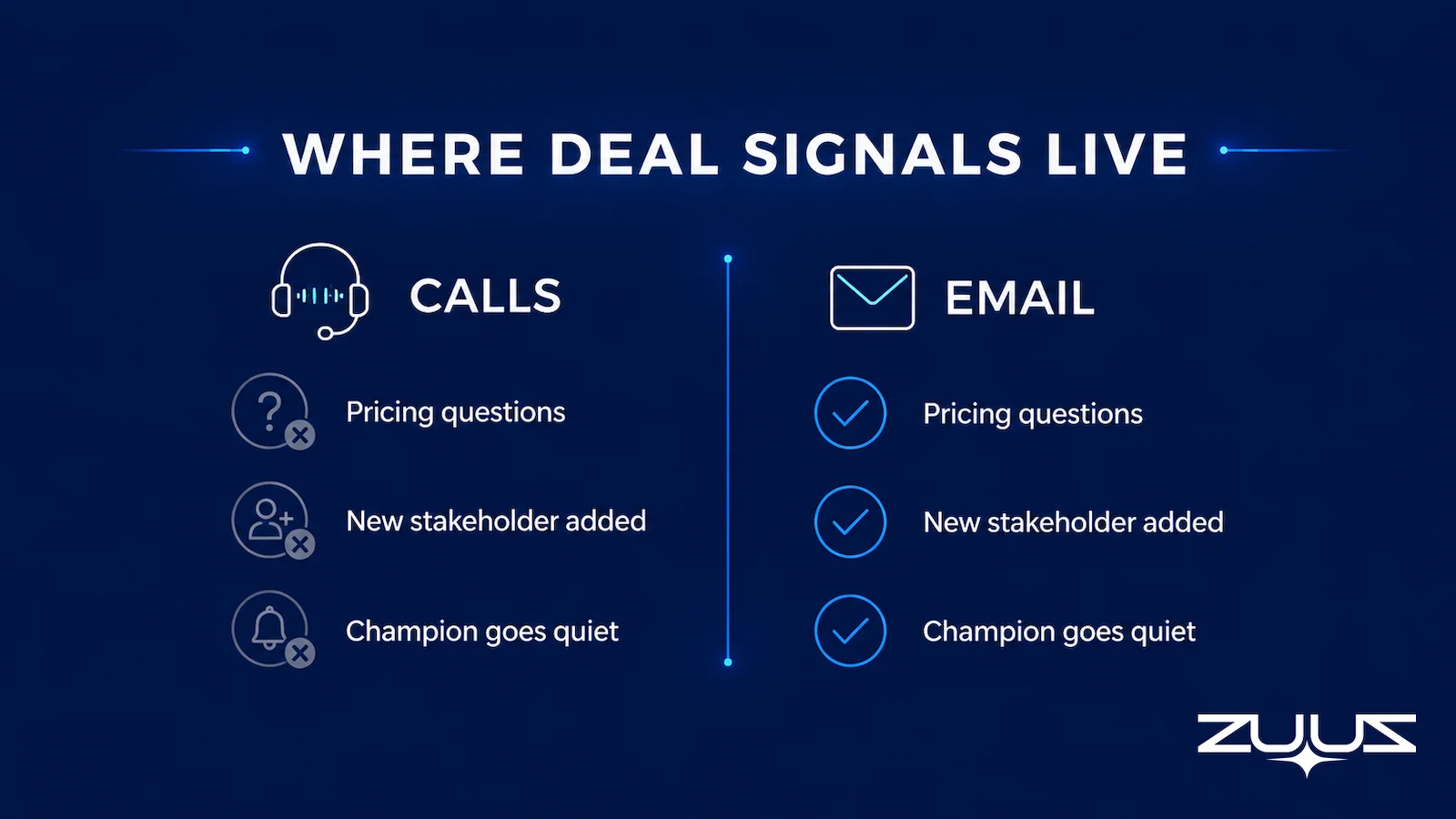
The table below maps the same deal signals against where each type of platform actually sees them. The pattern is consistent: the events that decide a deal between meetings live in email, not on the call.
| Deal Signal | Where It Usually Happens | Call-Only Intelligence | Email-Signal Intelligence |
|---|---|---|---|
| Discovery and demo sentiment | On the call | Captured | Partial, captures the follow-up |
| Pricing and quote questions | Email between calls | Missed | Captured |
| New stakeholder added to deal | Forwarded email thread | Missed | Captured |
| Procurement and legal entering | Email and attachments | Missed | Captured |
| Champion going quiet | Absence of email reply | Missed | Captured |
| Renewal and expansion mentions | Email threads with existing accounts | Partial | Captured |
| Competitor named in writing | Email reply | Missed | Captured |
Neither channel is complete on its own. Calls carry tone and nuance that email flattens.
Email carries the procedural movement, the documents, and the silences that calls never record. The point is not that email beats calls. It is that scoring a deal on one channel alone leaves half the evidence on the table.
The Pipeline Truth Test
Scoring models are easy to compare on a feature page and hard to compare on your own pipeline. The Pipeline Truth Test checks whether a pipeline number can survive a question.
- Take the top five deals by value in the current quarter.
- For each, find the evidence in the CRM for its stage and close date, a dated, written commitment, not a rep assurance.
- Count how many rest on a stage last changed more than two weeks ago.
- A pipeline in which most of the top five lack dated evidence is a forecast of rep optimism. ZUUZ does not forecast; it makes the record underneath the number real.
Run it before any revenue intelligence demo and the demo changes character. If the evidence for your top five turns out to be call notes plus a rep confidence rating, a call-only platform will score those same five deals from that same thin evidence. If the evidence is sitting in pricing and procurement threads nobody attached to the opportunity, the gap is capture, not scoring, and no amount of model tuning closes it.
What to Evaluate in Revenue Intelligence Tools
Demos make every platform look sharp. The questions below separate tools that score deals on real evidence from tools that score them on a narrow slice and present the result with confidence.
Together, the four questions form a simple evaluation framework: signal coverage, forecast accuracy, CRM-agnosticism, and signal latency. A platform that scores well on all four is reading the deal instead of guessing at it.
Signal Coverage Across Email and Calls
The first question is which channels the platform reads. A tool that scores from calls alone has a structural ceiling no model can lift.
Ask whether it reads inbound and outbound email, whether it captures attachments and forwarded threads, and whether the absence of a reply registers as a signal. Coverage is the variable that determines whether every score above it is trustworthy.
How a team retrieves those scores matters as much as how they are generated. Platforms that answer a plain-language question instead of requiring a saved report fall under conversational CRM.
Forecast Accuracy Over Time
A forecast is a claim that can be checked. Ask the vendor how the platform’s predicted categories compare to actual closed results across past quarters, not in a curated case study.
Accuracy that holds across a full pipeline, including the messy deals, is the only accuracy that matters on a forecast call. A confident score that history does not back is a liability.
CRM-Agnosticism
A revenue intelligence platform that only writes to one CRM forces an architecture decision the buyer may not want to make. Teams run Salesforce in one division and HubSpot or Zoho in another, or migrate between them.
A platform that reads signals and writes scored records back into whichever CRM is already in place removes a constraint. The guide to sales pipeline management software covers how the intelligence layer should map onto the pipeline the team already runs.
Signal Latency
Latency is the time between a signal happening and the platform turning it into a scored, visible record. A score that updates once a night, or once a week, describes a deal that has already moved.
In fast cycles, latency is the difference between a manager catching a slipping deal in time and reading about it in the post-mortem. Ask how quickly a new email or call becomes a scored field in the CRM.
Red Flags During a Vendor Demo
A few patterns during a demo predict problems after signing. Watch for these five.
- The demo only shows call transcripts. If nobody can produce a scored record derived from an email thread, the platform likely cannot read email at all.
- Every case study deal closed on schedule. A vendor that cannot show a forecast miss, and what happened after, has not been tested against a real pipeline.
- The rep cannot name which CRM fields get written back. Vague answers about integration usually mean a one-way sync or a dashboard bolted on top, not a two-way write.
- Historical lookback is priced separately, or unavailable. Without it, a new customer starts with zero signal history and no forecast baseline for months.
- Latency questions get a range, not a number. A vendor confident in the architecture states a specific delay, in minutes or hours, not “regularly” or “in real time.”
Read the Channel Your Pipeline Reviews Are Missing.
Connect your CRM in minutes and let ZUUZ score deals from the email activity call intelligence never sees. Start free, with no integration project required.
Capability is only half of an evaluation. The other half is what the capability costs, and in this category that is deliberately harder to find out than it should be.

How Revenue Intelligence Pricing Works
Pricing in this category is rarely a single published number, which makes comparison harder than it should be. Most vendors quote per deployment after a discovery call. Understanding the common structures helps a buyer read a quote and know what scales the bill.
Three models appear most often. Per-seat subscriptions charge for each rep or manager who uses the platform, which ties cost to team size rather than to value captured.
Platform or tiered pricing charges a base fee tied to revenue tracked, pipeline volume, or feature tier. Usage-based pricing charges against signals processed, calls transcribed, or records written, which scales with activity rather than headcount.
The structure shapes the incentive. A per-seat model can discourage rolling the tool out to the whole team, which undercuts the point of a shared intelligence layer.
A usage model can produce a variable bill that is hard to budget. Neither is wrong; both reward different buyers. The right question is which one matches how the team will actually use the platform.
Three questions cut through most quotes. What metric scales the bill as the team grows.
Is historical lookback included or charged separately. Does writing scored records back to the CRM count as a standard feature or a paid module. The answers reveal the real cost of the platform far better than the headline figure does.
Revenue Intelligence: How ZUUZ Reads the Email Signal
ZUUZ approaches revenue intelligence from the channel most platforms skip. Rather than transcribing calls, it reads inbound and outbound email, the place where B2B deals move between meetings, and turns that activity into scored, structured records.
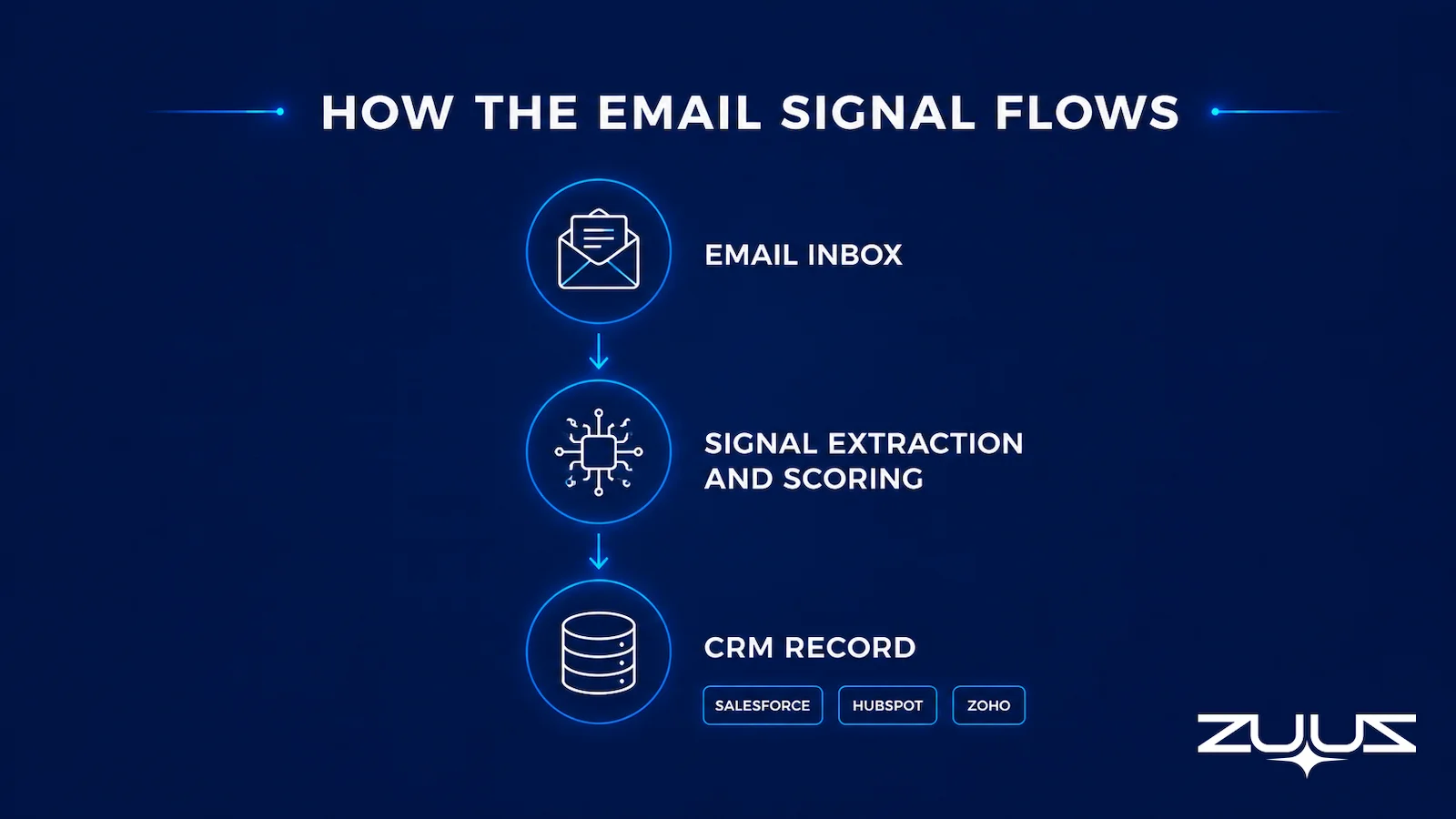
The mechanism is direct. ZUUZ reads each email thread, extracts the deal signals inside it, pricing questions, new stakeholders, scope changes, renewal mentions, competitor names, and quiet periods, scores them, and writes the structured result to Salesforce, HubSpot, or Zoho.
Reps do not change how they work in email. The intelligence layer runs in the background and surfaces what the CRM never captured.
CRM-agnosticism is built in rather than bolted on. ZUUZ connects to whichever system is already in place and writes in that system’s native format, which matters for organizations running different CRMs across divisions or mid-migration.
The score and the evidence land where the team already works, not in a separate dashboard that nobody opens. For how this layer maps onto the wider stack, see the modern RevOps stack walkthrough and the broader revenue operations software category map.
The Origin Story
The approach came from operating a real revenue org. CEO Avinash Gujje scaled a $25 million ARR IT services and distribution business from $0 before founding ZUUZ. At that scale, the pipeline was not in the CRM.
It was in email. Deals were progressing, renewing, and stalling through shared inboxes while the CRM showed a fraction of the activity. Any intelligence layer built on that CRM alone would have scored a fraction of the business.
What Customers Say
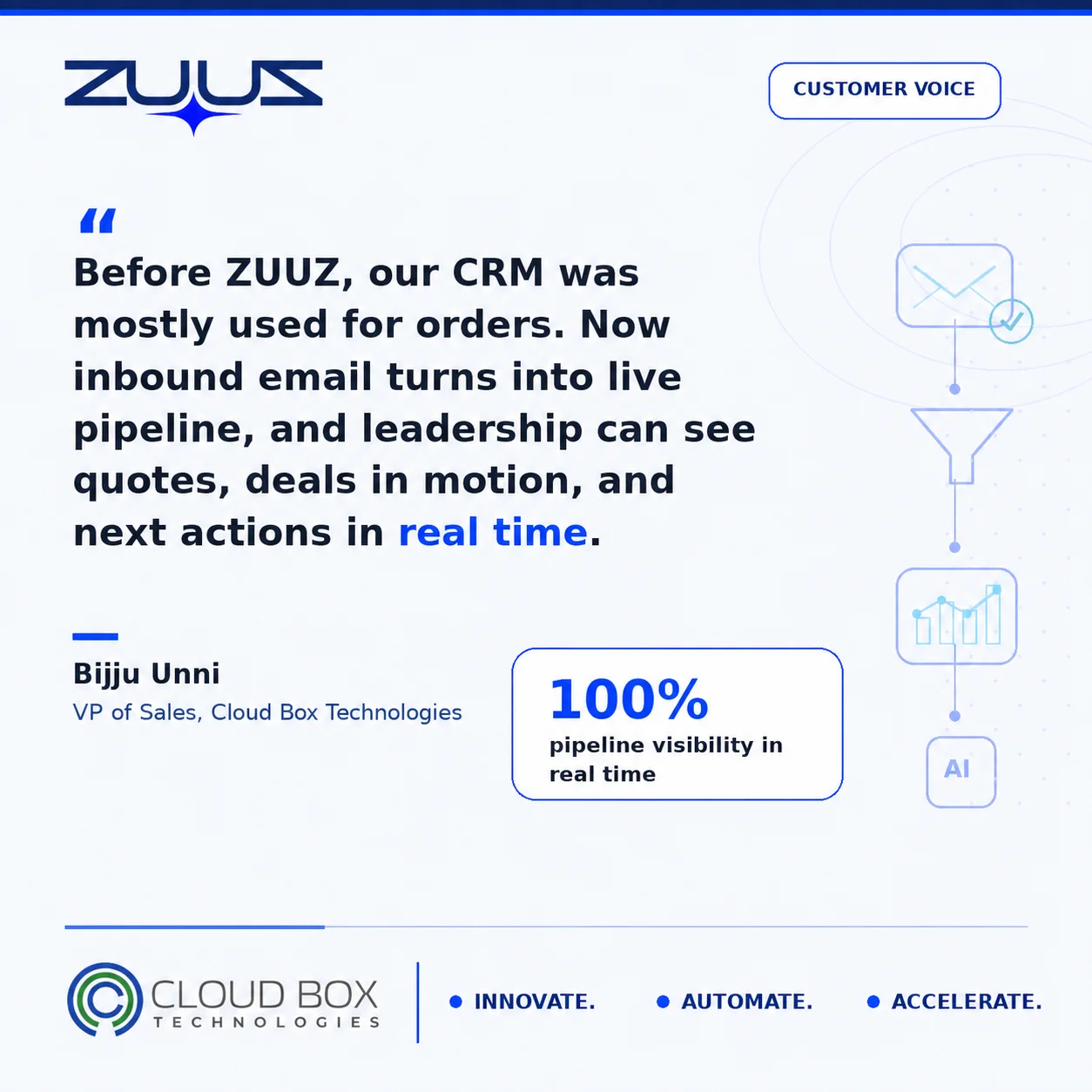
Cloud Box Technologies is a ZUUZ customer today, not just the origin story. Connecting the same email signal turned an order-processing-only CRM into a live view of pipeline in real time, with renewals now tracked in minutes instead of surfacing weeks after they came due.
RA Technologies: $120K Surfaced in 72 Hours
RA Technologies, an IT services firm in the United States, connected their email to ZUUZ and ran the 90-day historical lookback that runs on first connection. The system surfaced $120,000 in pipeline from prior email threads that had never been recorded in their CRM. These were active conversations, renewal discussions, and expansions, deals still in motion that no call-based tool would have scored because the activity lived in the inbox.
The $120,000 figure was pipeline the team could still work, not a retrospective on past losses. That is the practical test of a revenue intelligence platform: does it surface evidence the team can act on this week, or does it explain what already happened. Reading the email signal is how ZUUZ does the former, and it feeds the same records that power day-to-day sales pipeline management.
From an operator’s seat
Across the deployments ZUUZ runs, the pattern is that buyers evaluate scoring and then live with capture. A model that reads one channel is not wrong, it is narrow, and narrow shows up a quarter later as a pipeline that is confidently wrong about the deals nobody discussed on a call. The part teams do not plan for is the review habit: once the record carries dated evidence, the pipeline meeting gets shorter and more uncomfortable, because “I feel good about it” stops being an acceptable answer and somebody has to say what changed and when. Teams that brief their managers on that before go-live keep the discipline. Teams that do not quietly go back to the old meeting.
See the Deals Your Call Tool Can’t Score.
Conversation intelligence reads the meeting. ZUUZ reads the email where the deal actually moves, so book 15 minutes and see the pipeline risk signals your reviews are missing today.
Frequently Asked Questions
What Is Revenue Intelligence Software?
Revenue intelligence software captures signals from sales activity, scores deals by health and risk, and forecasts revenue from that evidence rather than rep opinion. It reads sources such as email, calls, and CRM records, then writes structured insight back to the system of record. The category overlaps with revenue operations software, but its specific job is interpretation: turning raw activity into deal scores, risk flags, and forecasts a leader can actually trust.
What Is the Difference Between Revenue Intelligence and Revenue Operations Software?
Revenue operations software runs the process: routing, sequencing, quoting, and CRM hygiene across the funnel. Revenue intelligence software reads the signals: scoring deals, flagging risk, and forecasting from activity data. One executes the workflow, the other interprets what the workflow produces. Many teams run both, with the intelligence layer reading the records the operations layer creates and adding scores the CRM never held on its own.
Why Does Call-Only Revenue Intelligence Miss Pipeline?
Most revenue intelligence tools score deals from call recordings. Between calls, B2B deals move through email: pricing questions, scope changes, procurement threads, and renewal mentions. A platform that only reads calls scores those deals on partial evidence and misses signals that never reach a recorded meeting. Email coverage closes the gap that conversation intelligence leaves open, which is why a deal can look healthy on calls and quietly stall in the inbox.
How Should You Evaluate Revenue Intelligence Platforms?
Evaluate four things: signal coverage across email and calls, not calls alone; forecast accuracy measured against closed results over time; CRM-agnosticism so the tool works with Salesforce, HubSpot, or Zoho; and signal latency, meaning how fast a new signal becomes a scored, visible record. A platform can score well and still mislead if it reads a narrow slice of activity, so coverage is the axis to test first.
How Is Revenue Intelligence Software Priced?
Pricing models vary. Common structures include per-seat subscriptions, platform fees tied to revenue tracked or pipeline volume, and usage-based pricing tied to signals processed. Many vendors publish no list price and quote per deployment. Buyers should ask what scales the bill, whether historical lookback is included, and whether CRM write-back counts as a separate module before comparing quotes across vendors.
Does Revenue Intelligence Software Replace the CRM?
No. Revenue intelligence software sits on top of the CRM. The CRM remains the system of record for deals, contacts, and activity. The intelligence layer reads that record plus external signals such as email, then writes scores, risk flags, and structured fields back into the CRM. A platform that cannot write back to Salesforce, HubSpot, or Zoho leaves the insight stranded in a separate dashboard the team rarely opens.
How Does ZUUZ Approach Revenue Intelligence Differently?
ZUUZ reads inbound and outbound email, the channel where most B2B deals move between calls, rather than call recordings. It extracts deal signals, scores them, and writes structured records to Salesforce, HubSpot, or Zoho. On first connection it runs a 90-day email lookback. RA Technologies, an IT services firm, surfaced $120,000 in previously unrecorded pipeline within 72 hours this way, all of it deals still in motion.

CEO of ZUUZ. He scaled Cloud Box Technologies from 0 to $25M ARR in IT services and distribution before building ZUUZ. Connect on LinkedIn