
What Is Deal Registration? Process and Best Practices
Deal registration explained for vendors and partners: the process step by step, program best practices, and why registered deals stall after approval.

CEO of ZUUZ. He scaled Cloud Box Technologies from 0 to $25M ARR in IT services and distribution before building ZUUZ. Connect on LinkedIn
TL;DR: Deal registration is the channel process in which a partner claims a specific opportunity with a vendor and, once approved, gets protection or better pricing on it for a set period. Good programs are fast to submit, quick to approve and strict about conflicts and expiry. They break after approval, because the registration sits in the partner portal while the evidence of who is working the deal sits in partner and customer email. ZUUZ, revenue intelligence for the IT channel, reads those threads, links them to the account and deal in the CRM, and surfaces signals such as a stalled registered deal or a partner gone quiet.
- Deal registration gives the partner that found an opportunity a protected claim on it, usually with better pricing, for a period the vendor sets.
- The process runs from qualification and submission through a conflict check and approval, then active selling, and finally extension, closure or expiry.
- Protection length, discounts, minimum deal size and extension rules vary by vendor and live in each vendor's own program documents.
- Most programs fail after approval: registered deals go quiet, expire mid-negotiation, or collide with another partner or a direct rep.
- The registration states the claim. The evidence of real progress lives in partner and customer threads that neither the portal nor the CRM sees by default.
- ZUUZ is not deal registration software or a PRM. It is a layer on top of the CRM that links partner and customer conversations to the right account and deal.
Picture a channel manager at a networking vendor running a quarterly review of registered deals. One registration, approved two months earlier for a regional VAR, shows no portal updates and is a week from expiry, so the obvious call is to let it lapse. What the portal cannot show is that the VAR's account manager and the customer's IT director have traded a dozen emails about a revised bill of materials, with the vendor's own systems engineer copied on three of them.
That gap is where most deal registration programs succeed or fail. This guide covers the definition, the step-by-step process, program design and best practices, and then the part glossary pages skip: what happens to a registered deal after approval, and how vendor channel teams and their partners keep the record aligned with the real deal. It is written for vendor channel leaders first, with a dedicated section for the VARs, MSPs and distributors who register deals.
What Is Deal Registration?
Deal registration is a formal step in a vendor's partner program where a reseller, managed service provider or other partner tells the vendor it is pursuing a specific opportunity and asks the vendor to recognize that claim. If the vendor approves, the partner receives program benefits on that opportunity for a defined period. Those benefits usually include protection from other partners and often a better price than an unregistered deal would get.
The purpose is fairness and investment. A partner that spends weeks discovering a need and running a technical evaluation should not lose the deal to another partner quoting a lower price on the same bill of materials. Red Hat's public deal registration page says approved registrations carry increased margin and pricing protection, and that Red Hat will not proactively introduce competing partners into the deal.
Deal registration is a claim, not a guarantee. Approval does not mean the partner will win, does not last indefinitely, and does not override the vendor's rules on eligibility, conflicts and expiry. Many program problems start when approval is treated as proof that a deal is alive.
Deal registration vs lead registration vs a CRM opportunity
Lead registration, where a program offers it, records that a partner has found a potential customer, often before a project is defined. Deal registration claims a specific opportunity: a named customer, a defined scope, an estimated value and an expected close date. A CRM opportunity is the internal sales record that tracks stage, stakeholders and next steps. One real deal often exists in all three places at once, in the vendor portal, the vendor CRM and the partner's own CRM, with slightly different names, values and dates in each.
A simple deal registration example
As an illustration: a VAR learns that a mid-sized manufacturer plans to replace its campus switching. The VAR confirms budget and timing, registers the opportunity in the switching vendor's portal with the customer, products and expected value, and the vendor approves it after a conflict check. The VAR then quotes the registered-deal price through its distributor and has to close inside the protection window or request an extension under the vendor's rules.
Why Vendors Run a Deal Registration Program
A deal registration program does four jobs for a vendor. It reduces channel conflict, because partners know the rules for who gets a protected claim. It encourages partners to develop new opportunities rather than wait for vendor leads, and it gives the vendor visibility into partner-sourced pipeline before purchase orders arrive. And it draws a line for the vendor's direct sales team on when it can engage an account a partner is working.
Partners value it when it works. In a 2020 partner blog post, Cisco wrote that partners had told it deal registration is the number one partner profitability incentive. The same post admitted the process had become too complicated and that approvals sometimes waited too long with account managers, and it said the redesign would cut the clicks needed to enter a deal by 50%. That is the core tension: partners want protection, and they stop registering when the process is slow or opaque, which takes away the visibility the vendor built the program for.
How the Deal Registration Process Works, Step by Step
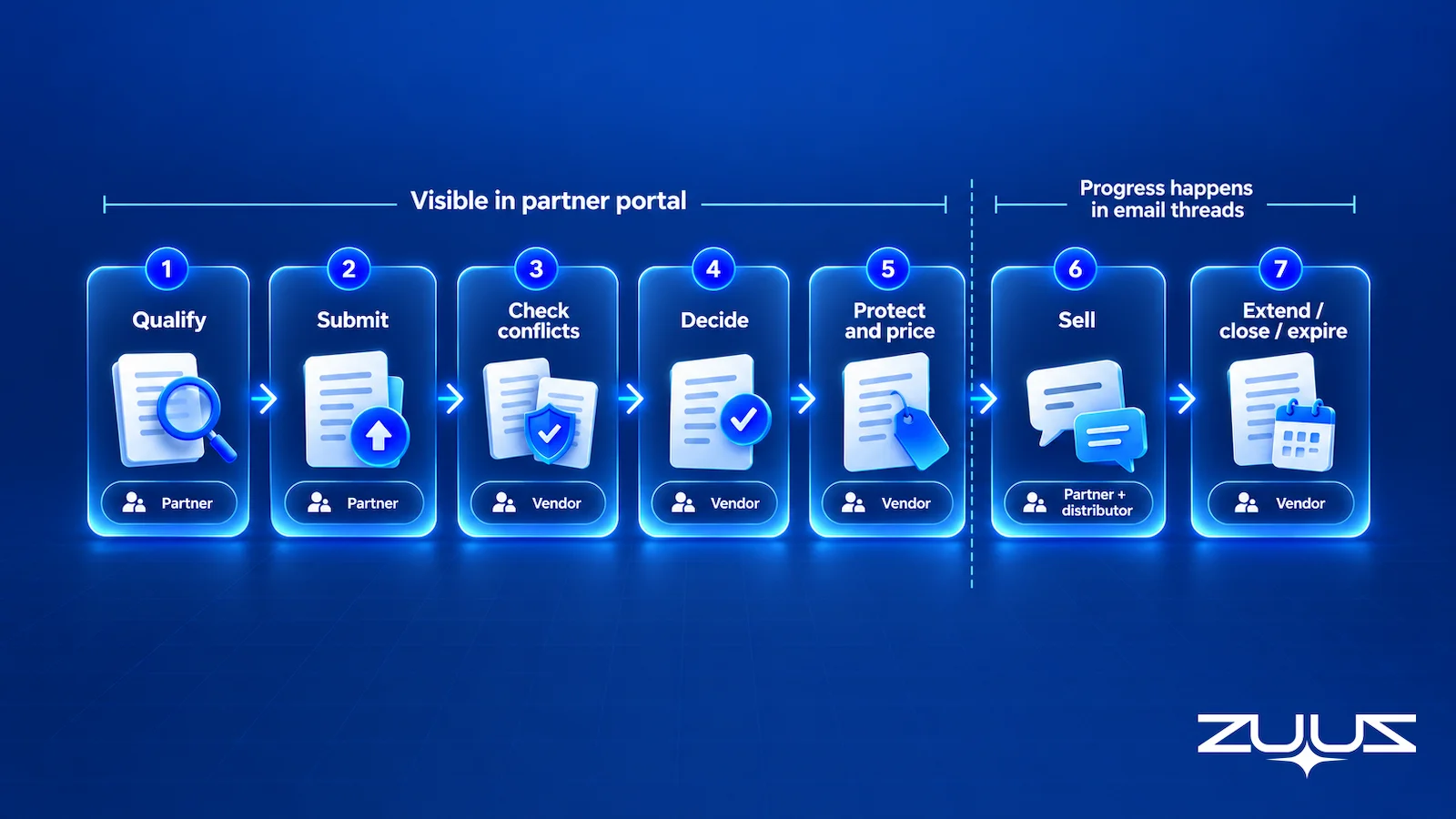
The deal registration process differs in detail between vendors, but the shape is consistent. Red Hat's published flow is a clear public example: the partner enters the opportunity in the partner portal, Red Hat reviews it, an approval email goes to the partner and its selected distributor, and the distributor quotes the discounted price. Most programs follow a similar sequence:
- Qualify. The partner confirms a real project, a named customer, scope, budget and timeline, and checks program eligibility.
- Submit. The partner enters the registration in the vendor's portal or PRM.
- Check conflicts. The vendor looks for overlapping registrations, open direct opportunities and reserved accounts.
- Decide. A channel manager or deal desk approves, rejects or asks for more detail, with a reason.
- Protect and price. The protection window starts and registered pricing is quoted, often through a distributor.
- Sell. The partner runs meetings, technical validation, revised quotes and procurement.
- Extend, close or expire. The registration ends as won, lost, withdrawn or expired, or is extended if the rules allow.
| Step | Owner | Typical timing | Where the real evidence lives |
|---|---|---|---|
| 1. Qualify | Partner sales rep | Before submission; days to weeks of discovery | Customer emails, discovery meetings, LinkedIn messages |
| 2. Submit | Partner rep or sales ops | Minutes, if the form is short | The registration form |
| 3. Conflict check | Vendor channel manager or deal desk | Within the vendor's approval turnaround | Portal history, vendor CRM, threads with other partners and direct reps |
| 4. Decision | Vendor channel manager | Set by the vendor's published turnaround | Approval or rejection notice, follow-up questions by email |
| 5. Protect and price | Vendor, distributor | Window length set by program terms | Program terms, distributor quote emails |
| 6. Sell | Partner, with vendor support | The bulk of the deal cycle | Partner, customer and vendor email threads and meetings |
| 7. Extend, close or expire | Partner requests; vendor decides | Near the end of the window | Recent customer activity, mostly in email |
The last column is the point. The portal holds the evidence only for submission and decision. Every step that shows whether the deal is real and moving produces its evidence in conversations, which is why programs that look healthy on paper can still be full of dead or contested claims.
The Registration Is One Record. The Deal Is in the Threads.
ZUUZ reads partner and customer conversations and links them to the account and deal in the CRM, so channel teams see which registered deals are actually moving.
Deal Registration Program Terms by Vendor Type
There is no industry standard for protection length, discount level, minimum deal size or extension rules. Each vendor sets its own, often differently by partner tier, product line or region, and any number quoted secondhand should be checked against the vendor's current program guide.
Some programs publish detailed criteria. Microsoft's Partner Center documentation on registering co-sell deals lists eligibility rules that include a deal value of at least USD 25,000 and at least one eligible solution in the deal, and advises waiting 72 hours after creating an eligible deal before marking it won. That is a different model from a hardware program where registration happens early to secure pricing. The table describes common patterns generically, because the numbers belong to each vendor.
| Vendor type | When partners register | Typical benefit | Who quotes | Common friction |
|---|---|---|---|---|
| Hardware and networking manufacturer | Early, once a project and bill of materials take shape | Registered-deal discount and protection from other partners | Often a distributor | Approval delays while the customer waits for a price |
| Software or subscription vendor | At qualification, sometimes again at expansion | Higher margin or fee on new business | Partner, vendor or marketplace | Whether renewals and expansions qualify |
| Cloud co-sell or marketplace program | Varies; some register around the close | Incentives, co-sell support, partner status credit | Marketplace or direct contract | Strict eligibility and evidence rules |
| Security vendor selling to MSPs | When a new client or service tier is in play | Pricing protection and pre-sales help | Distributor or direct | Separating new projects from existing managed contracts |
| Two-tier distribution model | Partner registers; distributor supports in some programs | Discount passed through the distributor's quote | Distributor | Three parties holding three versions of one deal |
For channel leaders, design choices matter more than the headline terms. A generous discount behind a slow approval and an opaque conflict policy produces less registered pipeline than modest benefits with a fast, predictable process.
Deal Registration Best Practices for Program Design
The deal registration best practices that hold up across vendor types come down to speed, clarity and consistency.
Define eligibility before launch
Publish which partner tiers, products and regions qualify, whether existing customers or renewals count, and any minimum deal size. Ambiguous eligibility causes most rejections and many disputes that should never have started.
Keep the form short and approvals fast
Ask only for what the decision needs: customer, scope, value, timing and the partner's role. Then publish an approval turnaround, route registrations to a backup approver when the owner is out, and report actual turnaround time. Partners register because they need a protected price to quote, and every day in a queue costs them time with the customer.
Match the protection window to the sales cycle
A window shorter than the real cycle forces constant extension requests, and a window far longer lets abandoned registrations block other partners. Set windows by product line or deal size where cycles differ, and send expiry reminders well ahead of the deadline.
Grant extensions on evidence of activity
Automatic extensions reward partners who registered and stopped selling. Extensions tied to recent, dated customer activity, such as a revised quote, a technical meeting or a procurement question, keep protection with the partners actually working the deal.
Write rules of engagement for direct sales
Conflict between a partner and the vendor's own account executive does more damage to trust than partner-to-partner conflict. Spell out when direct reps may engage a registered account, how they are paid when they do, and who decides disputes.
Measure quality, not volume
Registration counts reward speculative submissions. Better measures are approval turnaround, the share of registrations that expire without an outcome, extension and dispute rates, and the win rate of registered deals. A rising expiry rate is usually the first sign the registered pipeline has drifted from reality.
Where Deal Registration Programs Break
Most writing on deal registration stops at approval. In practice, failures cluster after it, when the record stops changing while the deal keeps moving, or the deal stops moving while the record still says it is protected.
Registered and forgotten
A partner registers a deal, the customer goes quiet, and nobody withdraws the claim. It blocks other partners until it expires and counts as partner pipeline the whole time. Without evidence of recent customer contact, the channel manager cannot tell an abandoned registration from a slow but live one.
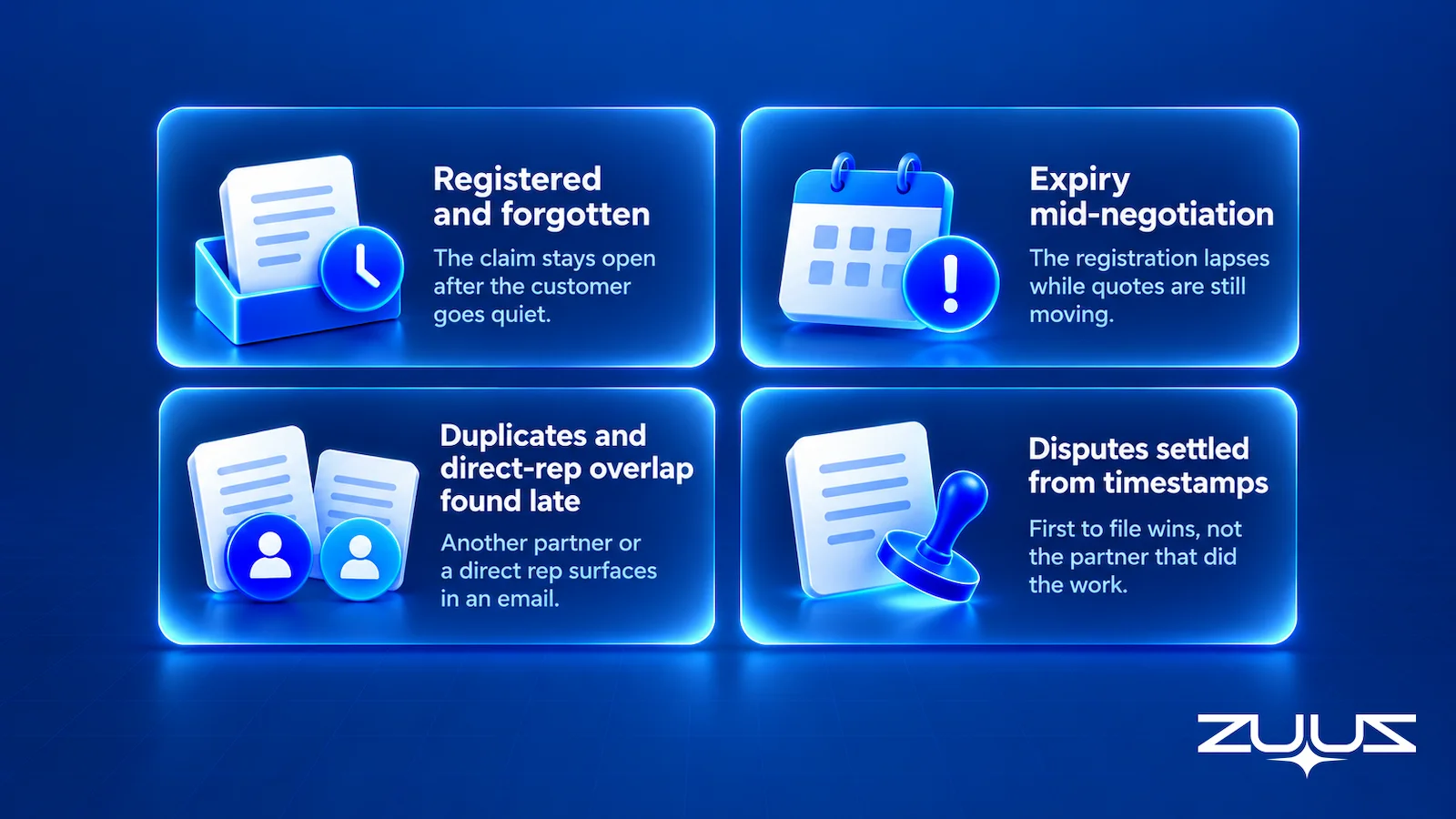
Expiry in the middle of a negotiation
The partner is deep in revised quotes, the portal shows no updates, and the registration lapses a week before the purchase order. The partner loses its protected price at the worst moment, and the vendor loses goodwill it spent months building.
Duplicates and direct-rep overlap found late
Two partners register the same project under slightly different customer names, or a vendor account executive engages a registered customer without knowing it, because the registration lives in the PRM and the rep works from the vendor CRM. The overlap often surfaces only when the customer mentions the other party in an email.
Disputes settled from timestamps
When claims collide, first to register is the easiest rule to apply. It is also the rule most likely to reward the partner that filed first rather than the one that did the work. Fair decisions need dated evidence of customer engagement, and that evidence is scattered across inboxes on both sides.
The Portal Holds the Claim, the Inbox Holds the Evidence
Every failure above has the same root. The registration captures the administrative state of an opportunity: partner, customer, scope, value, approval date and expiry date. It does not capture whether the partner spoke to the customer last week, whether the customer asked for a revised quote, or whether a second partner has started emailing the same IT director.
That information exists, in email between the partner and the customer, between the partner and the vendor's channel manager, and between the distributor and both of them, plus meeting invites and LinkedIn messages. Each party sees its own slice. The channel manager deciding an extension or a dispute usually sees the least, and ends up asking each side to forward emails.
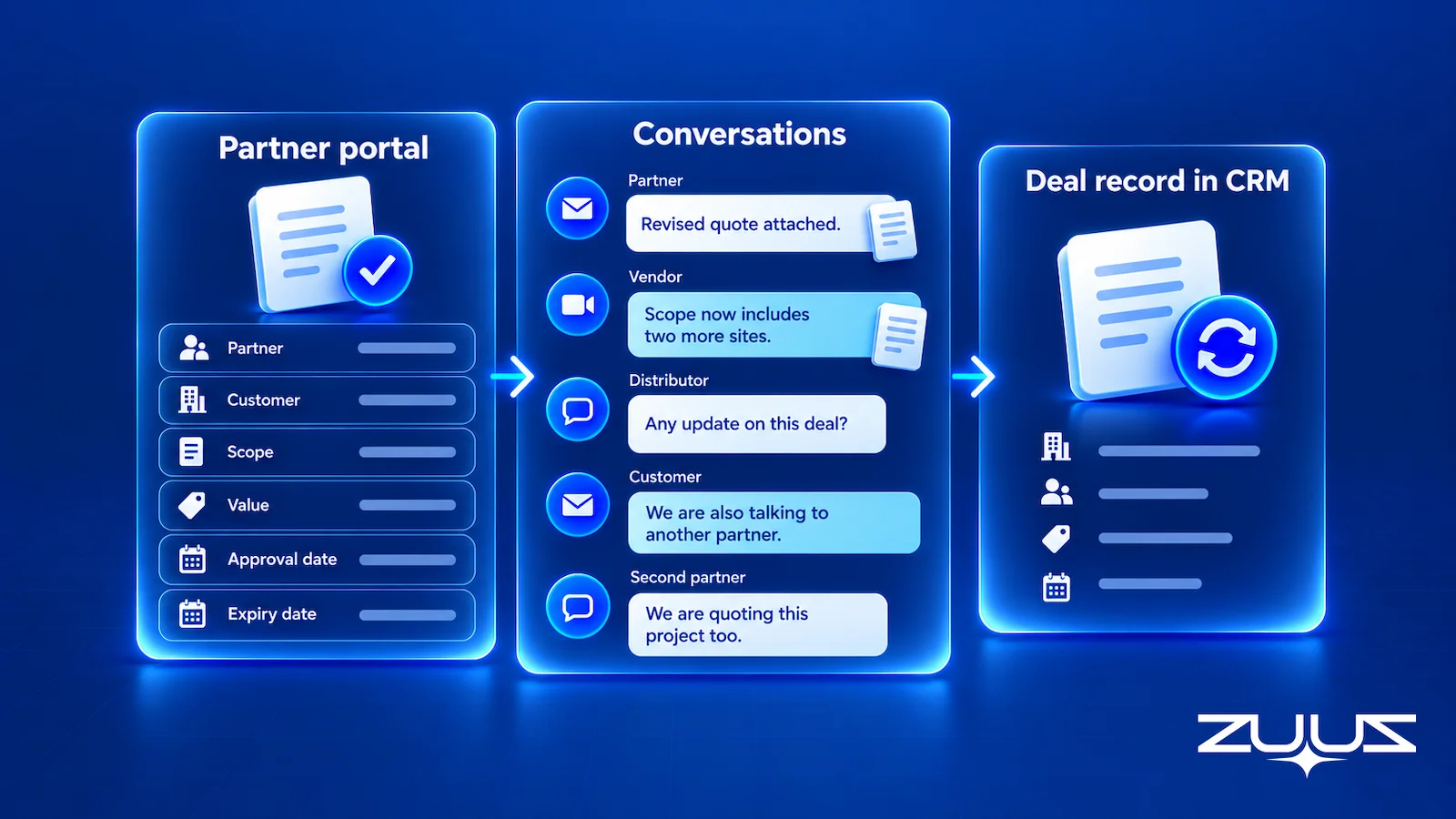
From an operator's seat, the pattern is consistent. Avinash Gujje, who scaled Cloud Box Technologies from $0 to $25M ARR in IT services and distribution, found that registered deals behave like any other pipeline record: accurate on the day they are entered, then gradually less so. The part teams do not plan for is that the moments that matter most, a customer delaying a purchase, a scope change that needs a new registration, a competing partner appearing, almost never arrive as a portal event. They arrive as a sentence in one person's inbox, and the program reacts only if that person updates the record.
That is why adding more portal fields rarely fixes the problem. The fix is connecting the record to the conversations, so extension, conflict and pipeline decisions rest on dated evidence instead of the last status a partner typed.
Decide Extensions and Disputes on Evidence, Not Timestamps.
ZUUZ links partner and customer threads to the deal in Salesforce, HubSpot, Zoho, Attio or Pipedrive, with full change history and one-click rollback.
Deal Registration for VARs, MSPs and Distributors
On the partner side, deal registration is about discipline: registering the right deals at the right time, keeping them alive, and proving the work when a claim is challenged. Rules differ by vendor, so the first habit is reading each vendor's current program guide rather than relying on how the last deal went.
VARs
For value-added resellers, registration is often the difference between a competitive price and a lost deal. The VARs that get the most from it register as soon as an opportunity qualifies, describe the scope precisely so a later change does not void the claim, and track approval and expiry dates on the opportunity in their own CRM. The IT VAR sales pipeline guide shows where registrations sit in the wider reseller pipeline, and the value-added reseller overview explains the VAR, vendor and distributor relationship.
MSPs
Managed service providers face a question VARs meet less often: whether work inside an existing managed contract qualifies. A new security tier or a site expansion may or may not count as a new registration, depending on the vendor. The safe practice is to check the terms before quoting and register expansion projects as distinct opportunities with their own scope.
Distributors
In two-tier programs, distributors often sit in the middle of deal registration without owning it. In Red Hat's process the approval goes to the partner and its selected distributor, which issues the quote with the registered discount, and some programs let distributors submit or support registrations for smaller resellers. Because quote revisions run through them, a distributor's inbox often holds the earliest sign that a registered deal has stalled or changed scope.
Keeping registrations alive and handling disputes
Expiry loses more protected deals than rival partners do. Disciplined partners set reminders well ahead of each expiry and request extensions with dated evidence of customer activity. When another partner claims the same deal, the partner reviews the program terms, gathers the dated record of its own customer engagement and escalates through the vendor's published process; many programs weigh engagement, not only who registered first.
Deal Registration Software, PRM, CRM and the Conversation Layer
Deal registration software usually comes as a module inside a partner relationship management (PRM) platform, though some vendors run registration through a CRM-based partner portal. It handles the submission form, approval workflows, duplicate detection, protection windows, expiry reminders, dispute records and reporting, and most versions sync approved registrations to the vendor's CRM as opportunities. What it does not do is read the conversations where the deal moves. It enforces rules on the data partners enter, which is the right division of labor and leaves a gap neither the PRM nor the CRM fills by default.
| Capability | Deal registration software or PRM | CRM | ZUUZ (layer on the CRM) |
|---|---|---|---|
| Accept registrations and enforce program rules | Primary job | Sometimes, via a partner portal | No; rules stay in the program |
| Track opportunities, stages and owners | Often, for registered deals | Primary job | Keeps the CRM record current from conversations |
| Capture partner and customer email, calendar, meetings and LinkedIn messages | Rarely | Only what someone logs | Primary job; links threads to the account and deal |
| Spot a registered deal that has stalled or a partner gone quiet | Date-based reminders | Only if activity was logged | Surfaces the signal from the conversations |
| Show dated evidence for extension and dispute decisions | Registration timestamps | Logged activities | The actual threads, linked to the deal |
When evaluating deal registration software, the useful questions go beyond the form. Does it sync both ways with the CRM the channel team already runs? How does it catch duplicates when customer names differ slightly, and can channel managers see evidence of partner activity, or only reported status? And what covers the conversations the software will never see?
Keep the PRM for the Rules. Add the Conversations to the Deal.
ZUUZ runs on top of the CRM the channel team already uses, with no migration, and first pipeline appears within 72 hours.
The Pipeline Truth Test for Registered Deals
ZUUZ uses one check across every pipeline topic, the Pipeline Truth Test, and it applies directly to a registered-deal review:
- Take the top five deals by value this quarter.
- For each, find the CRM evidence for its stage and close date: a dated written commitment, not a rep's assurance.
- Count how many rest on a stage last changed more than two weeks ago.
- Mostly-undated top five means the number reflects rep optimism. ZUUZ does not forecast; it makes the record underneath the number real.
Applied to deal registration, as an illustration: a channel manager takes the five largest approved registrations expiring this quarter and asks, for each, whether a dated customer commitment backs the stage the partner reported, such as a budget confirmation, a revised-quote request or a procurement meeting. If three of the five rest on a status untouched for more than two weeks, the channel manager knows which partners to call before approving any extension. If the evidence exists but sits in a partner's inbox, the test shows that too, which is usually the more useful finding.
Partner Deal Signals: How ZUUZ Links the Threads to the Deal
ZUUZ is revenue intelligence for the IT channel: MSPs and the vendors, distributors and resellers they work with. It is not deal registration software or a PRM, and registrations, approvals and program rules stay where they are. ZUUZ reads email, calendar, meetings and LinkedIn messages, finds deal signals, and links partner and customer threads to the right account and deal in Salesforce, HubSpot, Zoho, Attio or Pipedrive.
For a channel team, that means seeing a registered deal whose threads have gone quiet, a partner that has stopped responding, or a customer conversation showing a deal moving faster or slower than its record suggests. ZUUZ updates the CRM automatically with full change history and one-click rollback, so the channel manager can see what changed and reverse any update. It drafts replies, and the rep reviews and sends them. For MSPs on ConnectWise PSA, won customers sync to the PSA.
The structural difference is that ZUUZ is a layer on top of the CRM the team already runs: no migration and no new portal for partners. RA Technologies, a US IT services company, surfaced $120K of identified pipeline within 72 hours that two years of HubSpot had never recorded, as the RA Technologies case study details. Vendor channel teams can see how the same approach fits partner programs on the ZUUZ page for IT vendors.
The trial is concrete. A channel manager connects one mailbox to the free 30-day trial, and ZUUZ reads the last 90 days of partner and customer threads and links them to accounts and deals in the CRM. First pipeline appears within 72 hours, and a full rollout takes one to two weeks, so the comparison between what the registration records say and what the conversations show is ready before the next round of extension decisions.
Frequently Asked Questions
What is deal registration in simple terms?
Deal registration is how a channel partner tells a vendor it is working a specific opportunity and asks for that claim to be recognized. If the vendor approves, the partner usually gets protection from other partners and better pricing on that deal for a set period. The rules, benefits and expiry terms are defined in each vendor's partner program.
What are the steps in the deal registration process?
The deal registration process usually has seven steps. The partner qualifies the opportunity and submits it in the vendor's portal. The vendor checks for conflicts, then approves, rejects or asks for detail. Approved deals receive protection and registered pricing, the partner works the deal, and the registration ends as won or lost, expires, or is extended.
How long does a deal registration last?
A deal registration lasts as long as the vendor's program says, and the period can differ by partner tier, product line or deal size. Many programs allow an extension if the deal is still active, usually on request with supporting evidence. Partners should take the protection period from the vendor's current program guide and the approval notice, not from a previous deal.
What happens when two partners register the same deal?
The vendor applies its published conflict rules. Some programs favor the first valid registration, while others weigh qualification and customer engagement. The vendor may approve one claim, reject the other, or ask both partners for evidence. Partners with dated records of customer meetings, quotes and emails are in the strongest position during a dispute.
What is deal registration software?
Deal registration software is the system partners use to submit opportunities and vendors use to approve them, usually a module inside a partner relationship management platform. It handles forms, approvals, duplicate detection, protection windows, expiry reminders and reporting, and typically syncs approved registrations to the vendor's CRM. It enforces rules on entered data but does not read deal conversations.
What makes a good deal registration program?
A good deal registration program is easy to submit, quick to approve and consistent on conflicts. It publishes clear eligibility rules, matches protection windows to real sales cycles, grants extensions on evidence of activity, and sets rules of engagement for the vendor's direct sales team. It measures expiry, dispute and win rates rather than registration volume alone.
Why do partners avoid registering deals?
Partners avoid registering deals when the process costs more than the protection is worth. Long forms, slow approvals, unclear eligibility and inconsistent conflict decisions are the usual reasons. Some partners also worry that a registration exposes the deal to the vendor's direct team. Fast approvals and published rules of engagement address most of these concerns.
Do MSPs need to register renewals and expansions?
Whether MSPs register renewals and expansions depends on each vendor's program. Some count expansions or new service tiers inside an existing client as new opportunities, while others exclude renewals entirely. MSPs should check the program terms before quoting, and where the program allows it, register expansion projects as distinct opportunities with their own scope, value and expected close date.
How do distributors take part in deal registration?
Distributors take part mainly in two-tier programs, where the vendor approves the reseller's registration and the distributor quotes the registered price. In some programs the distributor can also submit or support registrations for smaller resellers. Because quote revisions pass through them, distributors often see early when a registered deal changes scope or stalls.
Does ZUUZ replace a PRM or deal registration software?
ZUUZ does not replace a PRM or deal registration software; registrations, approvals and program rules stay in the vendor's existing system. ZUUZ is revenue intelligence for the IT channel that sits on top of the CRM, reads partner and customer conversations, links them to the account and deal, and surfaces signals such as a stalled registered deal or a partner that has gone quiet.