
Channel Sales: How the IT Channel Sells Through Partners
Channel sales explained for IT vendors: the vendor to distributor to VAR/MSP model, partner types, channel sales management, strategy steps and metrics.

CEO of ZUUZ. He scaled Cloud Box Technologies from 0 to $25M ARR in IT services and distribution before building ZUUZ. Connect on LinkedIn
TL;DR: Channel sales is how a vendor sells through partners, such as distributors, value-added resellers and managed service providers, instead of only through its own sales team. In the IT channel, most of the customer conversation happens between partner and buyer, so the vendor's CRM and PRM see a deal only once someone registers or logs it. ZUUZ is revenue intelligence for the IT channel: it reads email, calendar, meetings and LinkedIn messages, finds partner deal signals, and updates the CRM automatically with full change history and one-click rollback.
- Channel sales means a vendor reaches customers through partners that resell, bundle, deliver or refer its products.
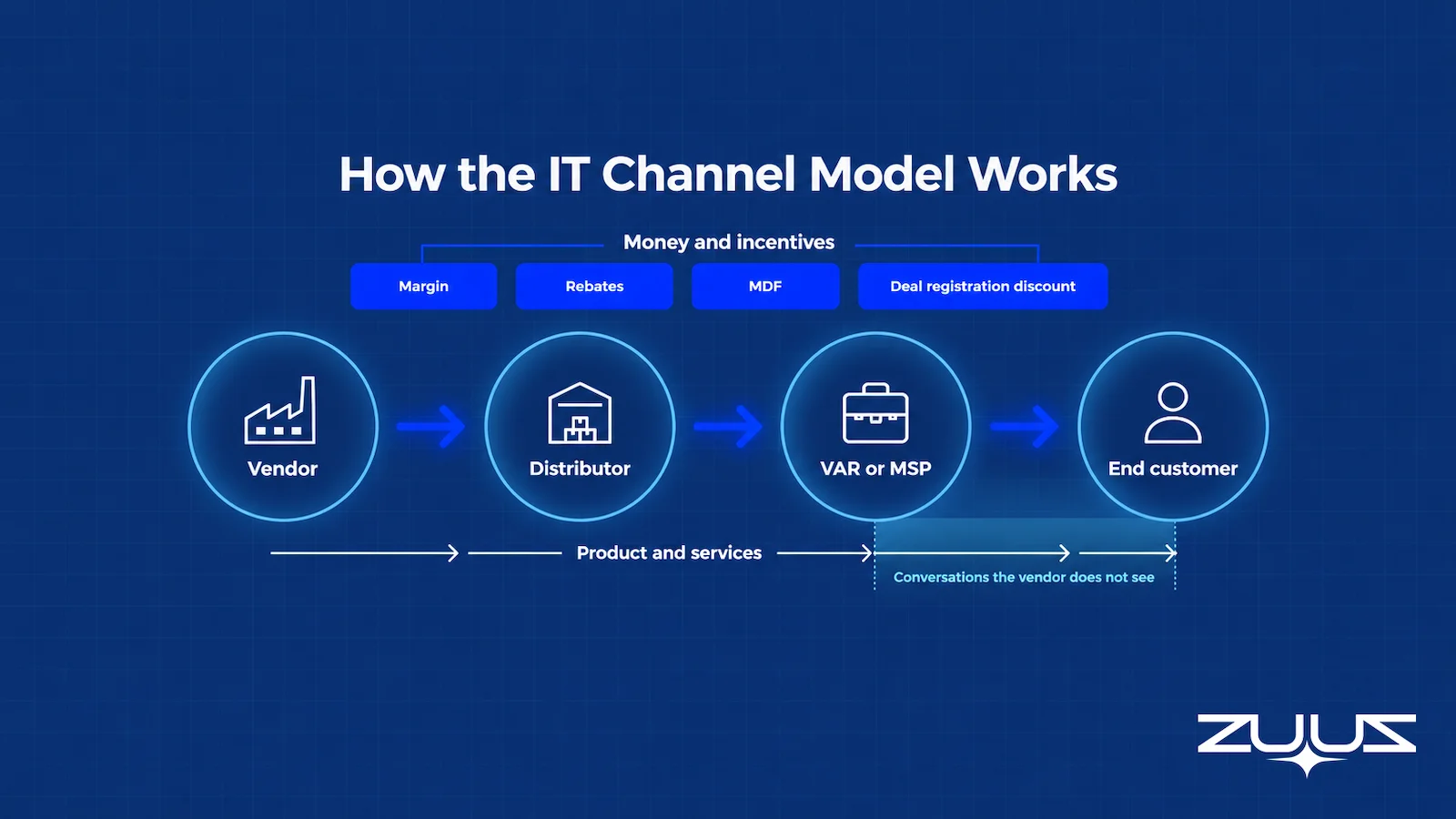
- The classic IT channel runs from vendor to distributor to VAR or MSP to the end customer, with margin, rebates and MDF flowing along the chain.
- Channel sales management covers recruiting, enabling, paying and measuring partners, plus the rules of engagement that prevent conflict.
- A channel sales manager owns a portfolio of partners, not a list of end customers, and is measured on what those partners sell.
- Channel visibility breaks in one place: partner deals move in email, meetings and LinkedIn messages long before they reach the CRM or PRM.
Picture a security software vendor's quarterly channel review. The channel sales manager shows forty registered partner deals and a list of newly certified resellers. The same week, one of those resellers has three customer threads asking for pricing on the vendor's product and a meeting invite for a proof of concept. None of it is in the vendor's CRM, because nobody has registered it yet.
That gap sits at the center of selling through partners. The vendor builds the program and owns the product, but the customer conversation happens one or two companies away. This guide covers what channel sales is, how the IT channel model works, partner types, channel sales management and the channel sales manager role, strategy, metrics, and where visibility into partner deals breaks.
What Is Channel Sales?
Channel sales is a go-to-market model in which a company sells through third parties instead of, or alongside, its own direct sales team. Those third parties are channel partners. They may resell the product, bundle it into a service, deliver the implementation, or refer the customer for a fee.
The vendor's job changes in this model. Instead of selling to every end customer, it recruits partners who already have those customers' trust, equips them to sell, and pays them through margin, rebates or referral fees. Salesforce's overview of partner relationship management describes the software side of that job: onboarding partners, sharing leads and tracking partner deals.
A channel sales example from the IT channel
A typical scenario: a backup software vendor sells through two North American distributors. A regional managed service provider buys licenses through one of them, bundles the backup product into its managed service, and bills its clients monthly. The vendor never invoices the end customer, yet its revenue depends on how many of that MSP's clients adopt the product and renew.
What Is a Sales Channel?
A sales channel is any route a product takes to reach a buyer. Direct sales channels include field sales, inside sales and the vendor's own website. Indirect sales channels include distributors, resellers, MSPs, systems integrators, referral partners and cloud marketplaces. The difference is who owns the transaction and, usually, the day-to-day customer relationship.
Channels can also be physical, such as retail stores and field sales reps, or digital, such as ecommerce sites and cloud marketplaces. Digital channels scale cheaply, but their drawbacks show up in complex IT purchases: little room for consultative selling, easy price comparison and no help with deployment. That is why so much IT spending still runs through partners who do that work.
Channel Sales vs Direct Sales
The choice between channel sales and direct sales is rarely either-or. Vendors usually sell strategic accounts directly and reach the mid-market and small businesses through partners. What changes between the two models is cost, control, reach and how much of the pipeline the vendor can see.
| Dimension | Direct sales | Channel sales |
|---|---|---|
| Who sells | The vendor's own sales team | Distributors, VARs, MSPs, integrators, referral partners |
| Customer relationship | Owned by the vendor | Usually owned by the partner day to day |
| Cost of reach | Salaries, commission and travel per territory | Margin, rebates and program costs, paid mostly when deals close |
| Pricing control | High | Shared, with partner margin built in |
| Who sees the deal early | The vendor's rep, in their own inbox | The partner's rep; the vendor sees it at registration or quote |
| Main risk | Cost of scaling headcount | Partner inactivity, channel conflict, weak pipeline visibility |
The last two rows explain most channel frustration. In direct sales, a deal is invisible only when a rep fails to log it. In channel sales, the deal starts in another company's mailbox.
See Partner Deals Before Someone Registers Them.
ZUUZ reads partner and customer conversations across email, calendar, meetings and LinkedIn and keeps the CRM current, with every change logged.
How the IT Channel Model Works
The IT channel is one of the most layered channel sales systems in business. Hardware, software, cloud and security vendors reach most business customers through a chain of partners. For IT vendors, designing that chain matters as much as pricing the product.
One-tier and two-tier distribution
In a one-tier model, the vendor sells directly to resellers and MSPs. In a two-tier model, the vendor sells to distributors, which sell to thousands of resellers and MSPs. Distributors carry credit and inventory, handle licensing and logistics, run cloud marketplaces, and provide pre-sales engineering smaller partners cannot afford. Large vendors often run both: top partners buy direct, and the long tail buys through distribution.
How margin, rebates and MDF flow
The partner buys below list price and keeps the difference as margin. The vendor adds rebates for hitting targets, certification tiers that earn better discounts, and market development funds, or MDF, for joint marketing. Deal registration adds an extra discount for the partner who registers an opportunity first.
How a channel deal moves to a purchase order
A typical path: the customer mentions a need to its MSP or VAR, often in an email or a quarterly review; the partner asks the distributor or vendor for pricing; the partner registers the deal; the vendor accepts it and may send a sales engineer; the partner quotes; the customer issues a purchase order. Every step before registration happens in conversations the vendor does not own, which is why deal registration matters so much to channel teams.
Types of Channel Partners in the IT Channel
Channel partners differ in how they make money and how close they sit to the customer. A channel sales strategy should name which types it needs, because a program built for resellers rarely fits MSPs unchanged.
| Partner type | What it does | How it earns | Where the deal conversation lives |
|---|---|---|---|
| Distributor | Aggregates vendors, holds credit and inventory, supports resellers | Distribution margin, vendor incentives | Reseller quote requests, vendor pricing threads |
| Value-added reseller (VAR) | Resells with configuration, integration and support | Product margin, rebates, services | Customer email, meetings, the VAR's own quotes |
| Managed service provider (MSP) | Bundles products into recurring managed services | Monthly service fees, license margin | Client email, business reviews, LinkedIn messages |
| Systems integrator | Runs complex, project-based implementations | Project fees, sometimes resale | Project meetings, executive email |
| Referral partner | Introduces customers without owning the sale | Referral fees | An introduction email |
| Cloud marketplace | Transacts subscriptions on a hyperscaler or distributor platform | Marketplace fees, private offers | Listings plus the partner's customer threads |
Value-added resellers and managed service providers carry most IT vendors' small and mid-sized business. A VAR earns most on the project and the resale, as the guide to the value-added reseller model explains. An MSP earns on the recurring service, so it adds a vendor only when the product fits its stack and margins.
Why Vendors Sell Through Partners, and What It Costs
The main benefit of channel sales is reach. Partners already have customer relationships, local presence and technical staff, so a vendor can enter a region without hiring a team there. Partners still carry most of the technology market: Canalys projected in November 2024 that 70% of customer spending on technology, IT services and telecom services would go through partners in 2025, down from 71% in 2024 and 73% in 2023.
Vendors also expect partner revenue to grow. Forrester's State of Partner Ecosystems research for 2025 found that 67% of B2B partner ecosystem and channel marketing decision-makers plan for indirect revenue, meaning revenue transacted by partners, to grow above or significantly above the previous year.
The costs are real. Partner margin reduces revenue per deal, the vendor gives up some control over positioning and price, and partners push whichever vendor is easiest to sell. The vendor also loses direct sight of its own pipeline. Channel conflict, where partners and direct reps chase the same account, is the most visible symptom.
Keep the Reach of the Channel Without Losing Sight of the Pipeline.
ZUUZ turns the partner and customer conversations a channel team already has into opportunities, contacts and next steps in the CRM.
What Is Channel Sales Management?
Channel sales management is the discipline of building, running and measuring a partner network so that partners actually sell. It covers the partner lifecycle from selection to payment, plus the operating rules that keep the channel fair. Done well, it treats partners as a sales force the vendor does not employ.
Recruiting and activating partners
Recruitment starts with an ideal partner profile: the customers a partner serves, its technical skills, its other vendors and its sales capacity. Signing a partner is the easy part. Activation, the partner's first real deal, is the milestone that matters, and many programs carry a long tail of partners who never sell.
Enablement and deal registration
Partners need training, demo environments, pricing tools and a fast path to a sales engineer. Deal registration then lets a partner claim an opportunity and receive protected pricing; Microsoft's Partner Center documentation on registering deals shows how a large vendor formalizes it. Rules of engagement define account ownership, registration length and what happens when a direct rep and a partner meet at the same customer.
Incentives and partner health
Margins, rebates, MDF and spiffs shape partner behavior more than training does. The test is whether a partner makes money on the vendor's product after its own pre-sales and support costs. Channel sales management also means watching which partners are active and which have gone quiet; measuring partner engagement by quote requests and registrations says more than portal logins.
What Does a Channel Sales Manager Do?
A channel sales manager, sometimes called a partner account manager, is responsible for revenue that partners generate. The role recruits and onboards partners, builds joint business plans, enables partner sellers, supports live deals, enforces deal registration and rules of engagement, and reports on partner-sourced and partner-influenced pipeline.
A typical week for a channel sales manager
Much of the week happens in conversations. The channel sales manager answers pricing questions from reseller reps, chases a distributor about a stalled special-pricing request, joins a partner's customer call as the vendor expert, reviews registrations, and runs a business review with a top partner. Then, on Friday, the CRM gets updated so Monday's pipeline review reflects what partners said. That last task is the one most often skipped.
Channel sales manager vs direct sales manager
A direct sales manager leads reps who sell to customers. A channel sales manager influences partner reps they do not manage, at companies that also sell other vendors' products. The channel role needs more persuasion and a working grasp of partner economics: what margin a VAR needs, why an MSP cares about monthly billing, and how a distributor picks which vendors to promote.
How to Build a Channel Sales Strategy in Eight Steps
A channel sales strategy decides which partners a vendor works with, how they make money, and how vendor and partners sell together. These eight steps fit an IT vendor building or rebuilding a program.
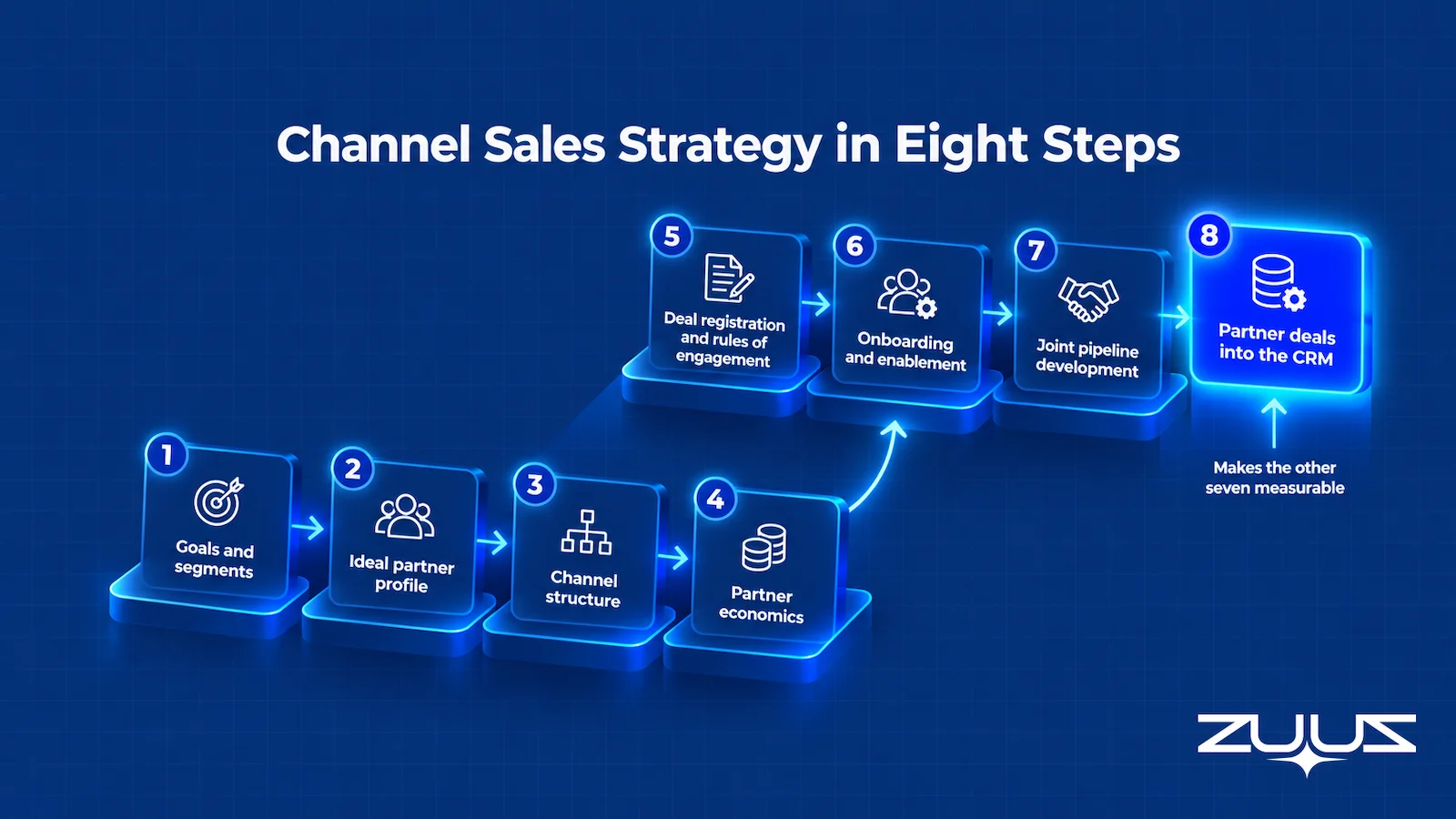
- Set goals and target segments. Decide which customers, regions and deal sizes the channel covers and which stay direct.
- Define the ideal partner profile. Name the partner types needed and the customers and skills each must bring.
- Choose the channel structure. Pick one-tier, two-tier or a hybrid, based on how many partners the vendor can support directly.
- Design partner economics. Set margins, rebates, MDF and tier benefits so a partner profits on a typical deal.
- Write registration rules and rules of engagement. Define eligibility, protection periods, account ownership and dispute handling.
- Build onboarding and enablement. Give partners training, demo assets and a named contact who answers quickly.
- Run joint pipeline development. Agree target accounts and follow-up with each top partner, and review open deals together.
- Decide how partner deals reach the CRM. Settle which records the CRM and the PRM each hold, and how conversations become opportunities. The PRM vs CRM comparison covers the split.
Most channel strategies spend their effort on the first six steps. The eighth decides whether the vendor can tell, three months in, which of those choices are working.
Make Step Eight the Easy One for the Channel Team.
ZUUZ connects to the channel team's mailboxes and writes partner deal signals into Salesforce, HubSpot, Zoho, Attio or Pipedrive, with change history and one-click rollback.
Channel Sales Metrics That Show What Partners Actually Sell
Channel sales metrics should separate partner activity from partner selling. Partners recruited, certifications earned and portal logins show effort. Pipeline and revenue metrics show results, and a useful scorecard weights them more heavily.
| Metric | What it measures | What it misses |
|---|---|---|
| Partner-sourced revenue | Revenue from deals a partner originated | Deals the partner shaped but did not originate |
| Partner-influenced revenue | Revenue from deals a partner touched | How much the touch mattered |
| Active partner rate | Partners with a deal in the period, divided by all partners | Partners selling without registering |
| Time to first deal | Days from signing to a partner's first closed deal | Partners that sold once and stopped |
| Registered pipeline and win rate | Accepted registrations and the share that close | Deals still in conversation |
| Partner renewal rate | Recurring revenue retained through partners | Renewal risk that has not surfaced yet |
Attribution is the hardest part, because several partners and a direct rep can claim the same deal; the guide to partner attribution covers fair credit rules. Every metric here depends on one input: deals recorded in the CRM with the right partner, stage and date.
Where Channel Sales Visibility Breaks
Channel pipeline reports are built from registrations, quotes and opportunities someone entered. The deal starts earlier, in a customer's email to its MSP, a reseller's pricing request to a distributor, or a partner rep's LinkedIn message to the vendor's channel manager. Until someone turns that conversation into a record, the CRM and the PRM both report a quieter channel than the one that exists.
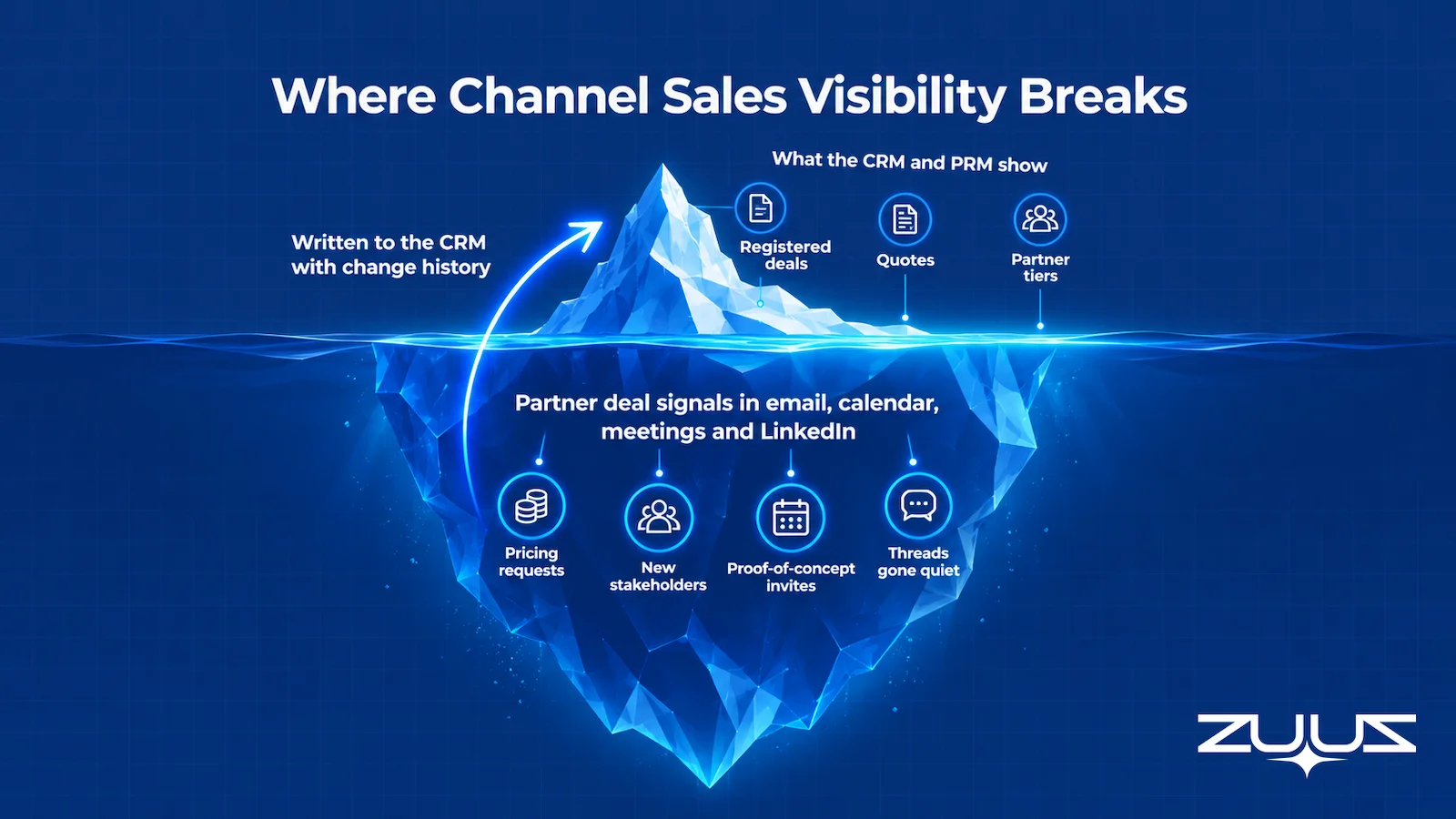
From an operator's seat on the services and distribution side of the IT channel, where Avinash Gujje built Cloud Box Technologies from $0 to $25M ARR, the pattern looks different from how vendor dashboards describe it. Partners do not register late because they are careless. They register once they are confident the deal is real and the vendor will protect it, often weeks after the first pricing email. The earliest reliable sign of a live partner deal is a specific question in a thread, such as a quote request for a stated quantity or an invite that adds the vendor's engineer, and it sits in the channel manager's inbox long before any registration form.

The gap runs the other way too. A registered deal can look healthy in the CRM while the partner's thread with the customer has been silent for a month, and the vendor learns about it when the registration expires.
The Pipeline Truth Test for partner deals
The Pipeline Truth Test is a ZUUZ framework for checking whether a pipeline number rests on evidence. For a channel team, run it on partner-sourced deals:
- Take the top five deals by value this quarter.
- For each, find the CRM evidence for its stage and close date: a dated written commitment, not a rep's assurance.
- Count how many rest on a stage last changed more than two weeks ago.
- Mostly-undated top five means the number reflects rep optimism. ZUUZ does not forecast; it makes the record underneath the number real.
Worked example for an IT vendor: of the top five partner-sourced deals, two have a stage set at registration and untouched since, one rests on a partner rep saying "it's close" on a call, and two have a dated customer email confirming a purchase timeline. Two of five carry real evidence, so the channel number is mostly partner optimism.
What each system records, and what it misses
| System | What it records well | What it misses |
|---|---|---|
| CRM | Accounts, contacts, opportunities, stages, reports | Anything nobody typed in, including most partner conversations |
| PRM | Partner onboarding, tiers, MDF, deal registrations | Deals before registration and the conversations behind them |
| Distributor portals and quoting tools | Pricing, quotes and orders | Who asked, why, and what the customer said |
| ZUUZ (revenue intelligence for the IT channel) | Deal signals from email, calendar, meetings and LinkedIn, written to the CRM with change history and rollback | PSA tickets, which it does not read, and unconnected mailboxes |
Better visibility does not replace channel rules. Registration policy, account ownership and conflict resolution still need owners. What changes is timing: the channel team sees overlap, stalls and new demand while there is still time to act.
Partner Deal Signals: How ZUUZ Writes Them to the CRM
ZUUZ is revenue intelligence for the IT channel: MSPs and the vendors, distributors and resellers they work with. It reads email, calendar, meetings and LinkedIn messages, finds deal signals in partner and customer conversations, and updates the CRM automatically with full change history and one-click rollback. A reseller's pricing request, a new stakeholder on a thread or a partner going quiet shows up on the right account and opportunity without anyone retyping it.
What is structurally different is where it sits. ZUUZ is a layer on top of the CRM the team already runs, whether Salesforce, HubSpot, Zoho, Attio or Pipedrive, so there is no migration and the CRM stays the system of record. It drafts replies to partner messages, and the channel manager reviews and sends them. For MSPs on ConnectWise PSA, won customers sync to the PSA; early-stage MSPs can use ZUUZ as their AI CRM.
The proof comes from the reseller side of the channel. RA Technologies, a US IT services company, surfaced $120K of identified pipeline within 72 hours that two years of HubSpot had never recorded. The RA Technologies case study shows how that pipeline sat in conversations rather than the CRM, the same gap resellers face in their own IT VAR sales pipeline.
The limits are plain. ZUUZ does not read PSA tickets, does not forecast, and does not run outbound campaigns. It is not a PRM; it works alongside one. The practical next step is small: connect one channel manager's mailbox and compare what ZUUZ writes to the CRM with the current pipeline report. First pipeline typically appears within 72 hours, full rollout takes one to two weeks, and the trial is free for 30 days.
Frequently Asked Questions
What is channel sales?
Channel sales is a model where a company sells through third-party partners, such as distributors, resellers, managed service providers and referral partners, instead of only through its own sales team. The partner usually owns the customer relationship and earns margin, rebates or fees, while the vendor recruits, trains and supports partners and measures what they sell.
What is a sales channel?
A sales channel is any route a product takes to reach a buyer. Direct channels include field sales, inside sales and the vendor's own website. Indirect channels include distributors, value-added resellers, MSPs, systems integrators and cloud marketplaces. Most B2B technology companies combine several channels and assign customer segments to each.
What is the difference between channel sales and direct sales?
Direct sales uses the vendor's own reps, giving more control over pricing and the customer relationship at a higher cost per territory. Channel sales uses partners, trading margin and some control for reach and lower fixed costs. Channel sales also makes pipeline harder to see, because deals start in partners' conversations.
What does a channel sales manager do?
A channel sales manager drives revenue through a portfolio of partners. The role recruits and onboards partners, builds joint business plans, trains partner sellers, supports live deals with pricing and technical help, manages deal registration and conflict, and reports on partner-sourced and partner-influenced pipeline. Most of the job happens in email, calls and partner meetings.
What is channel sales management?
Channel sales management is the work of building and running a partner network that sells. It covers partner recruitment and activation, enablement, incentives such as margin, rebates and MDF, deal registration, rules of engagement, conflict resolution and performance measurement. The goal is partners who profit from the vendor's product and a pipeline the vendor can see.
How do you build a channel sales strategy?
A channel sales strategy starts with goals and target segments, then defines the ideal partner profile and the structure, such as one-tier or two-tier distribution. Next come partner economics, deal registration rules, onboarding, and joint pipeline planning. The final step decides how partner deals reach the CRM, so the vendor can measure what works.
What are examples of channel partners in IT?
Common IT channel partners are distributors, which aggregate vendors and supply resellers; value-added resellers, which resell with configuration and support; managed service providers, which bundle products into recurring services; systems integrators; referral partners; and cloud marketplaces. A single deal often involves a vendor, a distributor and an MSP together.
How do you measure channel sales performance?
Channel sales performance is measured with partner-sourced and partner-influenced revenue, active partner rate, time to first deal, registered pipeline, win rate and partner renewal rate. Certifications and portal logins add context but do not prove selling. Every one of these metrics depends on partner deals being recorded accurately in the CRM.
Is channel sales a good career?
Channel sales is a strong career for people who like influencing others and understanding business models. Channel sales managers work across many partner companies, learn how distributors, resellers and MSPs make money, and often move into partner program, alliance or sales leadership roles. The trade-off is less direct control over deals.
Is ZUUZ a PRM for channel sales?
ZUUZ is not a PRM. It is revenue intelligence for the IT channel that reads email, calendar, meetings and LinkedIn messages, finds partner and customer deal signals, and updates the CRM automatically with change history and one-click rollback. It works with Salesforce, HubSpot, Zoho, Attio and Pipedrive alongside an existing PRM.