
What Is Channel Conflict? Types, IT Examples and Fixes
Channel conflict explained for IT vendors and distributors: vertical vs horizontal conflict, IT channel examples and rules of engagement that prevent it.

CEO of ZUUZ. He scaled Cloud Box Technologies from 0 to $25M ARR in IT services and distribution before building ZUUZ. Connect on LinkedIn
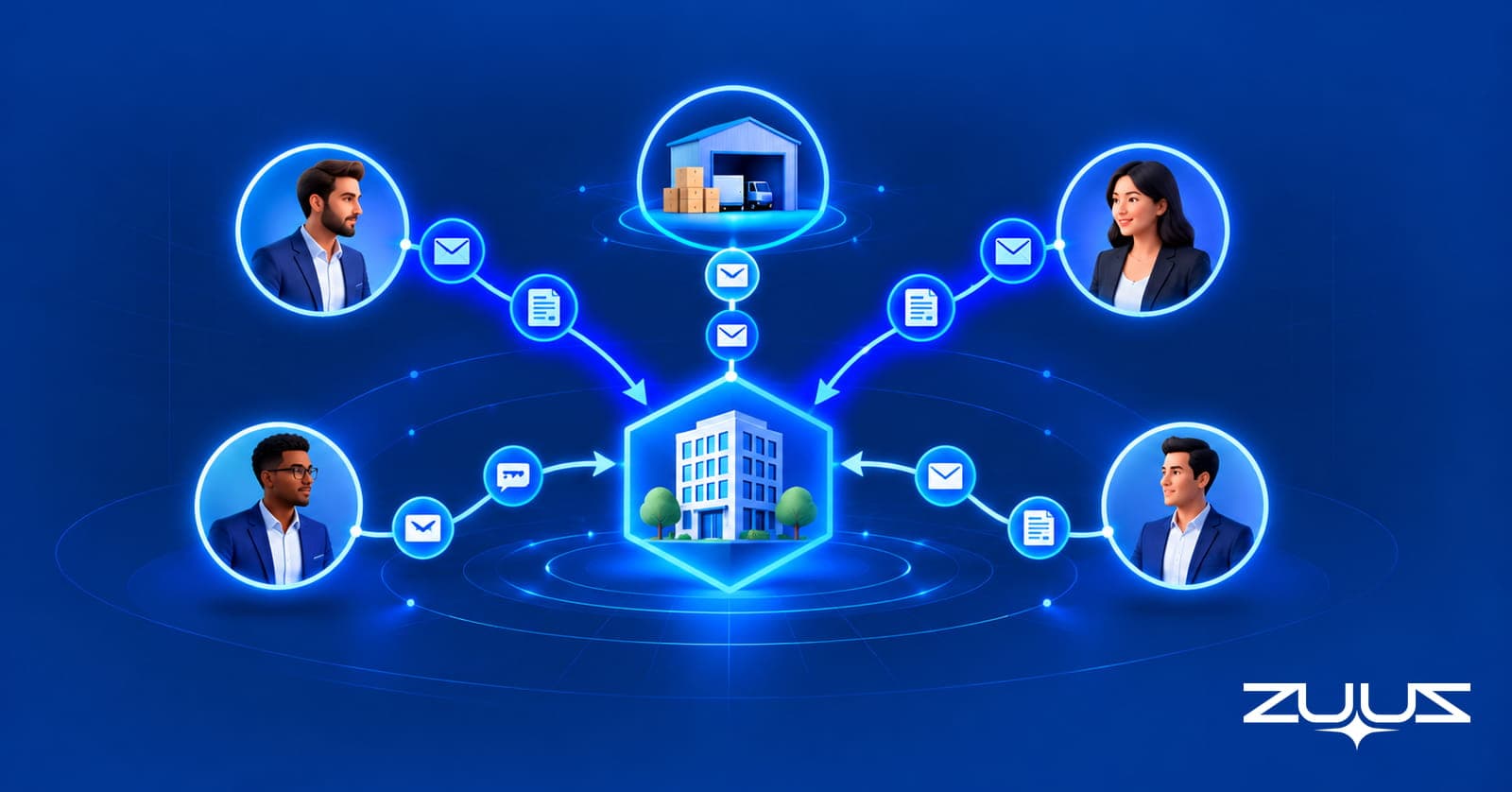
TL;DR: Channel conflict is when a vendor, its distributors and its partners compete for the same customer or deal: vertical between levels (a vendor's direct rep and an MSP), horizontal within one level (two VARs quoting one account). Rules of engagement and deal registration settle it once someone sees the overlap, and the overlap shows up in email, meetings and LinkedIn messages weeks before the PRM or CRM. ZUUZ, revenue intelligence for the IT channel, ties those threads to the account and deal so overlapping partners and direct reps are visible early.
- Channel conflict is a dispute between routes to market over the same customer, deal, territory or price. Competition becomes conflict when the program's rules are unclear or broken.
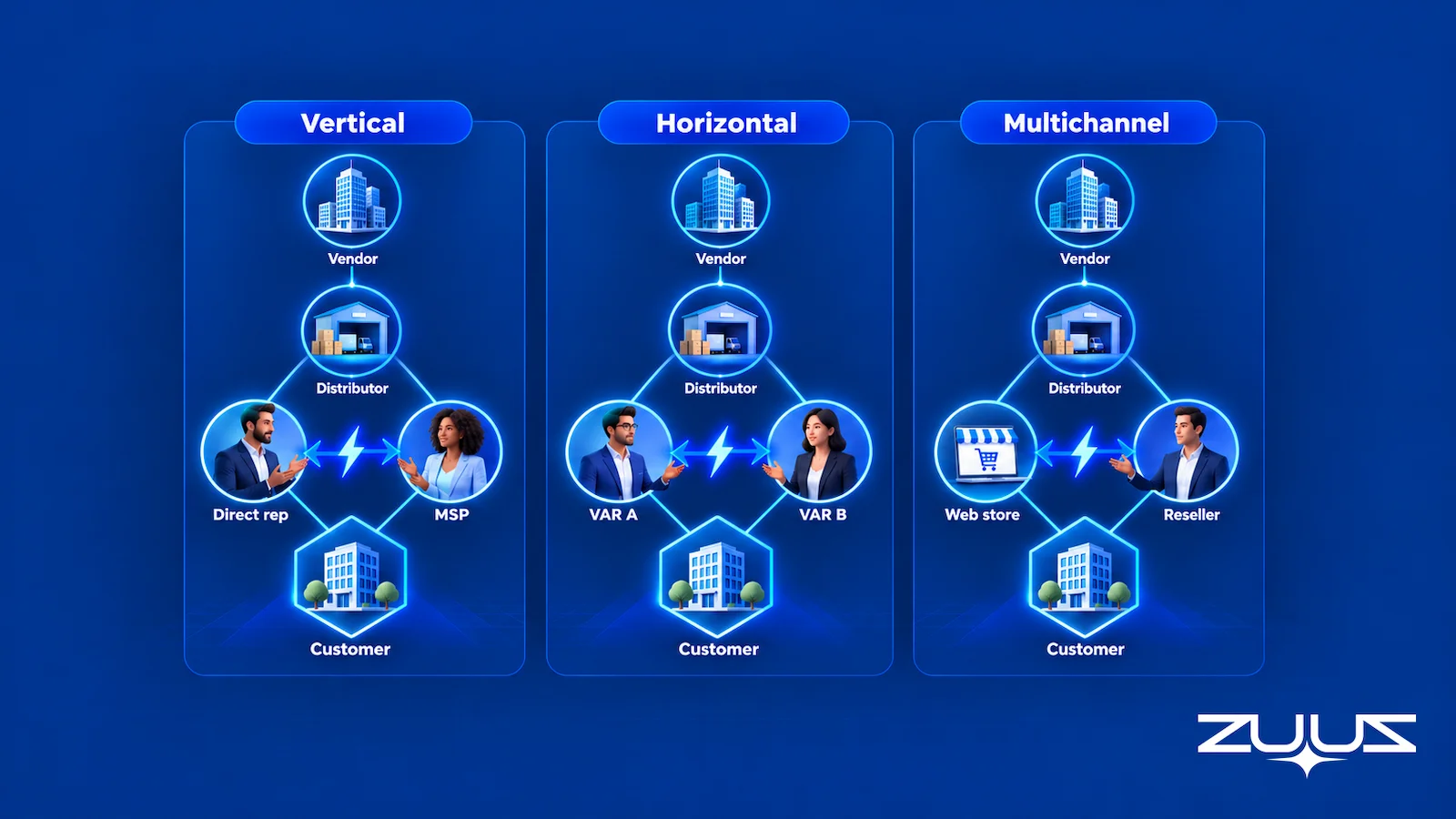
- Vertical conflict sits between levels (vendor and reseller). Horizontal conflict sits within a level (two VARs). Multichannel conflict pits direct and indirect routes against each other.
- Most IT channel disputes trace back to unclear account ownership, weak deal registration, pricing exceptions and compensation that rewards taking a partner's deal.
- Conflict is visible in conversations first. The PRM and CRM see it only once someone registers or logs it.
- The Channel Overlap Check compares who is talking to an account against who the systems say owns it.
- ZUUZ is not a PRM and does not adjudicate disputes. It makes the overlap visible so channel leaders can apply their own rules.
Picture a mid-market manufacturer refreshing its network. On Monday, a VAR asks the distributor for special pricing on forty switches. On Wednesday, a second VAR that met the customer's IT manager at a vendor event asks for the same bill of materials. On Friday, the vendor's enterprise rep books a meeting with the CIO, because the account is on his named list. Nobody has broken a rule yet, and the PRM shows one unapproved registration.
That is channel conflict in its early form, and the most expensive form to ignore. By the time it reaches a channel manager, three quotes are out and every party believes it found the deal first. This guide covers vertical and horizontal channel conflict with IT channel examples, the causes, the rules that prevent it, and why the overlap is visible in email long before any partner system. It is written for IT vendors running partner programs and for distributors sitting between those vendors and their resellers.
What Is Channel Conflict?
Channel conflict is a dispute between two or more routes to market pursuing the same customer, deal, territory or margin. In the IT channel, the parties are some mix of a vendor's direct sales team, its distributors, and the VARs and MSPs that sell and service its products. The standard academic framing splits it into vertical, horizontal and multichannel conflict, and that split is useful because each type has a different fix.
Not every overlap is a conflict. Two partners competing for a customer that has not chosen anyone is normal competition. It becomes channel conflict when the rules on ownership, registration or pricing are unclear or applied unevenly, and one party believes it lost something it had earned.
Why the IT channel is especially prone to it
A single IT deal can involve a vendor, a distributor, a reseller for the hardware and an MSP that will run it, each with its own CRM and its own view of who owns the customer. Renewals add a second layer, because the original seller is rarely guaranteed the renewal. Anyone who has run a value-added reseller business knows the result: one end customer, four systems, four owners.
Vertical, Horizontal and Multichannel Conflict
The three types describe where the dispute sits. Vertical disputes are usually settled by policy from the top; horizontal disputes are settled by evidence of who did the work first.
Vertical channel conflict
Vertical channel conflict happens between levels of the same channel: a vendor and a reseller, a vendor and a distributor, or a distributor and a VAR. The classic case is a vendor's direct rep working an account an authorized MSP has developed for a year, and the dispute is about ownership, pricing or credit.
Horizontal channel conflict
Horizontal channel conflict happens within one level. Two VARs quote the same customer, two MSPs pitch the same security upgrade, or two distributors chase one reseller with different discounts. The dispute is about who found the opportunity first and whether registration rules were followed.
Multichannel conflict
Multichannel conflict appears when a vendor's own routes compete, typically direct and indirect. The IT version is a vendor selling licenses on a web store or cloud marketplace while partners sell the same licenses with services attached. Research summarized in the California Management Review's 2025 piece on channel convergence treats price differences across channels as the core trigger.
| Type | Parties involved | IT channel example | Typical trigger |
|---|---|---|---|
| Vertical | Vendor and reseller, vendor and distributor, distributor and VAR | A vendor's enterprise rep and an MSP both working the same customer's renewal | Named-account lists that overlap partner-sourced deals |
| Horizontal | Two partners at the same level | Two VARs requesting special pricing for one infrastructure refresh | Late, duplicate or unclear deal registration |
| Multichannel | Direct and indirect routes of the same vendor | Web store or marketplace price undercuts a reseller's bundled quote | Inconsistent pricing across routes |
Horizontal conflict often turns vertical. When two VARs fight over an account, both escalate to the vendor or distributor, and the decision makes one partner feel the program itself took the deal.
See Who Is Talking to an Account Before Anyone Registers It.
ZUUZ links email, meeting and LinkedIn threads to the account and the deal, so overlapping partners show up early.
Channel Conflict Examples From the IT Channel
Each channel conflict example below is an illustration built from common patterns across IT vendors and distributors, not a specific company's dispute. The fifth common case, a marketplace price undercutting a partner's quote, is the multichannel row in the table above.
Two VARs quote one account
Illustration: two resellers meet different stakeholders at one customer, the infrastructure lead and procurement. Both ask the distributor for pricing in the same week, and one registers two days after the other. The customer holds two quotes, and the partner that registered second says it introduced the product first.
A vendor's direct rep and an MSP on the same deal
Illustration: an MSP has managed a customer for three years and is shaping a security upgrade. The vendor's direct rep, who has the customer on a named-account list, reaches the CIO with a direct offer. The MSP finds out when the customer forwards that proposal and asks why the MSP's quote is higher.
A distributor and a reseller both pricing
Illustration: a distributor's inside sales team answers an inbound request from a mid-sized customer while a reseller in its own network is already working the deal. Two prices from the same supply chain reach one buyer, and the reseller now sees its distributor as a competitor.
Two partners claim the renewal
Illustration: the original reseller sold a three-year subscription and expects the renewal. A newer MSP that runs day-to-day support receives the renewal question and quotes it. Both have a fair claim, and the rules are silent on whether incumbency or the current relationship wins.
What Causes Channel Conflict
Academic reviews point to conflicting economic interests, different views of roles and markets, and new channels that overlap existing customers. In the IT channel those show up as six practical gaps.
- Unclear account ownership. No written rule says which accounts are direct, which are partner-led, and what happens when a partner sources a deal on a named account.
- Weak deal registration. Vague evidence rules let the first partner to fill in a form beat the first partner to do the work.
- Pricing exceptions. Special pricing leaks between partners, or direct discounts run deeper than partner discounts.
- Compensation that rewards displacement. Direct reps paid only on their own closes gain nothing from a partner-led deal on their list.
- Overlapping territories. Geographic rules collide with specializations, and two partners can both be "right."
- Poor visibility across conversations. Each party sees its own inbox and CRM, and nobody sees the combined picture until someone complains.
The first five are policy problems. The sixth is a detection problem, and it is why good policies still fail: a rule can only be applied to an overlap someone has noticed.
Channel Conflict Shows Up in Email First
Every channel conflict becomes official at some moment: a duplicate registration is rejected or a partner escalates. That usually comes weeks after the overlap started. Before it, the conflict existed only in conversations: a pricing request in a distributor's inbox, a meeting invite on a direct rep's calendar, a LinkedIn message from the customer's new IT director to a second partner.
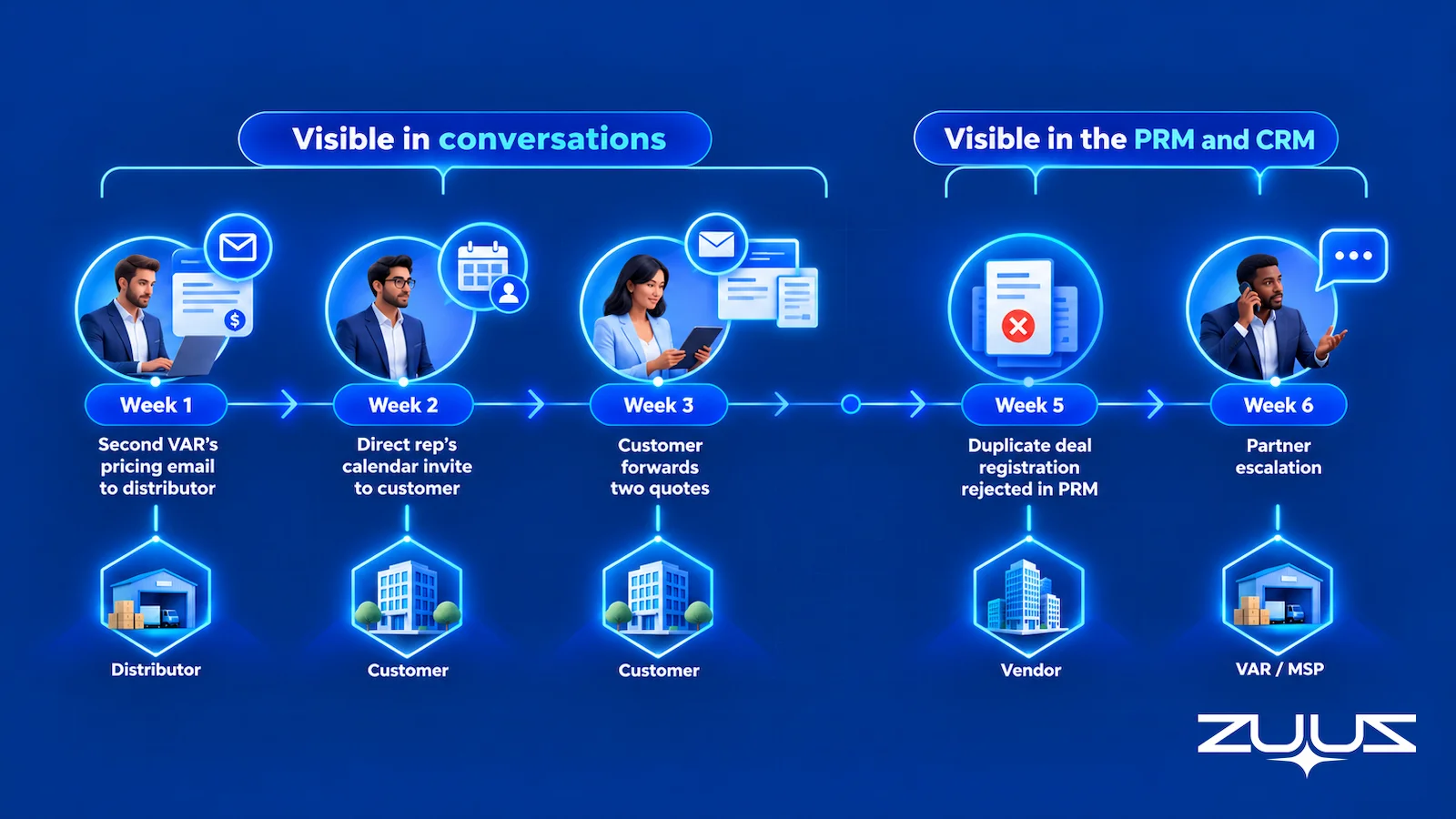
PRM platforms record what partners register, and CRMs record what reps log. Neither is built to notice that two partners and a direct rep are all writing to the same customer about the same project. Each system can be accurate and still miss the collision, because it sits between them.
| Conflict signal | Where it first appears | What the PRM sees | What the CRM sees |
|---|---|---|---|
| Second partner asks for pricing on the same project | Email to the distributor or vendor channel team | Nothing until a second registration is filed | Nothing, or a quote request on a separate record |
| Direct rep engages a partner-led account | Calendar invite and email to the customer | Nothing | An activity on the direct rep's opportunity, if logged |
| Customer compares two quotes | Customer email to one partner, often forwarded | Nothing | Rarely anything |
| Renewal question goes to a new partner | LinkedIn message or email from the customer | The original registration, now stale | A renewal date with no context |
In every row the signal exists in writing, with a timestamp, in someone's mailbox, and the systems of record see it late or not at all. That timestamp is also the best evidence of who engaged the customer first. Teams that already track IT sales pipeline visibility know the same gap from the direct side.
How to Manage Channel Conflict Before It Starts
Managing channel conflict means deciding the rules before the dispute, so the decision during it is a lookup rather than a negotiation.
Rules of engagement that prevent channel conflict
This table works as a template and a prevention checklist: each row needs a written answer and a named owner.
| Area | Rule to define | Owner | Prevention check |
|---|---|---|---|
| Account ownership | Which accounts are direct, partner-led or open; how a partner-sourced deal on a named account is handled | Channel chief and sales leadership | Named-account list shared with partners and reviewed quarterly |
| Deal registration | Eligibility, required evidence, protection window, duplicate handling, appeals | Channel operations | Every duplicate reviewed by a person, not auto-rejected |
| Partner of record | Who owns the installed base and the renewal; when customer choice overrides incumbency | Channel operations and account management | Renewal ownership confirmed before any quote goes out |
| Pricing | Discount tiers, special pricing approval, direct versus partner price floors | Pricing or deal desk | Conflicting quotes on one account flagged before approval |
| Compensation | Credit for partner-influenced and co-sell deals for direct reps | Sales leadership and finance | No direct rep earns more by displacing a registered partner |
| Escalation | Who decides, within how many days, and what evidence counts | Channel operations | Open disputes tracked with a decision deadline |
| Early detection | How overlap between partners and direct reps is spotted before quotes go out | Channel account managers | Accounts with more than one active party reviewed weekly |
Deal registration that holds up
Deal registration is the main tool for horizontal channel conflict, and it works best when the evidence bar is clear and duplicates get human review. Microsoft's Partner Center documentation on registering co-sell deals, for example, sends registrations to manual review instead of automatic approval when multiple partners are involved in the same referral. Registration settles a dispute between partners who registered; it cannot see a partner who is working the deal and has not registered yet.
Pricing and compensation neutrality
Pricing rules settle most multichannel conflict: published tiers, a deal desk that sees every special-pricing request on an account, and a direct price floor. Compensation neutrality settles most vertical conflict: if a direct rep earns the same credit for a registered partner deal as for a direct one, the reason to compete disappears.
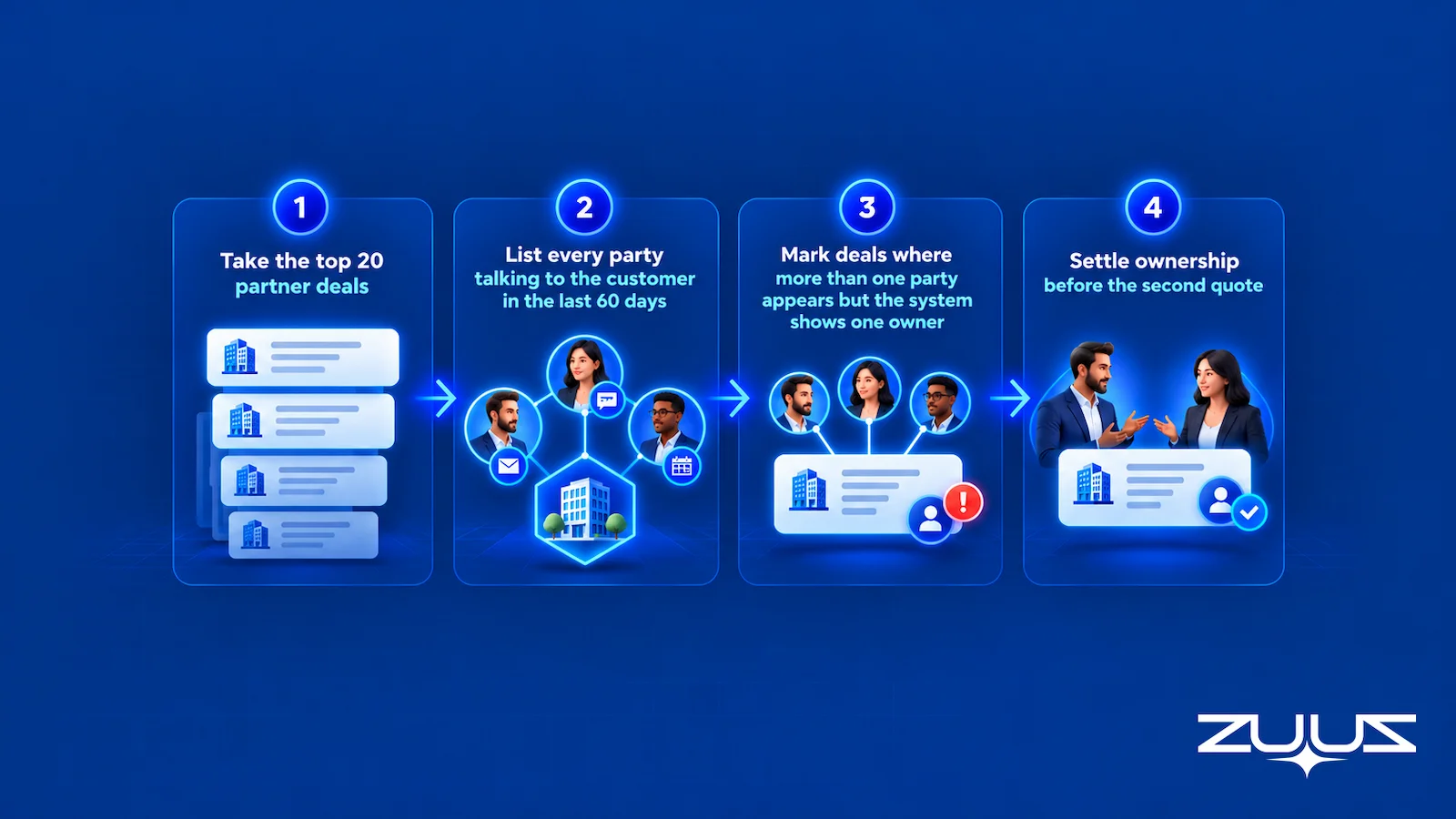
The Channel Overlap Check
Before rewriting any policy, run the Channel Overlap Check on open deals. It shows whether the program has a rules problem or a visibility problem.
- Take the top twenty partner-sourced or partner-influenced deals open this quarter.
- For each, list every party that has written to or met people at the end customer about this project in the last 60 days: direct reps, distributor reps and partner reps.
- Mark every deal where more than one party appears but the PRM or CRM shows only one owner.
- Those are the conflicts already in motion. Settle ownership under the existing rules before the second quote goes out.
Worked example for a distributor: of twenty open reseller deals, three show a second reseller asking for pricing on the same project, and one shows the vendor's direct rep on a calendar invite with the customer. The PRM shows one registration on each. The rules covered all four cases; nobody had seen the overlap.
Run the Channel Overlap Check on Real Conversations.
ZUUZ ties email, calendar and LinkedIn threads to accounts and deals, so step two takes minutes instead of an afternoon.
How to Resolve Channel Conflict, Step by Step
When prevention fails, a consistent process protects the program's credibility more than any single outcome, because partners accept losing a dispute more readily than an arbitrary process. This is how to resolve channel conflict predictably.
- Identify every party. List every rep, partner and customer stakeholder involved, not just the two who escalated.
- Reconstruct the timeline from evidence. Collect first customer contact, registration timestamps, quote requests and dated email and meeting history. Written, dated conversation beats recollection.
- Check the rules of engagement. Apply the registration rules, account ownership list, renewal rules and any contractual commitments that cover the case.
- Choose a resolution. Honor a valid registration, assign a lead partner, set up a documented co-sell arrangement, or split credit where the policy allows it.
- Communicate the decision once, to everyone. Explain the rule and the evidence, and give the customer one consistent message.
- Fix the gap that allowed it. Update the named-account list, registration evidence, pricing approval or compensation rule, and note how the overlap could have been seen earlier.
Step two decides most disputes. When the evidence lives in five inboxes, each party forwards the parts that help its case.
How Can Manufacturers Sell Direct Without Channel Conflict?
Rowland Moriarty and Ursula Moran described hybrid marketing systems in Harvard Business Review in 1990, when companies were adding direct sales alongside distributors to widen coverage and control cost. The question is not whether to sell direct but how to divide the market so the channels do not fight over one customer.
The answer that holds up is segmentation by written rule. The 2025 California Management Review analysis recommends transparent, tiered pricing, ground rules such as minimum advertised pricing, and direct sales for large accounts with distributors serving the rest. In the IT channel that means four practices.
- Define direct accounts by name. A named list partners can see beats a revenue threshold they have to guess.
- Protect partner-sourced deals. A partner that brings a deal on a direct account keeps it or co-sells with credit.
- Pay direct reps on partner-influenced revenue. Neutral compensation removes the reason to compete.
- Keep one price per product per segment. A marketplace price that undercuts partners invites multichannel conflict.
Co-sell programs formalize the same idea. Microsoft's co-sell model has partners and Microsoft sales teams share leads and work joint selling opportunities, so both sides work the deal together rather than against each other.
From an operator's seat
From an operator's seat in IT services and distribution, where Avinash Gujje built Cloud Box Technologies from $0 to $25M ARR, the part teams do not plan for is how early the overlap is knowable. By the time a dispute reaches the channel manager, the evidence has usually sat in someone's mailbox for weeks. The rules are rarely the problem: the second pricing request, the forwarded quote and the meeting invite were all in writing and dated, and none reached the people who could act. The cheap fix is a phone call to both parties before the second quote, and it only happens if someone reviews overlap account by account every week.
Catch the Second Pricing Request Before the Second Quote.
ZUUZ reads the conversations already happening and updates the CRM, so channel leaders see overlap while it is still a phone call.
Partner Overlap: How ZUUZ Makes It Visible Early
ZUUZ is revenue intelligence for the IT channel: MSPs and the vendors, distributors and resellers they work with. It reads email, calendar, meetings and LinkedIn messages, finds the deal signals, and ties every thread to the right account and deal. It then updates the CRM automatically, with full change history and one-click rollback, in Salesforce, HubSpot, Zoho, Attio or Pipedrive.
For channel conflict, that changes what a channel leader can see. A second reseller's pricing request, a direct rep's meeting at a partner-led account or a renewal question to a new partner lands on the same account and deal instead of staying in separate inboxes. Overlap becomes visible in the week it starts, which is the week the Channel Overlap Check is designed to catch. For IT vendor channel teams and distribution sales leaders, that is the difference between a quiet ownership call and a formal dispute.
What ZUUZ does not do
ZUUZ is not a PRM and not a CRM. It does not run deal registration, enforce rules of engagement or decide who wins a dispute; the program's rules and their owners still do that. It provides the dated conversation record those rules need, tied to the account, so step two of a resolution is a lookup. Replies stay with the rep: ZUUZ can draft one, and the rep decides what is sent.
Proof from an IT reseller
RA Technologies, a US IT services company, surfaced $120K of identified pipeline within 72 hours that two years of HubSpot had never recorded. The RA Technologies case study shows the same gap that hides channel overlap: commercial activity sitting in conversations, not the CRM. The same mechanism serves value-added resellers tracking their own IT VAR sales pipeline and managed service providers, where ZUUZ also syncs won customers with ConnectWise PSA.
A first step
The first pipeline appears within 72 hours of connecting, and a full rollout takes one to two weeks. A practical start is one channel account manager's mailbox and calendar: connect them, let ZUUZ link recent threads to accounts and deals, and run the Channel Overlap Check against what it shows. The free 30-day trial covers it.
Frequently Asked Questions
What is channel conflict?
Channel conflict is a dispute between two or more routes to market pursuing the same customer, deal, territory or margin. In the IT channel it usually involves a vendor's direct team, its distributors, and the VARs and MSPs that sell its products. It becomes conflict when ownership, registration or pricing rules are unclear or applied unevenly.
What is the difference between vertical and horizontal channel conflict?
Vertical channel conflict happens between levels of the same channel, such as a vendor and a reseller or a distributor and a VAR. Horizontal channel conflict happens within one level, such as two VARs quoting the same customer. Vertical disputes are usually settled by policy; horizontal disputes by evidence of who engaged first.
What is an example of channel conflict in IT sales?
A common channel conflict example is a vendor's direct rep approaching a customer an authorized MSP has been developing, because the account sits on the rep's named list. Others are two VARs requesting special pricing for the same refresh, or a distributor quoting a customer its own reseller is already working.
What causes channel conflict?
Channel conflict usually comes from unclear account ownership, weak deal registration rules, pricing exceptions that leak between partners, compensation that rewards direct reps for taking partner deals, and overlapping territories. Underneath sits poor visibility: each party sees only its own inbox and CRM, so overlaps go unnoticed until someone escalates.
How do you manage channel conflict?
Manage channel conflict by writing the rules before the dispute: account ownership, deal registration, partner of record, pricing, compensation and escalation, each with a named owner. Then review accounts with more than one active party every week, so overlaps are settled by a phone call before quotes go out.
How do you resolve channel conflict between two resellers?
Resolve it by rebuilding a dated timeline of who engaged the customer first, then applying the program's registration and ownership rules to that evidence. Options are honoring the valid registration, naming a lead partner or setting up a documented co-sell. Tell both partners the rule used, and give the customer one message.
How can manufacturers sell direct without channel conflict?
Manufacturers can sell direct without channel conflict by naming direct accounts on a list partners can see, protecting partner-sourced deals on those accounts, and paying direct reps on partner-influenced revenue. Keeping one price per product per segment across direct, web and marketplace routes prevents price-driven multichannel conflict.
Does deal registration prevent channel conflict?
Deal registration prevents much horizontal channel conflict, but not all of it. It settles disputes between partners who registered, if evidence rules and duplicate review are clear. It cannot see a partner or direct rep working the deal without registering, which is why many disputes start before any registration exists.
Can a PRM or CRM detect channel conflict?
A PRM or CRM detects channel conflict only once it is recorded, such as a duplicate registration or two opportunities on one account. The early signals, like a second pricing request or a direct rep's meeting invite, live in email, calendars and LinkedIn messages, so detection depends on linking those to the account.
Is ZUUZ a PRM?
ZUUZ is not a PRM and not a CRM. It is revenue intelligence for the IT channel that reads email, calendar, meetings and LinkedIn messages, ties each thread to the account and deal, and updates the CRM with full change history. It makes partner overlap visible; it does not run registration or decide disputes.