
What Is a Value Added Reseller? How VARs Work and Make Money
A value added reseller (VAR) resells vendor technology with its own design, deployment and support services. How VARs make money and differ from distributors.

CEO of ZUUZ. He scaled Cloud Box Technologies from 0 to $25M ARR in IT services and distribution before building ZUUZ. Connect on LinkedIn
TL;DR: A value added reseller (VAR) buys technology from vendors, usually through a distributor, and resells it to end customers bundled with its own services: design, installation, integration and support. It earns money from product margin, services, and vendor partner program benefits such as deal registration and rebates. Unlike a distributor, a VAR owns the customer relationship, and unlike a pure system integrator or MSP, it still sells the product.
- A value added reseller sells another company’s hardware, software or cloud subscriptions and adds services the customer cannot get from the vendor alone.
- Most VARs buy through distributors, which carry inventory, extend credit and book orders, while the VAR owns the customer and the solution design.
- The VAR business model blends thin product margin with higher-margin services, plus vendor program benefits such as deal registration, rebates and marketing funds.
- A distributor moves product at scale, a system integrator makes systems work together, and an MSP runs IT on a recurring contract. Many VARs now do some of all three.
- Every VAR deal involves at least four parties: vendor, distributor, VAR and customer, each on its own clock.
- Most of what moves a VAR deal lives in email and LinkedIn messages across those four parties, not in the CRM.
- ZUUZ is an AI layer on top of the CRM a VAR already runs. It connects to the sales inbox, reads LinkedIn messages and meeting or call transcripts, and writes leads, stakeholders, next steps and renewal signals into the CRM for the rep to approve in one click.
A 200-person law firm needs new firewalls, a Wi-Fi refresh across three floors and Microsoft 365 licenses for a new office. It could buy the hardware from a web store and the licenses from Microsoft directly. Instead it calls a local IT company that designs the network, orders the equipment, installs it over a weekend, migrates the mailboxes and answers the phone when something breaks. That IT company is a value added reseller, and it is the way a large share of business technology reaches the organizations that use it.
This explainer covers what a value added reseller is, how the VAR business model makes money, how VARs compare with distributors, system integrators and MSPs, and how a VAR deal moves across the vendor, the distributor and the customer.
What Is a Value Added Reseller?
A value added reseller, usually shortened to VAR, is a company that buys products from technology vendors and resells them to end customers together with services of its own. The product might be servers, storage, networking gear, security appliances, software licenses or cloud subscriptions. The added value is the work around it: assessing needs, designing a solution, configuring and installing it, integrating it with what the customer already runs, training staff and supporting it afterward.
The phrase “var value added reseller” shows up in searches because VAR is the name most people meet first, on a vendor’s partner locator or a job listing, before they know what it stands for. In the IT world the two terms are interchangeable. Outside IT, the same model exists in point-of-sale systems, telecom, industrial automation and specialist software, wherever a product needs expert setup before a customer can use it.
What separates a VAR from a plain IT reseller is the customer relationship. A catalog reseller or an online store sells a box and moves on. A VAR sells an outcome, such as a working network or a migrated email system, and the product is one line inside that project. The more services a firm attaches to each sale, the more it earns the “value added” label.
Where a VAR Sits in the IT Channel
Business technology rarely travels straight from the company that makes it to the company that uses it. It moves through a channel, and a VAR is one link in that chain.
The four standard links are the vendor, the distributor, the VAR and the end customer:
- Vendor. The manufacturer or software publisher, sometimes called the OEM. It builds the product, sets list prices and runs a partner program that decides which resellers can sell what, at what discount.
- Distributor. A wholesaler that buys from many vendors and sells to thousands of resellers. It holds inventory, extends credit, handles logistics and licensing, and books the order.
- Value added reseller. Owns the customer relationship and the solution design, sets the customer price, adds services and delivers the finished project.
- End customer. The business or public body that uses the technology and holds the budget and the decision.
Some large VARs buy direct from vendors, and some vendors sell direct to their largest customers, but the two-tier model of vendor to distributor to reseller is the common pattern for small and mid-sized VARs. Microsoft’s own Cloud Solution Provider program shows it plainly: its CSP overview describes indirect resellers that work through a global network of distributors, alongside direct bill partners that buy from Microsoft themselves.
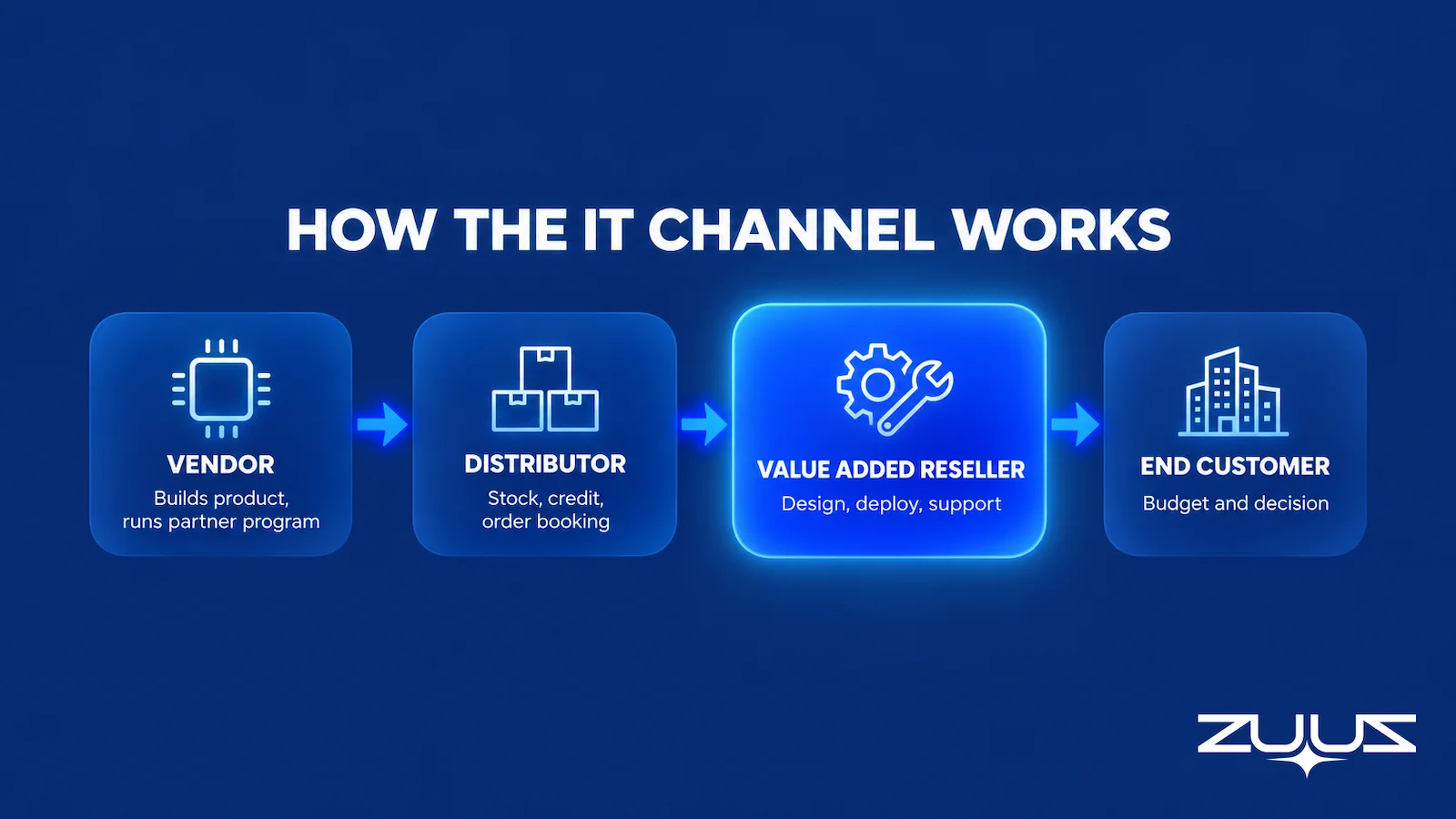
The practical consequence is that no VAR deal is a two-party transaction. Pricing comes from the vendor and the distributor, availability comes from the distributor, program benefits come from the vendor, and the decision comes from the customer. The VAR is the only party that talks to all of them.
What a VAR Actually Adds
The “added value” in value added reseller is not one service. It is a menu, and each VAR picks the items that match its skills and its customers. The most common ones fall into a few groups.
Pre-sales and solution design
Before anything is ordered, a VAR assesses what the customer has, what it needs and which products fit. A pre-sales engineer sizes the storage, designs the network or maps the licensing. This is often where the deal is won, because the customer is buying judgment as much as equipment.
Procurement and licensing
A VAR navigates vendor price lists, promotions, license types and renewal terms that most customers never want to read. It can combine products from several vendors on one order and one invoice, which matters to a finance team that would rather have one supplier than six.
Deployment and integration
Installation, configuration, data migration and integration with existing systems are the core of most VAR projects. A firewall that arrives in a box is not a security outcome until someone configures its policies and connects it to the rest of the network.
Support, maintenance and lifecycle
After the project, the VAR usually stays on as first-line support, manages warranty claims with the vendor and tracks when licenses, support contracts and hardware reach renewal or end of life. That lifecycle role is where many VARs earn repeat business, and it is covered in depth in the guide to renewal tracking for VARs and distributors.
Managed and recurring services
A growing number of VARs sell ongoing services on top of the product: monitoring, backup, help desk, security operations. This is where the line between a VAR and an MSP starts to blur, which the comparison section below covers.
Keep the CRM. Let It Read the Channel.
ZUUZ turns vendor, distributor and customer conversations into CRM records without asking reps to type them in.
What to look for in the systems a VAR runs its pipeline on
- Does one record hold all four sides of a deal – vendor, distributor, customer and the VAR’s own engineer?
- Are deal registration and rebate deadlines dated fields, or something an account manager remembers?
- Does the pipeline report read from fields, or from an activity feed a human has to open deal by deal?
- Is there a capture layer writing the record from the sales inbox, LinkedIn messages and meeting transcripts, or does accuracy depend on reps typing after the fact?
- Does it run on the CRM the firm already owns, without a migration?
- Can the account manager and the engineer each see what was last agreed without calling each other?
The Value Added Reseller Business Model
The VAR business model rests on several income streams that behave very differently. Product resale brings volume but thin margins. Services bring margin but depend on skilled people. Vendor programs add incentives that can turn an average deal into a profitable one. A healthy VAR balances all three.
Product margin
The VAR buys a product at a partner or distributor price and sells it to the customer at a higher price. The difference is the product margin. On commodity hardware and popular software this margin is often thin, because customers can compare prices online and several resellers compete for the same order. On specialist products, or products bundled into a larger project, the VAR has more room.
Services revenue
Professional services, such as design, installation, migration and training, are usually billed per project or per day. Support and managed services are billed monthly or annually. Services carry far better margins than product resale, which is why most VARs push to attach services to every product sale.
Vendor partner program benefits
Vendors reward resellers that sell their products well. Partner programs are usually tiered, with higher tiers bringing better discounts and more benefits in exchange for certifications, trained staff and sales volume. The benefits vary by vendor, but a few mechanisms are common across most programs:
- Deal registration. The VAR registers a specific opportunity with the vendor. If approved, the VAR typically receives extra discount or protection on that deal for a set period, which rewards the partner that found the opportunity and discourages price wars between resellers.
- Rebates and incentives. Back-end payments tied to hitting targets, selling specific products or growing a product line, often paid after the quarter closes.
- Market development funds (MDF). Money the vendor contributes toward the reseller’s marketing activities, such as events and campaigns, usually against an approved plan.
- Co-selling and pre-sales support. Access to the vendor’s own sales and technical staff on larger opportunities.
Terms, percentages and eligibility are set by each vendor and change often, so the only reliable source for any specific program is the program’s own documentation. Microsoft’s partner program pages are a representative example of how a large vendor structures tiers, designations and benefits.
How the streams fit together
The table below summarizes the main VAR revenue streams and how each one behaves.
| Revenue stream | How it is earned | Margin profile | What it depends on |
|---|---|---|---|
| Product resale | Buy at partner price, sell at customer price | Thin on commodity items, better in bundles | Distributor pricing, competition, deal registration |
| Professional services | Design, deployment, migration, training billed per project | High | Certified engineers and a strong project pipeline |
| Support and maintenance | Annual contracts, often alongside vendor support | High and recurring | Tracking renewal dates across many vendors |
| Managed services | Monthly fees for monitoring, backup, help desk | High and recurring | Tooling, service desk staff, contract discipline |
| Vendor incentives | Deal registration discounts, rebates, MDF | Adds margin on top of resale | Program tier, certifications, timely registration |
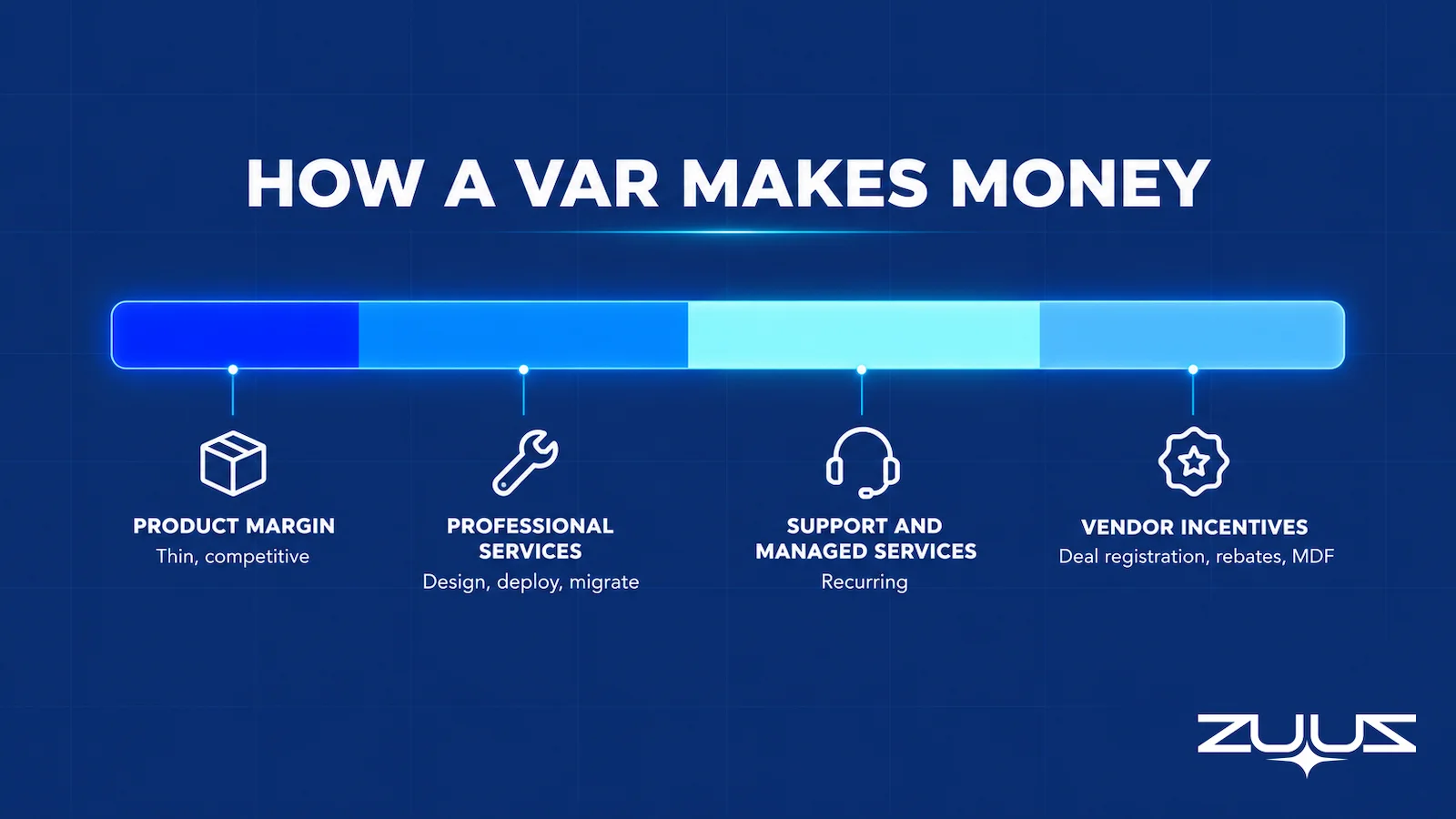
One detail matters for anyone judging a VAR’s pipeline. The real value of a deal is not the invoice total but the margin after distributor pricing, services and program benefits. Two deals with the same revenue can have very different profit, depending on whether the registration was approved and how many services hours are attached.
Every Registration and Rebate Starts as a Message.
ZUUZ reads a VAR’s sales inbox and LinkedIn messages and writes the deal signal into the CRM it already runs.
Value Added Reseller vs Distributor, System Integrator and MSP
The IT channel uses several labels that overlap, and many firms carry more than one. The cleanest way to separate them is by what each is paid for: moving product, adding services to product, making systems work together, or running IT on an ongoing basis.
Value added reseller vs distributor
A distributor sells to resellers, not to end customers. It buys in volume from many vendors, holds stock, extends credit, handles logistics and licensing, and books orders for thousands of VARs. A value added reseller sells to end customers and adds the design, deployment and support work. The distributor’s customer is the VAR, and the VAR’s customer is the business using the technology. In the question of VAR vs distributor, the short answer is that the distributor owns the supply and the VAR owns the customer.
Value added reseller vs system integrator
A system integrator (SI) is paid mainly to make separate systems work together: connecting applications, building custom integrations, and running large, complex projects. Some SIs never resell a product; the customer buys licenses elsewhere and hires the SI for the work. A VAR’s revenue still starts with product resale. The difference in value added reseller vs system integrator is the center of gravity. A VAR sells product plus services, while an SI sells project expertise and may include product only as a convenience.
Value added reseller vs MSP
A managed service provider runs some or all of a customer’s IT on a recurring contract, billed monthly, with defined service levels. An MSP earns from the ongoing service, not from each product sale. Many VARs have added managed services to smooth out lumpy project revenue, and many MSPs resell hardware and licenses, so the same firm can be both. The guide to the MSP sales pipeline covers how that recurring side of the business sells.
The table below compares the four models side by side.
| Dimension | Value added reseller | Distributor | System integrator | MSP |
|---|---|---|---|---|
| Main customer | End customer | Resellers | End customer | End customer |
| Primary revenue | Product margin plus services | Volume margin on product | Project and consulting fees | Recurring monthly fees |
| Sells product? | Yes, core to the model | Yes, wholesale | Sometimes | Often, as a secondary line |
| Owns the customer relationship | Yes | No | Yes, per project | Yes, ongoing |
| Typical engagement | Project, then support and renewal | Transaction | Large or custom project | Multi-year contract |
| Key skill | Solution design across vendors | Logistics, credit, scale | Integration and delivery | Operations and service levels |
| Main system of record | CRM plus distributor portals | ERP | Project and CRM tools | PSA plus CRM |
| Where a capture layer like ZUUZ fits | Writes vendor, distributor and customer email, LinkedIn messages and meeting transcripts into the CRM the VAR already runs | Little fit; the system of record is an ERP | Writes project correspondence, stakeholders and next steps into the CRM | Same on the CRM side; ConnectWise PSA is on the ZUUZ roadmap |
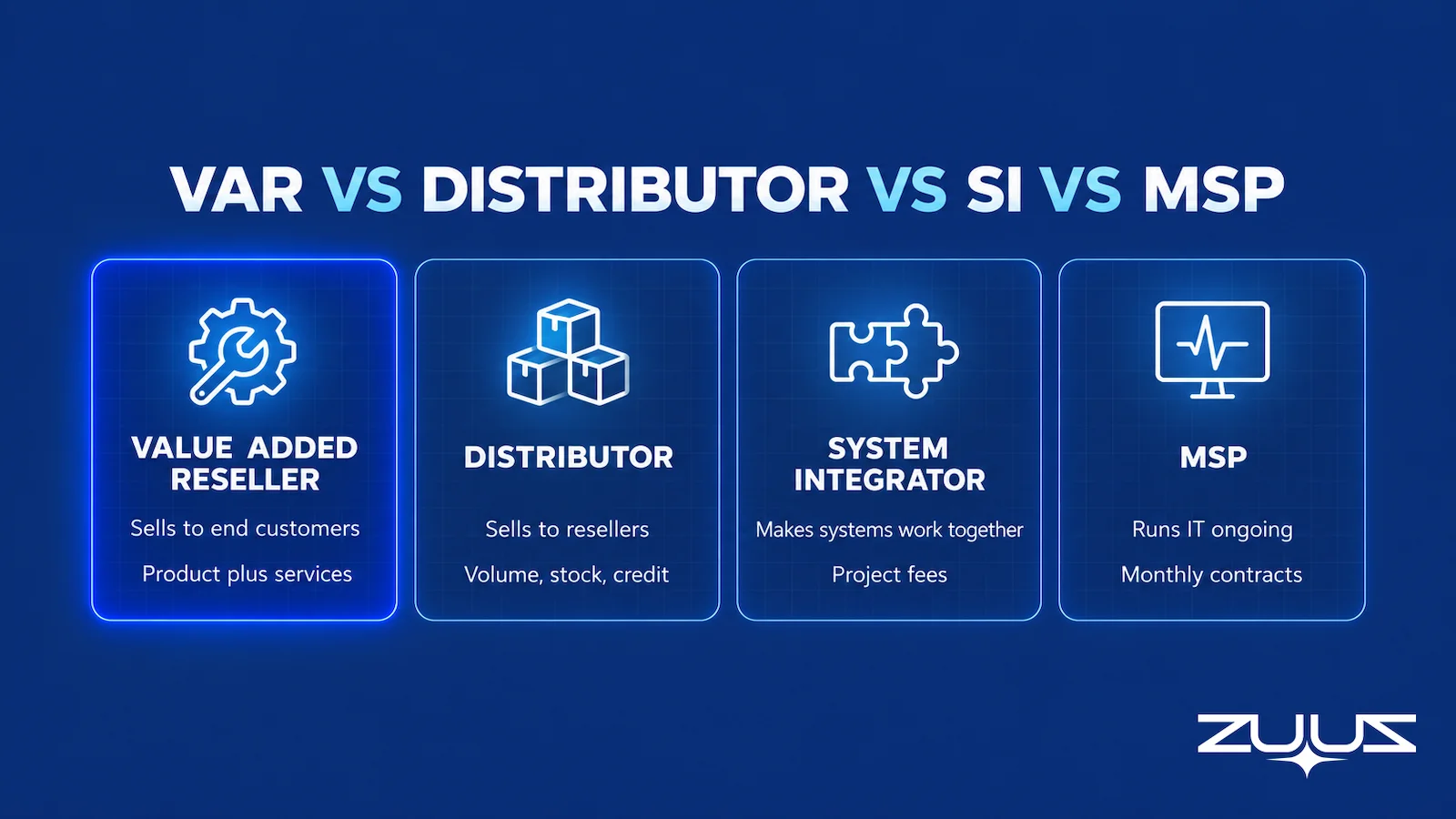
Most real firms are hybrids. A regional VAR might resell networking gear, run integration projects and hold a book of managed services contracts at the same time. The label on the website matters less than where the revenue comes from and which relationships the firm owns.
Types of Value Added Reseller Companies
Value added reseller companies range from two-person local shops to national firms with thousands of engineers. They tend to differ along three lines: focus, size and delivery model.
- Specialist VARs go deep on one domain, such as security, networking, data center, collaboration or a particular vendor’s platform. They win on expertise and certifications.
- Generalist or regional VARs serve a geography across many vendors and product lines. They win on relationships and breadth.
- Vertical VARs focus on an industry, such as healthcare, education, legal or government, where compliance and procurement rules shape what customers can buy.
- Cloud-focused resellers concentrate on subscriptions, often through programs like Microsoft CSP, and earn more from migration and management than from hardware.
- Hybrid VAR-MSPs combine resale and projects with recurring managed services, the direction many VARs have moved over the past decade.
Cloud Box Technologies, where ZUUZ founder Avinash Gujje scaled an IT services and distribution business from $0 to $25M ARR, is an example of how these lines blend in practice. A business like that carries vendor relationships, distributor relationships and a book of customer renewals at once, and each of them generates its own stream of messages.
From an operator’s seat
Across the deployments ZUUZ runs at resellers, the pattern is that the distributor thread is the one nobody owns. Customer email reaches the opportunity eventually because someone is chasing the order, while the registration confirmation and the rebate claim sit in one person’s mailbox and surface only when a margin is already lost. The part teams do not plan for is the shared alias: quotes and approvals land on sales@ or orders@, and until that mailbox is connected alongside the individual reps, half the deal still never reaches a field. Connect the shared alias in week one rather than week six.
How a VAR Sales Motion Runs Across Vendor, Distributor and Customer
A software company selling direct has one relationship per deal: seller and buyer. A VAR deal has at least four, and each party moves on its own schedule. Following one deal from start to finish shows how the motion works.
- The need surfaces. A customer mentions an expiring support contract, a platform reaching end of life or a new office. The VAR’s account manager books a discovery call and opens an opportunity.
- Solution design. A pre-sales engineer scopes the requirement and picks products, often from more than one vendor. The vendor’s own pre-sales team may join on larger deals.
- Deal registration. The VAR registers the opportunity on the vendor’s partner portal. Approval, rejection or a request for more detail comes back by email, and an approved registration usually runs for a set period.
- Pricing from the distributor. The VAR requests pricing and availability from one or more distributors, which apply the registered discount and confirm stock or lead times.
- Customer pricing and negotiation. The VAR combines product, services and support into one offer. Procurement, finance, IT and security at the customer each weigh in, often on separate email threads.
- Order and delivery. The customer issues a purchase order, the VAR places the order with the distributor, and the distributor asks for whatever it still needs, such as the end-user entity or the registration reference. Then the deployment project starts.
- Renewal and refresh. Closing starts new clocks: support renewals, subscription terms and hardware end-of-support dates, each announced later by vendor or distributor emails.
The customer side alone is rarely one person. Gartner’s research on the B2B buying journey describes the typical buying group for a complex B2B solution as six to 10 decision makers, each armed with four or five pieces of information gathered independently. Add a vendor channel manager, a vendor territory rep and a distributor account manager, and one mid-sized infrastructure deal can involve a dozen people across four companies.
The table below maps what each party controls in a VAR deal and how its signal usually arrives.
| Party | What it controls | How its signal usually arrives |
|---|---|---|
| End customer | Budget, scope, timing, sign-off | Email threads, meetings, occasional LinkedIn messages |
| Vendor channel manager | Registration approval, program benefits, pre-sales help | Portal notification emails, direct email, LinkedIn |
| Distributor account manager | Pricing, availability, credit, order booking | Email threads, often with sales ops rather than the rep |
| VAR account manager and engineer | Solution design and every other relationship | Their own inbox, calendar and LinkedIn account |
This is why VAR sales cycles are harder to read than direct sales. A deal can be ready on the customer side and still stall because a registration expired or the distributor is waiting on a document.
Four Parties Write About Every Deal. See What the CRM Missed.
Connect one inbox and see which vendor, distributor and customer messages never made it into the opportunity record.
Why VAR Deal Signal Rarely Reaches the CRM
Here is the operator’s view of everything above. In a VAR deal, the information that decides whether it closes is spread across four parties’ messages: the channel manager’s registration approval, the distributor’s question about the end-user entity, the customer’s email moving go-live back a month, and the new vendor rep who introduced himself on LinkedIn. Each of those lands in a different inbox, sometimes a sales ops coordinator’s rather than the account manager’s.
The CRM, meanwhile, usually holds the shape of the deal: account, amount, stage and close date. It gets a meaningful update when the opportunity is created and again when the order books, because someone needs it for commissions. Everything in between, which is where a VAR deal is actually won or put at risk, happens in conversations the CRM never reads.
This is not a discipline problem that more CRM training fixes. Salesforce’s State of Sales research, seventh edition, found sales professionals spend 40 percent of their time selling and 13 percent of the workweek manually entering data. A VAR account manager juggling a vendor and a distributor on every deal is not going to transcribe three other companies’ emails into the CRM as well. That is the structural reason behind most IT sales pipeline visibility problems, and one of the reasons a CRM pipeline is wrong more often than sales leaders assume.
The deep version of this argument, stage by stage, with the deal registration events and the vendor rep changes mapped out, is in the companion piece on why the IT VAR sales pipeline lives outside the CRM. For anyone who now understands what a VAR is, that is the natural next read, because it shows what the four-party model does to pipeline accuracy in practice.
The practical fix starts with deciding which inboxes and threads count as part of the pipeline. For most VARs that means the account managers’ mailboxes, the sales ops or order desk mailbox where distributor threads land, and the LinkedIn accounts where vendor reps make introductions. LinkedIn is the one that leaves with a departing rep, which the guide to logging LinkedIn messages in the CRM covers in detail.
The Renewal Signal Check
Renewals are where a reseller’s recurring revenue actually sits, and they are the easiest signal to lose, because a renewal date is a field and everything that decides the renewal is a conversation. Run this once a quarter.
- List every renewal in the next two quarters and its date field.
- For each, find the last real conversation – email, message or meeting – and what it said about budget, champion or satisfaction.
- Mark every renewal where the date is the only thing the system knows.
- Those are the renewals that surprise you. The signal existed; it was in a mailbox.
For a VAR, run it across support contracts and vendor subscription renewals together. A maintenance renewal whose only record is a date, with no email since the last invoice, is not a renewal in progress. It is a quote the incumbent has not been asked for yet, and the thread that would have said so is usually sitting with the engineer who closed the last ticket.
Four-Party Deal Signal: How ZUUZ Captures It for VARs
ZUUZ is an AI layer that sits on top of the CRM a VAR already runs, whether Salesforce, HubSpot, Zoho, Attio or Pipedrive. It does not replace the CRM. It reads the sales inbox and LinkedIn messages, read-only, and writes structured records back into the CRM: new contacts from a vendor or distributor, updates to the right opportunity, and deals that were never logged at all. The CRM stays the system of record. Reps keep working in email and LinkedIn as they do today, and ZUUZ hands them finished work to approve in one click.
For VARs that also run a managed services practice, a ConnectWise PSA integration is on the ZUUZ roadmap. RA Technologies, a US IT services company, shows what reading the mailbox surfaces: ZUUZ ran on its existing HubSpot instance and surfaced $120K in pipeline within 72 hours that the CRM had never seen. The RA Technologies case study has the detail, and the guide to email to CRM automation for IT companies covers the setup side.
Whether or not a VAR uses any tool for it, the underlying lesson holds. A value added reseller is a business built on relationships with vendors, distributors and customers, and its pipeline is only as accurate as the messages between those parties that reach the record. Teams that treat those conversations as part of the pipeline, not as background noise, run more accurate pipeline reviews and lose fewer deals to a lapsed registration or an unanswered distributor question.
A concrete first step
Connect one mailbox – the account manager who carries the most vendor and distributor traffic. ZUUZ reads the last 90 days and the rep reviews what it found, deal by deal, before anything is written into the CRM. That review is also the cheapest version of the Renewal Signal Check above, because the renewals with no conversation behind them show up as gaps. It is a 30-day free trial, no credit card: https://zuuz.ai/trial/
Frequently Asked Questions
What is a value added reseller?
A value added reseller (VAR) is a company that buys technology products from vendors, usually through a distributor, and resells them to end customers bundled with its own services. Those services typically include solution design, installation, integration, training and ongoing support, which turn a product into a working outcome for the customer.
What does VAR stand for in IT?
In IT, VAR stands for value added reseller. It describes a partner that resells hardware, software or cloud subscriptions from vendors such as Microsoft, Cisco or Dell and adds services around them. Vendors list their VARs in partner locators, often grouped by program tier, specialization or region.
How does a value added reseller make money?
A VAR earns from product margin, the gap between its partner price and the customer price, and from services such as design, deployment, support and managed services. Vendor partner programs add further income through deal registration discounts, rebates and market development funds, with terms set by each vendor.
What is the difference between a value added reseller and a distributor?
A distributor sells to resellers, while a value added reseller sells to end customers. The distributor buys in volume from many vendors, holds inventory, extends credit and books orders. The VAR owns the customer relationship, designs the solution and delivers the services that make the product work.
What is the difference between a value added reseller and a system integrator?
A value added reseller builds its business on product resale plus services, while a system integrator is paid mainly for making separate systems work together through integration and project delivery. Some system integrators never resell products. Many firms do both, so the difference is where most of the revenue comes from.
Is an MSP the same as a VAR?
No. An MSP runs some or all of a customer’s IT on a recurring monthly contract, while a VAR earns mainly from reselling products and project services. The two overlap heavily in practice, since many VARs have added managed services and many MSPs resell hardware and licenses.
What is deal registration for a VAR?
Deal registration lets a reseller register a specific opportunity with a vendor through its partner portal. If the vendor approves it, the reseller typically receives extra discount or protection on that deal for a defined period. Approval rules, benefits and expiry terms vary by vendor program.
What are some examples of value added reseller companies?
Value added reseller companies range from local IT firms serving small businesses to national solution providers. They include specialists in security, networking or a single vendor platform, regional generalists, industry-focused VARs in healthcare or government, and cloud-focused resellers working through programs such as Microsoft’s Cloud Solution Provider program.
How do you become a value added reseller?
Most firms start by joining a vendor’s partner program and opening an account with a distributor that carries that vendor. From there, the firm earns certifications, trains engineers and builds a services offering around the products. Higher program tiers usually require more certified staff and sales volume.
Why is it hard for a VAR to keep its CRM accurate?
Every VAR deal involves the vendor, the distributor, the VAR and the customer, and each communicates by email or LinkedIn with different people at the VAR. Registration approvals, distributor questions and customer date changes rarely get logged, so the CRM shows a deal’s shape while its real condition sits in the inbox.