
PRM vs CRM: What Each Does for IT Vendor Channels
PRM vs CRM for IT vendors: what a PRM and a CRM each do, a side-by-side table, when you need both, how they integrate, and the partner deal gap left.

CEO of ZUUZ. He scaled Cloud Box Technologies from 0 to $25M ARR in IT services and distribution before building ZUUZ. Connect on LinkedIn
TL;DR: PRM vs CRM is a split between the partner program and the pipeline: a PRM runs partner onboarding, the portal, deal registration, MDF and enablement, while the CRM runs accounts, opportunities and forecasting. Most IT vendors with a real channel end up running both, joined by an integration. Neither system sees the partner deal signal that lives in channel managers' and partners' email, meetings and LinkedIn messages. ZUUZ is neither a PRM nor a CRM: it reads those conversations, finds the deal signal and updates the CRM automatically, with full change history and one-click rollback.
- In PRM vs CRM terms, a PRM is built around the partner: recruitment, onboarding, the portal, deal registration, MDF, certifications and tiers. A CRM is built around the customer deal: accounts, opportunities, pipeline stages and reporting.
- A CRM can carry a small partner program. A PRM earns its place once partners need self-service, registration rules and benefits at scale.
- When a vendor runs both, the integration decides which system owns each field, and registrations must stay linked to opportunities.
- Integration moves records that already exist, not a distributor's pricing note that only lives in an inbox.
- The Capture Layer Test checks whether a partner stack captures from the channels where partner deals actually move.
- RA Technologies, a US IT services company, surfaced $120K of identified pipeline within 72 hours that two years of HubSpot had never recorded.
Picture a channel director at a mid-sized security software vendor opening the Monday partner pipeline report. A reseller registered a 400-seat deal through the partner portal seven weeks ago, and the linked CRM opportunity still sits at "Qualified" with a quarter-end close date. On paper, the PRM vs CRM setup works. In the channel manager's inbox, the distributor wrote on Thursday that the end customer asked for a revised quote at 250 seats, and a second reseller has started asking about the same account.
Neither system knows; the two facts that change the deal live in an email thread. That scene is an illustration, but most vendor channel teams will recognize it. This guide covers what a PRM does, what a CRM does, how they compare side by side, when a vendor needs both, how the integration works, and the gap that remains even when everything is wired together.
PRM vs CRM Comes Down to Who Each System Serves
A partner relationship management platform, or PRM, manages the companies that sell on a vendor's behalf: MSPs, value-added resellers, distributors, systems integrators and referral partners. Salesforce describes partner relationship management as managing interactions with the partners that sell a company's products, with software built for indirect sales partners rather than end customers. A customer relationship management platform, or CRM, is the system of record for selling: accounts, contacts, opportunities, pipeline stages and the reports built on them.
The short version of PRM vs CRM is that the PRM is where partners work with the vendor, and the CRM is where the vendor tracks the revenue those partners, and its own direct team, are chasing. The PRM faces outward, toward partner users logging in to a portal. The CRM faces inward, toward the vendor's own sellers, channel managers and leadership.
Salesforce's Trends in Partner Selling research, which surveyed 5,500 sales and partner professionals, reports that 9 out of 10 businesses use partners. For IT vendors, the question is where partner management should live: in a PRM, in the CRM, or in both.
What a PRM Does for an IT Vendor's Channel
A PRM runs the partner program. Its core user is the partner, so most of it is self-service: forms, content, training and dashboards a partner uses without emailing a channel manager. Six jobs make up most of what IT vendors buy a PRM to do.
Partner recruitment and onboarding
The PRM handles applications, agreements, onboarding checklists and first access to vendor resources. A new reseller signs the terms, gets logins for its sales and technical staff, and lands in the right tier. Without a PRM, this runs on spreadsheets and email.
The partner portal
The portal is the front door: price lists, product sheets, co-branded collateral, program updates and the partner's own deals and leads in one place. A good portal cuts the "can someone send me the latest deck" emails channel managers answer by hand.
Deal registration
Deal registration is the workflow most IT vendors care about first. A partner submits an opportunity with the customer, scope, products and expected value, the vendor checks it against existing deals and other partners' claims, and accepts or rejects it. An accepted registration usually brings protected pricing and a period of exclusivity, the main tool vendors have against channel conflict.
MDF and co-marketing
Market development funds, or MDF, are the budget a vendor gives partners for campaigns and events. The PRM tracks requests, decisions, proof of execution and claims, and holds co-marketing kits partners can brand.
Enablement and certification
The PRM, often with a connected learning system, delivers training, tracks certifications and gates program benefits on them. A reseller with two certified engineers can be offered different deals from one with none.
Tiers, incentives and program reporting
Most programs have tiers with requirements and benefits: revenue thresholds, certifications, rebates, discounts and lead sharing. The PRM tracks where each partner stands and reports on program health, such as registrations submitted, MDF used and certifications earned. Teams that measure partner engagement often start from these portal metrics.
What a CRM Does for the Same Vendor
The CRM is where the vendor's revenue lives before it closes: direct, partner-sourced and partner-influenced deals in one pipeline. Its users are inside the vendor: sellers, channel account managers, sales operations and executives.
Accounts and contacts
The CRM holds the end-customer account, its contacts and its history. Partner companies usually appear as accounts with a partner type, so a channel manager can see which reseller is attached to which customer.
Opportunities and pipeline
Every deal the vendor expects to close is an opportunity with a stage, an amount, a close date and an owner. Partner deals get a partner field, a source and often a registration ID, which is how a vendor tracks partner attribution and pays out on it. It is also where direct and channel teams see each other's deals.
Forecasting and reporting
Sales leadership forecasts from the CRM, and channel leaders report partner-sourced pipeline and win rates by partner. All of it depends on the opportunity record being current, the weak point this guide returns to later.
Can a CRM double as a channel partner CRM?
Up to a point. Salesforce sells PRM capabilities built on its CRM, Zoho CRM offers self-service portals for customers, partners and vendors, and HubSpot runs its own partner program's deal registration on top of its CRM. A small program can run a channel partner CRM this way: partner accounts, a partner field on opportunities, a registration form and reports. The limits show up when partners need their own logins, training, MDF and tier logic, which is the work a dedicated PRM is built for.
A Partner Deal Is Only as Current as the Last Email Someone Logged.
ZUUZ reads channel conversations in email, meetings and LinkedIn messages and updates Salesforce, HubSpot, Zoho, Attio or Pipedrive with what changed.
PRM vs CRM Side by Side
The PRM answers who the partner is and what it claimed; the CRM answers what the deal is worth and when it closes. The table adds a capture-layer column, because one row, partner conversations, belongs to neither system.
| Dimension | PRM | CRM | ZUUZ (capture layer) |
|---|---|---|---|
| Built for | Running the partner program | Managing pipeline and customer accounts | Keeping the CRM current from the conversations already happening |
| Main users | Partner sales and marketing staff | Vendor sellers, channel managers, leadership | The vendor's channel managers and sellers |
| Core object | Partner, registration, MDF claim | Account, opportunity, stage | Captured signal: new deal, stakeholder, next step, scope change |
| Partner onboarding and portal | Primary job | Limited, or through add-ons | Not in scope |
| Deal registration | Primary job | Stores the linked opportunity | Not in scope; reads the conversations around a registered deal |
| MDF, tiers, enablement | Primary job | Rarely | Not in scope |
| Pipeline and forecasting | Partner-level views | Primary job | Does not forecast; writes the deal facts the forecast depends on |
| Partner email, meetings and LinkedIn messages | Only what a partner types into the portal | Only what someone logs | Reads them and updates CRM fields automatically |
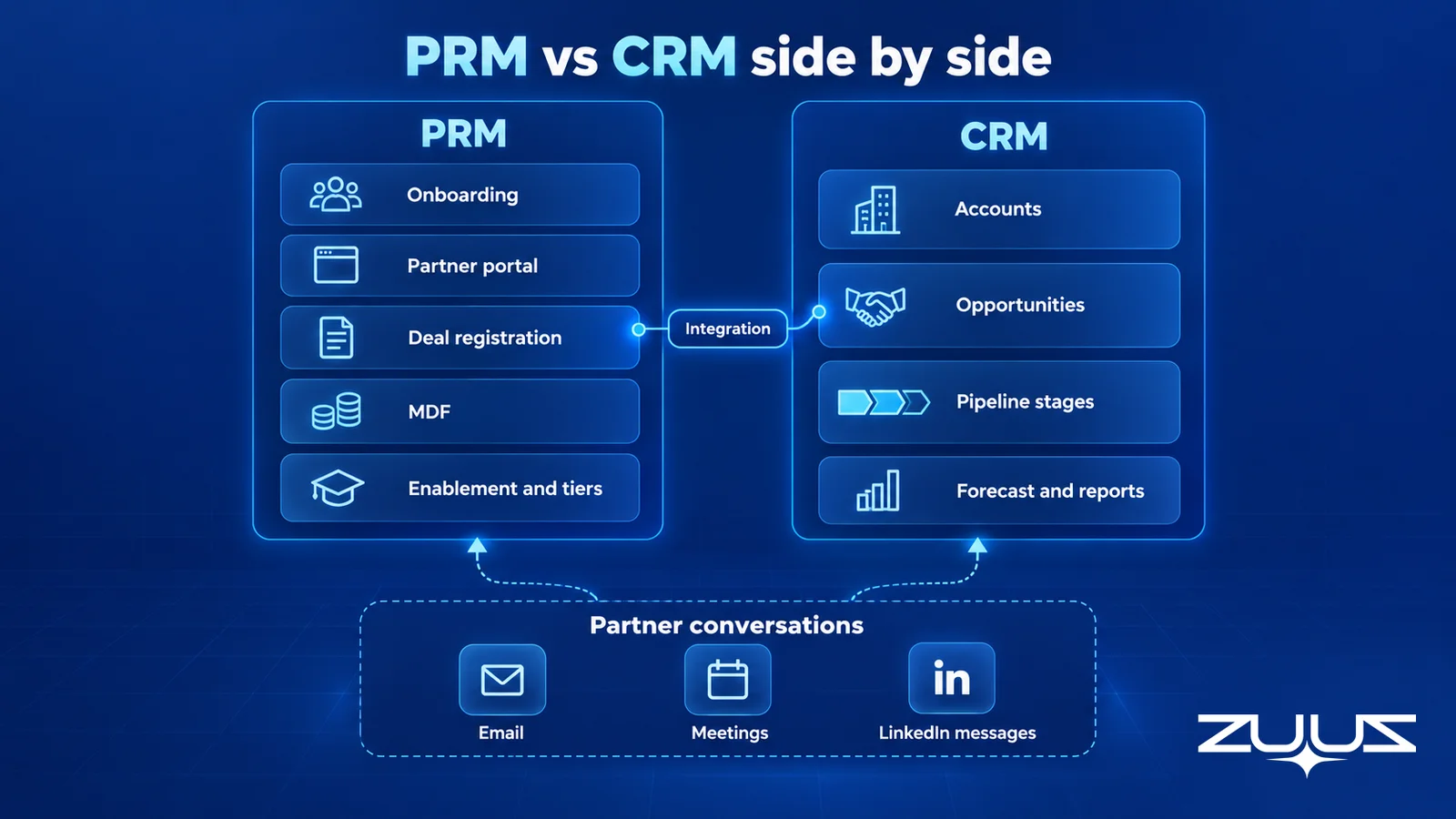
The last row is where partner pipeline drifts. In both systems, a conversation becomes data only when a person types it in, so everything said between updates stays in an inbox.
Where PRM and CRM overlap
When both systems hold a version of the same deal, one has to own each field, or the two drift apart. A PRM is also not just a CRM with partners in it: it administers a program for outside companies, with entitlements, funds and training a direct sales CRM has no equivalent for.
One Partner Deal, Followed Through Both Systems
The clearest way to see the PRM vs CRM split is to follow one deal. The scenario below illustrates a common two-tier motion: a vendor sells through a distributor to an MSP, which sells to an end customer.
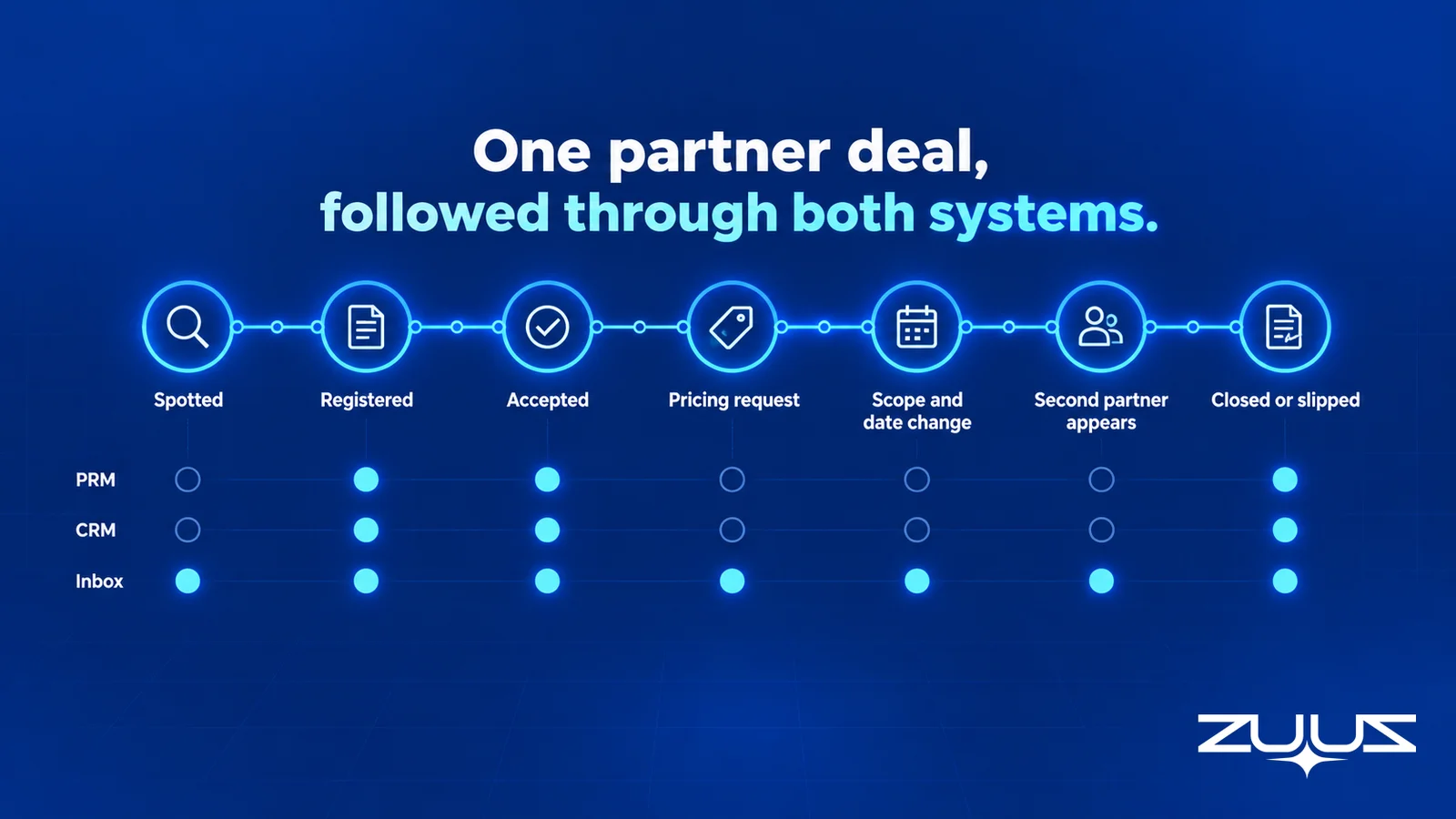
| Moment in the deal | Where it happens | What the PRM records | What the CRM records |
|---|---|---|---|
| MSP spots a firewall refresh at a client | A call and an email between the MSP and its client | Nothing yet | Nothing yet |
| MSP registers the deal | Partner portal form | The registration, customer, products and value | A linked opportunity, once the integration runs |
| Vendor accepts the registration | PRM workflow, channel manager review | Accepted status, protection dates | Opportunity stage and partner fields, if synced |
| Distributor asks for special pricing | Email between distributor, MSP and the vendor's channel manager | Usually nothing | Usually nothing until someone logs it |
| End customer cuts scope and moves the date | MSP's email to the channel manager, a Teams call | Nothing | Old amount and old close date |
| A second reseller asks about the same account | LinkedIn message to the channel manager | Nothing, unless a second registration is submitted | Nothing |
| Deal closes or slips | Purchase order email, or silence | Registration expires or is closed | Closed won, or a stale open opportunity |
Four of the seven moments happen in conversation, which is the part of PRM vs CRM that feature lists leave out. The moments that change the deal's value, timing and risk are the ones neither system sees. That pattern holds in the IT VAR sales pipeline on the partner side as well.
When a Vendor Needs a PRM, a CRM, or Both
Framed as CRM vs PRM, the choice is a false one: every vendor needs a CRM, and the decision is whether partner management needs its own system. That turns on channel complexity more than company size.
When a CRM alone is enough
A CRM alone works when a vendor has a small set of partners that channel managers know personally. Partner deals sit in the CRM with a partner field, a registration form and a weekly review. Adding a PRM at this stage often means paying for a portal partners will not log into.
When adding a PRM makes sense
A PRM starts to pay off once partners need self-service. The usual triggers are a growing number of resellers and MSPs, formal deal registration with conflict rules, MDF to administer, certifications that gate benefits, and tiered discounts. Running that from the CRM means custom objects and portals someone has to maintain.
When a vendor needs both
Most IT vendors with a real channel settle PRM vs CRM by running both, joined by an integration. It is the norm for two-tier distribution, hybrid direct and channel sales, or a channel sales model where partners source a large share of new business.
| Channel situation | Main need | Typical setup | What it still misses |
|---|---|---|---|
| Early-stage vendor with a few referral partners | Track partner-sourced deals | CRM with partner fields | Partner deal updates that arrive by email |
| Growing reseller and MSP network | Registration, onboarding, enablement | CRM plus a PRM | The same email updates, now across two systems |
| Distributor-led, two-tier channel | Registration, pricing, partner visibility | CRM plus a PRM, integrated | Pricing and scope changes negotiated in email threads |
Whichever Setup Fits, the Last Column Stays the Same.
ZUUZ works on top of the CRM a vendor already runs and writes partner deal signal from channel conversations into the right opportunity.
How PRM and CRM Integration Works
The integration is what makes PRM and CRM one partner stack. Most PRMs ship native connectors for the major CRMs, and many are built on one. What usually syncs: partner accounts and contacts, deal registrations, the opportunities they create, status changes and attribution fields. Leads often flow the other way, and training, MDF and tier data stay in the PRM.
How a deal registration becomes a CRM opportunity
A partner submits a registration, a channel manager reviews it, and on acceptance the integration matches the end-customer account in the CRM and creates or links an opportunity. From then on, status changes sync between the two.
One-way vs two-way sync
One-way sync is simpler: the PRM pushes registrations into the CRM, which owns them from then on. Two-way sync shows partners the vendor's stage and date changes, but needs field-level ownership rules. The trade-offs are the same as any bidirectional CRM sync.
Common integration problems
- Duplicate accounts. A partner spells the customer differently and a second account appears.
- Missing attribution. An opportunity created directly in the CRM never links to the registration.
- Stale stages. Both records say active while the deal changed weeks ago in email.
- Unclear ownership. Both systems edit the same field, and the last sync wins.
- Expired registrations on live deals. Protection lapses mid-negotiation because the extension request sat in an inbox.
Stale stages and expired registrations are not configuration problems: they mean the deal moved somewhere neither system reads.
The Gap Every PRM vs CRM Comparison Misses
A well-integrated PRM and CRM agree with each other, not necessarily with the deal. Partner deals move in conversations: the MSP's email, the distributor's pricing thread, a customer meeting, a partner rep's LinkedIn message. Neither system is built to read them.
A registration is a claim, not a status
Deal registration records that a partner claimed an opportunity with a given scope. It does not record that the scope halved last Thursday or the decision moved a quarter. Both records stay where the last update left them.
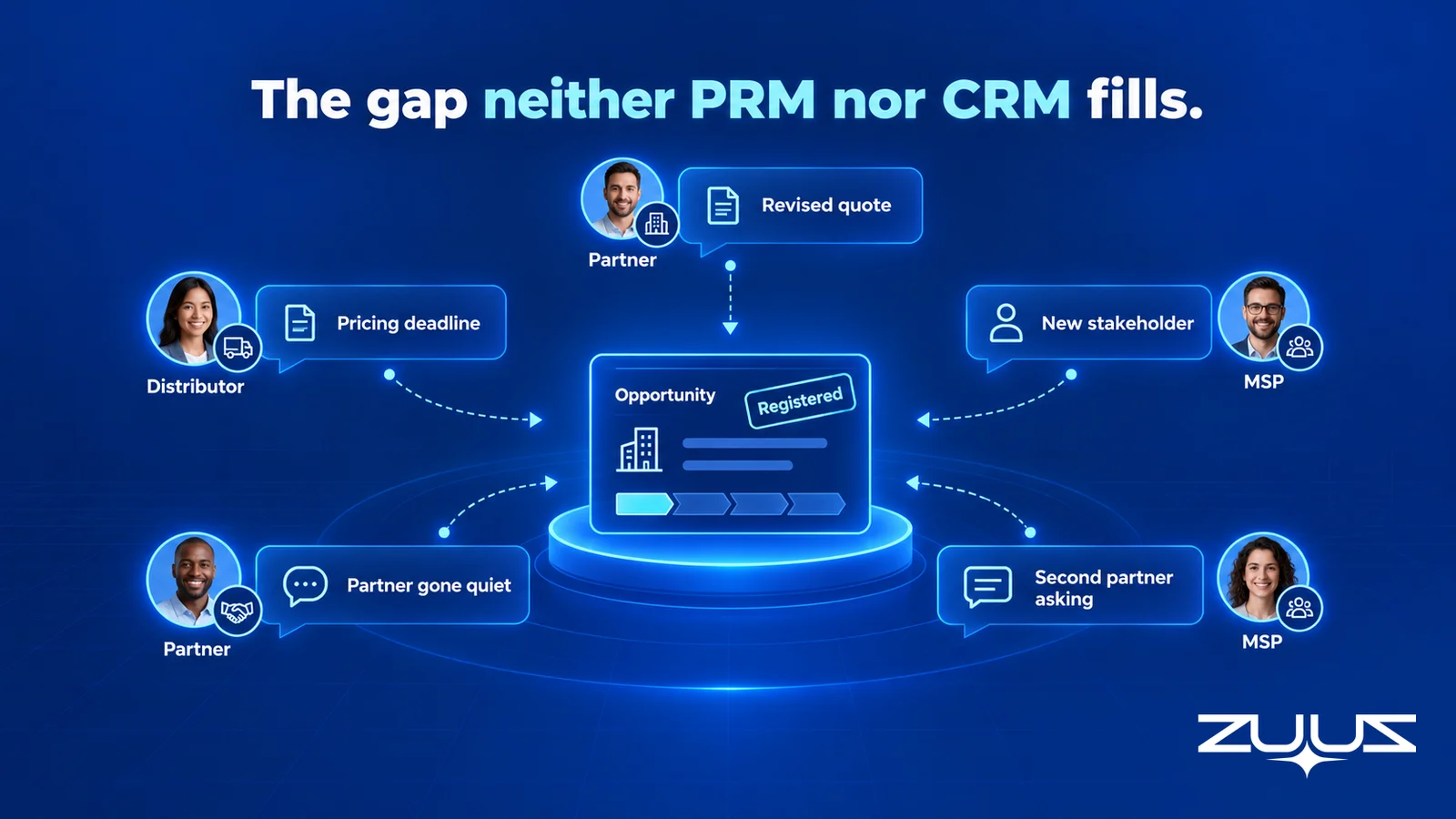
Five partner deal signals that usually go unrecorded
- A reseller asks for a revised quote with a different seat count or product mix.
- A distributor mentions a special-pricing deadline or a stock constraint.
- An MSP introduces a new stakeholder, such as a CFO or a security lead, to the thread.
- A partner who replied daily goes quiet.
- A second partner asks about the same end customer, an early sign of conflict.
The channel manager reads each one, means to update the record, and moves on. Across dozens of partners, the partner pipeline report ends up describing deals as they were weeks ago.

The Capture Layer Test for a Partner Stack
Comparing PRM vs CRM features does not reveal this gap. A better check asks whether the stack captures from where partner deals actually move. ZUUZ uses the same four questions for every capture decision.
The Capture Layer Test
- Does it capture from the channels where the deal moves: email, calendar, LinkedIn messages, meeting and call transcripts?
- Does it land in CRM fields a report can read, or only an activity feed?
- Does the rep have to remember a BCC, a button, a sidebar or a sync?
- Can the rep reverse it in one click after it is written?
A typical result, offered as an illustration: the PRM fails question 1, because it captures only what partners type into forms. The CRM's email plugin passes question 1 for threads a channel manager chooses to log, then fails question 2, because it logs an activity rather than a changed amount or close date. Failing 2 or 3 produces activity history, not a pipeline.
From an operator's seat
From an operator's seat in IT services and distribution, the part of the PRM vs CRM setup teams do not plan for is how much partner deal truth sits with the channel manager rather than the partner. Vendors invest in portals so partners will update deals themselves, and partners do update them, usually on the day a registration is due to expire. The changes in between, a scope cut or a new decision-maker, reach the channel manager first, by email or on a call. The registration data ends up describing the claim, and the channel manager's inbox describes the deal.
Partner Deals Move in Conversations. The CRM Should Move With Them.
Connect one channel manager's mailbox and see which partner deal changes never reached the CRM.
Partner Deal Signal: How ZUUZ Writes It to the CRM
ZUUZ is revenue intelligence for the IT channel: MSPs and the vendors, distributors and resellers they work with. For a vendor, it is neither a PRM nor a CRM. It reads the conversations channel managers and sellers already have in email, calendar, meetings and LinkedIn messages, finds the deal signal in them, and updates the CRM automatically, with full change history and one-click rollback. The PRM stays the system of record for the partner program and the CRM stays the system of record for pipeline.
In practice, the distributor's note about a 250-seat revised quote updates the amount on the right opportunity. The new CFO on the MSP's thread lands as a stakeholder on the account, and a partner gone quiet shows up as a stalled deal rather than as an unchanged stage. When a reply is needed, ZUUZ drafts it and the channel manager sends it. It runs on Salesforce, HubSpot, Zoho, Attio or Pipedrive, with no migration.
The results are measured in pipeline. RA Technologies, a US IT services company, surfaced $120K of identified pipeline within 72 hours that two years of HubSpot had never recorded. The deals were already in the conversations; they had never become records.
The limits matter too. ZUUZ does not run a partner portal, process deal registrations, administer MDF or manage tiers, so it does not replace a PRM. It also does not forecast, run outbound campaigns or read PSA tickets. The ZUUZ page for IT vendors covers how it fits a vendor's channel team.
Which Vendor Channel Teams This Fits, and Which It Does Not
ZUUZ fits a vendor whose channel managers carry real deal conversations with partners and distributors in email, meetings and LinkedIn, and whose CRM is Salesforce, HubSpot, Zoho, Attio or Pipedrive. It fits with or without a PRM, because it works on the CRM side. On the partner side, early-stage MSPs can use ZUUZ as their AI CRM, later-stage MSPs use it as the intelligence layer on their existing CRM, and ConnectWise PSA syncs their won customers.
It fits less well where partner deals are purely transactional, ordered through a distributor marketplace with no conversation around them. The PSA vs CRM comparison covers the same question from the MSP side of the channel.
Either way, make the PRM vs CRM decision on evidence. Compare the five largest registered deals in the PRM and CRM with the channel manager's last email thread on each. Where they disagree, the problem is capture, and neither a new PRM nor a tighter integration fixes it alone.
A first step that costs an hour
If the Capture Layer Test shows partner deal changes stuck in inboxes, the first step is small and reversible. Connect one channel manager's mailbox, let ZUUZ read the last 90 days, and see what it writes to the CRM, with full change history and one-click rollback. The first pipeline usually shows within 72 hours, and a full rollout takes one to two weeks. The trial runs 30 days free: https://zuuz.ai/trial/
Frequently Asked Questions
What is the difference between PRM and CRM?
A PRM manages a vendor's partner program: onboarding, the partner portal, deal registration, MDF, enablement and tiers. A CRM manages the vendor's pipeline and customer accounts: opportunities, stages, forecasts and reporting. Partners use the PRM; the vendor's own team uses the CRM.
Can you use a CRM as a PRM?
A CRM can handle a small partner program with partner accounts, a partner field on opportunities, a registration form and reports. Once partners need their own logins, training, MDF and tier rules at scale, a dedicated PRM or a PRM add-on usually becomes cheaper than custom building.
Do IT vendors need both a PRM and a CRM?
Most IT vendors with an active reseller, MSP or distributor channel run both. A PRM becomes worth adding when the program needs self-service onboarding, formal deal registration with conflict rules, MDF administration and certification-based tiers that would otherwise run on spreadsheets.
What is a channel partner CRM?
A channel partner CRM is a CRM configured to track partner companies and partner-sourced deals, usually with partner account types, partner fields on opportunities, attribution reports and sometimes a portal. It differs from a PRM, which administers the partner program itself, including training, funds, tiers and registration rules, for partners who log in directly.
What is PRM in Salesforce?
PRM in Salesforce refers to partner relationship management capabilities built on the Salesforce platform. They give partners a portal for deal registration, lead distribution, content and enablement, connected to the vendor's Salesforce CRM data. Partner and direct deals then share one pipeline.
How does a PRM integrate with a CRM?
A PRM integrates with a CRM through a native connector or by being built on the CRM. Partner accounts, contacts and accepted deal registrations sync into the CRM as accounts and opportunities, and status changes sync back to the portal. The key design decision is which system owns each field, so the two do not overwrite each other.
Can a PRM replace a CRM?
A PRM does not replace a CRM for most vendors. The PRM manages the partner program and partner-facing workflows, while the CRM remains the system of record for all pipeline, including direct deals, renewals and forecasting. Leadership reporting across direct and channel revenue still runs from the CRM.
Can PRM and CRM track partner deals automatically?
They track what partners and vendor staff enter, and an integration keeps the two in step. They do not read the email, meetings and LinkedIn messages where partner deals change scope, timing and stakeholders. A capture layer such as ZUUZ reads those conversations and updates the CRM, with change history and one-click rollback.
Is ZUUZ a PRM or a CRM?
ZUUZ is neither a PRM nor a CRM for vendors. It is revenue intelligence for the IT channel that reads email, calendar, meetings and LinkedIn messages, finds deal signals and updates Salesforce, HubSpot, Zoho, Attio or Pipedrive automatically. It does not run partner portals, deal registration or MDF, and it works alongside whatever PRM a vendor uses.