
What Is Deal Intelligence? A Guide for IT Channel Sales
Deal intelligence explained: the five deal signals, how it differs from revenue and conversation intelligence, and what CRM-integrated tools must do.

CEO of ZUUZ. He scaled Cloud Box Technologies from 0 to $25M ARR in IT services and distribution before building ZUUZ. Connect on LinkedIn
TL;DR: Deal intelligence is the practice of capturing deal-level signals (who is involved, what was agreed next, what could stall it, which competitors came up, and when the buyer needs to decide) and putting them on the opportunity record where a pipeline review can use them. In IT channel deals most of those signals sit in email and partner threads, not recorded calls. ZUUZ, revenue intelligence for the IT channel, reads email, calendar, meetings and LinkedIn messages, finds those deal signals and updates the CRM automatically, with full change history and one-click rollback.
- The five signals that matter most are stakeholders, next steps, risk, competitor mentions and timing. Each should change a specific CRM field, not just a note.
- Revenue intelligence covers the whole pipeline and conversation intelligence analyzes calls. Deal intelligence is the opportunity-level view.
- It improves pipeline management by replacing rep recollection with dated evidence, so stalled deals surface before the quarter ends.
- Multi-party IT channel deals (vendor, distributor, reseller or MSP, end customer) move mostly in email and partner threads, so a tool that only reads calls sees a fraction of the deal.
- When evaluating tools, check direct CRM field write-back, sources beyond calls, and whether every change is logged and reversible.
Picture a Thursday pipeline review at a reseller that sells security and networking projects. The largest open opportunity, a firewall refresh for a regional hospital group, has sat at "Proposal" for three weeks, and the rep says it is on track. Meanwhile, in a thread the rep was copied on, the distributor has told the vendor that the hospital's new CISO wants a second vendor's quote, and the vendor's channel manager has asked whether the deal registration can be extended by 30 days.
None of that is on the opportunity record. That gap is what deal intelligence exists to close. This guide covers what deal intelligence is, the five signals worth capturing, how it differs from revenue intelligence and conversation intelligence, how it improves pipeline reviews, and what to look for in a tool when most of the deal lives in email and partner threads.
What Is Deal Intelligence?
Deal intelligence is the capture and structuring of evidence about a single opportunity: who is involved on the buying side, what was last agreed, what could slow or kill the deal, which competitors are in play, and when the buyer actually needs to decide. The output is not a dashboard. It is an opportunity record that matches what the buyer and the partners have said, with a date attached to each fact.
A CRM already stores the stage, the amount and the close date, but those fields are opinions entered by the rep. Deal intelligence ties each field back to something that happened: an email that confirmed budget, a meeting invite that added a procurement contact, a message where the buyer mentioned a rival quote. In the IT channel that evidence is produced by several companies at once. The vendor knows about pricing and competitive pressure, the distributor knows about stock and credit, and the reseller or MSP knows the customer.
What deal intelligence is not
Deal intelligence is not a forecast. It does not score the odds of winning or pick the quarter a deal lands in; it gives the people who make that call better evidence. It is also not M&A deal data, a separate use of the same phrase in investment research.
The Five Deal Signals That Matter Most
Most frameworks list a dozen signal types. In practice five do nearly all the work in a pipeline review, and each should change a specific field on the opportunity rather than land as an unread activity note.
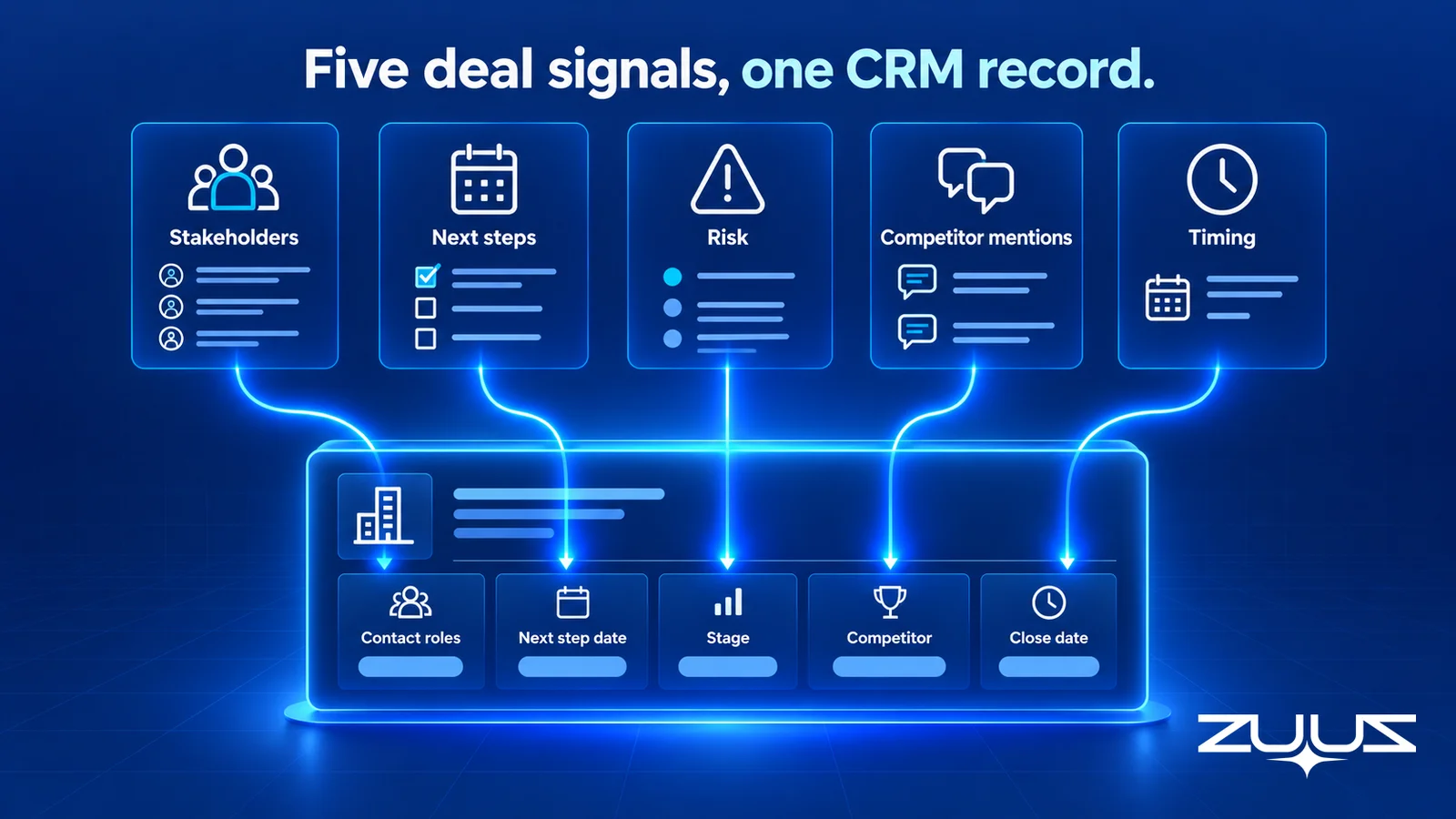
| Signal | What it looks like in a channel deal | Where it usually appears first | CRM field it should change |
|---|---|---|---|
| Stakeholders | A new CISO, a procurement lead or a finance approver joins the thread | Email cc lines, meeting invites, LinkedIn messages | Contact roles on the opportunity, buying group |
| Next steps | "Send the revised BOM by Friday" or "technical validation on the 14th" | Email replies and meeting follow-ups | Next step, next step date |
| Risk | Budget review, a freeze, a delayed board meeting, silence after a proposal | Customer email, partner threads, unanswered follow-ups | Risk flag, stage, close date |
| Competitor mentions | "They also asked for a quote from another vendor" | Distributor or vendor threads, customer email | Competitor field, deal notes |
| Timing | Fiscal year end, contract expiry, registration expiry, install window | Customer email, vendor channel manager email, calendar | Close date, renewal date, registration date |
The fourth column is the one most teams skip. A signal buried in an activity timeline forces the manager to read the timeline, which rarely happens; a signal that moves a field shows up in the pipeline report. The guide to B2B buying signals covers intent at the account level, while deal intelligence works one opportunity at a time.
Five Signals, Five Fields, Zero Copy and Paste.
ZUUZ reads email, calendar, meetings and LinkedIn messages and writes stakeholders, next steps and dates into Salesforce, HubSpot, Zoho, Attio or Pipedrive.
Deal Intelligence vs Revenue Intelligence vs Conversation Intelligence
The three terms overlap and vendors use them loosely. The cleanest split is by the question each answers: deal intelligence works on one opportunity, revenue intelligence across the whole pipeline and its accounts, and conversation intelligence on one recorded call or meeting.
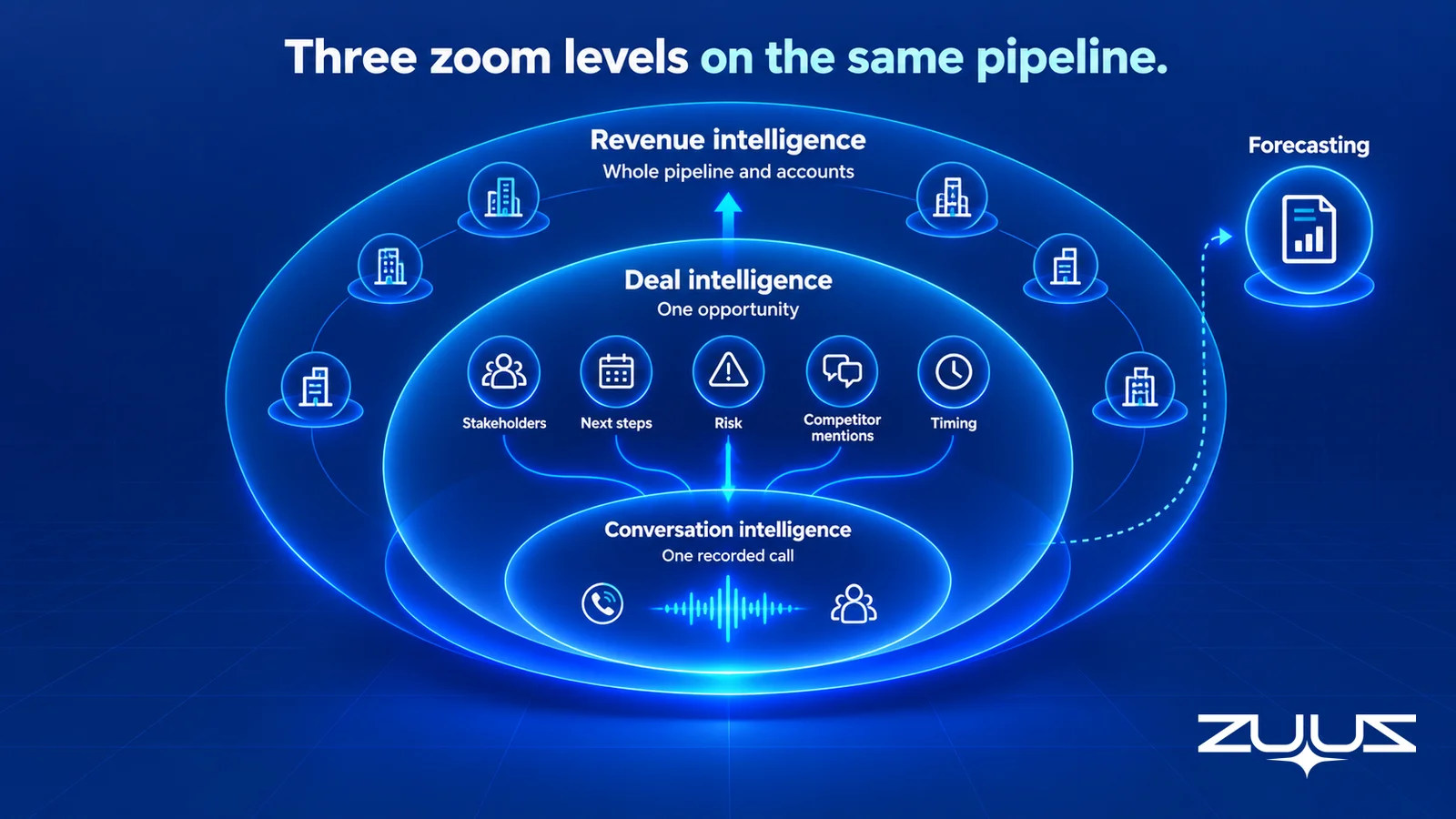
| Dimension | Deal intelligence | Revenue intelligence | Conversation intelligence | Forecasting |
|---|---|---|---|---|
| Core question | What is happening in this deal? | What is happening across the pipeline and accounts? | What happened on this call? | What number will close this period? |
| Unit of analysis | One opportunity | Pipeline, accounts, team | One recorded interaction | The quarter or period |
| Main inputs | Stakeholders, next steps, risk, competitors, timing | Signals from email, calendar, meetings, messages and the CRM | Call audio and transcripts | Pipeline data and history |
| Main output | An accurate, dated opportunity record | A CRM that reflects every live deal and account | Call summaries, talk patterns, coaching moments | A projected number |
| Where ZUUZ sits | Captures deal signals and writes them to the opportunity | ZUUZ is revenue intelligence for the IT channel | Reads meeting transcripts as one source among several | Not offered; ZUUZ does not forecast |
Deal intelligence is the foundation the others rely on: a forecast built on stale stages is only as good as the stages. The explainer on what revenue intelligence is covers the wider category, and the guide to revenue intelligence software compares the tools. This post stays at the level of the individual deal.
How Deal Intelligence Works, From Conversation to CRM Field
Every deal intelligence system runs the same four steps. Products differ mainly in which sources they read and whether the last step writes to the CRM or only suggests.
- Collect the conversations where the deal moves: email, calendar events, meeting and call transcripts, and messages such as LinkedIn.
- Match each conversation to the right account and opportunity. One distributor email can mention three end customers, so matching has to be correctable when it guesses wrong.
- Extract the deal signal: a new stakeholder, a dated next step, a budget risk, a competitor name, a contract expiry.
- Write the signal to the opportunity as a field change, with the source and date attached. HubSpot keeps a property history for each record, the kind of audit trail any deal intelligence layer should respect and extend.
How Deal Intelligence Improves Pipeline Management
The clearest answer to how deal intelligence improves pipeline management is that it changes what a pipeline review argues about. Without it, the meeting debates whether the rep feels good about a deal. With it, the meeting looks at dated evidence and spends its time on the deals where the evidence and the stage disagree.
Pipeline reviews run on evidence, not recollection
A manager with deal intelligence walks in knowing which opportunities had a buyer reply this week, which have a dated next step, and which have gone quiet. The question moves from "talk me through this one" to "no buyer response in 19 days and the close date is in 12, so what changed?"
Stalled deals show up before the quarter ends
Most deal slippage is visible weeks earlier in the conversation record: a delayed meeting, a new approver, a reply cadence stretching from days to weeks. Deal intelligence surfaces those patterns while there is still time to act.
Stages, close dates and stakeholders reflect what was said
When a customer writes that the purchase order follows their board meeting on the 20th, the close date should move to match. Tracking who has joined threads and meetings also exposes the finance approver nobody has met, so the team can ask for that meeting before it becomes the reason the deal stalls.
Reps spend less time typing
Salesforce's State of Sales research (seventh edition) found that reps spend 60% of their time on non-selling tasks, including manually entering customer notes into the CRM. Writing the signal to the record removes much of that work and the lag between an event and the CRM showing it.
Run the Pipeline Truth Test Before the Next Pipeline Review
Before buying anything, a sales manager can measure how much deal intelligence the pipeline already has. ZUUZ calls this the Pipeline Truth Test; it takes about an hour with the CRM and the deal threads.
The Pipeline Truth Test
- Take the top five deals by value this quarter.
- For each, find the CRM evidence for its stage and close date: a dated written commitment, not a rep's assurance.
- Count how many rest on a stage last changed more than two weeks ago.
- Mostly-undated top five means the number reflects rep optimism. ZUUZ does not forecast; it makes the record underneath the number real.
A typical scenario, offered as an illustration: a distributor's sales director runs the test on the five largest reseller deals. Two have a dated purchase commitment in an email. One was moved to "Negotiation" a month ago with no buyer message since. Two have close dates that were pushed forward twice. Three of five rest on assurance, which shows exactly where the next review should spend its time.
Using the result in the review itself
Before the review, the manager asks each owner of a failing deal for the latest written evidence. During it, the conversation covers only the gaps: who has gone quiet, which next step has no date, whether a competitor has entered. Afterward, every answer becomes a field change rather than a note. The guide to running a sales pipeline review covers the meeting format.
Walk Into the Review With the Evidence Already Attached.
ZUUZ ties stage and close-date changes to the email, meeting or message that justified them, with full change history on every update.
Why IT Channel Deals Need Signals Beyond Recorded Calls
The IT channel is where most technology is bought. Canalys data reported by IT Europa in 2023 put 70% of IT spending, about $3.4 trillion, through the channel. The same Salesforce State of Sales research found 94% of sales teams use partner selling, up from 86% the year before.
That structure changes where deal signals live. One deal can involve a vendor channel manager, a distributor account manager, a reseller or MSP rep and several people at the end customer, coordinating in email threads, partner portals and LinkedIn messages. A tool that only records the reseller's calls sees one edge of a four-company network.
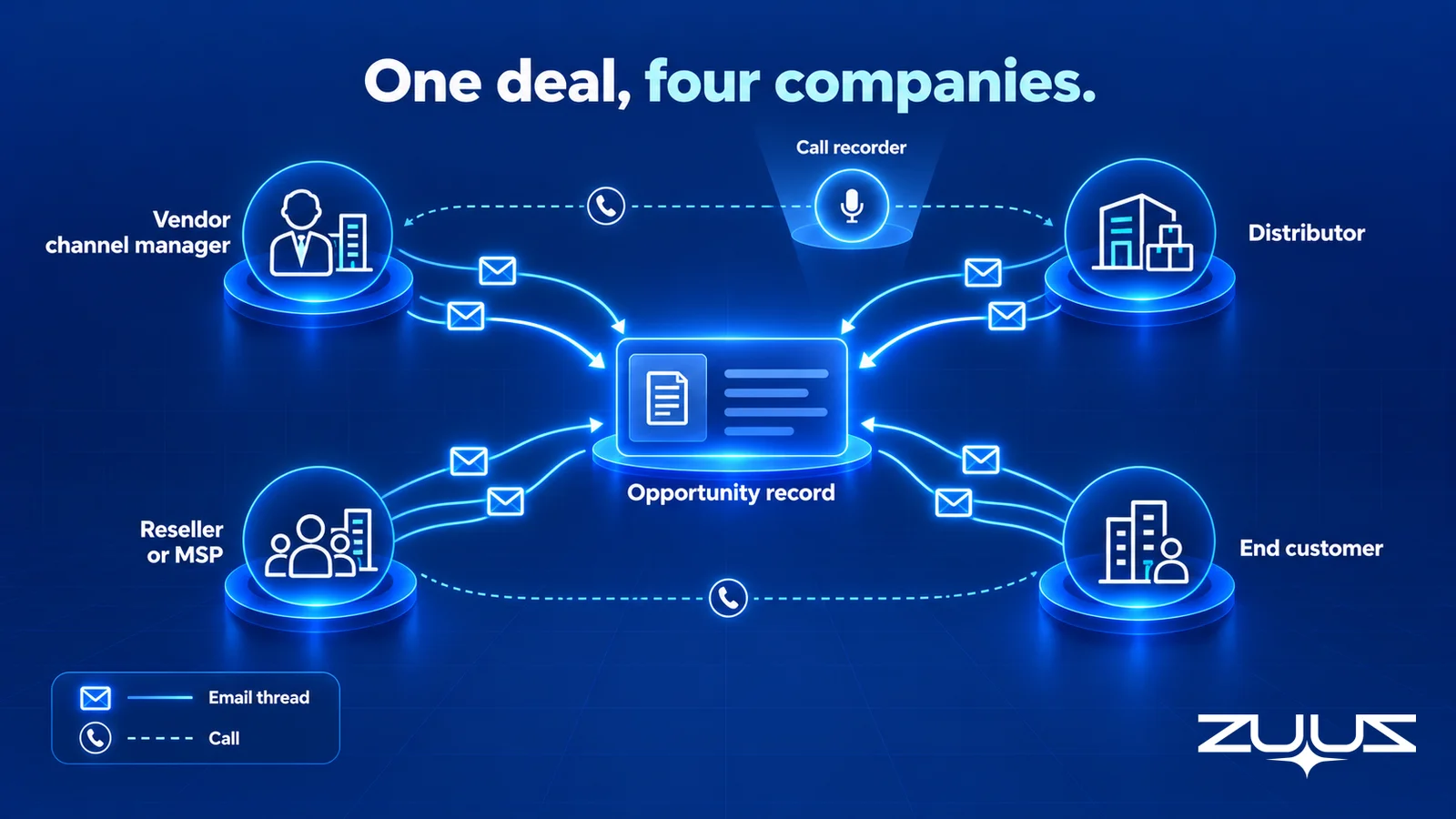
| Party | Typical channel | Signal example | Seen by a call recorder? |
|---|---|---|---|
| Vendor channel manager | Email, partner portal, LinkedIn | Special pricing granted, registration extended, competitor flagged | Rarely |
| Distributor account manager | Email, phone | Stock or lead-time risk, credit limit, quote revision | Rarely |
| Reseller or MSP rep | Email, meetings, calls | Agreed next step, technical validation date | Partly |
| End customer | Email, meetings, LinkedIn | New approver, budget review, purchase order timing | Partly |
So the first question for a channel business is not which tool records calls best. It is which tool reads the threads where the vendor, distributor and partner coordinate, and matches them to the right opportunity. Registration dates count too; the guide to deal registration explains why. The overview of ZUUZ for value-added resellers shows how these threads map to a VAR's pipeline.
What to Look for in Deal Intelligence Tools
Deal intelligence tools range from CRM features to call-recording platforms to revenue intelligence layers that read many sources. The criteria below separate tools that keep the opportunity record accurate from tools that add another screen to check.
| Criterion | Question to ask the vendor | How ZUUZ answers it |
|---|---|---|
| Direct CRM write-back | Does it update opportunity fields, or only post activities and summaries? | Updates the CRM automatically: contacts, stages, next steps and dates in Salesforce, HubSpot, Zoho, Attio or Pipedrive |
| Signal sources beyond calls | Which sources does it read: email, calendar, meeting transcripts, messages? | Email, calendar, meetings and LinkedIn messages |
| Multi-party matching | How does it match a distributor or vendor thread to the right end-customer deal? | Matches conversations to accounts and opportunities, with every write reversible |
| Change history and rollback | Can a manager see what changed, when, from which source, and undo it? | Full change history and one-click rollback on every update |
| Rep control of outbound | Does anything send messages to buyers without a person? | ZUUZ drafts replies; the rep reviews and sends them |
| Time to value | How long until the first real pipeline appears? | First pipeline within 72 hours; full rollout in one to two weeks |
| Honest scope | What does it not do? | No forecasting, no outbound sequences, no RFP responses, and it does not read PSA tickets |
Two criteria deserve extra weight in the channel. Source coverage matters because a call-only tool reports a deal as quiet while the distributor thread is busy. Reversibility matters because any system that writes to the CRM will occasionally match a thread to the wrong opportunity, and a manager must be able to see and undo that in one click.
Which Deal Intelligence Tools Integrate Directly With CRM Platforms?
Most tools claim a CRM integration, but the phrase covers very different things. Anyone asking which deal intelligence tools integrate directly with CRM platforms should sort the market into three groups, then test the claim rather than trust a logo.
CRM-native intelligence features
The major CRMs ship their own AI features for deal insights and activity capture, with the tightest integration by definition. Their limits tend to be source coverage and admin time. HubSpot's guide to setting up deal pipelines is a reminder that stages and fields must exist before anything can fill them.
Conversation intelligence platforms with CRM sync
Call recording platforms usually sync summaries and activities into the CRM, which helps coaching and call-heavy deals. The question is whether the sync changes next step, stage and close date, or adds an activity someone still has to read.
Revenue intelligence layers that write to fields
A third group sits on top of the CRM, reads several sources and writes structured updates back. ZUUZ belongs here. The guide to deal management software covers tools that run the deal process itself, a separate decision from how the record gets filled.
How to verify a direct CRM integration claim
Ask the vendor to show a field-level change, such as a close date moving, on a live or sandbox record. Ask where the change history lives and how one update is reversed. Ask which objects it can write to, since a tool that only writes activities will not fix stages or contact roles. A vendor that cannot show all three is offering a sync, not deal intelligence.
See a Field Change on a Live CRM, Not a Demo Account.
Connect one mailbox to ZUUZ and watch it write deal signals to Salesforce, HubSpot, Zoho, Attio or Pipedrive, with every change reversible.
What Operators Learn Running Deal Intelligence in the Channel
From an operator's seat, the first surprise is where the risk signals come from. Teams expect them in customer email, but in channel deals they show up first in partner threads: a distributor asking whether the quote can be held two more weeks, or a vendor channel manager quietly asking for an updated close date. Those messages are written to the rep, not the customer, and rarely reach the CRM because the rep reads them as admin rather than deal news.
The part teams do not plan for is the first week of captured signal. Connecting mailboxes surfaces opportunities and contacts the CRM never had, and somebody has to own the triage. Across the deployments ZUUZ runs, the pattern is that one named owner reviewing new signal for fifteen minutes a day beats a team-wide rollout with nobody accountable. Order of operations matters too: agree which fields the pipeline review reads before turning on capture.
Avinash Gujje ran sales in IT services and distribution before building ZUUZ, and the pattern from that seat is consistent. The deals that slipped were rarely the ones nobody knew about. They were the ones where somebody in the thread knew, and the record did not.
Deal Intelligence for the IT Channel: How ZUUZ Captures Deal Signals
ZUUZ is revenue intelligence for the IT channel: MSPs and the vendors, distributors and resellers they work with. It reads email, calendar, meetings and LinkedIn messages, finds the deal signals in them, and updates the CRM automatically with full change history and one-click rollback. Stakeholders, next steps, risks, competitor mentions and timing land on the opportunity in Salesforce, HubSpot, Zoho, Attio or Pipedrive. Pipeline capture writes the deal, and pipeline risk monitoring flags the deals that have gone quiet.
What makes it structurally different from a call recorder is the source list and the write-back: it reads the written threads where channel deals move and writes fields rather than summaries. When a reply is needed, ZUUZ drafts it and the rep reviews and sends it. For MSPs, the ConnectWise PSA integration syncs won customers, so a closed deal becomes a client record on the service side without retyping.
The proof is measured in pipeline. RA Technologies, a US IT services company, surfaced $120K of identified pipeline within 72 hours that two years of HubSpot had never recorded. The RA Technologies case study shows those deals were already in the mailbox and had never become records.
The scope has clear edges. ZUUZ does not do forecasting, outbound sequences or RFP responses, and it does not read PSA tickets. Early-stage MSPs can use ZUUZ as their AI CRM; later-stage MSPs use it as the intelligence layer on the CRM they already run. First pipeline typically appears within 72 hours, and full rollout takes one to two weeks.
A first step that takes an afternoon
Run the Pipeline Truth Test on the top five deals. Then connect one rep's mailbox and calendar to ZUUZ during the free 30-day trial and compare what it writes to those five opportunities with what the rep reported in the last review. Every change is logged and reversible in one click. Start here: https://zuuz.ai/trial
Who This Fits and Who It Does Not
This kind of deal intelligence fits IT channel teams whose deals involve more than two companies and move mostly in writing: resellers selling vendor projects through a distributor, MSPs running new-logo and expansion deals, distributors managing reseller pipeline, and vendor channel teams tracking partner-sourced deals. The view of the IT VAR sales pipeline shows where these deals typically get stuck.
It fits less well where deals are short transactional orders with one buyer and no partners, or where the team needs a forecasting engine or outbound tool. For everyone else, the Pipeline Truth Test shows in an hour whether the pipeline reflects what buyers and partners said. When it does not, the usual reasons are covered in why the CRM pipeline is wrong.
Frequently Asked Questions
What is deal intelligence?
Deal intelligence is the capture of evidence about a single opportunity: who is involved, what was agreed next, what could stall it, which competitors are in play and when the buyer must decide. It ties stage, next step and close date to dated conversations, so a pipeline review works from evidence rather than recollection.
How does deal intelligence improve pipeline management?
Deal intelligence improves pipeline management by putting dated evidence on every opportunity before the review. Managers see which deals had a buyer reply this week, which lack a dated next step and which have gone quiet, so reviews focus on deals where stage and evidence disagree and stalls surface early.
What is the difference between deal intelligence and revenue intelligence?
Deal intelligence works on one opportunity and asks what is happening in that deal. Revenue intelligence works across the whole pipeline and its accounts, capturing signals from email, calendar, meetings and messages to keep the CRM accurate. Revenue intelligence is the system that produces deal intelligence for every deal.
How is deal intelligence different from conversation intelligence?
Conversation intelligence analyzes recorded calls and meetings for transcripts, talk patterns and coaching. Deal intelligence uses transcripts as one input alongside email, calendar and messages, and its output is an accurate opportunity record. In IT channel deals, much of the progress happens in written partner threads that call analysis never sees.
Which deal intelligence tools integrate directly with CRM platforms?
Three groups do: CRM-native AI features, conversation intelligence platforms that sync call summaries, and revenue intelligence layers such as ZUUZ that write field-level updates to Salesforce, HubSpot, Zoho, Attio or Pipedrive. To verify a claim, ask to see a close date change on a real record, plus the change history and a one-click undo.
Does deal intelligence replace sales forecasting?
Deal intelligence does not replace forecasting. It makes the evidence underneath a forecast accurate by tying stages and close dates to dated conversations, but it does not score deals or project a number. ZUUZ does not forecast at all; it keeps the opportunity record real for whoever builds the forecast.
Why do IT channel deals need deal intelligence beyond call recording?
IT channel deals involve a vendor, a distributor, a reseller or MSP and the end customer, who coordinate mostly in email threads, partner portals and messages. A call recorder sees only the calls one party joins. Pricing approvals, registration extensions, stock risks and competitor flags usually arrive in writing.
How quickly does deal intelligence show results?
With ZUUZ, the first pipeline typically appears within 72 hours of connecting a mailbox, and a full rollout across a team takes one to two weeks. RA Technologies, a US IT services company, surfaced $120K of identified pipeline within 72 hours that two years of HubSpot had never recorded.
Is ZUUZ a deal intelligence tool or a CRM?
ZUUZ is revenue intelligence for the IT channel, and deal intelligence is part of what it does. It reads email, calendar, meetings and LinkedIn messages and updates Salesforce, HubSpot, Zoho, Attio or Pipedrive automatically, with change history and one-click rollback. Early-stage MSPs can use it as their AI CRM; later-stage MSPs use it as an intelligence layer.