
IT Distributors: What They Do for MSPs and VARs
IT distributors explained: what they do in the IT channel, the main types, how MSPs and VARs choose them, real costs, and how distributor sales teams run.

CEO of ZUUZ. He scaled Cloud Box Technologies from 0 to $25M ARR in IT services and distribution before building ZUUZ. Connect on LinkedIn
TL;DR: IT distributors sit between technology vendors and the VARs and MSPs that sell to end customers, supplying credit, logistics, licensing, cloud marketplaces, vendor programs and pre-sales help. MSPs and VARs should choose them on vendor coverage, credit, support and total cost, not unit price alone. On the distributor side, the deal lives in a flood of reseller quote requests, reorders and special pricing threads that rarely reach the CRM. ZUUZ, revenue intelligence for the IT channel, reads email, calendar, meetings and LinkedIn messages, finds those deal signals and updates the CRM automatically, with full change history and one-click rollback.
- An IT distributor buys from vendors at scale and resells to VARs and MSPs, adding credit, fulfillment, licensing and technical support.
- The working types are broadline, value-added or specialist, and cloud marketplace distributors; the largest run all three.
- MSPs and VARs get the most from a primary distributor plus one or two specialists, rather than a single supplier or a scattered set of accounts.
- The real cost of a distributor shows up in margin, freight, financing terms and admin time, not in an account fee.
- Distributor sales teams run on quote requests, reorders and special pricing threads that sit in email and rarely become CRM records.
- ZUUZ is not a distributor ERP or a quoting tool. It captures deal signals from conversations and writes them to Salesforce, HubSpot, Zoho, Attio or Pipedrive.
Picture a distributor account manager opening her inbox on a Monday. There are 41 new messages from resellers. Eleven are quote requests, four ask whether a vendor will extend special pricing on a firewall refresh, two are reorders of the same laptop model, and one MSP writes that its largest client "might move to a different security stack next year." By Friday the quotes, reorders and pricing requests are handled. The sentence about the security stack is still in one inbox, and the CRM has no idea it exists.
That week is how IT distributors actually work, and most explanations skip it. This guide covers what IT distributors do in the IT channel, the main types, how MSPs and VARs choose and work with them, what working with one really costs, and how distributor sales teams run, including where their deal signals disappear.
What IT Distributors Are and Where They Sit in the IT Channel
IT distributors are wholesalers of technology. They buy hardware, software and cloud subscriptions from vendors in volume, then sell them to resellers, value-added resellers (VARs), managed service providers (MSPs) and system integrators, who sell to the end customer. Along the way, an IT distributor adds credit, logistics, licensing, vendor program access and technical support that most resellers could not build alone.
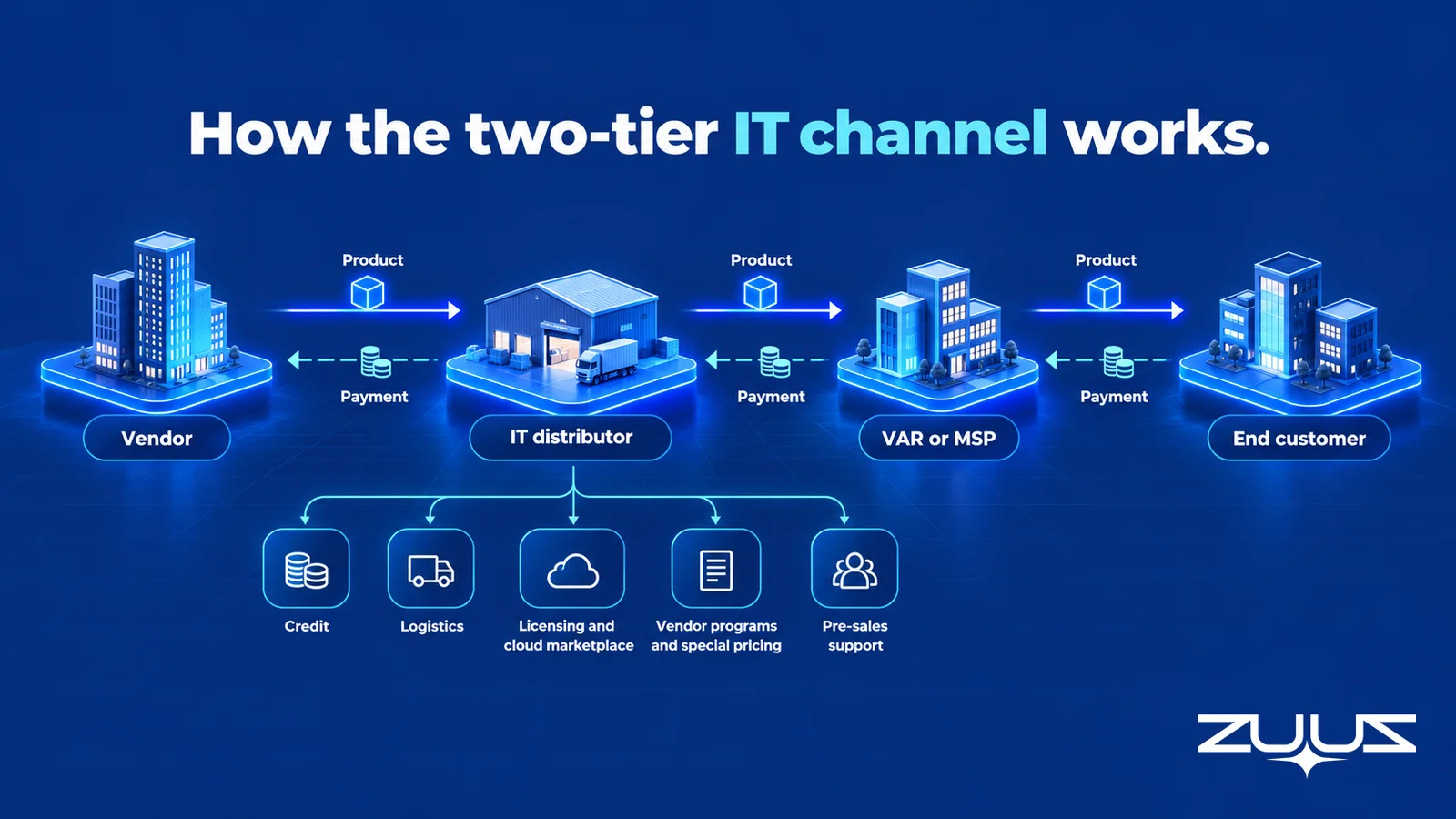
The model is usually called the two-tier channel. Tier one is the vendor, the distributor sits in the middle, and tier two is the reseller or MSP that owns the customer relationship. A vendor with thousands of small partners cannot extend credit to each, hold stock in every region or answer every configuration question, so distributors do that work at scale. The broader channel sales model depends on this middle layer.
The market is large and concentrated. Canalys, now part of Omdia, estimates the global IT distribution market at US$463 billion in 2024, with the top 15 distributors generating US$287 billion, over 61% of the total. The same analysis notes that the top three, TD Synnex, Ingram Micro and Arrow, generated nearly US$170 billion in gross sales between them.
What IT Distributors Do for Resellers and MSPs
Shipping is still part of the job, but for most VARs and MSPs the reasons to work with an IT distributor are financial and operational: credit, one place to buy from hundreds of vendors, and people who know the products.
Credit and financing
A distributor grants a credit line and payment terms, so a VAR can buy hardware for a project and pay after its own customer pays. As subscriptions replace one-time purchases, this matters more, because recurring billing strains a partner's working capital.
Logistics and fulfillment
Distributors hold regional inventory, ship to the reseller or straight to the end customer, handle returns and manage backorders. For an IT hardware reseller, stock visibility and delivery accuracy decide whether a project starts on time.
Licensing and cloud marketplaces
Software licensing and cloud subscriptions are now a large share of what distributors sell. Microsoft's Cloud Solution Provider program is a clear example. In its CSP indirect model, resellers buy from an authorized distributor, which can help with marketing, customer support and billing. Becoming a direct-bill partner requires at least 12 months as an indirect reseller and at least USD one million in trailing 12-month CSP revenue, which is why most MSPs buy Microsoft cloud through a distributor.
Vendor programs, special pricing and deal registration
Distributors administer vendor partner programs for the long tail of resellers. They pass through promotions, rebates and marketing funds, and carry special pricing requests between reseller and vendor, often attaching the registered discount to the order. The mechanics are covered in more depth in the guide to deal registration.
Pre-sales and technical support
Value-added distributors employ solution architects and pre-sales engineers who design configurations, check compatibility, run demos and sometimes join the reseller on a customer call. For a small MSP adding a new security or storage line, this borrowed expertise often makes the first deal possible.
| Service | What the reseller or MSP gets | Where the work actually happens |
|---|---|---|
| Credit and financing | Credit line, payment terms, project financing | Credit application, then email with the credit team when limits run short |
| Logistics | Stock, shipping, drop-ship, returns, configuration | Distributor portal and order confirmations |
| Licensing and cloud | Subscriptions, license changes, consolidated billing | Cloud marketplace or portal, plus renewal emails |
| Vendor programs | Promotions, rebates, special pricing, deal registration | Three-way email threads between reseller, distributor and vendor |
| Pre-sales support | Solution design, compatibility checks, demos, training | Calls, meetings and follow-up email |
The last column matters: the transaction lands in the ERP and portal, but the conversations that create it run through email, calls and meetings.
Every Channel Deal Starts as a Message. Few Reach the CRM.
ZUUZ reads reseller and vendor conversations and writes the deal signals into Salesforce, HubSpot, Zoho, Attio or Pipedrive.
Types of IT Distributors
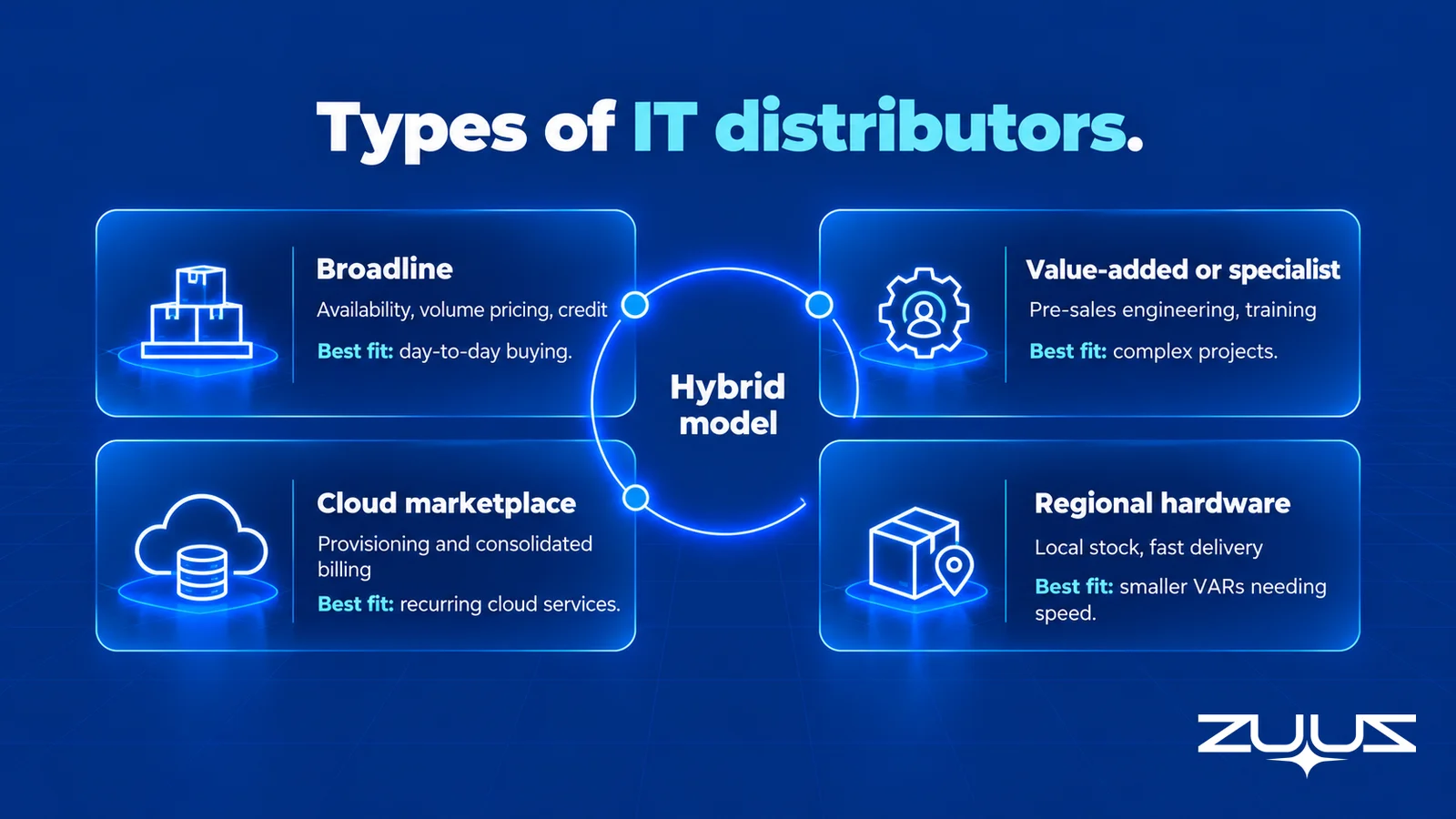
The categories overlap, and the largest companies run every motion at once, but the distinction helps a reseller decide which account to open for which job.
Broadline distributors
Broadline IT distributors carry thousands of products from a very wide set of vendors, across PCs, peripherals, networking, software and cloud. Their strengths are availability, price on high-volume items, logistics and credit. TD SYNNEX describes itself as working with the whole technology ecosystem with 23,000 co-workers worldwide. Ingram Micro says more than 165,000 customers and over 1,500 vendors work with it, and it runs Ingram Micro Xvantage, which it calls a digital distribution experience platform. D&H positions itself as a technology distributor serving resellers and retailers throughout North America, with more than a century of history.
Value-added and specialist distributors
Value-added distributors, often called VADs, carry fewer vendors in more depth, typically in security, data center, networking, storage or unified communications. They sell expertise as much as product. Emerging technology distributors for IT resellers are a subset of this group. They sign newer vendors in categories like AI infrastructure or new security tools and help resellers build a practice around them before the broadliners do. The trade-off is a narrower catalog and vendors that are less proven.
Broadliners also run specialist arms; Omdia describes TD Synnex's advanced solutions business as the world's largest specialist distributor.
Cloud marketplace distributors
Cloud marketplace distributors focus on subscriptions: Microsoft 365, Azure, security tools, backup and other SaaS that an MSP resells monthly. Pax8 calls itself a cloud marketplace and reports more than 47,000 partners and over 140 vendors on its platform. Most broadliners run cloud marketplaces too, so it is often a capability rather than a company type.
IT hardware distributors
IT hardware distributors are broadliners or regional distributors carrying PCs, servers, networking gear and peripherals. Stock, delivery time and credit decide the choice, because a project stalls when a single switch is backordered.
| Type | Focus | Main strengths | Best fit | Trade-off |
|---|---|---|---|---|
| Broadline | Very wide vendor and product range | Availability, price on volume, credit, logistics | Day-to-day hardware and software buying | Less hands-on help on complex solutions |
| Value-added or specialist | Security, data center, networking, emerging technology | Pre-sales engineering, training, vendor access | Complex projects and new practice areas | Narrower catalog, sometimes higher prices |
| Cloud marketplace | Subscriptions and SaaS for MSPs | Provisioning, license changes, consolidated billing | Recurring cloud and security services | Little or no hardware |
| Regional hardware | PCs, servers, networking in one region | Local stock, fast delivery, relationship service | Smaller VARs needing speed and attention | Smaller vendor list and credit capacity |
How MSPs and VARs Choose an IT Distributor
Price per unit is the easiest thing to compare and the least useful on its own. MSP forum threads about distributors circle the same large names, then turn to service fit, onboarding speed, lead times and whether someone answers the phone. A practical evaluation covers seven points.
- Vendor coverage. Today's vendors and the ones planned next.
- Credit terms. Limit, payment terms and how fast the limit moves for a large project.
- Special pricing access. Turnaround on special pricing and deal registration.
- Fulfillment. Stock visibility, backorder handling, configuration services and return policy.
- Pre-sales and support. A named account manager, solution architects and clear escalation.
- Cloud and licensing operations. Marketplace quality, license changes and billing integration.
- Total cost. Margin after freight, financing, restocking and admin time.
Weight these by business model: a cloud-heavy MSP cares most about the marketplace, a VAR delivering network refreshes about stock, credit and engineering help. The value-added reseller guide covers how VAR margins depend on these choices.
One IT Distributor or Several
Whether to consolidate suppliers or use multiple distributors is one of the most common questions resellers ask, and there is no single right answer.
| Factor | Single distributor | Multiple distributors | Hybrid (primary plus specialists) |
|---|---|---|---|
| Pricing power | Volume concentrated in one account | Can compare quotes on each deal | Volume with the primary, competition on large deals |
| Supply resilience | Exposed to one stock position | Fallback when one is out of stock | Fallback where it matters most |
| Credit | One larger line | Several smaller lines to manage | One main line plus project credit as needed |
| Admin effort | Lowest | Highest: more portals, invoices and contacts | Moderate |
| Expertise | Limited to that distributor's specialist teams | Broad | Specialists for complex lines |
Most growing resellers land on the hybrid: one broadline distributor for everyday buying and credit, one cloud marketplace for subscriptions, and a specialist for the practice area where engineering help matters.
What It Costs to Work With an IT Distributor
Opening a standard reseller account with a large IT distributor usually starts with a credit application rather than a membership fee, though terms vary and optional programs can carry charges. The real cost shows up elsewhere.
- Margin. The spread between vendor cost and reseller price, changed deal by deal by special pricing.
- Freight and handling. Shipping, drop-ship and configuration fees add up on small orders.
- Financing. Extended terms and project financing cost money.
- Returns. Restocking fees punish ordering mistakes.
- Admin time. Chasing quotes and license changes across portals and inboxes.
Adding freight, financing and staff time to a few typical orders often shows that the cheapest distributor on paper is not the cheapest in practice.
Quote Requests and Reorders Are Pipeline. Treat Them That Way.
Connect one mailbox and see which reseller conversations carry deals the CRM has never recorded.
How IT Distributor Sales Teams Actually Run
From the outside, a distributor looks like a catalog with a warehouse behind it. Inside, the sales team handles a very high volume of small, fast reseller conversations, plus fewer large, slow ones that involve the vendor too.
A high volume of reseller quote requests
A distributor account manager may cover dozens or hundreds of reseller accounts, and most of the day goes to quote requests: pricing and availability, substitutions, urgent requests tied to a customer deadline. Each is a small signal of real end-customer demand, and few become CRM opportunities because there are too many to type in.
Reorders and repeat buying
Reorders are the steady base of a distributor's revenue. A reseller that orders the same laptop model every month for a growing client is telling the distributor something about that client.
Special pricing between reseller and vendor
Larger deals bring the vendor in. The reseller asks for a better price on a competitive deal, the distributor takes the request to the vendor's channel team, and the answer comes back with a quote reference and an expiry date. That three-way email thread holds the customer, deal size, competitor and timeline, while the registration sits in a vendor portal and the order in the ERP. No system holds the whole story.
Renewals and resellers that go quiet
The renewal date sits in a system, but the context, such as a reseller mentioning that its client is reviewing vendors, sits in a conversation. Resellers going quiet are harder still: fewer quote requests, slower replies, a stalled project. The ERP shows the drop in orders weeks after the conversations changed.
From an operator's seat, the pattern is consistent. Avinash Gujje built Cloud Box Technologies from $0 to $25M ARR in IT services and distribution, and what that work teaches is that a change in a reseller's tone shows up long before a change in its order volume. The quote request that mentions a new client, the special pricing ask that names a competitor, and the reorder that arrives with "last one for a while" in the email are leading indicators. The order history is a lagging one. Distribution teams that read only the ERP are managing the past.
Where Distributor Deal Signals Get Lost
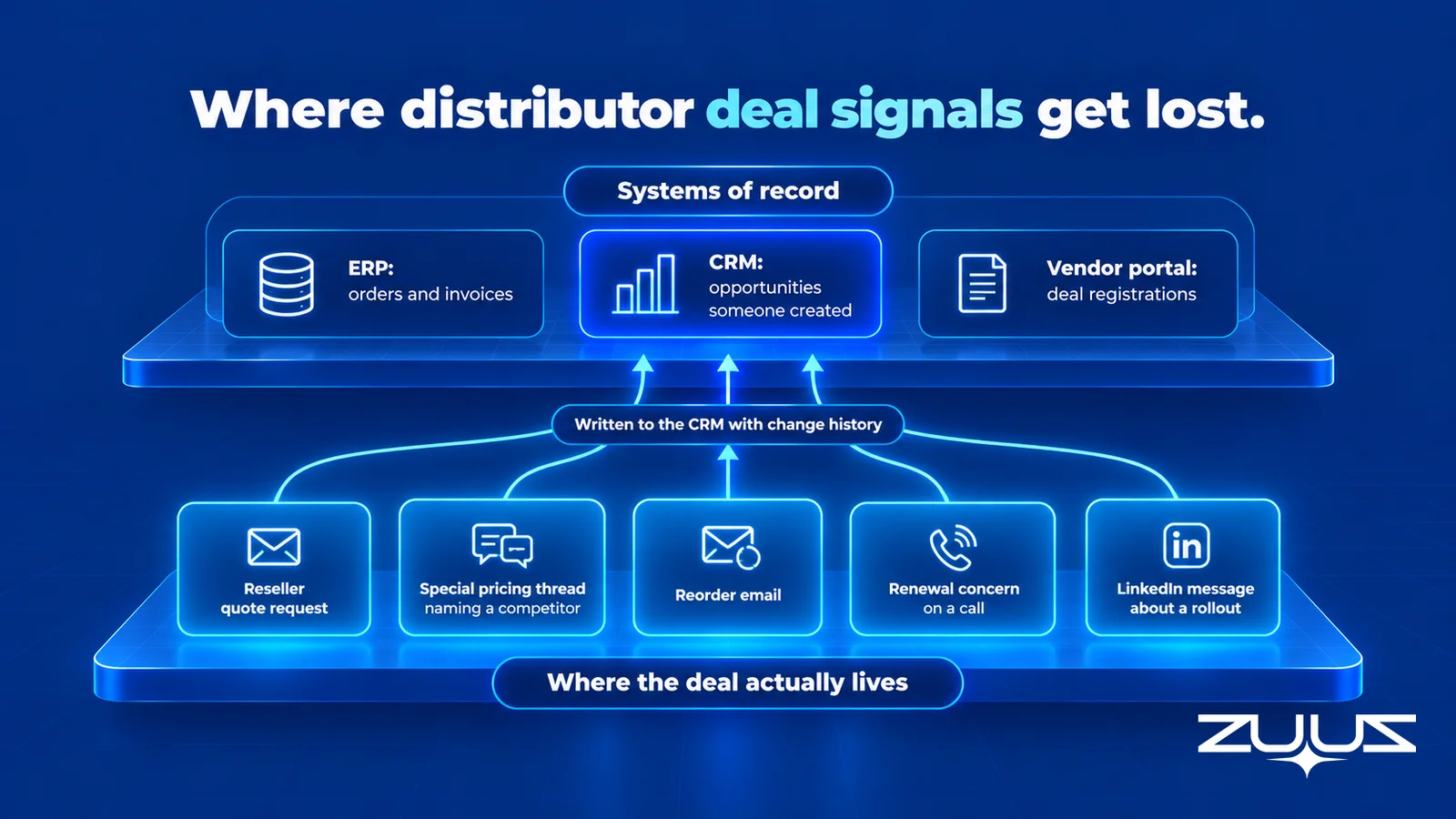
Each of a distributor's systems sees a different slice of the same deal: the ERP holds orders, the CRM holds whatever opportunities someone created, and the vendor portal holds registrations. The context that ties them together sits in email, calendars, meetings and LinkedIn messages, across three companies.
| Deal signal | Where it first appears | What the ERP sees | What the CRM sees |
|---|---|---|---|
| Quote request for a new end customer | Reseller email to the account manager | Nothing until an order is placed | Nothing unless someone creates an opportunity |
| Special pricing request naming a competitor | Three-way email thread with the vendor | The final price on the order, if it closes | Rarely the competitor or the deadline |
| Larger rollout mentioned in passing | A call, meeting or LinkedIn message | Nothing | Nothing |
| Reorders slowing for a key reseller | Fewer quote requests and slower replies | The drop, weeks later | Nothing |
| Renewal at risk | Reseller says its client is reviewing vendors | The renewal date only | The renewal date, if tracked |
These signals are not lost through carelessness. The volume is too high for manual logging, and the people best placed to log them are busiest answering resellers. The same gap affects resellers on the other side of the relationship, which is why email-to-CRM automation for IT companies has become a practical question rather than a nice-to-have.

For distributors, renewals are where this gap costs the most, because the contract value is known and the warning usually arrives in writing. A dedicated look at renewal tracking software for VARs and distributors covers the tooling side. The check below covers the process side.
The ERP Shows the Order. The Inbox Shows the Deal.
ZUUZ finds reseller deal signals in email, calendar, meetings and LinkedIn and updates the CRM with full change history.
The Renewal Signal Check for IT Distributors
The Renewal Signal Check is ZUUZ's four-step test for finding the renewals a team will be surprised by. It takes an afternoon.
- List every renewal in the next two quarters and its date field.
- For each, find the last real conversation and what it said about budget, champion or satisfaction.
- Mark every renewal where the date is the only thing the system knows.
- Those are the renewals that surprise you; the signal existed, in a mailbox.
A typical scenario, offered as an illustration: a distributor's cloud team runs the check on 60 reseller renewals due in the next six months. For 22 of them, the CRM holds a date and a value and nothing else. The threads show a reseller whose client is merging, one asking about a competing vendor's partner program, and three that stopped replying last month. None of that was in a field a report could read.
The check works by hand; doing it every week across hundreds of resellers is where a capture layer earns its place.
Distributor Deal Signals: How ZUUZ Writes Them to the CRM
ZUUZ is revenue intelligence for the IT channel: MSPs and the vendors, distributors and resellers they work with. It is not a distributor ERP, a quoting tool or a partner portal.
- Capture from the channels that carry the deal. ZUUZ connects to email and calendar, reads meeting transcripts and LinkedIn messages, and spots quote requests, special pricing asks, new end customers, stakeholders, next steps and renewal signals.
- The CRM updates without retyping. ZUUZ updates the CRM automatically, with full change history and one-click rollback on any record, in Salesforce, HubSpot, Zoho, Attio or Pipedrive. Manual entries take precedence.
- Replies stay with the rep. ZUUZ drafts replies to reseller messages; the account manager reviews and sends them.
- ConnectWise PSA. For channel teams running ConnectWise PSA, ZUUZ syncs won customers into it.
- Quiet resellers and renewals. Pipeline risk and renewal monitoring flag stalled threads and at-risk renewals.
The structural difference is where ZUUZ sits. It is an intelligence layer on top of the CRM the team already runs, so there is no migration, and it captures from conversations rather than relying on a rep to remember a BCC address. A 90-day mailbox lookback on first connection builds the first view from conversations already in the inbox. Early-stage teams without a mature CRM can use ZUUZ as their AI CRM; later-stage teams use it as the intelligence layer on the CRM they have.
The clearest proof comes from the reseller side of the channel. RA Technologies, a US IT services company, surfaced $120K of identified pipeline within 72 hours that two years of HubSpot had never recorded.
The limits are worth stating plainly. ZUUZ does not read PSA tickets, does not forecast revenue, does not run outbound sequences, does not generate quotes or pricing, and does not write RFP responses. It reports what happened in the conversations and writes it to the record.
The trial step is concrete. Connect one account manager's mailbox on the free 30-day trial, and ZUUZ reads the last 90 days of reseller and vendor threads. The first pipeline view typically arrives within 72 hours, showing the gap between what was logged and what was said, and a full rollout takes one to two weeks. More detail on the distribution use case is on the ZUUZ for IT distributors page, and the distribution reorder pipeline white paper covers reorders as a pipeline source.
Which Distribution Teams This Fits
It fits distributor sales and account teams whose reseller interaction runs through email and meetings, and whose CRM mostly shows what was ordered. It also fits the resellers on the other side. Value-added resellers chasing special pricing across distributors face the same gap, as do managed service providers whose expansion deals start in a client's email. MSPs building an MSP sales pipeline often find much of the deal context in distributor and vendor threads.
It fits less well where nearly all ordering is self-service through a portal with no conversation behind it; there, ERP and portal data already tell most of the story.
Frequently Asked Questions
What is an IT distributor?
An IT distributor is a wholesaler that buys hardware, software and cloud subscriptions from technology vendors and sells them to resellers, VARs, MSPs and system integrators. It adds credit and payment terms, logistics, license management, vendor program access and pre-sales technical support, which most resellers could not build on their own.
What is the difference between an IT distributor and an IT reseller?
An IT distributor sells to other businesses in the channel, mainly resellers and MSPs, and rarely owns the end-customer relationship. An IT reseller, such as a VAR or MSP, buys from the distributor and sells to the end customer, usually adding design, installation, support or management. The distributor supplies scale and credit; the reseller owns the customer.
Is it distributor or distributer?
The standard spelling is "distributor." Some dictionaries list "distributer" as a variant, but vendor contracts, partner programs, job titles and trade press in the IT channel use "distributor" consistently. Using the standard spelling in agreements, proposals and job postings avoids confusion.
What are the main types of IT hardware distributors?
The main types are broadline distributors, which carry a very wide vendor range with strong stock and credit; value-added or specialist distributors, which focus on areas like security or data center with pre-sales engineering; and regional hardware distributors offering local stock and fast delivery. Cloud marketplace distributors focus on subscriptions and usually carry little hardware.
How do MSPs buy hardware and software from IT distributors?
MSPs open a reseller account, pass a credit review, then request quotes or order through the distributor's portal or account manager. Hardware ships to the MSP or directly to the client, and cloud subscriptions are provisioned and billed through the distributor's marketplace. Special pricing and deal registration run through the account manager and the vendor.
How much does it cost to work with an IT distributor?
Opening a standard reseller account with a large distributor usually involves a credit application rather than a membership fee, although terms vary by distributor and optional programs can carry charges. The real cost sits in the distributor's margin, freight, financing on payment terms, restocking fees and the staff time spent chasing quotes and license changes. Compare total cost per order, not unit price.
Is it better to consolidate suppliers or use multiple distributors?
Most growing resellers do best with a hybrid: one primary broadline distributor for everyday buying and credit, a cloud marketplace for subscriptions, and a specialist where engineering help matters. Consolidating everything gives volume and simple admin but creates supply and credit risk. Spreading across many distributors adds coverage but multiplies portals, invoices and contacts.
What are emerging technology distributors for IT resellers?
Emerging technology distributors are specialist distributors that sign newer vendors, often in security, AI infrastructure, networking or data, and help resellers build a practice around them. They provide training, pre-sales engineering and vendor introductions that broadline distributors may not offer for young vendors.
How do IT distributor sales teams handle quote requests and special pricing?
Distributor account managers answer a high volume of reseller quote requests for pricing and availability, often through email and the distributor portal. For larger deals they carry special pricing requests to the vendor's channel team and return an authorized price with a quote reference and expiry date. Most of this context stays in email threads rather than CRM records.
Is ZUUZ a distributor ERP or a CRM?
ZUUZ is neither a distributor ERP nor a quoting tool. It is revenue intelligence for the IT channel that reads email, calendar, meetings and LinkedIn messages, finds deal signals and updates Salesforce, HubSpot, Zoho, Attio or Pipedrive automatically, with full change history and one-click rollback. Early-stage teams can use it as their AI CRM; others run it on their existing CRM.