
Partner Attribution: Sourced vs Influenced Revenue Explained
Partner attribution for IT vendors: sourced vs influenced revenue, first and multi-touch models, why disputes happen, and the evidence that settles them.

CEO of ZUUZ. He scaled Cloud Box Technologies from 0 to $25M ARR in IT services and distribution before building ZUUZ. Connect on LinkedIn
TL;DR: Partner attribution is how an IT vendor decides which partners created or moved a deal, usually split into partner sourced revenue (the partner originated the opportunity) and partner influenced revenue (the partner materially helped a deal it did not originate). Models such as first touch, last touch and multi-touch only divide credit; disputes come from missing evidence, because the record of who introduced the deal and when the partner first wrote sits in email threads, not the PRM. ZUUZ, revenue intelligence for the IT channel, links partner contacts and those threads to the deal in the CRM, so attribution is evidenced rather than argued.
- Partner attribution assigns credit for pipeline and revenue to the partners that created or advanced each deal.
- Partner sourced means the partner originated the opportunity; partner influenced means it materially helped a deal someone else originated. The two overlap, so never add them together.
- First touch, last touch and multi-touch models answer different questions, and none of them can fix a record that never captured the partner's introduction.
- The deciding evidence usually lives in the first email, the meeting invite and the thread where the partner brought the vendor in.
- ZUUZ is not a PRM or an attribution tool. It links partner contacts and threads to the deal in the CRM so the evidence is on the record when credit is decided.
Picture the quarterly business review at a security software vendor. The channel team reports that a regional MSP sourced a six-figure deal that closed last month. The direct account executive disagrees: the customer was already in the CRM, and the vendor's own team created the opportunity. Both are right as far as their systems show.
What neither system shows is the email the MSP's account manager sent the vendor's regional rep five weeks before that opportunity existed, introducing the customer's IT director. That thread decides the argument, and it sits in two inboxes. This guide covers partner attribution, partner sourced vs partner influenced revenue, the common models, why disputes happen and the evidence underneath, for channel teams at IT vendors.
What Is Partner Attribution?
Partner attribution is the practice of assigning credit for pipeline and revenue to the partners that created or advanced a deal. For an IT vendor selling through MSPs, value-added resellers and distributors, it answers the question finance keeps asking the channel team: which partners generate business, and which only process orders that would have happened anyway.
Attribution feeds partner tiers, rebates and funding. Forrester's Kathy Contreras argues in a 2025 post on why partner attribution is broken that most B2B organizations still lean on sourced-revenue models that miss much of what partners contribute, and that fixing it is a leadership job rather than a back-office one.
What partner attribution is not
Partner attribution is not deal registration. A registration is a partner's claim on an opportunity, filed for pricing protection, often weeks after the partner first introduced the customer. And it is not a PRM feature by default: the partner relationship management platform runs the program, but the deal and its revenue live in the CRM, as the PRM vs CRM split shows.
How partner attribution works in the IT channel
IT channel deals rarely involve one partner. A typical path runs from the vendor through a distributor to a reseller or MSP and on to the end customer. Attribution has to separate demand creation from sales influence and from fulfillment, because one "partner" field on the opportunity cannot hold all three. The wider channel sales motion depends on getting that separation right.
Partner Sourced vs Partner Influenced Revenue
Partner sourced revenue and partner sourced pipeline
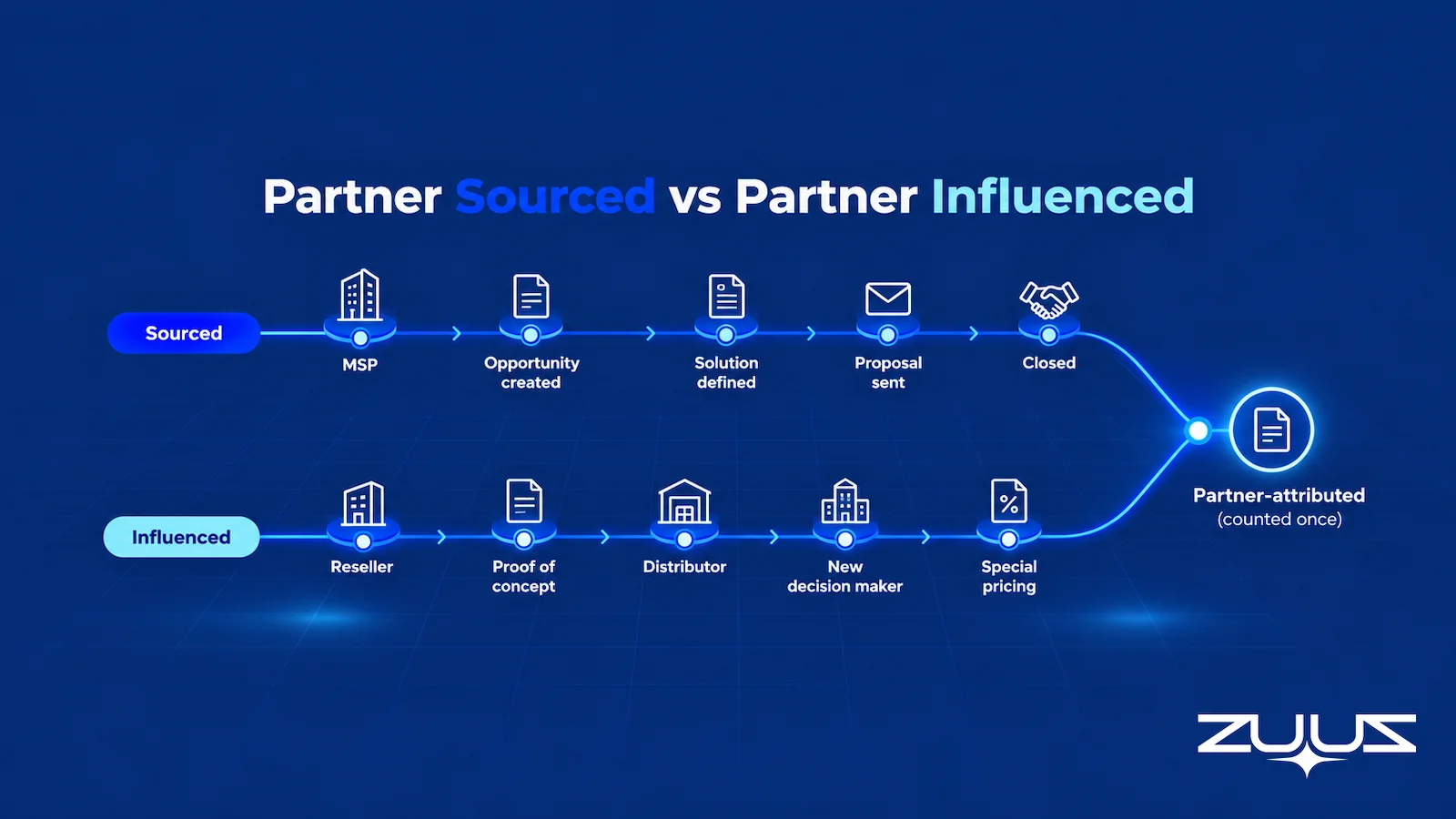
Partner sourced revenue comes from opportunities a partner originated: the partner identified the customer and the need and brought it to the vendor before the vendor was working it. Partner sourced pipeline is the open-opportunity version, measured before close. A sound sourced rule needs an identifiable end customer, a documented introduction, a date for it, and no active vendor opportunity for the same need at the time.
An MSP emailing the vendor's partner manager that a 300-seat client wants new endpoint protection, where the vendor has no open opportunity, is partner sourced. A reseller registering a customer the vendor's inside sales team has been emailing for a month is not, whatever the portal says.
Partner influenced revenue
Partner influenced revenue comes from opportunities the partner did not originate but materially helped, for example by running a proof of concept, bringing in a new decision maker or co-presenting the solution. PartnerStack's guide to sourced vs influenced revenue describes influence the same way: the partner does not generate the lead but helps move the deal forward. Being copied on an email, portal logins or fulfilling an order the customer already chose do not count unless the policy says so.
| Dimension | Partner sourced | Partner influenced |
|---|---|---|
| What the partner did | Originated the opportunity | Materially advanced an opportunity it did not originate |
| Typical activity | Introduces a new customer or a new need | Proof of concept, new stakeholder, technical validation |
| Timing | Before the vendor opportunity exists | Any point during the deal |
| Evidence needed | The dated introduction, and no active vendor opportunity | A dated record of the specific contribution |
| Main risk | Competing origin claims with direct sales | Over-crediting routine participation |
Can a deal be both partner sourced and partner influenced?
Yes, and that is where reports go wrong. An MSP can source a deal that an integrator influences, so adding the two totals double-counts it. Report them as separate views plus a deduplicated figure, partner-attributed revenue, where each deal counts once.
Sourced or Influenced Starts With the First Email.
ZUUZ reads the partner and customer conversations behind each deal and links them to the record in Salesforce, HubSpot, Zoho, Attio or Pipedrive, with full change history.
How to Write Partner Attribution Rules Both Teams Accept
Definitions only work as written rules, shared with direct sales, channel sales, revenue operations and finance, with one named owner for exceptions. Four rules decide most contested deals.
- The sourced rule. Define "originated": the partner introduced a named customer and a defined need, in writing, before any vendor opportunity existed for that need.
- The influence rule. List what qualifies (a partner-led meeting, a proof of concept, a stakeholder introduction, solution design) and what does not (email copies, portal activity, fulfillment alone).
- Windows and expiry. Set how long an introduction stays eligible. Some programs use a fixed exclusive window, often 90 to 180 days according to Altitude BI's overview of partner attribution models. Write separate rules for renewals, expansions and reopened deals.
- Multiple partners. Decide in advance who gets credit when two partners, a distributor and a reseller, or a partner and the direct team all claim origin.
The usual tie-breaker in every one of those collisions is the earliest dated, documented introduction. That is exactly the evidence most systems do not hold.
Partner Attribution Models, From First Touch to Multi-Touch
Once the rules say which partner actions count, an attribution model decides how credit is shared between them. Public sources describe the same short list, and each answers a different question.
First touch and last touch
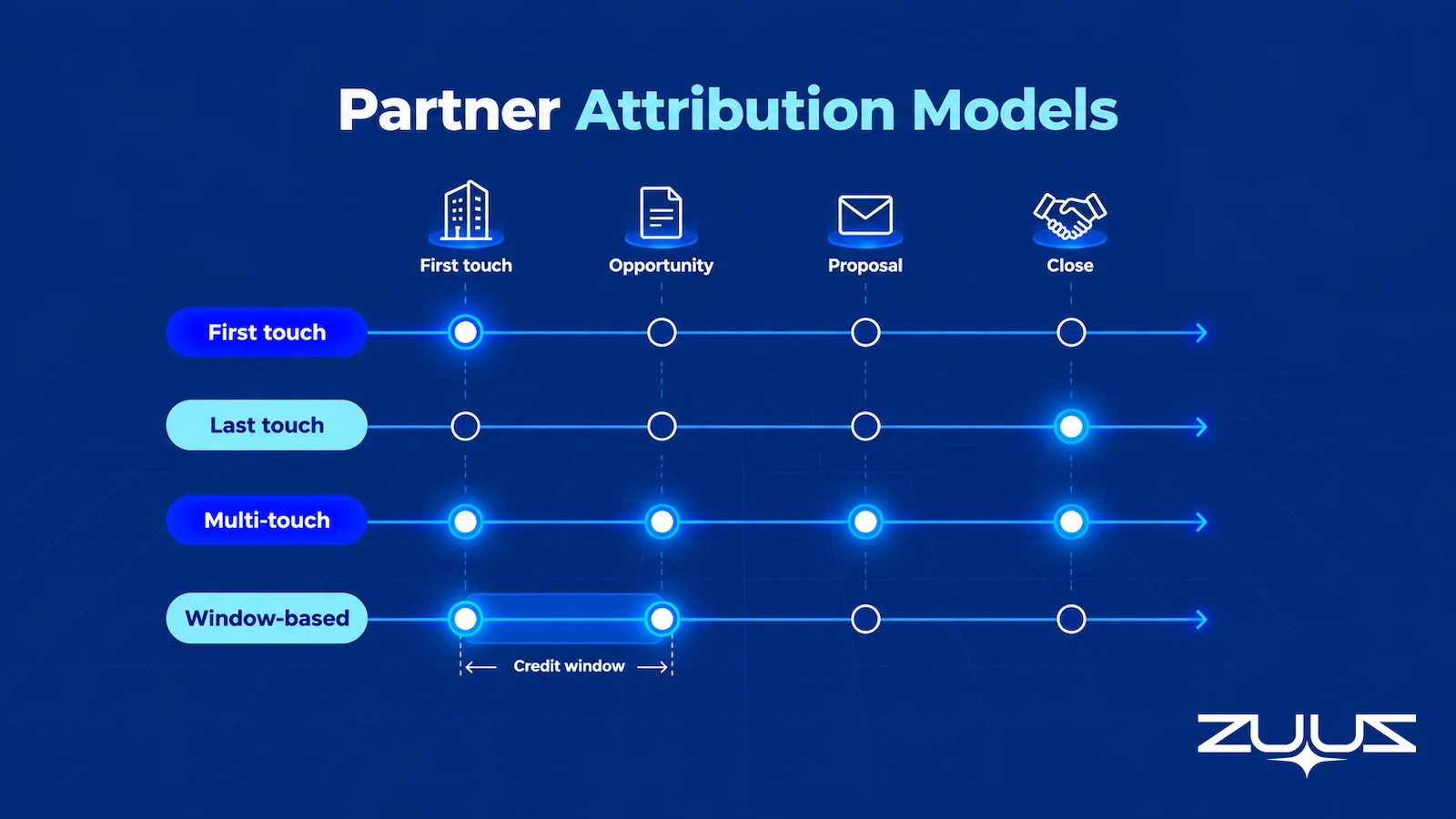
First-touch attribution gives full credit to the partner behind the first qualifying interaction. It is the natural model for partner sourced pipeline because it rewards the partner that found the deal, but it ignores the partner that ran the evaluation. Last-touch attribution credits the partner most involved before close, often the reseller that transacted. It recognizes late-stage work, undervalues origination, and over time can pull partners toward late-stage deals instead of new pipeline.
Multi-touch and window-based models
Multi-touch attribution spreads credit across qualifying partner interactions, equally (linear) or weighted toward recent touches (time decay) or the first and converting touches (position-based). HubSpot's attribution reporting documentation shows how specific these get: its U-shaped model gives 40% each to the first interaction and the lead-conversion interaction and splits the remaining 20% among the rest. Window-based attribution gives one partner exclusive credit for a fixed period after a documented introduction, close to how deal registration protection works.
| Model | How credit works | Best for | Limitation |
|---|---|---|---|
| First touch | All credit to the first qualifying partner interaction | Partner sourced pipeline | Ignores partners who advance or close |
| Last touch | All credit to the last partner interaction before close | Transactional programs | Undervalues origination |
| Multi-touch | Credit split across interactions, equally or weighted | Long, collaborative deals | Weights are hard to explain to partners |
| Window-based | Exclusive credit for a set period after introduction | Overlapping partner territories | Window length is a judgment call |
Choose the model from the question, not from its sophistication. If leadership wants to know whether the channel creates new business, first touch with a strict sourced rule is enough. If the question is which partners help deals close, a simple influence flag usually beats a weighted model. Every model needs dated partner interactions, and that dependency matters more than the choice.
How to Calculate Partner Sourced Pipeline and Revenue
Partner sourced pipeline is the sum of open opportunity amounts that meet the sourced rule in the period. Partner sourced revenue is the sum of closed-won amounts that meet the same rule. Partner influenced revenue is the sum of closed-won amounts with at least one qualifying influence action. Partner-attributed revenue counts each closed-won deal once if it is sourced, influenced or both. Fix the revenue measure and the denominator before reporting. The example below is an illustration with invented deals.
| Deal (illustration) | Value | Sourced by | Influenced by | Counts as |
|---|---|---|---|---|
| Endpoint refresh, 300 seats | $150,000 | MSP A | None | Sourced |
| Firewall upgrade | $80,000 | Direct team | Reseller B (proof of concept) | Influenced |
| Backup expansion | $60,000 | MSP C | Distributor D (special pricing) | Sourced and influenced |
| Licensing renewal | $40,000 | Direct team | None | Not partner-attributed |
Here, partner sourced revenue is $210,000 and partner influenced revenue is $140,000. Added together they make $350,000, more than the $330,000 of total revenue in the table. The deduplicated partner-attributed figure is $290,000. Reporting all three, clearly labeled, stops the QBR argument before it starts.
Why Partner Attribution Disputes Happen
Disputes are where attribution rules run into missing evidence, and almost all of them come down to a date nobody can prove. Channel conflict often shares the same root cause: two parties working one account without a shared record of who was there first.
The account was already active
The direct team opened the opportunity last month; the partner says its introduction email came first. The CRM cannot settle it, because the introduction never became a record.
Two partners claim the same customer
Two MSPs, or a distributor and a reseller, each have an email trail with the customer, and the vendor sees whichever registered first.
The registration does not match the activity
A partner registers and goes quiet while another partner runs the evaluation, or the registration arrives weeks after the first introduction.
Incentives and renewals pull in different directions
Direct reps are paid on deals they own, channel managers on partner contribution, and partners on rebates tied to sourced status, so when evidence is thin the loudest advocate tends to win. That erodes trust faster than a lost rebate, a theme that shows up in partner engagement. Renewals reopen the question all over again.
Settle Attribution on the Record, Not on Memory.
ZUUZ links the partner's contacts and the threads where the deal started to the opportunity in the CRM, so the introduction date is there when the question comes up.
Why the Evidence Lives in Email Threads, Not the PRM
Every attribution rule depends on a dated fact: when the partner introduced the customer, who was on the thread, what the partner did and when. Most programs fail before the report runs, because those facts never become structured data. The PRM records what partners submit and the CRM what someone types; the introduction happens in email, a meeting invite or a LinkedIn message.
The timing problem is built in: the partner emails the vendor rep, they talk for weeks, the rep creates the opportunity once the deal looks real, and the partner registers later. By the time either system has a record, the most important date in the decision is weeks old and lives in two mailboxes.
| Partner activity | Where it first appears | What the PRM sees | What the CRM sees | Attribution result |
|---|---|---|---|---|
| Partner introduces a customer | Email to the vendor rep or partner manager | Nothing until a registration | Nothing until an opportunity | Sourced deal looks direct |
| Partner brings a new decision maker | Meeting invite or email thread | Nothing | A contact, if someone adds one | Influence goes uncredited |
| Distributor arranges special pricing | Vendor, distributor and reseller email chain | Sometimes a pricing request | Rarely anything | Distributor contribution invisible |
| Second partner engages the customer | That partner's email or LinkedIn message | A duplicate registration, if filed | Nothing | Competing claims surface late |
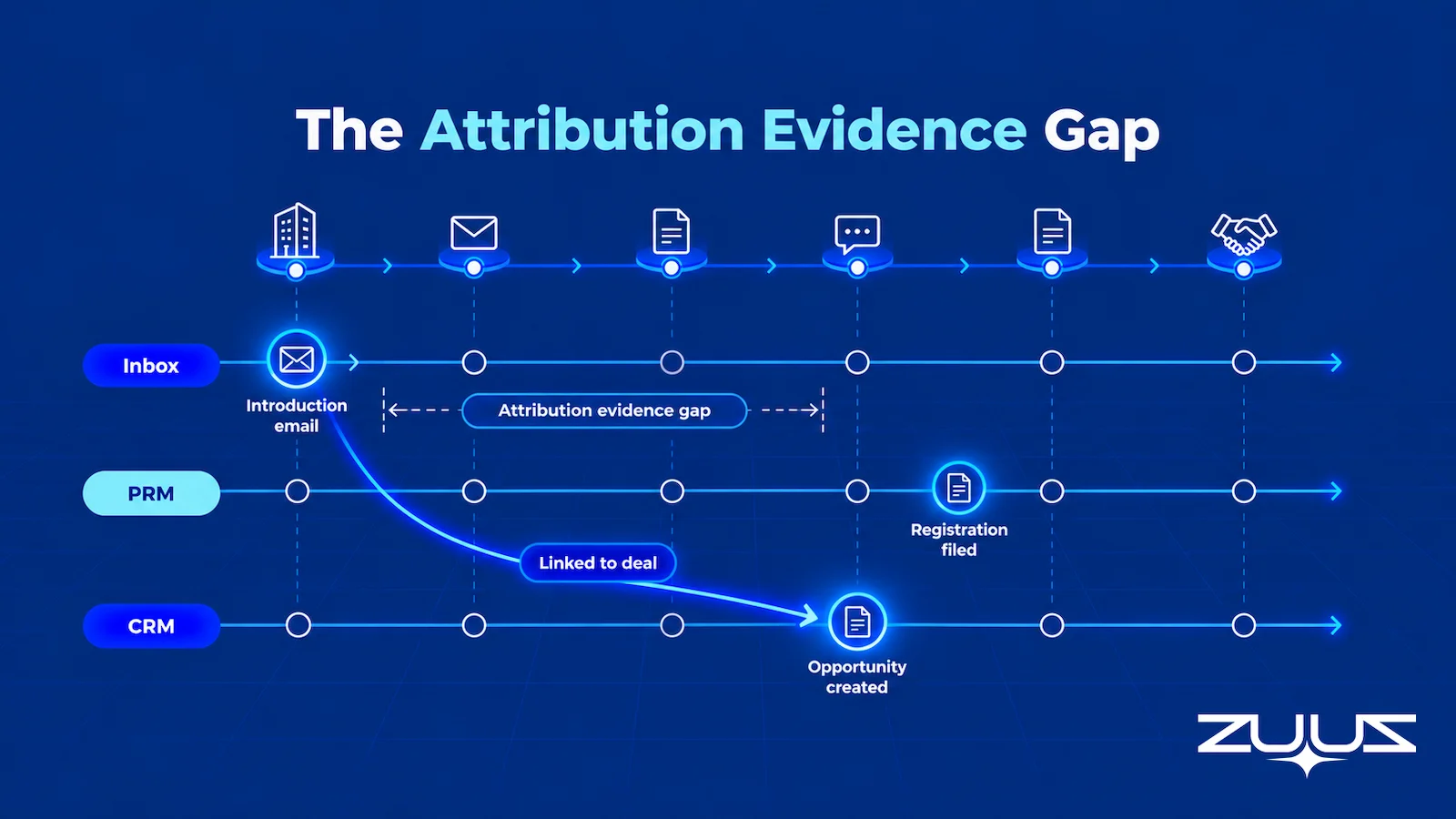
A timestamped email proves an introduction happened, not that it caused the deal, and the rules should say so. Still, a dated thread linked to the right opportunity turns a debate about memory into a review of facts, which is all most disputes need.
The Capture Gap Audit, applied to partner deals
The quickest way to see how much attribution evidence is missing is the Capture Gap Audit, run on partner deals:
- Pick one closed-won and one slipped deal from last quarter.
- Read the full email and message thread end to end and list every fact that mattered.
- Open the CRM record and mark which of those facts appear in a field, not a note.
- The percentage missing is the capture gap; above about a third means the CRM records outcomes, not the deal.
Worked example for a channel team: take a closed-won deal reported as partner sourced. From the threads, list the partner's first email and its date, every partner contact on the thread, the meeting where the partner brought in the customer's decision maker, and the distributor's pricing exchange. If the opportunity has the partner field filled but none of those facts, the sourced claim rests on a label, and the next dispute goes to whoever argues best.
A Partner Attribution Process That Holds Up in Review
A credible process needs agreed rules and evidence captured when it is created, not reconstructed at quarter end.
- Agree the definitions. Get direct sales, channel sales, revenue operations and finance to sign off on one version of the sourced rule, influence rule, window and exclusions.
- Capture involvement when it happens. Link the introduction email, the meeting with the partner present and the pricing exchange to the account and opportunity as they occur.
- Check claims against dates before assigning credit. Compare the partner's first dated involvement with the opportunity creation and registration dates.
- Report three numbers and a quality line. Sourced, influenced and deduplicated partner-attributed revenue, plus the share of partner deals with a dated introduction on record and the count of open disputes.
From an operator's seat
From an operator's seat in IT services and distribution, the pattern Avinash Gujje saw while building Cloud Box Technologies was that attribution arguments are rarely about the model. Teams debate linear against time decay for weeks, then lose the actual dispute because nobody can produce the first email. The part teams do not plan for is turnover: when the vendor rep or the partner's account manager moves on, the introduction leaves with their mailbox. Capturing the thread while the people are still there costs far less than reconstructing it later.
Keep the Introduction on the Deal After People Move On.
ZUUZ reads email, calendar, meetings and LinkedIn messages, and keeps partner threads tied to the account and opportunity in the CRM the team already runs.
PRM, CRM and Conversation Evidence Compared
No single system proves partner contribution on its own. A PRM runs the partner program, a CRM holds the deal and the revenue, and the evidence of who did what sits in conversations.
| Attribution need | PRM | CRM | ZUUZ (on top of the CRM) |
|---|---|---|---|
| Partner tiers, program rules, deal registration | Yes, its core job | Via integration | No, not a PRM |
| Opportunity, stage and revenue | Partial, for registered deals | Yes, the system of record | Keeps the CRM record current from conversations |
| Date the partner first introduced the deal | Registration date only | Opportunity creation date only | Links the introduction thread and its date to the deal |
| Partner contacts involved in the deal | Partner users in the portal | Only if someone adds them | Links partner contacts from threads and meetings to the deal |
| Assigning sourced or influenced credit | Some PRMs offer attribution features | Custom fields and reports | No, the vendor's rules decide credit |
| Change history on the record | Varies | Field history, if enabled | Full change history and one-click rollback |
The last column is deliberately narrow: ZUUZ does not decide credit. It makes sure the facts the decision depends on are on the CRM record. IT vendor channel teams keep the PRM for the program and use ZUUZ for the conversations it never sees.
Partner Deal Evidence: How ZUUZ Writes It to the CRM
ZUUZ is revenue intelligence for the IT channel: MSPs and the vendors, distributors and resellers they work with. It is not a CRM replacement, a PRM or an attribution tool. It reads email, calendar, meetings and LinkedIn messages, finds deal signals such as a partner introducing a customer, a new stakeholder joining a thread or a pricing request, and updates the CRM automatically with full change history and one-click rollback. It works on top of Salesforce, HubSpot, Zoho, Attio and Pipedrive, so the CRM stays the system of record.
For partner deals, that means the MSP account manager's introduction email is linked, with its partner contact, to the account and opportunity in the CRM. When the partner later joins a meeting with the customer's IT director, that meeting lands on the same deal. ZUUZ also drafts replies to partner and customer emails; the rep reviews and sends them.
The results are measured in pipeline. RA Technologies, a US IT services company, surfaced $120K of identified pipeline within 72 hours that two years of HubSpot had never recorded. That is identified pipeline, not revenue, found in the conversations already sitting in the sales mailbox, the same place partner introductions sit. The same capture keeps an IT VAR sales pipeline honest.
ZUUZ does not calculate attribution credit, run partner programs, process registrations, read PSA tickets or produce forecasts. Teams typically see first pipeline within 72 hours, and a full rollout takes one to two weeks.
Which Channel Teams This Fits, and Which It Does Not
This fits an IT vendor channel team whose partner deals move through email, meetings and LinkedIn messages, whose CRM is Salesforce, HubSpot, Zoho, Attio or Pipedrive, and whose disputes keep returning to "who introduced it first." It also fits distributors that need to show their contribution on deals they did not transact alone. It does not fit a vendor looking for a PRM, a rebate engine or a tool that assigns sourced and influenced credit by itself; those decisions belong to the program's rules and the people who own them.
A first step that costs an hour
Before the next QBR, run the Capture Gap Audit on two partner deals. Then connect one channel manager's mailbox in the free 30-day ZUUZ trial: ZUUZ reads the last 90 days, and the gap between what the CRM says about partner involvement and what the threads show becomes visible quickly.
Frequently Asked Questions
What is partner attribution in channel sales?
Partner attribution is the practice of assigning credit for pipeline and revenue to the partners that created or advanced a deal. In channel sales it usually splits into partner sourced revenue, where the partner originated the opportunity, and partner influenced revenue, where the partner materially helped a deal it did not originate. Vendors use it to set partner tiers, rebates and investment.
What is the difference between partner sourced and partner influenced revenue?
Partner sourced revenue comes from opportunities the partner originated, before the vendor was working them. Partner influenced revenue comes from opportunities the partner did not originate but advanced, for example by running a proof of concept or bringing in a decision maker. A deal can be both, so the two totals should not be added together without deduplication.
How do you calculate partner sourced revenue?
Partner sourced revenue is the sum of closed-won deal amounts that meet the program's sourced rule in the reporting period. The rule usually requires a dated partner introduction of a named customer before any vendor opportunity existed. Agree whether the amount is total contract value, annual contract value or first-year bookings, and keep that measure consistent every quarter.
What counts as partner sourced pipeline?
Partner sourced pipeline is the total value of open opportunities that meet the sourced rule: a partner introduced the customer and the need, in writing and with a date, before the vendor had an active opportunity for it. A deal registration on its own does not qualify if the direct team was already working the deal before the partner filed it.
What are the main partner attribution models?
The main partner attribution models are first touch, which credits the partner that originated the deal; last touch, which credits the partner active at close; multi-touch, which splits credit across partner interactions in linear, time-decay or position-based ways; and window-based attribution, which gives one partner exclusive credit for a set period after a documented introduction.
What is the difference between deal registration and partner attribution?
Deal registration is a partner's claim on an opportunity, filed to get pricing protection or exclusivity under the vendor's program. Partner attribution decides which partners get credit for the pipeline and revenue. A registration date can be useful evidence, but it records when the form was filed, which is often weeks after the partner first introduced the customer.
How can a vendor prove a partner introduced a deal if the CRM has no record?
The proof is usually the partner's first email, meeting invite or LinkedIn message to the vendor's team, with its date and the customer named. Search the vendor rep's and partner manager's mailboxes for that thread, then attach it to the opportunity. Linking partner threads to deals as they happen avoids the search entirely.
Is ZUUZ a PRM or a partner attribution tool?
ZUUZ is neither a PRM nor a partner attribution tool. It is revenue intelligence for the IT channel that works on top of Salesforce, HubSpot, Zoho, Attio or Pipedrive. It reads email, calendar, meetings and LinkedIn messages and links partner contacts and threads to the deal in the CRM, so the vendor's own attribution rules run on real evidence.
Is the eBay Partner Attribution app related to channel partner attribution?
No. The eBay Partner Attribution app is a system app that some Android phone owners find on their devices, and it has nothing to do with B2B channel partner attribution. Questions about whether it can be deleted, uninstalled or disabled are best answered by eBay or the phone maker's support pages.