
Partner Engagement: How to Measure and Improve It
Partner engagement shows up in deal registrations, quote requests and replies, not portal logins. A scoring rubric and plan for IT vendor channel teams.

CEO of ZUUZ. He scaled Cloud Box Technologies from 0 to $25M ARR in IT services and distribution before building ZUUZ. Connect on LinkedIn
TL;DR: Partner engagement is how actively a channel partner sells with a vendor, and the honest measure of it is commercial conversation: deal registrations, quote requests, customer introductions, replies, and silence. Portal logins, training completions and MDF claims measure program participation, which is a different thing. ZUUZ is revenue intelligence for the IT channel: it reads partner email, calendar, meetings and LinkedIn messages, links partner contacts to accounts and deals in the CRM, updates the CRM automatically with full change history and one-click rollback, and flags partners whose conversations have gone quiet.
- Partner engagement is commercial behavior, not program activity. A partner can complete every course and still bring no deals.
- The strongest channel partner engagement signals live in email and LinkedIn: deal registrations, quote requests, customer introductions and how fast a partner replies.
- Silence is a signal. A partner that stops asking questions has usually stopped selling, weeks before the quarterly numbers show it.
- The Partner Pulse Check scores five conversation signals over a trailing 90 days, so a channel manager can rank partners on evidence rather than impressions.
- A PRM runs the program and a CRM holds the deals. Neither reads the partner conversations in between, which is the gap a conversation layer fills.
Picture a channel manager at a security software vendor preparing for a quarterly business review. The partner dashboard shows a VAR in the top tier for partner engagement: weekly portal logins, four certified engineers, every MDF dollar claimed. The same morning, a small MSP that rarely opens the portal sends its third quote request of the month, and its owner messages the channel manager on LinkedIn about a customer that wants to standardize on the product. The dashboard ranks the VAR first. The deals are coming from the MSP.
That gap between what partner programs measure and what partners actually do is the subject of this guide, written for the channel teams at IT vendors who manage VARs, MSPs and distributors. It covers what partner engagement means, how to measure it from real conversations, how to plan and improve it, and where PRM, CRM and a conversation layer each fit.
What Is Partner Engagement?
Partner engagement is the degree to which a channel partner actively sells, services and talks with a vendor: registering deals, requesting pricing, bringing in end customers, answering follow-ups and planning accounts together. An engaged partner treats the vendor as part of its revenue. A disengaged partner holds the agreement but sells something else.
Most published definitions describe the vendor's effort to enable, activate and incentivize partners. That describes the inputs. The useful definition for a channel leader is the output: what the partner does in return, which mostly shows up in conversations.
Partner engagement vs partner enablement vs partner performance
The three terms get used interchangeably, and keeping them apart makes measurement much cleaner. Enablement is what the vendor provides: training, certifications, sales content, demo environments and marketing funds. Engagement is how the partner responds to that support through commercial activity. Performance is the lagging result: bookings, revenue and renewals.
Enablement without engagement produces trained partners who do not sell. Engagement shows up months before performance does, which is why it is the number a channel manager can still act on.
Why Channel Partner Engagement Is Hard to See
Channel partner engagement is hard to see because the systems vendors use to run partner programs were built to record program activity, not selling activity. A partner relationship management platform, or PRM, records logins, course completions, deal registration forms, MDF claims and content downloads. Each is a real event and easy to count. None of them captures the conversation in which a partner asks whether a discount is possible on a 300-seat deal.
The stakes are rising. In Forrester's 2025 partner ecosystem research, sixty-seven percent of those surveyed plan for their indirect revenue to grow above or significantly above the previous year's, and most expect their partner counts to grow. More partners and more partner revenue mean more conversations for the same channel team to track.
Where VARs, MSPs and distributors actually engage
A portal sees only what happens inside it, so portal activity measures partner habits as much as partner commitment. The commercial work happens in the channel manager's inbox and LinkedIn messages. A value-added reseller emails to ask for special pricing before a customer meeting. An MSP asks whether the product can be bundled into its managed security offer. A distributor forwards a reseller's question about stock and lead times. Each says more about engagement than a month of portal logs, and almost none reach a report.
Program Activity vs Conversation Signals
The practical shift is to pair each program metric a channel team already tracks with the conversation signal that shows whether the activity turned into selling.
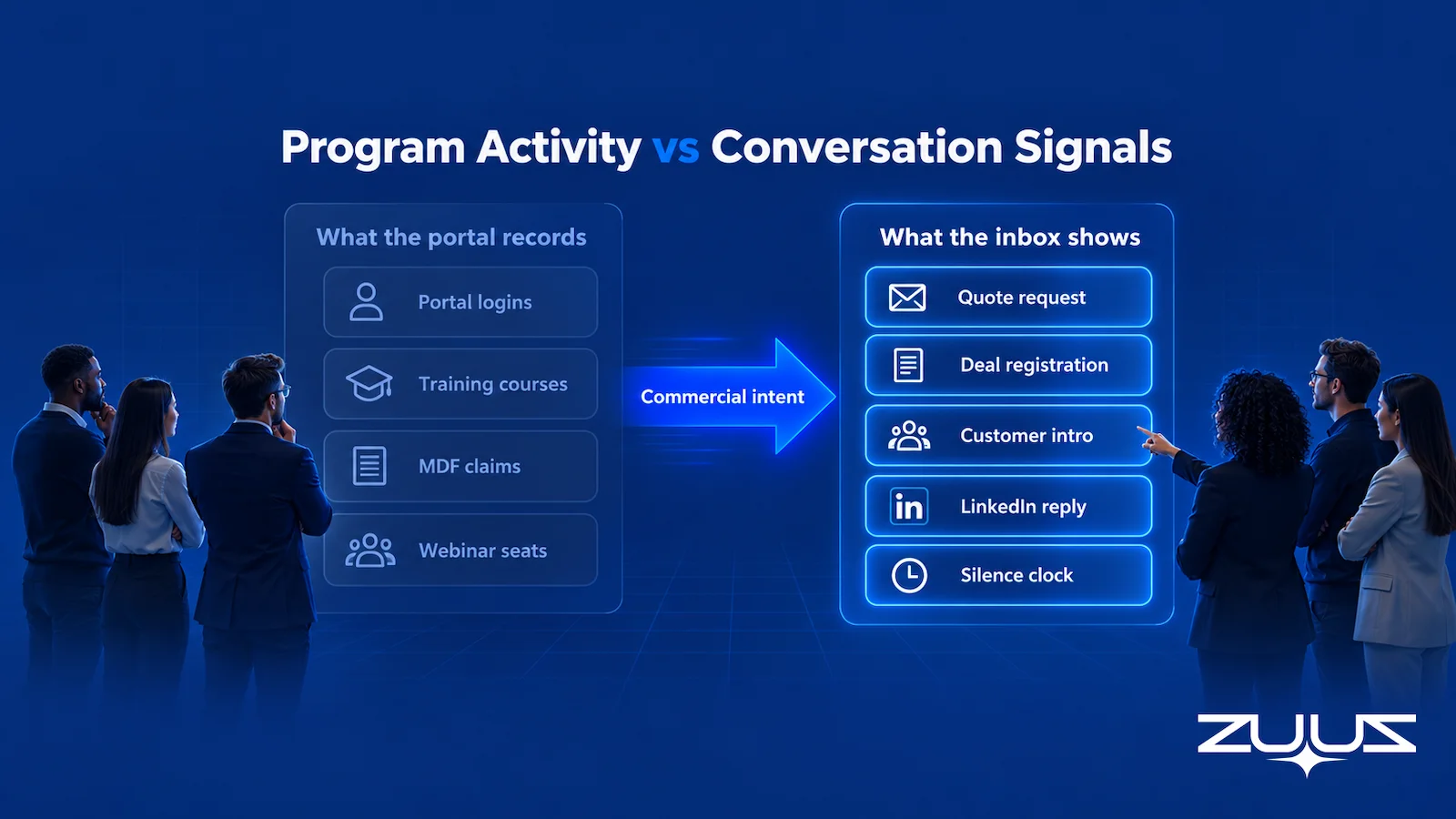
| Program metric | Conversation signal | What the signal reveals |
|---|---|---|
| Portal logins | The partner asks for a quote or special pricing | A live customer opportunity, often before it is registered |
| Training completions | The partner's engineer asks a technical question about a specific customer environment | Training being applied to a real deal |
| MDF claimed | The partner follows up on campaign leads and reports what happened | Whether the funded activity produced conversations |
| Webinar attendance | The partner introduces an end customer or requests a joint call | Willingness to put the vendor in front of its customers |
| Deal registration count | The partner sends updates on registered deals without being chased | Whether registered deals are actually being worked |
| Agreement status: active | Days since the partner last started a commercial conversation | Whether the relationship is still alive or quietly fading |
Program metrics still matter; they just answer a different question. They say whether a partner is equipped. Conversation signals say whether it is selling.
Partner Deals Start in the Inbox, Not the Portal.
ZUUZ reads partner email and LinkedIn messages and writes deal signals to the accounts and deals in the CRM.
How to Measure Partner Engagement With the Partner Pulse Check
The answer to how to measure partner engagement is shorter than most KPI lists suggest: score the five conversation signals that track commercial intent, over a fixed window, and rank partners by the total. ZUUZ calls this the Partner Pulse Check. It runs in four steps.
- Pick a trailing window of 90 days.
- For each partner, collect the evidence from email, LinkedIn messages, meetings and the deal registration log: registrations, quote requests, customer introductions, replies to the channel manager, and the date of the last commercial conversation.
- Score each of the five signals from 0 to 3 using the rubric below, then add them up for a total out of 15.
- Compare the total with the partner's tier and program activity. High program activity with a low pulse means a call this week.
The partner engagement scoring rubric
These thresholds are a starting point, not an industry benchmark. Calibrate them against the last year of partner history, and loosen the counts for distributors, who work through fewer, larger conversations.
| Signal (trailing 90 days) | 0 points | 1 point | 2 points | 3 points |
|---|---|---|---|---|
| Deal registrations submitted | None | 1 | 2 to 3 | 4 or more |
| Quote or pricing requests | None | 1 | 2 to 4 | 5 or more |
| Customer introductions or joint calls requested | None | 1 | 2 | 3 or more |
| Replies to the channel manager | Most go unanswered | Replies after repeated follow-up | Replies within a week | Replies within two business days, often unprompted |
| Days since last commercial conversation | More than 60 | 31 to 60 | 15 to 30 | 14 or fewer |
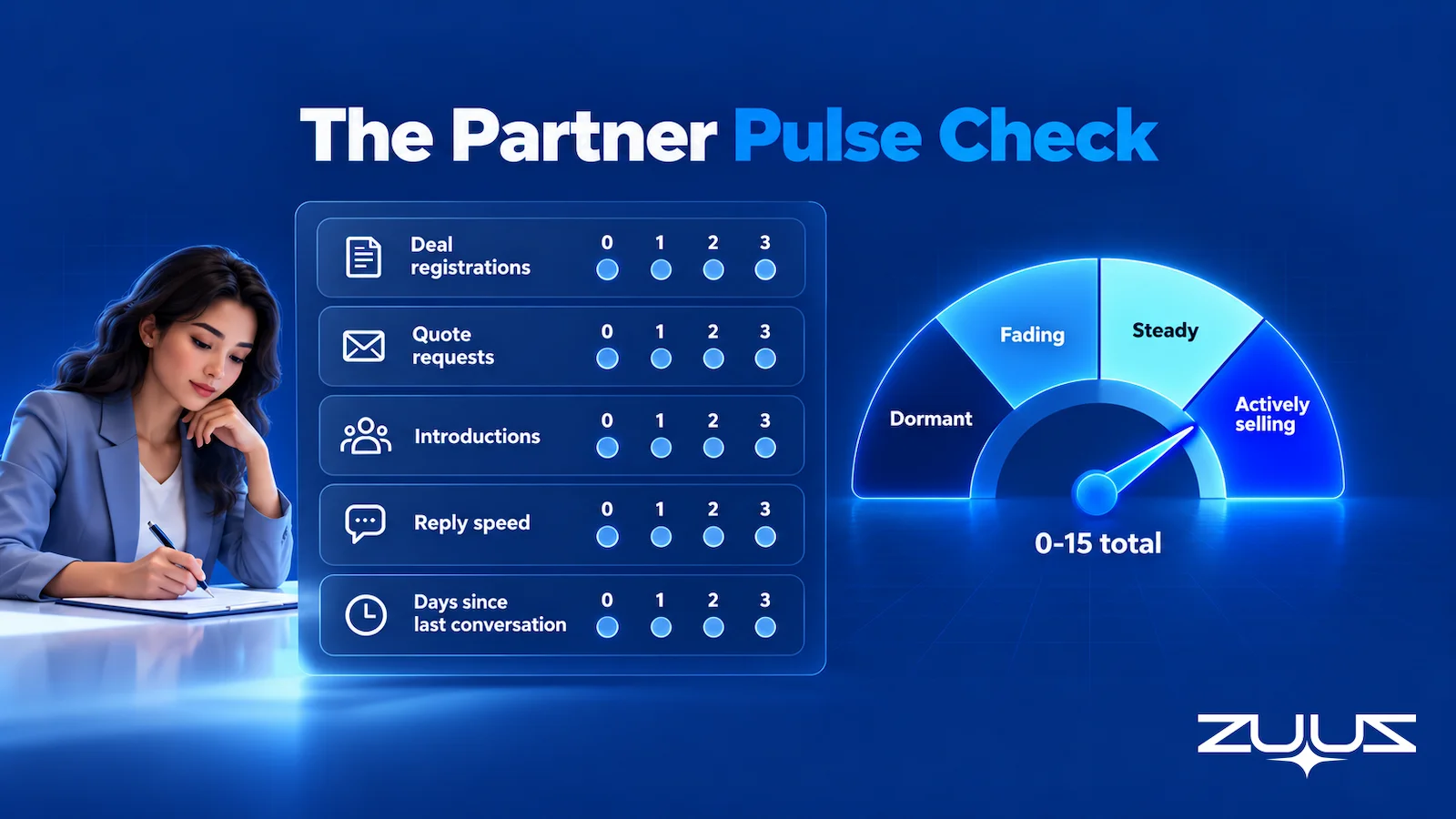
Two rules keep the score honest. Count only commercial conversations, since an invoice question is not a quote request. And do not reward volume: twenty emails about one stuck deal are not five times the engagement of four.
Reading the total
| Total | Engagement level | Suggested action |
|---|---|---|
| 12 to 15 | Actively selling | Protect response times, plan joint accounts, look for expansion into new product lines |
| 8 to 11 | Steady | Find the one missing signal, usually introductions, and agree a specific next account to work together |
| 4 to 7 | Fading | Call the partner owner, ask what changed, and check for a competing vendor or a lost champion |
| 0 to 3 | Dormant | Decide between a structured re-engagement offer and moving the partner to a lower-touch tier |
As a worked illustration, picture the VAR from the opening scene: zero quote requests, one registration, slow replies and a last commercial conversation 40 days ago. It scores 1 + 0 + 0 + 1 + 1 = 3 and lands in Dormant despite its portal record. The MSP scores 1 + 3 + 2 + 3 + 3 = 12 and lands in Actively selling, which is the opposite of the dashboard's ranking.
The score is a prioritization tool, not a prediction. It says where a channel manager's next hour is best spent, not how much revenue a partner will bring.
How to Build a Partner Engagement Plan
A partner engagement plan turns the score into actions with owners. It does not need to be long, but it needs to be segmented, because VARs, MSPs and distributors engage for different reasons and on different rhythms.
- Segment partners by business model and pulse. Group VARs, MSPs and distributors separately, then split each group by Partner Pulse Check tier.
- Set one commercial goal per segment. Registered deals per quarter for VARs, managed customers running the product for MSPs, active resellers buying through them for distributors.
- Agree a contact cadence for each tier. A weekly deal check for partners actively selling, a monthly account review for steady ones, and a direct call within two weeks for fading ones.
- Name the internal owner for every partner. The channel account manager owns the relationship and a sales engineer owns technical questions.
- Review the plan every 30 days against the pulse. A plan reviewed only at the quarterly business review reacts a quarter late.
For VAR partners, the plan works best when it is tied to the partner's own pipeline. A guide to the IT VAR sales pipeline shows what a reseller's deal flow looks like from the inside.
The Partner Engagement Process, Week to Week
The partner engagement process is the plan in motion: a weekly loop that keeps the score current and turns signals into action.
On Monday, the channel manager reviews last week's signals: quote requests, registrations, introductions and unanswered messages. Every quote request gets an answer within one business day, the cheapest engagement lever a vendor has. Any registration with no conversation for two weeks gets a direct question to the partner, and the Partner Pulse Check is rerun at month end.
The process also needs a rule for ownership. When two partners ask about the same end customer in separate threads, the channel manager needs to see both before approving either registration. Channel conflict usually starts in two inboxes that nobody has compared.
Re-engaging partners that have gone quiet
A partner that drops from Steady to Fading has usually changed something: a new vendor, a departed champion, a lost deal, or a shift in what its customers buy. Start the re-engagement call with that question rather than a new incentive. Incentives fix a margin problem; they rarely fix a relationship problem. If the business has moved on, a lower-touch tier frees time for partners still selling.
See Which Partners Went Quiet Before the Quarter Closes.
ZUUZ links partner contacts to accounts and deals in the CRM and flags partners whose conversations have stopped.
How to Improve Partner Engagement
How to improve partner engagement comes down to making it easier and more profitable for a partner to sell the product than to sell the alternative. The tactics below target the conversation signals in the rubric directly.
- Answer quote requests the same day. A partner in front of a customer remembers which vendor answered first.
- Make deal registration take minutes. If registering requires a long portal form, partners email the channel manager instead. Accept registrations by email and make sure they reach the CRM.
- Build joint account plans around named customers. A plan that lists five end customers produces introductions. A plan that lists revenue targets produces a spreadsheet.
- Tie enablement to live deals. Offer a sales engineer on the partner's next customer call instead of another generic course.
- Personalize by business model. An MSP cares about recurring margin, a VAR about deal margin and protection, a distributor about volume and reseller demand.
- Protect registered deals. Few things end partner engagement faster than a registered deal closed by the vendor's direct team.
- Recognize selling, not participation. Tie tier benefits and spiffs to registrations, introductions and closed deals rather than logins.
Microsoft's co-sell overview in Partner Center is a useful model for how a vendor and its partners share referrals and work deals together.
What the Partner Side of the Table Sees
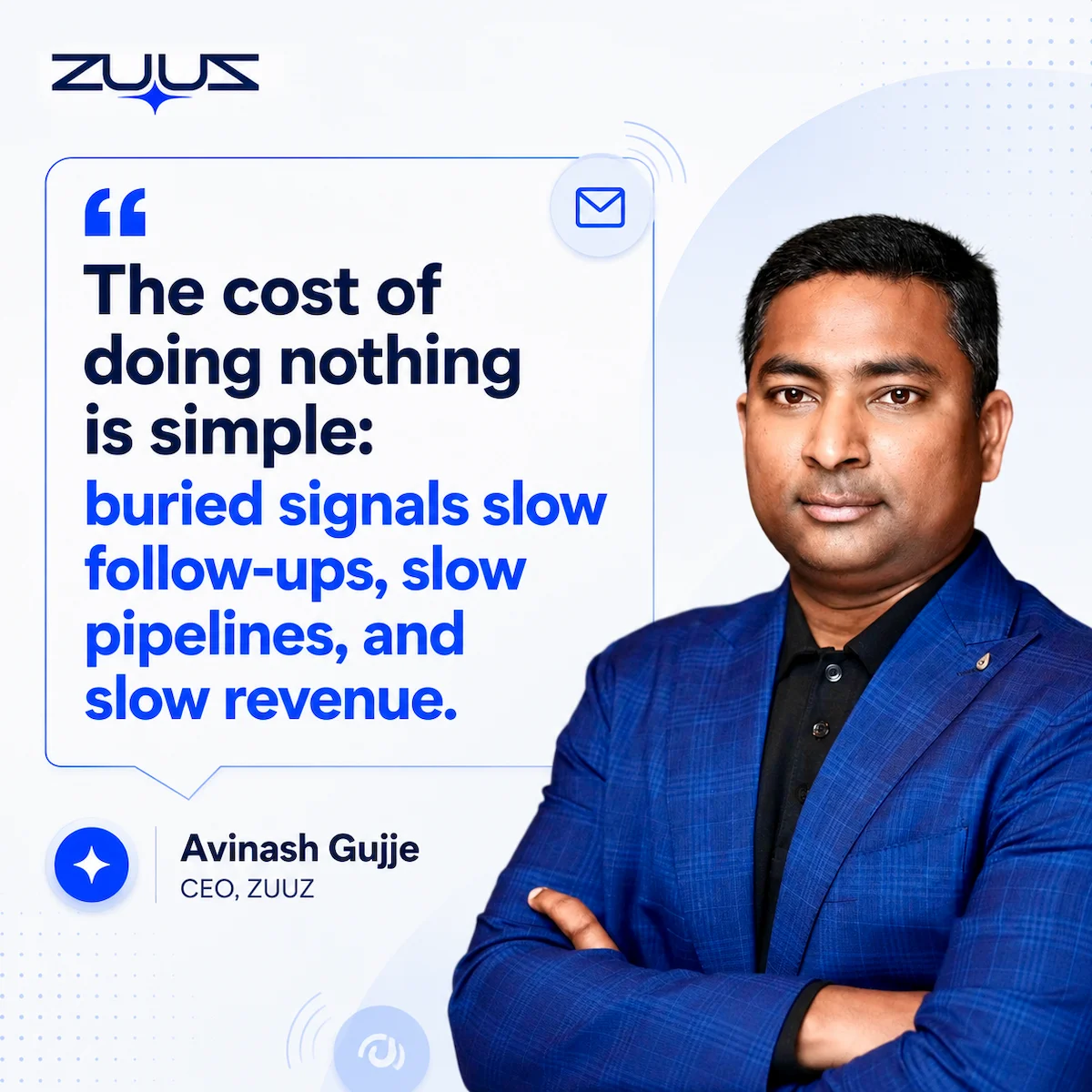
Avinash Gujje spent the years he scaled Cloud Box Technologies from 0 to $25M ARR on the partner side of vendor programs, as the IT services and distribution business that vendors were trying to engage. From that seat, the pattern was consistent. The vendors that won more of the partner's attention were rarely the ones with the best portal or the richest MDF. They were the ones whose channel manager answered a pricing email before the customer meeting, and who remembered the last conversation without being reminded.
The part vendors tend to miss is that partners rank vendors too, mostly on responsiveness. A partner juggling a dozen vendors routes the next opportunity to whoever made the last one easy, and that decision shows up only as a partner that slowly stops asking questions.
The other lesson from the partner side is that silence comes before churn by a long way. A partner that has moved its attention elsewhere still renews its agreement, still logs in now and then, and still attends the annual event. The only early evidence is that the commercial conversations stop. By the time the bookings drop, the decision was made months earlier in an inbox.
Partner Engagement Tools Compared
Three kinds of system touch partner engagement, and each answers a different question. Oracle's documentation on partner relationship management and channel sales is a good reference for how a PRM and a sales system divide the work between program management and opportunities.
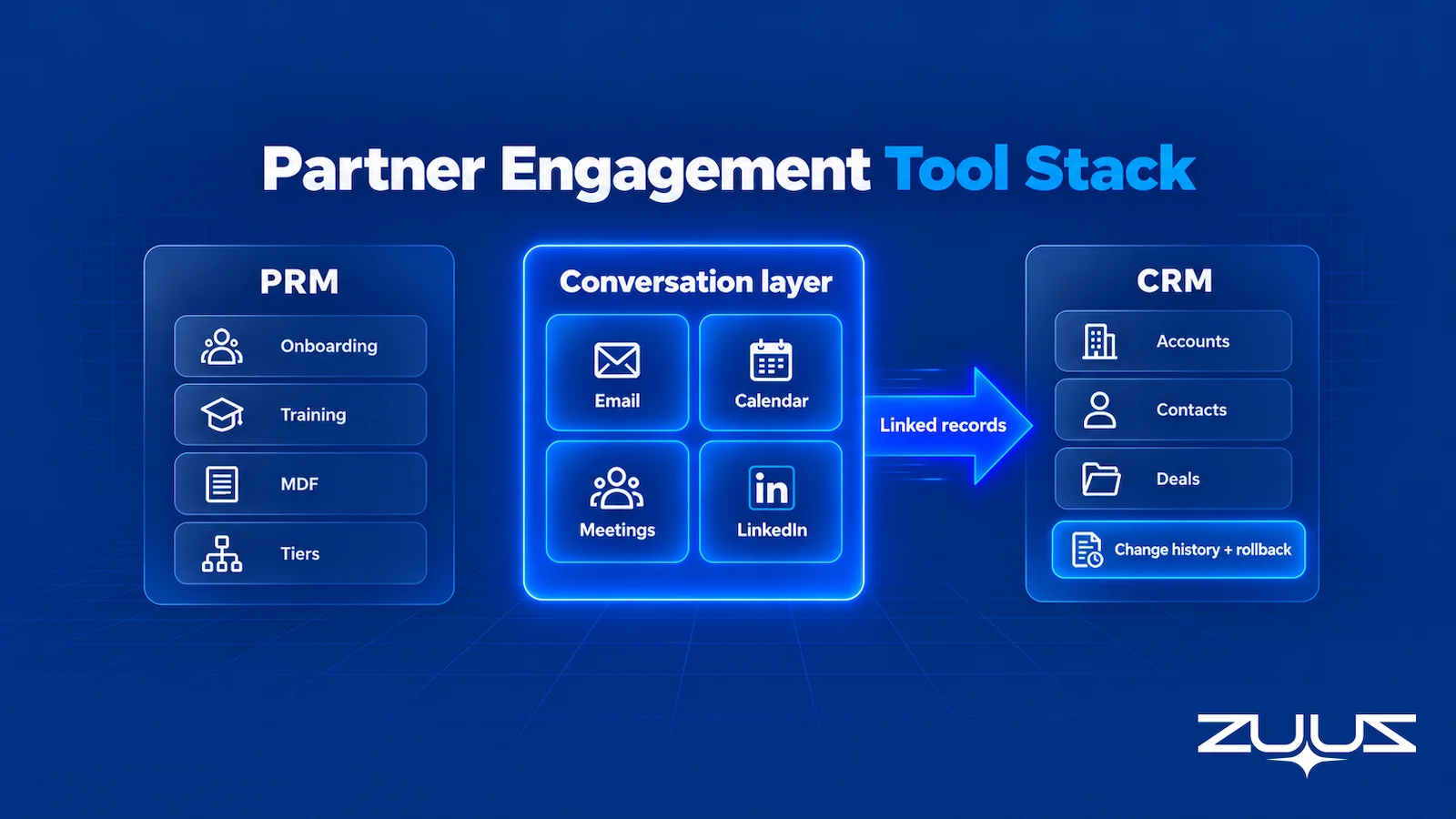
| Job | PRM | CRM | ZUUZ (conversation layer) |
|---|---|---|---|
| Built for | Running the partner program | Tracking accounts, contacts and deals | Turning partner conversations into CRM records |
| Onboarding, training, MDF, tiers | Primary job | Not its job | Not its job |
| Deal registration | Form-based workflow and approval | Holds the resulting opportunity | Picks up registrations and deal details sent by email and writes them to the deal |
| Partner email and LinkedIn messages | Not read | Only what someone logs | Reads them and links partner contacts to accounts and deals |
| Quote requests and introductions | Only if submitted in the portal | Only if logged | Captured from the conversation and written to the CRM |
| Partners that have gone quiet | Visible as low logins, which is a weak proxy | Visible only if activity was logged | Flags partner accounts where commercial conversation has stopped |
| System of record | For the program | For pipeline | Neither; it updates the CRM with full change history and one-click rollback |
In HubSpot, for example, contacts, companies and deals can be associated with each other, so a partner contact can sit on both the partner's company record and the end customer's deal. The hard part is never the data model. It is getting the conversation into it.
Keep the PRM and the CRM. Add What Neither Reads.
ZUUZ runs on top of Salesforce, HubSpot, Zoho, Attio or Pipedrive, with first pipeline within 72 hours.
Partner Conversations: How ZUUZ Writes Them to the CRM
ZUUZ is revenue intelligence for the IT channel: MSPs and the vendors, distributors and resellers they work with. It is not a PRM and not a CRM. It is the layer that reads the partner conversations the PRM and the CRM never see. ZUUZ reads email, calendar, meetings and LinkedIn messages, finds the deal signals in them, and updates the CRM automatically, with full change history and one-click rollback.
For a channel team at an IT vendor, that means an MSP's quote request lands on the right account, a partner's customer introduction attaches to the right deal, and a registration sent by email reaches its opportunity. Partner contacts are linked to the accounts and deals they work on, and ZUUZ flags partner accounts whose conversations have gone quiet. ZUUZ does not score partners; the channel manager makes that call with the evidence in front of them.
ZUUZ drafts replies to partner messages, and the channel manager reviews and sends them. It works with Salesforce, HubSpot, Zoho, Attio and Pipedrive, and for MSPs it syncs won customers with ConnectWise PSA. Nobody on the channel team changes how they work.
RA Technologies, a US IT services company, surfaced $120K of identified pipeline within 72 hours that two years of HubSpot had never recorded. The deals were already in the conversations; they had never become records, the same gap a channel team faces with its partners.
A first step that takes one mailbox
Before the next quarterly business review, connect one channel manager's mailbox. ZUUZ reads the existing partner conversations and writes what it finds to the CRM, showing the gap between the partner dashboard and the partner inbox. First pipeline usually appears within 72 hours, a full rollout takes one to two weeks, and the trial is free for 30 days. Every change is logged and can be rolled back in one click. Start the free 30-day trial.
Which Channel Teams This Fits, and Which It Does Not
This approach fits an IT vendor whose partners do most of their commercial talking in email and LinkedIn, whose CRM is Salesforce, HubSpot, Zoho, Attio or Pipedrive, and whose channel managers each cover more partners than they can read threads for. The same logic applies one step down the channel, to value-added resellers managing their own vendor and customer conversations.
It does not replace a PRM; onboarding, certification tracking, MDF and tiering still need one. It also adds little for a vendor with a handful of partners the channel manager talks to every day.
Either way, the Partner Pulse Check works with an inbox and an hour. Run it on the top 20 partners, compare the result with the portal ranking, and look closely wherever the two disagree. That is where channel partner engagement is being misread.
Frequently Asked Questions
What is partner engagement?
Partner engagement is how actively a channel partner sells and works with a vendor: registering deals, requesting quotes, introducing end customers and answering follow-ups. It differs from enablement, the support the vendor provides, and from performance, the revenue result. Engagement is the leading indicator a channel manager can still influence.
How do you measure partner engagement?
Measure partner engagement by scoring commercial conversation signals over a fixed window, such as 90 days. Count deal registrations, quote requests, customer introductions, reply speed and days since the last commercial conversation, then rank partners by the total. Portal logins and training completions show whether a partner is equipped, not whether it is selling.
What are the best KPIs for channel partner engagement?
The best channel partner engagement KPIs track commercial intent: deal registrations submitted, quote or pricing requests, customer introductions, joint calls requested, reply time to the channel manager, and days since the last commercial conversation. Certified staff and MDF use are supporting KPIs. Revenue and bookings lag engagement, so they confirm trends rather than reveal them.
How can I improve channel partner engagement?
Improve channel partner engagement by making selling easier: answer quote requests the same day, accept deal registrations by email, protect registered deals from the direct team, and build joint account plans around named customers. Reward registrations and introductions instead of logins. Responsiveness is the cheapest lever, and partners notice it first.
What should a partner engagement plan include?
A partner engagement plan should include partner segments by business model and engagement tier, one commercial goal per segment, a contact cadence per tier, a named internal owner for every partner, and a monthly review against the engagement score. A one-page plan reviewed every 30 days does more than a detailed plan reviewed once a quarter.
What is the partner engagement process?
The partner engagement process is the recurring loop that keeps engagement visible and acted on. Each week, the channel manager reviews new partner signals, answers quote requests within a day and checks registered deals that have gone quiet. Each month, the score is rerun and fading partners get a direct call rather than another campaign.
How do you know when a channel partner has disengaged?
A channel partner has usually disengaged when its commercial conversations stop: no quote requests, no new registrations, slower replies and no introductions for 60 days or more. Portal logins often continue after the partner has moved on. Silence in email and LinkedIn is the earliest reliable sign, and it appears well before bookings fall.
Can partner engagement be measured without a PRM?
Partner engagement can be measured without a PRM, because the strongest signals live in email, LinkedIn messages, meetings and the deal registration log. A channel manager can run a 90-day scoring rubric from an inbox and a CRM. A PRM adds program data such as training and MDF, which is useful context but not the core of commercial engagement.
What is the difference between a PRM and a CRM for partner engagement?
A PRM runs the partner program: onboarding, training, deal registration forms, MDF and tiers. A CRM holds the accounts, contacts and deals that partners help close. Neither reads the email and LinkedIn conversations where partners ask for pricing or introduce customers, so most commercial engagement reaches the CRM only if someone logs it by hand.
Is ZUUZ a PRM or a CRM?
ZUUZ is neither a PRM nor a CRM. It is revenue intelligence for the IT channel that reads partner email, calendar, meetings and LinkedIn messages, links partner contacts to accounts and deals, and updates Salesforce, HubSpot, Zoho, Attio or Pipedrive automatically with full change history and one-click rollback. The PRM keeps running the program and the CRM stays the system of record.