
What Is Revenue Intelligence? Definition and IT Channel View
What is revenue intelligence? A definition, how it evolved past call recording, how it differs from conversation intelligence, and the IT channel view.

CEO of ZUUZ. He scaled Cloud Box Technologies from 0 to $25M ARR in IT services and distribution before building ZUUZ. Connect on LinkedIn
TL;DR: What is revenue intelligence? It is the practice, and the software category, of capturing deal signals from customer conversations, tying them to accounts and deals, and giving revenue leaders a pipeline they can trust. It grew from CRM reporting to call recording to signal capture across email, calendar, meetings and LinkedIn. In the IT channel, one deal spans a vendor, a distributor, a reseller or MSP and a customer, mostly over email. ZUUZ reads those conversations and updates the CRM automatically, with full change history and one-click rollback.
- Revenue intelligence turns emails, meetings, calls and messages into structured facts about accounts and deals.
- The category evolved in three steps: CRM reporting, then call recording and conversation intelligence, then signal capture across every channel where deals move.
- It is not a CRM replacement, a forecasting engine or an outbound tool. It makes the record underneath them complete.
- Conversation intelligence analyzes recorded calls. Revenue intelligence is broader, which matters most in email-heavy sales.
- An IT channel deal involves four companies and runs mostly over email, so call-only tools see a small slice of what actually moves it.
- The Pipeline Truth Test checks whether the top deals in a pipeline rest on dated written evidence or on a rep's assurance.
Picture a channel account manager at an IT distributor before a Monday pipeline review. The CRM shows a reseller's firewall refresh deal at proposal stage, unchanged for three weeks. In her inbox, the reseller has already written that the end customer pushed the project to next quarter, and a second reseller has registered interest in the same account. None of it is in the record, so the review discusses a deal that no longer exists as described. (This is an illustration, not a specific client.)
That gap between the system and the conversations is what revenue intelligence exists to close. This guide defines it, traces how it evolved, sets out what it does and does not do, and compares it with conversation intelligence, RevOps software and forecasting. It then looks at the IT channel, where one deal crosses four companies and most signal never touches a recorded call.
What Is Revenue Intelligence?
Revenue intelligence is the practice of capturing the signals that customer-facing teams generate while they sell, connecting those signals to the right accounts, contacts and deals, and presenting the result as a pipeline that leaders can rely on. Revenue intelligence software is the category of tools that does this work, so leaders do not depend on what a rep remembered to type.
Put more simply, a CRM stores what someone chose to record, and revenue intelligence fills in what actually happened. A champion going quiet, a procurement contact joining a thread or a renewal date being questioned all matter to the number, and they usually live in inboxes long before they reach a CRM field.
Most definitions on the first page of search describe revenue intelligence as using data and AI to find risks and opportunities in the pipeline. That is accurate, and it hides the hard part: the insight is only as good as the data underneath, which is usually incomplete.
What counts as revenue intelligence data
There are two kinds of input. The structured record covers CRM opportunities, stages, amounts, close dates and contacts. Unstructured activity covers email threads, calendar invitations, meeting transcripts, call recordings and LinkedIn messages. The category exists because the second holds most of the truth and the first holds most of the reporting.
How Revenue Intelligence Evolved, From CRM Reports to Every Conversation
Sales leaders have always wanted to know which deals are real, and each generation of tooling answered with the data it could reach. The three eras explain why two vendors can both claim the label and do very different things.
The first era, CRM reporting
The first answer was the CRM report. Pipeline dashboards, stage conversion rates and win rates were built from whatever reps entered. The analysis was never better than the inputs, and reps entered the minimum needed to satisfy a manager.
The second era, call recording and conversation intelligence
The second answer was to record the conversations themselves. Conversation intelligence tools record, transcribe and analyze sales calls and video meetings, flagging competitor mentions, pricing questions, talk ratios and next steps. For inside sales teams that live on calls, this was a real step forward, and much of today's category grew out of it.
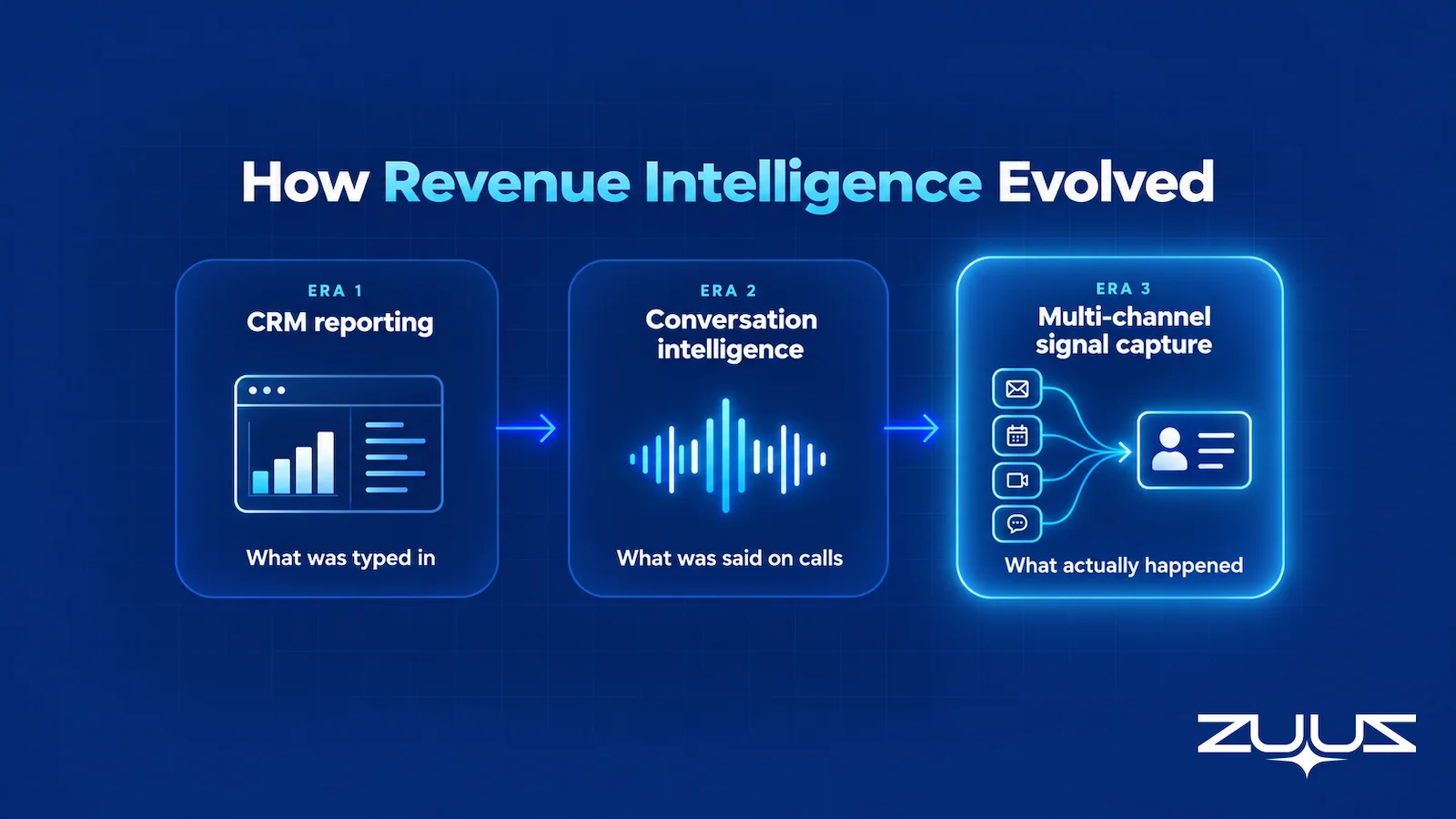
The third era, signal capture across email, calendar, meetings and LinkedIn
The third answer widens the lens to every channel where a deal actually moves. Email threads carry commitments, objections, pricing and new stakeholders, calendar invitations show who is really involved, and meeting transcripts and LinkedIn messages fill in the rest. Modern platforms capture signal from all of these and write it back to the CRM, so the record catches up with the conversation.
| Era | Main data source | Question it answers | Blind spot |
|---|---|---|---|
| CRM reporting | Fields reps typed into the CRM | What does the pipeline report say? | Anything nobody logged |
| Conversation intelligence | Recorded calls and video meetings | What was said on the calls? | Email, messages and every deal that is not run on calls |
| Multi-channel signal capture | Email, calendar, meeting transcripts, LinkedIn messages and the CRM | What is actually happening in each account and deal? | Signal kept in channels that are never connected |
How Revenue Intelligence Software Works
Under different brand names, most platforms run the same five steps.
- Connect the sources. It connects to the CRM and to the sales mailbox, calendar, meeting platform and messaging.
- Find the signal. It separates a budget comment, a new decision-maker or a timeline change from routine traffic.
- Match it to the record. Each signal is tied to the right contact, account and opportunity, which is harder than it sounds when one company appears under three email domains.
- Structure it. The signal becomes a field value, a stage change, a new contact, a next step or an activity, rather than a note nobody reads.
- Write it back with controls. Updates land in the CRM with a change history, so a sales leader can see what changed, why, and undo it if needed.
Steps three and five are where tools diverge. Signal left in a separate dashboard creates a second version of the truth, and CRM writes without an audit trail create a trust problem.
A Dashboard Is Only as Honest as the Record Underneath It.
ZUUZ reads email, calendar, meetings and LinkedIn messages and keeps the CRM current, with every change logged and reversible.
What Revenue Intelligence Does and Does Not Do
Done well, it surfaces opportunities that exist in conversations but not in the CRM, keeps deal activity current without manual logging, and flags follow-ups and renewal conversations before they go cold. It cuts the time reps spend on data entry and gives managers, RevOps and account teams the same picture in handoffs and pipeline reviews.
It also has limits that vendors do not always state. It does not replace the CRM, which stays the system of record. It does not guarantee more revenue; it makes the revenue picture accurate, a precondition for good decisions rather than a substitute. It does not necessarily include forecasting, deal scoring or coaching, though some platforms bundle them. And a person should stay in charge of anything a buyer will read.
The useful test for any claim is which data the tool reads. A platform that analyzes recorded calls cannot describe the email in which the customer moved the project to next quarter, because it never saw it.
Revenue Intelligence vs Conversation Intelligence vs RevOps Software vs Forecasting
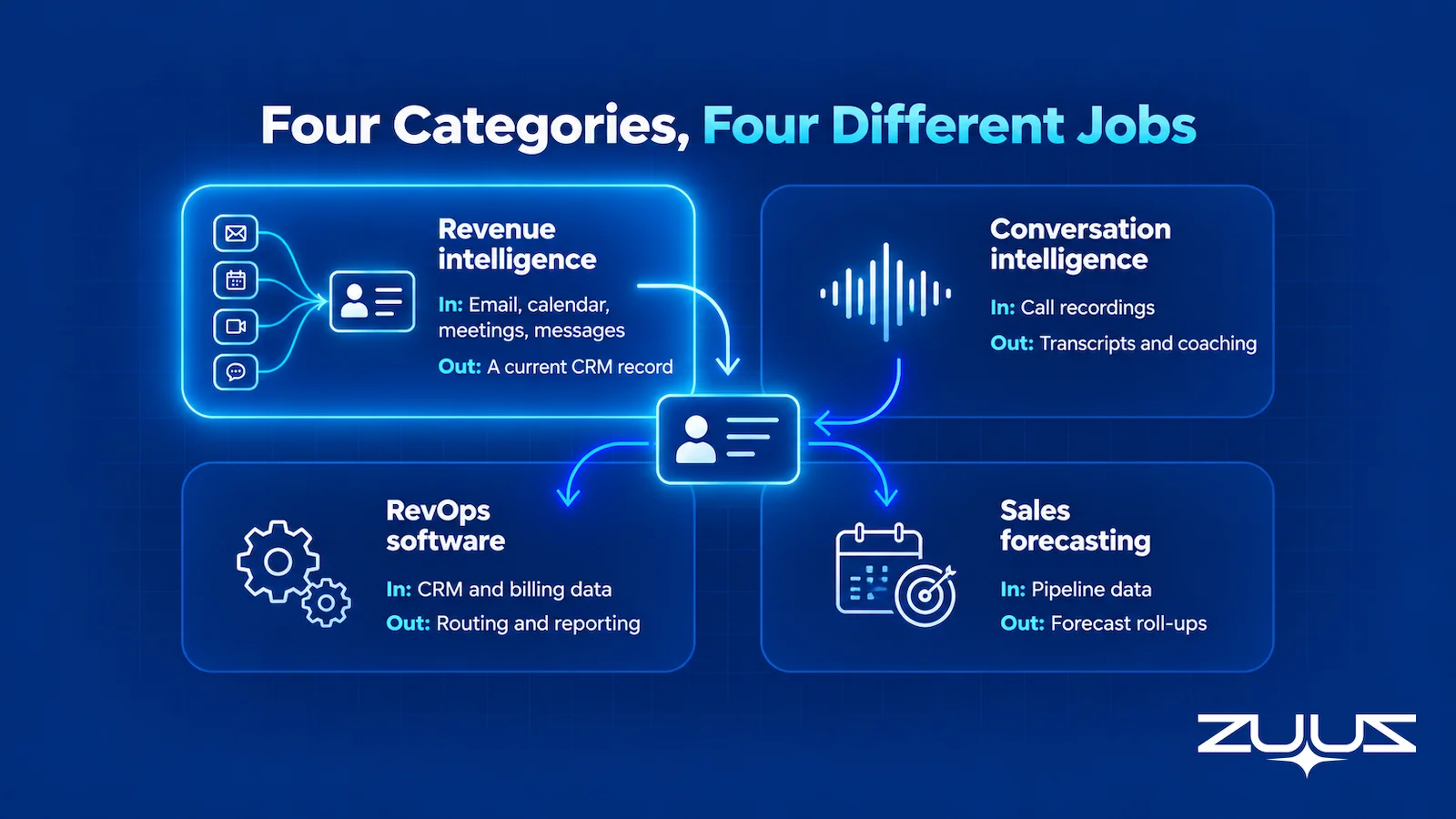
Vendor marketing uses these four terms interchangeably, but they describe different jobs. Many products touch more than one, and the table shows where each starts and stops.
| Category | Core job | Main inputs | Typical output | Where ZUUZ sits |
|---|---|---|---|---|
| Revenue intelligence | Capture and structure deal and account signal | Email, calendar, meetings, messages, CRM | A current CRM, surfaced opportunities, at-risk deals | ZUUZ's category, built for the IT channel |
| Conversation intelligence | Analyze recorded calls and video meetings | Call and meeting recordings | Transcripts, call summaries, coaching insights | Reads meeting transcripts as one source; not a call recorder or coaching tool |
| RevOps software | Run the revenue process across teams | CRM, marketing automation, billing | Routing, automation, reporting, territories | Feeds RevOps a cleaner record; does not replace RevOps tooling |
| Sales forecasting | Predict the revenue number for a period | Pipeline data, history, rep and manager calls | Forecast roll-ups and predicted outcomes | Does not forecast; keeps the underlying record accurate |
The ZUUZ page on conversation intelligence covers where call analysis fits beside email-first capture, and the guide to revenue operations software covers the RevOps stack, often called revenue operations and intelligence software.
Revenue intelligence vs sales intelligence
Sales intelligence provides external prospect data, such as firmographics, contacts and intent, used to decide whom to approach. Revenue intelligence works on relationships already in motion, using the company's own conversations. One finds the next account; the other explains what is happening inside current ones.
Why Revenue Intelligence Matters to Sales and RevOps Leaders
The case for revenue intelligence rests on two well-documented problems: reps spend real time on data entry, and leaders do not trust the data that results. In Salesforce's State of Sales, 7th edition, sales professionals report spending 40% of an average workweek selling and 60% on other work, with manually entering data accounting for 13% of the week. The same report finds that 46% of sales professionals using AI agents say data quality issues hurt their sales.
The trust problem is older and just as stubborn. Salesforce data republished in the State of Sales, 6th edition found that only 35% of sales professionals completely trust the accuracy of their organization's data. A pipeline review built on data that two-thirds of the room doubts is a negotiation, not an analysis.
The organizational trend points the same way. In 2021, Gartner predicted that 75% of the highest-growth companies in the world would deploy a RevOps model by 2025, naming functional silos as a barrier to growth. RevOps teams inherit the data problem directly.
Revenue Intelligence in the IT Channel
Most content on this topic assumes a direct sales team with its own reps, buyers and recorded calls. The IT channel works differently, and that changes what has to be captured.
One deal, four companies
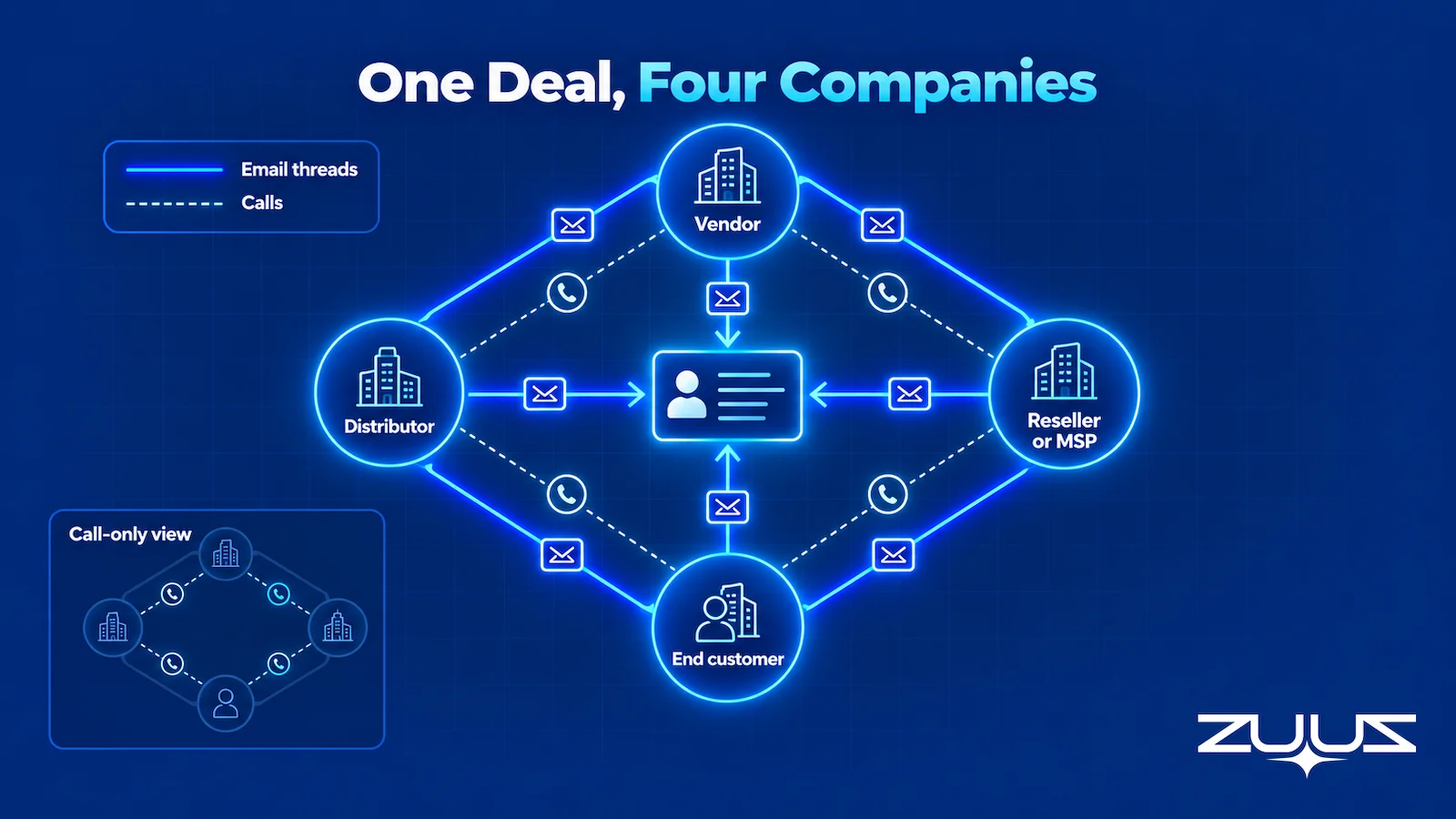
A typical IT channel deal involves a vendor that makes the product, a distributor that holds the stock, credit and pricing programs, a reseller or MSP that owns the customer relationship, and the end customer. Each keeps its own CRM, or none. The registration lives in the vendor's portal, the quote in the distributor's system and the customer conversation in the reseller's inbox, the pattern the guide to channel sales describes.
Partner selling is no longer a niche motion. In the same Salesforce State of Sales, 7th edition, 94% of sales professionals said their company uses partner selling in 2025, up from 86% in 2024, and 89% said partner selling is increasingly important to hitting revenue targets. As more revenue flows through partners, more signal sits in conversations between companies, and each company brings its own group: Harvard Business Review describes "a swelling raft of stakeholders" in each B2B purchase.
Why call-only tools miss most of the signal
Between those four parties, most of the work happens in writing. Pricing requests, registration confirmations, quote revisions, lead-time questions and renewal reminders travel by email, with LinkedIn messages and short meetings filling the gaps. A tool that records calls sees a small slice of that traffic, and a tool that reads one company's CRM sees only what its reps logged.
That is why capture in the IT channel starts with email: the B2B buying signals that matter most here, such as a new timeline, a new stakeholder or a competing registration, usually appear first in a written thread.
| Party | Signal it holds | Where that signal usually appears |
|---|---|---|
| IT vendor | Deal registration, special pricing, partner engagement | Partner portal, email with partner managers and distributors |
| Distributor | Quotes, credit, stock and lead times, reseller activity | Email threads with resellers and vendors, distributor systems |
| Reseller or MSP | Customer needs, timeline, budget, renewal intent | Account manager email, LinkedIn messages, customer meetings |
| End customer | Decision, approvals, procurement steps | Email and meetings with the reseller or MSP |
What each party needs from revenue intelligence
IT vendors need to see which partners are actually working which registered deals, not just which ones filed paperwork. Distributors need quote and reseller activity tied to accounts so channel account managers can prioritize. Value-added resellers need customer commitments and renewal conversations captured before they slip. Managed service providers need the expansion and renewal signals in client email to reach the CRM, because the PSA tracks tickets and billing, not commercial intent, as the comparison of PSA vs CRM explains.

In every case the signal is already written down somewhere. The question is whether anything connects it to the record leadership reviews.
Channel Deals Move in Email. The CRM Should Know It.
ZUUZ captures deal signals across vendor, distributor, reseller and customer threads, with first pipeline visible within 72 hours.
The Pipeline Truth Test
The Pipeline Truth Test is the ZUUZ framework for measuring, in under an hour and with any CRM, how much the current setup already delivers.
- Take the top five deals by value this quarter.
- For each, find the CRM evidence for its stage and close date: a dated written commitment, not a rep's assurance.
- Count how many rest on a stage last changed more than two weeks ago.
- Mostly-undated top five means the number reflects rep optimism. ZUUZ does not forecast; it makes the record underneath the number real.
A typical scenario in the channel: a VAR runs the test and finds that four of its five largest deals have a close date that nobody has touched since the quote went out. The account managers' inboxes hold a customer email moving one project out a quarter and a distributor note that a registration expired. Each fact was written down, and none reached the CRM. (This is an illustration, not a specific client.) The test is deliberately crude; it shows whether the deals that decide the quarter rest on evidence or on memory.
What Operators Learn Running Revenue Intelligence in the Channel
From an operator's seat, the surprise is rarely that the CRM is incomplete. It is where the missing signal sits. Across a career in IT services and distribution, including scaling Cloud Box Technologies from zero to $25M ARR, Avinash Gujje found that the most commercially important sentences in a channel deal are usually written by someone outside the selling company, such as a distributor's product manager or a customer's procurement lead. They arrive in threads where the person who owns the CRM record is often only copied.
The part teams do not plan for is the order of operations. Most try to fix pipeline accuracy by asking reps to log more, which rarely lasts. The pattern that holds is the reverse: capture first, then decide what the team should still do by hand. Once the record is current without anyone typing, pipeline reviews stop being about whether a deal is real and start being about what to do next.
A second lesson is that trust is earned by reversibility. Channel teams are protective of CRM data, since partner and customer records carry commercial terms. Updates with a visible change history and a one-click undo get accepted; silent updates get switched off, however accurate.
How to Evaluate and Roll Out Revenue Intelligence
A side-by-side review of vendors belongs in a buyer's guide, and the ZUUZ guide to revenue intelligence software covers the tools, pricing models and trade-offs in detail. Whatever the shortlist, five criteria separate platforms that fit a channel business.
- Source coverage. Does it read email, calendar, meeting transcripts and LinkedIn messages, or only recorded calls?
- CRM fit. Does it write to the CRM the team already runs, in fields a report can read, rather than in its own separate dashboard?
- Multi-party awareness. Can it tie a thread involving a vendor, a distributor and a customer to the right account and deal?
- Change control. Is every update logged with a history and reversible in one step?
- Time to evidence. How soon does the team see pipeline it did not have before, measured in days rather than quarters?
Rollouts stall on siloed data, manual entry and rep adoption. The practical answer is to start with one mailbox, compare what the platform captures with what the CRM holds, and expand once the difference is visible. A pipeline that is still wrong after the rollout usually points to a capture gap, as why your CRM pipeline is wrong explains.
Run the Pipeline Truth Test on Real Data.
Connect one mailbox and see which deal signals the CRM never recorded, free for 30 days.
Revenue Intelligence for the IT Channel: How ZUUZ Captures Deal Signals
ZUUZ is revenue intelligence for the IT channel: MSPs and the vendors, distributors and resellers they work with. It reads email, calendar, meetings and LinkedIn messages, finds the deal signals in those conversations and updates the CRM automatically, with full change history and one-click rollback. It works with Salesforce, HubSpot, Zoho, Attio and Pipedrive, and when a deal is won it syncs the new customer to ConnectWise PSA.
What is structurally different is the starting point. Call-centric platforms begin with recordings; ZUUZ begins with the written conversation, where a multi-party channel deal actually moves, and its pipeline capture lands the result in CRM fields rather than a separate feed. When a customer email needs an answer, the rep gets a draft reply from ZUUZ, edits it and sends it.
The proof so far is specific. RA Technologies, a US IT services company, surfaced $120K of identified pipeline within 72 hours that two years of HubSpot had never recorded. That is identified pipeline, not closed revenue, from conversations the team was already having.
The limits are just as specific: ZUUZ does not read PSA tickets, forecast, run outbound sequences or respond to RFPs. An early-stage MSP without a mature CRM can use ZUUZ as its AI CRM. A later-stage MSP uses ZUUZ as the intelligence layer on its existing CRM, which stays the system of record.
Who This Fits and Who It Does Not
An email-first approach fits teams whose deals move in writing: channel account managers at distributors, partner teams at IT vendors, account managers at VARs and MSPs, and the leaders who run their pipeline reviews. It fits best when several parties touch each deal and nobody has a complete view, a condition the guide to deal intelligence examines from the opportunity side.
It is a weaker fit for a high-volume inside sales team that closes most deals on recorded calls, where conversation intelligence already covers the main channel. Nor is it the right tool for a team whose real need is a forecasting model, an outbound engine or a proposal workflow; buy the tool that does that job directly.
A first step that takes one mailbox
The lowest-risk test is to connect one account manager's mailbox to a trial and compare what ZUUZ captures with what the CRM shows. First pipeline typically appears within 72 hours, and a full rollout takes one to two weeks. Every change ZUUZ makes is logged and can be rolled back in one click. The trial is free for 30 days: https://zuuz.ai/trial
Frequently Asked Questions
What is revenue intelligence?
Revenue intelligence is the practice of capturing signals from customer conversations and sales activity, connecting them to accounts and deals, and giving leaders an accurate view of the pipeline. It draws on the CRM plus email, calendar, meetings, calls and messages, so the record reflects what actually happened.
What is revenue intelligence software?
Revenue intelligence software is the category of tools that connects to the CRM and to communication channels, finds commercially meaningful signals, matches them to the right contacts and deals, and writes structured updates back to the CRM. Platforms differ mainly in which sources they read and how they control changes.
What is a revenue intelligence platform?
A revenue intelligence platform is the system that runs this work end to end: source connections, signal detection, record matching, CRM updates and the views that sales leaders and RevOps use. The word platform usually signals that it serves sales, account management and RevOps, not one rep-facing feature.
What is the difference between revenue intelligence and conversation intelligence?
Conversation intelligence records, transcribes and analyzes sales calls and video meetings, often for coaching. Revenue intelligence is broader: it captures signal from every channel where deals move, including email, calendar and LinkedIn messages, and keeps the CRM current. Conversation intelligence can be one input to revenue intelligence, but it cannot see deals that are run mostly in writing.
What is revenue operations and intelligence software?
Revenue operations and intelligence software is a broad label for tools that both run the revenue process and analyze revenue data. In practice it bundles RevOps functions such as routing, reporting and process automation with intelligence functions such as signal capture and deal visibility. Buyers should check which half a product actually delivers.
What is Salesforce revenue intelligence?
Salesforce uses revenue intelligence to describe data and AI that surface risks and opportunities in the pipeline, with insights delivered inside the CRM. Those insights depend on the activity that reaches Salesforce. Teams on Sales Cloud often add a capture layer such as ZUUZ so that email, calendar and LinkedIn signal arrives in Salesforce fields rather than staying in inboxes.
Does revenue intelligence replace a CRM?
No. Revenue intelligence works alongside the CRM rather than replacing it. The CRM remains the system of record for accounts, contacts and opportunities, and revenue intelligence keeps that record complete and current. ZUUZ, for example, writes to Salesforce, HubSpot, Zoho, Attio or Pipedrive. Only an early-stage team with no real CRM might use it as its AI CRM.
Does revenue intelligence include sales forecasting?
Not necessarily. Some platforms bundle forecasting, but forecasting is a separate job: predicting the number for a period. Revenue intelligence is about capturing what is happening in deals and accounts. ZUUZ does not forecast. It makes the pipeline record accurate, which is what any forecast, whether built in a spreadsheet or a dedicated tool, depends on.
How do MSPs and IT channel companies use revenue intelligence?
MSPs, VARs, distributors and IT vendors use it to capture deal signals that move by email between vendor, distributor, reseller or MSP, and customer. Typical uses are spotting expansion and renewal conversations, tying registrations to the right deal, and giving channel managers a pipeline that reflects real partner activity.