
MSP Account Management That Survives a Handoff
MSP account management breaks when account history lives in one person's inbox. See what an account record needs to survive a handoff or a departure.


CEO of ZUUZ. He scaled Cloud Box Technologies from 0 to $25M ARR in IT services and distribution before building ZUUZ. Connect on LinkedIn
TL;DR: MSP account management breaks when the real history of a client lives in one account manager's inbox and head. The PSA holds tickets and agreements, the CRM holds what somebody typed, and neither tells a colleague who the buying group is or what was last agreed. ZUUZ reads the conversation layer and prepares structured account updates for the CRM that the rep approves in one click, so the record survives a handoff, a vacation or a departure.
- MSP account management runs on conversation, so the quality of the account record depends on what gets captured from client email, meetings and LinkedIn messages.
- The PSA records service and billing. It does not record the buying group, what was last agreed or what happens next.
- The Record-Ready Test checks whether a colleague can run an account from the CRM alone, with no help from the owner.
- A thin record is expensive on three days: a handoff, a departure and the week a renewal opens.
- Salesforce reports that 46% of sales professionals using agents say data quality issues hurt their sales, and manual errors and duplicates top the list.
- ZUUZ is an AI layer on top of the CRM, not a CRM, and it does not read PSA tickets or produce QBR decks.
Picture a managed service provider whose longest-serving account manager takes three weeks of leave. A client's office manager emails to say the lease on a second floor is signed and the firm wants a price. A colleague covering the account opens the CRM and finds the opportunity name, an amount, a close date, and a note from March. Nothing says who else is involved, what was promised about the timeline, or what the client's last service issue was. The colleague spends the first hour rebuilding context from a mailbox that belongs to someone on the beach. This scene is an illustration, but every MSP has lived a version of it.
MSP account management is the work of owning a client relationship that is serviced every day and renewed every few years. It is also the work that depends most on information that never reaches a system. This guide covers where that information lives, a short test that shows how thin a record is, what a record needs to hold, and how ZUUZ captures the conversations that fill it. It builds on the MSP sales pipeline guide and sits beside MSP customer retention.
What MSP Account Management Actually Covers
Managed service provider account management goes by several titles. An MSP account manager might be a client success manager, a vCIO, a customer success lead or the owner of a book of business. The job is the same in each: own the commercial relationship with clients that already buy, keep the agreement healthy, and find what the client will need next.
That work divides into four threads. Renewals protect the recurring base. Expansion grows it, as clients add sites, users or services. Stakeholder management keeps the relationship alive as contacts change. Escalation handling keeps the commercial side informed when the service side has a bad week. All four are driven by what clients say, and all four are poorly served by a record that holds only an amount and a date.
MSP client management also differs from account management in a typical software company. The client is in constant contact with the provider through tickets and projects, which creates the illusion that the relationship is well documented. Ticket history is a record of service. It is not a record of the commercial relationship, and the two are easy to confuse.
Where Account History Lives in an MSP
A typical MSP runs a PSA such as ConnectWise, Autotask or HaloPSA for tickets, time, agreements and billing, and a CRM such as Salesforce, HubSpot or Zoho for sales. In MSP account management, the account history that matters sits in neither.
It sits in the account manager's sent folder, in the LinkedIn messages with a client's IT lead, in the notes from a call, and in the recollection of what was said at a lunch. Each is accessible to one person. When that person is unavailable, the history is unavailable too.
Salesforce's 7th State of Sales report, based on 4,050 sales professionals surveyed in 2025, found that 46% of those using agents say data quality issues hurt their sales, with manual errors and duplicate data ranked the top two problems. HubSpot's 2024 Sales Trends Report found reps spend about an hour a day on administrative tasks. Neither study is specific to MSPs and both are self-reported, but they describe the same pressure: the work of keeping records current competes with the work of serving clients, and records lose.
For a broader look at software for account records, see CRM account management software. For how the PSA and the CRM divide the work, see PSA vs CRM for MSPs.
Account History Should Not Live in One Inbox. Put It on the Record.
ZUUZ reads the sales inbox and prepares account updates for the rep to approve.
The Record-Ready Test for MSP Account Management
A thin record does not announce itself. It looks fine until the day somebody needs it. The test below makes the thinness visible in about ten minutes, with no software.
Four steps. The two-week gap matters because it removes the owner's recent memory from the equation.
- Choose an account the owning rep has not touched in two weeks.
- Ask a colleague to say who the buying group is, what was last agreed and what happens next, from the CRM alone.
- Every answer needing the rep, the inbox or a call is a record-ready failure.
- A record that passes survives a handoff, a territory change and a departure.
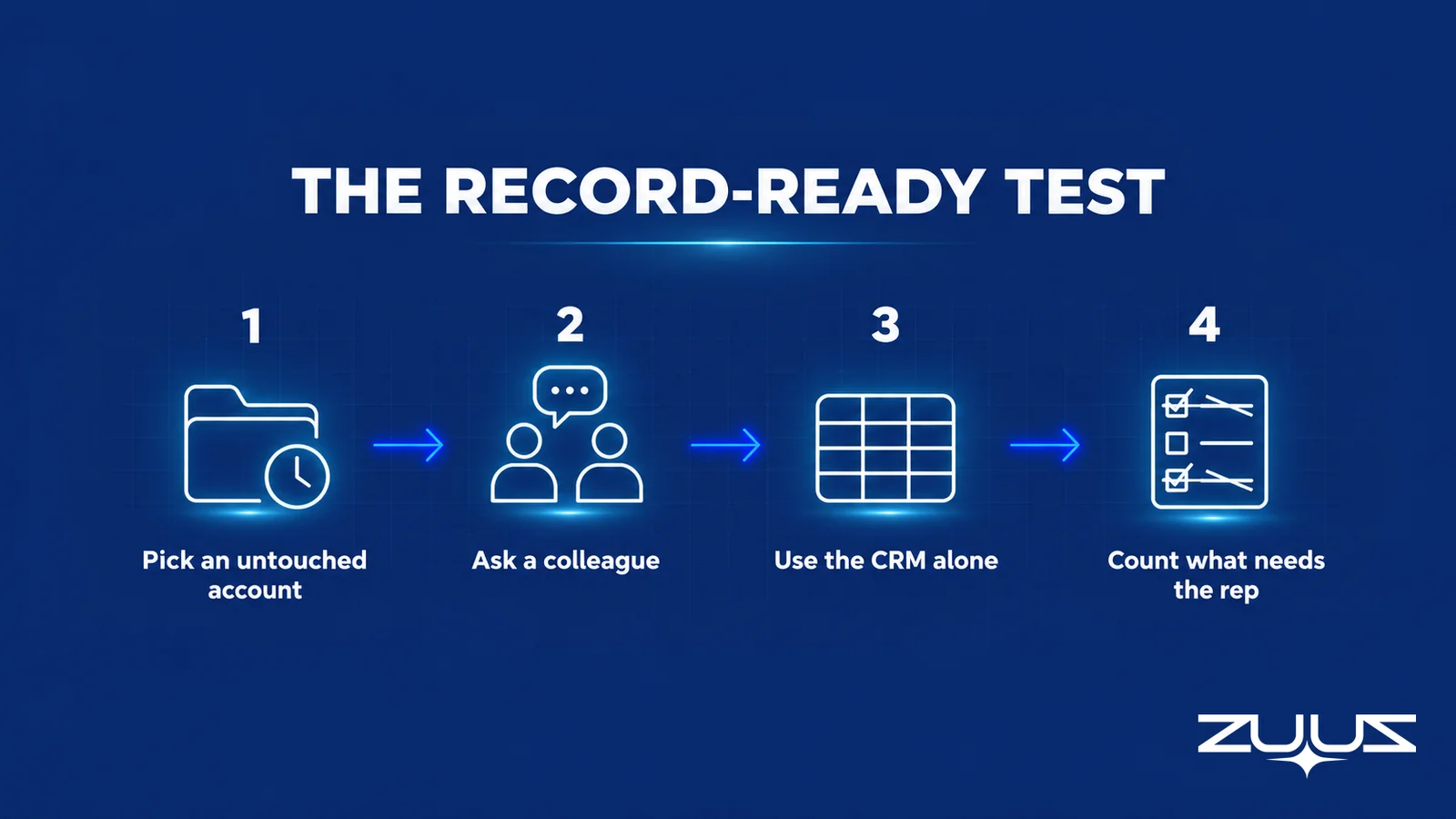
Here is a worked example, labeled as an illustration. A colleague is asked about a sixty-seat client. From the CRM alone, they can say the renewal is in November and the amount is on the opportunity. They cannot say who approves spending, whether the client was promised anything about the second-floor project, or what the owner planned to do next. Three of three answers need the owner. The record fails, and it is a typical result.
Notice what the test does not ask. It does not ask whether the record is complete in a form-filling sense. It asks whether the record holds the facts a colleague needs to act. A record can have every field populated and still fail, because the facts that matter were never fields.
From an operator's seat, the account record is tested far less often than leaders assume, and it is tested at the worst times: the week somebody leaves, the week a renewal opens, and the week a senior client escalates. A record that has been checked only against its own template tends to pass in a review and fail in a crisis. Running the test on accounts at random, rather than on the ones that look healthy, is what makes it informative.

Three Moments When a Thin Account Record Costs Money
MSP account management exposes a thin record at three moments, and each is expensive.
The handoff
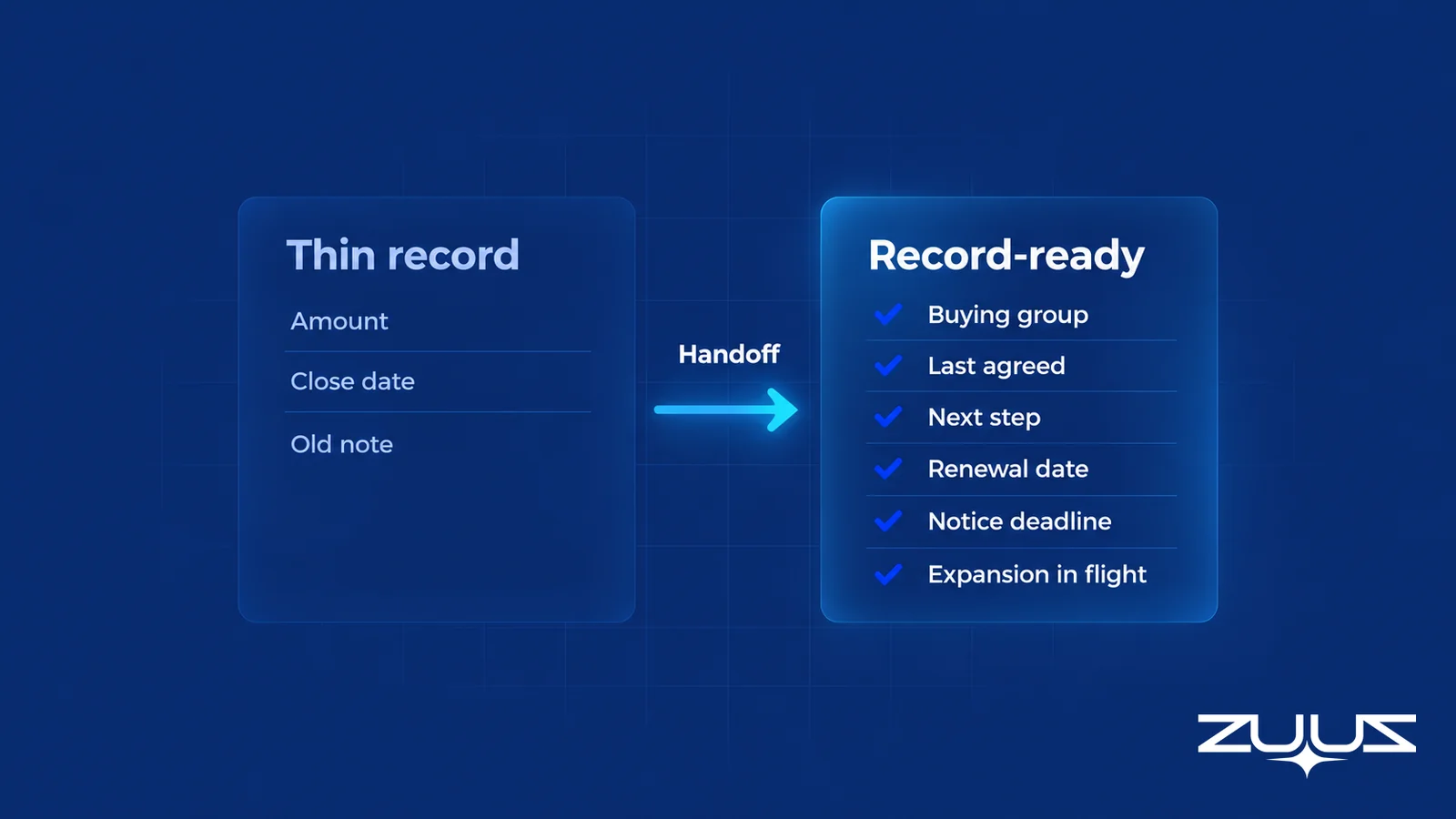
Accounts move for ordinary reasons: a promotion, a territory change, a new vCIO, vacation cover. Every move forces the receiving person to rebuild context, and the client notices. A handoff meeting helps, but only for what the outgoing owner remembers to say.
The departure
When an account manager leaves, the history they carried leaves with them unless it was captured. For an MSP with long relationships, that can mean clients whose preferences, sensitivities and informal promises are known to one person. Recovery takes months, and the recurring revenue under those accounts is at risk while it happens. For the broader practice of handing deals and accounts over, see sales handoff.
The week a renewal opens
A renewal conversation needs recent context: what the client has asked for, what concerns they raised, who changed roles. If that context is scattered, the renewal starts from a standing position that is weaker than it should be. The same pattern shows up in MSP customer retention, where the warning signs sit in the same inboxes.
Run the Test on an Account Nobody Touched. See What the Record Knows.
Connect one mailbox and compare the record with what the client actually said.
What a Record-Ready MSP Account Holds
In MSP account management, a record that passes the test holds a small set of facts, kept current. The table shows each fact, where it normally lives today, and whether a typical CRM holds it.
| Fact | Where it usually lives today | In the CRM? |
|---|---|---|
| Buying group and roles | Account manager's memory and signature lines | Rarely, and often outdated |
| What was last agreed | The most recent email or call | Sometimes as a free-text note |
| What happens next | The owner's to-do list | Rarely |
| Renewal date and notice deadline | The PSA agreement | The date, sometimes; the deadline, rarely |
| Expansion in flight | A comment in a thread | Only if an opportunity was created by hand |
| Stated concerns | Escalation emails and meeting notes | Rarely |
Every row is a conversation fact. None comes from the PSA, and none is a field a form would naturally ask for. That is the structural reason MSP account records are thin: the facts that matter are produced in places the record does not reach.
| Approach | Who does the work | What it produces |
|---|---|---|
| Notes typed by the account manager | The account manager, after hours | Notes that fade within weeks |
| Shared mailbox or BCC habit | Everyone, if they remember | A pile of threads, not a record |
| Native email sync inside the CRM | Mostly the tool, with rep clean-up | Activity history, usually not structured fields |
| ZUUZ conversation capture | ZUUZ prepares, the rep approves in one click | Structured updates to contacts, renewals, next steps and expansion |
MSP Account Management With ZUUZ, From Thread to Record
ZUUZ is an AI layer on top of the CRM an MSP already runs. For MSP account management, it connects to the sales inbox and calendar, reads LinkedIn messages without sending anything, and takes in Teams meeting transcripts and inbound call transcripts. Account history and deals sit together on the account, so the next step and the context behind it are visible to the whole team.
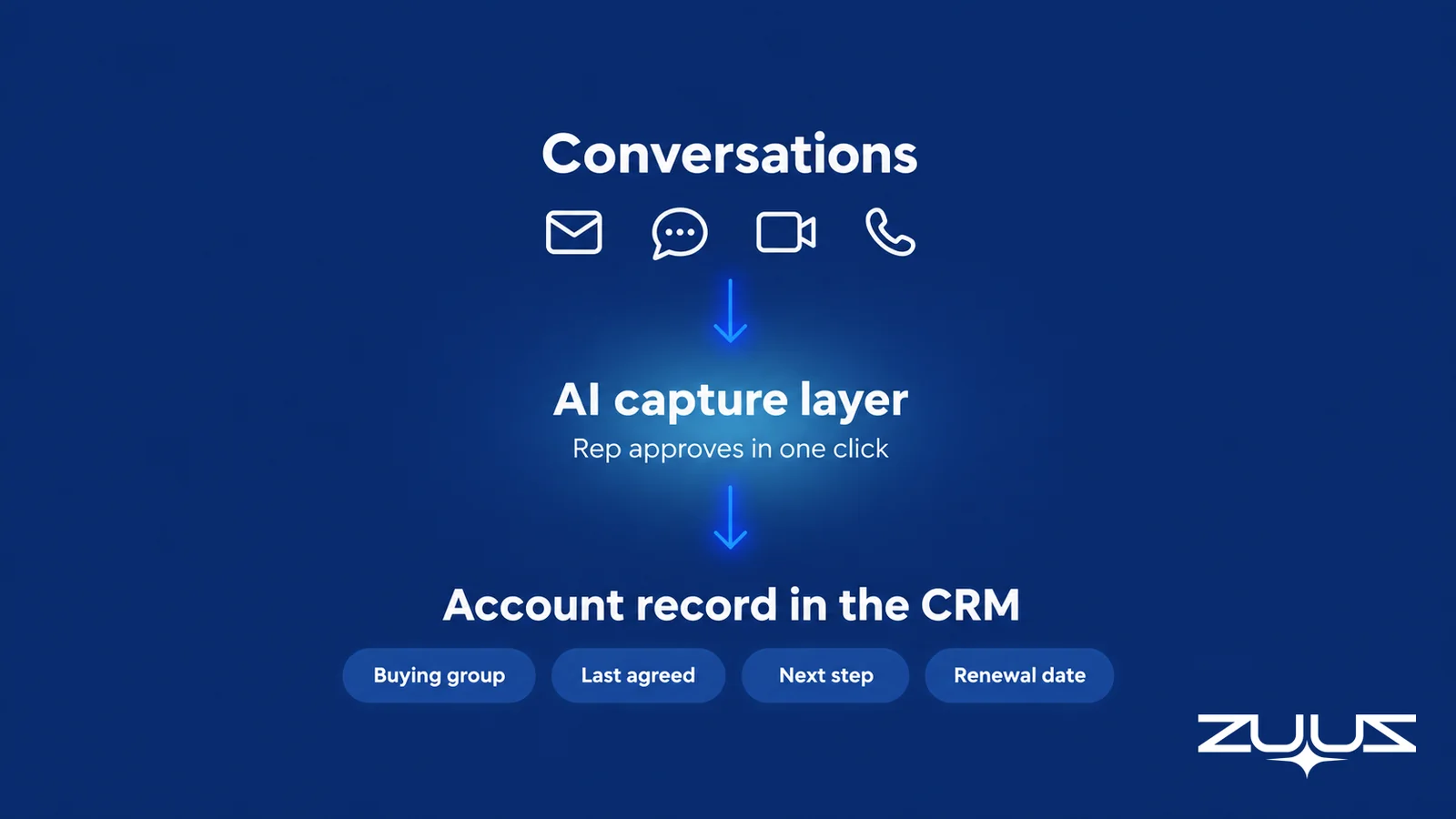
Each update arrives as a prepared record: the contact, the role change, the renewal or expansion signal, and the sentence it came from. The account manager reviews it, edits if needed, and approves it in one click. Manual entries take precedence over anything captured, and keyword filtering keeps out-of-scope threads out. ZUUZ reads the previous 90 days on first connection, which gives thinly documented accounts a starting record.
The structural difference is position. ZUUZ works across Salesforce, HubSpot, Zoho, Attio or Pipedrive, and an MSP can run more than one at once, without a migration. Reporting covers what actually happened on each account: pipeline at risk in dollars, renewals due, what changed, and an audit log of every action. It does not forecast revenue or score clients. Learn more on the account management page.
What the evidence says so far
RA Technologies, a US IT services company, ran ZUUZ on the HubSpot instance it had used for two years, with the same team, and $120K in pipeline was surfaced in the first 30 days that the CRM had never seen, captured from the sales mailbox. The full result is on the RA Technologies case study.
At Cloud Box Technologies, a UAE-based cloud and IT services business, 10 to 12 renewals are tracked in minutes from a single connected user, and leadership sees live pipeline. Both are services businesses where the account history lives in email, which is the profile this guide addresses.
Make the Account Record Survive Anyone Leaving. Start With One Mailbox.
ZUUZ prepares the account update and the rep approves it in one click.
What the Account Record Still Needs From People
Good MSP account management needs more than a current record, because a current record is not the same as a healthy relationship. ZUUZ prepares the facts. It does not decide what a sentence means or what the account manager should do about it. A client who mentions a budget review needs a person who knows the client to respond, and that stays with the account owner.
ZUUZ also does not replace the PSA and does not read PSA tickets today. It does not produce QBR decks, which draw heavily on usage, ticket and service data that sit in the PSA and monitoring tools. A ConnectWise PSA integration is on the ZUUZ roadmap, with no date, and nothing in this guide is a delivery promise. A business review is easier to prepare when the account record holds what the client said since the last one.
For the sales side of the same problem, read MSP sales automation, which covers the CRM data entry reps skip. For client data quality more broadly, see CRM data quality.
Test the Account Record on One Mailbox
The cheapest way to evaluate this is to run the Record-Ready Test by hand, then connect one mailbox and run it again. ZUUZ reads the previous 90 days on first connection, so the accounts that mailbox touches get prepared records the same day. The difference between the two runs shows what capture adds.
- Choose three accounts the owner has not touched in two weeks and run the Record-Ready Test on each.
- Connect the owner's mailbox and the CRM, and review the prepared records.
- Run the Record-Ready Test again with a colleague who does not know the accounts.
- Count how many answers no longer need the owner.
The cluster page for this vertical is CRM automation for managed service providers. Teams that sell through resale and distribution can read the IT VAR sales pipeline guide.
Frequently Asked Questions
What is MSP account management?
MSP account management is the ongoing work of owning a managed service client relationship: keeping the contract healthy, learning what the client is planning, and spotting renewals and expansion early. It differs from service delivery because its raw material is conversation, so the quality of the account record depends on what gets captured from those conversations.
What does an MSP account manager do?
An MSP account manager owns the commercial relationship with existing clients. That includes renewal conversations, expansion discussions, stakeholder relationships, escalation handling with the service team, and keeping the CRM current. The role works best when the account manager is not the only place the account's history exists.
How do you keep MSP account history from living in one person's inbox?
Move the capture of conversation facts to a layer that writes them to the account record as they happen. A shared notes habit works for a few weeks and then fades. Tools such as ZUUZ read the sales inbox and prepare structured updates to the CRM, so the record does not depend on anyone's memory.
What should an MSP account record contain?
It should hold the buying group, what was last agreed, what happens next, the renewal date and notice deadline, any expansion in flight, and any stated concern. These are the facts a colleague needs to run the account without asking the owner. The Record-Ready Test checks exactly this.
What is the Record-Ready Test?
The Record-Ready Test checks whether a CRM account record can stand on its own. Pick an account the owner has not touched in two weeks, ask a colleague to say who the buying group is, what was last agreed and what happens next, using the CRM alone. Any answer that needs the rep, the inbox or a call is a failure.
How does ZUUZ help with MSP account management?
ZUUZ connects to the sales inbox and reads LinkedIn messages, Teams meeting transcripts and call transcripts. It prepares structured account updates for the CRM: contacts, role changes, renewal and expansion signals, and the next step. The account manager approves each update in one click, and manual entries take precedence over anything captured.
Does ZUUZ replace our PSA or QBR process?
No. ZUUZ does not replace the PSA, does not read PSA tickets today, and does not produce business review decks, which depend on usage and service data it does not hold. It keeps the CRM account record current from conversations. A ConnectWise PSA integration is on the ZUUZ roadmap, with no date.
How should MSPs hand off an account when an account manager leaves?
Hand off from the record, not from a meeting. A record that passes the Record-Ready Test lets the new owner see the buying group, the last agreement and the next step on day one. ZUUZ reads the previous 90 days of a mailbox on first connection, which helps rebuild context for accounts that were thinly documented.
Which CRMs does ZUUZ write account updates to?
ZUUZ writes to Salesforce, HubSpot, Zoho, Attio and Pipedrive, and an MSP can run more than one at once. There is no migration, because ZUUZ sits above the CRM that stays the system of record. Microsoft Dynamics is not part of the live list.
How quickly can an MSP see account records improve?
The first improvement is visible on the day the mailbox connects, because ZUUZ reads the previous 90 days and prepares records for review. RA Technologies, a US IT services firm, ran ZUUZ on its existing HubSpot instance and saw $120K in pipeline surfaced in the first 30 days that the CRM had never seen.