
B2B Buying Signals Examples and How to Capture Them
B2B buying signals already sit in sales email, LinkedIn messages and call transcripts. See the signal types, how to identify them and where to record them.


CEO of ZUUZ. He scaled Cloud Box Technologies from 0 to $25M ARR in IT services and distribution before building ZUUZ. Connect on LinkedIn
TL;DR: B2B buying signals are the actions a buyer takes toward a purchase, and the most useful ones are first-party: pricing questions, proposed dates, new stakeholders copied in, and silence, all sitting in the sales inbox, LinkedIn messages and call transcripts. Most of them never reach a CRM field because nobody retypes them. ZUUZ is an AI layer over Salesforce, HubSpot, Zoho, Attio or Pipedrive that captures these signals from email, LinkedIn messages (read-only), Teams meeting transcripts and inbound call transcripts, and writes them as structured records for the rep to approve in one click.
- B2B buying signals are observable buyer actions toward a purchase; they are evidence for the rep to weigh, not a verdict on the deal.
- First-party signals, the ones the buyer wrote or said to the seller, are already owned by the team and sit unstructured in email, calendar, LinkedIn messages and transcripts.
- Six signal families cover most of the b2b buying signals that reach a sales mailbox: commercial questions, timing, scheduling intent, stakeholder expansion, evaluation depth, and cooling or silence.
- The strength of b2b buying signals depends on who sent the signal, whether it carries a date, and whether other signals back it up, so combinations outrank single events.
- A signal only helps at handoff if it lands in a CRM field a report can read, with the buyer's words and the date kept as evidence.
- ZUUZ captures first-party signals for the rep to approve and writes them to the CRM; it is not third-party intent data, website tracking or an outbound tool.
Picture a reply that lands on a Thursday afternoon: "Thanks for the walkthrough. This looks close. Could pricing go to our finance lead, and can legal review terms before the 30th?" This is an illustration, not a real client email, but any rep who has worked an inbox will recognize it. The rep answers it within the hour and the deal feels healthy.
That one reply holds four separate b2b buying signals: a pricing request, a new stakeholder, a review step and a deadline. The CRM, meanwhile, still shows the same stage, the same contact list and last month's close date. Nothing was wrong with the rep's response; the signals simply never became data.
Most advice on b2b buying signals points outward, at funding news, job changes and intent data bought from a vendor. This guide points inward, at the first-party signals already sitting in a team's own email, LinkedIn messages, Teams meeting transcripts and inbound call transcripts. It covers a taxonomy of signal types, how to identify them, how to weigh them, what the rep does next, and where each one belongs in the CRM.
What Are B2B Buying Signals?
B2B buying signals are observable actions by a buyer that point toward a purchase decision, such as asking for pricing, bringing in a colleague or proposing a date. A signal is evidence, not a verdict. One pricing question does not close a deal, but it changes what the rep should do this week.
Three terms get blurred in search results. A buying signal is the act itself. Intent signals and buyer intent signals usually describe research behavior inferred from outside the sales conversation, such as topic searches or content consumption, and intent data is the commercial product that packages them, typically at account level. In this guide, sales buying signals means something the buyer did or wrote to the seller.
The volume of that material is larger than it looks. Harvard Business Review notes that many people now weigh in on each B2B purchase, which means one deal can generate a long trail of replies, forwards, calendar changes and calls. Each carries a small signal, and a team that reads only the stage field sees almost none of them.
First-Party Signals Versus Third-Party Intent Signals
Third-party intent data says that an account appears to be researching a category somewhere else on the internet. First-party signals say what a named person told the team directly. The first answers who might be in market, and the second answers what is happening in a live deal or conversation.
First-party signals have a practical advantage because the team already owns them. They sit in the sales inbox, the calendar, LinkedIn message threads, Teams meeting transcripts and inbound call transcripts, and each one carries the buyer's exact wording, a timestamp and a sender. A rep can reply to a named contact in a way that no rep can reply to an anonymous account list. Website visitor tracking is a separate source that shows page visits rather than conversations, and this guide leaves it aside.
The cost of first-party signals is that they are unstructured. A pricing question is a sentence in a thread, not a field. The earlier guide to missed sales leads in email covers how new leads slip past the inbox, and this guide takes the next step by sorting signals by type, strength and CRM destination.
Buying Signals Examples Across Six Signal Families
Six families cover most of what reaches a sales mailbox. The wording in the table is illustrative, written to show the pattern rather than quoted from any customer. A few families deserve a closer look afterward.
| Signal family | Illustrative buyer wording | What it usually means |
|---|---|---|
| Commercial questions | "Could pricing for ten seats be sent over?" or "What are the payment terms?" | The buyer is testing whether the deal can work financially. |
| Timing | "We need this live before the end of the quarter." or "Budget closes on the 30th." | A real deadline exists, or the buyer wants one to exist. |
| Scheduling intent | "Thursday at 2 works. Adding two colleagues." | The buyer is spending calendar time and widening the audience. |
| Stakeholder expansion | "Copying our finance lead and IT manager." | The deal has moved from one champion to a buying group. |
| Evaluation depth | "Does it connect to our ticketing system?" or "Can security review data handling?" | The buyer is checking whether the product survives internal scrutiny. |
| Cooling and silence | "Let's revisit next quarter." or replies that took a day now take a week. | Momentum is fading, and it is still recoverable if someone notices. |
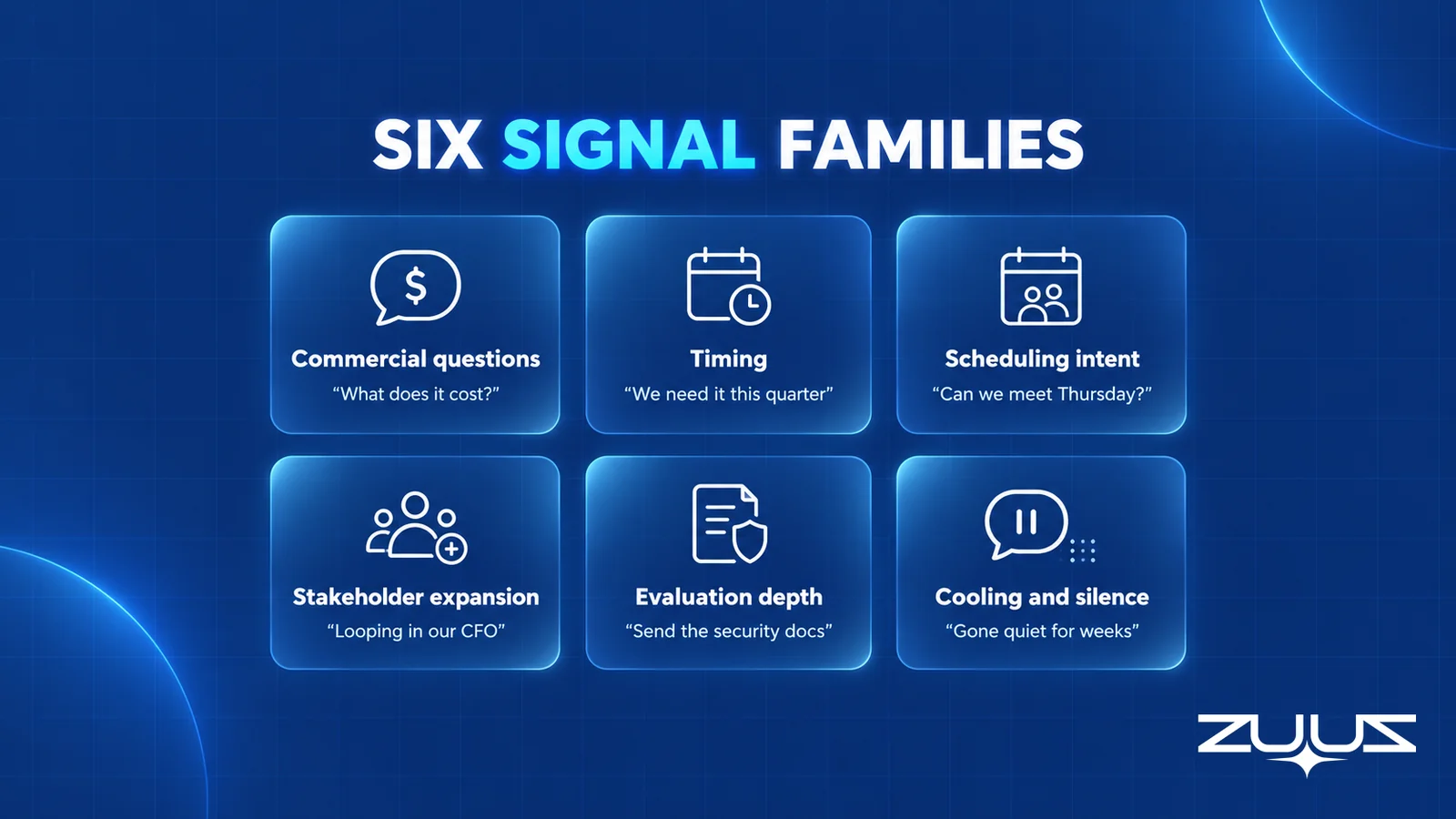
Stakeholder expansion is the least recorded family
A new name copied on a thread asks for nothing, so it triggers no reply and no task. It is also one of the clearest signs that a deal is being taken seriously inside the buyer's organization. The CRM contact list usually reflects the first two names on the deal and misses everyone added later.
Scheduling intent counts even when the meeting never happens
A buyer who proposes times, asks for a longer slot or adds colleagues to an invitation is spending effort. A reschedule is still engagement, because a buyer who wants out rarely bothers to propose a new date. Spotting this wording in a thread is what lets Meeting Scheduling in ZUUZ help the rep book the follow-up.
Silence is a signal with a clock
Silence differs from the other families because it is the absence of an event, and nobody owns an absence. A reply gap that doubles against the thread's own rhythm is a more honest cue than a generic "no activity in 14 days" rule. The risk it points to is stalled deals, the subject of deal slippage.
How to evaluate whether a b2b buying signals program can work
- Channel coverage. Does it capture from the channels where the deal actually moves: email, calendar, LinkedIn messages, and meeting or call transcripts?
- Fields, not feeds. Does a captured signal land in a CRM field a report can filter, or only in an activity feed someone opens deal by deal?
- No remembered step. Does the rep have to remember a BCC address, a button, a sidebar or a sync for the signal to count?
- Evidence kept. Does the record keep the buyer's words, the sender and the date, so a manager can check the signal rather than trust a summary?
- Signal families. Does it tell a stakeholder introduction from a pricing question, or only record that something happened?
- Rep correction in one click. When something is written for the rep, can the rep fix or reject it before it saves?
Stop Losing the Signals Already in the Inbox.
See how ZUUZ connects to the sales inbox and writes structured updates to the CRM for the rep to approve, so a pricing question or a new stakeholder becomes a record.
How to Identify Buying Signals in Email, LinkedIn and Transcripts
How to identify buying signals starts with knowing where each family lives. Email carries commercial questions, forwards and new recipients. The calendar carries scheduling intent, including added attendees and reschedules. LinkedIn messages carry short replies and introductions to colleagues, and ZUUZ reads these read-only rather than sending anything. Teams meeting transcripts carry spoken questions on timing, budget and who else must agree, and Microsoft documents how Teams transcription works
Inbound call transcripts carry what a caller asks first, which is often the real priority. The routine below keeps the reading consistent across channels.
A repeatable reading routine keeps the work consistent across reps, and it takes five steps.
- Read the thread end to end instead of only the last message, because the signal is often in the third reply back.
- Mark the buyer's own words rather than the rep's summary of them.
- Place each mark in one of the six families.
- Note the sender, the date and the sender's role in the deal.
- Compare the result with the CRM record and list what the record does not show.
Combinations matter more than single events. A pricing question alone is moderate. A pricing question, a new finance contact and a proposed review date in the same week tell a different story, and the combination is what a rep or manager should act on. Channel matters too: a LinkedIn reply that introduces a colleague is as meaningful as the same sentence in email, which is why logging LinkedIn messages in the CRM belongs in the same process.
Which Sales Buying Signals Are Strong, Moderate or Weak
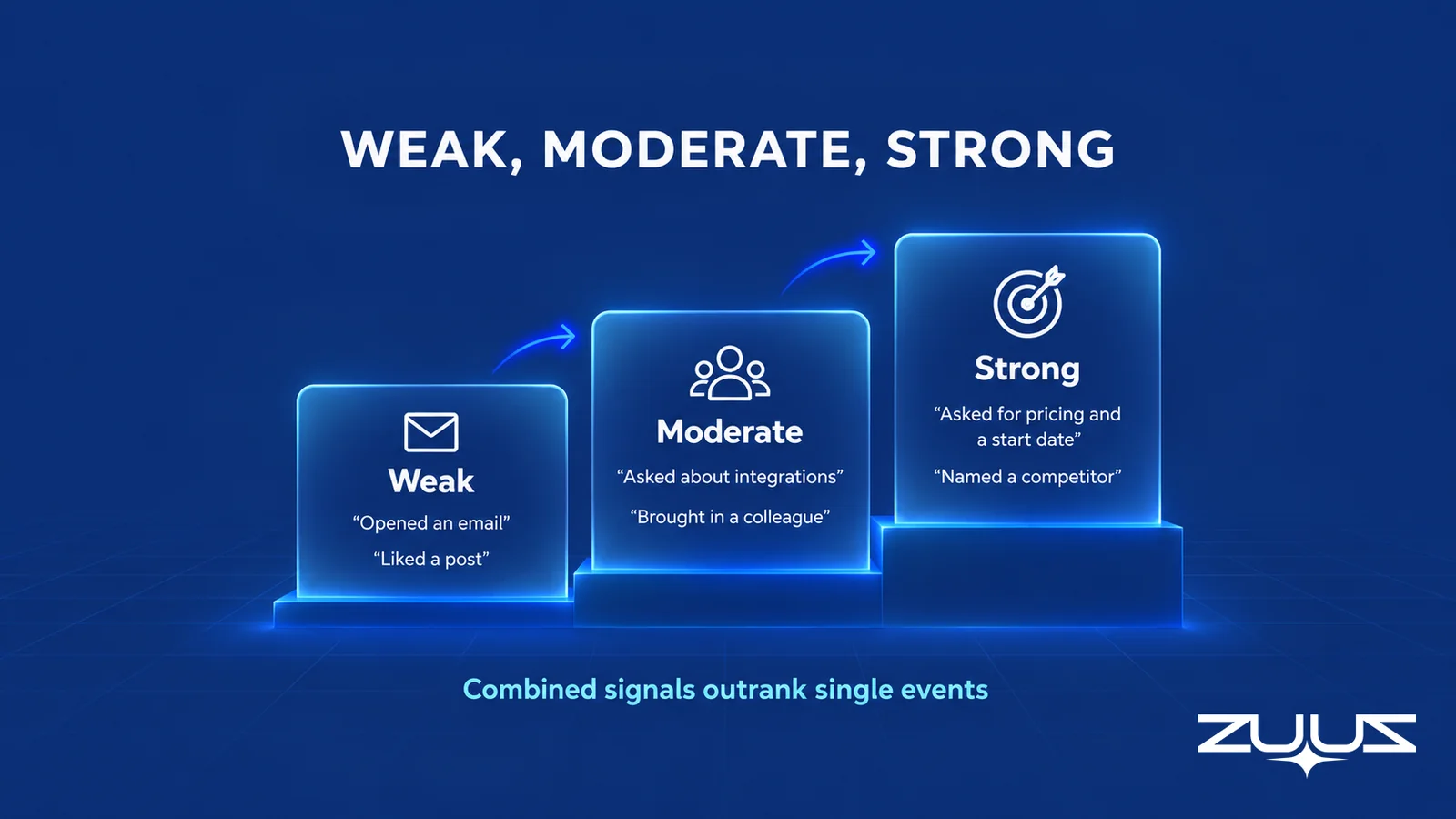
The strength of b2b buying signals is a judgment call, and the table below is an editorial framework from sales operating experience, not a measured ranking. It sorts signals by how directly the buyer commits something that can be checked. The same signal can move between rows depending on who sent it.
| Strength | Signals | Why |
|---|---|---|
| Strong | A buyer-proposed dated next step; a request for contract or procurement paperwork; a finance, legal or IT contact introduced; a deadline tied to a business event | The buyer commits time or people, and the commitment has a date. |
| Moderate | A pricing question with no next step; integration or security questions; a request for references; a new attendee on a call | The buyer is investing effort but has not committed anything yet. |
| Weak | A short "thanks" reply; a general content request; a single acknowledgement of a proposal | The reply is polite and costs the buyer almost nothing. |
False positives follow a pattern. Procurement teams often request pricing to satisfy a comparison-quote policy, and an enthusiastic champion may lack authority to buy. A signal grows stronger when it comes from someone with authority, carries a date, or is repeated by a second person. The same logic is why intent signals gathered from outside the deal are best read as a reason to start a conversation, not as proof that a deal exists.
What the Rep Does With Each Signal
A signal is only useful if it changes what the rep does. The table pairs each family with a concrete next move. Every action stays a rep decision. Capture exists to remove the retyping rather than to replace the judgment.
| Signal | Rep action |
|---|---|
| Pricing or terms question | Answer the question asked, then ask who else needs to see the numbers. |
| Deadline named | Confirm the deadline in writing and ask what the buyer plans to do if it moves. |
| Scheduling intent | Propose two specific times and ask for the attendees' roles. |
| New stakeholder | Add the person to the opportunity with a role, and ask the champion what that person will care about. |
| Evaluation question | Route it to the right internal expert and record any competitor the buyer names. |
| Cooling or silence | Send one specific follow-up tied to the buyer's last statement, and log the date. |
For inbound leads, the same family logic feeds qualification, as described in email lead qualification automation and the routing questions in inbound lead management. Lead Scoring in ZUUZ applies to leads, shows the reasons behind each one and leaves approval with the rep. It does not give deals a numeric score, and the weighing of a live deal stays with the rep and the manager. The wider topic of ranking leads is covered in lead scoring software.
Hand the Rep Finished Work, Not a Pile of Threads.
See how ZUUZ turns buyer replies, scheduling intent and new stakeholders into structured records the rep approves in one click, without a new tool to remember.
Mapping Buyer Intent Signals to CRM Fields
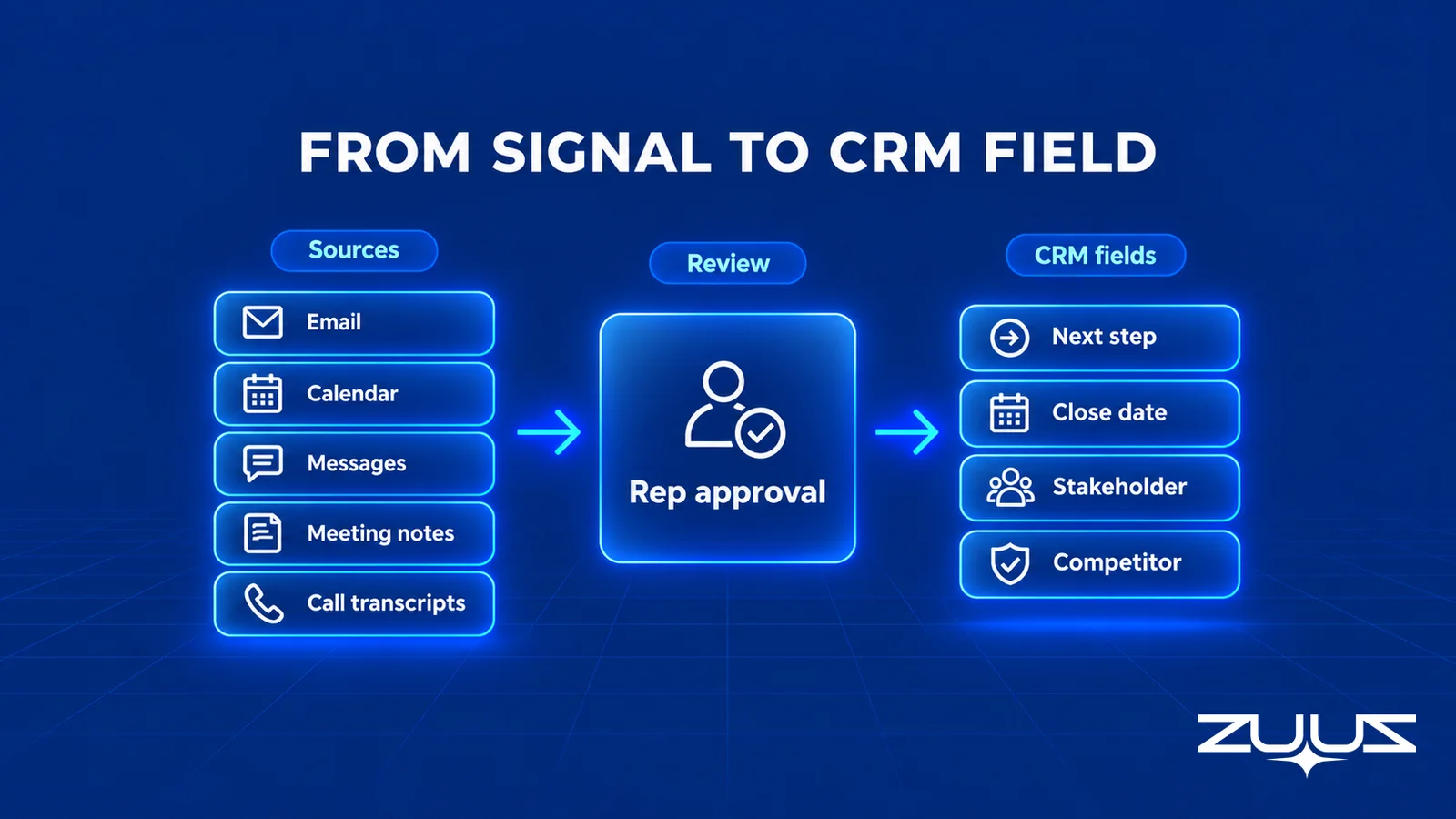
A signal that stays in a thread is lost at the next handoff, territory change or manager review. The practical rule is that each family of b2b buying signals should have a field a report can filter, plus evidence the manager can open. HubSpot explains how its custom properties work, and the same idea applies in Salesforce, Zoho, Attio and Pipedrive: a field beats a note.
| Signal family | CRM destination | Evidence to keep |
|---|---|---|
| Commercial questions | Stage evidence and next step | The buyer's sentence, the date and the sender |
| Timing | Close date, with earlier dates retained | The wording that set the deadline |
| Scheduling intent | Next step and meeting date | Proposed times and attendees |
| Stakeholder expansion | Contact and role on the opportunity | Who introduced whom, and when |
| Evaluation depth | Competitor and requirement fields | The question as asked |
| Cooling and silence | Last buyer reply date and stalled-deal marker | The last real buyer message |
Evidence is what separates a field from an assertion. A close date of the 30th means little, while a close date of the 30th with the buyer's sentence attached can be defended in a review. The same applies to transcripts, and logging meeting notes in Salesforce shows how the meeting side feeds the same record. Field quality then becomes a data question, which is the subject of CRM data quality.
The Capture Layer Test for B2B Buying Signals
The Capture Layer Test is the four-question check ZUUZ applies to any tool or process that claims to surface b2b buying signals. It exists because a signal that is spotted but not recorded is lost on the same day. The questions are asked in order, and each one narrows what a tool can honestly claim.
- Does it capture from the channels where the deal moves: email, calendar, LinkedIn messages, meeting and call transcripts?
- Does it land in CRM fields a report can read, or only an activity feed?
- Does the rep have to remember a BCC, a button, a sidebar or a sync?
- Can the rep correct it in one click before it is written?
Failing 2 or 3 produces activity history, not a pipeline. As an illustration, a rep who BCCs a logging address on some emails and forgets on others fails question 3, and the CRM ends up with a partial record that looks complete. The test is deliberately blunt so that it can be applied in a single meeting.
| Approach | Where the signal comes from | Reaches CRM fields | Rep must remember a step | Rep corrects before write |
|---|---|---|---|---|
| Third-party intent data | Research behavior gathered outside the team's own conversations | Usually account-level flags or lists | No | Not applicable |
| Website visitor tracking | Visits to the company's own pages | Visit counts and page lists | No | Not applicable |
| Rep notes and call logs | What the rep remembers to write down | Only if the rep types it | Yes | The rep is the author |
| Meeting and call recording tools | Recorded conversations | Often a summary or activity feed; field writes vary by tool | Often a bot, link or button | Varies by tool |
| ZUUZ | Sales inbox, calendar, LinkedIn messages (read-only), Teams transcripts, inbound call transcripts | Structured stages, contacts and stakeholders written to the CRM | No | Yes, approve or correct in one click |
Third-party intent data and website tracking are useful for deciding whom to contact first, but by design they fail question 1, because they do not capture the deal's own conversations. That is a difference of purpose rather than quality. The two kinds of b2b buying signals answer different questions and can sit side by side.
Put the Capture Layer Test on One Real Mailbox.
Connect one mailbox, let ZUUZ read the last 90 days, and compare what the threads say with what the CRM records.
A Thirty-Minute Audit of Signals the CRM Never Saw
An audit shows the gap faster than any tool review. It needs one rep, three recently closed-won deals, three deals that slipped or died, and thirty minutes. The point is to count the b2b buying signals the CRM never learned, not to judge anyone's diligence.
- Open each of the six threads in full and list every buyer signal with its family, date and sender.
- Open the matching CRM record and mark each signal as present in a field, present only in a note, or absent.
- Tally the absent and note-only signals by family.
- Check whether any slipped deal had a cooling signal that nobody acted on.
If most signals live only in threads, the CRM records outcomes rather than the deal, and a report built on it describes stages instead of buyer behavior. The finding also explains why pipeline coverage ratios look healthier than the pipeline underneath, and why revenue leakage tends to start with an unrecorded signal. Repeating the audit after a change to the capture process shows whether anything improved.
The Operator View of Buying Signals
Having run sales in IT services and distribution, Avinash Gujje, CEO of ZUUZ, has watched teams chase the loud signals and miss the quiet ones. Price questions get answered because they demand a reply. A new name copied on a thread demands nothing, so it rarely reaches the record, even though it is often the clearest sign that a deal is being discussed one level up. The part teams do not plan for is silence, because nobody owns a missing reply until the close date passes.
A habit worth building is a standing question in the weekly sales pipeline review: who is new on this deal since the last review? It takes seconds to ask and it forces the answer out of the thread and onto the record. The habit works only when the record can answer, which is why capture has to come before the meeting rather than during it.
Capturing B2B Buying Signals: How ZUUZ Helps
ZUUZ does not sell b2b buying signals, and it does not infer them from outside the team's own conversations. It is an AI layer on top of the CRM a team already runs, with no migration. It connects to the sales inbox, calendar, LinkedIn messages (read-only), Teams meeting transcripts and inbound call transcripts, and it writes structured stages, contacts and stakeholders to Salesforce, HubSpot, Zoho, Attio or Pipedrive. The rep approves the finished work in one click.
A few details matter for signal work. A 90-day mailbox lookback on first connection means history is not blank, keyword filtering keeps out-of-scope threads out, and manual entries take precedence. Pipeline Risk Monitoring flags stalled deals, and Analytics reports pipeline at risk in dollars and what changed. ZUUZ is not an outbound tool, it does not track website visitors, and it does not forecast.
In the proof so far, a US-based IT services company, RA Technologies, ran ZUUZ on the HubSpot instance it had used for two years, with the same team, and $120K in pipeline was surfaced in the first 30 days that the CRM had never seen, captured from the sales mailbox. At Cloud Box Technologies, a UAE cloud and IT services business, one connected user tracks 10 to 12 renewals in minutes and leadership sees live pipeline.
The first step is small. Connect one mailbox, let ZUUZ read the last 90 days, and run the thirty-minute audit against the result. Teams that work mostly from Outlook can see how the pieces fit in using Outlook as a CRM.
Frequently Asked Questions
What are B2B buying signals?
B2B buying signals are observable buyer actions that point toward a purchase, such as asking for pricing, proposing a date, copying a new stakeholder or requesting a security review. They are evidence for the rep to weigh, not proof of a deal. First-party signals come from the buyer's own messages and calls to the seller.
What are examples of b2b buying signals in sales?
Common buying signals examples include a pricing or terms question, a named deadline, a proposed meeting time, a finance or IT contact added to a thread, an integration or security question, and a request for references. Cooling signals matter too, such as slower replies or a request to revisit next quarter.
What is the difference between buying signals and intent signals?
A buying signal is something the buyer did or wrote to the seller. Intent signals and buyer intent signals usually describe research behavior seen outside the sales conversation, such as topic searches, and are packaged as intent data at account level. The two answer different questions, and first-party signals tie to a named person in a live deal.
How do you identify buying signals in sales emails?
Reading the whole thread, not only the last message, is the core method. The reader marks the buyer's own words, places each mark in a signal family, notes the sender, date and role, and compares the result with the CRM record. New recipients, dates, pricing questions and changes in reply speed are the quickest cues.
Is asking for pricing a buying signal?
Asking for pricing is a moderate buying signal, not a guarantee. It shows the buyer is testing financial fit, but procurement teams also request pricing to satisfy comparison-quote policies. The signal strengthens when it comes with a new stakeholder, a deadline or a proposed next step, so the rep should ask who else needs to see the numbers.
Is a prospect going silent a buying signal?
Silence is a cooling signal, and it is best measured against the thread's own rhythm. A buyer who replied within a day and now takes a week has changed behavior. The useful response is one specific follow-up tied to the buyer's last statement, not a generic check-in, with the date logged on the record.
What are the strongest sales buying signals?
The strongest sales buying signals are commitments that carry a date or bring in people: a buyer-proposed next step, a request for contract or procurement paperwork, a finance, legal or IT contact introduced, and a deadline tied to a business event. This ranking is an operating judgment rather than a measured statistic.
Can b2b buying signals come from LinkedIn messages?
Yes. LinkedIn replies often carry short buying signals, such as an introduction to a colleague or a proposed time to talk. ZUUZ reads LinkedIn messages read-only for deal signal and writes records to the CRM. It does not send messages, automate connection requests or run sequences, so it sits on the capture side, not the outreach side.
How can b2b buying signals be tracked in the CRM without more data entry?
The workable pattern is capture from the channels where the deal already moves, with the rep approving the result. ZUUZ connects to the sales inbox, calendar, LinkedIn messages, Teams transcripts and inbound call transcripts and writes structured stages, contacts and stakeholders to the CRM. The rep corrects or approves in one click.
Is buying signal data the same as third-party intent data?
No. Third-party intent data is gathered by a provider from research activity outside the team's own conversations, usually at account level. Buying signal data in this guide is first-party: it comes from the team's own email, LinkedIn messages and transcripts, with a named sender and a date. Teams can use both for different jobs.
Does ZUUZ score deals on buying signals?
No. ZUUZ does not give deals a numeric score or forecast revenue. Lead Scoring applies to leads, shows the reasons behind each one and leaves approval with the rep. For deals, ZUUZ captures the signals and their evidence into the CRM and flags stalled deals, so the manager and rep make the call.
A first step smaller than a rollout. Connect one mailbox. ZUUZ reads the last 90 days and the rep reviews what it found before anything is written to the CRM. Whatever that surfaces on the six threads from the audit is the honest picture of the signals the CRM never saw. 30-day free trial, no credit card: https://zuuz.ai/trial/