
Hiring CRM Data Cleanup Consultants vs Automating the Fix
CRM database cleanup and cleansing consultants: what they do, how engagements are priced, why cleanups decay, and when automating capture beats hiring.
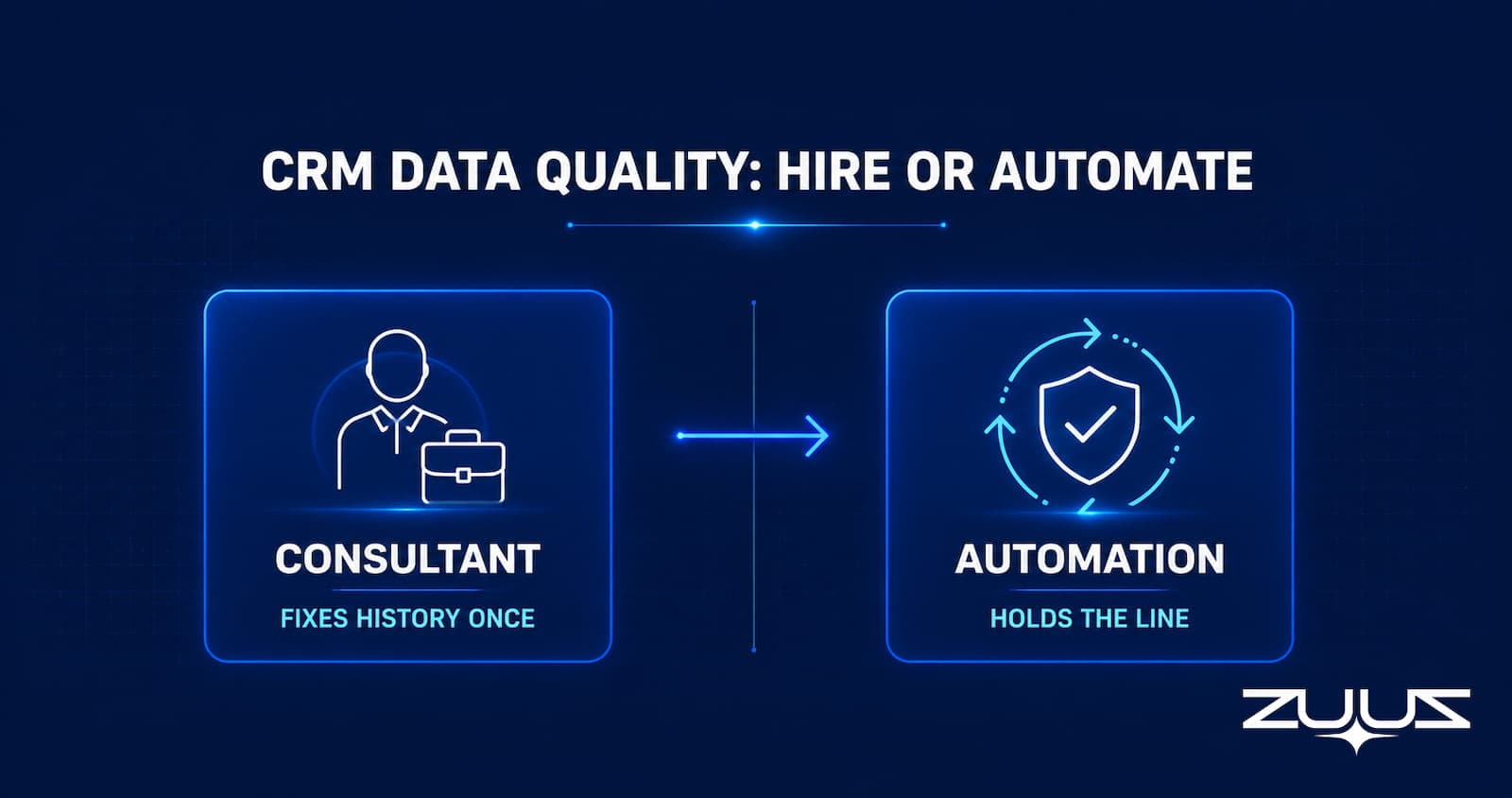
- A CRM data quality consultant audits the database, removes duplicates, standardizes fields, designs governance rules, and cleans data during migrations. The work is project-based and fixes the records that exist at a point in time.
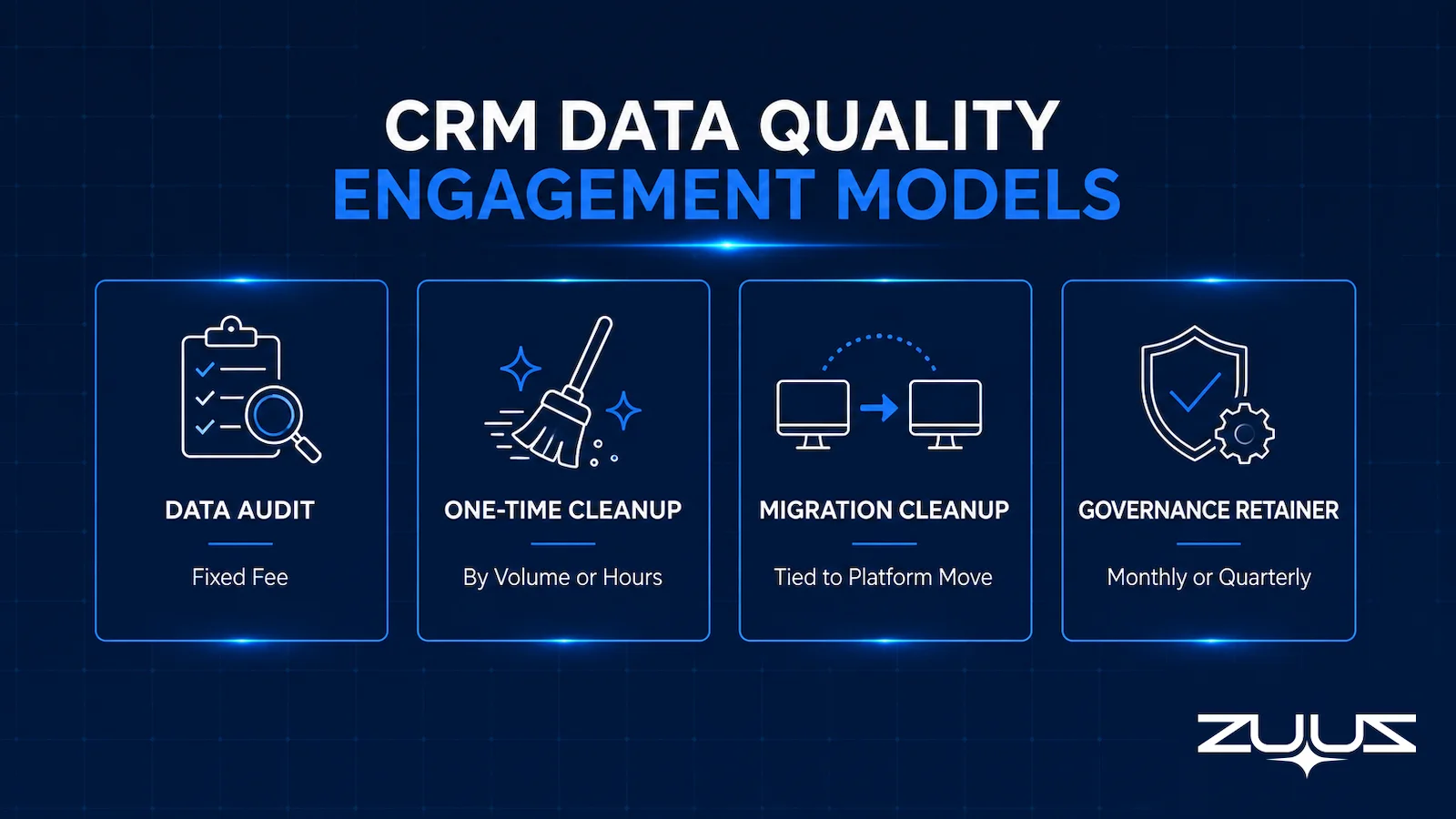
- Engagements are scoped, not rate-carded. Common models are a fixed audit fee, a one-time cleanup priced by volume or hours, a migration cleanup, and a governance retainer.
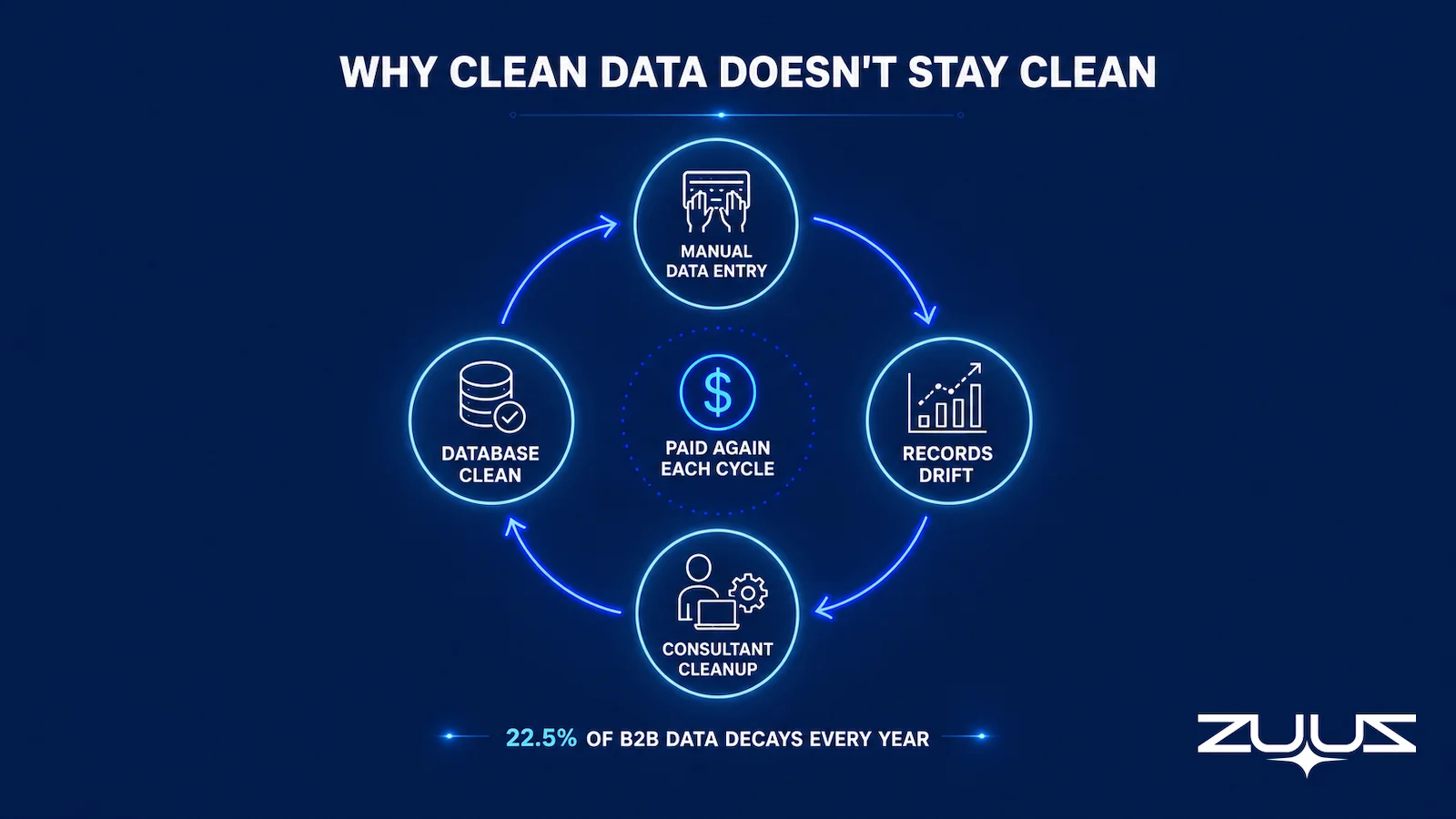
- The structural limit is decay. A one-time cleanup degrades again because the capture process behind it is still manual, and roughly a fifth of B2B data goes stale every year.
- Hire a consultant for one-time events: messy migrations, post-acquisition merges, and years of accumulated duplicates that need human judgment.
- Automate the recurring half. Continuous email-to-CRM capture removes the manual entry that re-creates the mess the consultant just cleaned.
- The strongest setup is hybrid: a consultant fixes history once, then automation holds the line so the cleanup never has to be re-bought.
- ZUUZ is an AI layer on top of the CRM a team already runs. It connects to the sales inbox, reads LinkedIn messages and meeting or call transcripts, and writes leads, stakeholders, next steps and renewal signals into the CRM for the rep to approve in one click.
A team evaluating CRM data quality consultants is usually past the point of denial. The pipeline report no longer matches the deals reps describe out loud, the same account appears three times under three spellings, and a migration or audit has surfaced a backlog too large to fix between other work. The question is no longer whether the data is broken. It is who fixes it, and whether the fix holds.
That second half is where most buying decisions go wrong. A consultant can return a clean database in weeks. What a consultant cannot do is change the process that dirtied it in the first place. This guide covers what a CRM data quality consultant does, how engagements are scoped and priced, why a one-time cleanup degrades, and how to decide between hiring a person and automating the work.
What a CRM Data Quality Consultant Actually Does
The title covers a range of work, and the scope varies by firm. Most CRM data quality consultants concentrate on four kinds of engagement, often bundling several into one project.
The Data Audit
The audit is the diagnostic. A consultant measures duplicate rates, field completeness, formatting inconsistency, and how far the records have drifted from reality. A proper CRM data audit produces a baseline: how many records are duplicates, how many contacts are stale, how many deals carry missing close dates or owners. The audit is what every other phase is priced from.
Deduplication and Cleansing
This is the visible work most buyers picture. The consultant merges duplicate accounts and contacts, standardizes fields such as industry and region, fills gaps through enrichment, and resolves conflicting account hierarchies. Deduplication in particular needs human judgment, because two records that look identical to a script may be a parent company and a subsidiary that should stay separate.
Governance Design
A stronger engagement does not stop at cleaning records. The consultant designs the rules meant to keep them clean: required fields, validation logic, picklist standards, naming conventions, and an ownership model for who maintains what. CRM data governance is the part of the engagement that has the longest shelf life, because rules outlast a single cleanup.
Migration Cleanup
Many teams first hire a CRM data quality consultant during a platform move, a Salesforce-to-HubSpot switch, or a post-acquisition merge of two databases. Migration is the highest-stakes moment for data quality, because dirty records carried into a new system are far harder to untangle once they land. A consultant cleans and maps the data before it crosses over.
Signs a Team Needs One
Not every data problem justifies a consultant. The signals below point to the kind of one-time, judgment-heavy work that a person handles better than an internal admin squeezing it between other duties.
- A migration or merger is imminent. Two databases about to become one, or a platform switch on the calendar, is the clearest case for outside help.
- Duplicate rates are high and tangled. When the same company appears under multiple spellings, regions, and owners, scripts alone cannot resolve the hierarchy safely.
- Years of debt have accumulated. A database that has never been cleaned carries layered errors that need a structured, sequenced project rather than ad hoc fixes.
- Leadership no longer trusts the reports. When the pipeline number is openly discounted in forecast meetings, the problem has reached a scale that warrants a formal audit.
- There is no governance model. If no one owns field standards or validation rules, a consultant can design the framework an internal team then runs.
Each of these shares a trait: it is a backlog or a one-time event. None of them is the steady, daily drift that automation handles better, which is the distinction the decision framework below turns on.
Cleanup Is the Easy Part. Keeping It Clean Is the Problem.
ZUUZ captures deal signals from email and writes structured records to Salesforce, HubSpot, or Zoho automatically. See how continuous capture keeps a database clean after the consultant leaves.
Recognizing the need is the easy half. Scoping it is the harder one, because the cost of an engagement is set almost entirely by conditions inside the database rather than by the provider’s rate.
How to evaluate a CRM data quality provider
- A written scope of work that names the objects, fields and record counts in range, not a headline price.
- A measured starting point: duplicate rate, field completeness and staleness quantified before any cleanup begins.
- Governance rules the internal team can run on its own once the provider hands over.
- A capture layer in the plan, not only a cleanup – something that keeps writing the record from email, LinkedIn messages and meeting transcripts after the engagement ends.
- A stated re-degradation assumption, so both sides agree what the database should look like six months later.
- References on a database the size of yours, on the CRM you actually run.
How Engagements Are Scoped and Priced
CRM data quality consultants rarely publish a rate card, because the work is shaped by the database. Pricing follows the scope of work, and the scope depends on database size, the number of connected systems, and how much custom field logic the CRM carries. The table below maps the common engagement models against what each one covers and the variables that move the price.
| Engagement Model | What It Covers | Typical Pricing Basis | What Moves the Cost |
|---|---|---|---|
| Data Audit | Diagnostic of duplicates, completeness, drift | Fixed project fee | Database size, number of objects and fields |
| One-Time Cleanup | Deduplication, standardization, enrichment | By record volume or by hours | Duplicate rate, complexity of account hierarchy |
| Migration Cleanup | Clean and map data before a platform move | Tied to the migration project | Source and target schema gap, record count |
| Governance Retainer | Ongoing rule maintenance and periodic cleanup | Monthly or quarterly retainer | Frequency of review, number of integrated systems |
Two things are worth flagging before comparing quotes. First, ask for a written scope of work, because a $5,000 audit and a $50,000 cleanup are not comparable line items. Second, watch for the retainer. A governance retainer is often where a one-time engagement quietly becomes a recurring cost, and it exists precisely because the underlying capture problem was never solved. For a fuller breakdown of recurring models, the guide to CRM data quality services covers managed pricing in detail, and the roundup of CRM data quality tools covers the software side.
The Limitation Nobody Quotes For: Data Re-Degrades
Here is the part that does not appear in a statement of work. A consultant cleans the records that exist on the day of the engagement. The process that created the mess is almost always still manual, so the database starts drifting back the moment the engagement ends.
The mechanism is simple. Reps still log deals by hand, often at the end of the week from memory. Contacts still change jobs, companies still rebrand, and email signals such as renewal mentions and pricing questions still miss the CRM entirely. The consultant fixed the symptom. The cause kept running.
That decay rate is why a single cleanup has a short shelf life. It also has a cost attached. Gartner research from 2020 put the average cost of poor data quality at $12.9 million a year per organization, and that number does not pause while a database slowly re-degrades between consulting engagements.
The capture problem sits upstream of all of it. Salesforce State of Sales research finds the average seller spends about 40 percent of their time selling, with the rest absorbed by non-selling work that includes manual data entry. As long as a person is the mechanism for getting a deal signal into the CRM, the signal will sometimes not arrive, and the database will need cleaning again. This is the dynamic explored in why your CRM pipeline is wrong: the report is downstream of a capture gap that no one-time fix closes.
The Capture Gap Audit
Before buying either a cleanup or a tool, measure how much of what the team already knows never reached the CRM. The audit takes an afternoon, and it decides the scope of everything bought after it.
- Pick one closed-won and one slipped deal from the last quarter.
- Read the full email and message thread end to end; list every fact that mattered – people, objections, dates, competitors, commitments.
- Open the CRM record for the same deal and mark which of those facts appear in a field, not a note.
- The percentage missing is the capture gap. Anything above about a third means the team is running on a CRM that records outcomes, not the deal.
Run it on the two deals before the scoping call, not after. If nine of the twenty-four facts in the closed-won thread live nowhere but the mailbox, the duplicate count is not the real finding. A deduplication project will return a clean database that is missing the same nine facts, and the audit tells a consultant which fields to create rather than which rows to merge.
Hire or Automate: A Decision Framework
The choice is not consultant versus automation in the abstract. It is a question of which problem a team has. A consultant is built for one-time, judgment-heavy work. Automation is built for recurring, high-volume work. The table below sorts common situations by which approach fits.
| Situation | Best Fit | Why |
|---|---|---|
| Messy data migration or platform switch | Consultant | One-time, high-stakes, needs schema mapping and human judgment |
| Post-acquisition merge of two databases | Consultant | Deduplication across systems requires hierarchy decisions a script cannot make |
| Years of accumulated duplicate backlog | Consultant | Layered historical errors need a sequenced one-time project |
| No governance rules exist | Consultant | Framework design is a one-time deliverable an internal team then runs |
| Data re-degrades every quarter | Automation | Recurring drift from manual capture is a process problem, not a backlog |
| Reps skip logging deals and emails | Automation | Continuous capture removes the manual step that creates the gap |
| Both a backlog and ongoing drift | Hybrid | Consultant fixes history once, automation holds the line afterward |
| The facts that matter live in email and LinkedIn threads, never in a field | Capture layer | ZUUZ runs on top of the existing Salesforce, HubSpot, Zoho, Attio or Pipedrive instance and writes those facts into fields a report can read, for the rep to approve |
The pattern in the table is consistent. Anything that is a one-time event or a backlog points to a consultant. Anything that recurs points to automation. The trap is using a consultant to solve a recurring problem, because that is how a one-time engagement becomes an annual line item. For teams whose drift comes mainly from manual entry, the best CRM setups for reducing manual data entry address the cause directly rather than the symptom.

Where a Consultant Plus Automation Is the Right Combination
For most teams with a real backlog, the answer is not one or the other. It is both, in sequence. A consultant is the right tool for the history that already exists, and automation is the right tool for everything that arrives after.
The sequence matters. A consultant fixes the historical database and designs the governance rules, which is work that benefits from human judgment and a defined endpoint. Automation then enforces clean capture going forward, so new records do not re-create the backlog the consultant just cleared. Run in that order, the consulting engagement becomes a one-time investment rather than a standing retainer.
What breaks the model is skipping the second half. A team that cleans history without fixing capture is back in the same database within a year, paying again for the same work. The difference between a one-time cost and a recurring one is whether the capture process changed. The comparison of ZUUZ versus manual CRM entry shows where that ongoing capture cost lands.
From an operator’s seat
Across the deployments ZUUZ runs, the pattern is that the order of operations decides whether a cleanup holds. Teams that connect the capture layer first and run the deduplication second pay less for the deduplication, because a few weeks of captured threads show which of the three spellings of an account is the one buyers actually write to. The part teams do not plan for is the field audit: a consultant can only clean the fields the CRM has, and a good share of the facts worth keeping have nowhere to land, so an admin has to create those fields before any automation can write to them. Budget a day for that, not an hour. The other unbudgeted cost is rep review in week one, where approvals are quick but the first batch covers the backlog as well as the week.
CRM Data Quality: How ZUUZ Keeps the Cleanup From Coming Back
ZUUZ is an AI layer on top of the CRM a team already runs – it is never a CRM and never replaces one. A consultant and a data quality tool both work on what the rep already entered; ZUUZ writes the record.
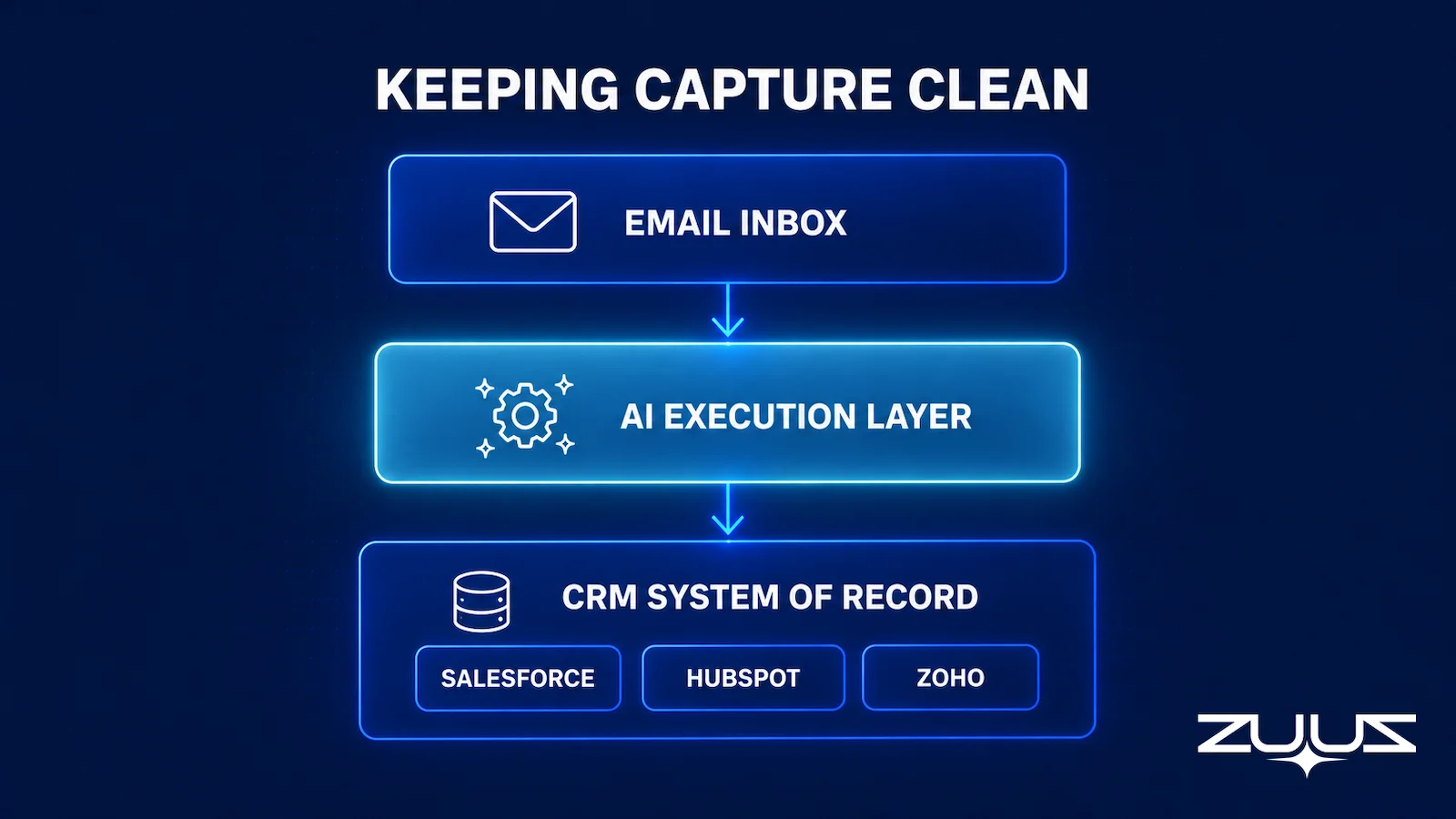
ZUUZ addresses the half a consultant cannot: the capture process that re-dirties the database. It reads inbound and outbound email, extracts deal signals, and writes structured records to Salesforce, HubSpot, or Zoho. The manual data entry that a consultant cannot remove, ZUUZ removes, so new records arrive clean instead of needing a future cleanup.
The CRM-agnostic design matters for teams that hired a consultant during a migration or that run different systems across divisions. ZUUZ does not require a specific platform. It connects to whichever CRM is already in place and writes in that system’s native format, which makes it the continuous layer that sits underneath whatever governance rules a consultant designed.
RA Technologies: $120K Surfaced in 72 Hours
RA Technologies, an IT services firm in the United States, connected their shared inbox to ZUUZ and ran a 90-day historical email lookback on first connection. The system surfaced $120,000 in pipeline that had never been recorded in their CRM. These were not lost deals. They were active conversations progressing through email that the database had never captured, the same kind of gap a consultant audit would flag, found continuously rather than once.
The distinction is the recurring cost. A consultant audit finds that backlog once and hands it back. ZUUZ finds it on connection and then prevents the next one from forming, because the capture runs every day rather than at the start of an engagement. The cleanup does not have to be re-bought.
The insight came from operating Cloud Box Technologies, an IT services and cloud distribution company that grew from $0 to $25 million ARR. At that scale, no amount of one-time cleanup kept pace with the volume of deal activity moving through email. The fix was to change capture, not to re-clean the database every quarter. For the foundation behind this topic, the pillar guide to CRM data quality covers the full picture, from audit through continuous capture.
Fix the Past Once. Prevent the Next Backlog.
Connect a CRM in minutes and let ZUUZ capture the signals reps never log, so a one-time cleanup stays a one-time cost. Start free, with no integration project required.
A concrete first step
Before scoping a cleanup, connect one mailbox. ZUUZ reads the last 90 days, and the rep reviews what it found before anything is written to the CRM. That one pass separates the part of the mess a consultant should fix once from the part a capture layer has to hold every week, which is the split the quotes above turn on. It is a 30-day free trial, no credit card: https://zuuz.ai/trial/
Frequently Asked Questions
What Does a CRM Data Quality Consultant Actually Do?
A CRM data quality consultant audits the existing database, removes duplicate and stale records, standardizes fields, and merges conflicting account hierarchies. Many also design governance rules, validation logic, and field standards, and clean data during a migration between systems. The engagement is project-based: it fixes the records that exist at a point in time and hands back a cleaner database with documented rules.
How Much Does a CRM Data Quality Consultant Cost?
Pricing is usually scoped per project rather than published as a rate card. Common models include a fixed audit fee, a one-time cleanup priced by record volume or hours, a migration cleanup tied to a platform move, and a retainer for ongoing governance. Cost scales with database size, the number of integrated systems, and how much custom field logic the CRM carries. Request a scope of work before comparing quotes.
When Should You Hire a CRM Consultant Instead of Automating?
Hire a consultant when the problem is a one-time event: a messy migration, a post-acquisition merge of two databases, or a backlog of years of duplicates that needs human judgment to resolve. Automate when the problem is recurring: data that re-degrades every quarter because reps capture it by hand. Most teams need both, with the consultant fixing history and automation holding the line going forward.
Why Does CRM Data Get Dirty Again After a Consultant Cleans It?
A consultant cleans the records that exist on the day of the engagement, but the process that created the mess is usually still manual. Reps keep logging deals by hand, contacts keep changing jobs, and email signals keep missing the CRM. According to HubSpot, about 22.5% of B2B data degrades each year, so a static database drifts back toward the state that triggered the cleanup.
Can Automation Replace a CRM Data Quality Consultant?
Automation replaces the recurring part of the work, not the one-time part. Continuous capture tools like ZUUZ keep new records clean by writing structured data from email to the CRM, which removes the manual entry that re-creates errors. A consultant is still the right choice for historical cleanup and governance design. The two solve different halves of the same problem.
What Is the Difference Between a CRM Data Audit and CRM Data Cleansing?
A CRM data audit is the diagnosis: it measures duplicate rates, field completeness, and how far the database has drifted from reality. CRM data cleansing is the treatment: deduplication, standardization, enrichment, and merging. An audit tells a team how bad the problem is and what it will cost to fix. Cleansing executes the fix. Most engagements start with the audit and price the cleansing from its findings.
Does ZUUZ Work Alongside a CRM Consultant?
Yes. The common pattern is a consultant cleaning the historical database and designing governance rules, then ZUUZ keeping new data clean by capturing deal signals from email and writing structured records to Salesforce, HubSpot, or Zoho. The consultant fixes the past once. ZUUZ prevents the next backlog so the cleanup does not have to be re-bought.

CEO of ZUUZ. He scaled Cloud Box Technologies from 0 to $25M ARR in IT services and distribution before building ZUUZ. Connect on LinkedIn