
CRM Data Quality Services: What You Pay For vs What AI Does
CRM data quality services cleanse, dedupe, and enrich your records on a recurring basis. Here is what they include, how they price, and when capture-at-source beats paying again.
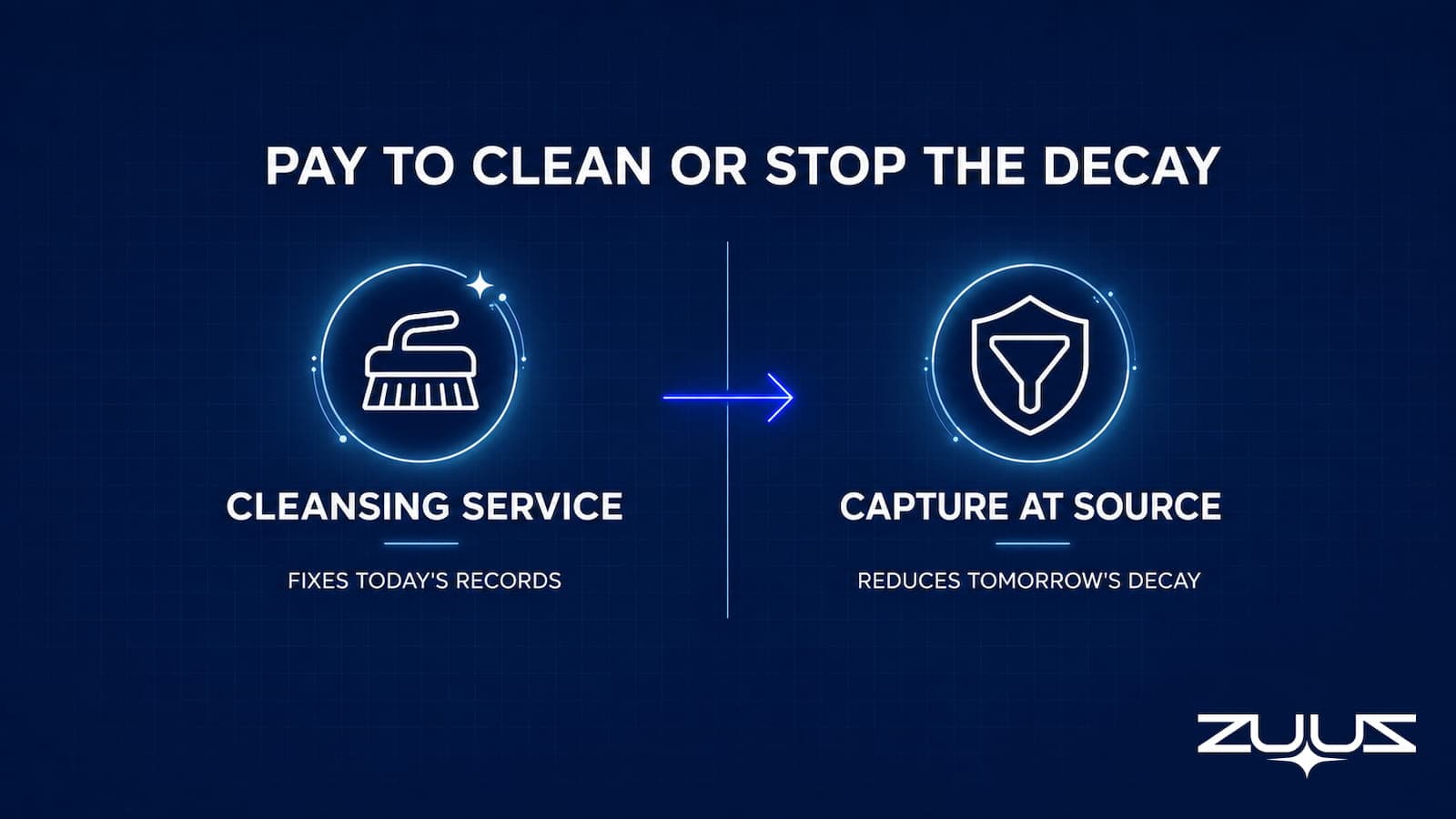
- CRM data quality services bundle five jobs: cleansing, deduplication, enrichment, validation, and monitoring. Most are sold as projects, recurring engagements, or a managed subscription.
- Pricing follows three models. Per-record fits a one-time cleanup, project pricing fits a fixed dataset, and subscription pricing fits ongoing maintenance. The right model depends on whether the problem is a backlog or a flow.
- A cleansing service fixes the records that exist today. It does not change how new records enter the CRM, so the data re-degrades and the engagement becomes recurring spend.
- The buying decision is rarely in-house versus outsourced alone. It is whether to keep paying to fix decay or to reduce the decay at the capture layer.
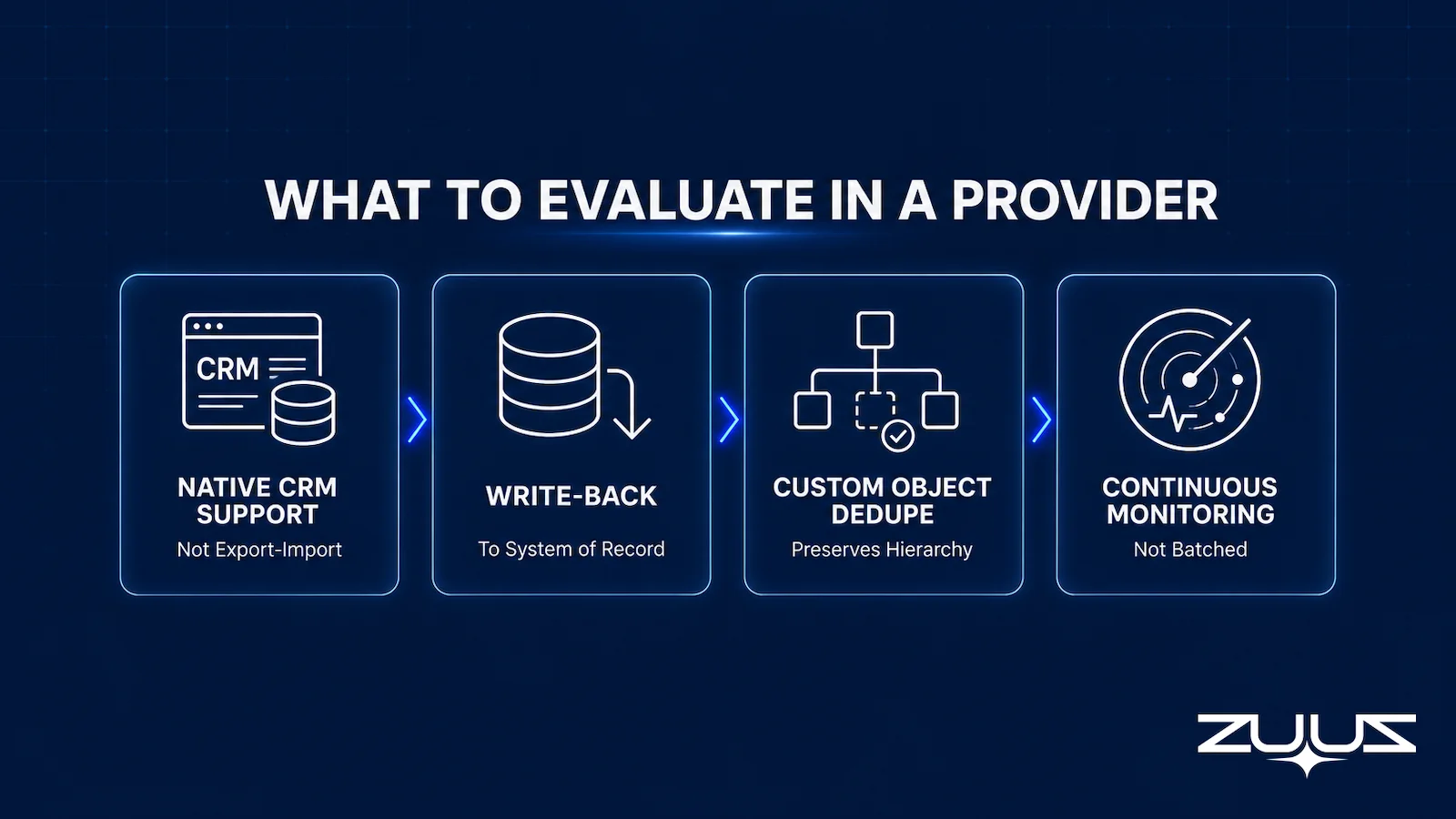
- Evaluating a provider means checking native CRM support, write-back to the system of record, dedupe handling of custom objects, and whether monitoring is continuous or batched.
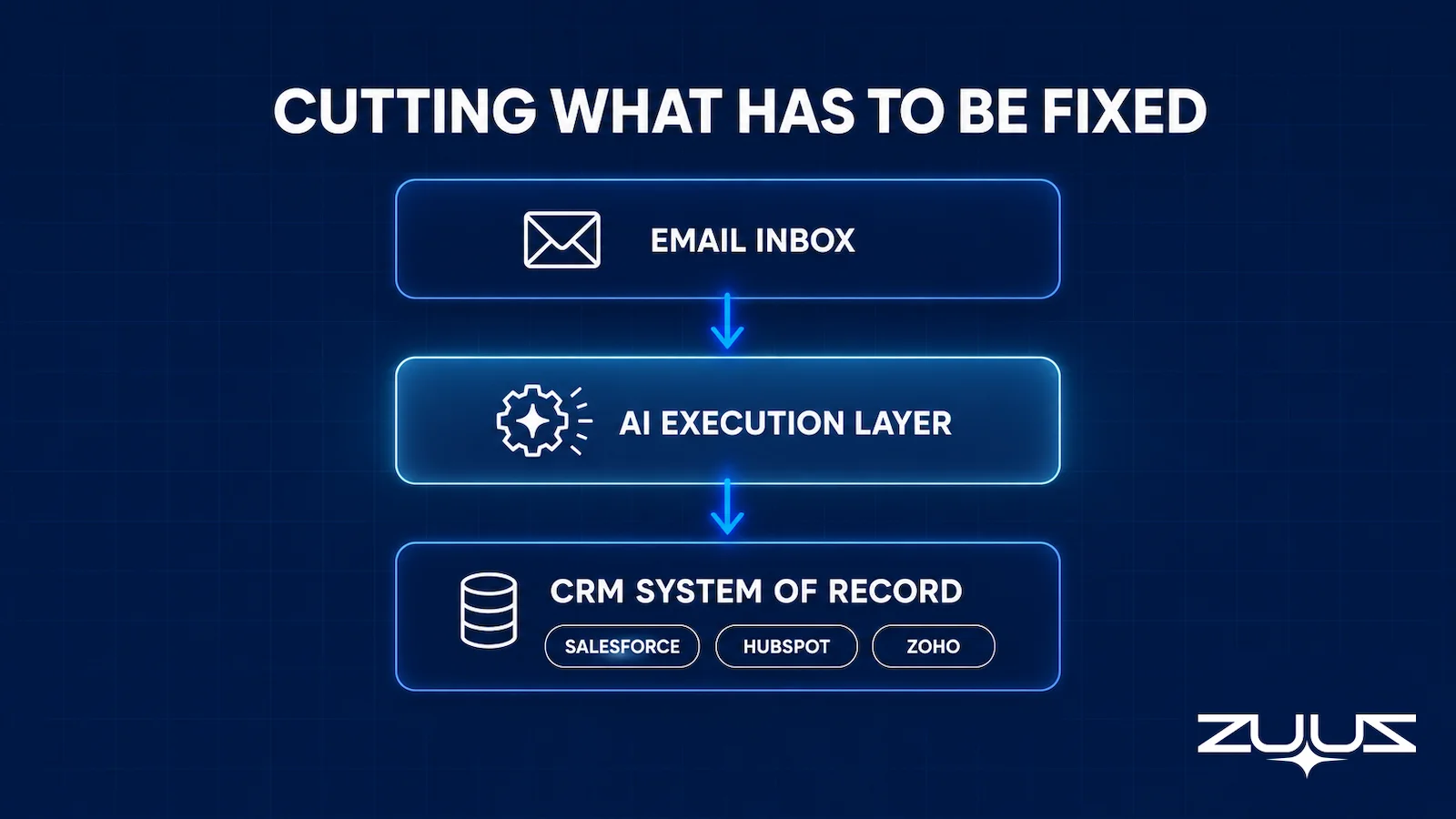
- ZUUZ captures structured records from email into Salesforce, HubSpot, or Zoho, which lowers the volume a cleansing service has to repeatedly fix.
A sales operations lead signs a cleansing contract, the provider merges 40,000 duplicate contacts and validates the email column, and the CRM looks healthy for a quarter. Then the duplicates creep back, half the new accounts arrive with blank fields, and the next invoice lands. The service did its job. The job just did not stay done.
That cycle is the central question buyers face with crm data quality services. The work is real and the providers are competent. The issue is that recurring cleansing treats a symptom while the cause, how records enter the CRM, keeps producing new defects.
This guide covers what these services include, how they are priced, where the recurring-spend trap forms, and how to weigh outsourced cleansing against fixing capture at the source. For the broader topic, the CRM data quality pillar sets the foundation, and two siblings go deeper on adjacent decisions: hiring CRM data quality consultants for advisory work, and choosing CRM data quality tools to run in-house.
What CRM Data Quality Services Actually Include
Most providers package the same five tasks under the umbrella of managed data quality. The labels differ, but the underlying work is consistent across vendors. Understanding each one helps a buyer scope a contract against the specific problem in their CRM rather than buying a generic bundle.
Cleansing
Cleansing fixes records that are malformed, outdated, or incomplete. That covers standardizing inconsistent field formats, correcting misspelled company names, filling missing fields where a reliable source exists, and removing records that no longer reference real accounts. CRM data cleansing is the most common entry point because the symptoms are visible: reports break, segments overlap, and sales lists bounce.
Deduplication
Deduplication identifies and merges records that describe the same account or contact. In a busy CRM, the same company appears as “Acme Inc,” “Acme Incorporated,” and “ACME” with three owners and three activity histories. A dedupe pass uses matching rules to merge these while preserving the activity trail. This is where custom objects and relationships break if the matching logic is naive.
Enrichment
CRM data enrichment services append data from third-party sources: firmographics like industry and employee count, contact details like direct dials and verified emails, and technographic or intent signals. Enrichment fills the gaps that capture missed. It is also the field that ages fastest, because the appended data describes people and companies that keep changing.
Validation
Validation verifies that a field is real and current. Email validation checks deliverability, phone validation confirms a number is in service, and address validation standardizes against postal databases. Validation is often sold per-record or per-check because it maps cleanly to a measurable unit of work.
Monitoring
CRM data quality monitoring is the recurring layer. Instead of a one-time pass, the service runs scheduled checks that flag new duplicates, decayed contacts, and rule violations as they appear. Monitoring is what turns a project into a subscription, and it is the layer where the recurring-spend question becomes sharpest.
Fewer Bad Records to Clean.
ZUUZ writes structured records from email into your CRM at the source, so less of your data shows up broken in the first place. See it on your own inbox in 15 minutes.
How These Services Are Priced and Scoped
Pricing for crm data cleansing services and broader data quality engagements tends to follow one of three models. None is inherently better. Each fits a different shape of problem, and mismatching the model to the problem is where buyers overpay.
| Pricing Model | How It Works | Best Fit | Where It Costs More |
|---|---|---|---|
| Per-record | A unit fee per record cleansed, deduplicated, validated, or enriched | One-time cleanup of a defined dataset | Charges scale with record volume; recurring decay means paying per record again |
| Project | A fixed fee for a scoped dataset and a defined outcome | A known backlog with a clear finish line | Out-of-scope records or repeat cycles fall outside the fixed fee |
| Subscription / managed | A recurring fee for ongoing monitoring, cleansing, and enrichment | Continuous maintenance where data keeps decaying | Fee continues indefinitely; treats the symptom rather than the cause of decay |
Scoping matters as much as the model. A per-record quote on a 200,000-record database looks cheap until enrichment doubles the touched-record count. A subscription looks predictable until the monthly decay rate climbs and the same records cycle through cleansing every quarter. The honest question for a buyer is not which model is cheapest per unit. It is how many times the same record will be paid for.

The Recurring-Spend Trap
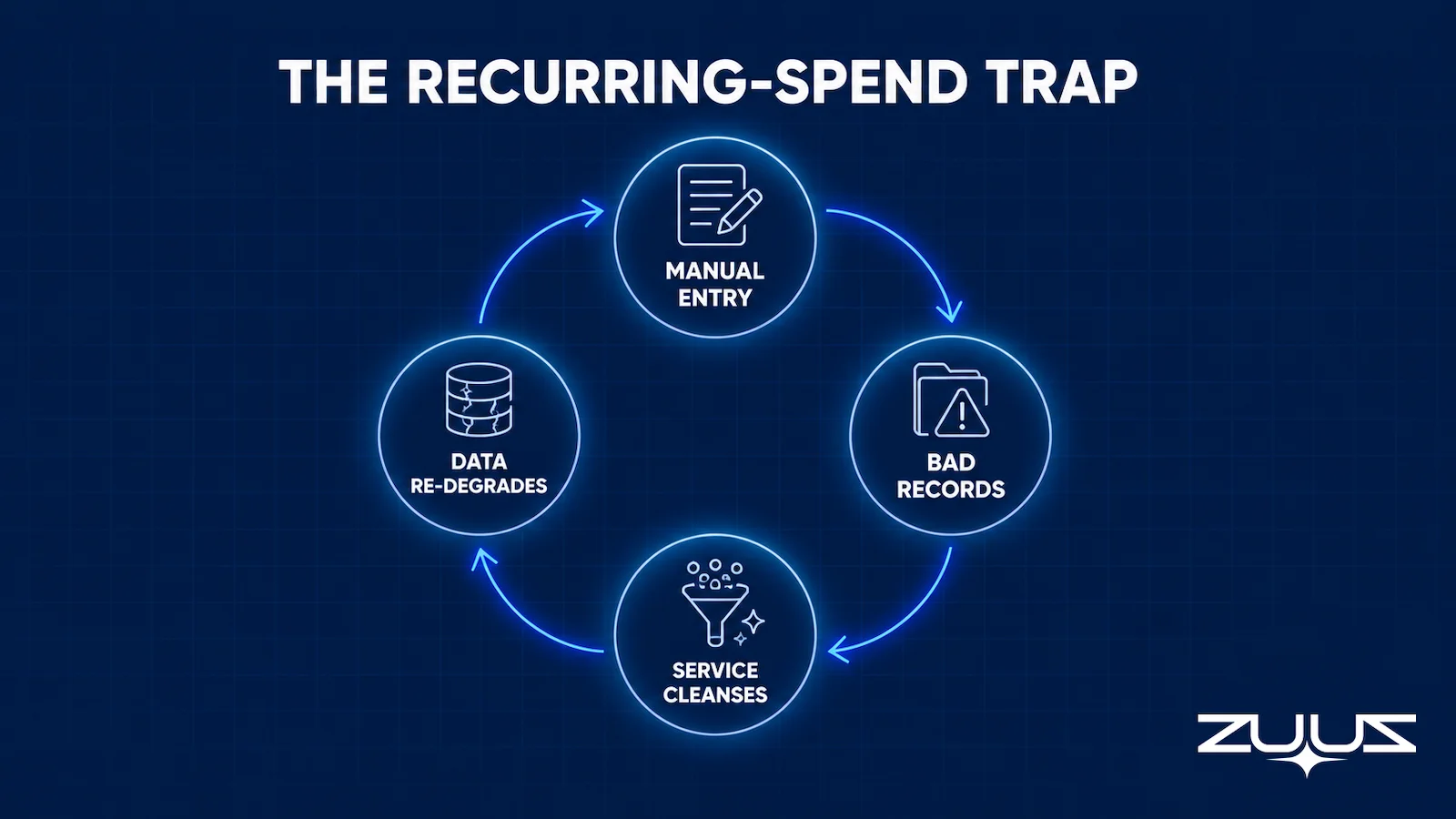
Here is the mechanism that turns a one-time cleanse into a standing line item. A cleansing service operates on the records that exist at a point in time. It standardizes them, merges duplicates, validates fields, and hands back a clean dataset. What it does not touch is the process that created the bad records in the first place.
In most CRMs, that process is manual entry. Reps type deals in after the fact, skip the fields that do not affect commission, and leave most email signals unrecorded. Every new lead, every forwarded thread, every renewal mention enters through the same lossy gate. The service cleans the pool while the faucet keeps running dirty.
Decay also comes from the outside world. Contacts change jobs and companies continuously, which is why even a perfectly clean database ages on its own. A Validity survey reported that 44 percent of organizations lose more than 10 percent of annual revenue due to low-quality CRM data, a cost that recurs precisely because the underlying data keeps moving.
When both forces are active, a recurring cleansing subscription becomes a maintenance tax. The provider is not failing. They are doing exactly what the contract asks: re-cleaning data that re-degrades. The buyer pays again because the cause was never addressed. This is the difference between a backlog problem and a flow problem, and recurring spend usually means a flow problem is being treated as a backlog.
The Capture Gap Audit
There is a cheap way to tell a backlog problem from a flow problem before signing anything. The Capture Gap Audit measures how much of what the team already knows never reached the CRM.
- Pick one closed-won and one slipped deal from the last quarter.
- Read the full email and message thread end to end; list every fact that mattered, people, objections, dates, competitors, commitments.
- Open the CRM record for the same deal and mark which of those facts appear in a field, not a note.
- The percentage missing is the capture gap. Anything above about a third means the team is running on a CRM that records outcomes, not the deal.
Worked for a data quality buyer: on the closed-won deal, the thread names a procurement contact, a security review, a competitor and two dates the buyer committed to in writing. The CRM has the account, the amount and a close date. Four of those five facts live in a mailbox, so a cleansing service asked to improve that record has almost nothing to improve; the fields are not wrong, they are empty. Run the audit on two deals and the quote in front of you reads differently: a per-record fee buys accuracy on the fields that exist, and it buys nothing for the fields that were never filled.
In-House vs Outsourced vs Continuous Capture
The usual framing pits in-house tooling against an outsourced service. That framing is incomplete because it leaves out the option that changes the equation: reducing decay at the capture layer so there is less to fix at all. The table below sets all three against the same criteria.
| Criterion | In-House Tools | Outsourced Service | Continuous Capture | ZUUZ |
|---|---|---|---|---|
| What it does | Team runs dedupe, validation, and monitoring software itself | Provider runs cleansing and enrichment on a project or subscription | Records are captured structured at the source, before they decay | An AI layer on the CRM already in place: connects to the sales inbox, reads LinkedIn messages and meeting or call transcripts, and writes structured records into Salesforce, HubSpot, Zoho, Attio or Pipedrive |
| Effort required | High; needs internal RevOps and admin time | Low; provider handles execution | Low; automation runs in the background | Low; ZUUZ prepares the record and the rep approves it in one click, with manual entries taking precedence |
| Effect on root cause | Treats symptoms; depends on team discipline | Treats symptoms; data re-degrades after each pass | Reduces the volume of bad records entering the CRM | Works on the cause: fields arrive filled from the source message, with the source sentence attached to every update |
| Cost shape | Software licenses plus internal labor | Recurring per-record or subscription fee | Subscription that lowers downstream cleansing volume | Subscription on top of the existing CRM; no migration and no second system of record |
| Backlog cleanup | Yes, with effort | Yes, this is the core strength | Not the primary job; pairs with a one-time cleanse | A historical lookback recovers deal facts from past threads, which is different from cleansing and does not replace it |
These are not mutually exclusive, and the durable answer usually combines them. Clean the historical backlog once, whether in-house or through a service, then fix capture so fewer defects enter going forward. The CRM data quality checks guide covers the recurring validation rules that keep the cleaned dataset honest, and the revenue operations software overview maps where each layer sits in the wider stack.
Stop Paying to Re-Clean the Same Records.
Capture-at-source means fewer duplicates, fewer blank fields, and a smaller cleansing bill every quarter. Start free and connect your CRM in minutes.
Choosing a model narrows the field to a handful of providers. Telling those providers apart is a different exercise, and surface-level comparisons rarely manage it.
What to Evaluate in a Provider
Once a buyer has decided a service is the right move for the backlog, the providers start to look similar on the surface. The differences that matter are operational. The checklist below separates a provider that fits a specific CRM from one that will create new problems while solving old ones.
Native CRM Support and Write-Back
Confirm the service supports the exact CRM in use, not a generic export-import loop. A provider that cleanses a CSV and hands it back leaves the re-import to the team, which reintroduces error. The stronger model writes corrected records back into the system of record directly, preserving relationships and activity history.
Deduplication of Custom Objects
Generic dedupe passes match on standard fields and can collapse custom objects that should stay separate. Ask how the provider handles custom objects, parent-child account hierarchies, and the merge rules that decide which record survives. A bad merge is harder to undo than a duplicate.
Continuous vs Batched Monitoring
Monitoring that runs monthly leaves four weeks of decay invisible between passes. Ask whether checks are continuous or batched, how flagged records are surfaced, and whether the team can act on them inside the CRM rather than in a separate report.
Source of Truth for Enrichment
Enrichment is only as current as its source. Ask where the appended data comes from, how often that source refreshes, and what the provider does when two sources disagree. Stale enrichment is bad data wearing a clean shirt.
CRM Data Decay: How ZUUZ Cuts What a Service Has to Fix
ZUUZ does not compete with a cleansing service on backlog work. It addresses the cause that makes the backlog refill. ZUUZ reads inbound and outbound email, extracts deal and contact signals, and writes structured records to Salesforce, HubSpot, or Zoho. Because the record is built from the source conversation rather than typed in later, fewer fields arrive missing, malformed, or duplicated.
The category placement matters, because it decides what the spend is for. ZUUZ is an AI layer on top of the CRM a team already runs; it is never a CRM and it never replaces one. Most tools in this market report on, or clean up after, what the rep entered. ZUUZ writes the record from the conversation that produced it, and the rep approves it.
The effect on a data quality budget is direct. Every record that enters the CRM already structured is a record a cleansing service does not have to standardize, a duplicate that does not form because the match happened at capture, and a blank field that was filled from the email instead of left for enrichment to guess. Less decay enters, so less cleansing is needed downstream.
CRM-agnostic design matters here. Many providers specialize in one platform and treat the others as add-ons. ZUUZ runs natively across Salesforce, HubSpot, Zoho, Attio or Pipedrive, which suits organizations that run different systems across divisions or that are mid-migration. The guide to the best CRM for reducing manual data entry covers how capture-at-source changes the entry workflow, and the comparison of ZUUZ versus manual CRM entry shows the lag and accuracy difference in detail.
What This Looks Like in Practice
RA Technologies, an IT services firm in the United States, had run HubSpot for two years and connected their shared inbox to ZUUZ. On the same instance, with the same team, ZUUZ surfaced $120,000 in pipeline within 72 hours from prior email threads that the CRM had never seen. Those were structured records that capture had missed and that no cleansing pass would have recovered, because cleansing fixes records that exist rather than creating the ones that were never logged.
That example reframes the data quality conversation. A cleansing service improves the records in the CRM. Capture-at-source determines how many correct records reach the CRM in the first place. The two solve different halves of the same problem, and the recurring half shrinks once capture is fixed.
The broader pattern shows up across sales teams. According to Salesforce research (2023), reps spend only about 28 percent of their week actually selling, with much of the rest consumed by tasks like deal management and data entry. The manual entry that fills that time is the same process that produces the records a cleansing service later has to fix. Reduce the manual entry, and both the selling-time loss and the cleansing bill move in the same direction.
From an operator’s seat
Across the deployments ZUUZ runs, the pattern is that the first lookback changes the conversation from cleansing to coverage. Teams expect a report about bad data and get a list of deals, contacts and commitments that were never recorded at all, which is a different budget line and usually a different owner. The part teams do not plan for is the sequence: running a cleansing pass first and capture second means the service re-cleans records that capture is about to overwrite anyway, so the cheaper order is to switch capture on, watch a month of new records arrive structured, and only then scope the backlog that remains. The other thing that surprises people is where the gap is widest. It is rarely the contact fields, which enrichment already patches. It is next step, stakeholders and anything a buyer committed to in writing, because nobody ever typed those in.
A concrete first step
Before scoping a cleansing project, connect one mailbox. ZUUZ reads the last 90 days and shows what it found: the contacts, the opportunities, the next steps and the renewal signals that never reached the CRM. The rep reviews that list before anything is written, and nothing is migrated, because the CRM stays the system of record. It is a 30-day free trial, no credit card, at https://zuuz.ai/trial/. What comes back is also the cleanest scoping input a data quality project can have: the real size of the capture gap, measured on the team’s own mail.
Frequently Asked Questions
What Do CRM Data Quality Services Include?
Most CRM data quality services bundle five tasks: cleansing (fixing malformed and outdated fields), deduplication (merging duplicate accounts and contacts), enrichment (adding firmographic and contact data from third-party sources), validation (verifying emails, phones, and addresses), and monitoring (recurring checks that flag new decay). Providers deliver these as one-time projects, recurring engagements, or a managed subscription depending on the contract.
How Are CRM Data Quality Services Priced?
Three pricing models dominate. Per-record pricing charges for each record cleansed, deduplicated, or enriched, which suits one-time cleanups. Project pricing scopes a fixed fee for a defined dataset and outcome. Subscription or managed pricing charges a recurring fee for ongoing monitoring and cleansing. Per-record favors a single fix; subscription favors continuous maintenance. Buyers should map the model to whether the problem is one-time or recurring.
What Is the Difference Between Data Quality Tools and Data Quality Services?
Tools are software a team operates itself: deduplication engines, validation APIs, and monitoring dashboards. Services are an outside provider running those tasks for the team, often using their own tooling plus human review. Tools require internal expertise and time. Services trade a recurring fee for that effort. Many providers package both, selling managed data quality where the software and the labor come together.
Why Does CRM Data Degrade After a Cleansing Service Finishes?
A cleansing service fixes the records that exist at a point in time. It does not change how new records enter the CRM. If reps still log deals manually and skip most email signals, the same gaps reappear. Contacts also change jobs and companies continuously, so even clean data ages. This is why one cleanse rarely holds and why many engagements become recurring spend.
Should a Company Hire a CRM Data Quality Service or Fix Capture Instead?
It depends on where the errors come from. A backlog of historically bad records is a one-time job a cleansing service handles well. Records that go stale because capture is manual are a flow problem that recurring cleansing only treats as a symptom. The durable approach is both: clean the existing backlog once, then fix capture so fewer bad records enter going forward.
How Does ZUUZ Reduce the Need for Recurring Data Cleansing?
ZUUZ reads inbound and outbound email, extracts deal and contact signals, and writes structured records to Salesforce, HubSpot, or Zoho. Because records are captured from the source conversation rather than typed in later, fewer fields arrive missing or malformed. That lowers the volume a cleansing service must repeatedly fix, shrinking ongoing data quality spend over time.
Can CRM Data Quality Services Run Inside Salesforce, HubSpot, and Zoho?
Most providers support the major CRM platforms, but coverage varies. Some specialize in one platform and treat the rest as add-ons. Before signing, a buyer should confirm native support for the specific CRM in use, whether the service writes back into the system of record, and how it handles custom objects and fields that a generic dedupe pass can break.
See How Much Less There Is to Clean.
Cleansing services fix the records you already have. ZUUZ reduces how many bad ones arrive. Book 15 minutes and see capture-at-source running on your own CRM.

CEO of ZUUZ. He scaled Cloud Box Technologies from 0 to $25M ARR in IT services and distribution before building ZUUZ. Connect on LinkedIn