
What Is Deal Slippage? Slip Rate, Causes and Early Signals
Deal slippage explained: how to calculate slip rate, why deals slip, and the conversation signals that show a deal is slipping before the CRM changes.

CEO of ZUUZ. He scaled Cloud Box Technologies from 0 to $25M ARR in IT services and distribution before building ZUUZ. Connect on LinkedIn
TL;DR: Deal slippage is when an open deal’s close date moves out of the period it was due in, without the deal being won or lost. Measure it as slip rate: deals whose close date moved out of the period divided by deals that were due in it. Deals slip for a handful of repeatable reasons, and nearly all of them show up in emails, LinkedIn messages and meetings weeks before the CRM stage or close date changes.
- Deal slippage means an open deal’s close date moves out of the period it was due in. The deal is still open, neither won nor lost.
- Deal slippage rate is deals whose close date moved out of the period divided by deals due in the period at its start, times 100. Freeze the starting list so late additions do not dilute it.
- Track slip rate by count and by value, and count repeat slips separately. A deal that has moved twice is a different risk from one that moved once.
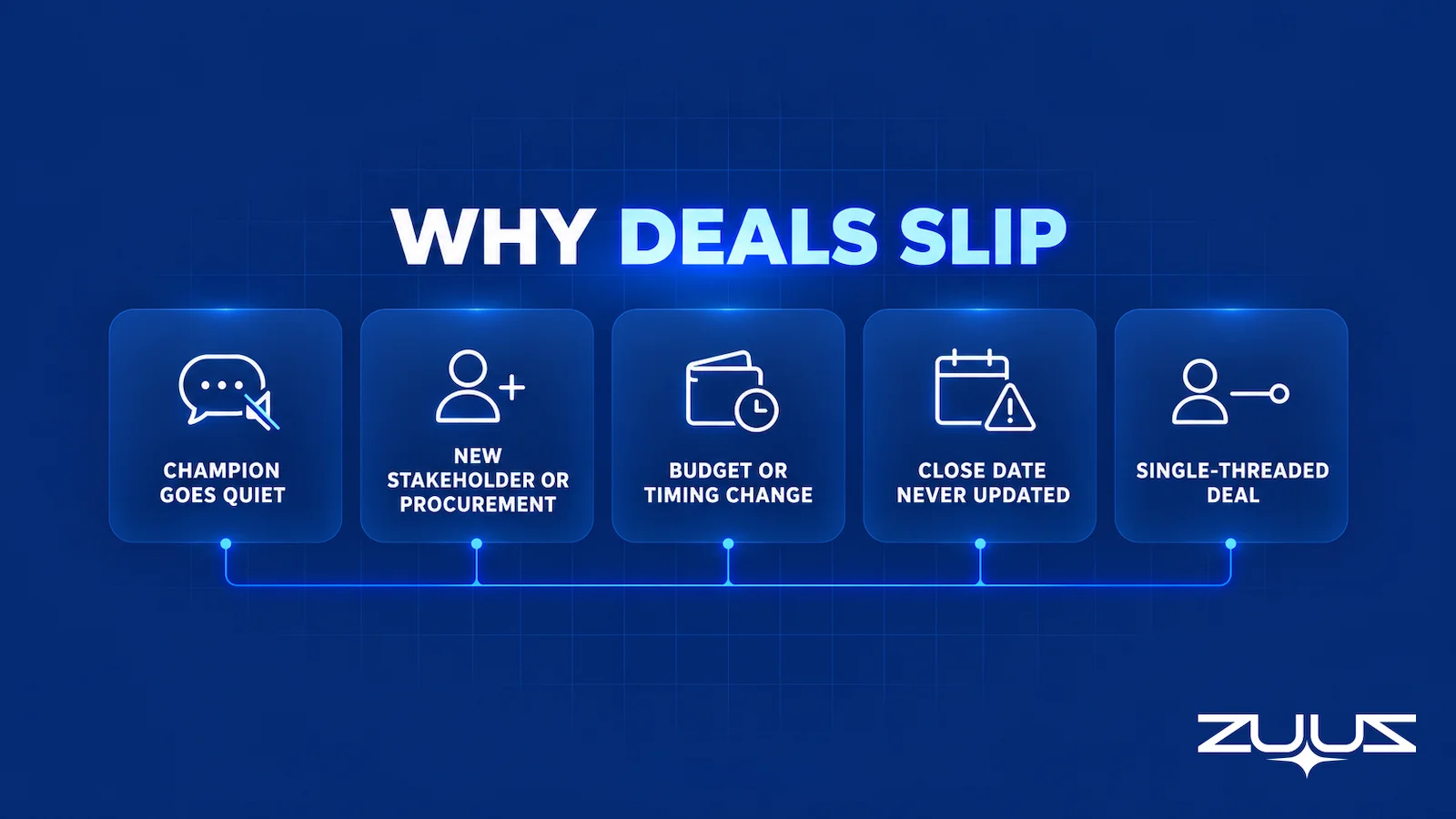
- Five causes account for most slipped deals: a champion going quiet, a new stakeholder or procurement step, a budget or timing change, a close date nobody updated, and a single-threaded deal.
- Each cause leaves evidence in a conversation before the CRM changes, so the early warning window sits in email and meetings, not in stage fields.
- ZUUZ runs on top of Salesforce, HubSpot, Zoho, Attio or Pipedrive and flags slipping deals with the reason behind each flag. It does not forecast or score deals.
- ZUUZ connects to the sales inbox, reads LinkedIn messages and meeting or call transcripts, and writes leads, stakeholders, next steps and renewal signals into the CRM for the rep to approve in one click, which is how a slipping deal reaches the record while there is still time to act on it.
Picture the last week of a quarter at a sixty-person software reseller. The sales leader has eleven deals due in the period. By Wednesday, four of them carry new close dates in the following quarter, and in every case the rep can point to an email, weeks old, where the buyer wrote something like “we need to run this past procurement” or “budget is being reviewed after the reorg.” The deals did not change on Wednesday. The CRM did. The scene is an illustration, but most sales leaders have lived a version of it.
That lag, between the moment a deal starts to slip and the moment the record admits it, is what this guide is about. It covers the deal slippage meaning in plain terms, how to calculate a deal slippage rate with a formula that holds up in a pipeline meeting, why deals slip as an operator sees it, and how to catch and reduce deal slippage before the close date moves.
What Is Deal Slippage?
Deal slippage is what happens when an open deal’s expected close date moves out of the period it was due in, usually from one month or quarter into the next. The deal is not lost. It is still open, often still at the same stage, and the buyer may still intend to buy. It simply will not close when the pipeline said it would, so every plan built on that date, from quarterly bookings to hiring and capacity, now describes something that will not happen on time.
Slippage in sales is sometimes used loosely for any deal that goes worse than expected, but the useful definition is narrower. A slipped deal is defined by a date change: its close date sat inside the period at the start, and by the end of the period the deal was still open with a date outside it. That narrow definition is what makes deal slippage measurable, and measurable is what makes it manageable.
Slipped, Stalled and Lost Deals Are Different Problems
Three words get used interchangeably in pipeline meetings, and they call for different responses. A stalled deal has stopped progressing: no buyer reply, no next step, no stage movement for longer than it should take. A slipped deal has had its close date pushed out of the period, whether or not it is still moving. A lost deal is closed, because the buyer chose someone else or chose to do nothing.
The overlap causes most of the confusion. A stalled deal often becomes a slipped deal, because nobody updates the close date until the quarter forces it. But a deal can slip while very much alive, for example when the buyer adds a security review that genuinely takes six weeks. The guide to deal management software covers stall patterns in detail. This guide focuses on the date, because the date is what slips.
Why Deal Slippage Matters More Than It Looks
A single slipped deal looks like a timing detail. A pattern of them changes how a team runs. Quarter-end plans get built on deals that were never going to land, managers spend the last two weeks chasing signatures instead of coaching, and deals that slip once tend to slip again, because whatever pushed them the first time is usually still there.
Slippage also hides inside healthy-looking totals. The pipeline figure can stay flat week after week while the deals underneath it quietly roll forward into the next period. There is a cost on the buyer side too: a rep who has not noticed a deal slipping keeps pushing for a signature the buyer cannot give, which reads as not listening. The seller who notices early can adjust the plan with the buyer instead of against them.
How to Calculate Deal Slippage Rate
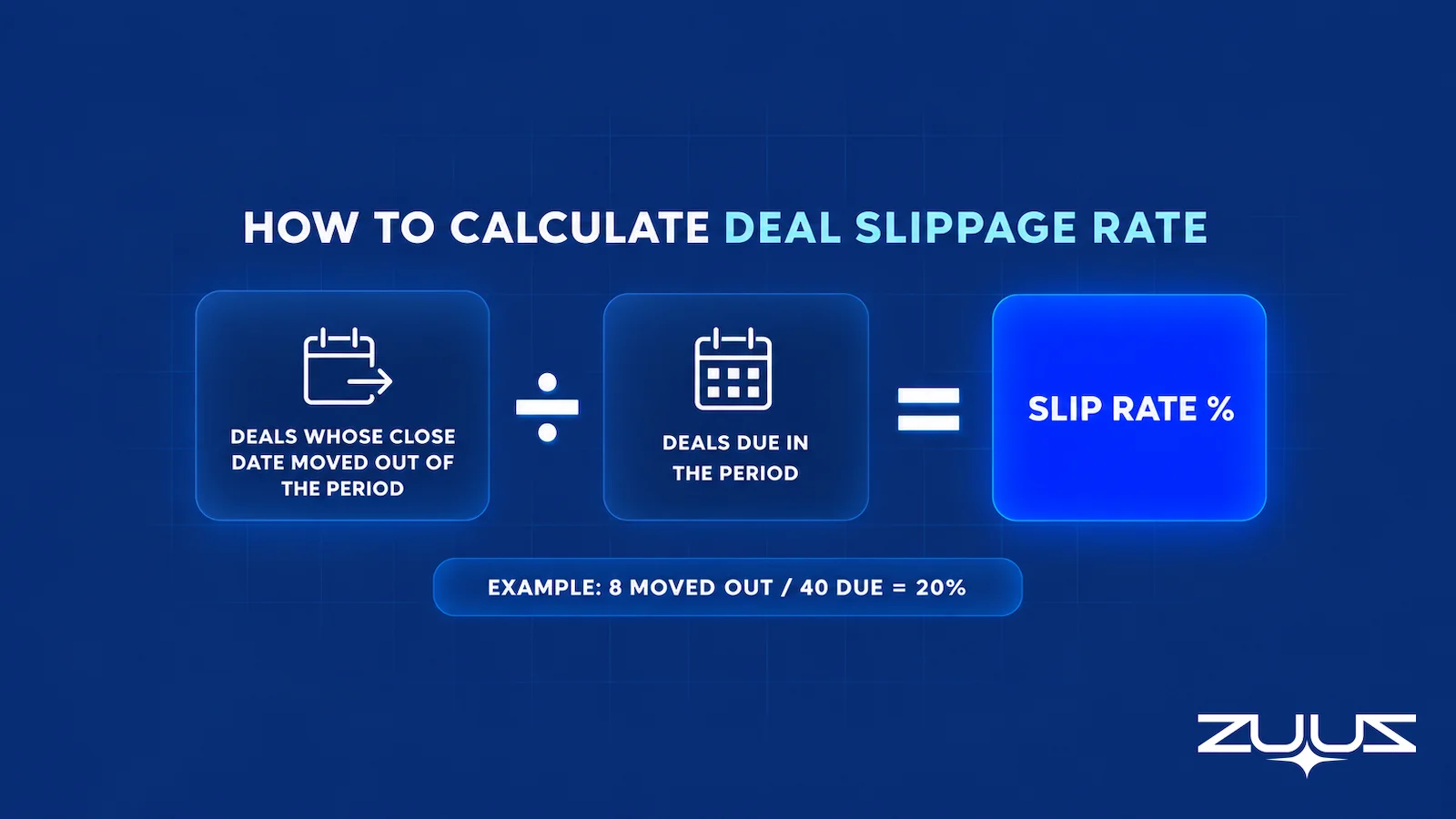
Deal slippage rate, also called deal slip rate or simply slip rate, measures the share of deals due in a period that were pushed out of it instead of closing. The formula is simple, and keeping it simple is the point. A slippage metric that needs a paragraph of caveats will not survive a pipeline meeting.
Deal slippage rate = (deals whose close date moved out of the period / deals that were due in the period) x 100
Deals that were due in the period means the open deals whose close date sat inside the period at a fixed starting point, such as the first business day of the quarter. Deals whose close date moved out of the period are the ones from that starting list that are still open at the end of the period with a close date in a later period. Won and lost deals are not slips, whatever their dates did along the way.
Freeze the Starting List
The most common mistake is measuring against a moving list. If deals added mid-quarter join the denominator, a busy quarter looks like a low-slip quarter simply because the list got longer. Take a snapshot of the deals due at the start of the period, keep it, and measure only those deals at the end. Deals created or pulled into the period later can be tracked on a separate line.
History matters for the same reason. Most CRM fields only hold their current value, so a close date that moved in week three and moved back in week nine leaves no trace unless something recorded it. HubSpot documents how to view a record’s property history, and Salesforce supports historical trend reporting that compares a set of opportunities across snapshot dates. The guide to CRM reporting covers how to set up weekly snapshots when the CRM keeps no history on close date.
A Worked Example
The table below is an illustration of one quarter for a small B2B sales team, not a real company’s numbers. It starts from a frozen list of 40 deals due in the quarter and shows where each one ended up.
| Line (illustration) | Deals | Value |
|---|---|---|
| Deals due this quarter, frozen on day one | 40 | $2,400,000 |
| Closed won in the quarter | 20 | $1,150,000 |
| Closed lost in the quarter | 12 | $610,000 |
| Still open, close date moved to a later quarter | 8 | $640,000 |
| Slip rate by count | 8 / 40 = 20% | |
| Slip rate by value | $640,000 / $2,400,000 = about 27% | |
By count, the slip rate is 20%. By value it is about 27%, which says the larger deals slipped more often than the smaller ones. That gap is worth more attention than either number alone, because it usually points at the causes covered below. Larger deals carry more stakeholders, more procurement steps and more exposure to budget reviews.
Count Repeat Slips and Past-Due Dates
Two refinements keep the metric honest. First, count how many times each deal has slipped, not just whether it slipped. A deal on its third new close date is a different conversation from a deal that moved once for a clear reason. Second, treat any deal still open at the end of the period with a close date in the past as slipped. Leaving it out rewards the reps who never update the field, which is the opposite of what the metric is for.
How to evaluate a fix for deal slippage
- Does it show slippage while the period is still open, or only report it after the quarter has closed?
- Does every flag arrive with the evidence behind it, the dated message or meeting, so a manager can check it against the conversation?
- Is there a capture layer that gets buyer signals out of email, LinkedIn messages and meeting or call transcripts and into CRM fields without a rep typing them?
- Do those signals land in fields a pipeline report can read, or in an activity feed somebody has to open deal by deal?
- Does it run on the CRM the team already has, with no migration and no change to how reps sell?
- Does it stop at showing evidence, rather than handing out a score or a probability nobody can audit?
What a Deal Slip Rate Tells a Sales Leader
There is no dependable public benchmark for a good deal slippage rate. Figures quoted online vary widely, rarely say how they were measured and mix sales motions that have little in common. The useful comparison is internal: this quarter against the last four, one segment against another, one stage against the next. A slip rate that rises quarter over quarter is a signal wherever it started.
Cut It by Stage, Segment and Deal Size
Slip rate becomes diagnostic when it is broken down. By stage, it shows where close dates are least credible. A high slip rate among early-stage deals usually means dates were set as placeholders, while a high rate in late stages points at procurement, legal or budget steps nobody mapped. By segment and deal size, it shows whether larger buyers need longer, differently planned cycles.
By rep, used carefully, it shows who sets optimistic dates. That is a coaching conversation, not a disciplinary one, and it goes better when the rep can see the same evidence the manager sees.
Pair the Rate With a Reason
A slip rate on its own says how much, never why. The number becomes useful once every slipped deal carries a short reason, captured when the date moves: procurement added, budget frozen, champion left, date never confirmed. After a quarter or two, the reasons show whether the fix sits in qualification, in multi-threading, in close plans or simply in keeping records current. The guide to sales pipeline management software covers how teams structure stages and fields so reasons like these are captured consistently.
Slipped Deals Leave a Trail Long Before the Date Moves.
ZUUZ reads email and LinkedIn messages and writes stages, stakeholders and next steps into Salesforce, HubSpot, Zoho, Attio or Pipedrive, so the record reflects a slip when it starts.
Why Deals Slip, as Operators See It
Most lists of why deals slip describe symptoms: poor qualification, weak urgency, a long sales cycle. Those are true and not very actionable. Seen from inside a sales team, the causes are more specific, and five of them account for most of the slipped deals a sales leader reviews in a quarter. Each one has a moment when it becomes visible, and in almost every case that moment is in a conversation.
ZUUZ was built around that observation. Avinash Gujje scaled Cloud Box Technologies from $0 to $25M ARR in IT services and distribution, a business where the details that move a deal, such as a revised quantity, a new approver or a changed go-live date, usually arrive in writing. In that kind of sale, the reason a deal moves is written down somewhere before anyone touches a field. The five causes below are that pattern broken into parts.
1. The Champion Goes Quiet
The most common first sign of a slipping deal is a champion who stops replying at the pace they used to. Replies that came in hours now take days, meeting invites get accepted and then moved, and messages get shorter. Sometimes the champion has lost the internal argument, sometimes they have been pulled onto another priority, and sometimes they have left the company.
Each of those needs a different response, and none of them changes a CRM field on its own. The trap is that the record often still looks busy. The rep keeps sending follow-ups, each one logged as activity, so the deal shows recent engagement while the buyer side of the conversation has gone silent. Days since the last buyer reply is a far better measure here than days since the last activity.
2. A New Stakeholder or Procurement Step Appears
A deal that was moving with one or two contacts suddenly gains a new name on the thread: a procurement lead, someone from IT security, a finance approver, a legal reviewer. Each addition is a new step with its own timeline, and a close date set before that person appeared was built without them. Gartner describes the typical buying group for a complex B2B solution as involving six to 10 decision makers, a useful reminder of how many people a single close date quietly depends on.
The signal is almost always an email. A buyer writes that the contract needs to go through vendor onboarding, copies a new person on a reply, or mentions that the security team wants a questionnaire completed. Until someone adds that contact to the deal and reconsiders the date, the CRM shows the old plan.
3. Budget or Timing Changes in Email or a Meeting
Buyers usually say when timing changes, just not in the CRM. Phrases like “let’s revisit after the budget review,” “the rollout is on hold until the new VP starts” or “we are looking at next quarter now” turn up in emails, LinkedIn messages and meetings. The rep hears it, means to update the deal later, and moves on to the next conversation.
These are the clearest slippage signals because they are explicit. The buyer has told the seller the date is wrong. What turns an explicit signal into a slipped deal is the gap between hearing it and recording it, which is why the same deal can be a surprise in the pipeline meeting and old news in the rep’s inbox.
4. A Close Date the Rep Never Updated
Some slipped deals were never going to close in the period. The close date was set when the deal was created, often as the end of the current quarter because that was the default or the hope, and nobody revisited it when the conversation made clear it was not realistic. The date did not slip so much as it was never real.
This cause is mostly a data entry problem rather than a sales problem. Updating close dates competes with selling for the same hours, and the updates that get skipped are the ones that do not feel urgent on the day. The guide to reducing manual data entry with CRM automation explains why asking reps to type more rarely fixes this, and the breakdown of why a CRM pipeline is wrong traces the same gap across the whole pipeline.
5. Single-Threaded Deals
A deal that runs through one person is exposed to everything that happens to that person. If the only contact goes on leave, changes role or loses budget authority, the deal has no other path forward, and the rep often does not find out until the next scheduled check-in goes unanswered. Single-threaded deals slip more because one quiet inbox is enough to stop them.
Multi-threading is not just about adding contacts to the record. It means the rep has an active conversation with more than one person who cares about the outcome, ideally including someone with budget authority. A deal with three named contacts, only one of whom has ever replied, is still single-threaded.
Slipped Deal, or a Close Date That Was Never Real?
Before treating every slipped deal as a sales failure, separate two situations. In the first, the buyer committed to a timeline and something changed. In the second, the timeline was the seller’s hope, recorded as if it were the buyer’s plan. Both show up identically in a slip rate report, and they need very different fixes.
A close date is credible when it is tied to something the buyer has confirmed: a dated decision meeting, an agreed evaluation plan, a known budget cycle, the contract end date on the product being replaced. It is a placeholder when it is the end of the quarter with nothing behind it. A useful test in a pipeline meeting is to ask what the buyer said, and when, that supports the date. If the answer is nothing specific, the deal has not slipped yet, but it will.
How Stale Records Make Old Delays Look New
Stale records add a third situation that looks like slippage and is really a reporting lag. A buyer pushed the timeline in an email a month ago, the rep updated the date this week, and the change appears in this week’s report as fresh news. The pipeline review treats it as a new slip when the slip happened weeks earlier.
Comparing the date the field changed with the date of the conversation that caused it separates real slips from late updates. The CRM data quality checks that compare records with source conversations catch this pattern directly, and they are worth running on every deal that slipped last quarter.
Deal Slippage Signals Show Up in Conversations First
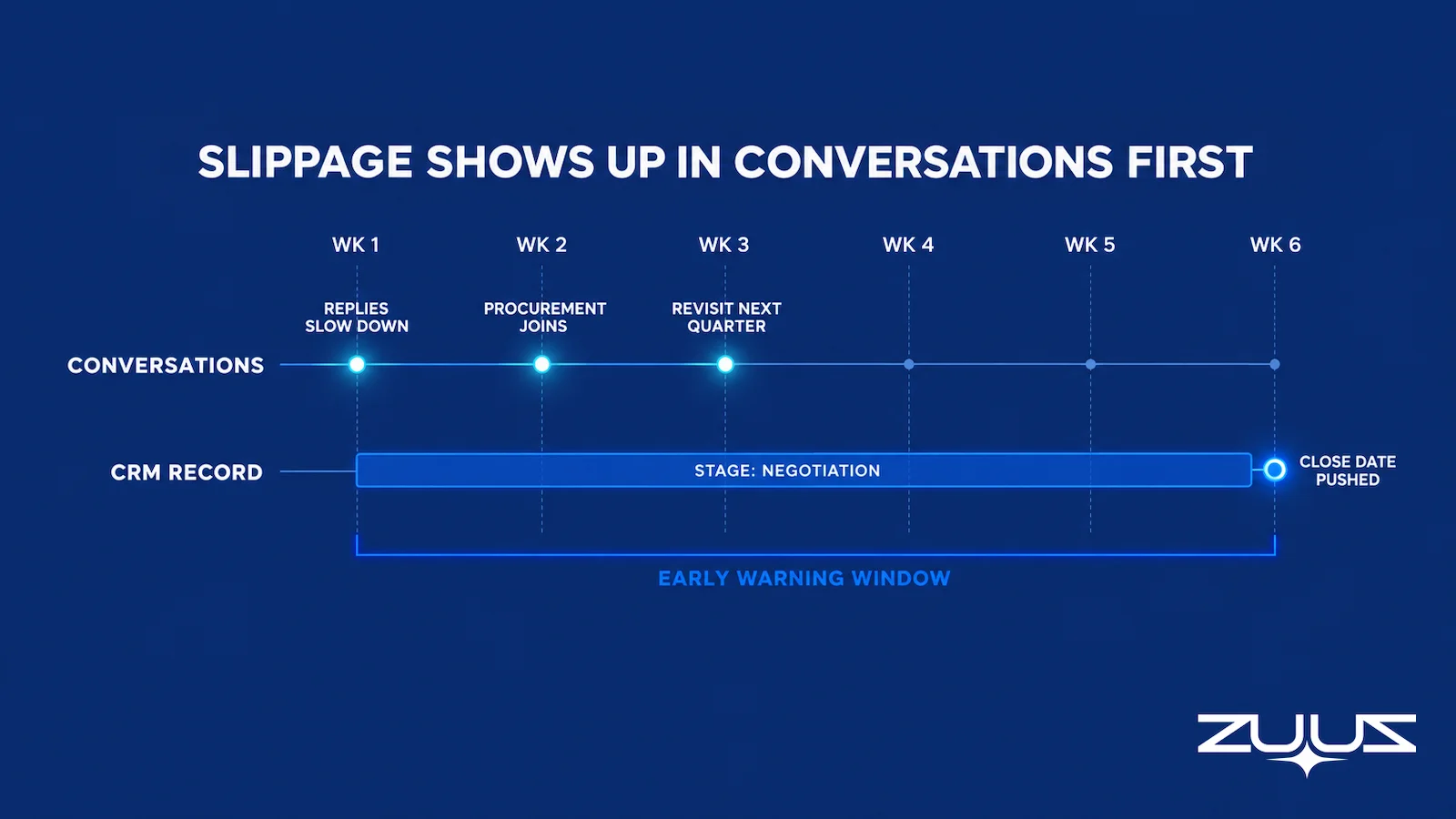
Every cause above has something in common. The first evidence appears in a conversation, and the CRM reflects it later, sometimes weeks later, sometimes only when the quarter ends. That delay is the early warning window. A team that watches conversations has the whole window to act, while a team that watches stage fields has almost none of it.
| Slippage signal | Where it first appears | What the CRM shows | What ZUUZ writes to the record |
|---|---|---|---|
| Champion replies slow from hours to days | Email and LinkedIn threads | Recent activity logged by the rep, so the deal looks engaged | Last buyer reply date and the days since it, on the deal, with the thread behind it |
| Meeting accepted, then moved or declined | Calendar and email | Next step unchanged, or dated in the past | Next step and date proposed from the calendar change, for the rep to approve |
| Procurement, legal or security contact copied on a thread | Same contacts on the deal, no new step | The new contact created on the deal with its role, plus a dated next step | |
| “Let’s revisit after the budget review” | Email or a meeting conversation | Close date still in the current period | A timing change proposed against the close date, with the sentence it came from |
| Buyer asks for pricing on a smaller scope | Amount unchanged | Scope and amount change flagged on the opportunity for the rep to confirm | |
| Champion changes role or leaves | LinkedIn, a bounced email or an out-of-office reply | Primary contact still listed as active | Contact change recorded and the account flagged as single-threaded |
| Only one buyer contact has ever replied | Email threads | Several contacts on the record, so the deal looks multi-threaded | Replying contacts counted, so the deal reads as single-threaded instead of multi-threaded |
The right-hand column is the problem in one line each. Almost every signal that predicts deal slippage exists before the record changes, and the record changes last because a person has to notice the signal, interpret it and type it in.
LinkedIn deserves a mention of its own. Buyers increasingly move conversations there, particularly champions who are changing roles, and those messages almost never reach the CRM without a deliberate step. The guide on how to log LinkedIn messages in a CRM covers that gap.
Why Stage Fields Lag Behind
Stage fields are designed to move forward when something is achieved: a demo held, a proposal sent, a verbal yes. They are not designed to move when a deal gets harder, so a deal can sit in Negotiation for weeks while the timeline underneath it changes completely. Close dates have the opposite problem. They can change at any time, but only when someone remembers to change them.
Neither field is built to register the moment a buyer’s plans shift, and that is why slippage feels sudden. From the record’s point of view, nothing happened until the day the date moved. From the buyer’s point of view, they said so weeks ago.
See the Slip While There Is Still Time to Act.
Nobody changes how they work. ZUUZ turns buyer emails and messages into structured CRM updates and hands reps finished work to approve in one click.
How to Catch Deal Slippage Early
Catching slippage early is less about new metrics and more about looking at the right evidence at the right cadence. The goal is to find every deal due this period where the latest buyer conversation no longer supports the date, while there is still time to do something about it.
Run a Weekly Slippage Check on Deals Due This Period
Once a week, list every open deal due in the current period and put the latest buyer-side evidence next to each one: the date of the last buyer reply, the next dated step the buyer agreed to, and anything the buyer said about timing, budget or approvals. Deals where that evidence is missing or contradicts the close date go to the top of the list. The guide to running a sales pipeline review covers how to fit this into a thirty-minute meeting.
Watch Buyer Behavior, Not Rep Activity
Three measures catch most early slippage. The first is days since the last buyer reply, not the last logged activity. The second is next steps that are overdue or have no date at all. The third is new contacts on the buyer side who are not yet on the deal. Each can be checked from email and calendar data, and each moves before the close date does.
Rep activity still matters, but as context rather than evidence. Ten follow-up emails in a week with no reply is not an active deal; it is a deal where one side is working and the other has gone quiet.

Ask the Questions That Test the Date
In the review itself, three questions do most of the work. What did the buyer last say about timing, and when? Who else has to approve this, and has anyone spoken to them? What has to happen between now and the close date, and is each step dated?
A rep who can answer all three from recent conversations has a credible date. A rep who answers from memory or optimism has a deal that is about to slip, and the right move is to go back to the buyer this week rather than wait for the quarter to decide.
The Pipeline Truth Test
A slip rate tells a leader what already happened. This test asks a harder question: whether the number on the board this week can survive being questioned. It takes about twenty minutes per rep, and it is worth running before a forecast call rather than after one.
- Take the top five deals by value in the current quarter.
- For each, find the evidence in the CRM for its stage and close date – a dated, written commitment, not a rep’s assurance.
- Count how many rest on a stage last changed more than two weeks ago.
- A pipeline in which most of the top five lack dated evidence is a forecast of rep optimism. ZUUZ does not forecast; it makes the record underneath the number real.
As an illustration, run the test on the eleven deals from the opening scene. The largest one carries a stage that last moved five weeks ago and a close date nobody can trace to anything the buyer wrote; the only dated commitment in the file is an email introducing procurement, which implies a later date, not this one. Three of the five fail on step two. That is deal slippage, visible weeks before any close date moves, and it is the same list worth walking into the weekly check above.
How to Reduce Deal Slippage
Knowing how to reduce deal slippage mostly comes down to fixing the causes above one at a time. None of the fixes is new. What makes them work is applying them to the deals due this period, every week, rather than as a quarterly clean-up.
Tie Close Dates to Buyer-Confirmed Milestones
Set the close date from the buyer’s plan, not the seller’s quarter. Work backward from the date the buyer needs the solution live, through contract signature, procurement, security review and final approval, and confirm each step with the buyer. A mutual close plan shared with the buyer turns an assumed date into an agreed one, and it makes a change visible the moment a step moves.
Multi-Thread Early and Ask About Procurement Before the Proposal
Build relationships with more than one person on the buyer side before the deal reaches its late stages, including someone with budget authority. Ask early who else will be involved in approving the purchase, and whether vendor onboarding, a security questionnaire or a legal review applies. Procurement steps that are known in week two rarely cause a slip. Steps discovered in the final week almost always do.
Update the Close Date the Day the Buyer Changes It
When a buyer signals a timing change, the record should change the same day, with a short reason. That habit alone removes most of the gap between real slips and reported slips. It is also the habit that breaks down first in a busy week, which is why teams that depend on reps typing updates tend to see slippage surface late. The guide on how to shorten the sales cycle covers the related work of removing delays between a buyer’s signal and the seller’s response.
| Cause | Question to verify with the buyer | What to update in the CRM |
|---|---|---|
| Champion goes quiet | Is this still a priority, and has anything changed internally? | Last buyer reply date, risk reason, a second contact |
| New stakeholder or procurement step | Who else approves, and what does their process involve? | New contact on the deal, new dated step, revised close date |
| Budget or timing change | When is the budget decision, and what does it depend on? | Close date, reason for the change, amount if scope changed |
| Close date never updated | What date does the buyer’s own plan support? | Close date taken from the confirmed milestone plan |
| Single-threaded deal | Who else should be part of the next conversation? | Additional active contacts, with roles |
The table works as a checklist for any deal on the weekly slippage list. The middle column is what the rep asks, and the right-hand column is what should change in the record afterward.
Catch Slipping Deals Without Asking Reps to Type More.
ZUUZ flags deals where the conversation has moved and the record has not, with the reason behind each flag, on top of the CRM the team already runs.
What to Do When a Deal Slips
Some slippage is unavoidable, and a slipped deal is not a lost one. What matters is how the team handles it. A deal that slips with a clear, buyer-confirmed reason and a new dated plan is a timing change. A deal that slips because nobody knows what happened is a warning.
Reset the Date From Fresh Evidence
Never move a slipped deal’s close date by a default amount, such as the end of the next quarter, just to clear it from the current period. That creates the next slip. Reset the date only after a conversation with the buyer that establishes what changed and what the new plan is, and record the reason alongside the new date.
Requalify Deals That Slip Twice
A deal on its second or third new close date deserves a harder look. Check whether the original problem is still there, whether the budget still exists and whether the champion still has influence. Some of these deals should be closed as lost or moved to a nurture stage, which keeps the pipeline honest and frees the rep’s time. Deals that slip every quarter and are never resolved are one form of revenue leakage: value the pipeline counts, quarter after quarter, that never converts.
Learn From the Pattern
At the end of each quarter, group slipped deals by reason. If most slipped because procurement appeared late, the fix is in discovery. If most slipped because dates were never real, the fix is in how close dates are set. If most slipped because buyer signals were not recorded, the fix is in capture, and no amount of coaching on qualification will change it.
From an operator’s seat
Across the deployments ZUUZ runs, the pattern is that the first slipping-deal flag a team argues with is the quiet champion, because the deal looks busy. The activity count on the record is high; what nobody had noticed is that every recent message went outbound and the buyer has not replied for weeks. Direction of the last message turns out to say more about slippage than any amount of logged activity, and it is the field almost no CRM puts on a pipeline view by default. The part teams do not plan for is the first week after connecting: a 90-day lookback hands a manager a list of deals whose close dates were never real, some of them due in a quarter that has already ended, and somebody has to decide what to do with them before the next pipeline review. Teams that fix the order – reset the dates first, requalify second – get through that list in an afternoon; teams that try to do both at once stall on the third deal.
Deal Slippage: How ZUUZ Surfaces Slipping Deals Before the Date Moves
ZUUZ is an AI layer that sits on top of the CRM a team already runs. It is not a CRM, and it works with Salesforce, HubSpot, Zoho, Attio and Pipedrive, which stay the system of record. ZUUZ connects to the sales inbox and reads email and LinkedIn messages, read-only, along with Microsoft Teams meeting transcripts where connected, and writes structured records back to the CRM. Nobody changes how they work. Reps keep selling in email and on LinkedIn, and ZUUZ hands them finished updates to approve in one click.
Three parts of ZUUZ address deal slippage directly. Pipeline Capture reads deal progression signals across email and other channels and writes stages, stakeholders and momentum to the CRM, so a new procurement contact or a buyer’s “revisit next quarter” reaches the deal record instead of staying in a thread. Pipeline Risk Monitoring surfaces stalled deals and flags pipeline health issues, such as a champion who has stopped replying or a close date the conversation no longer supports. The Analytics module then reports on what actually happened: what changed this week, pipeline at risk in dollars and follow-through on committed next steps, with the reason behind each at-risk deal, such as “no reply in 16 days” or “next step overdue.”
What ZUUZ does not do matters as much. It does not forecast revenue, predict whether a deal will close or give deals a numeric health score. It shows the evidence, meaning the message, the date and the change it implies, so a sales leader can check each flag against the conversation. Slippage is treated as pipeline risk and close-date hygiene that a manager can act on this week, rather than a probability to be taken on trust. Teams that want to ask about a deal directly can use the AI CRM assistant side of ZUUZ, which answers from the same captured data.
The approach shows up in the pipeline itself. RA Technologies, a US IT services company, had run HubSpot for two years; ZUUZ ran on the same instance with the same team and surfaced $120K in pipeline within 72 hours that the CRM had never seen, captured from the sales mailbox. On first connection ZUUZ looks back over 90 days of email, so deals that were already drifting before a team connects are part of the picture from the start. At Cloud Box Technologies, inbound email turns into leads and renewals, and leadership sees live pipeline.
Where to Start This Quarter
Start with one number and one list. Freeze the list of deals due this quarter today, and at the end of the quarter calculate the deal slippage rate by count and by value, with a reason for every slipped deal. In the meantime, run the weekly check on that same list: last buyer reply, next dated step, and what the buyer last said about timing.
After one quarter, the reasons column will say where slippage in this team actually comes from. If it is late procurement and single-threaded deals, the fix is in how deals are run. If it is timing changes that sat in inboxes for weeks, the fix is in getting conversations into the CRM, and slipped deals will stop feeling like surprises.
The First Step, Concretely
Before changing any process, connect one mailbox. ZUUZ reads the last 90 days of that inbox and the rep reviews what it found, the deals, the new stakeholders and the timing changes that never reached the CRM, before anything is written to a record. That review is usually the fastest version of the slippage audit described above, because it surfaces the dates the conversations never supported. There is a 30-day free trial with no credit card required.
Frequently Asked Questions
What does deal slippage mean?
Deal slippage means an open deal’s expected close date moves out of the period it was due in, usually from one month or quarter into the next. The deal is not lost and may still be progressing; it simply will not close when the pipeline said it would. Slippage is defined by the date change, which is what makes it measurable as a slip rate.
How do you calculate deal slippage rate?
Divide the number of deals whose close date moved out of the period by the number of deals that were due in the period at its start, then multiply by 100. For example, 8 slipped deals out of 40 due is a 20% slip rate. Freeze the starting list so deals added mid-period do not dilute the result, and calculate it by value as well as by count.
What is the difference between deal slip rate and win rate?
Win rate measures the share of closed deals that were won. Deal slip rate measures the share of deals due in a period whose close date was pushed out instead of closing. A team can have a healthy win rate and a high slip rate, which usually means deals eventually close but rarely when planned, a sign that close dates are not tied to the buyer’s real plan.
What is a good deal slippage rate?
There is no dependable public benchmark, because published figures rarely explain how they were measured and mix very different sales motions. The most useful comparison is internal: this quarter against the previous four, and one segment, stage or deal size against another. A slip rate that rises quarter over quarter deserves attention wherever it started, especially when slipped deals share a reason.
Why do deals slip at the end of the quarter?
Deals slip at quarter end mostly because the slippage happened earlier and was only recorded then. A champion went quiet, a procurement step appeared or the buyer mentioned a budget review, and the close date stayed put until quarter end forced the update. Other causes include close dates set as placeholders and single-threaded deals that stop when one contact does.
What are the early warning signs that a deal will slip?
The earliest signs appear in conversations: champion replies slowing from hours to days, meetings being moved, new procurement or security contacts joining a thread, and buyers mentioning budget reviews or next quarter. Overdue next steps and deals where only one buyer contact has ever replied are also strong signals. Most appear weeks before the CRM stage or close date changes.
How do you reduce deal slippage?
Reduce deal slippage by tying close dates to buyer-confirmed milestones, multi-threading deals early, asking about procurement, security and legal steps before the proposal, and updating the close date the day the buyer signals a change. A weekly check of deals due this period against the latest buyer evidence catches most slips while there is still time to act.
How do you track deal slippage in a CRM?
Track deal slippage by snapshotting the deals due at the start of each period and comparing their close dates at the end. Turn on field history for close date where the CRM supports it, so each change is timestamped, and add a reason field for every pushed date. A report of deals whose close date has moved more than once highlights repeat slips.
Should deals added mid-quarter count toward slip rate?
Not in the main slip rate. Measure only the deals that were due in the period at its start, so a busy quarter with many new deals does not look like a low-slip quarter. Track deals created or pulled into the period later on a separate line, and note any deal that was pulled forward and then slipped, since that usually signals an optimistic date.
What should a sales manager do when a deal keeps slipping?
Requalify it. Confirm the original problem still exists, the budget is still available and the champion still has influence, and ask the buyer directly what has to happen before signature. Reset the date only from a dated plan the buyer agrees to. If none of that holds, close the deal as lost or move it to nurture to keep the pipeline honest.
Does ZUUZ forecast which deals will slip?
No. ZUUZ does not forecast, predict win probability or score deals. It runs on top of Salesforce, HubSpot, Zoho, Attio or Pipedrive, captures email and LinkedIn conversations into the CRM, and flags at-risk deals with the reason behind each one, such as no reply in 16 days or a next step overdue, so managers can check the evidence themselves.