
How to Run a Sales Pipeline Review That Reflects Reality
A sales pipeline review is only as honest as the data behind it. Get a working agenda, a reusable pipeline review template, and the metrics that matter.

CEO of ZUUZ. He scaled Cloud Box Technologies from 0 to $25M ARR in IT services and distribution before building ZUUZ. Connect on LinkedIn
TL;DR: A sales pipeline review inspects open deals, tests whether the next step is real, and decides where the team spends the coming week. Most reviews are limited long before the meeting starts, because the records under discussion were refreshed from memory the night before. ZUUZ monitors pipeline risk as an execution layer over Salesforce, HubSpot, Zoho, Attio or Pipedrive, flagging engagement decay, missed next steps, and stakeholder changes with the evidence behind each flag, and it does not perform sales forecasting.
- A pipeline review is a recurring inspection of open deals, not a status readout and not a forecast meeting.
- The ceiling on any review is set by how current the CRM records were when the meeting opened, which is why data freshness is a precondition rather than an agenda item.
- A workable agenda spends most of its time on three to five deals instead of scrolling the whole board.
- The metrics worth reviewing are the ones attached to a decision, such as stage conversion, time in stage, and slippage against a committed close date.
- Good deal questions ask for evidence the buyer produced, not for a confidence rating the rep produced.
- ZUUZ monitors pipeline risk across Salesforce, HubSpot, Zoho, Attio or Pipedrive at the same time, and it does not forecast revenue.
It is 9:05 on a Monday and twenty open opportunities are on the shared screen. The manager asks where things stand on the largest one. The rep says it is looking good, legal has the paperwork, and the room moves on to the next row. Three weeks earlier, in the same meeting, the same deal got the same answer.
Nothing about that exchange is unusual, and nothing about it is useful. The stage field says Negotiation, the close date says the end of the quarter, and the last logged activity is a call summary typed in a hurry the previous evening. Every question asked in the meeting is answered from that record, so the meeting can only be as accurate as the record was.
This article covers what a sales pipeline review is for, an agenda and a reusable template teams can copy, the deal questions and metrics worth the meeting’s time, and why the preparation matters more than the facilitation.
What a Sales Pipeline Review Is Supposed to Do
A sales pipeline review is a recurring working session in which a sales manager and a rep inspect open opportunities, test whether each one is still moving, and agree on what happens next. It is an inspection ritual, not a reporting ritual. The output is a short list of decisions and owners, not an updated slide.
Three jobs justify the calendar time. The first is finding deals that have quietly stopped moving, which is rarely obvious from a stage label. The second is confirming that the next step is a real, dated commitment involving the buyer rather than a task the rep set for themselves. The third is deciding where the rep’s limited selling hours go over the next five working days.
The meeting is often confused with two adjacent ones, which is part of why so many of them drift. A forecast review asks how much will close and when, and it answers to finance. A deal review or deal desk session goes deep on the commercial shape of a single large opportunity, usually with legal and pricing in the room. The pipeline review sits between them and answers a narrower question about deal movement.
| Meeting | Core question | Primary audience | Typical cadence |
|---|---|---|---|
| Pipeline review | Which open deals are actually moving, and what happens next? | Rep and their manager | Weekly |
| Forecast review | How much lands this period, and at what confidence? | Sales leadership and finance | Weekly or monthly |
| Deal review | Is this specific opportunity commercially sound? | Deal team, legal, pricing | Ad hoc, by deal size |
| Territory or account review | Is coverage aimed at the right accounts? | Rep, manager, RevOps | Quarterly |
Salesforce makes a similar distinction in its own guidance on running productive pipeline review meetings, which argues for cutting the team-wide version in favor of focused one-to-one sessions. That structural advice is sound. It also assumes the underlying records describe reality, which is the assumption worth examining.
Why Most Pipeline Reviews Inspect Fiction
Reps do not update the CRM as deals happen. They update it before the review, from recall, in a single sitting. That timing is the least reliable moment in the entire week to reconstruct what a buyer said, because the detail that mattered was in a thread three days ago and the reconstruction happens under time pressure.
What survives that reconstruction is the shape of the deal, not its state. The stage advances because it felt like it should. The close date moves to the end of the quarter because that is the tidy answer. The next step becomes “follow up,” which is a rep-owned intention rather than a buyer-owned commitment. None of these fields are lies, and all of them are unreliable in exactly the way that matters during an inspection.
The consequence is that a well-facilitated meeting over stale records is a well-facilitated meeting about fiction. Better agendas do not fix it, because an agenda governs the questions and not the answers. This is the same drift documented in more detail in the root causes of inaccurate CRM pipeline data, and it compounds every week the review runs on top of it.
Analytics inherit the problem rather than solving it. A stage conversion rate calculated across records whose stages were set from memory is a precise number computed on an unreliable input. Most published pipeline review advice treats CRM hygiene as one checklist item inside the agenda, usually a few minutes near the top. Treating it that way is the error. Deal state being current is the precondition for the review to mean anything, and it belongs to the week rather than to the meeting, which is why CRM data quality is a pipeline problem before it is a reporting problem.
How to evaluate whether your pipeline review can work
- Dated buyer evidence. Can every stage and close date on the board be traced to something the buyer wrote, with a date on it?
- A capture layer. Does anything put the deal thread into CRM fields without the rep retyping it, across the sales inbox, the calendar, LinkedIn messages and meeting or call transcripts?
- Fields, not feeds. Does captured activity land in fields a report can filter, or only in an activity feed someone has to open deal by deal?
- Selection by query. Can the priority list be generated as a saved report, such as no buyer activity in fourteen days or a close date that has moved twice, rather than by scrolling?
- History retained. Does the record keep prior stages and prior close dates instead of overwriting them silently?
- Rep correction in one click. When something is written for the rep, can the rep fix it or roll it back in one click after it saves?
Walk Into the Review With Current Deal State.
See how ZUUZ reads the deal thread and writes structured updates back to the CRM during the week, so Monday’s review starts from what happened rather than from what the rep remembers.
The Pipeline Review Agenda That Fits Thirty Minutes
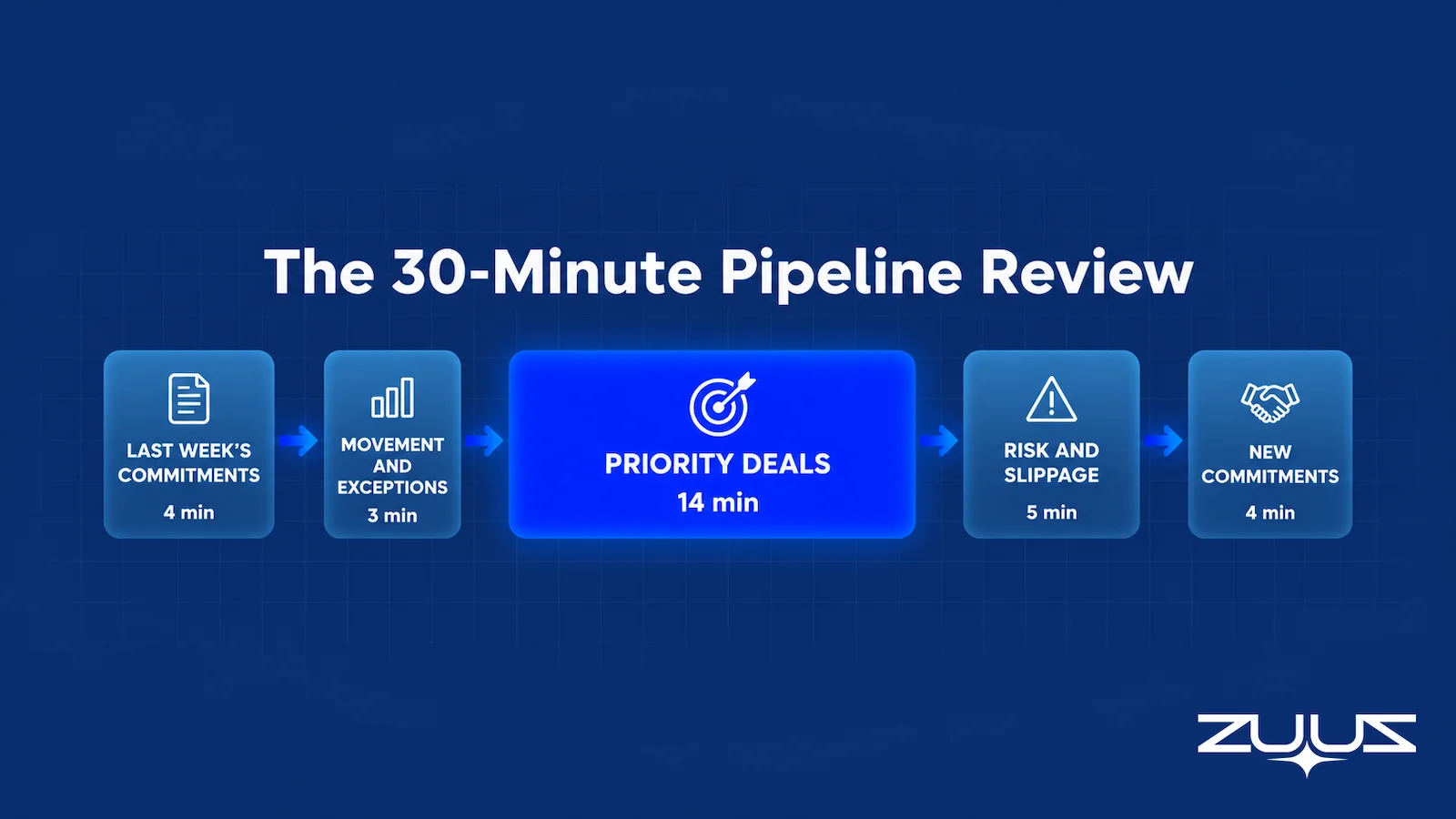
A weekly one-to-one review runs comfortably in thirty minutes when the agenda is fixed and the preparation is done in advance. The failure pattern is the open-ended scroll through every open opportunity, which spends the whole slot on recitation and leaves nothing for the deals that needed attention. Time should be allocated deliberately, with the largest block reserved for a handful of deals chosen before the meeting.
The selection rule matters more than the timings. Deals earn their slot by exception rather than by size, which means a stalled mid-sized opportunity outranks a large one that moved twice last week. Reviewing three to five deals properly beats touching twenty superficially, and it is the single change that most reliably makes the meeting worth attending.
| Block | Minutes | What happens | Output |
|---|---|---|---|
| Last week’s commitments | 4 | Which actions from the previous review happened, and what changed as a result | Carry-forward decisions |
| Movement and exceptions | 3 | What changed since the last review, including newly created deals and deals that did not move at all | The exception list |
| Priority deals | 14 | Three to five deals inspected against the question set, evidence first | Revised stage, date, and next step per deal |
| Risk and slippage | 5 | Deals whose committed close date has already moved once, and deals that have gone quiet | Recovery play or a decision to disqualify |
| New commitments | 4 | Read back the actions, each with an owner and a date | Written action list |
Two rules protect the structure. Nothing enters the priority block that was not selected before the meeting, which forces the preparation to be real. Nothing leaves the commitments block without a named owner and a date, because an action item without both is a topic rather than a commitment.
The opening block is the one most often cut, and cutting it is what lets the same deal receive the same answer for three weeks running. Reviewing last week’s actions is not a formality, because the question is not whether the task was completed but whether it changed the deal’s position. A rep who sent the follow-up email and heard nothing back has completed the action and learned something important, and that outcome belongs at the top of the meeting rather than buried in the deal discussion.
A Pipeline Review Template Teams Can Copy
A pipeline review template is a fixed set of fields captured for every deal that reaches the priority block. Its value is consistency across weeks and across reps, because the same fields week after week make drift visible in a way that free-form notes never do. The table below can be rebuilt as a spreadsheet, a CRM report, or a shared document without losing anything.
| Field | What it captures | What makes the entry valid | What ZUUZ can fill before the meeting |
|---|---|---|---|
| Account and opportunity | The deal under inspection | Links to the CRM record, not a name typed from memory | Matched to the existing CRM record rather than created again |
| Value and stage | Amount and current stage | The amount has been revised at least once since creation | Stays the rep’s call; ZUUZ flags when the thread and the stage disagree |
| Days in current stage | How long the deal has sat where it is | Calculated from the record, not estimated | Read from the CRM timestamps, nothing to enter |
| Last buyer-side activity | The most recent thing the buyer did, and when | A buyer action, not a rep action | Captured from the connected sales inbox, LinkedIn messages and meeting or call transcripts |
| Next step | The next dated commitment | Involves the buyer and has a specific date | Written from the dated commitment in the thread automatically, with full change history and one-click rollback |
| Economic buyer | Who signs | Named, and the rep has spoken to them | Stakeholders on the thread are written to the record; who signs is confirmed by the rep |
| Champion and status | Who advocates internally | Named, with the date of last contact | Date of last contact captured; the read on whether they are still advocating stays human |
| Close date and history | The committed date and how often it has moved | Prior dates retained, not overwritten silently | Any date the buyer named in writing is surfaced next to the field |
| Primary risk | The one thing most likely to kill it | Stated as a specific condition, not “timing” | Evidence surfaced, such as a competitor named or a procurement hold; the wording stays the rep’s |
| Ask | What the rep needs from the manager | Actionable this week, or left blank | Not captured. This one belongs to the rep |
Two of these fields do most of the work. Days in current stage exposes deals that look active because they were touched but have not actually progressed. Close date history exposes the slip pattern, since a date that has already moved twice is a different kind of risk than one that has held since the deal was created. Salesforce documents how opportunity close dates behave in its own records, and HubSpot exposes comparable stage and date history through its pipeline management tooling.
A short preparation checklist sits alongside the template and belongs to the rep, not the meeting. Confirm every open deal has a next step with a date in the future. Confirm any close date in the past has been corrected or the deal disqualified. Flag every deal with no buyer-side activity in the last two weeks. Nominate the three to five deals for the priority block, and note the ask for each.
One caution applies to any template kept outside the CRM. The moment a spreadsheet holds values the CRM does not, it has become a second source of truth, and the review starts arbitrating between two versions of the same deal. The fields that exist in the CRM should be pulled from it rather than retyped, leaving the template to hold only the judgement fields and the meeting’s own decisions.
The Deal Questions That Change the Answer
Most pipeline review questions invite a summary, and a summary is what reps are best at producing under pressure. Questions that ask for evidence produce a different meeting, because evidence either exists or it does not. The distinction is between asking how a deal feels and asking what the buyer did.
The strongest question in the set is the simplest one. What did the buyer do most recently, and when. A deal where the buyer has taken no action in three weeks is in a different state than a deal where the buyer forwarded pricing internally on Thursday, regardless of what the two records say about stage. Per-deal risk signals of this kind are covered in more depth in the guide to deal management software.
Underneath every question in the table is one distinction. Seller activity is not buyer progress. Proposal sent, demo delivered, and follow-up email logged are all things the rep did, and a pipeline can be full of them while no buyer has committed to anything. Stage criteria written in terms of seller activity will always be satisfiable without the deal moving, which is why the useful version of an exit criterion names something the buyer has to do.
| What it tests | Ask this | Not this |
|---|---|---|
| Buyer engagement | What was the last thing the buyer did, and on what date? | How is the deal going? |
| Next step reality | What is scheduled, with whom, and on which day? | What is the next step? |
| Stage validity | What did the buyer do that moved this into its current stage? | Are we still in Negotiation? |
| Authority | Who signs, and when did the rep last speak with them directly? | Are we talking to the decision maker? |
| Champion strength | What has the champion done internally without being asked? | Do we have a champion? |
| Competitive position | What alternatives has the buyer named, in their own words? | Are we in a competitive deal? |
| Close date credibility | What has to be true for this date to hold, and who controls it? | Will this close this quarter? |
| Disqualification | What would have to happen for this to be removed from the pipeline? | Should we keep this open? |
A useful habit is to run the last question on every deal in the priority block. Pipelines inflate because removing a deal feels like a loss, so opportunities linger for months in an active stage with no buyer behind them. Asking what would justify removal, out loud, every week, keeps the board honest and makes the remaining coverage number mean something.
Bring Evidence to the Meeting, Not Recollection.
ZUUZ surfaces the deals that have gone quiet along with the thread activity behind each flag, so a manager can inspect what the buyer did instead of asking the rep to remember it.
How to Conduct a Pipeline Review Using Analytics
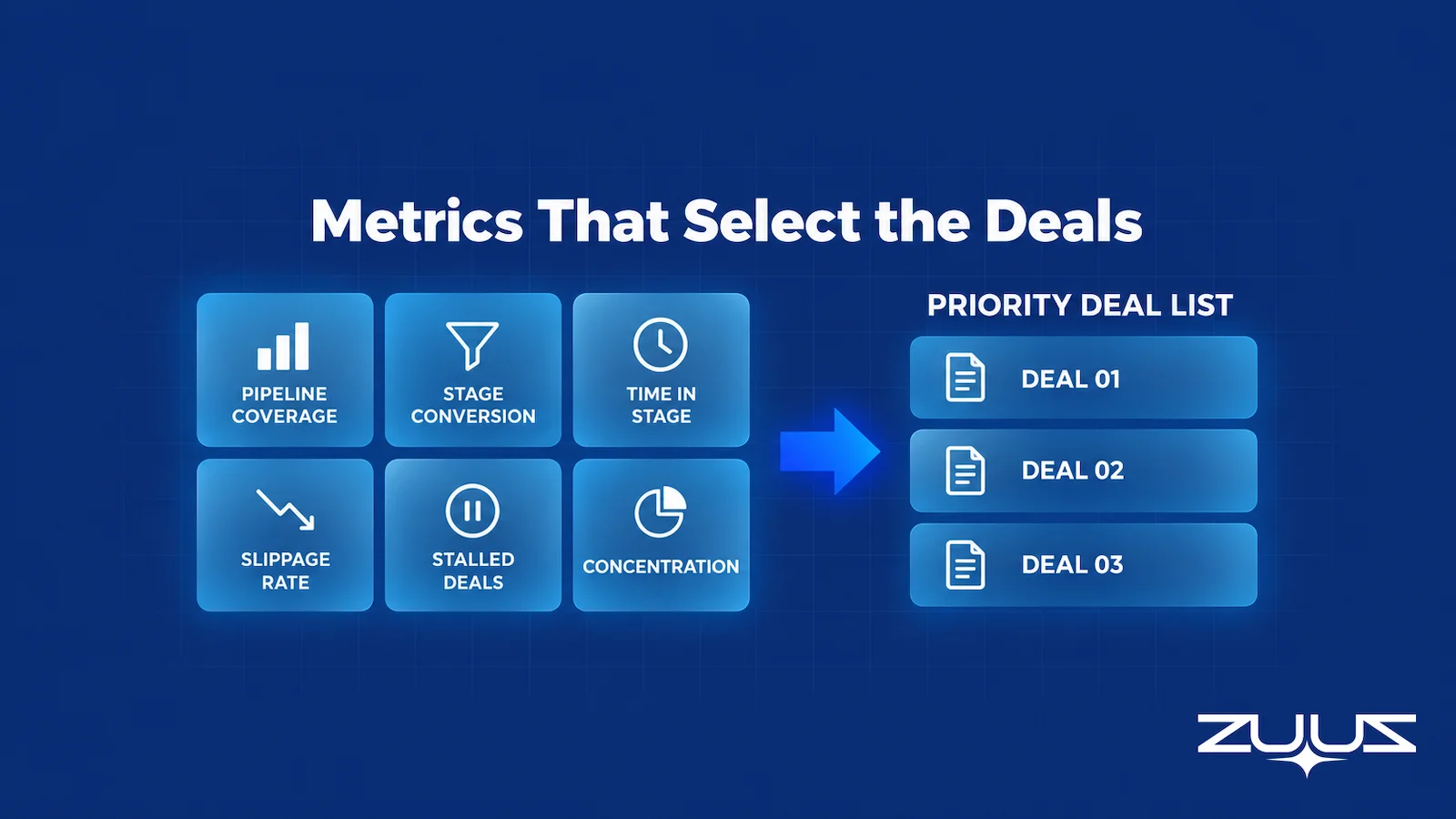
Analytics belong in a pipeline review as a way to select what gets inspected, not as a way to conclude the meeting. The useful metrics are the ones that point at a specific deal or a specific stage and prompt a decision this week. Metrics that summarize the quarter belong in the forecast review instead.
| Metric | What it answers | The decision it prompts |
|---|---|---|
| Pipeline coverage | Is there enough open value against the target? | Shift effort toward creation or toward closing |
| Stage conversion rate | Where do deals stop progressing? | Fix the stage exit criteria or the qualification ahead of it |
| Average time in stage | Which deals have sat past the normal dwell time? | Select the exception list for the priority block |
| Deal slippage rate | How often do committed close dates move? | Tighten what qualifies a deal to carry a date at all |
| Stalled deal count | How many deals have no buyer-side activity? | Run a recovery play or disqualify |
| Win rate by source | Which origins produce deals that close? | Redirect prospecting and qualification effort |
| Deal velocity | How fast does value move through the pipeline? | Target the stage adding the most cycle time |
| Concentration | How much of the period depends on a handful of deals? | Escalate coverage on the deals carrying the quarter |
Three cautions apply. Every metric here is computed from CRM records, so each one carries the freshness problem described earlier, and a coverage ratio built on opportunities nobody has disqualified in four months overstates the position. Time in stage holds up best of the set precisely because it derives from timestamps rather than from a judgement a rep typed in. And coverage has no universal target, despite how often a single multiple gets quoted as one, because the number that means safety depends on the team’s own historical win rate, cycle length, and deal mix.
Analytics also work better as a selector than as a scoreboard. Running a saved report before the meeting that returns every deal with no buyer activity in fourteen days, or every deal whose close date has moved more than once, produces the priority list without argument. Teams building this out usually do it inside their existing reporting layer, and the wider tooling category is mapped in the guide to sales pipeline management software.
The Pipeline Truth Test
Before rewriting the agenda, run this once against the current board. It takes about twenty minutes and it answers a narrower question than any best practice does: is this review inspecting deals, or inspecting recollection?
- Take the top five deals by value in the current quarter.
- For each, find the evidence in the CRM for its stage and close date, a dated, written commitment, not a rep’s assurance.
- Count how many rest on a stage last changed more than two weeks ago.
- A pipeline in which most of the top five lack dated evidence is a forecast of rep optimism. ZUUZ does not forecast; it makes the record underneath the number real.
Worked example. A renewal-plus-expansion opportunity sits in Proposal with a close date on the last Friday of the quarter. The CRM holds one rep-created task, “follow up with procurement”, and a stage that last changed five weeks ago. The thread holds a procurement reply asking for a revised scope and a security questionnaire, neither of which is in a field. The deal fails step two and step three, so the right use of its slot in the review is establishing the next dated commitment, not debating how confident the rep feels.
Best Practices for Pipeline Review Meetings
The best practices for pipeline review meetings that hold up in practice are mostly about constraint. A fixed agenda, a small number of deals, evidence-first questions, and a written action list cover most of the value. Everything else tends to be local preference.
Run the review one to one wherever possible. Group reviews turn into performance, because a rep asked to describe a struggling deal in front of peers has an incentive to describe it favorably, which is the opposite of what an inspection needs. Where a group session is genuinely useful, such as reviewing a shared pursuit, it should be scheduled separately and framed as coaching rather than inspection.
Keep the cadence stable and the duration short. A thirty-minute weekly slot that never moves produces better data than a ninety-minute session that gets rescheduled twice a month, because reps prepare for meetings that reliably happen. Manager preparation matters equally, and reviewing the exception report before the call is what allows the meeting to open with a specific question rather than a general one.
Make moving a deal backward a normal outcome. When a review can only advance stages or hold them, reps learn that admitting a deal regressed is a cost with no benefit, and the pipeline inflates one optimistic stage at a time. A manager who responds to a stage regression with the next question rather than with pressure gets more accurate records from that rep for the rest of the year, which is worth considerably more than the number the board showed that week.
The habits that break these meetings are consistent across teams. The scroll through every open deal. Accepting “following up” as a next step. Letting the meeting become a forecast negotiation, where the discussion turns into whether a number can be committed rather than whether a deal is real. Treating a completed action as progress when the action produced no response from the buyer. Ending without written owners and dates. And treating the CRM update as something that happens because the review is coming, which is where the whole problem started.

The 90 Day Pipeline Review and the RevOps Rollup
The weekly review is one rung on a ladder, and confusing the rungs is a common reason the weekly session drifts. Each level asks a different question over a different time horizon, and each one needs the level below it to have been done properly.
A 90 day pipeline review is the quarterly version, and it inspects the shape of the pipeline rather than individual deals. It asks which stages leaked, how much created pipeline actually converted, how far close dates slipped across the quarter, and whether the deals carried forward deserve to be. It is also the natural point to purge, since deals that survived a full quarter without buyer activity are unlikely to be revived by a fourth month of hope. For teams with recurring revenue, the same session is where renewal exposure gets examined alongside new business, which is why renewal tracking tends to sit in the quarterly view rather than the weekly one.
A revops pipeline review is a different job again. It inspects the system rather than the deals, asking whether stage definitions still match how the team actually sells, whether exit criteria are being applied consistently across reps, where data is missing at the point of capture, and whether the reports feeding the weekly reviews are measuring what they claim to. Findings here usually turn into process or configuration changes, not deal actions, and they belong to the wider RevOps stack rather than to any one manager.
| Level | Cadence | Unit of inspection | Owner | Output |
|---|---|---|---|---|
| Deal review | Weekly | Three to five open deals | Rep and manager | Next steps with owners and dates |
| Team rollup | Monthly | Coverage and stage health by rep | Sales leader | Where to reallocate effort |
| 90 day review | Quarterly | Conversion, slippage, and carried-forward deals | Sales leader and RevOps | Purge list and stage-level fixes |
| RevOps review | Quarterly | Stage definitions, data capture, reporting | RevOps | Process and configuration changes |
Quarterly Reviews Are Only As Good As the Weekly Ones.
ZUUZ keeps deal records current across Salesforce, HubSpot, Zoho, Attio or Pipedrive throughout the quarter, so the 90 day review inspects a real pipeline instead of one reconstructed at the end.
How to Automate Sales Pipeline Review Meetings
The question of how to automate sales pipeline review meetings usually gets answered too broadly. The judgement in the meeting, deciding whether a deal is real and what to do about it, is not automatable and should not be. The preparation around it almost entirely is, and that is where the time goes anyway.
Three parts of the ritual automate cleanly. Selecting the deals for the priority block can run as a saved report that returns exceptions rather than a manual scan. Keeping deal state current can happen continuously as conversations occur, rather than in a batch the night before, which removes the recall problem at its source. Circulating the written action list after the meeting, with owners and dates written back onto the deal records, removes the step most often skipped.
Language models have a narrow, honest role here as well. Useful ai prompts for pipeline review work on material the team already has, such as asking a model to summarize what changed on a deal thread since the last review, to draft the questions worth asking given a deal’s stage and dwell time, or to turn meeting notes into structured action items with owners. Prompts that ask a model to score deal health or predict which deals will close are a different matter, because the model is guessing from the same incomplete record everyone else is reading. Teams that want conversational access to their own pipeline usually get more from querying the CRM in plain language than from asking a model to speculate.
What automation cannot do is supply the buyer evidence that was never captured. If the deal thread lives in an inbox and nothing reads it, no amount of report scheduling will put it in the review. That capture gap is the part that has to be closed first, and it is covered in detail in the guide to reducing manual CRM data entry.
From an operator’s seat
Across the deployments ZUUZ runs, the pattern is that the first exception list reads as an accusation, and that first week decides whether the change holds. Many of the deals flagged as quiet are deals a rep called healthy eight days earlier, so the review immediately after capture is switched on runs longer, not shorter, and a manager who treats the list as a performance conversation teaches the team to argue with the record instead of reading it. The part teams do not plan for is the reconciliation in that first week, where the thread and the field disagree about the close date, the owner or the next step, and somebody has to decide which one wins. Doing that pass on one rep’s book first, with the rep checking each correction, gets through it in an afternoon; doing it for the whole team at once turns the afternoon into a fortnight of disputed records.
Pipeline Review Preparation: How ZUUZ Surfaces At-Risk Deals Before the Meeting
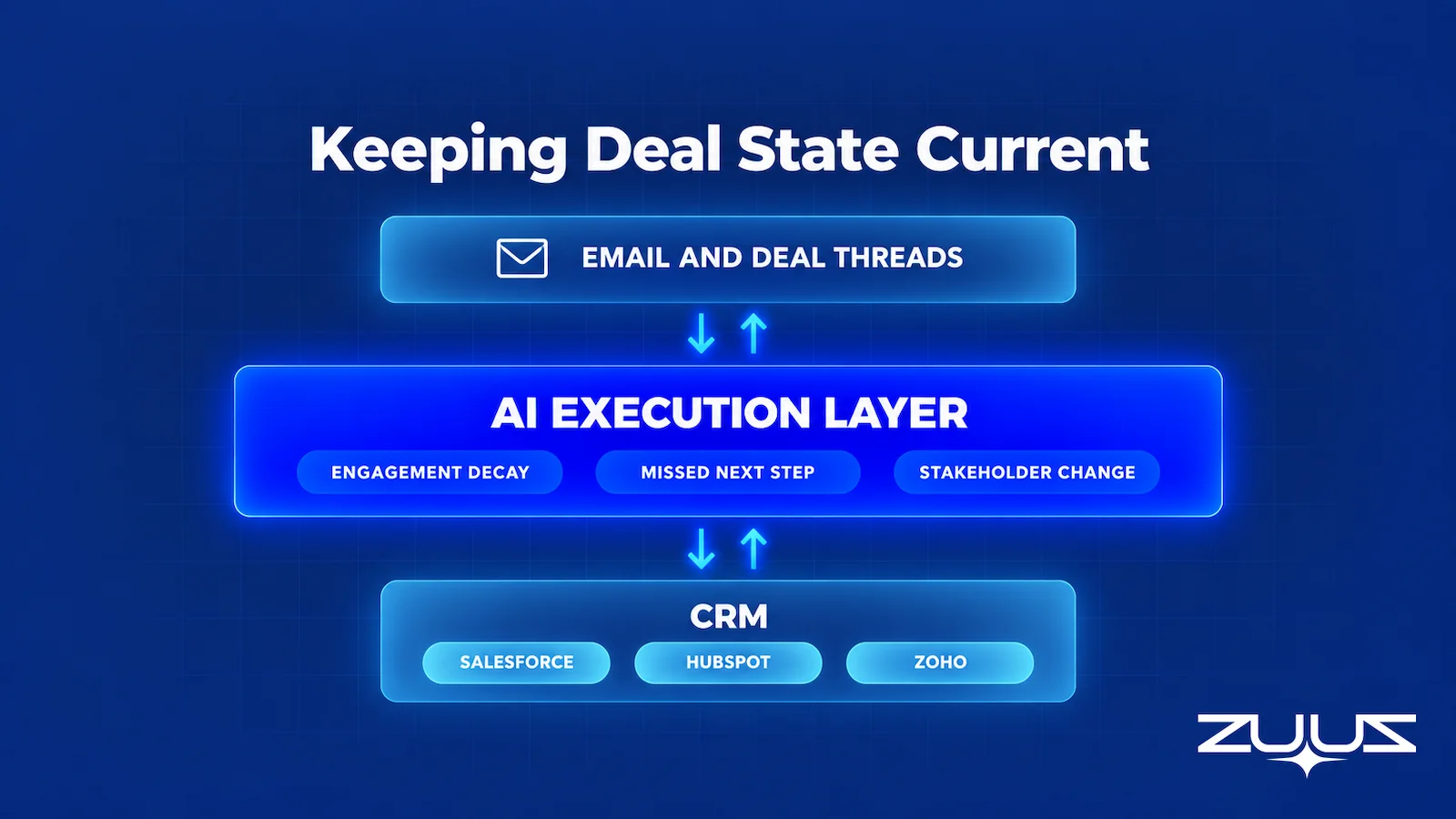
ZUUZ is a revenue intelligence layer that runs on top of an existing CRM rather than replacing it. It reads the email where deals actually happen, captures and scores inbound leads, and writes structured updates back to Salesforce, HubSpot, Zoho, Attio, or Pipedrive. The CRM stays the system of record, and reps keep the interface they already use.
For the pipeline review specifically, the relevant capability is pipeline risk monitoring. ZUUZ watches for engagement decay, missed next steps, and stakeholder changes across open deals, and surfaces the ones that have gone quiet along with the evidence behind each flag. That evidence is the part that changes the meeting, because a flag a manager can trace back to a specific thread is inspectable in a way that a health score is not. ZUUZ does not forecast revenue or predict which deals will close, and pipeline risk monitoring is deliberately a narrower claim than that.
The practical effect is on timing rather than on the agenda. Because updates are written back as conversations happen, the deal state is already current when the review opens, and the meeting does not begin with reconstruction. Updates flow both ways through bidirectional CRM sync, and because ZUUZ is CRM-agnostic it can run across Salesforce, HubSpot, Zoho, Attio or Pipedrive at the same time, which matters for teams that inherited more than one through acquisition.
At RA Technologies, a US-based IT services firm, ZUUZ surfaced $120K in previously unrecorded pipeline within 72 hours of deployment. That value existed in email threads and had never reached the CRM, which means it had never appeared in a pipeline review either. The full deployment is documented in the RA Technologies case study, and the broader pattern of value that never reaches a report is covered in revenue leakage.
Worth stating plainly, because this category blurs it: ZUUZ is a revenue intelligence layer on top of the CRM a team already runs, never a CRM and never a replacement for one. Most tools sold into the pipeline review report on what the rep entered; ZUUZ writes the record the review then inspects.
Frequently Asked Questions
What is a sales pipeline review?
A sales pipeline review is a recurring working session where a manager and a rep inspect open opportunities, test whether each deal is genuinely moving, and agree on the next action for each one. It differs from a forecast review, which answers to finance and asks how much will land. The output is a written list of owners and dates, not a report.
How often should a pipeline review happen?
Weekly is the workable cadence for one-to-one deal inspection, usually in a fixed thirty-minute slot that does not move. Monthly rollups suit team-level coverage, and quarterly sessions suit stage conversion and slippage analysis. Consistency matters more than length, because reps prepare properly for meetings that reliably happen at the same time each week.
What questions should managers ask in a pipeline review?
The most useful questions ask for evidence the buyer produced rather than a summary the rep produced. What did the buyer do most recently and when, what is scheduled with whom and on which date, who signs and when did the rep last speak with them, and what would have to happen for this deal to be removed from the pipeline. Each has a checkable answer.
How do you run a pipeline review using analytics?
Analytics work best as a selector rather than a scoreboard. A saved report run before the meeting returns the exceptions, such as deals with no buyer-side activity in fourteen days or deals whose close date has moved more than once, and those become the priority list. Time in stage is the most reliable of these metrics because it derives from timestamps rather than rep judgement.
What is a 90 day pipeline review?
A 90 day pipeline review is the quarterly session that inspects the shape of the pipeline rather than individual deals. It examines which stages leaked, how much created pipeline converted, how far close dates slipped, and which carried-forward deals deserve to stay open. It is also the natural point to purge opportunities that survived a full quarter with no buyer activity.
What is a pipeline review template and what should it include?
A pipeline review template is a fixed set of fields captured for every deal that reaches the priority block, which makes drift visible week over week. Useful fields include value and stage, days in current stage, last buyer-side activity, the next dated commitment, the economic buyer, close date history, the primary risk, and the rep’s ask. It works equally well as a spreadsheet or a CRM report.
Can pipeline review meetings be automated?
The preparation automates well, and the judgement does not. Selecting exception deals, keeping records current as conversations happen, and writing action items back to the CRM can all run without manual effort. Deciding whether a deal is real and what to do about it stays with the manager and the rep, since that call depends on context no report contains.
Why do pipeline reviews often surface the wrong deals?
Selection usually happens by deal size or by stage label, and both favor deals that look important over deals that have quietly stopped moving. Records refreshed from memory the night before compound it, because a stage that advanced on intuition reads the same as one that advanced on buyer action. Selecting by exception, such as dwell time or absent buyer activity, corrects most of it.
A first step smaller than a rollout. Connect one mailbox. ZUUZ reads the last 90 days and writes what it finds to the CRM automatically, with full change history and one-click rollback. Whatever that surfaces on the top five deals is the honest input for the next pipeline review. 30-day free trial, no credit card: https://zuuz.ai/trial/