
Channel Sales Incentive Programs That Pay for Proof
Channel sales incentive programs only work when payouts rest on proof. See how rebates, MDF and SPIFFs go wrong and how to pay on provable results.


CEO of ZUUZ. He scaled Cloud Box Technologies from 0 to $25M ARR in IT services and distribution before building ZUUZ. Connect on LinkedIn
TL;DR: Channel sales incentive programs are the rebates, market development funds, SPIFFs, tiered margins and registration bonuses an IT vendor or distributor pays partners for results. Most pay on partner-sourced or partner-influenced pipeline, and the evidence of who introduced a deal sits in email threads, not the PRM, so disputes and mispayments come from missing proof. ZUUZ, revenue intelligence for the IT channel, links partner contacts and the threads behind each deal to the CRM record, so incentives are paid on evidence.
- Channel sales incentive programs reward partner behavior, so each incentive is only as fair as the evidence that the behavior happened.
- Rebates, MDF, SPIFFs, tiered margin and registration bonuses fail differently and need different proof.
- Sourced and influenced pipeline trigger most payouts, and the dated introduction behind them usually lives in a mailbox.
- The Pipeline Truth Test checks each payout for a dated, written commitment instead of a rep's assurance.
- ZUUZ is not a PRM or an incentive engine. It puts partner threads and contacts on the CRM deal before money moves.
Picture the channel finance meeting at a networking vendor, an illustration rather than a real client. A regional MSP files a rebate claim saying it sourced three large deals. Sales operations finds that two of the three opportunities were created by the vendor's own account executives. The MSP's channel manager answers with an email from five weeks earlier, in which the MSP introduced the customer.
The rule was fine. The payout is stuck because the proof sits in two mailboxes and no system of record holds it. This guide covers channel sales incentive programs for IT vendors and distributors: the types, how to tie each to provable results, and why disputes trace back to missing evidence.
Five checks before any partner incentive pays out
- Dated trigger. The event that earns the payout has a date that can be shown.
- Named customer and partner contact. The record says who introduced or advanced the deal.
- Linked to the deal. The evidence sits on the CRM opportunity, not in an inbox.
- Counted once. One deal cannot trigger the same reward through two programs.
- Reversible. A wrong record can be traced and corrected.
What Are Channel Sales Incentive Programs?
Channel sales incentive programs are the rewards a vendor or distributor pays partners to produce specific results: new customers, larger deals, faster growth or co-funded marketing. In channel sales for IT vendors, the program is the main lever for steering where MSPs and resellers spend their attention.
Every incentive pays for a behavior. A rebate pays for volume, a market development fund pays for approved marketing, and a registration bonus pays for a deal the vendor did not have. So program quality depends on whether the vendor can prove the behavior happened, on what date, and by whom. The rule sits across the PRM and the CRM (see PRM vs CRM), and its proof often sits in neither.
Types of Channel Sales Incentive Programs Compared
Rebates and volume incentives
A rebate is a retroactive payment to the partner company, usually based on volume or growth over a quarter or year. It fails when the volume counts deals the partner only fulfilled.
Market development funds
MDF is money set aside for partner marketing, released against an approved plan and a claim with proof of performance. It fails when nobody can show which opportunities a paid campaign created.
SPIFFs
A SPIFF is a short-term bonus, often paid to a partner's individual sellers, for closing a product or deal in a set window. It fails when the window opens after a deal was already moving.
Tiered margin and deal registration bonuses
Tiers set discounts and funding by partner level, earned through revenue or sourced pipeline, so one disputed deal can move a partner across a threshold. Registration bonuses, added on top of the pricing protection that deal registration gives, fail when the registration date is treated as the introduction date.
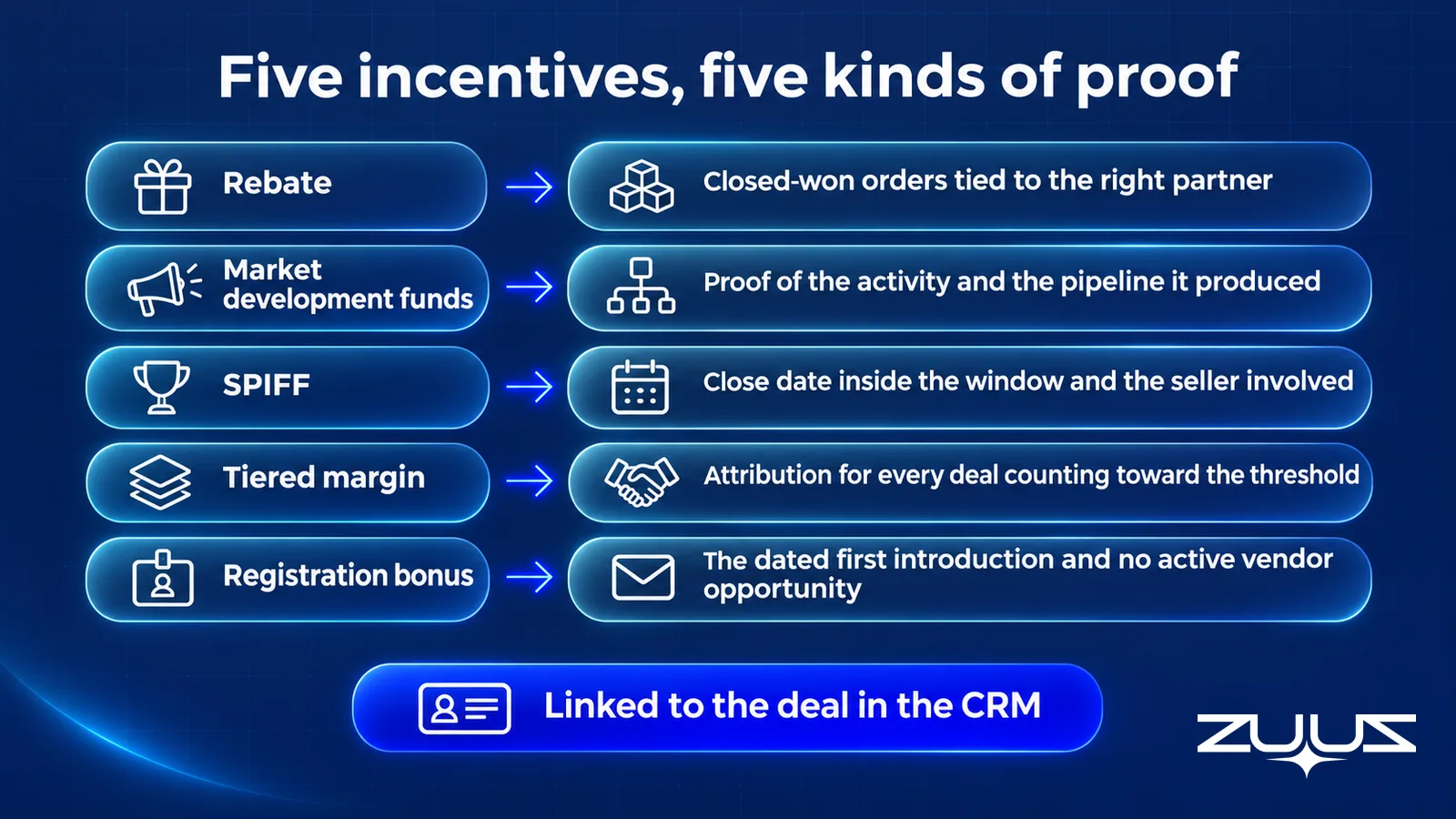
| Incentive type | What it rewards | Evidence it needs | Where it goes wrong |
|---|---|---|---|
| Rebate | Volume or growth over a period | Closed-won orders tied to the right partner | Pays for fulfillment of deals the partner did not originate |
| Market development funds | Approved partner marketing that creates demand | Proof of the activity and the pipeline it produced | Spend is paid but no opportunity traces to it |
| SPIFF | Closing a named product or deal in a window | Close date inside the window and the seller involved | Rewards timing luck on deals already in motion |
| Tiered margin | Reaching a partner level | Attribution for every deal counting toward the threshold | One disputed deal moves a partner across a tier |
| Registration bonus | Bringing in a deal the vendor did not have | The dated first introduction and no active vendor opportunity | Registration date mistaken for the introduction date |
| ZUUZ (evidence layer, not an incentive) | Does not reward or pay anything | Links partner contacts and dated threads to the deal in the CRM | Cannot decide eligibility; the program rules do |
ZUUZ does not design, calculate or pay incentives. It supplies the dated facts the first five rows depend on.
Pay on the Introduction, Not on the Argument.
ZUUZ links partner contacts and the threads where a deal started to the opportunity in Salesforce, HubSpot, Zoho, Attio or Pipedrive, so the proof is on the record before a claim arrives.
How to Design Channel Sales Incentive Programs That Pay for Proof
Good channel sales incentive programs start from the question finance will ask later: what makes this payout defensible?
Pay for sourced and influenced pipeline separately
Partner sourced pipeline means the partner originated the opportunity. Partner influenced pipeline means the partner materially advanced a deal someone else originated. The two deserve different rewards, and a deal that is both pays once. The partner attribution guide covers the models in depth.
Write eligibility in checkable terms
"The partner brought the deal" cannot be audited. "The partner emailed the vendor about a named customer and need, before any vendor opportunity existed, and that email is linked to the opportunity" can.
Decide which date wins
Most incentive disputes are date disputes. The program should state whether the winning date is the first partner email, the meeting, the registration or the opportunity creation, and what happens when they disagree. Where two partners claim one customer, the channel conflict rules should settle who is protected, and the incentive rules should follow.
Why Partner Incentive Payouts Get Disputed
A dispute happens when someone notices the evidence is thin. A mispayment happens when nobody does.
- The vendor already had the account. A partner claims a sourced bonus on a customer the vendor's team had been emailing. The earlier introduction never became a record, so the payout goes to whoever has the cleaner screenshot.
- Two partners, one customer. A distributor and a reseller each hold an email trail with the same end customer, and the first registration is not necessarily the first introduction.
- Influence without a record. A partner says it ran the proof of concept. The meeting sits on a rep's calendar and nowhere on the deal.
- The quiet overpayment. A rebate pays on a deal the partner only processed. No one complains, so the cost never shows in a dispute log. It shows in margin and in partner engagement, because partners who see unclear payouts stop investing.
Make Every Payout Traceable to a Thread.
ZUUZ reads the sales mailbox, calendar, meetings and LinkedIn messages, and keeps partner conversations tied to the account and deal in the CRM the team already runs.
Why the Evidence Lives in Email Threads, Not the PRM
Every incentive rule depends on a dated fact: when the partner first wrote about the customer, which contacts were involved, who brought in a decision maker. Those facts happen in email, calendar invites and LinkedIn messages. The PRM records what partners submit and the CRM what someone types, and the introduction happens before either.
The timing is built into how channel deals move. The partner writes to the vendor rep, they talk for weeks, the rep creates an opportunity once the deal looks real, and the partner registers after that. By then the key date is weeks old and held in two mailboxes. A dated thread proves an introduction happened, not that it caused the sale, but it turns a debate about memory into a review of facts.
The Pipeline Truth Test, Applied to Incentive Payouts
The fastest way to see whether an incentive program rests on evidence is the Pipeline Truth Test, run on the deals that triggered payouts:
- Take the top five deals by value this quarter.
- For each, find the CRM evidence for its stage and close date: a dated written commitment, not a rep's assurance.
- Count how many rest on a stage last changed more than two weeks ago.
- Mostly-undated top five means the number reflects rep optimism. ZUUZ does not forecast; it makes the record underneath the number real.
Worked example for a channel team: take the five largest deals this quarter that triggered a rebate accrual, SPIFF or registration bonus. For each, ask what in the CRM shows when the partner first introduced the customer and when the deal reached its current stage. A deal with a partner name in a field, no dated introduction and a month-old stage means the payout rests on a label.
From an operator's seat
From an operator's seat in IT services and distribution, the pattern Avinash Gujje saw while building Cloud Box Technologies was that incentive arguments are almost never about the size of the reward. Teams spend weeks tuning percentages and tier thresholds, then lose the dispute because nobody can produce the first email. The part teams do not plan for is the hours finance and sales operations spend reconstructing history at payout time, which mostly disappear when the thread was linked to the deal on the day it happened.
Start With One Mailbox and the Last 90 Days.
Connect one channel manager's mailbox and see which partner introductions the CRM never recorded, before the next payout cycle.
Partner Incentive Evidence: How ZUUZ Writes It to the CRM
ZUUZ is revenue intelligence for the IT channel: MSPs and the vendors, distributors and resellers they work with. It is an AI layer on top of the CRM the team already runs, with no migration, and not a CRM, a PRM or an incentive engine. It captures from email, calendar, LinkedIn messages (read-only), Microsoft Teams meeting transcripts and inbound call transcripts, and writes structured records to Salesforce, HubSpot, Zoho, Attio or Pipedrive, which stays the system of record.
For partner deals, the partner's introduction email is linked, with the partner contact, to the account and opportunity. ZUUZ updates the CRM automatically, every change carries history with one-click rollback, and the first connection reads a 90-day mailbox lookback.
RA Technologies, a US IT services company, ran ZUUZ on the HubSpot instance it had used for two years, with the same team, and $120K in pipeline was surfaced within 72 hours that the CRM had never seen. That is pipeline surfaced, not revenue. At Cloud Box Technologies, a UAE cloud and IT services business, 10 to 12 renewals are tracked in minutes from a single connected user, with leadership seeing live pipeline.
ZUUZ does not calculate incentives, decide sourced or influenced credit, process registrations or run a partner portal. It reports what happened, which keeps an IT vendor channel record honest.
Which Channel Teams This Fits, and Which It Does Not
This fits an IT vendor or distributor whose partner deals move through email, meetings and LinkedIn messages, and whose incentive reviews keep returning to "who introduced it first." It does not fit a team looking for a PRM or a rebate calculation engine.
A first step that costs an hour
Before the next payout cycle, run the Pipeline Truth Test on the top five incentive-triggering deals. Then connect one channel manager's mailbox in the free 30-day ZUUZ trial. ZUUZ reads the last 90 days, and the gap between the CRM and the threads shows in minutes.
Frequently Asked Questions
What are channel sales incentive programs?
Channel sales incentive programs are the structured rewards a vendor or distributor pays partners to drive sales results. Common forms are volume rebates, market development funds, SPIFFs, tiered margins and deal registration bonuses. Each pays for a behavior, so a program only works when that behavior can be proven.
What types of channel sales incentives do IT vendors use?
IT vendors typically use five types: rebates paid after a period on volume or growth, market development funds for approved partner marketing, SPIFFs that pay a partner's reps for specific deals or products, tiered margin that sets discounts by partner level, and registration bonuses for protected deals. Most programs combine two or three.
How should a vendor reward partner-sourced and partner-influenced pipeline?
A vendor should pay more for sourced pipeline than influenced, because origination is harder to replace, and should tie both to dated evidence. Sourced pays when the partner introduced a named customer before any vendor opportunity existed. Influenced pays for a recorded contribution such as a proof of concept. Deduplicate so a deal pays once.
What is the difference between a rebate and a SPIFF in channel sales?
A rebate is a retroactive payment to the partner company, usually calculated on volume or growth over a quarter or year. A SPIFF is a short-term bonus, often aimed at the partner's individual sellers, for closing a specific product or deal during a defined window. Rebates shape long-run behavior; SPIFFs move attention quickly.
How do you stop partner incentive disputes?
Stop disputes by writing eligibility rules in dated, checkable terms and capturing the evidence when the event happens, not at payout. Each claim should point to a timestamped introduction, a named customer and a deal record. When the proof is already attached to the CRM opportunity, a review becomes a check of facts instead of a negotiation.
What evidence should support a partner incentive claim?
A sound claim carries four items: the partner's dated first communication about the customer, the named partner contacts involved, the vendor opportunity and its creation date, and a record of any specific contribution claimed, such as a proof of concept meeting. A registration form alone is weak, because it records when the form was filed.
Should channel incentives pay on pipeline or closed revenue?
Most programs pay on closed-won revenue because it is final, and some add a smaller reward when a sourced opportunity reaches a defined stage. Paying on pipeline alone invites inflated submissions. Whichever point triggers the payment, the rule should name the stage, the date field and the evidence that must exist before money moves.
Is ZUUZ a PRM or an incentive management tool?
ZUUZ is neither a PRM nor an incentive management tool. It is revenue intelligence for the IT channel that works on top of Salesforce, HubSpot, Zoho, Attio or Pipedrive. It links partner contacts and the email threads behind each deal to the CRM record, so the vendor's own incentive rules run on real evidence. It does not calculate or pay incentives.