
CRM Data Entry Services and When to Automate Instead
CRM data entry services price the typing by the hour. Compare outsourcing against automated capture with real cost math and a clear break-even point.
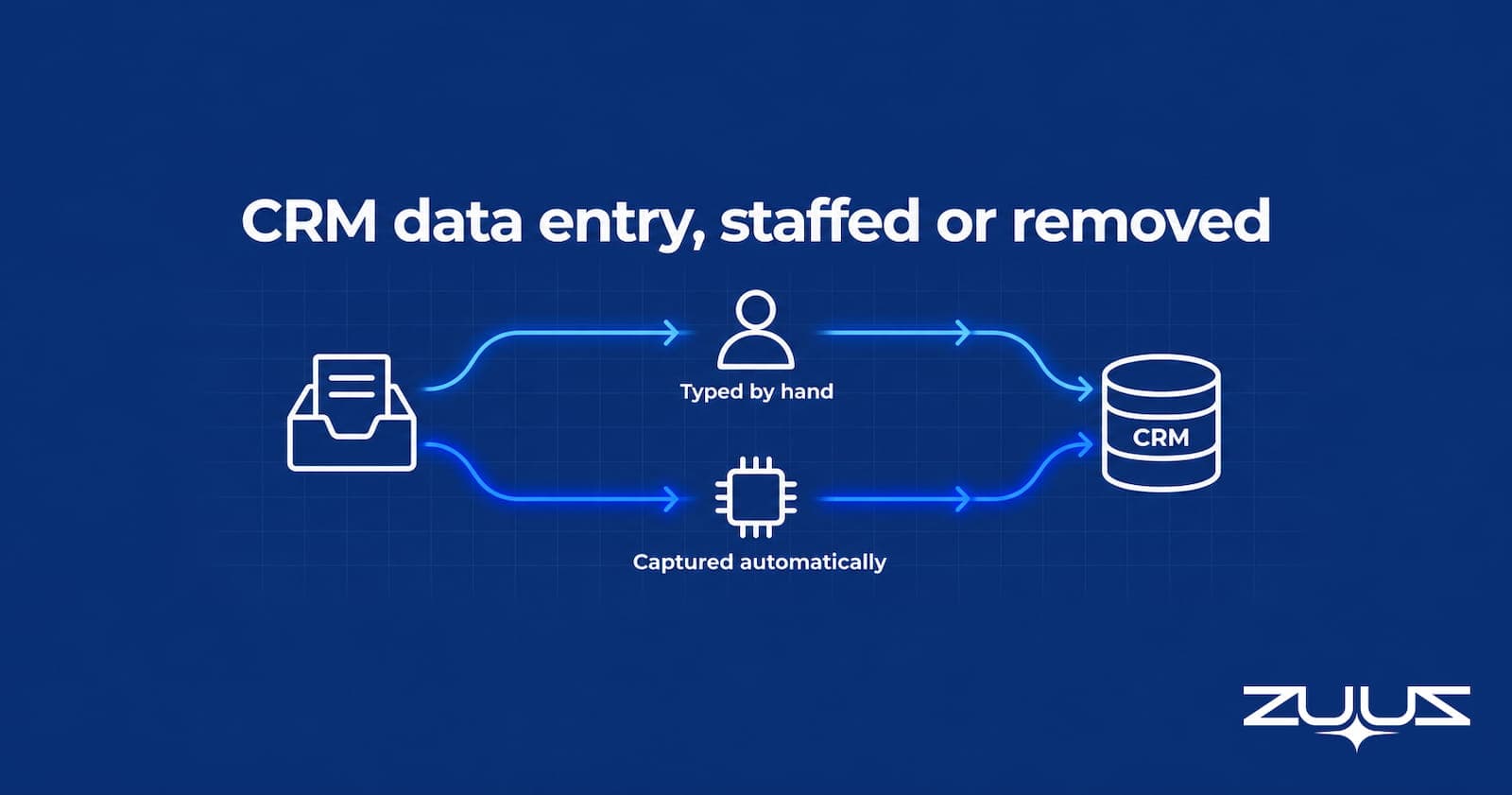
TL;DR: CRM data entry services price the typing by the hour or by the record, and for a finite backlog or a messy migration that is often the correct purchase. For recurring updates that originate in email and calendar, the same budget buys a capture layer that removes the typing instead. The number that settles the argument is cost per correct record delivered inside the window a rep can still act on.
- CRM data entry services and CRM data quality services are different purchases: one enters new activity, the other repairs records that already exist.
- Providers in this category almost never publish rates, so the only honest comparison is between quotes solicited for a workload the buyer has defined field by field.
- Cost per correct record delivered on time, not cost per record, is the single figure that makes human entry and automated capture comparable.
- Outsourcing is the right call for finite migrations, non-digital source documents, judgment-heavy research, and volumes too low to justify software.
- Automation wins when the source is digital and recurring, because human cost stays linear with volume while capture cost flattens after setup.
- ZUUZ reads inbound and outbound email and writes structured updates into Salesforce, HubSpot, or Zoho, removing the entry step rather than staffing it.
- ZUUZ is an AI layer on top of the CRM a team already runs. It connects to the sales inbox, reads LinkedIn messages and meeting or call transcripts, and writes leads, stakeholders, next steps and renewal signals into the CRM for the rep to approve in one click.
Two quotes land on a revenue operations lead’s desk in the same week. One is from a vendor offering a dedicated offshore team to keep the CRM current for a fixed monthly fee. The other is from a software vendor promising the same records will populate themselves from email traffic that already exists.
Both claim to fix the identical symptom, which is a CRM nobody trusts because half the activity never got logged. CRM data entry services and capture automation are not, however, the same purchase, and the choice between them is rarely decided by the headline rate. This guide covers what these services actually deliver, what they cost once the invisible line items are added back, the four situations where paying people to type genuinely beats automating it, and the arithmetic that shows which side of that line a given team sits on.
What CRM Data Entry Services Actually Do
A CRM data entry service supplies people who put information into a CRM on a team’s behalf. The published scope is remarkably consistent across providers: creating and updating contacts and companies, logging calls and meetings, transcribing rep notes, advancing opportunity stages, importing lists captured at events or webinars, and merging obvious duplicates. Most work across Salesforce, HubSpot, Zoho and Pipedrive, either through a limited-permission seat or a shared login.
What actually varies between providers is not the task list but who supplies the source material. In the cheapest arrangements an ops coordinator hands over a spreadsheet, a call list, or a folder of badge scans, and the service types it in. In more expensive arrangements the service is granted inbox or calendar access and does the reading as well as the typing, which is a different job at a materially different price.
The unit of work is not one thing
A five-field contact created from a conference badge and an opportunity update that requires reading a fourteen-message email thread both count as one record on most quotes. They are not the same amount of work, and any quote that does not separate them will drift the moment real volume arrives. Before comparing two proposals, a buyer needs to define monthly volume, the exact fields required per update, the source formats involved, the turnaround window, and what counts as an accepted record.
How this differs from CRM data quality work
Data entry and data quality are adjacent purchases that buyers confuse constantly, and the distinction changes which vendor to call. A data entry service adds information that is not in the system yet. CRM data quality services repair information that already exists through cleansing, deduplication, enrichment, and validation, while CRM data quality consultants design the governance meant to stop it degrading again. A team staring at a full CRM of stale records needs the second category. A team with an empty CRM and reps who never log anything needs the first.
What CRM Data Entry Services Cost
Three pricing models dominate the category. Hourly billing against a dedicated or shared resource is the most common structure for ongoing work. Per-record or per-project pricing shows up on finite jobs such as a migration or an event list. Managed-team retainers bundle a named group, a supervisor, backup coverage, and a service level into a single monthly figure.
Published rates are close to nonexistent. One of the most visible listings in the category, Data Entry Outsourced’s CRM data entry page, documents its workflow in detail across a dozen headings and quotes no rate anywhere, directing buyers to request a quote instead. That is the norm rather than an outlier, which means the only reliable comparison available is between quotes personally solicited against a workload personally defined.
One anchor is public. The US Bureau of Labor Statistics puts the median wage for data entry keyers at 19.88 dollars an hour, or 41,340 dollars a year, in its May 2025 Occupational Employment and Wage Statistics estimates. That number is the domestic floor before benefits, supervision, or a CRM seat, and every offshore quote in this category is priced as a fraction of it. No neutral published rate exists for the offshore side, because every rate card in circulation belongs to a company selling the service, which is one more reason the decisive comparison is against a buyer’s own payroll rather than against another vendor’s proposal.
| Pricing model | Usually fits | What the rate typically excludes |
|---|---|---|
| Hourly resource | Ongoing, variable-volume entry | Onboarding, SOP authoring, idle time, rework |
| Per record or per project | Migrations, event lists, finite backlogs | Failed matches, duplicates, records rejected at QA |
| Managed team retainer | Predictable high volume with a service level | CRM seat licenses, out-of-hours coverage, scope changes |
| Capture layer subscription (ZUUZ) | Teams where the record should be written from the conversation rather than typed from it | Rep review time for approvals, CRM seat licenses, and anything discussed outside a connected channel |
Every one of those exclusions lands on the buyer’s own payroll rather than the invoice. Writing the standard operating procedure, granting and auditing CRM access for external staff, sampling output for accuracy, and sending records back for correction are all real hours, and they belong in the comparison even though no vendor bills for them.
Before Pricing the Typing, Price Removing It.
ZUUZ reads the email traffic a team already generates and writes the structured update into Salesforce, HubSpot, or Zoho. Fifteen minutes is enough to see what it would have captured last quarter.
How to evaluate a CRM data entry proposal
- Accuracy and freshness quoted as two separate numbers, each with a measurement method.
- A denominator of correct records, not records touched.
- A named source of truth for every field: where does the provider get the fact, and who forwards it?
- Exception and rework handling priced, including records rejected at QA.
- A capture layer priced alongside the team, so the comparison is entry versus removing the entry – not two vendors typing.
- A handover plan: what the buyer keeps if the contract ends mid-quarter.
The Four Costs That Never Appear on the Quote
The quoted rate describes one input. Four other costs decide whether the arrangement actually works, and none of them are the vendor’s fault or a sign of a bad provider. They are structural properties of putting a person between the conversation and the record.
Accuracy and freshness are separate measurements
A batch delivered on a next-business-day cycle can be flawlessly accurate and still arrive after the moment it mattered. A competitor mention logged on Thursday for a Monday call did not inform the Monday call. Any service level worth signing states a turnaround window measured against the sales workflow, not against the vendor’s internal queue, and time zones and holiday coverage belong in that same conversation. Latency is also the quietest contributor to a pipeline view that reads as accurate and is not, because a stage that is correct as of last Tuesday looks identical in a report to one that is correct today.
The right denominator is correct records, not records
Cost per record is the number on the quote. Cost per correct record is the number that matters, and it is simply the quoted cost divided by one minus the rejection rate. A service billing 30 cents a record with a 10 percent rework rate is really charging about 33 cents, plus whatever the internal reviewer’s time is worth to catch that 10 percent in the first place. Without a sampling process, the rejection rate is unknown rather than zero.
Rigorous measurements of human keying error are rare outside clinical research. A peer-reviewed study in the Journal of the American Medical Informatics Association compared manually entered point-of-care test results against the same results delivered by an instrument interface and found 260 of 6,930 manual entries, or 3.7 percent, were discrepant. Those are lab records rather than CRM records, so the figure does not transfer directly. It does establish that careful people entering short numeric values under clinical process controls still miss a measurable share, which is a generous baseline for reps and vendors typing free-text deal notes. A standing set of CRM data quality checks is what turns that unknown rate into a measured one.
The rep handoff usually survives the outsourcing
Outsourcing removes the typing. It does not automatically remove the preparation, and this is the cost that surprises teams most often. If reps still have to forward the right threads, flag which account a message belongs to, and explain what the customer actually meant, the expensive half of the task stayed exactly where it was, and only the cheap half moved offshore.
The scale of that half is not small. Salesforce’s 2026 State of Sales report, based on a survey of 4,050 sales professionals across 22 countries, found the average seller spends 40 percent of their time actually selling. A data entry engagement that only touches the keying step leaves the other 60 percent untouched, which is why the honest question is how much of the preparation the arrangement absorbs, not whether it absorbs the typing.
Human capacity scales in a straight line
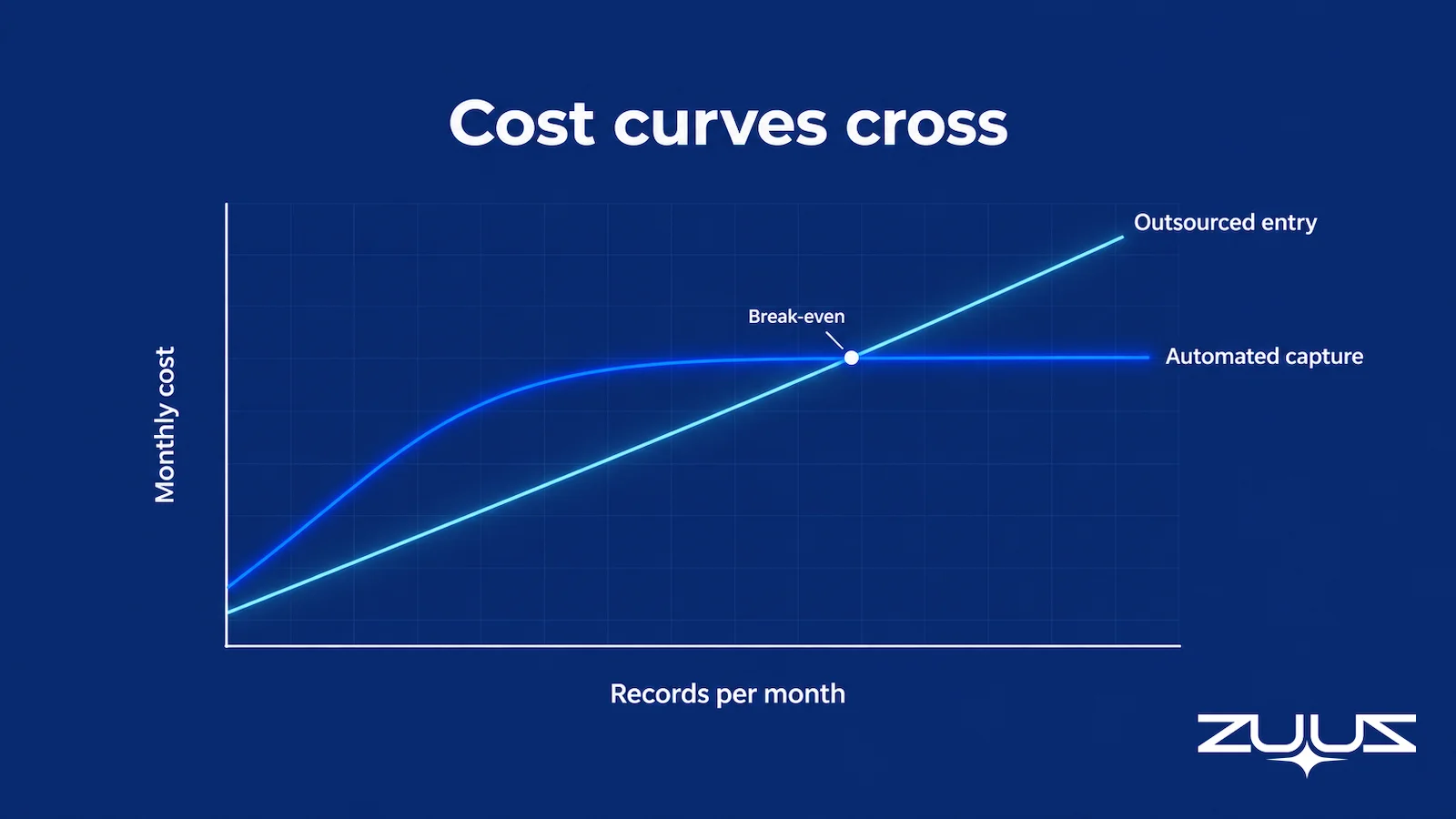
Doubling the volume of manual data entry services roughly doubles the cost, because the resource is people and people do not have a marginal cost curve. Capture automation carries most of its cost at setup and then flattens. That difference is irrelevant at low volume and decisive at high volume, which is why the same decision resolves differently for a five-person team and a fifty-person team.
When Outsourcing CRM Data Entry Is the Right Call
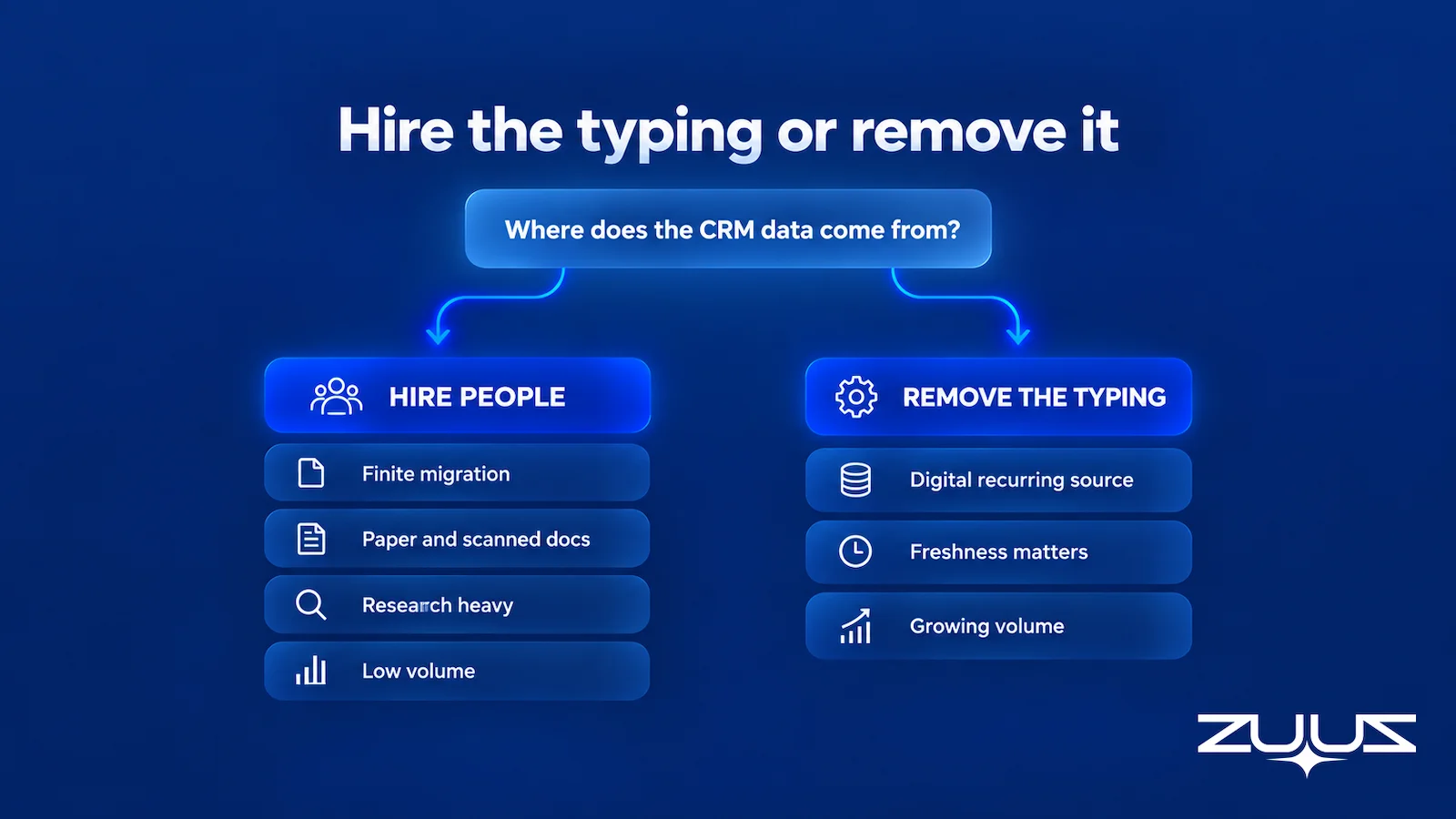
There are four situations where the honest recommendation is to hire people, and a post arguing otherwise would be selling rather than advising. Recognizing them early saves a team from buying software that cannot reach the work.
A finite backlog or migration. Consolidating two CRMs after an acquisition, or clearing four years of unlogged history, is bounded work with an end date. Humans resolve ambiguous matches and inconsistent historical records better than a rules engine does, and there is no recurring cost to amortize because the job finishes.
Sources that are not digital. Paper forms, scanned purchase orders, badge stacks from a trade show, and handwritten notes have no API. A team whose input arrives that way should outsource CRM data entry without much agonizing, because the constraint is the source format rather than the process.
Work that is mostly research. Finding a missing decision-maker, reconciling two conflicting addresses, or verifying a company structure is judgment work wearing a data entry costume. It is priced like entry and performed like analysis, and it is a poor fit for anything that expects a clean input to transform.
Volume too low to justify software. A team adding forty records a month should not sign an annual software contract to avoid a few hours of typing. Occasional batches genuinely cost less when someone is paid by the hour to handle them, and there is no shame in the arithmetic saying so.
When Removing the Typing Costs Less
The mirror image is equally clear. The case for CRM data entry automation strengthens as three conditions stack up, and when all three are present the human option tends to lose on cost and coverage at the same time. The reason to automate CRM data entry with AI rather than with static rules is that the remaining work is interpretation: a rule can copy a sender address into a field, but it cannot tell that a two-line reply just moved a close date.
The first condition is a digital, recurring source. When the information a CRM is missing already exists in email threads and calendar invites, a person retyping it is transcribing a machine-readable document by hand. The second is that freshness carries real value, which is true for anything touching an open opportunity, a renewal date, or an inbound lead where response time drives conversion. The third is growing volume, since that is where the linear-versus-flat cost curves separate.
There is a quality argument underneath the cost argument as well. A person typing from a forwarded thread sees the thread they were forwarded. The signals that never get forwarded, including a quiet competitor mention or a budget approval buried in a reply, are invisible to any process that depends on a rep deciding what to hand over. Coverage, not just speed, is what changes when capture moves upstream of the handoff. Teams that want the mechanics of that shift rather than the business case can follow the five-step sequence in the guide on how to reduce manual data entry using CRM automation.
Native CRM logging already covers part of the job
It is worth knowing exactly how far the existing stack reaches before paying anyone to fill the gap. Salesforce documents Einstein Activity Capture, which syncs email and calendar activity from a connected Microsoft or Google account against contacts, leads, and opportunities. HubSpot documents automatic logging of replies to mail sent from a connected work address, and Zoho CRM supports IMAP email configuration for the same purpose.
What all three record is that a message happened and who was on it. Reading the message and concluding that a buyer named a competitor, pushed a date, or approved a budget is the interpretive step that still gets typed by somebody, which is precisely the work a data entry service is being hired to absorb. Teams already running native capture and still finding records thin can compare the gap in the review of Einstein Activity Capture alternatives, or in the breakdown of CRM email automation more broadly.
See What a Data Entry Team Would Never Have Been Forwarded.
Most of what a CRM is missing was never handed to anyone to type. ZUUZ surfaces the deal signals sitting in email that no handoff process ever reached.
The Capture Gap Audit
Both options above are priced per unit of typing, which assumes the backlog is the problem. This audit checks whether it is.
- Pick one closed-won and one slipped deal from the last quarter.
- Read the full email and message thread end to end; list every fact that mattered – people, objections, dates, competitors, commitments.
- Open the CRM record for the same deal and mark which of those facts appear in a field, not a note.
- The percentage missing is the capture gap. Anything above about a third means the team is running on a CRM that records outcomes, not the deal.
Do this before asking any vendor for a per-record rate. The audit usually shows that the records a data entry team would have updated are not the records the deal needed, because the facts that mattered were never forwarded to them in the first place. A team whose gap is mostly facts nobody forwarded is buying the wrong unit of work, and no hourly rate fixes that.
Comparing Both Options on One Page
The comparison only works if both sides are priced against the same workload, the same required fields, and the same acceptance standard. Pricing a human team on 2,000 updates a month and software on a vague notion of coverage produces a number that cannot be defended in a budget meeting.
A worked example makes the shape visible. The inputs below are placeholders to be replaced with figures from an actual quote and an actual payroll, not market rates, and the point is the structure rather than the totals. Assume 2,000 updates a month at two minutes each, a blended entry rate of 15 dollars an hour, and internal coordination valued at 50 dollars an hour.
| Line item | Outsourced entry | Automated capture |
|---|---|---|
| Core work | 2,000 x 2 min at $15/hr = $1,000 | Subscription, assumed $600 |
| Setup, amortized | Included in onboarding | $600 over six months = $100 |
| Exceptions and review | 6 hrs QA at $50/hr = $300 | 20% reviewed = $200, plus 3 hrs at $50/hr = $150 |
| Modeled monthly total | $1,300 | $1,050 |
Change one input and the answer flips. At 500 updates a month the same assumptions produce roughly 550 dollars for the outsourced option against about 900 for the automated one, because the software floor does not shrink with volume. Break-even under these particular assumptions arrives near 1,375 updates a month, and every team’s real break-even sits somewhere else. The exercise worth running is not copying this table but rebuilding it with a genuine quote, a genuine handling time, and a genuine rejection rate.
One caution that keeps budget conversations honest: released rep time is not the same as cash saved. Hours returned to a sales team only become revenue if those hours go into selling, and only the software line and the vendor invoice are actual cash movements.
CRM Data Entry Support: How ZUUZ Removes the Entry Step
ZUUZ is not a CRM and does not replace one. It is an agentic AI execution layer that sits on top of Salesforce, HubSpot, or Zoho and does the work that would otherwise be handed to a person to type. Instead of receiving a forwarded thread and transcribing it, it reads inbound and outbound email directly, identifies the deal signal, and writes structured fields back into the CRM that remains the system of record.
The practical difference from a staffed arrangement is where the process starts. A data entry service starts when someone decides a message is worth logging, which means the coverage question is settled by a busy rep at the moment of least attention. ZUUZ starts at the message itself, so contact details, stage movement, next steps, competitor mentions, and renewal language are captured whether or not anyone thought to flag them. Reps confirm rather than compose, and the CRM stops depending on discipline.
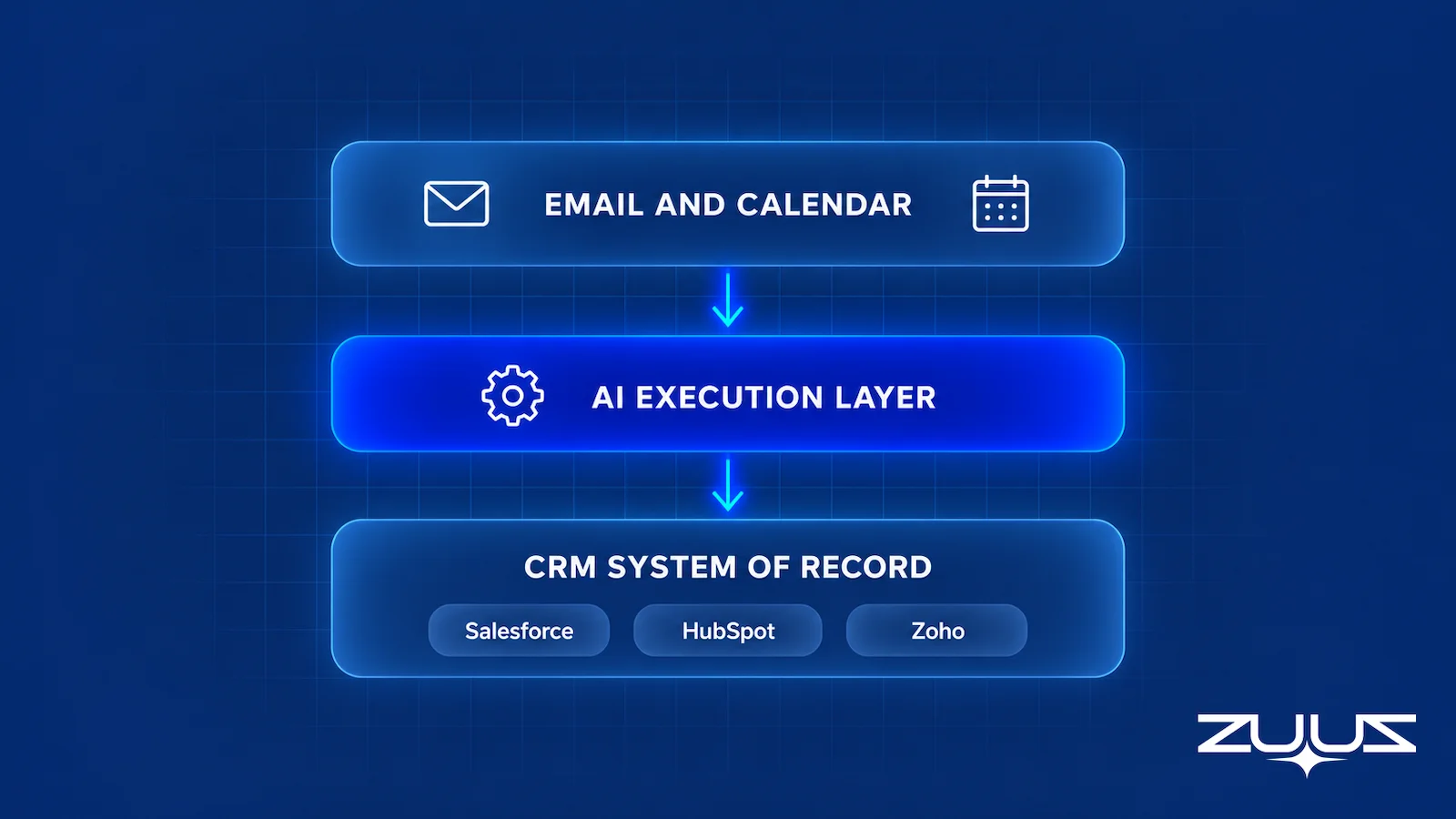
Because it runs across Salesforce, HubSpot, and Zoho at once, it also fits teams with more than one CRM in the building after an acquisition, a common reason a manual arrangement gets expensive fast. Beyond capture, the same layer monitors pipeline movement and renewal risk and answers plain-English questions about the CRM, which is where CRM data quality stops being a cleanup project and starts being a property of how records arrive. A US-based IT services firm working this way surfaced pipeline that had been sitting unlogged in inboxes rather than paying to have it entered after the fact.
ZUUZ’s Take

From an operator’s seat
Across the deployments ZUUZ runs, the pattern is that outsourced entry quietly keeps the rep in the loop it was bought to remove. Someone still has to decide which thread is worth logging and forward it, and that decision is the expensive part of the job, not the typing. The part teams do not plan for is CRM access for external staff: provisioning, field-level permissions and the quarterly access review are real hours on the buyer’s own payroll, and they appear on no quote. On the automation side, the unbudgeted cost is the first approval queue, which is large because it covers history as well as this week – staff it for a few days and it never looks like that again.
Running a Fair Pilot Before Signing Either Contract
Both options sell well in a proposal and behave differently against real data, so the cheapest way to decide is a bounded pilot on the same sample. Build that sample deliberately: straightforward records, long threads, near-duplicate accounts, records with missing fields, and at least a few genuinely ambiguous matches. A sample made only of easy records will make both options look excellent and settle nothing.
Measure four things rather than one. Accepted updates, missed updates, delay between the source event and the CRM write, and internal hours consumed on each side. The last two are the ones teams forget, and they are usually where the difference lives, since a service can score well on accuracy while failing entirely on latency or quietly consuming a coordinator’s afternoon.
The outcome does not have to be exclusive. A common and sensible answer is a human engagement to clear the historical backlog once, followed by automated capture to keep the backlog from rebuilding, with a named owner for exceptions on both sides. What matters is that the recurring work and the one-time work get priced as the separate problems they are, rather than bundled into a single monthly retainer that quietly renews forever. Teams comparing this against having reps do it themselves can also read the direct comparison of ZUUZ and manual CRM entry, or the wider survey of tools that reduce manual CRM data entry.
Run the Pilot Against Your Own Last Quarter.
ZUUZ looks back at email a team has already sent and shows what a data entry process would have captured, and what it would have missed.
A concrete first step
Before signing either contract, connect one mailbox. ZUUZ reads the last 90 days and the rep reviews what it found before anything is written into the CRM, which gives the pilot above a real rejection rate and a real handling time instead of modelled ones. It is a 30-day free trial, no credit card: https://zuuz.ai/trial/
Frequently Asked Questions
How much do CRM data entry services cost?
Almost no provider in this category publishes rates, so a real figure only comes from a solicited quote. Pricing arrives in three shapes: hourly against a dedicated or shared resource, per record or per project on finite jobs, and a managed-team retainer with a service level. Whichever shape a quote takes, the comparable number is cost per accepted record delivered inside the agreed window, not the headline rate.
Is it cheaper to outsource CRM data entry or automate it?
It depends almost entirely on volume and source format. Human cost rises in a straight line with record count while capture software carries most of its cost at setup, so there is a break-even point every team can calculate for itself. Below it, outsourcing is cheaper. Above it, automation is, and the gap widens with every additional record.
What does a CRM data entry service actually do?
A CRM data entry service supplies people who create and update contacts and companies, log calls and meetings, transcribe rep notes, move opportunity stages, import event and webinar lists, and merge duplicates inside Salesforce, HubSpot, Zoho or Pipedrive. The scope is similar across providers. What differs is whether the team is handed a spreadsheet to type or given inbox access to read from directly.
Can you hire someone to update your CRM instead of buying software?
Yes, and for some workloads it is the better decision. Hiring a virtual assistant or an outsourced team makes sense for a finite migration, for source documents that are not digital, for research-heavy enrichment, and for volumes too small to justify a software contract. It makes less sense for recurring updates that originate in email, where the person is retyping information a machine can already read.
Will CRM be replaced by AI?
No. The CRM remains the system of record that stores accounts, opportunities, and history, and AI has not changed that role. What AI is replacing is the manual work of getting information into the CRM and pulling answers back out of it. That is a layer sitting on top of Salesforce, HubSpot, or Zoho rather than a substitute for them.
Can AI replace a CRM data entry VA?
For digital, recurring sources it usually can, since email and calendar data is machine-readable and needs no human transcription step. For paper documents, scanned forms, ambiguous historical records, and research that requires judgment, a virtual assistant still performs better. Most teams past a certain size end up using both, with the human work bounded to a project rather than running indefinitely.
How accurate is automated CRM data entry compared to manual entry?
The more useful comparison is coverage rather than raw accuracy. A person transcribing a forwarded thread is accurate on that thread but blind to every message nobody forwarded, so accuracy on captured records and completeness of the record set are two different measurements. Any pilot should measure missed updates alongside incorrect ones, since a process can score perfectly on one and badly on the other.

CEO of ZUUZ. He scaled Cloud Box Technologies from 0 to $25M ARR in IT services and distribution before building ZUUZ. He built it after seeing how much manual CRM entry sales teams tolerated simply because no one had connected the inbox to the record.