
Sales Pipeline Health: 6 Signals to Check
Sales pipeline health, judged from what buyers actually did: six observable signals, plain status words and a 20-minute test to run on your top deals.


CEO of ZUUZ. He scaled Cloud Box Technologies from 0 to $25M ARR in IT services and distribution before building ZUUZ. Connect on LinkedIn
TL;DR: Sales pipeline health is whether the open deals in the CRM are still moving toward a buyer decision, judged from observable activity rather than from stage labels. The reliable signals are stalled deals, no buyer reply, slipped close dates, single-threaded deals and next steps with no date. ZUUZ is an AI layer over Salesforce, HubSpot, Zoho, Attio or Pipedrive that reads the sales inbox, calendar, LinkedIn messages and meeting transcripts and reports each deal in plain status words (Moving, Quiet, Stalled or Needs follow-up) with the evidence behind it. It does not score deals or forecast revenue.
- Sales pipeline health is a judgment about momentum, not size. A large pipeline full of deals no buyer has touched is unhealthy, and a smaller one with live buyer activity is not.
- Six signals can be observed without asking the rep: stalled deals, no buyer reply, slipped close dates, single-threaded deals, missing or undated next steps, and a stage with no evidence behind it.
- Plain status words (Moving, Quiet, Stalled, Needs follow-up) are easier to act on than a made-up number, because each word points to a specific piece of evidence.
- The CRM fields that matter most are the ones with history: stage entry dates, prior close dates, last buyer-side activity, a dated next step and the contacts attached to the deal.
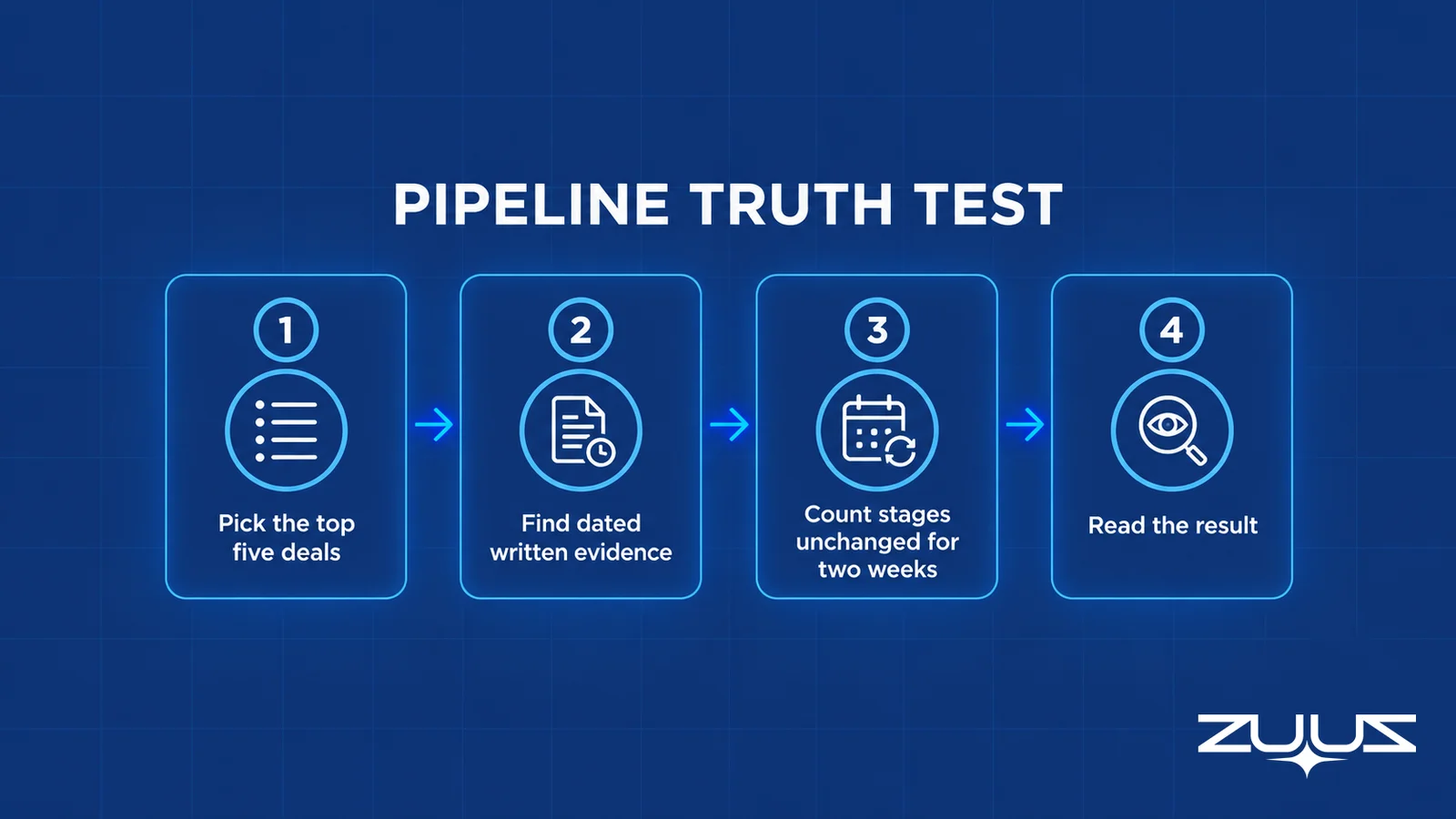
- The Pipeline Truth Test measures pipeline health in about twenty minutes by checking the top five deals against dated, written buyer evidence.
- ZUUZ keeps the CRM current from the inbox and reports pipeline at risk in dollars and what changed. It does not forecast, score deals or predict outcomes.
On Monday morning the dashboard says $3.8M is open and every opportunity has a stage, an amount and a close date inside the quarter. Nothing on the screen looks wrong. Then the manager asks one question of the largest deal, which is when the buyer last wrote back, and the answer is a pause followed by a guess. (This is an illustration, but every sales manager has been in that pause.)
That pause is the whole subject. A pipeline can be full and still be unhealthy, because the CRM records what the rep typed and a stage label does not change when a buyer goes quiet. Managers, CROs and RevOps leads who have stopped trusting the dashboard are not wrong, they are noticing that stale records cannot answer a question about momentum.
This guide covers what sales pipeline health actually means, the six signals that can be observed without taking a rep's word for it, the plain status words that replace a score, the CRM fields worth trusting, and a twenty-minute test for measuring pipeline health on real deals.
What Sales Pipeline Health Means in Practice
Sales pipeline health is the degree to which open deals are still progressing toward a buyer decision, measured from what buyers and reps actually did rather than from what a field says. A pipeline is healthy when most of its value sits in deals with recent buyer-side activity, a dated next step, more than one contact and a close date that has not been moved repeatedly. The usual definition of a pipeline as a visual snapshot of where deals sit in the sales process is accurate, but a snapshot only shows where deals are, not whether they are going anywhere.
Size is the usual shortcut and the weakest one. Open value, deal count and stage mix all describe the shape of the pipeline. They say nothing about whether a single buyer is still engaged. That is why pipeline coverage and sales pipeline health are different questions: coverage asks whether there is enough pipeline for the target, while health asks whether the pipeline that exists is real.
It is also not the same as the meeting where deals get discussed. A sales pipeline review is the ritual, and the health check is the evidence the ritual should start from.
Why CRM Fields Alone Do Not Show Sales Pipeline Health
Most pipeline fields are opinions entered by the rep. The stage is the rep's view of where the deal is, the close date is the rep's hope, and the amount is the rep's estimate. None of them updates when a buyer stops answering, which is why the CRM pipeline is wrong in a predictable direction: it stays optimistic until someone forces a cleanup.
Even the field that looks objective, last activity date, usually records when the rep logged something, not when the buyer responded. A rep who sent three follow-ups to a silent contact has a fresh activity date on a dead deal. The evidence of real movement lives in the sales inbox, the calendar, LinkedIn messages and call transcripts, which is the gap described in CRM data quality work and in sales activity tracking.
That is the problem behind the stale data complaint. The CRM stores whatever was last typed, and sales pipeline health cannot be read from a record that is weeks behind the conversation. A usable health view has to meet a few conditions first.
How to evaluate whether a pipeline health view can be trusted
- Dated buyer evidence. Can every stage and close date be traced to something the buyer wrote, with a date on it?
- A capture layer. Does anything put the deal thread into CRM fields without the rep retyping it, across the sales inbox, the calendar, LinkedIn messages and meeting or call transcripts?
- Fields, not feeds. Does captured activity land in fields a report can filter, or only in an activity feed someone has to open deal by deal?
- History retained. Does the record keep prior stages and prior close dates instead of overwriting them silently?
- Rep correction in one click. When something is written for the rep, can the rep fix or reject it before it saves?
See the Signals Without Asking the Rep.
Connect one mailbox and ZUUZ reads the last 90 days, so stalled deals and silent buyers show up from the thread instead of from memory.
A Pipeline Health Check in Six Observable Signals
A sales pipeline health check does not need a model. It needs six questions that can be answered from dated evidence, asked of each deal that carries real value. Each signal below is something a manager can verify in the record or the thread without relying on the rep's confidence.
Stalled deals
A stalled deal has sat in one stage longer than the team's own norm for that stage, with no stage movement and no new buyer-side activity. The threshold is a team decision, such as fourteen days in Proposal, and it should come from the team's own history. HubSpot's guidance on the sales pipeline makes the same point, that time in stage should be watched and that deals with no scheduled next step should move to nurture or be closed out. Stalled deals still count toward pipeline value, which makes them a main source of pipeline risk.
No buyer reply
The most useful single fact about a deal is when the buyer last wrote or spoke. Counting rep emails sent measures effort. Counting the days since the last inbound message or attended meeting measures engagement. A deal with five outbound messages and no reply in three weeks is Quiet regardless of what the stage says, because an opened email is not an answered one.
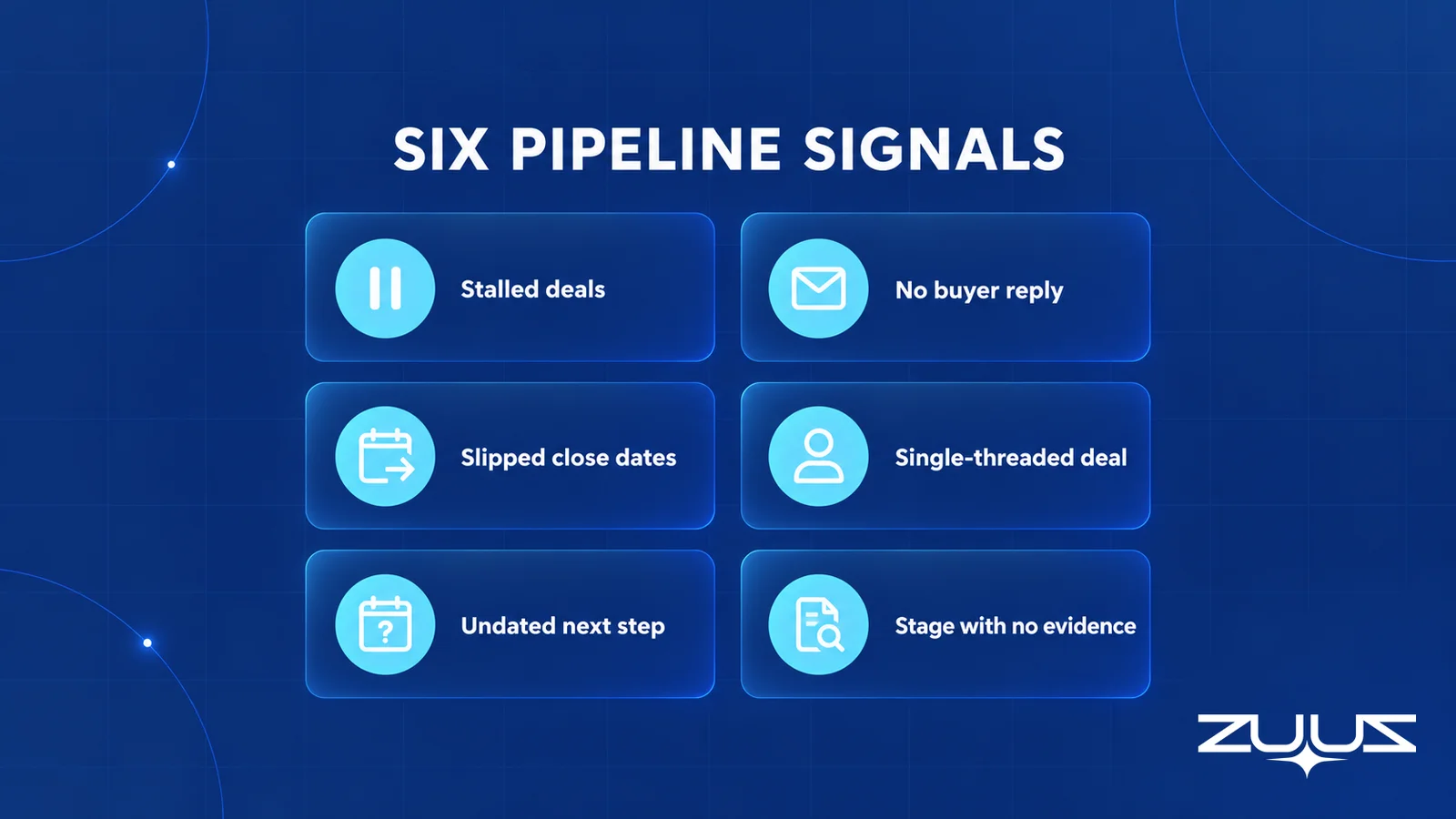
Slipped close dates
A close date that has moved once is normal. One that has moved twice is a pattern, and one that moved three times is usually a deal the buyer never committed to. The signal is only visible if the record keeps prior close dates, which most CRMs do not surface by default. The mechanics are covered in deal slippage, and the point here is that the count of date changes is evidence and the date itself is not.
Single-threaded deals
A deal with one contact is exposed to one job change, one vacation or one lost champion. Buying decisions involve many people, a point Harvard Business Review makes when it notes that many people now weigh in on each B2B purchase. If the thread shows only one name and the CRM shows only one contact, the deal is single-threaded, and a sudden handoff or absence turns it quiet overnight.
Missing or undated next steps
"Following up" is not a next step. A real next step names an action, a person on the buyer side and a date. Counting the share of open deals whose next step meets that standard is one of the cleanest pipeline health metrics available, because it needs no judgment, only a look at the field.
A stage with no evidence
Stages should be earned by something the buyer did: a scoped requirement, a shared proposal, a procurement question. When a deal reaches Negotiation and the thread holds nothing from the buyer in a month, the stage is a claim, not a fact. This signal ties the other five together, and it is the one the Pipeline Truth Test below is built around.
Plain Status Words Instead of a Number
The instinct after finding six signals is to roll sales pipeline health into one score. That is the wrong move, because a score hides which signal fired and invites argument about the weights. A status word does the opposite: it names the condition and sends the reader straight to the evidence. ZUUZ uses four words, each tied to what was observed in the inbox, calendar, LinkedIn messages and transcripts.
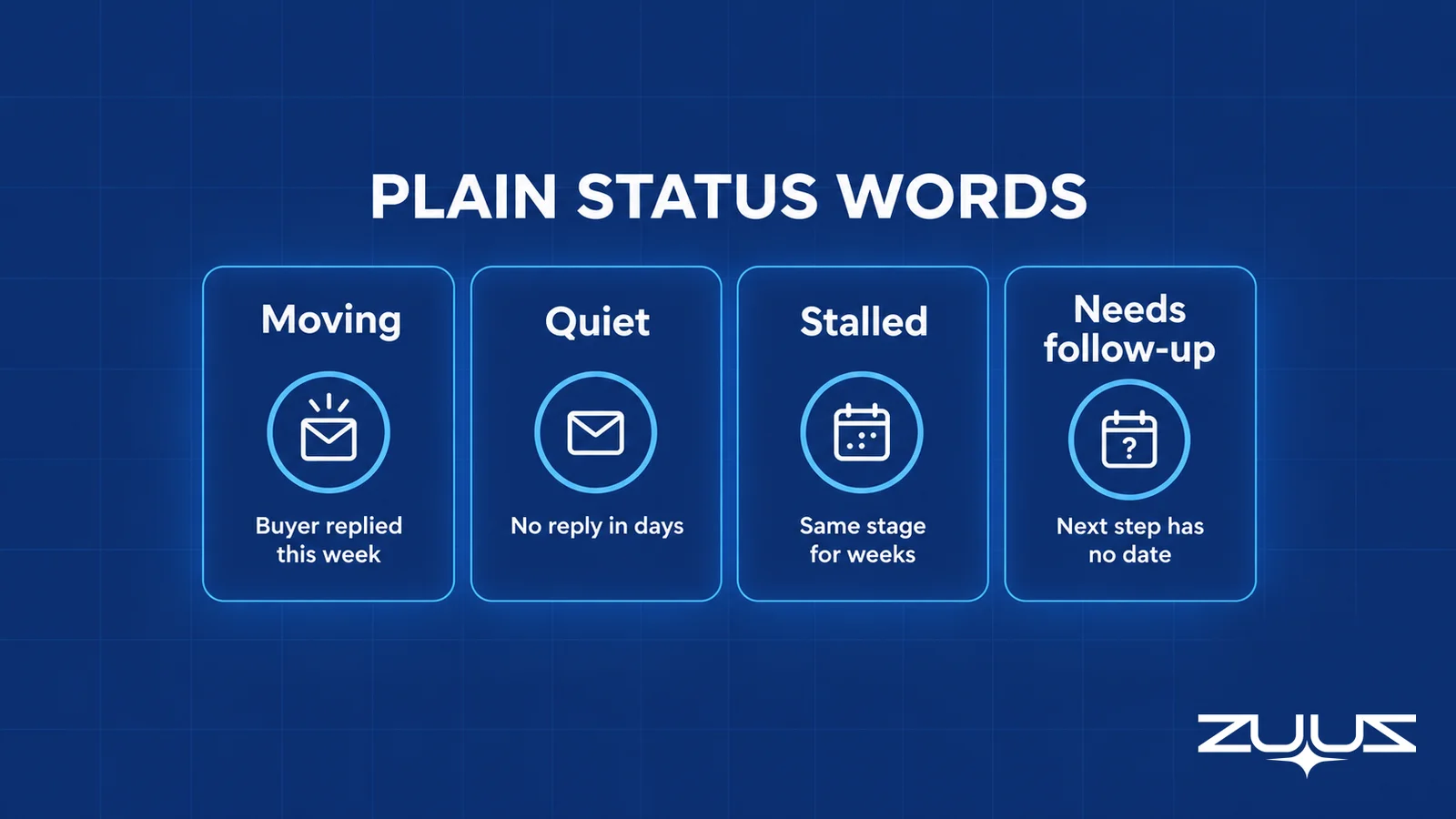
| Status | What was observed | The question it prompts |
|---|---|---|
| Moving | Recent buyer-side activity and a dated next step | Is the next step on the calendar? |
| Quiet | No buyer reply for a while, but inside the stage norm | Who else on the buyer side can be reached? |
| Stalled | No stage movement and no buyer activity past the team threshold | Is this deal real, or should it leave the pipeline? |
| Needs follow-up | A buyer message or commitment is waiting on the rep | What is owed, and by when? |
None of these words is a prediction. Moving does not mean the deal will close, and Stalled does not mean it will be lost. Each describes what happened, which is why a manager can challenge it by opening the thread. A win probability is a different product category, and ZUUZ deliberately stays out of it.
The rep stays in control: updates land in the CRM as finished work the rep approves in one click, and a rep's correction takes precedence.
Which CRM Fields Matter Most for Pipeline Health
The honest answer on which CRM fields matter most is that fields with history beat fields with values. A current stage tells little. The date the stage was entered, the previous stage, and the prior close dates tell a story. Salesforce makes a similar point in its pipeline management guidance, noting that conversion benchmarks between stages show where prospects stall, and that comparison only works when stage timing is recorded.
| Field | Why it matters | Common failure |
|---|---|---|
| Stage entered date | Shows time in stage, the base measure of a stalled deal | Overwritten when the stage is edited |
| Close date history | Counts how often the date has moved | Only the latest value is kept |
| Last buyer-side activity | Separates buyer engagement from rep effort | Holds the rep's last logged touch |
| Next step and its date | Proves the deal has a defined action | Free text such as "follow up" |
| Contacts and roles | Shows whether the deal is single-threaded | One contact on a deal with a buying group |
| Amount change history | Reveals quiet downsizing before a loss | Edited in place without a trail |
The failure column is the useful one. Every row fails the same way: the field exists but the record of change does not, or it holds the rep's entry rather than the buyer's behavior. Reports built on these fields, and the dashboards described in CRM reporting, are only as good as the capture underneath them.
Make the Fields Carry the Conversation.
ZUUZ writes stages, contacts and next steps from the thread into Salesforce, HubSpot, Zoho, Attio or Pipedrive, so the fields reflect what the buyer said.
How to Measure Pipeline Health With the Pipeline Truth Test
The question of how to measure sales pipeline health usually gets answered with a dashboard. A faster and more honest method is to test a few deals against evidence. The Pipeline Truth Test takes about twenty minutes, needs no new tool, and shows whether the pipeline number describes deals or recollection.
- Take the top five deals by value this quarter.
- For each, find the CRM evidence for its stage and close date: a dated written commitment, not a rep's assurance.
- Count how many rest on a stage last changed more than two weeks ago.
- Mostly-undated top five means the number reflects rep optimism. ZUUZ does not forecast; it makes the record underneath the number real.
Worked example, as an illustration. A managed IT services opportunity sits in Negotiation with a close date on the last Friday of the quarter. The CRM holds one rep-created task, a stage last changed six weeks ago, and one contact. The thread holds a procurement reply asking for a revised scope and a security questionnaire, and neither request appears in a field. Steps two and three fail, and the contact count marks the deal as single-threaded. Its status is Needs follow-up, not Moving.
Run across a whole pipeline, the same test gives a clear read of sales pipeline health: the share of top deals with dated buyer evidence is the share of the pipeline that is real. The gap between that share and the CRM total is the leak described in revenue leakage.
Early Warning Signs a Pipeline Is About to Slip
The early signs of a slip in sales pipeline health are visible weeks before the close date moves, which is the useful part. None of them is a verdict. Each is a reason to ask one specific question of the deal, and each is something that happened rather than something predicted.
- Reply gaps widen. A buyer who answered in a day now answers in a week. The reply is still coming, but the priority has changed.
- The champion goes missing. The contact who drove early meetings stops appearing on threads, and no one new has replaced them.
- A meeting is rescheduled twice. One move is calendar noise. Two is a signal about priority.
- Buyer questions go unanswered. A procurement, security or legal request sits in the thread with no reply from the rep. The deal is stuck on the seller's side.
- The next step slides without a new date. The agreed action keeps getting pushed and no replacement is set.
- The amount shrinks quietly. Scope is trimmed in the thread before the CRM amount is edited.
Most of these live in email and calendar behavior, not in fields, which is why slippage is so often a surprise to the CRM and not to the mailbox. The same pattern shows up in renewals, as covered in churn risk software.
Catch the Quiet Deals Before the Date Moves.
ZUUZ flags deals where the buyer has gone quiet or a commitment is waiting on the rep, with the thread behind each flag.
Pipeline Health Metrics and Pipeline Risk in Dollars
The pipeline health metrics worth keeping for sales pipeline health reporting are the ones that come from timestamps and buyer behavior, because those cannot be nudged by optimism. A short list covers most of the value.
- Time in stage. Days since the current stage was entered, compared with the team's norm for that stage.
- Days since buyer reply. Elapsed time since the last inbound message or attended meeting.
- Close date changes per deal. The count of times the date has moved this quarter.
- Next step coverage. The share of open deals with an action, a buyer-side name and a date.
- Contacts per deal. The number of buyer-side people active on the thread.
- Pipeline at risk. The dollar value sitting in deals that are Quiet or Stalled.
The last one is where pipeline risk becomes concrete. Saying that eleven deals are Stalled is easy to ignore. Saying that $1.4M of open value sits in Stalled and Quiet deals, and listing what changed since last week, gets a decision. (The figures here are illustrative.) ZUUZ Analytics reports pipeline at risk in dollars and what changed, from observed activity, and it does not forecast or assign probabilities.
Some common measures deserve suspicion. Weighted pipeline multiplies each amount by a stage probability that is a rep or admin guess, activity counts reward motion over progress, and stage distribution shows the funnel's shape, not whether any deal in it is alive.

No metric is better than the capture feeding it. A thread that never reaches the CRM is invisible to every number, as covered in IT sales pipeline visibility tools, so capture comes before measurement.
The Operator View of a Healthy Pipeline
From an operator's seat in IT services and distribution, the habit that held was to stop asking how a deal felt and start asking when the buyer last wrote. Avinash Gujje, CEO of ZUUZ, built that habit while scaling Cloud Box Technologies from $0 to $25M ARR, and the surprise was how fast the question sorted the pipeline. The part teams do not plan for is the single-threaded deal that looks healthy because it is recent: one friendly contact can produce activity every week and still leave the deal one email away from silence. What changed behavior was not a score but a question, who else on the buyer side has been on the thread, and reps began adding people before anyone asked. In distribution, where one customer request often fans out into several opportunities, that question also exposed duplicate lines that inflated the number.
Sales Pipeline Health: How ZUUZ Reports What Changed
ZUUZ does not calculate a health number and does not forecast. It keeps the record underneath the pipeline current, so the six signals can be read from fields instead of reconstructed from memory.
ZUUZ is an AI layer on top of the CRM a team already runs, with no migration. It connects to the sales inbox, calendar, LinkedIn messages (read-only), Teams meeting transcripts and inbound call transcripts, and writes structured stages, contacts and stakeholders to Salesforce, HubSpot, Zoho, Attio or Pipedrive. The rep approves the finished work in one click, a 90-day mailbox lookback means history is not blank, and Analytics reports pipeline at risk in dollars and what changed. Each deal carries a plain status word, Moving, Quiet, Stalled or Needs follow-up, and the thread that supports it. Related ground is covered in sales pipeline management software and deal management software.
In the proof so far, a US-based IT services company, RA Technologies, ran ZUUZ on the HubSpot instance it had used for two years, with the same team, and $120K in pipeline was surfaced in the first 30 days that the CRM had never seen, captured from the sales mailbox. At Cloud Box Technologies, a UAE cloud and IT services business, one connected user tracks 10 to 12 renewals in minutes and leadership sees live pipeline.
The first step toward visible sales pipeline health is small. Connect one mailbox, let ZUUZ read the last 90 days, and compare the top five deals with what the threads say. The gap between the CRM and the conversation is visible in minutes, and it answers the sales pipeline health question with evidence instead of opinion.
Frequently Asked Questions
What is sales pipeline health?
Sales pipeline health is how much of the open pipeline is still genuinely moving toward a buyer decision. It is judged from observable activity such as buyer replies, stage age, close date changes, contacts on the deal and dated next steps, not from stage labels or total value. A large pipeline of silent deals is unhealthy; a smaller one with live buyer activity is healthy.
How do you measure sales pipeline health?
Measure sales pipeline health by testing deals against dated evidence. Take the top five deals by value, find the written buyer commitment behind each stage and close date, and count how many rest on a stage unchanged for over two weeks. Then track time in stage, days since buyer reply, close date changes and next step coverage as ongoing pipeline health metrics.
What are the key pipeline health metrics?
The most reliable pipeline health metrics come from timestamps and buyer behavior: time in stage, days since the last buyer reply, close date changes per deal, next step coverage, contacts per deal and pipeline at risk in dollars. Weighted amounts, activity counts and stage mix are weaker because they reflect rep estimates or effort rather than buyer engagement.
How do you run a pipeline health check?
A sales pipeline health check asks six questions of each significant deal: is it stalled, has the buyer replied recently, has the close date moved, is more than one contact involved, is there a dated next step, and does the stage have buyer evidence behind it. Each answer is a status, such as Moving, Quiet, Stalled or Needs follow-up.
What are the signs of poor sales pipeline health?
Signs of weak sales pipeline health include deals sitting in one stage past the team norm, buyers who have not replied in weeks, close dates moved more than once, single-contact deals, next steps like "follow up" with no date, and stages with no buyer evidence. Heavy reliance on a few large deals and a large share of value in Quiet or Stalled deals are further warnings.
What CRM fields matter most for pipeline health?
For sales pipeline health, fields with history matter most: stage entered date, prior close dates, last buyer-side activity, next step with a date, the contacts and roles on the deal, and amount change history. A current value says little, while the record of change shows whether a deal is moving. Fields that only hold the rep's latest entry hide the signals that matter.
What are early warning signs your pipeline is about to slip?
Early warning signs include widening gaps between buyer replies, a champion who stops appearing on threads, meetings rescheduled twice, buyer questions left unanswered, a next step that keeps sliding without a new date, and a quietly shrinking amount. They appear weeks before the close date moves, and each is an event to ask about, not a prediction.
What counts as a stalled deal?
A stalled deal has stayed in the same stage longer than the team's own norm, with no stage movement and no new buyer-side activity. The threshold is set from the team's history, for example fourteen days in Proposal. Stalled deals still count toward pipeline value, which makes them a main source of pipeline risk.
Why is a single-threaded deal risky?
A single-threaded deal depends on one buyer contact, so a job change, vacation or lost champion can end all communication at once. Many people weigh in on each B2B purchase, and a deal with one name on the thread has not reached them. Adding contacts early is the simplest way to reduce the risk.
How is sales pipeline health different from pipeline coverage?
Pipeline coverage is a ratio of open pipeline value to target, and it shows whether there is enough pipeline. Sales pipeline health shows whether that pipeline is real, based on buyer activity, stage age and next steps. A pipeline can show strong coverage and poor health at once, which is why the two are checked separately.
Does ZUUZ score deals or forecast the pipeline?
No. ZUUZ does not forecast revenue, predict outcomes or assign a numeric rating to deals. It is an AI layer over the existing CRM that reports what happened, using plain status words (Moving, Quiet, Stalled, Needs follow-up), and Analytics reports pipeline at risk in dollars and what changed. The rep reviews and approves what is written to the CRM.
A first step smaller than a rollout. Connect one mailbox. ZUUZ reads the last 90 days and the rep reviews what it found before anything is written to the CRM. Whatever that surfaces on the top five deals is the honest input for the next pipeline health check. 30-day free trial, no credit card: https://zuuz.ai/trial/