
How to Shorten Your Sales Cycle Without Losing Deals
See what actually shortens a B2B sales cycle: qualification quality, follow-up speed, deal-risk visibility, and CRM data that keeps pace with every deal.

CEO of ZUUZ. He scaled Cloud Box Technologies from 0 to $25M ARR in IT services and distribution before building ZUUZ. Connect on LinkedIn
TL;DR: A B2B sales cycle rarely stretches because of one big problem. It stretches because of small delays compounding across qualification, follow-up, quoting, stalled deals, handoffs, and CRM data that lags behind the real conversation. Shortening it means fixing the specific lever losing the most time in a given pipeline, not adding pressure or new tools on top of the existing process.
- Sales cycle length is the time from first qualified contact to closed deal, and it should always be measured against win rate together, not on its own.
- Companies that respond to a new lead within an hour are nearly seven times more likely to qualify it than companies that respond later, according to Harvard Business Review research.
- Sales reps spend just 28% of their time actually selling, according to Salesforce’s State of Sales research, and every hour lost to admin work is an hour a deal sits untouched.
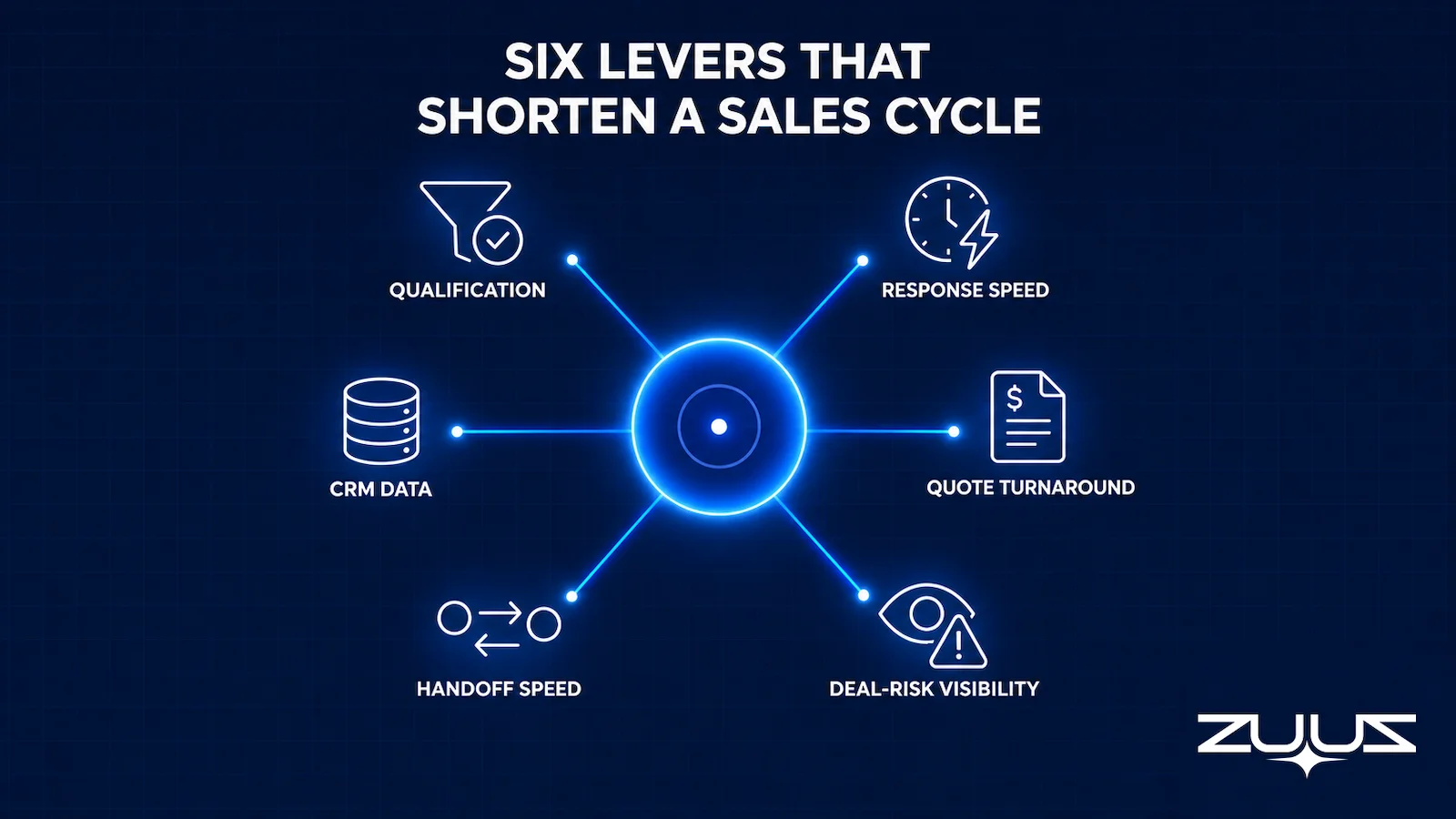
- The levers that actually shorten a sales cycle are qualification quality, response speed, quote turnaround, deal-risk visibility, handoff speed, and CRM data completeness, roughly in that order of impact.
- Some of these levers are process and people problems with no software fix. Others are structurally about how fast information moves between the inbox, the rep, and the CRM.
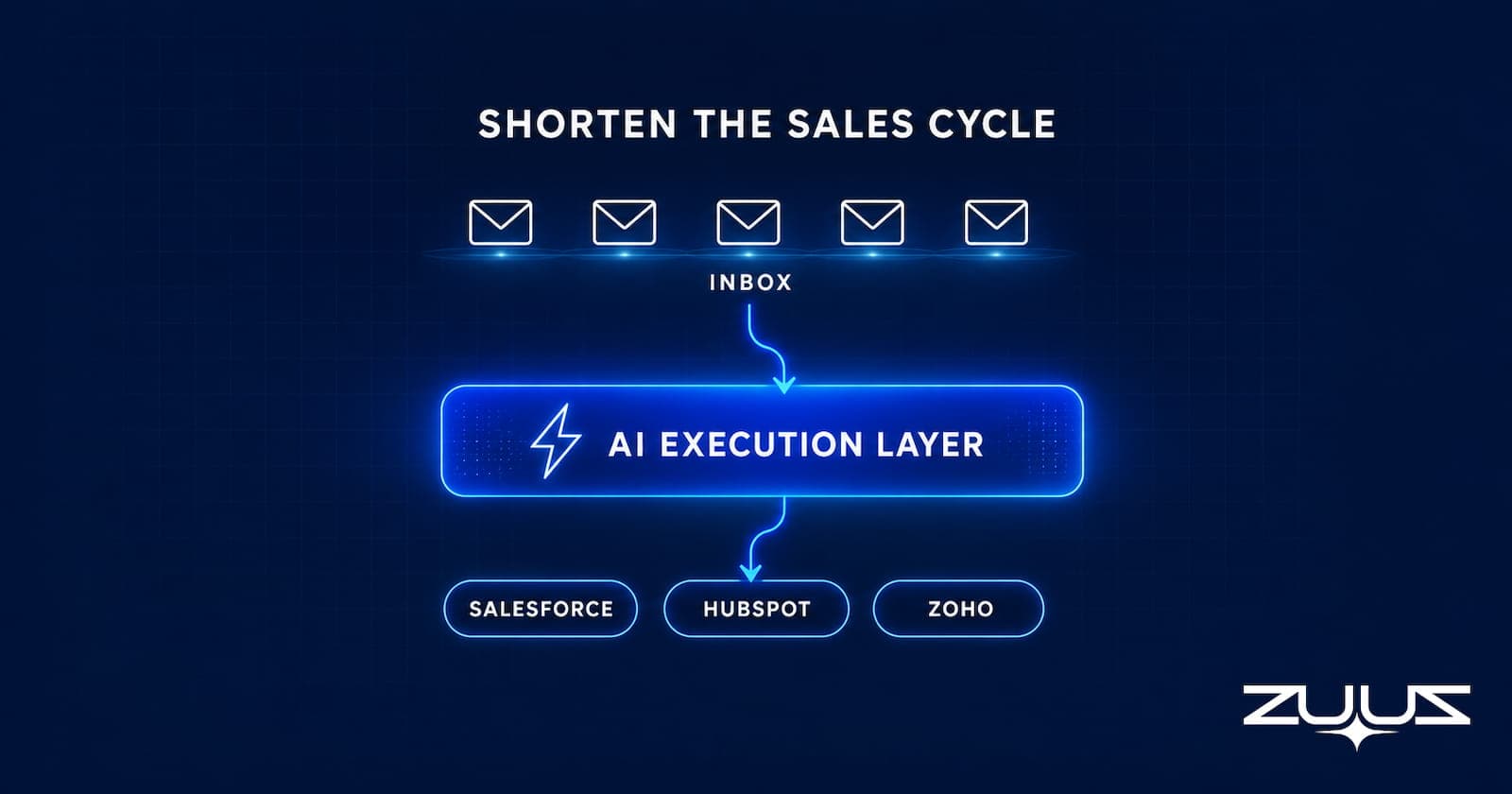
- ZUUZ, an AI layer that sits on top of a team’s existing CRM, addresses the second category by reading email, scoring leads, flagging at-risk deals, and syncing records back automatically.
- ZUUZ is an AI layer on top of the CRM a team already runs: it connects to the sales inbox, reads LinkedIn messages and meeting or call transcripts, and writes leads, stakeholders, next steps and renewal signals into the CRM for the rep to approve in one click.
A deal that should close in six weeks drifts into its fourth month, and nobody can point to the single moment it went wrong. The qualification call went fine. The proposal went out on time. The buyer never said no. It just kept slipping, one small delay at a time, until the quarter ended without it.
Sales leaders tend to reach for the same fix when a sales cycle runs long: more urgency, more follow-up cadence, more pressure on the rep. That treats the symptom. A long sales cycle is almost always the sum of several specific, fixable delays, and the fix looks different depending on which one is doing the most damage in a given pipeline.
This guide breaks down the real levers that shorten a sales cycle, in the order they tend to matter, and is honest about which ones are process fixes with no software involved and which ones are structurally about how fast information moves.
What Sales Cycle Length Actually Measures
Sales cycle length is the average time between a lead becoming a qualified opportunity and that opportunity closing, won or lost. It is usually tracked in days and segmented by deal size, product line, or lead source, since a $5,000 deal and a $500,000 deal rarely move at the same speed. Teams that only track the closed-won average miss half the picture, because a cycle that looks short might just mean weak deals are getting disqualified fast rather than strong deals closing fast. Most revenue operations software reports this metric by default, but the number is only useful once a team trusts the underlying data feeding it.
Sales Cycle Length Is Only Useful Next to Win Rate
A shorter sales cycle paired with a falling win rate usually means reps are rushing qualified buyers or chasing weak opportunities that die quickly. The pairing that matters is cycle length next to win rate and average deal size, tracked together, since that shows whether a faster cycle comes from a healthier process or from cutting corners on deals that were never going to close.
Where the Clock Should Start and Stop
Teams define the start of the sales cycle differently: first outbound touch, first inbound reply, or the moment a lead is marked qualified. Whichever definition a team picks, applying it consistently matters more than which one, since comparing cycle length across reps or quarters is meaningless if the starting line keeps moving.
Why B2B Sales Cycles Keep Getting Longer
Most B2B sales cycles have gotten longer over the past several years, and the reasons are structural rather than a sign that reps are working less hard. More people sit on the buying side of a deal, more of the early research happens without a rep in the room, and more of the coordination work inside the selling company happens over email instead of face to face.
Buying Decisions Involve More People Than They Used To
A typical B2B purchase now involves several stakeholders across departments, each arriving with their own priorities and often their own independently gathered information about the options on the table. Getting that group to agree takes longer than getting a single buyer to agree, and it adds coordination steps that did not exist when one person could sign off on a deal alone.
Selling Time Is Shrinking Even as Deal Complexity Grows
Sales reps spend just 28% of their time actually selling, according to Salesforce’s State of Sales research, with the rest going to administrative work, internal meetings, and searching for information a deal needs. That imbalance matters more as deals get more complex, because a rep juggling more stakeholders and more moving parts has less time available to manage any single one of them well, which shows up directly as slower cycle time.
Lead Qualification Quality
Weak qualification is the single most common reason a sales cycle drags. A deal that never had real budget, authority, or a genuine timeline still consumes calls, a demo, and often a proposal before it quietly dies, and every one of those steps is time a rep could have spent on a deal that was actually going to close.
Qualify for Disqualification, Not Just Fit
Most qualification frameworks focus on confirming fit: does this account match the ideal customer profile. The frameworks that actually protect cycle time also actively look for reasons to disqualify early, checking for a confirmed budget owner, a real timeline, and a business reason the deal has to move now rather than eventually. A rep trained to disqualify fast, not just qualify hopefully, keeps the pipeline full of deals that can actually close.
Score Leads on Signal, Not Just Form Fills
A form fill or a demo request says a prospect is curious. Intent language buried inside a reply, a forwarded email to a finance contact, or a question about implementation timeline says a prospect is actually evaluating. Scoring leads on that kind of signal, not just on activity volume, is what lead scoring software exists to do, and ZUUZ builds that scoring directly from the intent phrases, company mentions, and buying language it reads in email rather than requiring a rep to log activity for the score to update.
Stop Qualifying on Gut Feel. Score on Real Signal.
ZUUZ reads the intent language already sitting in a prospect’s email and scores the lead automatically, so reps chase the deals actually worth chasing.
- Does it shorten detection or just add pressure? Most lost time is the gap between a buyer acting and anyone noticing.
- Is there a capture layer: does it read the channels where the deal actually moves (email, calendar, LinkedIn messages, meeting and call transcripts)?
- Does what it captures land in CRM fields a report can read, or only in an activity feed a human must open?
- Does the rep have to remember anything – a BCC, a button, a sidebar, a sync – for the record to stay current?
- Can the rep correct it in one click before it is written, so the record stays human-curated?
- Does it run on the CRM already in place – Salesforce, HubSpot, Zoho, Attio or Pipedrive – without a migration first?
Response and Follow-Up Speed
Speed to first response is one of the most measurable levers on this list, and one of the easiest to get wrong without realizing it. Companies that respond to a new lead within an hour are nearly seven times more likely to qualify it than companies that respond later, according to Harvard Business Review’s research on online sales leads, which audited over 2,000 companies on how long they actually took to make first contact.
The Real Bottleneck Is Usually Detection, Not Effort
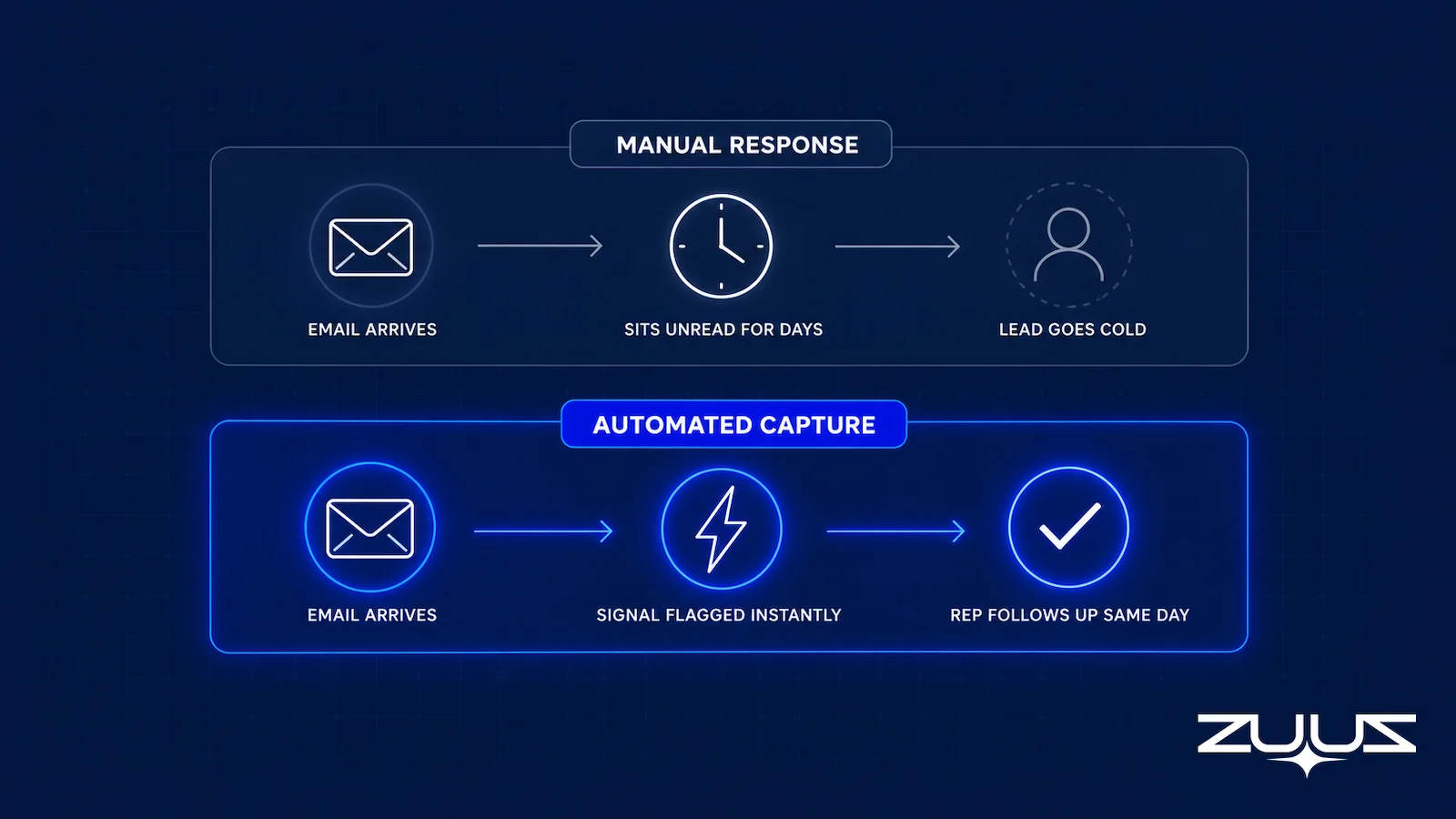
Reps rarely ignore a hot lead on purpose. The delay usually happens because the signal that a lead is ready sat unnoticed in an inbox, a shared alias, or a CRM field nobody checked that day. A high-intent reply buried under routine email traffic loses exactly the same amount of time as a rep who is simply slow, even though nobody was actually slow to respond once they saw it.
Follow-Up Cadence Loses Deals as Often as First Response Does
The first reply is only the first test. A prospect who asks a specific question and gets a generic follow-up three days later reads that gap as low priority, regardless of how the first call went. Leads that go missing inside a normal inbox are rarely lost to a competitor outright. They are lost to silence, and closing that gap is most of what email tracking software is built to solve, by surfacing the moment a reply needs a response instead of leaving it to be found by chance.
Quote and Proposal Turnaround
A slow quote is one of the few delays a buyer notices directly, and it is entirely within a selling team’s control. A prospect who is ready to move and waits four days for pricing has time to second-guess the decision, loop in one more stakeholder, or simply lose momentum, none of which happens by accident.
Standardize the Parts That Do Not Need to Be Custom
Most proposals reuse the same pricing structure, the same core scope language, and the same standard terms deal after deal, with only a handful of fields genuinely custom to the buyer. Building a template around that reality, rather than starting each proposal from a blank document, removes most of the drafting time without removing any of the customization that actually matters to the buyer.
Find the Real Approval Bottleneck
Slow quotes are usually an internal approval problem more than a drafting problem. A discount that needs three signatures, a legal review that queues behind unrelated contracts, or a pricing exception that has to wait for a weekly meeting all add days that have nothing to do with how fast the rep works. Mapping the actual approval chain, and cutting any step that exists out of habit rather than necessity, is often the single fastest fix available in this category.
Track Where Proposals Actually Stall
A proposal that sits unopened for three days signals something different than one that gets opened repeatedly with no response. Tracking proposal activity, not just whether it was sent, tells a rep whether to follow up with new information or simply pick up the phone, instead of guessing at silence. This tracking discipline overlaps heavily with the broader deal management software category, since a quote is really just one stage of a deal record that needs to stay current.
Deal-Risk Visibility
Most stalled deals do not announce themselves. A deal quietly stops moving weeks before anyone flags it, because the signs, a missed follow-up, a stakeholder who has gone quiet, a stage that has not changed in a month, live scattered across email threads and a CRM record that only gets updated when a rep remembers to touch it.
Track Stage Age, Not Just Stage
A deal sitting in the same stage for three weeks needs a different response than one that just arrived there yesterday, but a standard pipeline view treats them identically. Stage age, measured from the last time a deal genuinely moved forward rather than the last time someone edited a field, is a far more honest signal of which deals actually need attention this week.
Watch for the Signals Buried in the Thread, Not Just the CRM
The clearest early warning that a deal is at risk is rarely in the CRM. It is in an email: a champion who stops replying, a budget conversation that gets vague, a competitor mentioned in passing. Pipeline visibility tools that only read what a rep manually logs miss exactly this kind of signal, which is why a pipeline built on delayed, self-reported updates tends to understate risk until a deal is already gone. ZUUZ’s pipeline risk monitoring reads those signals directly from the inbox and surfaces a stalled or at-risk deal before it costs the quarter, rather than after.

Catch the Stall Before It Costs the Deal.
ZUUZ flags at-risk deals from the signals already sitting in email, so a rep finds out a champion has gone quiet in days, not at quarter close.
Internal Handoff Speed
Every handoff between marketing and sales, or between a closing rep and the team that takes over after the contract is signed, is a place where a deal can lose days it never gets back. The delay rarely comes from anyone being careless. It comes from the receiving team starting from close to zero, because the context that existed in the previous owner’s head or inbox never made it into a record the next person can actually use.
Pass Context, Not Just a Contact Record
A lead handed to sales with only a name and an email address forces the rep to rediscover everything marketing already learned: what content the prospect engaged with, what question triggered the request, what urgency they expressed. Every hour a rep spends reconstructing context that already existed somewhere is an hour not spent advancing the deal, and the same problem repeats at every later handoff, not just the first one.
Give the Next Team a Full Account View, Not a Fresh Start
A deal that closes and moves to onboarding or account management should not require a second discovery call to relearn what the sales team already knows. Assembling a single account view, deal history, prior conversations, and open commitments in one place a new owner can read, rather than a dataset they have to rebuild, is what keeps a handoff from resetting the clock. Because ZUUZ syncs deal and account data back to whichever CRM a team runs, that context stays attached to the account regardless of who owns it next.
CRM Data Completeness
A CRM that lags behind the real state of a deal slows the whole team down, not just the rep who forgot to update a field. A sales manager reviewing a pipeline built on stale data makes the wrong call about where to spend coaching time, and a rep picking up a colleague’s account inherits a record that does not match what actually happened.
Manual Entry Is the Single Biggest Source of Lag
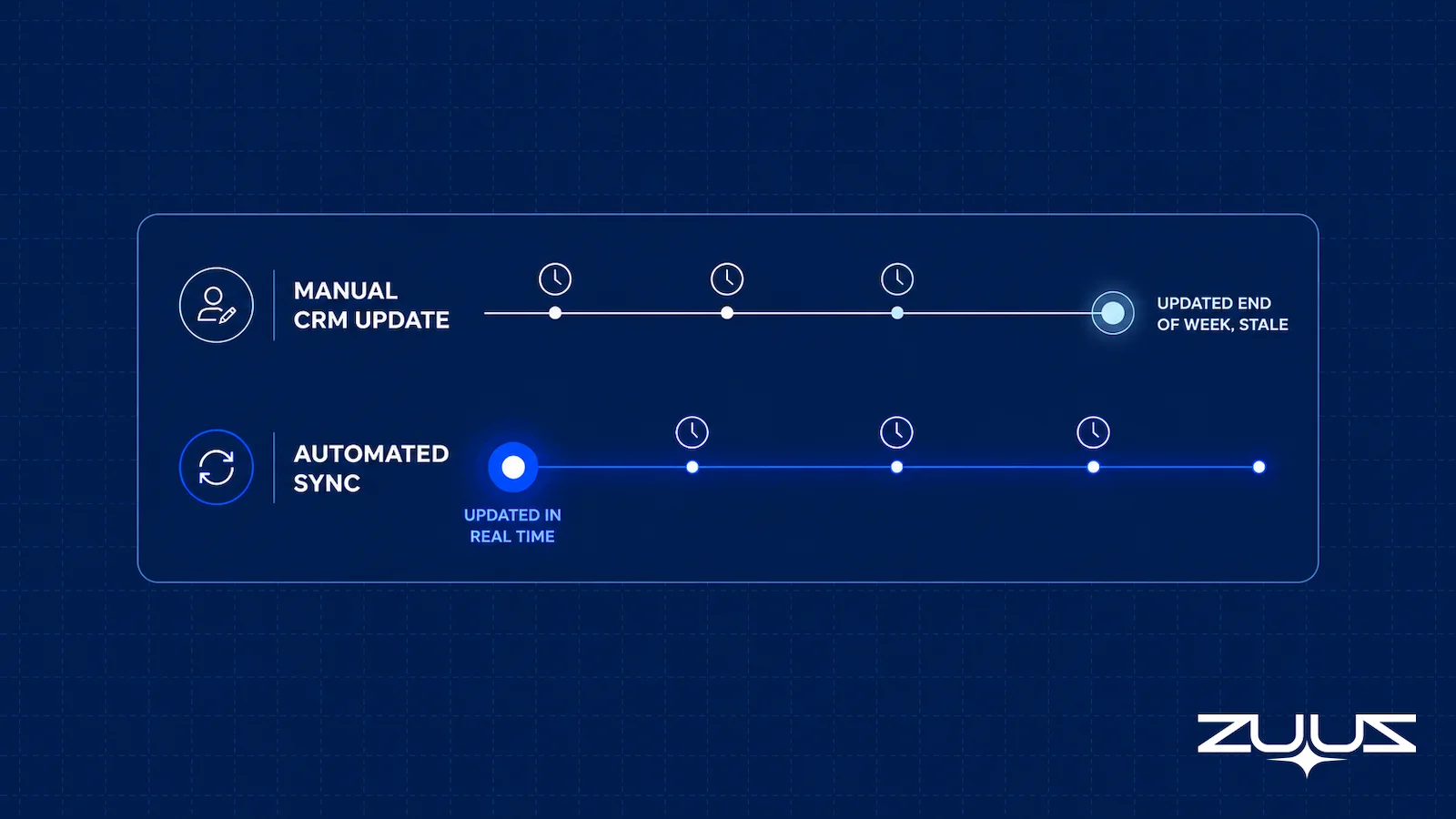
Reps update the CRM when they have time, which usually means after hours or once the week winds down, well after the conversation that should have triggered the update. Reducing manual data entry through CRM automation closes most of that lag by capturing the update the moment the underlying email or activity happens, instead of waiting for a rep to find the time to type it in. The same underlying mechanism supports genuinely clean CRM data quality, since a record updated automatically at the source rarely drifts the way a manually maintained one does.
Sync Has to Run Both Ways to Actually Help
A tool that only pulls data out of a CRM, or only pushes data in without reading what is already there, still leaves a rep reconciling two systems by hand. Bidirectional CRM sync reads existing CRM context to inform what gets captured next, then writes structured updates back in real time, which is how ZUUZ keeps Salesforce, HubSpot, or Zoho current without asking a rep to be the one closing the gap. A rep still reviews and approves what gets written, since the goal is removing the typing, not the judgment.
Keep the CRM Honest, Without the Typing.
ZUUZ writes deal signals back to Salesforce, HubSpot, or Zoho as they happen, so the pipeline reflects reality instead of whatever a rep had time to log.
The six levers are not equally available to every team, and they fail in different ways. The table below maps each one to what it actually changes and the symptom that suggests it is the binding constraint.
| Lever | What shortening it actually changes | Symptom that it is the bottleneck | Where ZUUZ changes it |
|---|---|---|---|
| Lead qualification quality | Removes deals that were never going to close from the denominator | High volume of early-stage deals that stall before a second meeting | Surfaces the thread and the people in it so a rep can disqualify on real signal; the decision stays with the rep |
| Response and follow-up speed | Compresses the dead time between buyer action and seller reaction | Inbound replies sitting unanswered for a day or more | Shortens detection: the reply lands on the record the day it arrives, not the day someone logs it |
| Quote and proposal turnaround | Removes an internal wait state the buyer is forced to absorb | Deals that go quiet immediately after a pricing request | Nothing. This is an internal approval problem, not a capture problem |
| Deal-risk visibility | Shortens the time between a deal going wrong and anyone noticing | Slipped deals that surprise the forecast at quarter end | Writes next steps and stakeholder changes from the thread into CRM fields, so stage age means something |
| Internal handoff speed | Cuts the gaps where a deal belongs to nobody | Time lost between qualification, technical validation, and close | The receiving team opens a record that already holds the buying group and what was last agreed |
| CRM data completeness | Makes every measurement above trustworthy enough to act on | Cycle length that cannot be measured consistently across reps | Writes from the sales inbox, LinkedIn messages and meeting or call transcripts into CRM fields, for the rep to approve in one click |
The Pipeline Truth Test
Before deciding which lever to pull, establish whether the pipeline number being managed is real. The Pipeline Truth Test exists to check whether a pipeline number can survive a question.
- Take the top five deals by value in the current quarter.
- For each, find the evidence in the CRM for its stage and close date – a dated, written commitment, not a rep’s assurance.
- Count how many rest on a stage last changed more than two weeks ago.
- A pipeline in which most of the top five lack dated evidence is a forecast of rep optimism. ZUUZ does not forecast; it makes the record underneath the number real.
Worked example. On a quarter’s top five, the test usually returns two deals with a written date from the buyer, one where the only evidence is a verbal “we are aligned internally” from a call six weeks ago, and two where the stage was last touched the week it was created. Those last three are not slow deals; they are deals nobody can describe without ringing the rep. That distinction matters for cycle time, because a deal with no dated evidence cannot be triaged – a manager cannot tell whether it is stalled on procurement, on a champion who left, or on nothing at all, so it sits in the pipeline consuming forecast and attention until the quarter ends.
From an operator’s seat
From an operator’s seat, the top five is the flattering end of the pipeline. Across the deployments ZUUZ runs, the pattern is that the biggest deals carry the most written evidence, because they get the most attention, and the cycle time is actually being destroyed in deals six through twenty, where nobody has looked in a month. Running the test on the top five and then on a random five from the middle is what makes the gap visible. The part teams do not plan for is that the pipeline review gets longer before it gets shorter: once the record holds the buying group and the last written commitment, the first few reviews turn into arguments about deals that were previously waved through, and a manager who is not ready for that reads the new honesty as a problem with the tool.
ZUUZ is an AI layer on top of the CRM a team already runs; it is never a CRM and never replaces one. Most tools in this category report on what the rep entered and call the output a forecast; ZUUZ writes the record the number rests on, from the conversation, for the rep to approve in one click.
What to Prioritize First
Not every team should attack all six levers at once. The right starting point depends on where a specific pipeline is actually losing the most time, which is worth measuring before investing in a fix.
Audit Before Investing
Pull the last quarter of closed-lost deals and closed-won deals and look for the pattern: were most losses tied to weak qualification, slow response, quotes that dragged, deals that quietly stalled, messy handoffs, or a CRM record that never matched reality. The lever showing up most often in that review is the one worth fixing first, since guessing tends to produce investment in the wrong place.
Process Fixes First, Software Where the Bottleneck Is Structural
Qualification discipline, proposal templates, and approval-chain cleanup are genuinely process problems, and no software fixes a team’s willingness to disqualify a bad-fit deal early. Response speed, deal-risk detection, and CRM data completeness are different: they are structurally about how fast information moves from an inbox to the people and systems that need it, which is exactly the gap an execution layer like ZUUZ is built to close, operating across a team’s existing CRM rather than replacing it.
Real deployments show what closing that gap actually saves. At RA Technologies, a US-based IT services company that had run HubSpot for two years, ZUUZ surfaced $120,000 in pipeline within 72 hours that the CRM had never recorded, captured directly from the sales mailbox. At Cloud Box Technologies, a UAE-based cloud and IT services company, ZUUZ cut the time to review 10 to 12 renewals down to minutes from a single connected inbox, work that previously meant hunting through email by hand.
A concrete first step
A practical way to run the audit above without a project: connect one mailbox. ZUUZ reads the last 90 days, and the rep reviews what it found – the people, the commitments and the dates already sitting in the thread – before anything is written to the CRM. That review is usually the audit. Thirty-day free trial, no credit card: https://zuuz.ai/trial/
Frequently Asked Questions
How do you shorten a B2B sales cycle?
Shortening a B2B sales cycle means fixing the specific delay costing the most time in a given pipeline, typically weak lead qualification, slow response to inbound interest, slow quote turnaround, undetected stalled deals, slow internal handoffs, or a CRM that lags behind reality. Auditing recent closed-lost and closed-won deals shows which lever is doing the most damage before investing in a fix.
What is the average B2B sales cycle length?
Average B2B sales cycle length varies widely by deal size and industry, commonly ranging from a few weeks for smaller transactional deals to several months for complex enterprise purchases involving multiple stakeholders. The more useful number for any specific team is its own historical average by deal segment, tracked alongside win rate, rather than an industry-wide figure.
Why do sales cycles get longer over time?
Sales cycles lengthen mainly because more people sit on the buying side of a typical deal and more coordination happens over email rather than in person, adding steps that did not exist when a single buyer could approve a purchase alone. Selling teams also lose time to the same problem internally, since reps spend just 28% of their time actually selling according to Salesforce’s State of Sales research.
Does responding faster to leads actually shorten the sales cycle?
Yes. Companies that respond to a new lead within an hour are nearly seven times more likely to qualify it than companies that respond later, according to Harvard Business Review research on lead response time. A fast first response also tends to set the tone for follow-up speed through the rest of the deal.
How does lead qualification affect sales cycle length?
Weak qualification is one of the most common reasons a sales cycle drags, since a deal without real budget, authority, or a genuine timeline still consumes calls and proposals before it dies. Qualifying to actively rule out bad-fit deals early, not just to confirm fit, keeps the pipeline full of deals that can actually close on a reasonable timeline.
What is deal-risk visibility and why does it matter for cycle time?
Deal-risk visibility means catching the early signs that a deal has stalled, a missed follow-up, a stage that has not changed in weeks, a stakeholder who has gone quiet, before it costs the quarter. Most of those signals live in email rather than the CRM, so visibility that only reads manually logged CRM activity tends to miss them until the deal is already gone.
Can CRM automation shorten the sales cycle?
CRM automation shortens the sales cycle mainly by closing the lag between something happening in a deal and it appearing accurately in the system of record, which keeps managers and handoff teams working from reality instead of a stale record. ZUUZ, an AI layer that sits on top of an existing CRM, does this by reading email for deal signals and syncing structured updates back automatically, with a rep reviewing and approving what gets written.
Does a CRM by itself shorten the sales cycle?
Not on its own. A CRM records what a rep has time to type, but the delays that actually stretch a sales cycle, slow qualification, slow response, slow quotes, undetected stalls, and messy handoffs, happen upstream of the CRM record. Closing those gaps requires either a process fix or a tool that captures the underlying signal directly, rather than the CRM alone.