
Sales Handoff Checklist for Closed Deals and Departing Reps
A sales handoff fails when context lives in one rep’s inbox. Checklist by role, timing, what belongs in the document, and what to do when a rep leaves.


CEO of ZUUZ. He scaled Cloud Box Technologies from 0 to $25M ARR in IT services and distribution before building ZUUZ. Connect on LinkedIn
TL;DR: A sales handoff moves an account from the person who won it to the person who keeps it, and it fails for one reason more than any other: the history that matters was never written down anywhere except one rep’s inbox. A checklist and a handoff document help. Capturing the context as it happens helps more: ZUUZ reads the sales inbox and LinkedIn messages and keeps stakeholders, commitments and renewal dates on the CRM record, so a handoff becomes a review rather than an excavation.
- There are five handoff moments, not one: marketing to sales, SDR to AE, sales to customer success or account management, sales to implementation, and the unplanned handoff when a rep resigns or a territory is re-carved.
- The handoff should start before the deal closes, not at signature. Most teams that run it well involve the receiving owner once the deal is realistically committed, then confirm again in the first week after signing.
- A handoff document that gets written from memory on a rep’s last Friday is a reconstruction, not a record. Most of what the next owner needs sits in email threads, LinkedIn messages and meeting notes that nobody copied into the CRM.
- Open deals and closed-won accounts need different handoffs. A live opportunity mid-negotiation carries commitments and timing that a customer onboarding checklist never asks about.
- For VARs, MSPs and distributors, the handoff also carries renewal dates, co-termed contract lines and the quiet history of what a client was promised during implementation.
- Handoff quality is measurable with plain numbers: days from close to first contact with the new owner, how many CRM fields were filled before the transfer, and how often the customer repeats information they already gave.
A rep resigns on a Friday. Their accounts are reassigned the following Monday. The CRM shows stages, amounts and close dates, and almost nothing about the promise made on a call in March, the procurement contact who has to approve anything over a threshold, or the competitor the buyer keeps benchmarking against. The new owner inherits records. The context stays in a mailbox that IT is about to deactivate.
The same gap shows up in a happier moment. A deal closes, and the account moves from the account executive to customer success, account management or the implementation team. Everyone agrees the transition should be smooth. The mechanism for making it smooth is usually a form somebody fills in at the end of a quarter.
This guide covers both moments: the planned handoff after a win, and the unplanned handoff when a rep leaves or accounts get reassigned. It includes a checklist split by role, what belongs in the handoff document, how to tell whether a handoff actually worked, and what changes when the account history is captured as it happens instead of written from memory.
The Record-Ready Test: what a handoff-ready account looks like
- Every stakeholder who appeared in the deal is on the record, including the ones who went quiet.
- Commitments made on calls are written down with dates and names.
- Renewal and co-term dates sit on the account, not in a rep’s calendar.
- The last real buyer reply is visible without opening anyone’s mailbox.
If answering those means asking the rep, the account is not ready to change hands. ZUUZ keeps all four current from the conversations the team is already having, and a free trial connects one mailbox and reads the last 90 days, so the gap is visible in minutes rather than after someone resigns.
What Is a Sales Handoff?
A sales handoff is the transfer of an account, a deal or a relationship from one owner to another, together with the context needed to continue it. The transfer of records is the easy half. The context is the half that decides whether the customer notices.
Five handoff moments occur in most B2B revenue teams:
| Handoff | From and to | What usually gets lost |
|---|---|---|
| Marketing to sales | Marketing qualified lead to an SDR or AE | Which content the buyer engaged with and why the lead was scored the way it was |
| SDR to AE | Qualified meeting to the closing rep | The pain the prospect described in their own words during qualification |
| Sales to customer success | Closed-won account to CS or account management | Success criteria, verbal commitments and the real decision makers |
| Sales to implementation | Signed contract to delivery or professional services | Scope assumptions, technical blockers raised during evaluation |
| Rep to rep | Departure, leave, territory re-carve, promotion | Everything above, plus open deal commitments and relationship history |
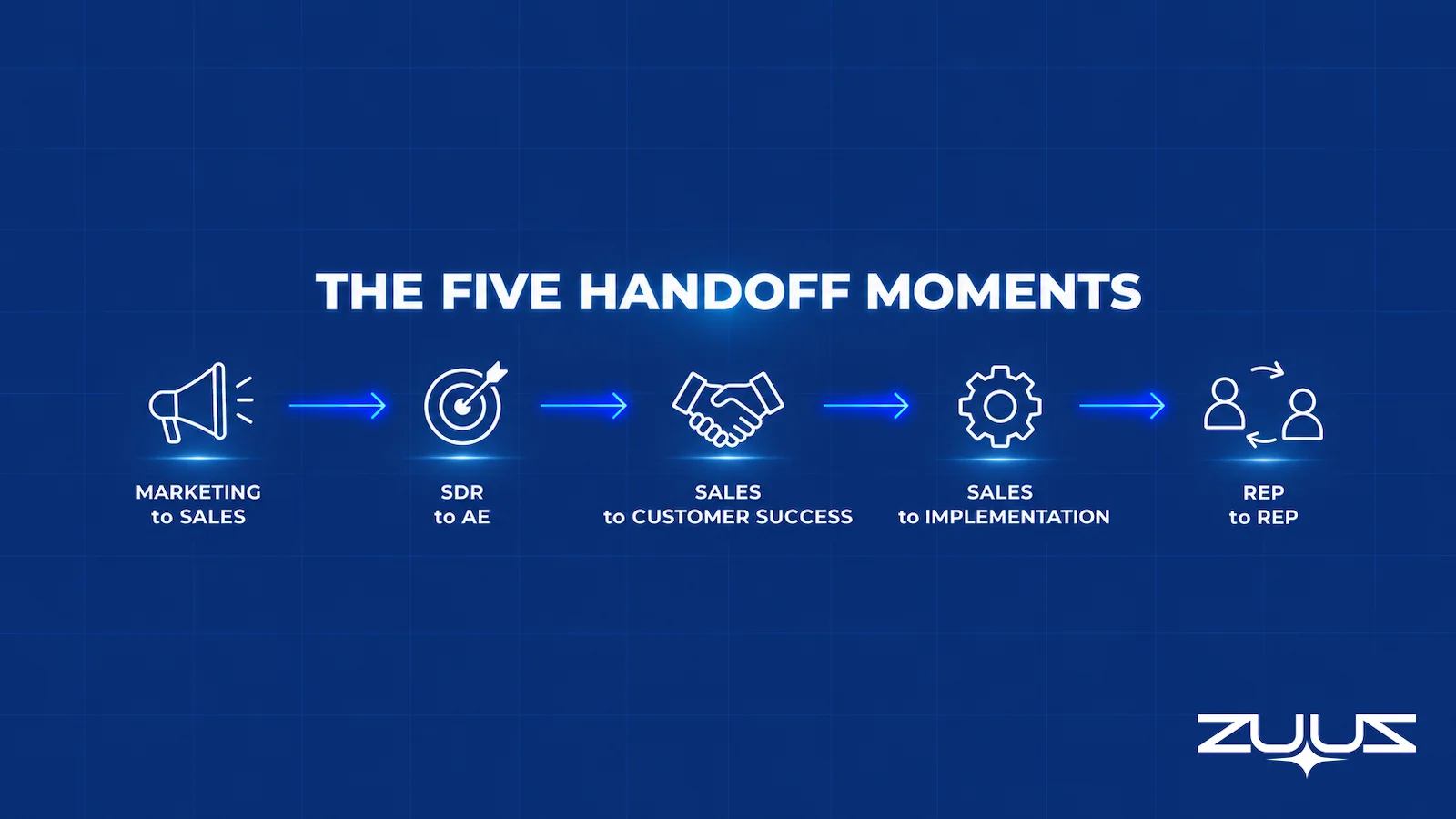
Search interest concentrates on the third and the fifth. Sales leaders look for a sales to customer success handoff process when onboarding keeps starting badly, and they look for account transition guidance when someone resigns. Both questions have the same root cause underneath them.
Why Do Sales Handoffs Fail?
Six causes appear in almost every post-mortem, and a seventh sits underneath all of them.
- Incentives stop at the signature. A rep is compensated for closing. Documentation after the close competes with the next quarter’s pipeline.
- No standard document. When every handoff is a fresh email or a Slack thread, the quality depends on who is writing it that day.
- The handoff happens too late. A transfer that begins at signature gives the receiving owner no chance to ask questions while the buyer is still engaged.
- Tool silos. Deal context lives in the CRM, delivery context in a project tool, and conversation context in an inbox that neither system reads.
- No internal kickoff. Teams jump straight to the customer introduction without a working session between the old and new owner first.
- No feedback loop. Nobody tells the AE that the account they handed over had three surprises in week two, so the next handoff repeats them.
- The context was never captured. This is the one that makes the other six expensive. If the promise, the stakeholder change and the objection only ever existed in a thread, the handoff document is an act of recall under time pressure.
That last point is worth sitting with. Teams treat handoff quality as a discipline problem and try to solve it with a better template. The template is fine. The input is missing, because CRM records are updated when a rep has time, and the sales inbox holds what actually happened. Pipeline records drift for the same reason, and handoffs simply expose the drift at the worst possible moment.
A Handoff Is Only as Good as the Record Behind It.
ZUUZ connects to the sales inbox and LinkedIn messages, and writes stakeholders, next steps and commitments into Salesforce, HubSpot, Zoho, Attio or Pipedrive for the rep to approve in one click.
There is a pattern worth naming from years of running sales in IT services and distribution. The accounts that changed hands cleanly were never the ones with the most thorough handoff document. They were the ones where the relationship had always been plural: two or three people from the vendor side already on the threads, so the customer had somebody to call who already knew the history. The single-threaded accounts, the ones carried by one excellent seller, were the ones that wobbled the moment that seller moved on, regardless of what got written down on their last week.
That is why the practical fix is upstream of the checklist. A handoff document records what one person remembers. A record that fills itself as conversations happen removes the dependency on that person being available, motivated and accurate at exactly the wrong moment.
What this looks like in a real deployment
At RA Technologies, a US IT services company, ZUUZ ran on the HubSpot instance the team had used for two years, with the same people and no migration. It surfaced $120K in pipeline within 72 hours that the CRM had never seen, captured from the sales mailbox.
At Cloud Box Technologies, a UAE cloud and IT services business, 10 to 12 renewals are tracked in minutes from a single connected user, and leadership sees live pipeline without asking anyone for an update. Both run the CRM they already had, which is the point: the layer is additive, so a handoff never waits on a migration.
When Should the Sales Handoff Start?
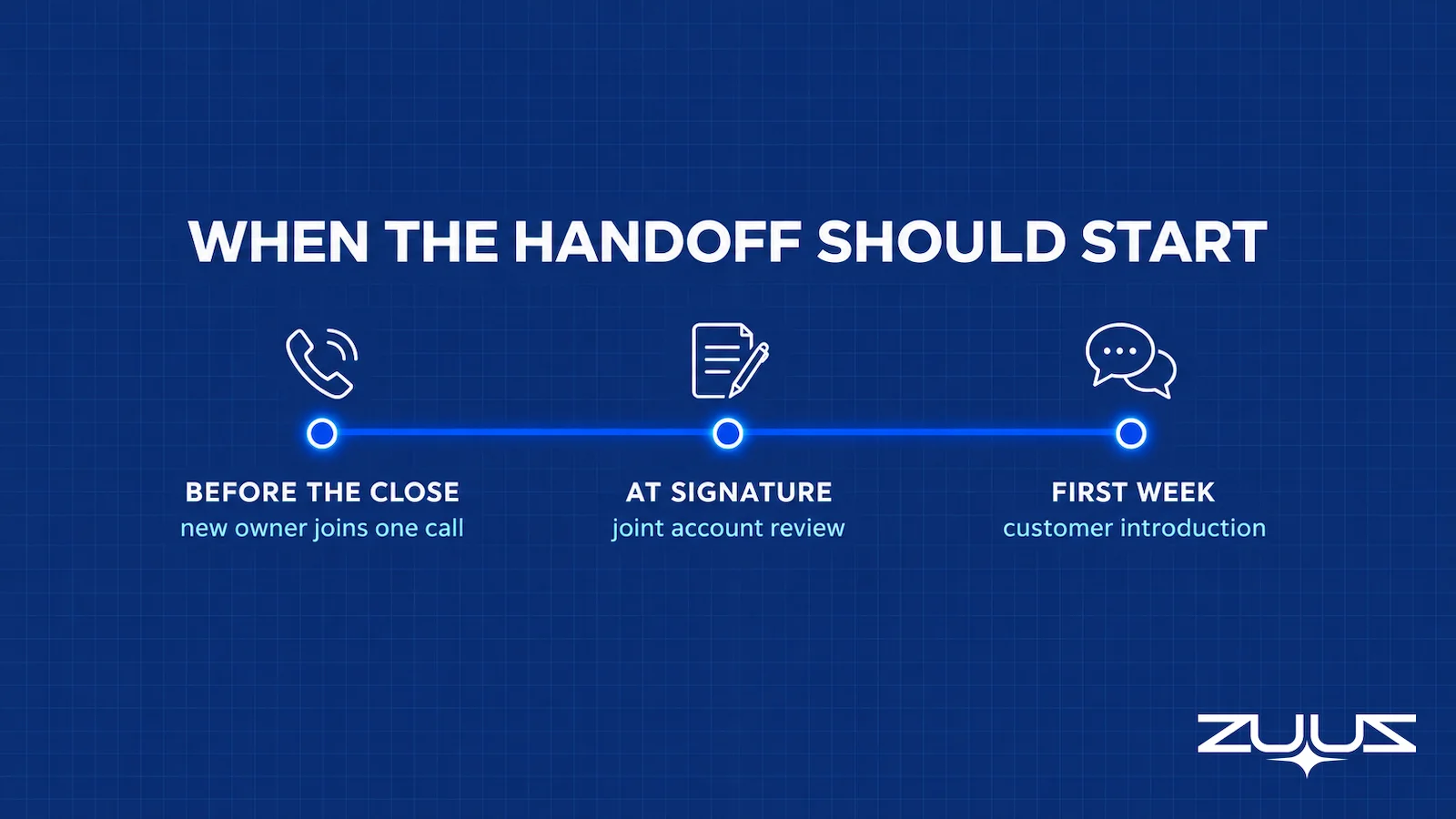
Three stages work better than a single event.
Before the close. Once a deal is realistically committed, the receiving owner joins one call as an observer. No introduction speech, no new discovery. The point is to hear the customer describe the outcome they bought in their own words, which is the single thing that never survives a written summary.
At signature. The internal handoff happens within a day or two: the outgoing and incoming owners review the account together, confirm what was promised, and flag anything that was left open. This is a working session, not a status update.
In the first week. The joint introduction to the customer happens once the internal review is done, so the new owner arrives informed rather than asking the buyer to repeat the evaluation. Internal handoff speed also affects cycle length on the deals that follow, because reference calls and expansions start from a warm account instead of a cold one.
Unplanned handoffs compress all three stages into whatever notice period exists. That is exactly why the record matters more than the ritual.
What Belongs in a Sales Handoff Document?
Six categories cover what the next owner needs. The detail inside them is what separates a useful handoff from a form.
| Category | Generic version | Useful version |
|---|---|---|
| Goals and success criteria | “Improve efficiency” | The metric the buyer named, who is judged on it, and when they expect to see movement |
| Deal context | Amount, close date, stage history | Why this vendor was chosen, what was compared, what nearly derailed it |
| Stakeholders | Primary contact | Every person who appeared on a thread, their role in the decision, and who went quiet |
| Risks and commitments | “Some concerns about timeline” | The exact promise made on a call, the date attached to it, and who made it |
| Action plan | “Kickoff scheduled” | First three milestones with owners, plus anything the customer agreed to provide |
| Artifacts | Signed contract | Proposal versions, security review answers, procurement conditions, renewal and co-term dates |
Two of these are routinely wrong. Stakeholder lists are usually a single name, even though a typical B2B purchase involves several people whose objections shaped the outcome. Commitments are usually summarized as sentiment rather than recorded as sentences, which means the next owner learns about them when the customer asks why something was not delivered.
Where the Handoff Context Actually Comes From
Four sources can carry an account’s history to its next owner, and they differ in who does the work and what survives.
| Source | Who maintains it | What it carries | What it loses |
|---|---|---|---|
| Handoff document | The outgoing rep, once | A summary written from memory | Anything recalled wrongly or left out under time pressure |
| CRM fields | The rep, continuously | Stage, amount, dates | Stakeholders, promises, the reason a deal was won |
| Native email sync | Automatic once connected | That messages and meetings existed | What changed in them, and anything outside the mailbox |
| Capture layer such as ZUUZ | Automatic, rep approves in one click | Participants, next steps, commitments and renewal signals on the record | Nothing the connected channels contain, though judgment still sits with the team |
A Sales Handoff Checklist, Split by Role
Checklists fail when one person owns everything. Splitting the list by role makes the gaps visible, and giving each line an owner, a due date, a link to the evidence and an acceptance status makes it auditable. The receiving owner marks each item accepted, missing or not applicable. A changed record owner in the CRM is not by itself a completed handoff.
Outgoing owner, the account executive:
- Confirm stage, amount, products and contract dates are accurate in the CRM, not approximately accurate.
- List every stakeholder who appeared in the buying process, including the ones who disappeared, and note who objected to what.
- Write down commitments made verbally, with dates and the person who made them.
- Attach the artifacts: the proposal that was accepted, the security or compliance answers, procurement conditions and any co-term or renewal schedule.
- Name the two things most likely to go wrong in the first ninety days.
Incoming owner, customer success or account management:
- Read the thread history before the internal session, then bring questions to it.
- Confirm the success metric with the customer in the first call, in the customer’s words.
- Restate the commitments back to the outgoing owner so misunderstandings surface internally, not in front of the buyer.
- Set the first review date before the kickoff ends.
Sales operations or RevOps:
- Transfer record ownership across accounts, contacts, open opportunities and activities, and check that nothing is orphaned.
- Preserve the mailbox and calendar history before access is revoked, following the platform’s own retention process.
- Reassign by value and risk, not alphabetically, so the largest renewals get an owner first.
- Confirm the new owner has the access, dashboards and account records they need on day one.
- Name an interim owner for anything that cannot be reassigned immediately, so no account sits unowned while coverage is decided.

How Is Handing Off an Open Deal Different?
Most handoff advice assumes the deal is already won. Reassigning a live opportunity is a different problem, and it happens constantly during departures, leaves and territory changes.
An open deal carries momentum that a closed account does not. There is a proposal in flight, a champion who has spent political capital, a procurement timeline and often a competitor still in the room. Three things matter more here than in a post-close handoff:
- Continuity of voice. The buyer agreed to a process with a person. A silent swap mid-evaluation reads as instability, so the introduction should come from the outgoing rep or the manager while the relationship is still warm.
- Exact status, not stage. “Proposal sent” is a stage. “Second revision sent Tuesday, legal reviewing the liability clause, decision meeting the following Thursday” is a status, and only one of those lets the new rep act.
- Deal risk, reread. A handoff is a good moment to check whether the deal is still moving or has quietly stalled behind the transition. Deals slip most often when nobody owns the follow-up, and a reassignment creates exactly that vacuum.
What Happens to Accounts When a Sales Rep Leaves?
Records get reassigned quickly. Context leaves with the person unless someone deliberately preserves it.
A workable sequence for the first 48 hours:
- Preserve before revoking. Mailbox and calendar history are the account’s memory. Follow the platform’s retention path, such as Microsoft’s inactive mailbox process, before the license is removed.
- Debrief while the rep is still present. Thirty minutes per significant open deal, recorded as notes on the record, beats a written summary produced on the last afternoon.
- Transfer ownership in the CRM. Salesforce documents how to change record ownership, and the same principle applies in HubSpot and Zoho: move accounts, contacts, open opportunities and activities together, not just the account.
- Triage by exposure. Open deals closing this quarter and renewals due within ninety days get an owner first.
- Tell the customer, once. A short introduction from the manager prevents the buyer discovering the change through an unanswered email.
The uncomfortable part is that most of this is recovery work. It exists because the account’s history lived in one mailbox. Teams that capture conversation context continuously treat a departure as a reassignment rather than an archaeology project, which is the difference between a bad week and a lost renewal.
When a Rep Leaves, the Account History Should Stay.
ZUUZ keeps stakeholders, commitments and deal history on the account record in the CRM, captured from conversations as they happen rather than reconstructed on someone’s last day.
What VARs, MSPs and Distributors Hand Off That Software Teams Do Not
Handoff advice is written for software onboarding. Channel and services businesses carry extra baggage through the same transition.
- Renewal and co-term dates. A reseller account is a stack of licenses and support contracts with different anniversaries. The next owner inherits a calendar, not a single renewal. Tracking those dates across product lines is part of the handoff, not a separate exercise.
- Implementation promises. What was scoped during the sale and what delivery agreed afterwards are often different, and the gap is where margin disappears.
- Client signals outside the ticket system. For an MSP, the early warning that a client is unhappy usually arrives in an email to the account manager, not as a ticket. The PSA records service work while the CRM records deals, and neither captures the conversation.
- Multi-line reorder history. Distributors hand over buying patterns rather than a single subscription, and reorder timing is the relationship.
At Cloud Box Technologies, an IT services and distribution business, the accounts that survived a change of owner best were the ones where renewal dates and open commitments already sat on the record. The ones that suffered were the accounts a single relationship had carried.
How Do You Measure Whether a Handoff Worked?
Handoff quality is measurable without inventing a score. Four plain numbers are enough for a manager to see the pattern.
| Measure | What it reveals |
|---|---|
| Days from close to first contact by the new owner | Whether the transition is a process or an afterthought |
| Percentage of required fields complete at transfer | Whether the record was ready before the transfer, not after it |
| Questions the customer answers twice | The re-discovery tax the buyer pays for the internal change |
| Escalations and surprises in the first 90 days | What the handoff document left out |
These are reports on what happened, which is exactly what a CRM report should be able to answer without a manual audit. None of them require a predicted outcome or a health score, and a team that tracks the first two for a quarter usually finds the third and fourth improve on their own.
Sales Handoff: How ZUUZ Keeps the Account Record Current
ZUUZ is an AI layer that sits on top of the CRM a team already runs. It does not replace Salesforce, HubSpot, Zoho, Attio or Pipedrive, and the CRM stays the system of record.
For handoffs, three things matter:
- The context is captured as it happens. ZUUZ connects to the sales inbox and reads LinkedIn messages, Microsoft Teams meeting transcripts and inbound call transcripts, then writes stakeholders, next steps, stage signals and commitments to the CRM record. Reps approve finished work in one click, and nobody changes how they work.
- The account record answers the handoff questions. Because meeting notes and LinkedIn conversations land on the record rather than in a personal mailbox, the incoming owner reads history instead of interviewing a colleague who has already left.
- Renewal and risk context travels with the account. ZUUZ watches conversations for renewal timing and churn warning signs, so a transition does not reset what the previous owner knew.
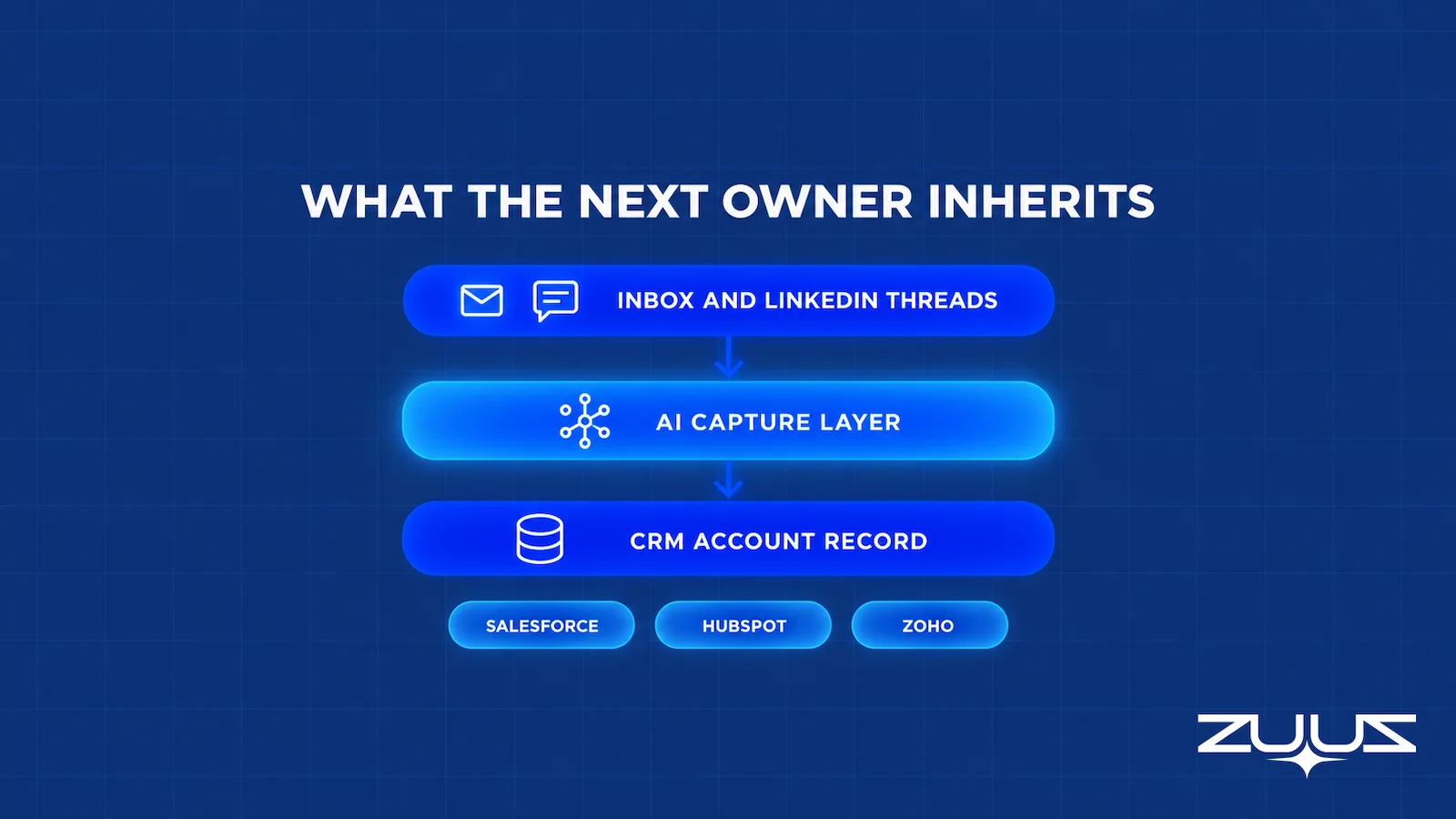
On a first connection, ZUUZ reads a 90-day history of the connected mailbox, which means an account that changes hands next month already has a record behind it. At RA Technologies, a US IT services company running HubSpot, ZUUZ surfaced $120K in pipeline within 72 hours that the CRM had never seen, captured from the sales mailbox. At Cloud Box Technologies, 10 to 12 renewals are tracked in minutes rather than rebuilt by hand.
What ZUUZ does not do is run the meeting. The internal kickoff, the customer introduction and the judgment about who should own an account stay with the team. ZUUZ removes the part where that judgment has to be made from memory.
Hand Over Accounts With Their History Attached.
See what a 90-day read of the sales mailbox puts on the account record before the next transition happens.
The Record-Ready Test: What a Manager Should See in Five Minutes
Handoff readiness is a question about the account, not about the paperwork. Before a transfer, a manager should be able to answer four questions from the record itself: who the stakeholders are and which of them have gone quiet, what was last promised and by whom, when the next renewal or milestone falls, and what the account is waiting on right now.
If answering those means asking the rep, the account is not ready to change hands. That is also the fastest test of whether a pipeline review is running on records or on recollection, and it is the same test that CRM adoption programs keep trying to solve with reminders.
The Record-Ready Test, in four steps:
- Choose an account the owning rep has not touched in two weeks.
- Ask a colleague to say who the buying group is, what was last agreed and what happens next, using the CRM alone.
- Every answer that needs the rep, the inbox or a call is a record-ready failure.
- A record that passes survives a handoff, a territory change and a departure. One that fails is a person, not a system.
From an operator’s seat
Across the deployments ZUUZ runs, the handoff that goes wrong is almost never the one missing a document. It is the one where the stakeholder list was right six weeks ago. The person who actually signs has changed roles, the technical champion has gone quiet, and the incoming owner spends the first call rediscovering a buying group the previous owner carried in their head. The part teams do not plan for is sequencing: the account has to be read back by the new owner while the outgoing rep is still reachable, which means starting two weeks before the last day rather than on it. Run the Record-Ready Test on the three largest accounts in that window first, because those are the ones where one unrecorded commitment costs a renewal.
Frequently Asked Questions
What is a sales handoff?
A sales handoff is the transfer of an account, deal or relationship from one owner to another along with the context needed to continue it. Common handoffs run from marketing to sales, SDR to AE, sales to customer success or implementation, and rep to rep when someone leaves or a territory changes. The records transfer easily. The context is what teams lose.
What should be included in a sales handoff document?
Six things: the customer’s success metric in their own words, deal context including what was compared and what nearly derailed it, every stakeholder and their role, verbal commitments with dates and who made them, the first three milestones with owners, and artifacts such as the accepted proposal, procurement conditions and renewal or co-term dates.
When should the sales to customer success handoff happen?
It should start before the close, not at signature. The receiving owner listens to one call once the deal is realistically committed, the internal handoff session happens within a day or two of signing, and the joint customer introduction follows in the first week. Starting at signature leaves no time to ask questions while the buyer is still engaged.
What is a sales handoff checklist?
It is a role-split list rather than one long form. The outgoing rep confirms record accuracy, stakeholders, commitments and artifacts. The incoming owner reads the history first, confirms the success metric with the customer, and sets a review date. Sales operations transfers ownership of accounts, contacts, opportunities and activities, and preserves mailbox history.
Who owns the sales handoff?
The outgoing rep owns the content, the incoming owner owns the questions, and sales operations owns the mechanics of transfer and access. Leadership owns the timing rule that says when a handoff must start. Teams that leave ownership implicit usually discover the gap during a departure, when nobody has authority to slow the transition down.
What happens to accounts when a sales rep leaves?
Accounts are usually reassigned within days, and the CRM records move cleanly. What disappears is the conversation history in the departing rep’s mailbox and LinkedIn messages: promises made on calls, stakeholder changes and open questions. Preserving mailbox history before access is revoked, debriefing open deals while the rep is present, and triaging by renewal exposure limit the damage.
How do you hand off an open deal in the middle of a sales cycle?
Introduce the new rep while the outgoing rep is still available, so the change reads as continuity rather than instability. Record exact status rather than stage: what was sent, who is reviewing it, and what date the decision depends on. Then check whether the deal has stalled behind the transition, because reassignment creates a follow-up vacuum.
How do you measure whether a handoff worked?
Four numbers are enough: days from close to first contact by the new owner, the percentage of required fields complete at transfer, how many questions the customer has to answer twice, and escalations in the first 90 days. None of them require a predictive score, and the first two are usually available directly from CRM reporting.
What is the difference between a sales handoff and an account transition plan?
A sales handoff is the event and its checklist. An account transition plan is the wider sequence that follows a departure or re-carve: reassignment priorities, customer communication, coverage while accounts are unowned, and the review schedule for the first quarter. The handoff is one step inside the plan.
How do you keep a stakeholder list current after the handoff?
Update it from the conversations that already happen rather than in a quarterly cleanup. New names appear on email threads and LinkedIn messages long before anyone adds them to the CRM, and contacts who go quiet are as informative as new ones. Capturing participants automatically keeps the list accurate without asking the new owner to maintain it.
Do teams still need a handoff meeting if the CRM is up to date?
Yes, but it becomes a short review instead of an excavation. A current record answers the factual questions, which frees the session for judgment: which relationship is fragile, what was implied rather than written, and where the next owner should spend the first two weeks. The meeting gets shorter, not unnecessary.
How does ZUUZ help with the sales handoff?
ZUUZ is an AI layer on top of the existing CRM. It connects to the sales inbox, reads LinkedIn messages, Teams meeting transcripts and call transcripts, and writes stakeholders, next steps, commitments and renewal signals onto the account record for the rep to approve in one click. The handoff then starts from a record rather than a reconstruction.