
MSP Sales Team Structure and Who to Hire First
MSP sales team structure for owner-led firms: who to hire first and how to split sales, account management and renewals as the team grows up.


CEO of ZUUZ. He scaled Cloud Box Technologies from 0 to $25M ARR in IT services and distribution before building ZUUZ. Connect on LinkedIn
TL;DR: The right MSP sales team structure follows the job that is leaking: the owner sells until the calendar is full, the first hire takes whichever of new business or account growth is slipping, and every renewal gets a named account manager. What breaks as the team grows is the handoff, because client context sits in the owner's inbox and memory. ZUUZ, revenue intelligence for the IT channel, captures those conversations from email, calendar, meetings and LinkedIn messages and keeps the account history current in the CRM, so any structure runs on one shared record.
- An MSP sales team structure divides three jobs: winning clients, growing them and keeping the contract at renewal.
- The first hire should cover whichever job is leaking. The Renewal Signal Check shows which one that is.
- Renewals need a named owner. Hunters are paid for new business, and the service desk sees tickets, not budgets.
- Handoffs fail on lost client context, not skill, so the record must exist before the hire starts.
- ZUUZ is a capture layer under any structure. It does not replace a role and it does not read PSA tickets.
Picture a thirty-five-person MSP whose owner has closed every new client for six years. A new account manager asks which clients renew this year and what each has said about the contract. The owner answers from memory, correctly, for nine of the twelve. For the other three, the answer sits in an email thread from last spring.
That scene is an illustration, not a client story, but most owner-led MSPs reach a version of it, and the question becomes what to hire first and how to divide the work. This guide covers MSP sales team structure for owner-led firms: the stages, a test for where the structure leaks, the common models, who to hire first, and how to keep renewals from slipping between roles.
What MSP Sales Team Structure Means at Each Stage
An MSP sales team structure is the way three jobs are divided among people: winning new clients, growing existing ones and keeping the contract through renewal. In a small MSP the owner does all three. As the firm grows, the split decides who talks to the client, who owns the number and where the account history lives.
Three stages most owner-led MSPs pass through
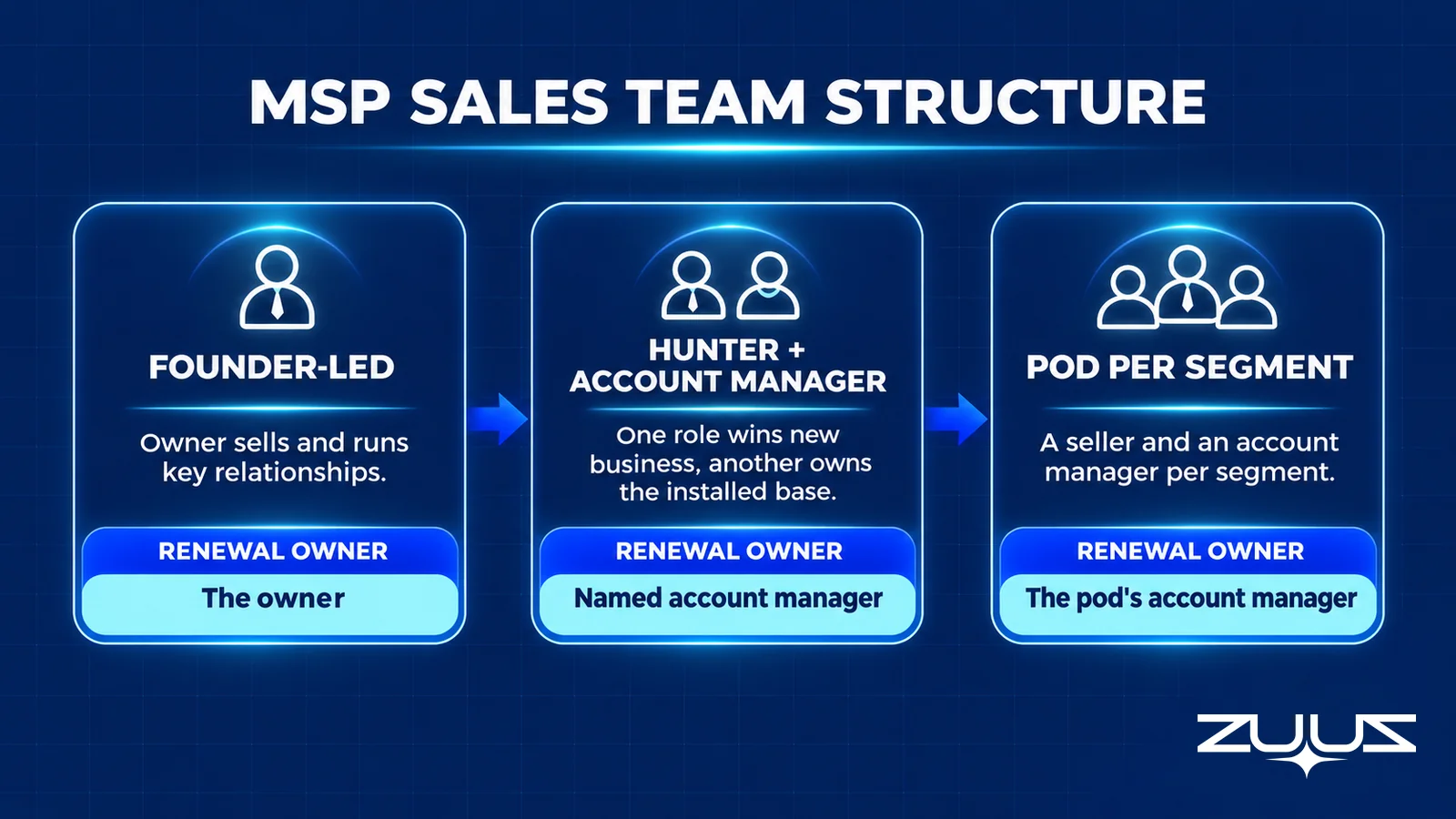
- Founder-led. The owner sells, runs the main relationships and handles renewals.
- Hunter plus account manager. One role owns new business and another owns the installed base, including renewals and expansion.
- Pod per segment. Small teams of a seller and an account manager each serve a segment such as healthcare, legal or a region.
These are stages, not thresholds, and an MSP can sit at the first one for years and be right to. The structure should serve the firm's MSP growth strategies, not the other way round.
The account side deserves as much attention as the hunting side. Writing in Harvard Business Review, Amy Gallo noted that acquiring a new customer is anywhere from five to 25 times more expensive than retaining one.
Test Any MSP Sales Team Structure With the Renewal Signal Check
Org chart debates start with titles. A better start is the book of business, because it shows which job is already failing. The test takes about an hour.
The Renewal Signal Check
Run it across every client before deciding what to hire. It shows which accounts depend on one person's memory.
- List every renewal in the next two quarters and its date field.
- For each, find the last real conversation and what it said about budget, champion or satisfaction.
- Mark every renewal where the date is the only thing the system knows.
- Those are the renewals that surprise you; the signal existed, in a mailbox.
Worked example for an MSP: a three-year agreement renews in March, and the owner personally closed it. The PSA holds the agreement date and the CRM holds a renewal record. Neither holds the September email in which the office manager wrote that a new CFO is reviewing every recurring contract. That client gets step three's mark, and the account needs a named account manager before another seller.
Read the result two ways. If most marked renewals are accounts the owner personally holds, the gap is account management. If few are marked but the pipeline is thin, the gap is new business.
Find the Renewals the System Only Knows by Date, Before the Next Hire.
ZUUZ keeps the account history current in the CRM from client email, meetings and LinkedIn messages.
MSP Sales Team Structure Options Compared
Each model has a natural fit and a predictable failure. The table sets them side by side, with a plain row for ZUUZ underneath all of them.
| Structure | Best fit | Who owns renewals | Main risk | Where account history lives |
|---|---|---|---|---|
| Founder-led | Early MSP, owner is the best seller, small client base | The owner | Owner's calendar caps growth; context lives in one head | Owner's inbox and memory |
| Hunter plus account manager | MSP with a client base to protect and new business to win | A named account manager | Handoff loses what was promised in the sale | CRM, as complete as logging habits allow |
| Pod per segment | Larger MSP with distinct markets or regions | The pod's account manager, with the vCIO on top accounts | Duplicated effort and uneven practices between pods | Each pod's CRM records, plus pod-level habits |
| ZUUZ (capture layer under any structure) | Any of the three, added without changing roles or the CRM | Unchanged; the named owner can review and roll back what is written | Does not assign roles, replace the CRM or read PSA tickets | Email, calendar, meetings and LinkedIn messages, written to the CRM |
Founder-led selling
Founder-led selling is the right default while the owner wins deals faster than anyone could be trained to. It fails quietly, because every renewal routes through one person.
Hunter plus account manager
This is the most common first split. The hunter is rewarded for new recurring revenue, and the account manager for retention and expansion. It works only when the handoff is explicit.
Pod per segment
A pod pairs a seller and an account manager around a segment, so messaging and service packaging can be specific. Pods fit once the MSP has enough clients in two or more segments. The cost is consistency, since each pod can drift into its own logging habits.
Which CRM holds the record is a separate decision, covered in the guide to the best CRM for MSPs. Every structure needs one record that survives a handoff.
Who to Hire First in an Owner-Led MSP
The first sales-side hire should take the job that is leaking, not the one that sounds most senior. Three situations cover most owner-led MSPs.
Hire an account manager first when renewals depend on the owner
If the owner personally holds the relationships behind most renewals, an account manager frees the owner and protects recurring revenue. The role runs reviews and owns every renewal date.
Hire a hunter first when clients are stable and the pipeline is thin
If the Renewal Signal Check shows few surprises but new-client volume has stalled, a hunter is the better first hire. The hunter needs a defined target market, a clear service package and an existing pipeline in the CRM.
Hire neither yet when the process is not written down
A new seller inherits the MSP sales process, and if that process lives only in the owner's head, writing it down comes first. A one-page version covering qualification, scoping, proposal and handoff is enough to start.
Where Account Management and Renewals Belong
Renewals belong with a named account manager, with the owner or vCIO joining on top accounts. Hunters should not own them by default, because their incentives point at new business, and the service desk sees tickets rather than budgets.
A workable renewal routine has four parts: a named owner per client, a review cadence, renewal dates visible two quarters ahead, and a place for client signals between reviews. The first three are process. The fourth is a record problem, where most structures fall short. Running those reviews is covered in MSP account management, and retention more broadly in MSP customer retention.
Give Every Renewal an Owner With the Client's Own Words Attached.
ZUUZ writes client requests and complaints to the right account in the CRM.
What Changes When the Owner Stops Being the System of Record
From an operator's seat, the hardest part of the first sales hire is not recruiting or compensation. It is the context the owner has about each client: who really signs, which complaint is still raw, what was promised on a call. The pattern across Avinash Gujje's years scaling Cloud Box Technologies from $0 to $25M ARR in IT services and distribution is that a new hire is handed names and dates and never handed that context.
The part teams do not plan for is the order of operations. Capturing context after the hire starts means the new person sits in on calls to absorb it, which depends on what the owner remembers. Capturing it before means the new person opens an account and sees what the client said. The owner's reluctance to hand over top accounts is usually about this gap, not trust.
Compensation and Handoffs Between Sales and Account Management
Compensation should reward each role for its own job. Hunters earn on signed new recurring revenue, and account managers earn on retention and expansion. Tying part of the hunter's payout to a clean handoff, such as a completed onboarding milestone, keeps deals from being thrown over the wall.
A clean handoff has a short checklist. Before a deal closes, the record should state who the buying group is, what was promised, which commitments are dated and what happens next. If an account manager has to ask the hunter any of those, the handoff has failed.
Admin work that needs no judgment, such as logging a thread, is the part worth automating, as covered in MSP sales automation. The judgment stays with the people.
Make the Handoff a Record, Not a Conversation.
A new owner opens the account in the CRM and sees what the client already said.
The Capture Layer Under Any Structure
ZUUZ is revenue intelligence for the IT channel: MSPs and the vendors, distributors and resellers they work with. It reads email, calendar, meetings and LinkedIn messages, finds the deal and account signals in them, and updates the CRM automatically, with full change history and one-click rollback. The CRM stays the system of record, whether Salesforce, HubSpot, Zoho, Attio or Pipedrive.
That makes it independent of structure. Under founder-led selling, it moves the owner's context from an inbox into the record. Under a hunter plus account manager model, it carries what was promised across the handoff. Under pods, it keeps records consistent because they build from conversations, not each pod's habits. When a deal is won, ZUUZ writes the customer to ConnectWise PSA.
RA Technologies, a US IT services company, ran ZUUZ on the HubSpot instance it had used for two years, with the same team, and $120K in pipeline was surfaced within 72 hours that the CRM had never seen. At Cloud Box Technologies, a UAE cloud and IT services business, a single connected user tracks 10 to 12 renewals in minutes, and leadership sees live pipeline.
The boundaries matter. ZUUZ does not read PSA tickets or RMM data, and reports what happened rather than scoring deals. Early-stage MSPs can use it as their AI CRM, and later-stage MSPs run it as the layer on the CRM they already have. The ZUUZ page for managed service providers has the detail.
A first step before the next hire
Connect one mailbox, let ZUUZ read the last 90 days, and compare what it writes for the next three renewals against the CRM today. The gap is context a new hire would otherwise relearn. The trial is free for 30 days: start a free trial.
MSP Sales Team Structure Mistakes That Cost Growth
- Hiring a hunter before writing down the sales process. The new seller spends months rebuilding what the owner already knew.
- Leaving renewals with whoever sold the deal. Hunters are paid for new business, so renewal work quietly loses.
- Splitting roles without a handoff standard. The account manager inherits contracts without the promises behind them.
- Adding pods before the record is shared. Each pod develops its own habits.
A sales structure is only as strong as the record it runs on. Run the Renewal Signal Check, name an owner for every renewal, and the first hire becomes clear.
Frequently Asked Questions
What is the best sales team structure for an MSP?
The best sales team structure for an MSP depends on stage. Owner-led selling works until the calendar is full, hunter plus account manager suits most MSPs once growth and renewals both need attention, and a pod per segment fits larger firms with distinct markets. Every renewal needs one named owner.
Who should an MSP hire first for sales?
An MSP should hire first for whichever job is leaking. If renewals and expansion depend on the owner, hire an account manager. If clients are stable but the pipeline is thin, hire a hunter. The Renewal Signal Check settles it by showing how many renewals the system knows only by date.
When should an MSP owner stop doing the selling?
An MSP owner should step back from selling once the owner's calendar, not demand, caps new business, and once the sales process is written down well enough for someone else to run it. Stepping back earlier hands a new hire a process that exists only in the owner's head.
Should an MSP separate sales and account management?
Yes, once both jobs compete for the same hours. Hunters naturally favor new logos, while account managers protect and grow the base, and one person doing both usually neglects one. Small MSPs can combine the roles for a while, provided every renewal still has a named owner.
How should MSP sales compensation be structured?
Pay hunters for signed new recurring revenue and account managers for retention and expansion. Tie part of the hunter's payout to a clean handoff, such as an onboarding milestone, so deals are not thrown over the wall. Keep the plan simple enough to explain quickly.
Who should own renewals at an MSP?
A named account manager should own every renewal, with the date and latest client signals on the record. Hunters should not own them by default, because their incentives point at new business, and the service desk sees tickets, not budgets.
How many salespeople does an MSP need?
There is no fixed number. An MSP needs enough sales capacity to cover new-client targets and enough account management to review every client on a set cadence. A useful test is whether each client has a named owner and a scheduled review. Add headcount when either answer is no.
How does ZUUZ fit into an MSP sales team structure?
ZUUZ sits under any MSP sales team structure as a capture layer, not a role or a CRM. It reads email, calendar, meetings and LinkedIn messages and updates the CRM with change history and one-click rollback. Won customers are written to ConnectWise PSA. ZUUZ does not read PSA tickets or RMM data.