
MSP Growth Strategies That Start With Existing Clients
MSP growth strategies that start with clients already under contract: expansion, new services and referrals, and how to catch each signal in email.

CEO of ZUUZ. He scaled Cloud Box Technologies from 0 to $25M ARR in IT services and distribution before building ZUUZ. Connect on LinkedIn
TL;DR: MSP growth strategies work best when they start with the clients already under contract: expansion in seats and sites, new service lines, early renewal conversations and referrals. Each of these shows up first as a conversation in email or a meeting, long before the PSA or the CRM records it. ZUUZ is revenue intelligence for the IT channel. It reads email, calendar, meetings and LinkedIn messages, finds the growth signals, and updates the CRM automatically with full change history and one-click rollback, so no signal waits in an inbox.
- The four classic growth strategies map to four MSP levers: sell more to current clients, add service lines, win referrals and enter new segments.
- Growth inside the existing client base is usually the shortest path, because trust and an agreement already exist.
- Expansion, renewal and referral signals appear in conversations before the PSA or the CRM holds them.
- The Renewal Signal Check finds the renewals where a date is the only thing the system knows.
- ZUUZ captures the signals and keeps the CRM current; ConnectWise PSA receives won customers. It reports what happened and does not forecast.
Picture a 25-person MSP on a Monday morning. A client's office manager emailed on Friday afternoon to ask whether a new branch office could be covered under the existing agreement. The email is read, flagged and buried under service escalations. The owner meant to answer it from the car, and the CRM still shows the client as "Active, no open deal." Nobody will notice the expansion until the invoice questions start, or until another provider answers first.
That scene is an illustration, but the pattern is common. This guide covers the MSP growth strategies that start with the clients already under contract, how each one shows up in email before it shows up anywhere else, and how to keep those signals in the CRM instead of the inbox.
What MSP Growth Strategies Actually Cover
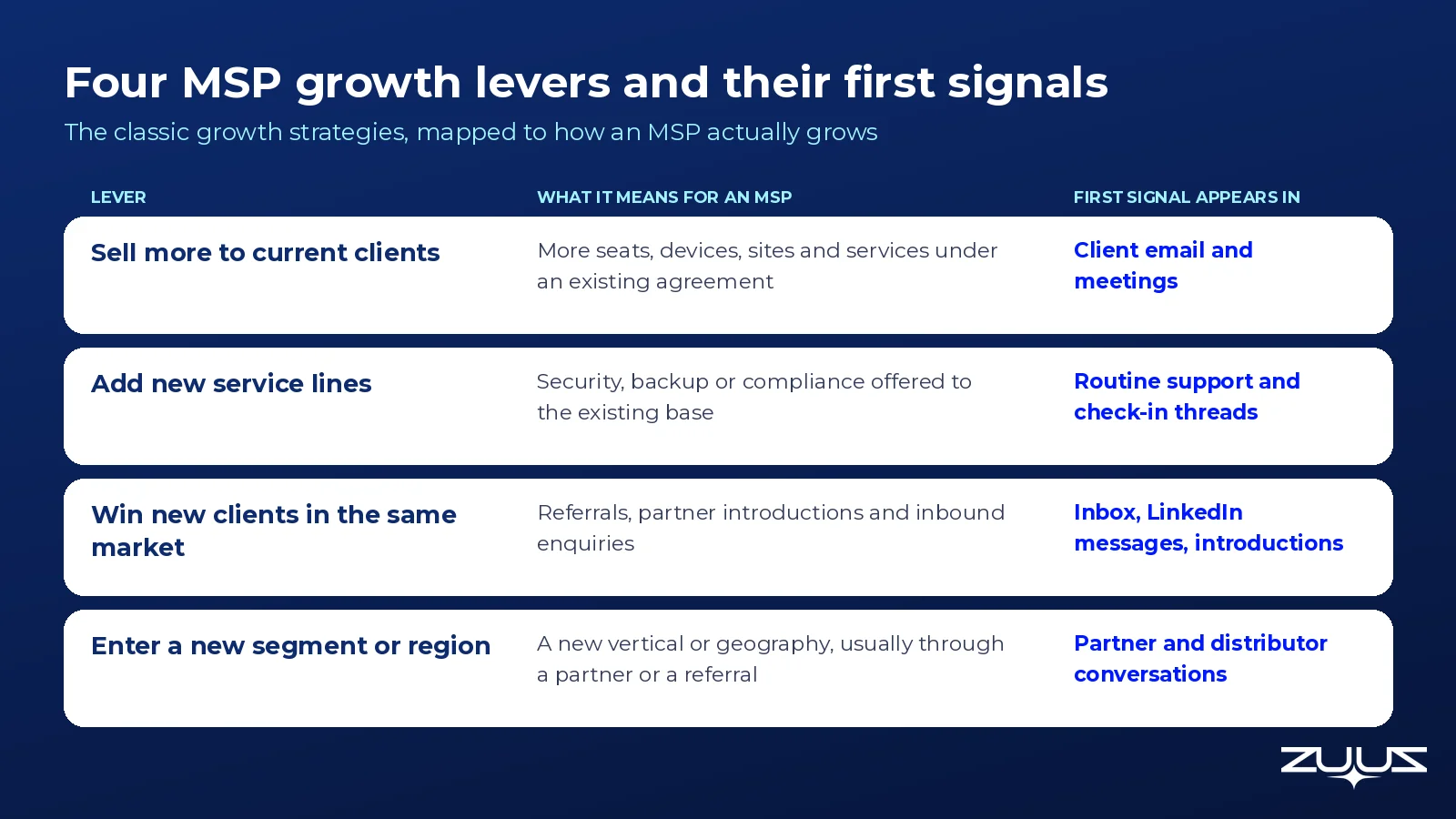
MSP growth strategies are the repeatable ways a managed service provider adds recurring revenue. The classic framework lists four: market penetration, market development, product development and diversification. Applied to an MSP, they become four levers: sell more to current clients, enter a new segment or region, add new service lines, and win new clients in the same market through referrals and partners.
The levers differ in cost and speed. Selling more to current clients and adding service lines build on trust and an agreement that already exist. Winning new clients in the same market depends on introductions. Entering a new segment is the slowest, usually run through a partner or a distributor.
Most advice on MSP growth lists tactics for marketing and lead generation. That advice is useful for the third and fourth levers, and it is covered in the guide to MSP sales leads. This guide concentrates on the first two, because they run through conversations the MSP is already having.
Growth From Existing Clients Comes First
For an MSP with multi-year agreements, the shortest path to growth is usually inside the client base. The client already trusts the provider, the contract exists, and the next purchase is a conversation, not a campaign. Typical expansion triggers are a new hire count, a second site, a device refresh, an acquisition by the client, or a security incident at a peer business.
Each trigger reaches the MSP the same way: as a sentence in an email, a remark at the end of a meeting, or a message in a routine check-in thread. The sentence is often phrased as a favor, such as "can you add Dana to the account," and it is answered by whoever sees it first, priced from memory and never entered as an opportunity.
That is why the same few habits separate MSPs that grow from the base from those that do not. Every client question has an owner and a date on the day it arrives. Every expansion request becomes a recorded opportunity with a next step. The same discipline is covered for sales stages in the MSP sales process guide and for account ownership in MSP account management that survives a handoff.
Expansion Requests Belong on the Account, Not in an Inbox.
ZUUZ reads client threads for requests to add seats, devices and sites and writes them to the CRM as opportunities, with a next step and change history.
New Service Lines Sell Into the Base
New service lines, such as security monitoring, backup and recovery, or compliance support, are the second lever. They sell best to current clients, because the MSP already knows the environment and the client already trusts the team. The first signal is rarely a purchase request. It is a question in a routine thread: whether the backups were tested, what the policy says about a lost laptop, whether a customer questionnaire can be answered.
A question like that is a buying signal about a service the client does not yet have. When it lands in a support ticket it stays with the service desk, and when it lands in the owner's inbox it waits. In both cases the sales record never sees it. The MSP sales pipeline guide covers how these signals, and seat and device growth, appear in email before the invoice.
New Clients Come Through Referrals and Partners
The third and fourth levers add new clients and new segments. For most MSPs these come through referrals from current clients, introductions from vendors and distributors, and inbound enquiries. A referral is a conversation too: a client mentions a neighbor business in passing, a distributor rep forwards a contact, a peer MSP asks to subcontract a service.
Partner-sourced opportunities work the same way, and they need the same capture discipline. A distributor introduction that sits unanswered for a week is a lost introduction. The IT channel guides on what IT distributors do for MSPs and VARs and on channel sales cover how these relationships run from the vendor and distributor side.
Where MSP Growth Signals Show Up First
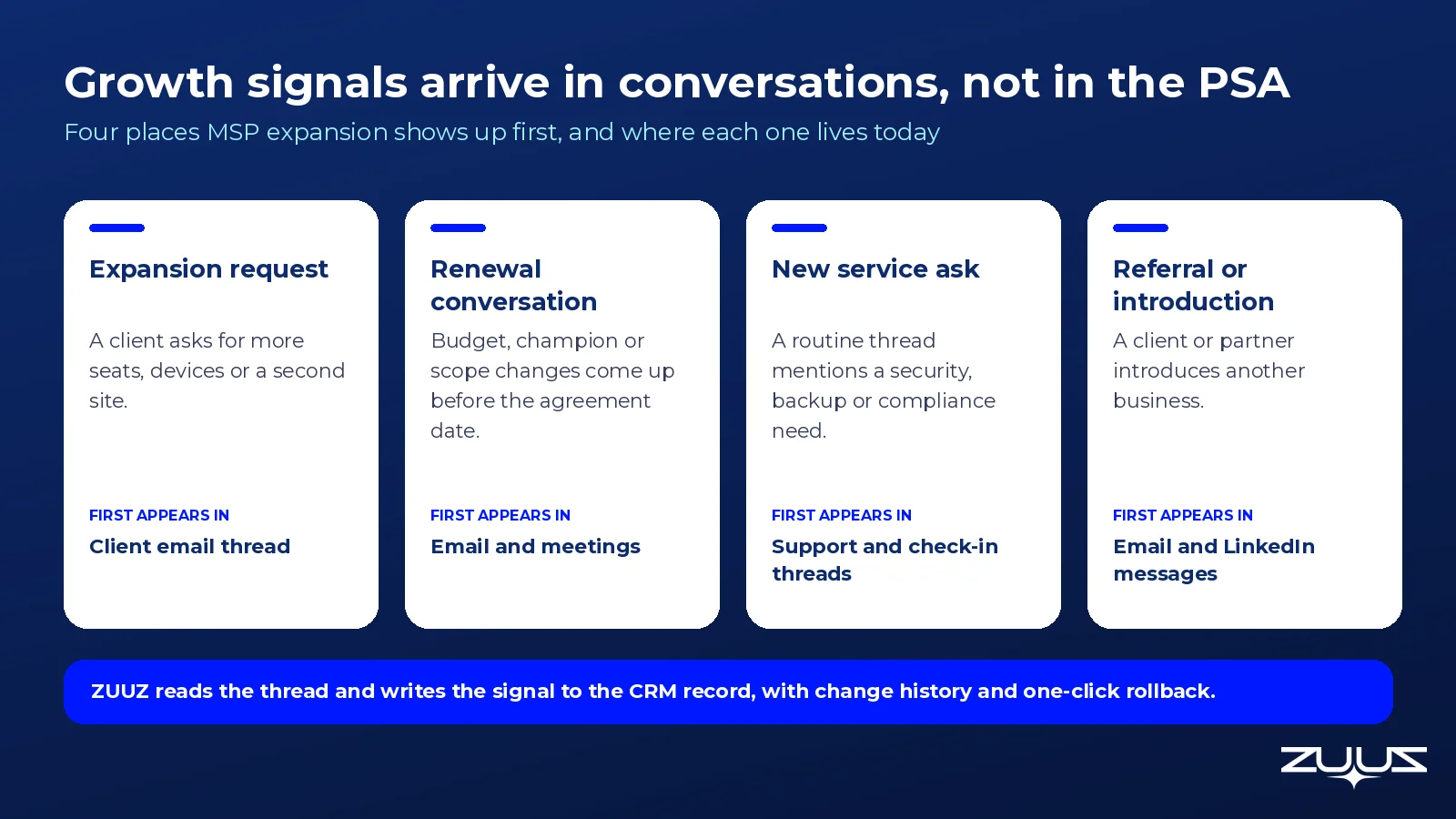
The PSA records what has been agreed: the agreement, its date, the covered users and the billing. The CRM, where one exists, records what someone typed. Growth signals sit upstream of both, in the conversations that lead to an agreement or change one.
| Growth signal | First appears in | What the PSA holds | What a complete record holds |
|---|---|---|---|
| Request for more seats, devices or a new site | Client email or a meeting | Nothing until the agreement changes | An opportunity with the ask, the requester and a next step |
| Renewal conversation | Email and meetings | The agreement end date | What was said about budget, champion and scope |
| Question about security, backup or compliance | Support and check-in threads | A ticket, if one was opened | A service-line opportunity linked to the account |
| Referral or introduction | Email and LinkedIn messages | Nothing | A lead with its source and the introducer |
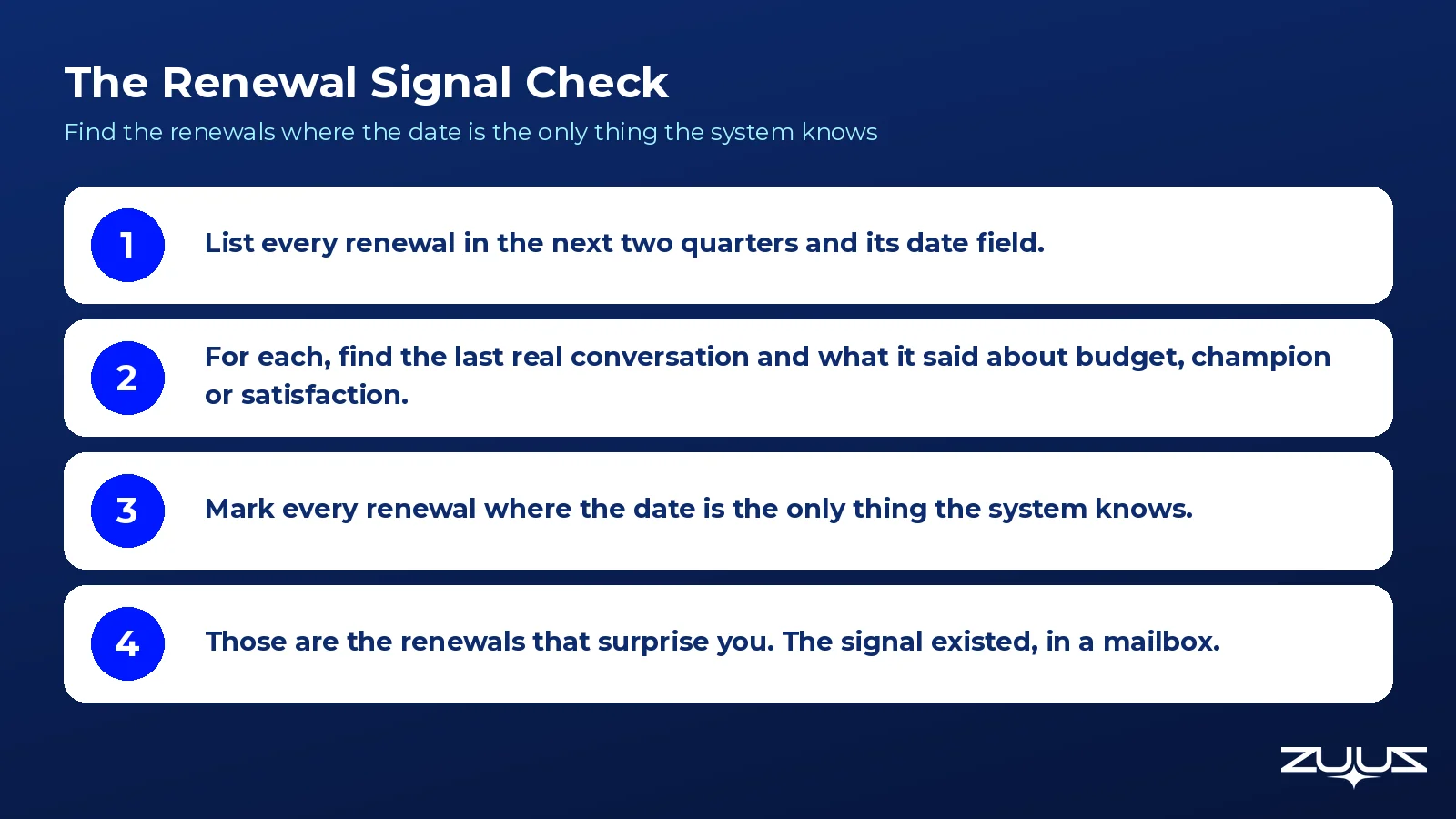
To find where the gap is widest, run the Renewal Signal Check, a ZUUZ framework:
The Renewal Signal Check
- List every renewal in the next two quarters and its date field.
- For each, find the last real conversation and what it said about budget, champion or satisfaction.
- Mark every renewal where the date is the only thing the system knows.
- Those are the renewals that surprise you; the signal existed, in a mailbox.
A typical result, offered as an illustration: of ten renewals in the next two quarters, most carry a date and a monthly amount, and only a few carry any note from a recent conversation. The renewals with no conversation attached are the ones where a client could already be talking to another provider, and the date field would never show it.
From an operator's seat
From an operator's seat in IT services and distribution, the part of MSP growth that teams do not plan for is how ordinary the signals look. An expansion request rarely sounds like a purchase. It sounds like a favor, a question or a complaint, and it lands with whoever is nearest, usually a technician or the owner. The growth that gets missed is not the deal that was lost in a competition. It is the request that was answered kindly, priced from memory and never recorded, so nobody followed up on the second site until the client asked why it was still not covered.
Renewals Need a Conversation, Not Just a Date.
ZUUZ reads the renewal threads and meetings and writes what was said about budget, champion and scope onto the record, with full change history.
MSP Growth Strategies: How ZUUZ Keeps Growth Signals in the CRM
ZUUZ is an AI layer that connects to the sales inbox, calendar, meetings and LinkedIn messages. LinkedIn is read-only: ZUUZ does not send messages or run sequences. It finds the growth signals in those conversations, such as an expansion request, a renewal discussion or an introduction, and writes them to the CRM as structured records, with full change history and one-click rollback. Manual entries take precedence, and a 90-day mailbox lookback on first connection shows what was already said.
The setup depends on the MSP's stage. An MSP with no CRM yet can run on ZUUZ as its AI CRM, which builds leads, contacts, accounts, deals and renewals from those conversations. An MSP on Salesforce, HubSpot, Zoho, Pipedrive or Attio keeps that CRM, and ZUUZ updates it. In both cases ConnectWise PSA receives won customers, so the CRM and the PSA match. ZUUZ does not read PSA tickets or agreements, and the rep reviews and sends any reply ZUUZ drafts.
The result shows up as proof, not promises. RA Technologies, a US IT services company, ran ZUUZ on the HubSpot instance it had used for two years, with the same team, and ZUUZ surfaced $120K in pipeline within 72 hours that the CRM had never seen (identified pipeline, not closed revenue). Read the RA Technologies case study. Cloud Box Technologies, a UAE cloud and IT services business, tracks 10 to 12 renewals in minutes from a single connected user, and leadership sees live pipeline.
A first step smaller than a migration. Connect one mailbox. ZUUZ reads the last 90 days and writes what it finds to the CRM automatically, with full change history and one-click rollback. The gap between what the CRM logged and what the threads say shows up in minutes, and it is the evidence an MSP needs to see which growth signals are waiting. 30-day free trial, no credit card: https://zuuz.ai/trial
The CRM and sales automation for MSPs page covers the product view, and the ConnectWise PSA integration page covers how won customers reach the PSA. For the CRM question itself, see the best CRM for MSPs, by stage and PSA vs CRM for MSPs.
Growth Signals Belong in the Record, Not Only in the Inbox.
Connect one mailbox and ZUUZ shows which expansion requests, renewals and introductions are waiting in the last 90 days of email.
Measuring MSP Growth From What Happened
Growth is easiest to manage when it is counted from events that already happened. Four counts are enough to start. How many expansion requests were recorded in the last quarter, and how many days passed between the request and the first reply. How many renewals in the next two quarters have a dated conversation in the last 60 days. How many new leads came from a client or partner introduction. How much pipeline came from the existing base versus new names.
These are counts of recorded events, not predictions. ZUUZ does not forecast revenue or score deal health. It reports what changed, what was captured and which records were updated, so the numbers leadership discusses rest on dated evidence. The MSP customer retention guide covers the renewal side of the same record, and the MSP QBR guide covers how those facts feed a client review.
Which MSPs This Fits, and Which It Does Not
This approach fits MSPs where the owner or a small team sells, most growth comes from current clients and the real pipeline lives in an inbox. It fits MSPs on ConnectWise PSA with or without a CRM, and MSPs adding a CRM for the first time. It fits less well for an MSP whose growth is almost entirely outbound campaigns to strangers, because the signals ZUUZ captures come from conversations the MSP is already having.
It also does not replace the PSA, a marketing platform or a quoting tool. ZUUZ keeps the record of the conversations that lead to growth current. The decisions about price, scope and the next service line stay with the MSP.
Frequently Asked Questions
What are MSP growth strategies?
MSP growth strategies are the ways a managed service provider adds recurring revenue: selling more seats, devices and services to current clients, adding new service lines, winning new clients through referrals and partners, and entering new segments. For most MSPs the shortest path runs through the clients already under contract, because trust is already earned.
What are the four growth strategies for an MSP?
The classic four growth strategies are market penetration, market development, product development and diversification. For an MSP they map to selling more to current clients, entering a new segment or region, adding new service lines such as security or backup, and moving into unrelated offerings. The first two cost the least and are the easiest to track in a CRM.
How can an MSP grow without increasing marketing spend?
An MSP can grow without more marketing by working the base it already has: answering expansion requests quickly, starting renewal conversations early, offering the next service line to current clients, and asking for introductions. Every one of these starts as a conversation in email or a meeting, so the work is capturing and following up, not advertising.
Where do MSP expansion opportunities come from?
MSP expansion opportunities come from client conversations: a request for more seats or devices, a second office, a security or compliance question in a routine check-in, a change in decision-maker, or a renewal discussion. They arrive in email threads and meetings before they appear in the PSA, which records the agreement after the decision is made.
How should an MSP track expansion and renewal signals in a CRM?
An MSP should record each expansion request and renewal conversation as a dated field on the account or opportunity: what was asked, who asked, the next step and the owner. A date in the PSA is not enough. The Renewal Signal Check shows which renewals rest on a date alone, and those need a conversation first.
Can an MSP use ZUUZ as its CRM?
Yes, for an MSP without a CRM yet. ZUUZ can serve as the AI CRM, building leads, contacts, accounts, deals and renewals from email, calendar, meetings and LinkedIn messages. MSPs on Salesforce, HubSpot, Zoho, Pipedrive or Attio keep that CRM, and ZUUZ updates it automatically with full change history and one-click rollback.
Does ZUUZ forecast MSP growth?
No. ZUUZ does not forecast revenue or score deal health. It reports what happened: expansion requests captured, renewals with a recent conversation, pipeline that changed and records that were updated. Those counts make the record underneath any growth number real, and the MSP's own leadership still decides what the number means.
Does ZUUZ work with ConnectWise PSA?
Yes. ZUUZ works with ConnectWise PSA and syncs won customers to it, so the CRM and the PSA match without retyping. ZUUZ does not read PSA tickets or agreements. It reads the sales conversations in email, meetings and LinkedIn messages and updates the CRM, with a 30-day free trial available.