
Sales Call Prep Checklist and Template for B2B Teams
Sales call prep checklist and template for B2B teams: pull the buying group, last agreed, next step and renewal date from the CRM record in minutes.

CEO of ZUUZ. He scaled Cloud Box Technologies from 0 to $25M ARR in IT services and distribution before building ZUUZ. Connect on LinkedIn
TL;DR: Sales call prep is the short routine before a customer or prospect call that confirms the buying group, what was last agreed, the next step, the open questions, the renewal date and the risks. Most of the time goes to rebuilding that context from inboxes and stale CRM records, because the conversations were never captured. ZUUZ is an AI layer over Salesforce, HubSpot, Zoho, Attio or Pipedrive that captures email, calendar, LinkedIn messages, Teams meeting transcripts and inbound call transcripts, so its AI Search Agent can answer each prep question from the record. It does not research prospects on the web, write call scripts or record calls.
- Sales call prep is a one-page brief built before the call. It is different from notes taken after the call and from an account plan written once a quarter.
- Six facts carry most calls: the buying group, what was last agreed, the next step, the open questions, the renewal date and the risks.
- The prep time is set by where those facts live. If they sit in a CRM record that conversations keep current, ten minutes is enough; if they sit in inboxes, it never is.
- A first call, a follow-up, a QBR-style review and a renewal call each need a different pull from the same record.
- The Record-Ready Test shows which accounts cannot be prepped from the CRM alone, before the call finds out.
- ZUUZ answers prep questions only from what it captured and the CRM holds, and the rep approves what is written in one click. It does not research prospects externally or write scripts.
A typical scenario, offered as an illustration: an account manager at a forty-person managed services provider has a call with a customer in twenty minutes. The CRM shows a last activity from five weeks ago that reads "discussed renewal." The real conversation since then is spread across a reply from the customer's finance lead, a Teams meeting the owner joined last month and a LinkedIn message from a new IT manager nobody has met.
None of that is secret, and none of it is in one place. The account manager can open four tools and reconstruct the story, or walk in with what the CRM says and find out the rest during the call.
This guide covers what sales call prep is, a checklist and a one-page sales call prep template, how the pull changes for first calls, follow-ups, QBR-style reviews and renewal calls, and what has to be true of the record for the prep to take minutes instead of an afternoon.
What Sales Call Prep Is, and What It Is Not
Sales call prep is the short, repeatable routine a rep or manager runs before a customer or prospect call to confirm who is involved, what has already been said and what the call needs to achieve. The output is a one-page brief, not a script. The same routine applies whether the call is a first conversation, a follow-up, a QBR-style review or a renewal.
Most published guides frame sales call preparation as outside-in research: the prospect's website, funding news, a LinkedIn profile. That advice fits a cold first call. Reps at IT services firms, VARs, MSPs and distributors spend most of their calls somewhere else, on accounts that already exist, with a renewal coming, a project half delivered or a proposal waiting on an answer. For those calls the missing context is inside the company, in threads and meetings, not on the web.
The brief also sits in a specific place in the sales workflow. Notes written after the call belong to the practice covered in logging meeting notes in Salesforce. The strategy for a single customer belongs to an account plan. The manager's inspection of many open deals belongs to the sales pipeline review. Call prep is the brief that reads from all three records for one conversation, in the minutes before it starts.
Why Sales Call Preparation Turns Into Archaeology
The CRM was built to hold outcomes: a stage, an amount, a close date, a renewal field. A call depends on something different, which is the conversation that produced those outcomes. Who else joined the thread, what a customer asked for in a reply, what the owner promised in a meeting. Those facts live in the sales inbox, the calendar and the meeting transcript, and they reach the record only when someone retypes them.
So the prep becomes a search. The rep opens the account, reads the last logged activity, switches to the mailbox, searches the contact's name, scrolls back to the last real message, then checks whether a meeting happened since. Ten minutes become thirty, or the search is cut short and the call opens with the question every buyer notices: "remind me where things stand?"
The cost lands hardest when the person on the call is not the account owner. A colleague covering for a rep on leave, a manager joining a renewal or a new owner after a territory change has no memory to fall back on, only the record, which is the situation described in the guide to sales handoffs. Teams that run the inbox and the CRM as separate worlds, as happens when Outlook is used as a CRM, feel it first. It is also a data problem before it is a discipline problem, which is why CRM data quality decides how fast any prep routine can run.
How to evaluate whether a call can be prepared from the record
- Dated sources. Can each fact in the brief be traced to a message or meeting with a date on it, not to a rep's recollection?
- Capture beyond the rep. Do the sales inbox, the calendar, LinkedIn messages and meeting or call transcripts feed the record without anyone retyping them?
- Fields, not a feed. Do the six facts land in CRM fields a report or a search can read, or only in an activity stream that must be scrolled?
- Anyone can read it. Could a colleague who has never touched the account prepare the call from the record alone?
- Correction in one click. When a fact is written for the rep, can the rep fix or reject it before it saves?
- Honest gaps. Does a blank field mean unknown, rather than a guess typed to fill the cell?
Stop Rebuilding Context From Inboxes Before Every Call.
See how ZUUZ captures the conversations behind each account and writes structured updates to the CRM, so call prep starts from a record that is already current.
The Sales Call Prep Checklist
A sales call prep checklist is short on purpose. Seven items are facts the record should already hold, and one is the rep's own judgement. Anything beyond that tends to be research that feels productive and changes nothing about how the call goes.
| Check | Question to answer | Where it should live | If it is blank |
|---|---|---|---|
| Buying group | Who is on the buyer side, what does each person care about and who signs? | Contacts and roles on the account and the opportunity | Treat as unknown and ask early in the call |
| Last agreed | What did both sides agree to at the last conversation, and on what date? | A dated entry that points to the thread or meeting | Reread the last thread before the call, do not guess |
| Next step | What is the next dated commitment, and does it involve the buyer? | Next step and date fields on the opportunity | A rep-owned "follow up" is not a next step; set one on the call |
| Open questions | What did the buyer ask that is still unanswered, and what did the rep promise? | Captured from replies and meetings, listed on the account | Check sent mail for promises before the call |
| Deal in play | What is open, at what amount and in which stage? | Opportunity record | Confirm with the owner |
| Renewal date and notice | When does the contract end, and by when must notice be given? | Renewal and notice date fields | Find the contract date before anything else on a renewal call |
| Risks | Has a competitor been named, has the champion changed, has the buyer gone quiet? | Surfaced from conversations, confirmed by the rep | Ask a direct question on the call |
| Call objective | What one outcome would make the call a success? | The rep's own judgement | Do not start the call without one |
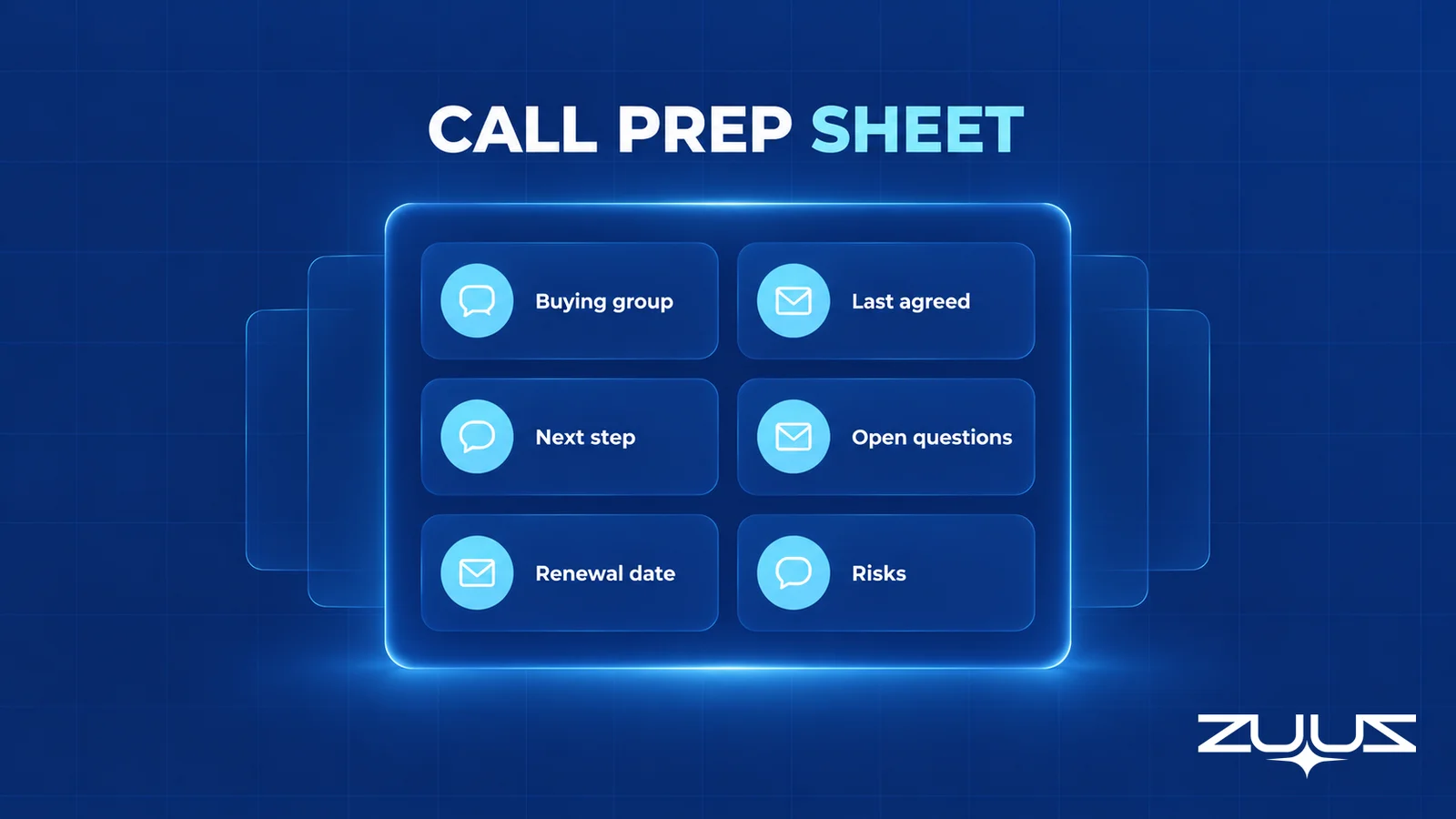
The first seven rows are retrieval. Row eight is the only one that needs a person to think, and it is where the preparation time should go. The retrieval half works best when the fields exist in the CRM as real fields rather than notes. Salesforce documents contact roles on opportunities for the buying group, and HubSpot lets admins arrange record cards and sidebars so the right fields sit where a rep looks first.
A Sales Call Preparation Template Teams Can Copy
A sales call prep template turns the checklist into a one-page sheet the rep fills before the call and the manager can read in a minute. The extra column that matters is the last one. Writing a source and a date beside every fact makes stale entries visible, because a fact with no date has no claim to being current.
| Field | What goes in it | Source and date |
|---|---|---|
| Account and call | Account name, call type (first, follow-up, QBR-style, renewal), date and attendees | CRM record, calendar invite |
| Buying group | Names, roles, who signs, who is missing from the thread | Contact roles, last three threads |
| Last agreed | The last mutual commitment in one sentence | Thread or meeting, with date |
| Next step | The dated commitment that follows from it, and who owns it | Opportunity fields |
| Open questions | Buyer questions not yet answered, and anything the rep promised | Replies and meeting transcripts |
| Renewal date and notice | Contract end date, notice period, last conversation about renewal | Renewal fields, thread |
| Risks | Competitor named, champion change, budget hold, silence | Conversations, confirmed by the rep |
| Objective and two questions | The one outcome wanted and the two questions that decide whether it is reachable | The rep |
| After the call | Next step agreed, owner, date | Written back to the record |
Here is the sheet filled in for one renewal call. This is an illustration, not a real customer.
| Field | Illustrative entry | Source and date |
|---|---|---|
| Buying group | Office manager (day to day), finance lead (signs), a new IT consultant copied since March | Last three threads |
| Last agreed | Customer asked for the renewal terms in writing before month end | Reply, April 3 |
| Next step | Owner sends terms by April 12, customer reviews by April 19 | Opportunity fields |
| Open questions | Whether the support hours can be split across two locations; rep promised an answer on April 3 | Reply, April 3 |
| Renewal date and notice | Contract ends June 30, sixty days written notice, so notice falls on May 1 | Renewal fields |
| Risks | Consultant asked what other providers charge for the same scope | Thread, March 28 |
| Objective | Agree the renewal terms in principle and book the signature date | Rep |
The template works as a spreadsheet, a shared document or a saved view in the CRM, and the CRM is the best of the three. A copy kept in a document drifts from the record by the next call, and a prep sheet that disagrees with the account page leaves the rep deciding which to trust. The fields that already exist in the CRM should be read from it, with the sheet holding only the objective and the rep's questions. The same discipline applies to the longer-horizon document in an account planning template.
How to Prepare for a Sales Call by Call Type
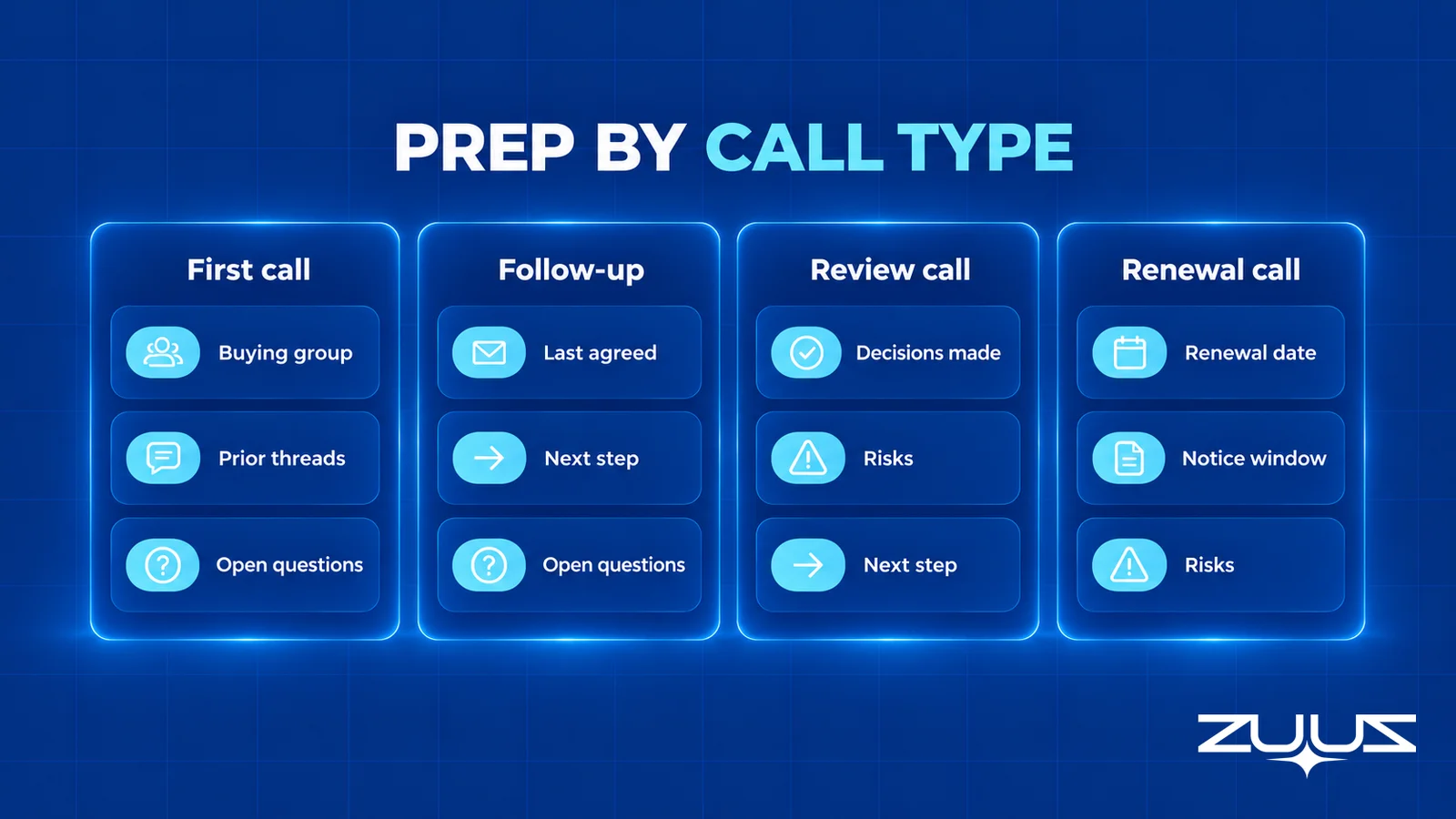
Pre call planning changes with the call. The record is the same, but the pull is different, and the biggest saving comes from knowing what to skip. The table shows the first thing to pull for each type and what to leave out.
| Call type | Pull first | Leave to the rep's judgement | Skip |
|---|---|---|---|
| First call | Whatever the record holds: the inbound email, who referred, any earlier replies | The objective and the discovery questions | Deal-stage history that does not exist yet |
| Follow-up call | Last agreed, open questions, promises made since | What to ask next | Re-explaining the company |
| QBR-style review | Open issues, deliveries, who attended earlier reviews, renewal date | What to raise unprompted | Slides about the vendor |
| Renewal call | Renewal date and notice, champion changes, what the customer said about budget and satisfaction | How to open the commercial conversation | Anything older than the last real conversation |
First call
When a prospect has emailed in, replied to outreach or been referred, the thread is the prep, and the record should show it. When the record is empty, that is accurate, and the rep's own research on the company is the right input. ZUUZ does not research prospects on the web, so outside-in research stays with the rep. Teams that watch for early interest signals can pair this with the patterns in B2B buying signals.
Follow-up call
A follow-up is won or lost on whether the rep remembers what was promised. The pull is the last agreed commitment, the questions still open and anything the buyer wrote since. The buyer's last message beats the rep's own summary of it, which compresses the detail the buyer cared about.
QBR-style review
A QBR-style review is a customer conversation about how the service has gone and what comes next. The prep pulls open issues, what was delivered, who attended previous reviews and the renewal date. Expansion belongs on the agenda only when the customer has raised it in writing, and the account management record should show that conversation, not a rep's hunch.
Renewal call
Renewal calls depend on dates and on tone. The date and notice period come from the record; the tone comes from what the customer last said about budget, the champion and satisfaction. For VARs, distributors and MSPs with many contracts, the same pull has to work across a book, which is the subject of renewal tracking software and the guide to tracking renewals across multiple products. Retention-heavy MSP teams will find more in MSP account management.
Make the Renewal Call Prep a Matter of Minutes.
ZUUZ reads the conversations behind each renewal and writes the dates, stakeholders and commitments to the CRM, so the rep can confirm them in one click before the call.
The Record-Ready Test for Call Prep
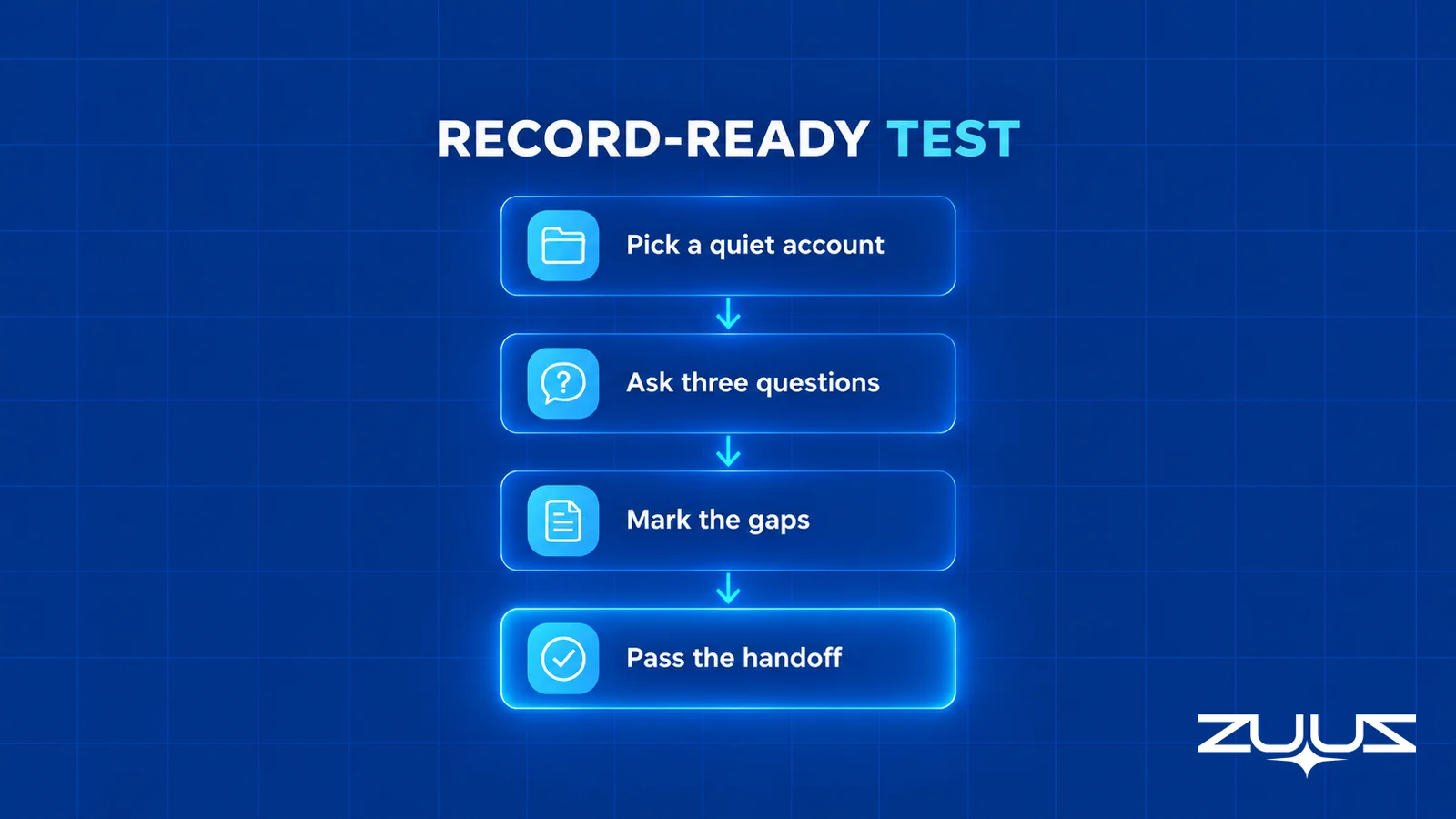
The quickest way to find out whether a team's call prep can be fast is to test the record, not the rep. The Record-Ready Test is a four-step check that shows which accounts cannot be prepared from the CRM alone.
- Choose an account the owning rep has not touched in two weeks.
- Ask a colleague to say who the buying group is, what was last agreed and what happens next, from the CRM alone.
- Every answer needing the rep, the inbox or a call is a record-ready failure.
- A record that passes survives a handoff, a territory change and a departure.
Worked example, again an illustration. A manager picks three accounts with calls booked next week and asks a colleague to answer the three questions from the CRM. On the first account all three answers are there. On the second, the buying group is a single name and the colleague has to ask the rep who else is involved. On the third, the last agreed step is a call summary that says "discussed pricing," and the real commitment is in a reply the colleague finds only by searching the mailbox. Two of the three accounts fail, and each failing answer is a prep task that will cost the rep minutes on the day.
The test separates two problems that look alike. A rep who prepares poorly from a good record has a discipline problem. A rep who prepares slowly from a thin record has a capture problem, and no checklist fixes it.

Pre Call Planning in Ten Minutes
When the record is current, how to prepare for a sales call comes down to a ten minute routine that a rep can run between meetings. The timings below are a working guide, not a standard.
| Minutes | Step | Output |
|---|---|---|
| 0 to 2 | Confirm the account, the call type and the attendees against the calendar | Right record, right people |
| 2 to 4 | Read the last agreed commitment and the open questions | Where the conversation stands |
| 4 to 6 | Check the buying group and the risks, including anyone new on the thread | Who is missing, what could derail it |
| 6 to 8 | Confirm the next step, or the renewal date and notice on a renewal call | The dated anchor for the call |
| 8 to 10 | Write the objective and two questions | The only part that is the rep's own thinking |
The routine breaks when the first four steps take longer than their slots. That is a useful signal rather than a failure of the rep: it marks the accounts where the conversations are not reaching the record. Fixing those accounts is cheaper than coaching every rep to search faster, and it is the same gap a pipeline review keeps running into.
Walk Into Every Customer Call With the Record Behind You.
ZUUZ keeps the buying group, last agreed and next step current across Salesforce, HubSpot, Zoho, Attio or Pipedrive, so ten minutes of prep is enough.
Call Prep Mistakes That Waste the First Ten Minutes
- Prepping from the last note only. A note is the rep's summary of a conversation, and the buyer's own words in the thread are the better source.
- Treating prep as research. Time spent reading a company's news site rarely changes a call about an account the team already serves.
- Writing the objective as a topic. "Discuss renewal" is a topic. "Agree the renewal terms and the signature date" is an objective.
- Ignoring who is not on the thread. The finance lead who signs but has never replied is the missing row in most buying groups.
- Keeping the sheet outside the CRM. A prep document that diverges from the record becomes a second source of truth.
- Prepping the call and not the exit. Walking in without a target next step means the call ends with "I will follow up."
From an operator's seat
Having run sales in IT services and distribution, Avinash Gujje, CEO of ZUUZ, has seen that the prep that mattered was rarely research. The surprise on a customer call was almost always something already said in the account's own mail: a promise a colleague made, a new name copied on a thread, a notice date mentioned in passing. The reps who prepared well were not the most diligent. They were the ones whose accounts had a current record, because that made ten minutes enough. The part teams do not plan for is the call taken by a colleague covering for the owner, where the missing context shows up in the first minute.
Sales Call Prep: How ZUUZ Answers From the Record
ZUUZ is an AI layer on top of the CRM a team already runs, never a CRM and never a replacement for one. It connects to the sales inbox, the calendar, LinkedIn messages (read-only), Microsoft Teams meeting transcripts and inbound call transcripts from CallTrackingMetrics, and writes structured records to Salesforce, HubSpot, Zoho, Attio or Pipedrive. Nobody changes how they work: ZUUZ hands the rep finished work to approve in one click, and manual entries take precedence.
For call prep, the relevant capability is the AI Search Agent, which works for the rep. The rep asks in plain language, by voice or typing, something like "who is on the buying side at this account, what was last agreed and when does the contract renew?" The answer comes only from what ZUUZ captured and the CRM holds, and the agent can summarize the thread or produce a one-page brief the rep reviews before the call. The idea behind it is covered in querying the CRM in plain language and in the overview of the AI sales agent.
The limits are specific. ZUUZ does not research prospects on the web or in external data, does not write call scripts or run calls, and does not record calls: it reads Teams meeting transcripts and CallTrackingMetrics inbound call transcripts only. It reports what happened and does not score accounts or forecast outcomes. LinkedIn capture is read-only, as described in logging LinkedIn messages in the CRM.
| Prep work | Who does it | Notes |
|---|---|---|
| Setting the call objective and the questions | The rep | The one part of the sheet that is judgement |
| Keeping buying group, last agreed, next step and dates current | ZUUZ captures, the rep approves | Written to CRM fields in real time once approved |
| Answering "where do things stand" before the call | The rep asks the AI Search Agent | Answers only from captured conversations and CRM records |
| Researching a prospect on the web | Not ZUUZ | Stays with the rep |
| Writing call scripts, running or recording calls | Not ZUUZ | Not part of the product |
| Scoring accounts or forecasting renewals | Not ZUUZ | ZUUZ reports what happened |
The proof is in customer results. At RA Technologies, a US IT services company, ZUUZ ran on the same HubSpot instance the team had used for two years, with the same people, and surfaced $120K in pipeline in the first 30 days that the CRM had never seen, captured from the sales mailbox. At Cloud Box Technologies, a UAE cloud and IT services business, one connected user tracks 10 to 12 renewals in minutes and leadership sees live pipeline, which is the same speed a renewal call needs from its prep.
The first step is small. Connect one mailbox, let ZUUZ read the last 90 days, then run the Record-Ready Test on the account with the next call booked. The gap between what the record says and what the threads say is visible in minutes, before anyone commits to a rollout.
Frequently Asked Questions
What is sales call prep?
Sales call prep is the routine a rep or manager runs before a call to confirm who is involved, what was last agreed, what happens next and what outcome the call needs. It produces a one-page brief rather than a script. The routine applies to first calls, follow-ups, QBR-style reviews and renewal calls, with a different pull from the CRM record for each.
How do you prepare for a sales call?
Start from the record: confirm the account and attendees, read what was last agreed and the open questions, check the buying group and risks, confirm the next step, then write one objective and two questions. Ten minutes is enough when the CRM holds current facts. When it does not, the missing facts are the real prep task.
What should a sales call prep checklist include?
A good sales call prep checklist covers the buying group, what was last agreed, the next dated step, open questions, the deal in play, the renewal date and notice period, and the risks. The eighth item is the rep's own objective for the call. Everything else should be retrievable from the record rather than researched.
What is a sales call prep template?
A sales call prep template is a one-page sheet with a fixed set of fields, such as buying group, last agreed, next step, open questions, renewal date and risks, plus a source and date beside each fact. It makes stale facts visible and lets a manager read the brief in a minute. It works best when pulled from CRM fields.
How long should sales call preparation take?
Ten minutes is a workable target for most calls, with more time for a large first meeting or a renewal with a lot at stake. The time depends on the record, not the rep. If the facts are in the CRM, retrieval takes a few minutes. If they sit in inboxes, the same prep takes much longer or gets skipped.
How is pre call planning different from account planning?
Pre call planning prepares one conversation and takes minutes, while account planning sets the strategy for a customer and is reviewed monthly or quarterly. The call brief reads from the account plan and the record. A plan that stays current makes the brief fast, and a brief that exposes stale facts is a prompt to update the plan.
What should a prep sheet for a renewal call include?
A renewal prep sheet needs the contract end date, the notice period and its deadline, the last real conversation about renewal, any change of champion or buying group, and what the customer said about budget and satisfaction. It should also hold any competitor the customer has named, and the rep's objective for the call.
How do you prepare for a first sales call with a new prospect?
Check whether the record already holds anything: an inbound email, a referral, an earlier reply. Then research the company and the person, since that is where outside-in work pays off, and write the objective and discovery questions. If the record is empty, that is accurate. ZUUZ does not research prospects externally, so that step stays with the rep.
Can AI do sales call prep?
AI can speed up the retrieval half. ZUUZ lets the rep ask in plain language, by voice or typing, and answers only from what it captured and the CRM holds, and it can summarize a thread or produce a one-page brief. It does not research prospects on the web, write call scripts or record calls, and the objective stays with the rep.
Where should a sales call prep sheet live, in a document or in the CRM?
The CRM is the better home, because the fields already live there and a copy in a document drifts from the record by the next call. A saved view or record layout showing the six prep facts is enough. The document, if one is used, should hold only the objective and the rep's questions.
What if the CRM record is out of date before the call?
Treat it as a finding. Read the last threads and meetings, note which fact was wrong, and correct the record after the call. Repeated gaps on the same accounts mean the conversations are not reaching the CRM. Capturing email, calendar and transcripts into fields fixes the cause instead of the symptom.
How do you prepare for a QBR-style customer review?
Pull the open issues, what was delivered, who attended earlier reviews and the renewal date, then decide what to raise unprompted. Expansion topics belong on the agenda only when the customer has raised them in writing. The record should show the conversation behind each item so the review is not built on the rep's memory.
A first step smaller than a rollout. Connect one mailbox. ZUUZ reads the last 90 days and the rep reviews what it found before anything is written to the CRM. Whatever that surfaces on the account with the next call booked is the honest input for the next prep sheet. 30-day free trial, no credit card: https://zuuz.ai/trial/