
What Is an AI Sales Agent? Two Kinds and How They Differ
An AI sales agent either replaces the rep for outbound or works for the rep inside the CRM. How each kind works, how to evaluate one, and where ZUUZ fits.

CEO of ZUUZ. He scaled Cloud Box Technologies from 0 to $25M ARR in IT services and distribution before building ZUUZ. Connect on LinkedIn
TL;DR: An AI sales agent comes in two kinds. One replaces part of the rep’s job for outbound: AI SDRs that find prospects, write and send email, and book meetings on their own. The other works for the rep inside the CRM the team already runs, capturing deal signal from email and LinkedIn messages, keeping records current, and answering the rep’s questions by voice or typing. ZUUZ is the second kind.
- “AI sales agent” covers two different products: buyer-facing AI SDRs that prospect and send on their own, and rep-facing agents that work inside the existing CRM.
- An AI SDR is judged on replies and meetings booked. An AI sales agent for the rep is judged on whether records are current and answers are right.
- A rep-facing agent can only answer from what it captured, so capture from email and LinkedIn matters more than how fluent the chat sounds.
- Evaluate any AI sales assistant on the CRM the team actually runs, the channels reps actually sell in, write accuracy, and the source behind every answer.
- AI takes over tasks before it takes over relationships. The model that holds up is human-curated and AI-accelerated, with the rep selling and approving.
- ZUUZ is an AI layer on top of Salesforce, HubSpot, Zoho, Attio or Pipedrive. It never prospects, emails or calls buyers.
Picture a regional sales manager who searches for an AI sales agent after a quarter in which her reps spent Friday afternoons catching up on the CRM. The first page of results is mostly products that promise to take over prospecting: an AI SDR that researches accounts, writes cold email and books meetings without anyone typing a word. That is a real category, but it answers a different question from hers. Her reps already have more conversations than they can keep track of; what they lack is a record of those conversations and a fast way to ask about them.
The phrase covers two kinds of software that share a label and little else. One kind works on buyers. The other works for the rep, inside the CRM the team already runs. This guide explains what an AI sales agent is, how the two kinds differ, how the rep-facing kind works step by step, how to evaluate AI sales assistant software, and what AI does and does not replace in a sales team.
What Is an AI Sales Agent?
An AI sales agent is software that uses AI to understand sales context and carry out sales tasks with some degree of independence. It takes in inputs such as email threads, CRM records, call transcripts or a prospect list, works out what they mean, and then acts inside a defined set of permissions. IBM’s overview of AI agents in sales draws the line at exactly this point: what separates an agent from a non-agentic assistant is its ability to analyze data, compose a plan of action and carry it out.
What separates one AI sales agent from another is less the model underneath than who the agent works for and which actions it may take. An agent permitted to email strangers from the company domain is a very different purchase from one permitted to update an opportunity’s next step. Both are sold as an AI agent for sales, which is why buyers often land on the wrong kind first.
AI Sales Agent, AI Sales Assistant, Copilot and Automation
The terms blur in vendor copy. Rule-based automation follows fixed triggers, a copilot suggests text while the rep drives, and an AI sales assistant performs bounded tasks when asked, such as summarizing an account. An AI sales agent takes on multi-step work with less prompting, and many products do both: they file information in the background, then answer like an assistant when a rep has a question.
Can AI Agents Do Sales?
AI agents can do specific sales tasks well. They can research an account, draft a first email, qualify an inbound lead against set criteria, pull a deal’s history into a summary, and file what a buyer said into the right CRM field. What they do not reliably do is own a complex B2B sale from first contact to signature, where the work is negotiation, judgment about people, and commitments the company has to keep.
So the honest answer runs task by task. Salesforce’s State of Sales report (7th edition, 2026) found that sales professionals spend 40% of their time selling and 60% on everything else, with manual data entry alone taking 13% of the week. That non-selling work is where an AI sales agent earns its keep today, and every task it absorbs hands time back to the conversations only a person can have.
The Two Kinds of AI Sales Agent
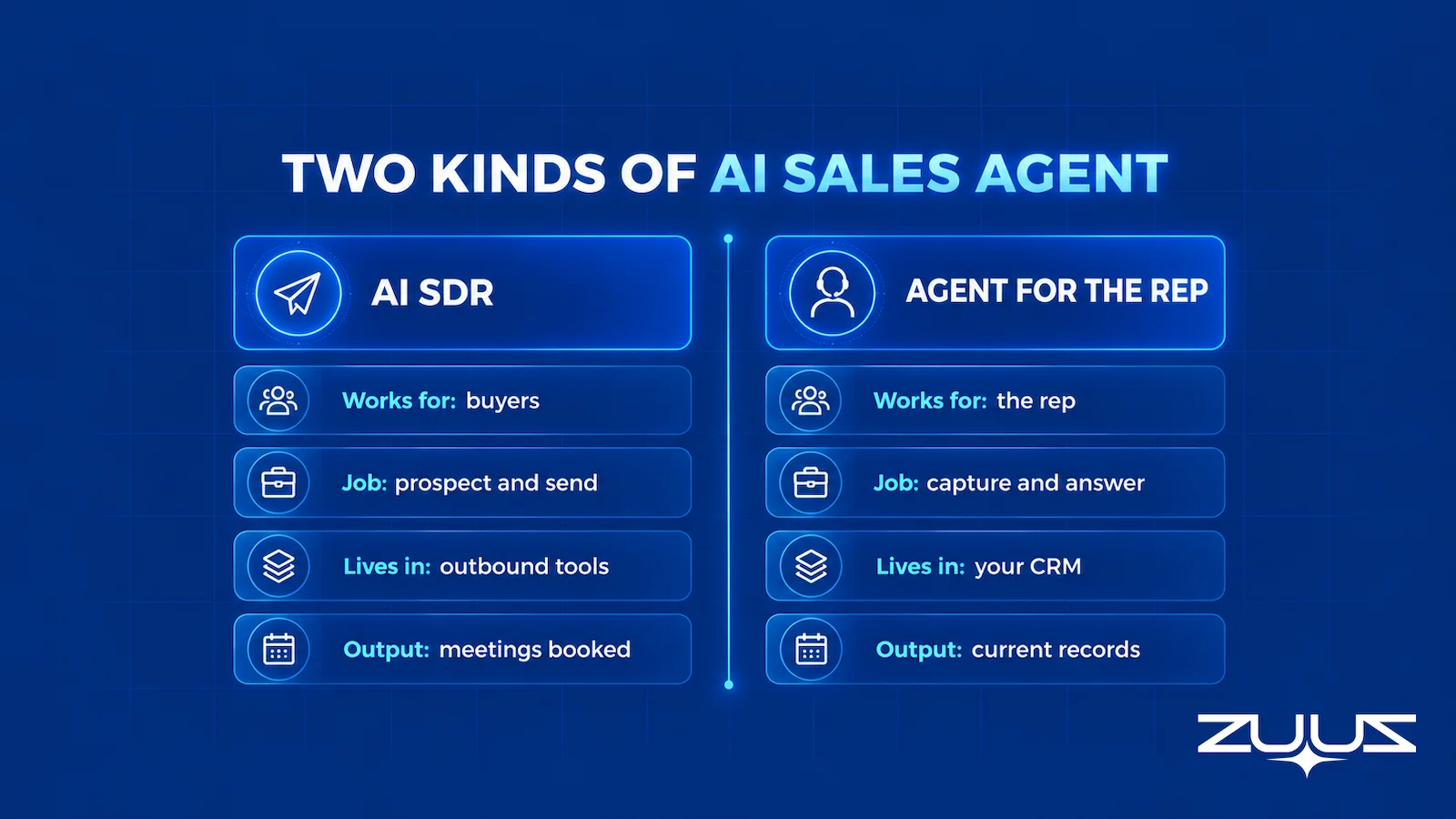
Almost every AI sales agent on the market falls into one of two camps, even where the edges blur. One kind works directly on buyers. The other works for the rep and never talks to buyers at all.
Outbound AI SDRs That Work on Buyers
The AI SDR is what most of the current search results sell. Vendors in this camp, including Artisan with its Ava agent and SalesCloser, market agents that handle some combination of building prospect lists, researching accounts, writing and sending personalized outbound email, holding qualification conversations and booking meetings. The rep, where there is one, picks up once a buyer is interested.
The value case is volume. An AI SDR can run far more first touches than a person, around the clock, and is measured in replies and meetings booked. The risk sits in the same place: sending from the company’s domain at scale puts deliverability and brand reputation in the agent’s hands, which is why many of these products offer approval modes that let a person review messages before they go out.
AI Sales Agents That Work for the Rep
The second kind starts from the conversations the rep is already having. It reads the email and LinkedIn messages where deals actually move, turns what buyers said into structured records in the CRM, and answers the rep’s questions about accounts and deals. The rep still writes every message to the buyer. The agent’s job is to make sure nothing the buyer said gets lost, and that the rep can find it again in seconds.
Its success is measured differently: whether the CRM matches reality, whether the answers are right, and how much admin disappears from the week. HubSpot’s 2024 Sales Trends Report found that reps spend about two hours a day actually selling and about an hour on administrative tasks. A rep-facing AI sales agent goes after that hour, and after the stale pipeline that follows whenever it gets skipped.
| Dimension | AI SDR (works on buyers) | AI sales agent for the rep | ZUUZ |
|---|---|---|---|
| Primary job | Find prospects and start conversations | Capture deal signal and answer the rep’s questions | Captures deal signal from the rep’s own conversations and answers the rep’s questions |
| Who it talks to | Prospects and buyers | Only the rep, plus the CRM | Only the rep, plus the CRM |
| Main inputs | Prospect lists, enrichment data, messaging templates | Email and LinkedIn conversations, CRM records | Connected sales inbox, LinkedIn messages, meeting and call transcripts, CRM records |
| Actions outside the company | Sends email; some products also call or chat | None | None |
| Actions in the CRM | Logs its own outreach activity | Writes contacts, activities, deals and next steps | Writes leads, stakeholders, next steps and renewal signals into CRM fields |
| Human review | Approval modes vary by product | The rep approves finished work | The rep approves in one click before anything is written |
| Success measure | Replies and meetings booked | Record accuracy, time saved, answers the rep trusts | Records a report can read, and answers that trace back to a source message |
| Best fit | Teams short on top-of-funnel volume | Teams whose deals already live in email and LinkedIn | Teams on Salesforce, HubSpot, Zoho, Attio or Pipedrive whose deals move in email and LinkedIn |
Capabilities vary by product, and some tools cover parts of both columns. The two solve different bottlenecks: a team short on first conversations needs an AI SDR, while a team with plenty of conversations and a CRM nobody trusts has a capture problem that more outbound volume only makes worse. For the wider landscape beyond agents, the guide to AI sales tools sorts the categories by what each one automates.
Why the Rep’s Own Conversations Need an Agent Too
Most deal changes do not happen on the CRM’s schedule. A buyer writes that the rollout is moving to next quarter, a new procurement contact is copied on a thread, a customer asks whether the renewal can add ten seats. Each of these changes the deal, and each arrives in an inbox or a LinkedIn message between the moments a rep sits down to update records.
Avinash Gujje built ZUUZ after scaling Cloud Box Technologies from $0 to $25M ARR in IT services and distribution, a business where most of what moves a deal arrives in writing: a revised quantity, a renewal question, a new decision-maker copied on a thread. In that kind of sale the conversation is the pipeline. The CRM only holds whatever someone found time to type after the fact.
Logging a Message Is Not Capturing Its Meaning
Many CRMs can attach an email thread to a contact, and some tools log LinkedIn messages as activities. That helps with history, but a logged thread is not an updated deal. The close date is still wrong, the new stakeholder is still missing from the opportunity, and the next step still says what it said three weeks ago, which is one of the quieter reasons a CRM pipeline is wrong even when everyone is diligent. The guide on how to log LinkedIn messages in HubSpot, Salesforce and Zoho covers the native options and where they stop.
An Assistant Can Only Answer From What Was Captured
This is the part of the category that gets skipped. A chat interface on top of the CRM is only as good as the records underneath, and an AI CRM assistant asked about a deal that was never updated will answer confidently and wrongly. Capture is what makes the answers worth trusting, which is why the rep-facing AI sales agent treats the conversation, not the CRM form, as its source.
The data problem is widely felt. Among sales professionals who use AI agents, 46% say data quality issues hurt their sales, according to the same Salesforce State of Sales edition, with manual errors and duplicate data ranked as the top two problems. An agent that writes records from the conversation itself takes out the retyping step where manual errors come from.
An Answer Is Only as Good as What Got Captured.
ZUUZ reads email and LinkedIn messages and writes the record into Salesforce, HubSpot, Zoho, Attio or Pipedrive, so the rep’s answers come from the real conversation.
How an AI Sales Agent for the Rep Works, Step by Step
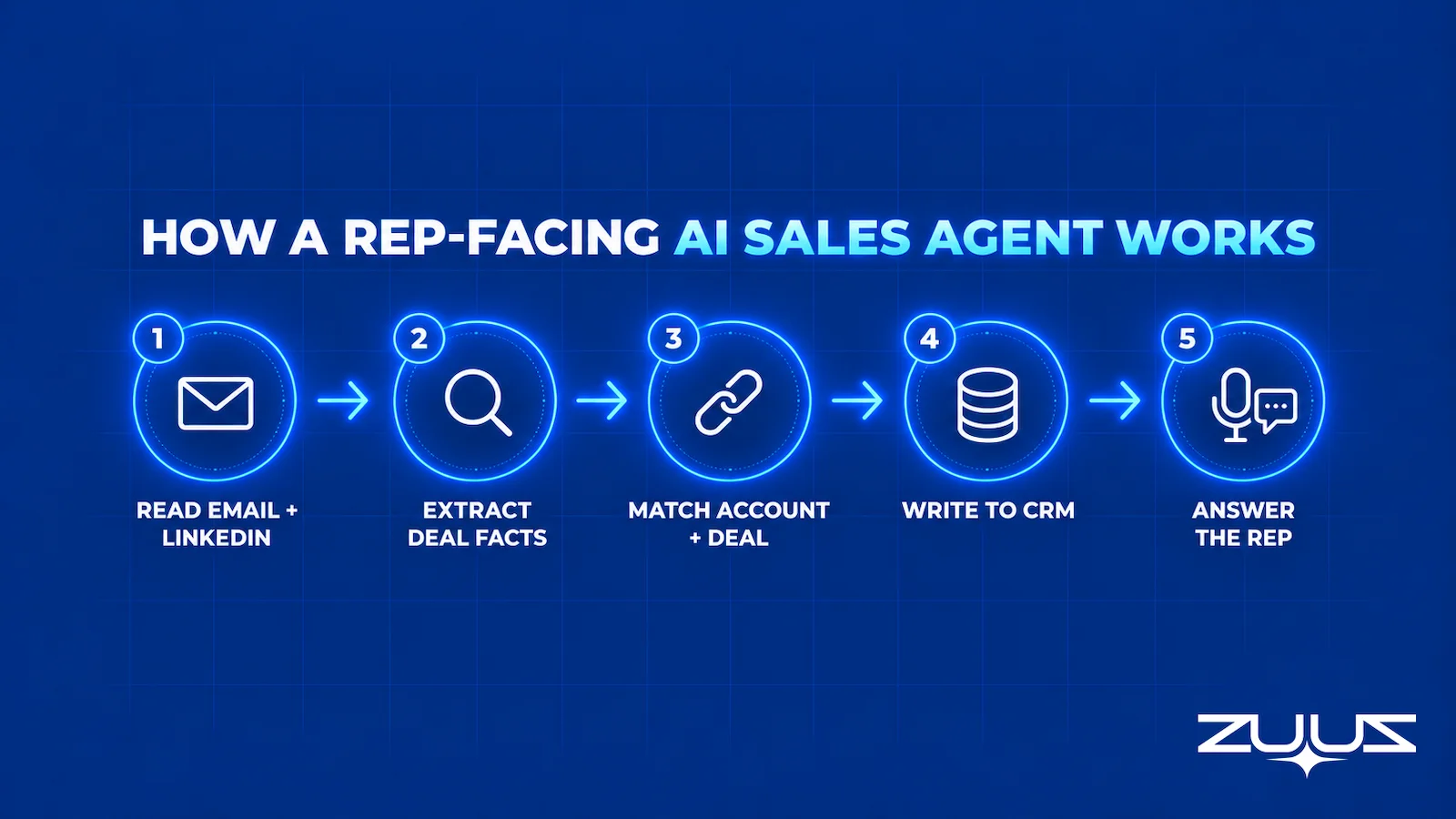
A rep-facing AI sales agent runs the same five-step chain every time a relevant message arrives. Each step is a place where products differ, and a weak one shows up later as a wrong record or a wrong answer.
1. Read Connected Email and LinkedIn Messages
The agent connects, with permission, to the mailboxes and LinkedIn accounts reps actually sell from, typically Outlook or Gmail plus LinkedIn messages. At this stage it only reads: a well-built rep-facing agent does not send, reply or run connection requests. Meeting and call transcripts can be further sources where supported.
2. Extract Deal Facts Without Inventing Intent
Next the agent pulls out what the buyer actually said: a requirement, a quantity, a date, a new contact, a stated next step. The discipline is separating what was said from what was hoped. “We are considering a second office” is an expansion signal worth recording, not an approved expansion, and an agent that writes it up as one creates exactly the false confidence a pipeline review exists to catch.
3. Match the Message to the Right Account and Deal
Matching is where many tools quietly fail. One account may have three open opportunities, a forwarded thread may carry a different sender than the original, and two contacts may share a name. The agent has to attach the signal to the right contact, account and deal, or it files accurate information in the wrong place.
4. Write Structured Records to the CRM
Once matched, the agent writes the update as structured data: a new contact, an activity, a changed next step, a deal stage or a stakeholder added to the opportunity. The strongest setups keep the CRM as the system of record and sync in both directions, so the agent reads existing context before writing and does not overwrite what a rep entered by hand. The mechanics are covered in the guide to bidirectional CRM sync.
5. Answer the Rep’s Questions
With current records underneath, the agent becomes worth talking to. The rep asks a question by voice or by typing, and the agent answers from what it captured and what the CRM holds, summarizes an account or a thread, or produces a document the rep needs. The rep asks and the agent answers; it does not go on to act with buyers by itself.
| What the buyer wrote (illustration) | Signal | Record affected | What the rep checks |
|---|---|---|---|
| “Can we push go-live to after the board meeting in March?” | Timeline change | Deal close date and next step | Confirms the new date before it moves the pipeline |
| “Adding Priya from procurement to this thread.” | New stakeholder | Contact created and added to the opportunity | Her role, and whether she signs |
| “We may need licenses for the Dallas team too.” | Possible expansion | Activity and note on the account | Not a new deal until the buyer confirms scope |
| “What would renewal look like if we add ten seats?” | Renewal and upsell question | Renewal record and account activity | Who owns the renewal conversation |
The messages in the table are an illustration, not a real customer thread. The last column matters most: an agent that hands the rep finished work to approve keeps a person in the loop exactly where judgment is needed, without making the rep type anything.
What an AI Powered Sales Assistant Should Answer
An AI-powered sales assistant should answer the questions a rep has in a normal week from what it captured, without a report or five open records. Two moments test it hardest, and the table after them shows the pattern.
Before a Meeting
“What changed on this account since our last call?” is the most common question and the best test. A good answer lists the recent messages, the people involved, the open items and any documents shared, with dates. A rep driving between meetings should be able to ask it out loud and hear the answer.
During Pipeline Review
“Which deals have a next step nobody has answered?” and “Which renewals come up this quarter?” turn a pipeline meeting into a check of real activity rather than a round of recollections. The guide to running a sales pipeline review that reflects reality covers how to structure the meeting around questions like these.
| Question, by voice or typing (illustration) | What the answer draws on | Output |
|---|---|---|
| “What did Acme say about budget last week?” | Captured email and LinkedIn messages | Direct answer with dates and sender |
| “Which of my deals have gone quiet?” | Activity on open deals in the CRM | List with the last contact date for each |
| “Summarize the Northwind account before my call.” | Account history, contacts and open deals | Short account summary |
| “Draft an internal brief on this renewal.” | Renewal record and customer messages | A document the rep can edit and share |
The account names above are hypothetical. Voice questions from a rep are a different capability from an AI that calls buyers, and every answer should show its source so the rep can check it before repeating it to a customer. For the customer-facing side of conversational AI, see the guide to conversational CRM.
Ask the Pipeline a Question and Get a Straight Answer.
ZUUZ answers from what it captured in email and LinkedIn, summarizes accounts and produces documents, on top of the CRM the team already runs.
What’s the Best Sales AI Assistant for CRM?
There is no single winner, and any list that crowns one without asking about the buyer’s CRM, channels and team is guessing. The useful question is which product does the specific job needed, on the CRM already in place, with evidence rather than a demo dataset. The checklist below turns vendor claims into tests.
Who Has the Best AI Sales Agent?
It depends on the job. For outbound volume, compare AI SDRs on deliverability controls, approval options and meetings that actually get held. For rep productivity, compare rep-facing agents, and the CRM’s own built-in AI, on capture coverage, write accuracy and answer quality. Assistants built into Salesforce, HubSpot or Zoho work well inside one ecosystem; a CRM-agnostic layer matters more when a team runs a different CRM, or more than one.
Test It on the Team’s Own CRM, Channels and Edge Cases
Confirm the exact CRM edition and which objects and custom fields the tool reads and writes, then check which mailboxes and LinkedIn connections it covers; if deals move in LinkedIn and the tool reads only email, half the signal never arrives. Run the awkward cases too: a forwarded thread, a contact tied to two accounts, a corrected date, a message that should create nothing. Every record and answer should trace back to a source message with an audit log, which matters more to lasting CRM data quality than any model benchmark.
| Requirement | Test to run | Evidence to ask for |
|---|---|---|
| CRM fit | Connect to the real CRM instance | Objects and custom fields it reads and writes |
| Channel coverage | Connect real mailboxes and LinkedIn | Share of a week’s deal messages it captured |
| Matching | Feed a forwarded thread and a duplicate contact | Records attached to the correct account and deal |
| Write safety | Fix a date it captured wrongly | Manual edits preserved and visible in an audit log |
| Answer grounding | Ask about a deal with no recent activity | An answer that cites sources or says it does not know |
| Permissions | Remove one user’s access | Access revoked; no send capability unless intended |
| Data handling | Read the data policy | Retention, deletion, and whether customer data trains models |
| Effort | Time the pilot setup | Admin hours, and whether reps had to change their routine |
The Capture Layer Test
Before comparing model quality, judge any rep-facing agent on whether the record is complete without rep effort.
- Does it capture from the channels where the deal actually moves, email, calendar, LinkedIn messages, meeting and call transcripts?
- Does what it captures land in CRM fields a report can read, or only in an activity feed a human must open?
- Does the rep have to remember anything, a BCC, a button, a sidebar, a sync?
- Can the rep correct it in one click before it is written?
A tool that fails 2 or 3 produces activity history, not a pipeline you can run a review on.
Applied to this category, the test sorts products fast. An agent that lives in a browser sidebar usually passes step 1 and fails step 3, because nothing is captured on a day the rep does not open the sidebar. An agent that summarizes a thread into a note passes step 1 and fails step 2, since a summary no report can filter leaves pipeline review exactly where it was. Step 4 is the one buyers forget to test: ask the vendor to fix a close date the agent read wrongly, then check whether that correction is still there after the next sync.
How to Pilot AI Sales Assistant Software Before Buying
A pilot answers what a demo cannot. Pick one team and one workflow, measure the baseline first, and let the agent run on real inboxes and the real CRM for a few weeks. Keep the pilot small enough that someone can check every record it writes.
Set a Baseline
Record how long reps spend updating the CRM, how many open deals carry a stale next step, and how long it takes to prepare for an account meeting. Assign a RevOps owner to judge results against that baseline, not against the vendor’s slide. Without a baseline, every pilot looks like a success.
Measure Work Done, Net of Corrections
Count what the agent captured that the CRM lacked, how many records it matched correctly and how often a rep had to fix something, and only count time saved after review time is subtracted. Then match the measure to the role. Judge AI sales agent software on the outbound side by meetings held and opportunities accepted, and a rep-facing AI sales agent by record accuracy, time returned to selling and previously unseen pipeline surfaced. The guide to sales rep productivity covers the broader measures worth tracking.

Will AI Replace Sales Agents?
Some sales tasks, and in some teams some roles, are already shrinking. High-volume first-touch outbound is the clearest case: work that once needed a room of SDRs can now be partly run by software, and pretending otherwise does not help anyone plan. Teams should decide deliberately which tasks they hand to an agent, rather than let a tool decide by default.
Complex B2B selling is a different job. Deciding what to offer, reading who really holds the budget, negotiating terms and keeping commitments all need a person who is accountable for the outcome. Buyers also notice when a relationship is being run by software, and in relationship-led markets such as IT services and distribution that costs trust.
The model that holds up is human-curated and AI-accelerated. The rep is the one selling and the one who approves; the agent does the capture, the filing and the looking-up that eat the week. AI will replace a great deal of the admin that surrounds sales agents long before it replaces the people buyers want to talk to.
Give Reps Finished Work to Approve in One Click.
Nobody changes how they work. ZUUZ captures what buyers said in email and LinkedIn and writes it to the CRM for the rep to approve.
Deal Signal and Answers: How ZUUZ Works for the Rep
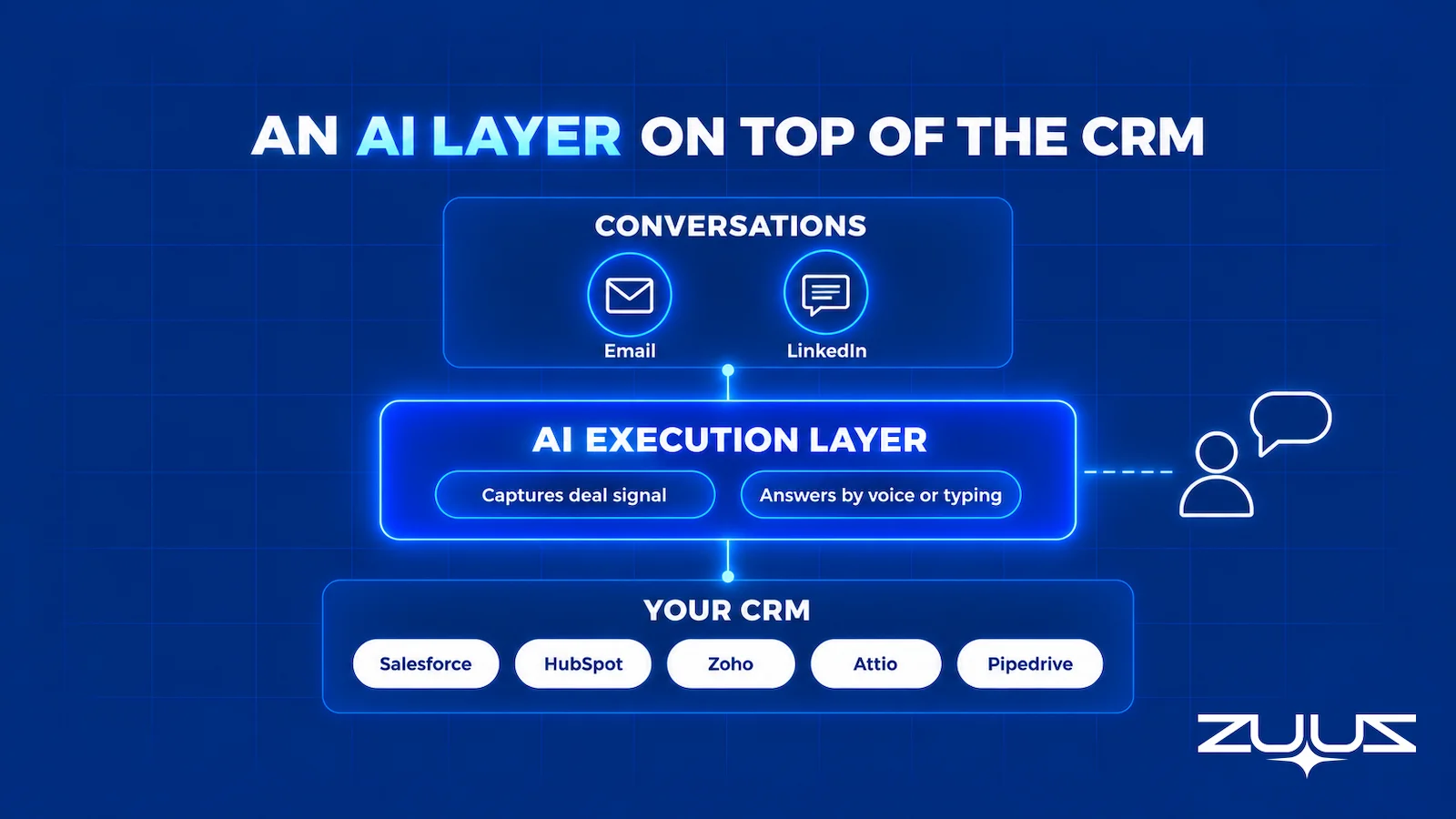
ZUUZ is the second kind of AI sales agent. It is an AI layer that sits on top of the CRM a team already runs, not a CRM itself, and it works with Salesforce, HubSpot, Zoho, Attio and Pipedrive. It reads email and LinkedIn messages, read-only, and writes structured records to the CRM, which stays the system of record. It does not prospect, send email, call buyers or talk to customers.
The capture side covers Email Lead Capture across email and LinkedIn messages, Enrichment of contact and account records when a lead is identified, Pipeline Capture of stages and stakeholders, and CRM Sync back to the record. On top of that, Pipeline Risk Monitoring surfaces stalled deals, and Account Management pulls together each account’s history, deals and renewal status, including early churn risk warning signs. Nobody changes how they work: reps keep selling in the inbox and on LinkedIn, and ZUUZ hands them finished work to approve in one click.
The AI Search Agent, which Avinash Gujje calls the AI search sales agent, is the part reps talk to. A rep asks by voice or by typing, for example which deals went quiet this week or what a customer said about the renewal, and ZUUZ answers from the pipeline and CRM data it captured. It can also summarize an account or a thread and produce the documents a rep needs. The rep asks and ZUUZ answers; it never acts with buyers on its own.
The results show up as pipeline. RA Technologies, a US IT services company, had run HubSpot for two years; ZUUZ ran on the same instance with the same team and surfaced $120K in pipeline within 72 hours that the CRM had never seen, captured from the sales mailbox. Cloud Box Technologies runs ZUUZ so that inbound email turns into leads and renewals, leadership sees live pipeline in real time, and tracking 10 to 12 renewals takes minutes. It is the same idea as email-to-CRM automation for IT companies, with a rep-facing agent on top.
From an operator’s seat
Across the deployments ZUUZ runs, the pattern is that an agent earns trust through the boring half of the job first. Reps judge it on whether a new stakeholder landed on the right opportunity, and only start asking it questions once that holds; teams that open a pilot with the question-and-answer demo get enthusiasm in week one and silence in week three. The part teams do not plan for is calibrating what should create nothing: a forwarded thread, an introduction with no deal behind it, a customer complaint. An agent that writes a record for every message is louder than the inbox it was meant to quiet, so early in a deployment the work is restraint rather than coverage. Mailbox and CRM permissions are also an IT ticket rather than a sales decision, and that ticket, not the sales team, usually sets the real start date.
Which Sales Teams This Fits, and Which It Does Not
A rep-facing AI sales agent fits teams whose deals move in writing: B2B sales where buyers, partners and customers negotiate over email and LinkedIn, and where the CRM is supposed to reflect those conversations but lags behind them. IT services firms, managed service providers, value-added resellers and distributors fit this pattern well, as do most account management and renewal teams.
It fits less well where selling happens mostly in person or on calls that are never transcribed, or where the team has no CRM at all. It is also the wrong tool for a team whose real bottleneck is too few conversations; that team needs top-of-funnel help first. ZUUZ in particular runs on Salesforce, HubSpot, Zoho, Attio or Pipedrive, so a team on another CRM is outside its reach today.
Either way, choose an AI sales agent on evidence. Look at where the last few deals actually moved and whether the CRM knew at the time; if the answer is the inbox and no, the gap is capture, and the AI sales agent to evaluate is the one that works for the rep.
A concrete first step
Connect one rep’s mailbox. ZUUZ reads the last 90 days, and the rep reviews the leads, stakeholders, next steps and renewal signals it found before any of it is written to the CRM. The 30-day free trial needs no credit card: zuuz.ai/trial.
Frequently Asked Questions
What is an AI sales agent?
An AI sales agent is software that uses AI to understand sales context and carry out sales tasks with some independence. Some agents work on buyers, prospecting and sending outbound email on their own. Others work for the rep inside the existing CRM, capturing deal signal from email and LinkedIn messages, keeping records current and answering the rep’s questions.
What is the difference between an AI sales agent and an AI sales assistant?
The difference is mostly autonomy. An AI sales assistant performs bounded tasks when asked, such as answering a question or summarizing an account. An AI sales agent takes on multi-step work with less prompting. Many products do both, capturing and filing information in the background and then answering like an assistant when the rep asks.
Can AI agents do sales?
AI agents can do specific sales tasks well, including researching accounts, drafting outreach, qualifying inbound leads, summarizing deals and filing buyer information into the CRM. They do not reliably own a complex B2B sale, where negotiation, judgment about people and commitments the company must keep still need an accountable person. The practical approach is to assign tasks, not whole roles.
Who has the best AI sales agent?
No single vendor has the best AI sales agent for every team. For outbound volume, compare AI SDRs on deliverability, approval controls and meetings actually held. For rep productivity, compare rep-facing agents on capture coverage, CRM write accuracy and answer traceability, tested on the team’s own CRM and inboxes rather than a demo dataset.
Will AI replace sales agents?
AI will replace many sales tasks before it replaces salespeople. High-volume first-touch outbound is already partly automated, and some SDR work is shrinking. Complex selling still needs a person to negotiate, judge who holds the budget and keep commitments. The model that holds up is human-curated and AI-accelerated, with the rep selling and approving while the agent handles capture and admin.
What’s the best sales AI assistant for CRM?
The best sales AI assistant for CRM is the one that works on the CRM a team already runs, reads the channels reps actually sell in, writes accurate structured records, and shows the source behind every answer. Built-in assistants suit teams committed to one CRM ecosystem. A CRM-agnostic layer suits teams that want the same approach across Salesforce, HubSpot, Zoho, Attio or Pipedrive.
How much does AI sales assistant software cost?
Pricing depends on the model. Most AI sales assistant software charges per seat, by usage or through a platform fee, and some tools require a specific CRM edition. The real cost also includes setup, admin time and the time reps spend correcting errors, so a pilot on real data is the most reliable way to compare cost against time actually saved.
Can an AI sales agent capture deal information from email and LinkedIn messages?
Yes, rep-facing AI sales agents are built for this. They connect with permission to the rep’s mailbox and LinkedIn messages, extract requirements, dates, contacts and next steps, match them to the right account and deal, and write structured records to the CRM. ZUUZ does this read-only: it reads messages for deal signal and never sends or automates outreach.
Can you ask an AI sales assistant questions by voice?
Some AI sales assistants accept questions by voice as well as typing. With ZUUZ, a rep can ask hands-free, for example which deals went quiet this week, and get an answer from the pipeline and CRM data ZUUZ captured, along with summaries and documents. A rep asking questions by voice is different from an AI that calls buyers, which ZUUZ does not do.
Do you need to replace your CRM to use an AI sales agent?
No. A rep-facing AI sales agent can run as a layer on top of the existing CRM, which stays the system of record. ZUUZ works this way on Salesforce, HubSpot, Zoho, Attio and Pipedrive, so there is no migration and no retraining, and reps keep working in their inbox and on LinkedIn as before.
Does ZUUZ send emails or call prospects?
No. ZUUZ does not prospect, send email, call buyers or talk to customers. It reads email and LinkedIn messages read-only, writes structured records to the CRM, monitors pipeline risk and answers the rep’s questions by voice or typing. Every message to a buyer is still written and sent by the rep, and ZUUZ hands the rep finished records to approve.
Is an AI sales agent the same as an AI SDR?
Not always. An AI SDR is one kind of AI sales agent, built to work on buyers by finding prospects, sending outbound email and booking meetings. The other kind works for the rep inside the CRM, capturing signal from existing conversations and answering questions. The two solve different problems: too few conversations, versus conversations that never reach the CRM.